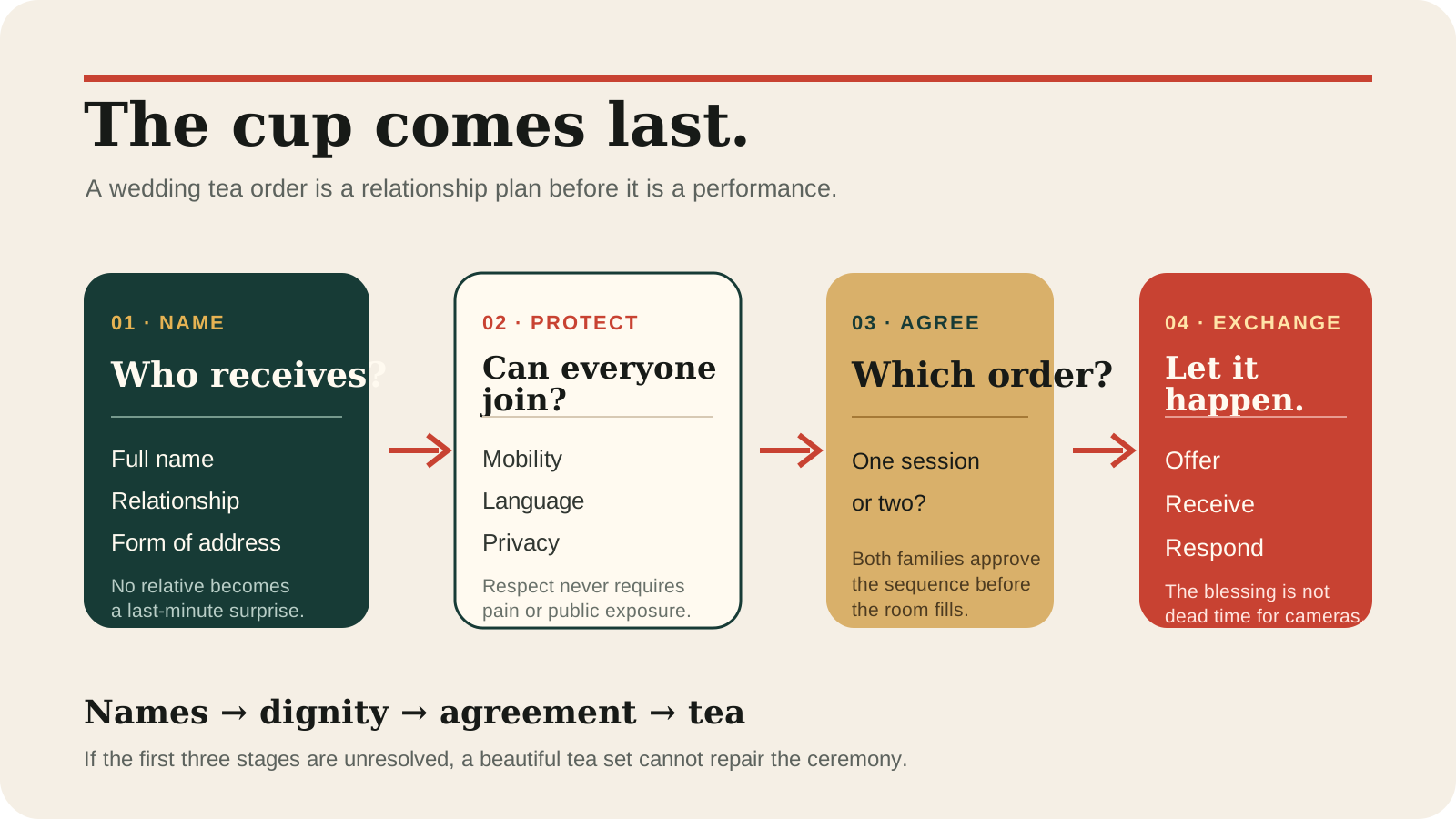
A Chinese wedding tea ceremony is complete when both families have agreed on four things: who receives tea, in what order, how each person is addressed and what response follows. The cup makes a new family relationship visible. Kneeling, Chinese wedding clothing, jewelry and a particular tea set may matter to one family, but none is a universal test of whether the ceremony is authentic.
Chinese wedding tea ceremony: settle relationships before rehearsing movements
The essential exchange is simple. The couple offers tea to parents or senior relatives; each recipient accepts the cup and responds with welcome, blessing, advice or a gift. What makes the moment meaningful is not an inherited national script. It is that the people involved understand which relationship is being recognized.
That is why decoration should come last. A couple can buy the right-looking cups and still create confusion by missing a relative, using the wrong kinship title or letting a photographer control the exchange. Conversely, a ceremony held in an ordinary room with safe cups and plain language can be complete when the relationships are clear.
Before booking time or buying equipment, finish this four-field record for every recipient:
| Field | What must be decided | Failure it prevents |
|---|---|---|
| Recipient | Full name and relationship to each partner | Missing or unexpectedly adding a relative |
| Order | The family's agreed sequence | Public arguments about seniority or family side |
| Address | Kinship term, name or title, with pronunciation | Turning a sincere moment into a language test |
| Response | Blessing, advice, gift or simple acknowledgment | Rushing the recipient or mishandling valuables |
The order is correct when the participating families recognize it as theirs. Online lists can suggest questions, but they cannot know the hierarchy, language, health needs and wedding-day structure of a particular household.
Two real families, two valid designs
The distinction becomes visible in two separate first-person family records. They are presented separately because combining them would manufacture a ceremony that neither family held.
Family record A: tea as entry into a new family chapter
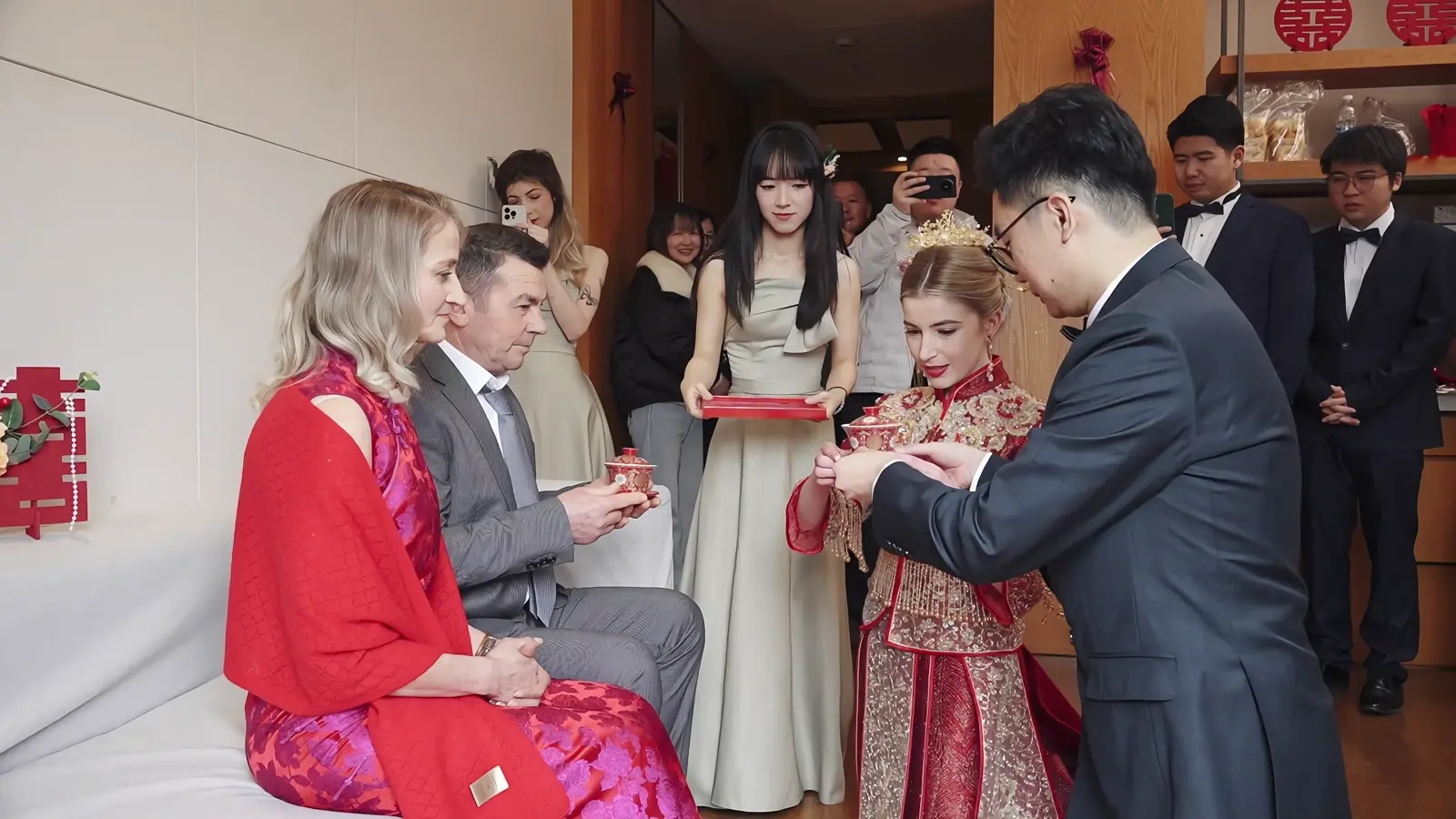
In a Chinese-international wedding, Ana Petrovna described serving tea as respect, gratitude and the beginning of a new family chapter. The couple offers covered cups while seated parents and relatives watch. A second frame shows both parents drinking after receiving the tea.
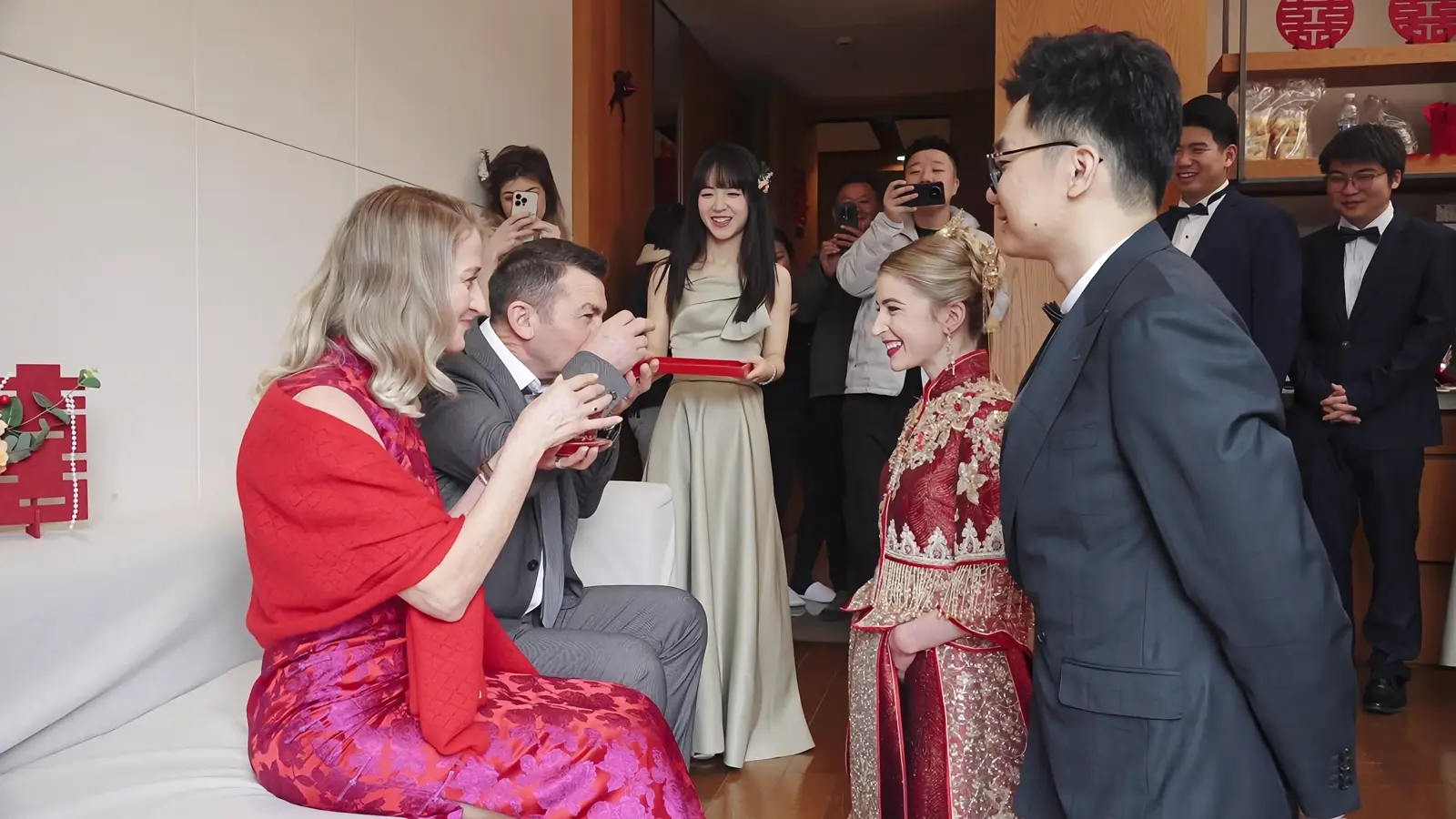
This sequence supports a narrow but useful observation: offering is only half of the ritual. The recipient must have time to receive, drink and respond. The record does not establish one national order, posture, language or gift rule.
Family record B: one combined session before the ceremony
In a separate Shandong-context record, Xiao Ci and her partner chose a no-pickup wedding. Both families joined one tea session before the main ceremony. The couple knelt on cushions and included kowtow in their own sequence, but Xiao Ci explicitly told another bride that kneeling could be omitted.
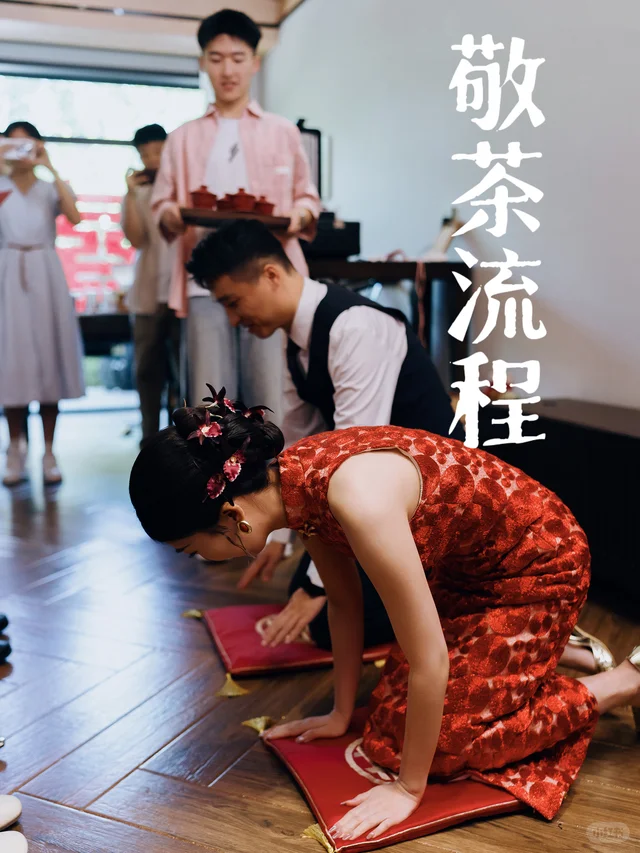
This photograph proves that this couple knelt. It does not prove that every Shandong family kneels or that kneeling is required in a Chinese wedding tea ceremony. Its greater value is showing how a family-specific choice can be documented without turning it into a national command.
UNESCO describes Chinese tea knowledge as practices carried by communities, but it does not prescribe a wedding sequence. Singapore's National Heritage Board documents Chinese wedding customs in a specific Singaporean history. These sources provide context; neither replaces a conversation with the participating family.
Choose one combined session or two family sessions
This decision changes the schedule, room and order more than the choice of tea.
| Format | Works best when | Main advantage | Main risk |
|---|---|---|---|
| One combined session | Both families can be present and accept one agreed sequence | Everyone witnesses the same exchange; less duplicate setup | The merged order may expose unresolved hierarchy or language differences |
| Two family sessions | Families are in different locations or prefer distinct customs | Each side can keep its own language, order and posture | Travel, reheating and schedule pressure can make the second session feel rushed |
| Parents-only session | Time is limited or the families want privacy | Clear, intimate and easy to manage safely | Extended relatives may assume they were accidentally excluded |
| Extended-family session | The family explicitly wants grandparents and other senior relatives included | More relationships are recognized | Recipient count, gifts and photographs can multiply the duration |
Do not choose a combined session merely because it looks efficient. First write the complete order. If the sequence cannot be agreed on privately, combining the families in public will not solve it. The Shandong record shows that one session can work when it follows a deliberate wedding design; it is not evidence that one session is always preferable.
Build the ceremony as an eight-part operating sequence
1. Lock the recipient list
Write one numbered list with full names, relationship to each partner, attendance status and agreed address. Ask one representative from each family to approve it. Mark deceased or absent elders separately so acknowledgment does not become an improvised decision in front of guests.
2. Design the room around movement
Seat recipients where the couple can approach without stepping over bags, camera cables, long clothing or low furniture. Keep the hot-water station outside the walking path. Place a stable surface within reach for gifts and used cups; do not ask a recipient to balance jewelry, an envelope and hot tea at once.
3. Choose tea for reliable service
Use a tea the family is comfortable drinking. A straightforward black tea, oolong or familiar household tea is often easier to brew repeatedly than a delicate tea that turns bitter during delays. Sweet tea or symbolic ingredients may belong to a family's practice, but confirm allergies, medication concerns, pregnancy, diabetes and caffeine sensitivity before adding them.
The service target is drinkable tea, not maximum heat. Test the temperature after the tea has travelled from the brewing vessel to the tray and then to a seated recipient. Near-boiling liquid does not demonstrate greater respect.
4. Assign hands, not vague responsibilities
At minimum, name a brewer, a tray helper, a family coordinator and a valuables keeper. The brewer controls water, tea strength and refills. The tray helper presents and clears cups. The family coordinator calls the next recipient and checks names. The valuables keeper immediately secures envelopes and jewelry.
One person should not manage boiling water while locating relatives and directing photographs. That is not efficiency; it is a predictable failure point.
5. Address, offer and release the cup
Use the agreed title before lifting the cup. Offer with both hands if that is the family's chosen practice and the vessel permits it safely. Wait until the recipient has a secure grip before releasing. One partner may serve while the other supports the tray, or both may offer together.
6. Protect the response
After the cup changes hands, stop directing. The recipient may drink, speak, give advice, welcome a spouse, present jewelry or hand over an envelope. This response is part of the ceremony, not dead time between photographs. The international-family sequence shows precisely this movement from offering to parents drinking.
7. Clear, reset and secure
The helper removes used cups, checks spills and prepares the next pair. Jewelry should be fastened only if it can be done without holding up hot cups; otherwise place it in a named pouch and complete photographs later. Move envelopes directly to secure storage rather than stacking them on the tea table.
8. Close before staging photographs
Thank the recipients and state that the tea exchange is complete. Only then take additional group or detail photographs. Repeating an intimate exchange for several camera angles turns family members into props and makes cup temperature harder to control.
What should the couple say?
There is no universal Mandarin script, and not every Chinese family uses Mandarin. Use a three-part framework instead:
Correct address + invitation to receive tea + one relationship-specific sentence.
For example: “Mum, please have tea. Thank you for welcoming me into the family.” A different relationship may call for gratitude, a memory, a promise of care or simply “Please have tea.” The family should provide the correct words and pronunciation.
For mixed-language families, choose one of three workable formats:
| Language situation | Practical format |
|---|---|
| Both sides understand one language | Use one short sentence naturally |
| One partner is learning a kinship term | Put the term and phonetic cue on the recipient list; rehearse privately |
| Relatives do not share a language | Speak the key line in each language or use one brief interpreter cue |
Do not make an unfamiliar partner perform a long borrowed speech. Correct address and sincere meaning matter more than flawless pronunciation for a video.
How much should be given in red envelopes or gifts?
There is no responsible universal amount. A number copied from the internet ignores country, currency, family finances, relationship and local convention. The useful decision is not “What does China give?” but “What does this family normally do, and what can it give comfortably?”
Use this decision ladder:
- Ask a trusted relative on each side whether the response is normally words, an envelope, jewelry or another object.
- If money is customary, ask that relative for a private range appropriate to this family and location.
- Confirm whether the gift is for the couple together or each partner separately.
- Decide whether it is presented, opened or photographed during the ceremony.
- Assign one named person and one secure container before the first cup is served.
The firm rule is: do not convert family affection into a public price list. A modest gift given without strain is not made inferior by an online number.
Kneeling is a family choice; accessibility is not optional
Posture should be discussed explicitly, never inferred from clothing, ancestry or a viral wedding video.
| Need or preference | Safe arrangement |
|---|---|
| Family chooses kneeling and the couple can do it comfortably | Use stable cushions, clear floor space and rehearse rising in the actual clothing |
| Knee, hip, balance, pregnancy or injury concern | Stand, bow or use a raised cushion or low seat agreed by the family |
| Recipient has limited reach or grip | Move the chair, use a handled or cooler cup and let a helper support the tray |
| Long sleeves or restrictive clothing | Rehearse cup clearance and walking before the event |
| Family members disagree about posture | Treat respect as the shared goal and select the least coercive workable action |
The Shandong family record is valuable precisely because its author separates meaning from requirement: kneeling belonged to their choice, and omission remained possible. Respect is not measured by whether someone ignores pain.
Calculate the schedule from recipient units
Do not estimate the whole ceremony from the seconds required to drink tea. Count recipient units: one seated person or one receiving pair served together.
Use this planning formula:
Base time = recipient units x 2-4 minutes, plus 10 minutes for setup and at least 15 minutes of buffer.
This is a scheduling allowance, not measured ritual law. Use the lower end when recipients give brief responses and no gifts are exchanged. Use the upper end when jewelry, interpretation, mobility assistance or longer blessings are likely.
| Recipient units | Service allowance | Setup + minimum buffer | Planning total |
|---|---|---|---|
| 2 | 4-8 min | 25 min | 29-33 min |
| 4 | 8-16 min | 25 min | 33-41 min |
| 8 | 16-32 min | 25 min | 41-57 min |
Write order, names, relationship, special instruction and allowed minutes on one sheet. If the wedding schedule cannot hold the upper estimate, reduce recipient units or separate sessions. Do not plan to recover time by interrupting elders.
Set photographer and privacy boundaries before the first cup
Tell the photographer which moments cannot be restaged: the first use of a new kinship title, a private blessing, the presentation of a family object and any exchange involving a relative who dislikes being recorded. Capture the real event from an agreed position, then make still-life photographs of the cups or gifts afterward.
Guests should ask before posting identifiable relatives or recorded blessings. A person may agree to attend without agreeing to become public content. Anyone who cannot drink the tea for health or personal reasons needs an agreed alternative: receive and touch the cup, take a symbolic sip or use another drink. Resolve this privately before the event.
Run a failure rehearsal, not a beauty rehearsal
The final rehearsal should try to break the plan:
- Read every name and title aloud; correct pronunciation before the wedding day.
- Walk the route in the actual shoes and clothing while carrying a tray weighted with cool water.
- Measure how many cups one brew produces and how long a refill takes.
- Test whether recipients can comfortably hold the cup at serving temperature.
- Simulate one absent relative, one spilled cup and one delayed gift.
- Confirm standing or seated alternatives without forcing anyone to explain a medical condition publicly.
- Put replacement cups, towels, extra tea and water where the helper can reach them.
- Give envelopes and jewelry to the valuables keeper during rehearsal, not for the first time during the ceremony.
- Tell the photographer when the exchange must continue without direction.
- Finish by asking both family representatives: “Does anyone feel missing, misnamed or rushed?”
The strongest Chinese wedding tea ceremony is not the one that looks most ancient. It is the one where every person knows why they are receiving or offering the cup, the response is allowed to happen, and nobody's dignity or safety is traded for choreography.
Continue with Chinese tea ceremonies and family rituals, compare the distinct brewing practice of gongfu tea or choose practical pieces in the Chinese tea set guide.