In the Mood for Love is worth watching because it makes restraint active. Chow Mo-wan and Su Li-zhen do not simply fail to begin a romance; they repeatedly decide what their desire will not permit them to become. Wong Kar Wai measures those decisions through returning music, borrowed rooms, narrow passages and rehearsed dialogue. The pain comes from watching a boundary survive after its original certainty has gone.
In the Mood for Love in 60 seconds
| Question | Short answer |
|---|---|
| Original title | Fa yeung nin wa (花样年华) |
| Director and writer | Wong Kar Wai |
| Release | 2000; set mainly in Hong Kong in 1962 |
| Language | Cantonese |
| Main characters | Newspaper editor Chow Mo-wan and secretary Su Li-zhen |
| Spoiler-free premise | Married neighbors discover that their frequently absent spouses are having an affair |
| Best reason to watch | Form, performance and moral uncertainty become the story rather than decoration around it |
| Common wrong shortcut | “A beautiful movie about two people who never get together” |
| East Moment verdict | Watch once for feeling; watch again to track what changes inside repetition |
The Criterion Collection's official film record identifies a 98-minute Hong Kong film starring Maggie Cheung Man Yuk and Tony Leung Chiu Wai, with cinematography credited to Christopher Doyle and Mark Lee Ping Bing and production design, editing and costume design credited to William Chang Suk Ping. Those credits matter because image, rhythm, clothing and enclosure do not merely package the plot. They carry it. The Tony Leung guide isolates the reaction work inside that system, while the Wong Kar Wai guide explains why the system is temporal rather than merely visual.
Use the Chinese movies collection for a broader first-watch route. The Maggie Cheung profile follows the bodily work that the film's architecture and costume place under pressure. This guide owns the film's repetition, moral restraint and ending.
What In the Mood for Love is really about
The film's central question is not “Will they have an affair?” It is how two people decide who they are when betrayal has made their old moral map unreliable.
I love the film's discipline, but I reject the fashionable idea that restraint is automatically noble. Chow and Su's self-control protects something real: they refuse to let their spouses' betrayal dictate the shape of their own conduct. The mistake is to stop there and call every delay beautiful. I believe the film becomes harsher each time a rehearsed sentence replaces a decision, because good manners can also become a hiding place. I insist on holding both truths together: their boundary matters, and the life lost behind that boundary matters too.
Chow and Su learn that their spouses are involved with each other. Their discovery creates intimacy, but it also creates a frightening resemblance: if they answer betrayal by repeating it, have they chosen one another or merely accepted the roles written by their spouses? Their insistence that they will not be “like them” begins as a clear rule. The film then tests that rule until conduct, desire and performance can no longer be separated cleanly.
This is why a plot-only summary feels thin. Almost every decisive event occurs between visible actions: before a knock, after a meal, during a pause that social etiquette allows to remain unexplained. Restraint is not the absence of drama. It is a sequence of choices with costs.
What happens without major spoilers
Chow and Su move into neighboring rooms in a crowded apartment building on the same day. Their landlords and neighbors share meals and mahjong; privacy is scarce. Each spouse travels or works late. Small recognitions involving possessions and habits lead Chow and Su to the same conclusion about the affair.
They begin spending time together, first to understand how their spouses' relationship might have started and later to collaborate on martial-arts serial writing. Their meetings must fit around work, neighbors and appearances. What begins as investigation becomes companionship, then something harder to name without changing it.
The film withholds the unfaithful spouses' faces. That choice prevents a conventional confrontation from taking over. Betrayal is the condition that opens the story, but Wong keeps attention on what the two injured partners now do with knowledge, loneliness and freedom.
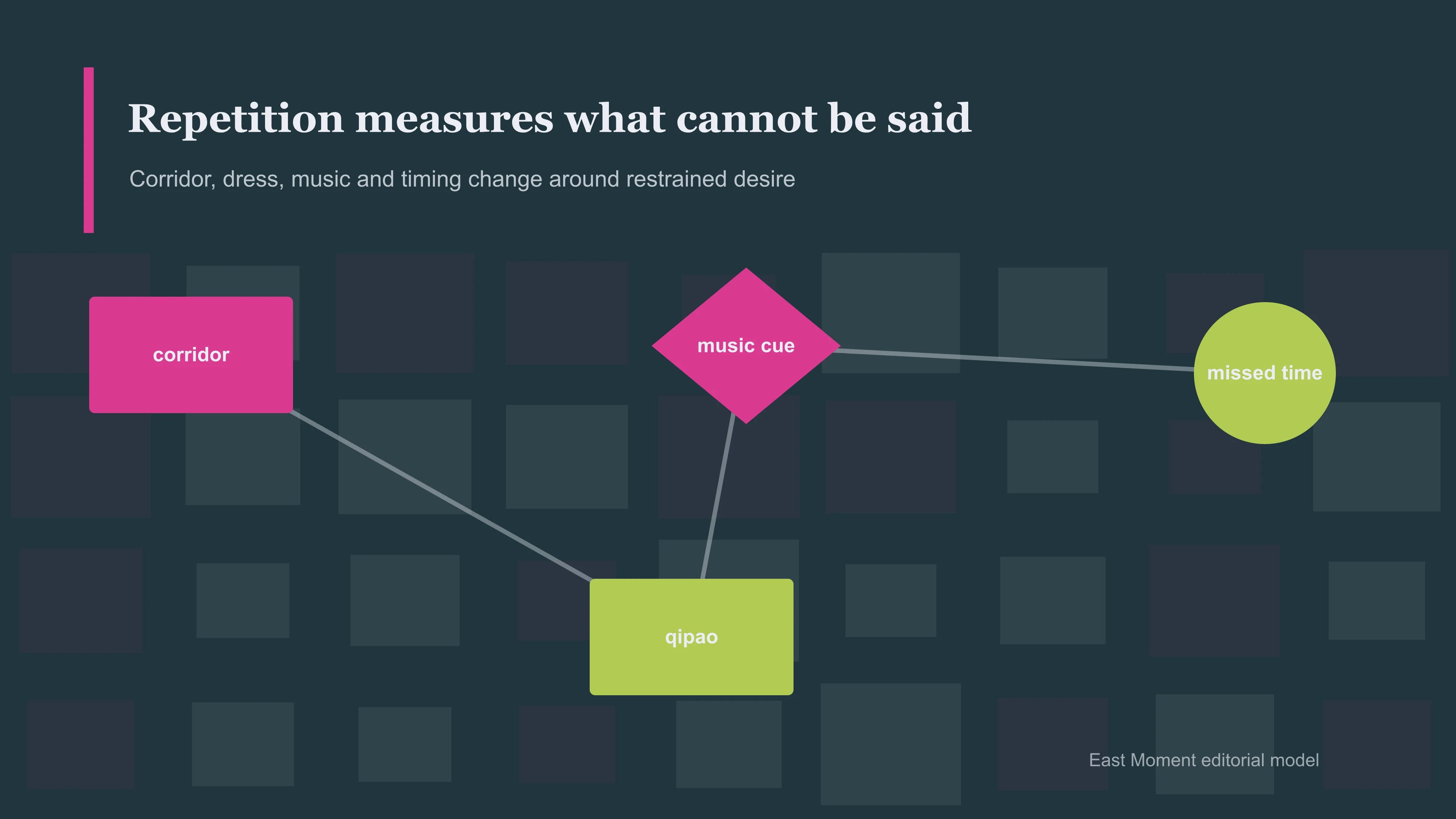
Repetition does not slow the story; it measures change
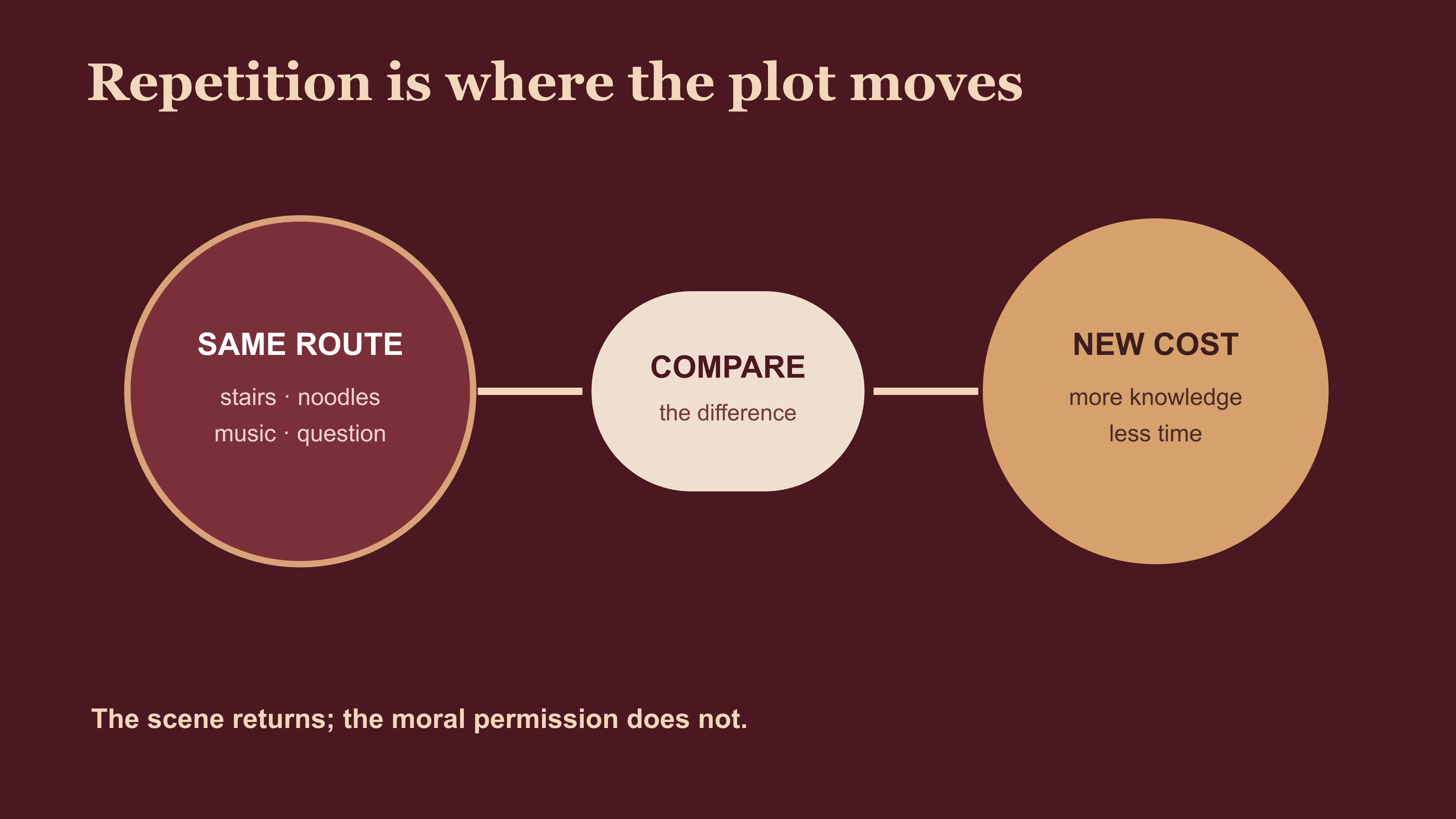
Su walks to buy noodles. A theme returns. Chow passes on the stairs. Later, a similar route or piece of music returns, but the emotional information has changed. Repetition asks the viewer to compare, not wait.
The same method governs their rehearsals. Chow and Su act out imagined conversations: how one spouse might have approached the other, how a confrontation might unfold, what a departure might sound like. At first these scenes can be mistaken for literal events because the film does not announce every transition into performance. The uncertainty is purposeful. Rehearsal gives them permission to say what ordinary conduct forbids, then leaves them responsible for the feeling the performance produces.
Three questions make a second viewing more useful:
- What is repeated: the route, music, question, costume or position in the frame?
- What has changed since the previous instance?
- Is the character practicing control, testing intimacy or postponing a decision?
Once viewed this way, the film is not static. Its smallest differences are its movement.
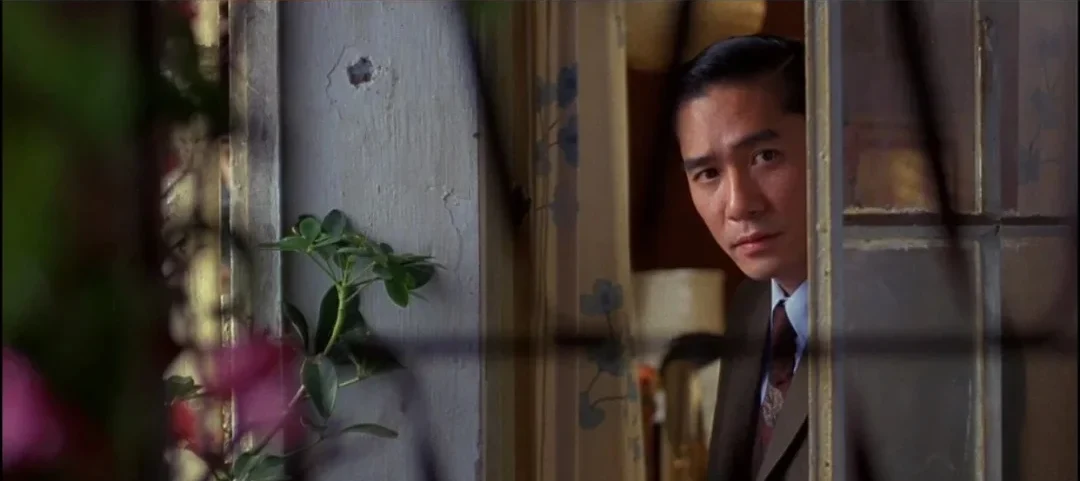
Doorways and corridors make privacy physically expensive
The apartments are crowded enough that an ordinary meeting can become social evidence. Doors remain partly open. Neighbors notice schedules. A shared wall can connect two people and expose them at the same time. Chow and Su therefore borrow temporary spaces: a restaurant booth, an office, a hotel room used for writing, a stairwell between home and street.
None becomes fully theirs. Wong frequently places a doorframe, wall edge, curtain or foreground object between the camera and the characters. We do not receive unrestricted access simply because the film is about intimacy. The composition makes looking feel conditional.
This spatial pressure should not be treated as a documentary claim about every Hong Kong household in 1962. It is a designed environment in a film set in a particular migrant social world. Within the film, however, the rule is clear: private feeling must pass through public architecture.
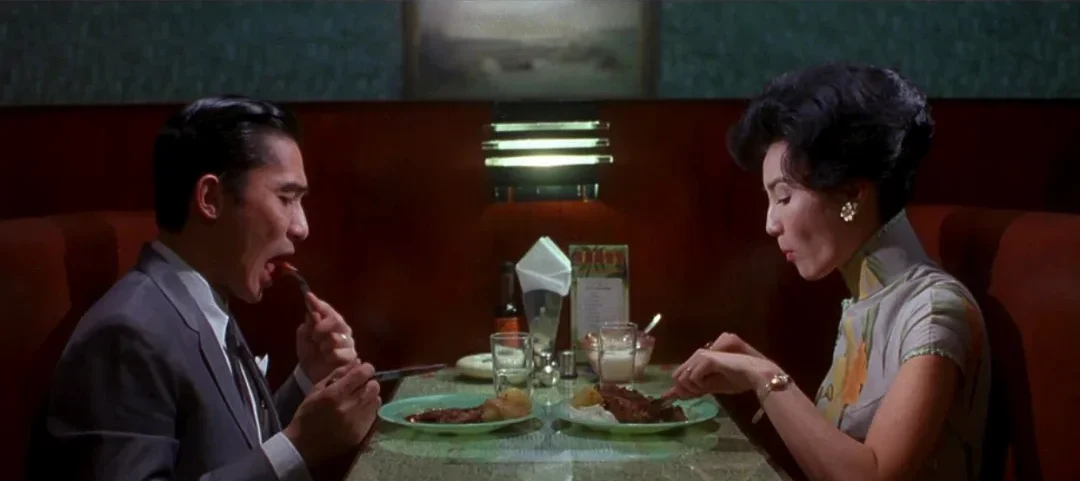
The cheongsams are time, not a costume exhibition
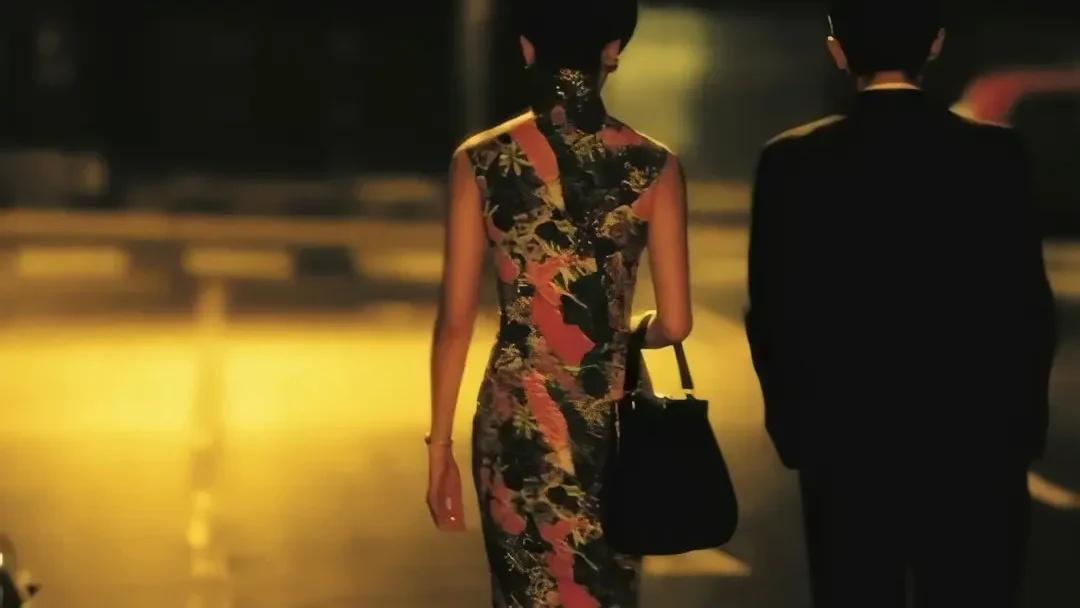
Su's cheongsams are among the film's most remembered images, but treating them only as “Chinese elegance” empties them of dramatic work. Changes in pattern and color help separate repeated days while the fitted silhouette preserves controlled posture. Clothing makes time visible without freeing Su from scrutiny.
The contrast is productive: visual abundance surrounds a character whose choices remain constrained. A new dress does not equal a new life. It marks another interval inside the same social enclosure.
William Chang Suk Ping's combined credit for production design, editing and costume design helps explain the integration. Fabric, room and cut belong to one temporal system. The question is not merely what Su wears, but how a pattern appears against wallpaper, a curtain or a dark passage and what that arrangement permits us to notice.
Why the music keeps returning
The recurring waltz associated with the pair stretches ordinary movement into ceremony. Steps toward noodles, a passing glance or rain beneath an awning become events the characters cannot publicly name. Nat King Cole's Spanish-language songs add another layer of distance: emotion travels through a voice and language outside the dialogue rather than arriving as direct confession.
Repeated music does not certify that the feeling is unchanged. It creates a stable vessel into which changed circumstances are poured. On each return, ask whether the characters know more, risk more or have less time.
This is the same larger principle that makes Chungking Express a useful comparison. Both films use repeated songs and ordinary routines as emotional memory. Here repetition tightens restraint; in Chungking Express, it more often keeps a stalled person moving.
Are Chow and Su actually in love?
Yes, if love means sustained attention, imaginative partnership and a desire that changes what a person risks. The harder question is what they permit that love to become.
The film refuses a clean ledger of physical acts because its moral and emotional stakes do not depend on one forensic answer. Chow and Su cross boundaries through secrecy, reliance, rehearsal and the creation of a shared intellectual room. At the same time, they continue distinguishing themselves from the spouses who betrayed them.
That distinction is both sincere and unstable. It protects their self-respect, but it can also postpone an honest choice until circumstances choose for them. The film does not reward restraint as pure virtue or dismiss it as cowardice. It shows restraint becoming an identity the characters cannot easily leave.
In the Mood for Love ending explained
Major spoilers begin here.
Time separates Chow and Su through missed opportunities rather than one final refusal. When each returns to a former shared place, timing prevents reunion. The rooms have changed occupants or meaning; private history leaves no public marker.
Chow earlier describes an old practice: someone with a secret could whisper it into a hole in a tree and seal the opening with mud. At Angkor Wat, he whispers into a cavity and covers it. The gesture does not reveal the secret to us. It gives secrecy a container outside his body.
The ending is therefore more than “he tells a wall because they cannot be together.” Throughout the film, borrowed rooms and rehearsed scenes temporarily held what public life could not. Angkor offers a structure vast enough to outlast the people, yet unable to answer them. The secret is preserved and made inaccessible at once.
My reading is definite but not exclusive: Chow does not finally overcome the past; he converts a living possibility into memory so that life can continue without requiring the past to become ordinary. The moss and stone make time visible on a scale larger than romantic regret. Closure here is storage, not resolution.
Is the film romantic or a warning?
It is romantic about attention and severe about delay. Chow and Su notice one another with a care absent from their marriages. Their collaboration proves that intimacy can create thought, not only scandal. Yet beauty does not cancel the damage of waiting until every option has become a memory.
That tension is why copying the film's surface rarely reproduces its force. Red light, slow motion, cheongsams and a famous soundtrack can imitate atmosphere. The original works because every aesthetic return tightens an ethical problem.
For broader context, the Chinese film guide separates industry, language and regional traditions that the single label “Chinese cinema” can hide. The Hong Kong guide provides city context without treating a stylized 1962 screen world as a present-day travel record.
Where to watch In the Mood for Love legally
Use the Criterion film page to confirm the director-approved restoration, runtime and current US purchase or digital options. Availability changes by country and date, so verify the listing immediately before paying.
This page embeds no rental, subscription or payment-gated player. Do not rely on unauthorized full-film uploads: image quality, cut, subtitles and rights status may all be uncertain, and this is a film whose color and timing materially affect interpretation.
Final verdict
In the Mood for Love solves a difficult artistic problem: how to make decisions visible when characters cannot state them. Its repetitions are comparisons, its rooms are social pressure, its clothes are time, and its ending gives secrecy a physical form.
Do not watch only to discover whether Chow and Su “get together.” Watch for the moment a repeated action stops being accidental and becomes chosen. Then bring that exact moment to the comments. A scene, object or cut gives the community something it can examine; a declaration that the film is simply beautiful does not.