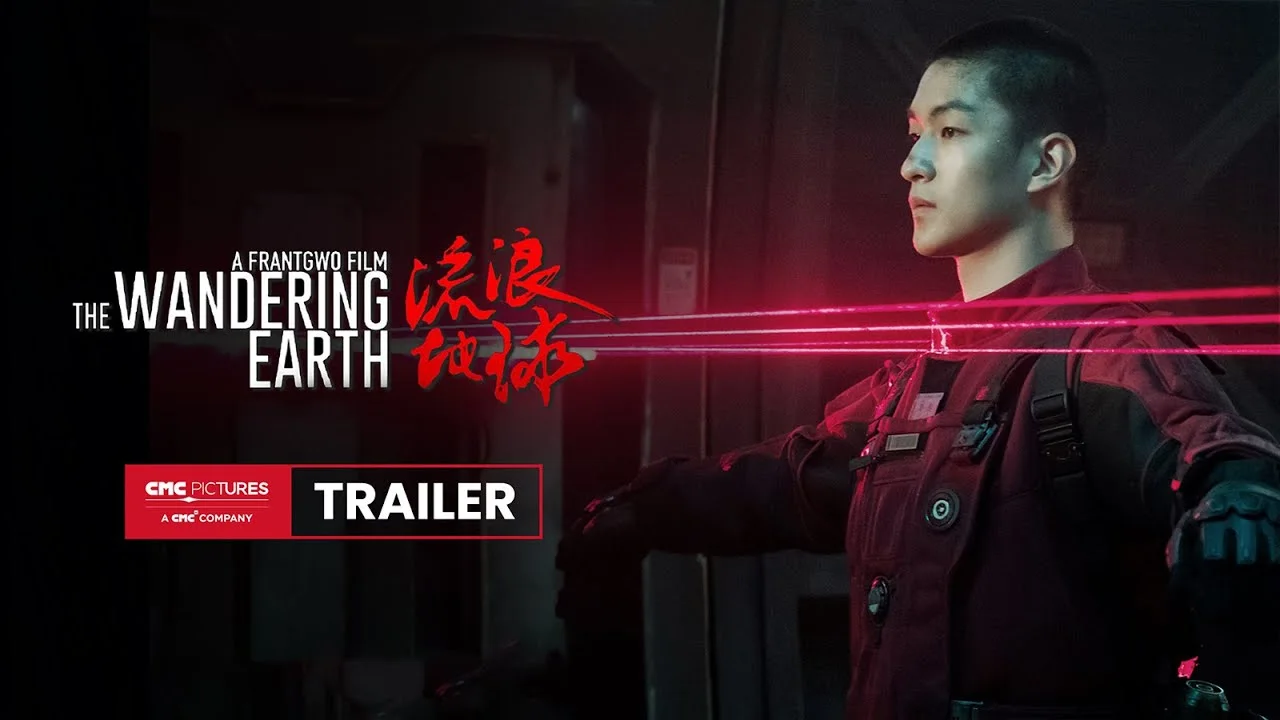
The unforgettable idea in The Wandering Earth is not that humanity builds larger machines. It is that the machines turn Earth itself into shared infrastructure: nobody escapes unless the inherited home moves too. That image makes the film essential Chinese science fiction. Its weakness is just as important: at this scale, individual people are too often reduced to fuel for the next sacrifice.
The Wandering Earth: plot, cast, ending and watch order
| Reader question | Direct answer |
|---|---|
| What is the premise? | A dying Sun forces humanity to build planetary engines and move Earth toward a new star. A collision risk with Jupiter threatens the migration. |
| Who is in it? | Qu Chuxiao plays Liu Qi, Wu Jing plays astronaut Liu Peiqiang, Zhao Jinmai plays Han Duoduo, Ng Man-tat plays grandfather Han Zi'ang and Li Guangjie plays rescue-team captain Wang Lei. |
| Is it based on Liu Cixin's story? | Yes, but the film expands the premise into a family-led Jupiter rescue. It is not a literal screen transcript of the novella. |
| Is it worth watching? | Yes for the planetary image, production scale and moral argument. Expect blunt humor, compressed characterization and aggressive emotional cues. |
| Is the ending happy? | Earth survives the Jupiter crisis, but Liu Peiqiang sacrifices himself. The larger 2,500-year migration has barely begun. |
| Is Part 2 a sequel? | The Wandering Earth 2 is a prequel that explains how the Moving Mountain Project and digital-life conflict developed. |
| Which should I watch first? | Release order: Part 1, then Part 2. The first film gives the central image; the prequel then deepens the institutions behind it. |
| Where is it available? | Netflix has maintained an official title page in some markets; licensing varies, so verify your regional catalog. |
Most disaster films begin by asking who gets onto the vehicle. The Wandering Earth makes the vehicle impossible to board because we are already standing on it.
That single reversal changes everything.
First decision: move the house

"Take Earth with us" is frequently described online as Chinese romance, and the phrase has become almost too polished through repetition. Its real power is rougher.
A home is not only land. It is graves, accents, childhood routes, family obligations and the embarrassing things a culture cannot pack neatly. Moving Earth refuses the clean fantasy of selecting a few bodies and declaring them humanity's future. The planet arrives with history attached.
I respond to the film's heavy-industry beauty, restrained father-son feeling and "saturation rescue" through familiar moral language: carrying home, moving mountains and doing the impossible together.
The danger is turning that language into essence. Not every Chinese viewer values collective sacrifice in the same way, and no civilization owns loyalty to home. The film is specifically Chinese because it makes these ideas legible through Chinese speech, institutions, kinship and public memory - not because other cultures are incapable of them.
The engines are the protagonist

The film's best character is not Liu Qi or his father. It is the system connecting planetary engines, underground cities, frozen highways, orbital control and rescue teams.
This is not an insult. Infrastructure is where the film's imagination becomes distinct. The engines need routes; routes need drivers; drivers need standardized suits, instructions, food and people willing to repair a machine they did not design. A giant blue flame matters because thousands of ordinary tasks keep it burning.
The frozen Beijing and Shanghai landmarks sit beside the outrageous safety announcement, "Roads are countless; safety is foremost," while Earth leaves a trail like a ship behind the planetary engines. The ridiculous and the sublime belong together. That mixture is the film's real texture. The future is not a clean white laboratory. It contains a familiar traffic slogan, a grandfather, a damaged truck and somebody using a nickname nobody outside the group understands.
Production design does the argumentative work. Doors, vehicles, warning labels and protective suits repeat the same visual language, so the rescue system feels standardized before the script explains every institution. I believe the world because the machines look repaired, assigned and used—not because a character tells me China has entered a science-fiction future. The heavy surfaces carry scratches, bolts and procedures. They make technology feel like labor.
That distinction matters. “Industrial scale” is often used as empty praise for any expensive frame. Here scale has choreography: people queue, seal, drive, relay, fail and replace one another. A planetary engine is impressive; a system that can route a broken vehicle toward it is world-building.
Saturation rescue is thrilling because it refuses the chosen one
"Saturation rescue" means sending overlapping capacity so that the mission does not depend on one perfect team. In the drama, multiple rescue parties converge because failure is expected and redundancy is moralized: somebody else must still be moving when you stop.
That is a powerful alternative to the invulnerable superhero. It is also a machine for producing sacrifice.
The film knows how to make the radio call "someone got there before us" feel like collective hope. But it rarely pauses long enough to show who all those someones were. The system recognizes them as capacity before the story recognizes them as people.
This is where my admiration stops being unconditional. A collective becomes meaningful through the individuality it protects, not through how efficiently it consumes individuals. When every death automatically enlarges the music, grief turns into an energy source for the screenplay.
The tragic and romantic premise is weakened by excessive emotional language. Bombardment and sacrifice do not create epic feeling by themselves. That is the cost hidden inside the same design that makes the rescue exhilarating.
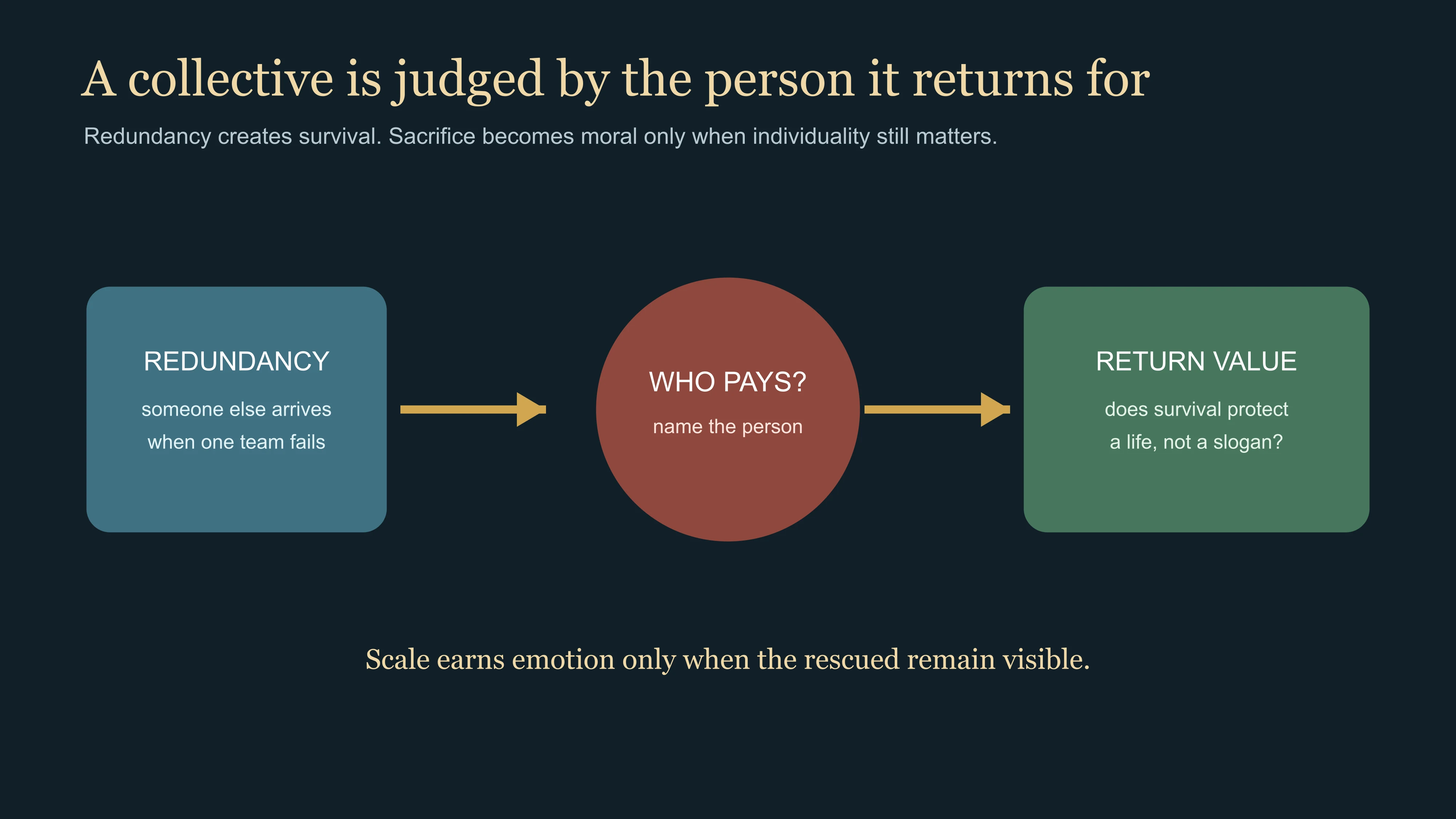
This is the pressure test I refuse to soften. A rescue is collective when the system expects failure, sends redundancy and still remembers the names inside every replaceable unit. It becomes coercive when a person's death is treated as the quickest proof that the group was right. The film contains both impulses. Its radio network says no one should carry the planet alone; its climax still reaches for a father whose death can settle love, duty and strategy in one explosion.
That contradiction does not cancel the film. It makes the film worth arguing with. Liu Peiqiang's absence has lasted for years. Sacrifice finally makes his love undeniable, but death cannot listen to Liu Qi's anger, repair an ordinary morning or endure the embarrassing slowness of apology. I cry because the act is enormous. I remain dissatisfied because enormous acts are the shortcut this family never needed.
Why the science argument never ends
The film's giant machines should not be treated as diagrams. The Wandering Earth uses science to construct scale, constraints and material consequences. It is still a feature film, not an engineering proposal.
That distinction does not mean errors are irrelevant. A convincing constraint helps the audience believe that choices have costs. A visible contradiction can break that belief. The useful debate is therefore not "science fiction can do anything" versus "one error destroys the movie." It is whether the invented rules stay coherent enough to carry the moral problem.
Calling it the best science-fiction film in decades does not erase scientific mistakes, and replying that science fiction is not documentary does not resolve them either.
My test is narrower: does the science create a difficult choice, or merely decorate a predetermined emotional climax? The engines pass that test. Some of the Jupiter mechanics matter less than the rescue decision they enable.
The Wandering Earth ending explained
Major spoilers begin here.
Earth approaches Jupiter and faces destruction. The surface team attempts to ignite the planet's hydrogen-rich atmosphere to create a shockwave. The plan lacks enough reach until Liu Peiqiang abandons the orbital station's escape logic and uses its fuel to bridge the gap.
He dies. The explosion pushes Earth away from Jupiter, the engines recover and the migration continues.
This is survival, not arrival. The final scale of the 2,500-year journey makes the celebration deliberately small. One generation has solved one crisis inside a project whose destination nobody alive can see.
The father-son reconciliation works because Liu Peiqiang's public duty and private absence finally collide. It also compresses years of hurt into one sacrificial act. Death proves love with terrible efficiency; it cannot conduct the slower work of apology.
That is why the ending moves me and frustrates me in the same moment.
The novella gives the planet; the film builds a rescue vehicle around it
Liu Cixin's source story supplies the audacious civilizational premise and follows the long consequences of leaving the Solar System. The film concentrates on the Jupiter crisis, invents or greatly expands the central family route and turns an immense historical process into a disaster-film clock.
The adaptation gains propulsion, faces and a climax that can be staged in two hours. It loses some of the source's cold duration: generations living under a plan whose truth they cannot personally verify.
Do not use the film as a plot summary of the novella. Read the story after watching if the most disturbing part for you is not Jupiter, but obedience across centuries.
Part 2 goes backward and makes the system more human
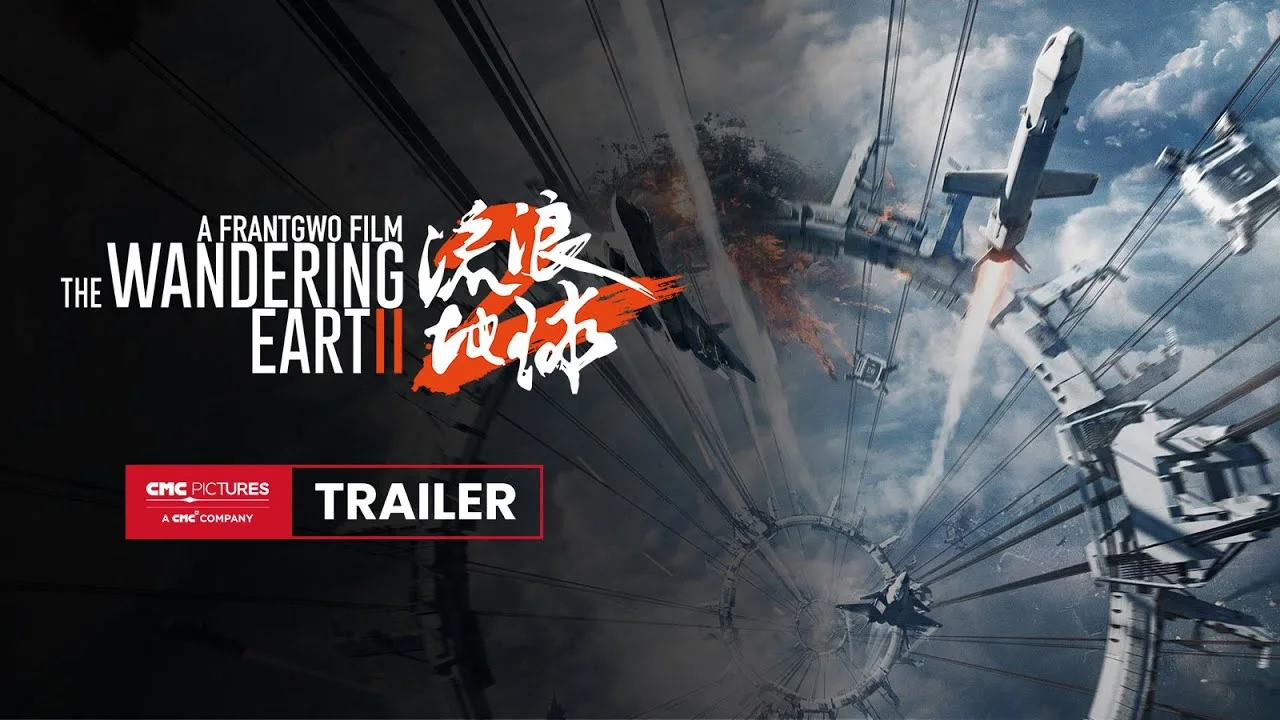

The Wandering Earth 2 is a prequel. It returns to the formation of the planetary-migration project, the opposition between physical survival and digital life, and the people who build institutions before those institutions look inevitable.
That reversal helps. Part 1 shows infrastructure already commanding obedience. Part 2 asks how a species agreed to create it.
For a first-time viewer, release order remains better. Part 1 delivers the primitive shock of seeing Earth as a vehicle. Part 2 can then complicate the image with engineering, politics and loss. Chronological order explains more before you have learned why the explanation matters.
Part 2 also makes the first film's machines less anonymous. The elevator, computing infrastructure and Moving Mountain Project are not neutral wonders waiting for heroic use. They are built through arguments about who counts as alive, which future deserves material resources and how much coercion can be justified by extinction. That political prehistory is what the first film lacks whenever urgency turns debate into a countdown.
Final verdict: a landmark with a human-size problem
Watch The Wandering Earth because it gives Chinese cinema an image large enough to reorganize a global genre: Earth transformed from threatened location into collective vehicle. Watch it critically because a civilization-sized protagonist can make actual people look small. Netflix's official title page remained live when rechecked on August 25, 2026; catalog access, audio and subtitles still depend on region.
For more animation-scale cultural argument, Ne Zha 2 asks a different question about fate and institutions. For a film where national form, color and political order are inseparable, continue to Hero. The Chinese movies collection connects those works by ideas rather than by a generic ranking.
In the comments, name one rescue decision where collective duty becomes earned solidarity - or crosses into emotional pressure. Then bring the scene to the East Moment community, where readers can compare designs, subtitles and moral assumptions without reducing the film to either a national trophy or a technical error list.