Formed Police Unit is worth watching when physical action reveals who accepts responsibility under pressure. It becomes less convincing when explosions, uniforms and sacrifice are asked to prove seriousness by themselves. Wang Yibo brings sharp, contained energy; Huang Jingyu gives the team weight; Zhong Chuxi supplies professional resistance. The film's strongest moments are bodily and immediate. Its weakest moments explain the moral conclusion before the drama has fully earned it.
Formed Police Unit: cast, plot and quick verdict
| Question | Direct answer |
|---|---|
| Chinese title | Weihe Fangbaodui (《维和防暴队》) |
| What is it? | A 2024 Chinese action film about a police contingent deployed on an overseas peacekeeping mission. |
| Main cast | Huang Jingyu as Yu Weidong, Wang Yibo as Yang Zhen and Zhong Chuxi as Ding Hui. |
| Is it based on one true mission? | The film draws on the public frame of Chinese peacekeeping police, but it should be watched as dramatized fiction rather than a record of one operation. |
| Best reason to watch | Committed physical performance and team pressure rather than geopolitical explanation. |
| Main weakness | Institutional speeches and escalating danger can replace the slower work of making civilians, place and consequence specific. |
| East Moment verdict | Watch if you want a tense ensemble action film and Wang Yibo in a contained physical role. Do not use it as a documentary introduction to UN peacekeeping. |
The English title sounds procedural. The Chinese title is more direct: “peacekeeping riot squad.” Both make the same promise - this is not a lone hero wandering into danger. It is a formed unit whose meaning should come from coordination.
The uniform is a contract before it is an image
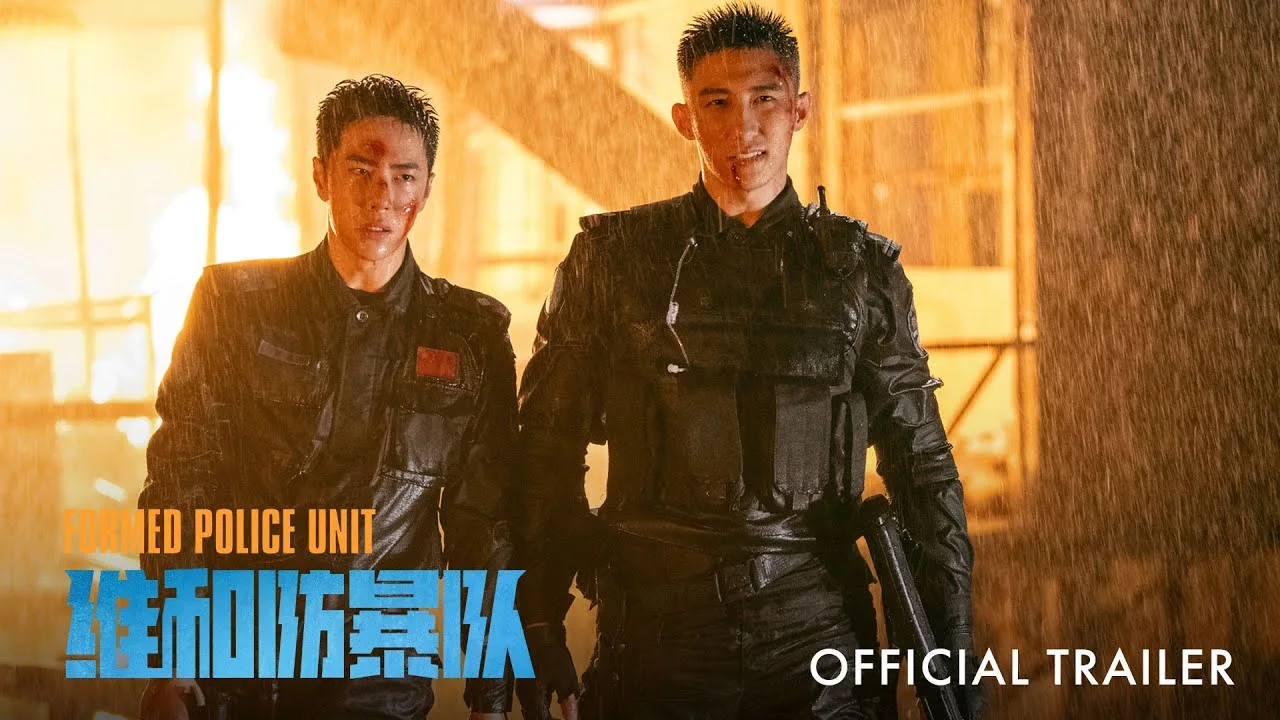
Watch the central team in the official Formed Police Unit trailer Action cinema loves uniforms because they instantly organize a frame. Matching color, equipment and formation tell the eye where discipline lives. But a uniform can also perform moral work the screenplay has not earned: if the characters look official enough, the viewer is expected to trust every decision.
Formed Police Unit is stronger when it treats the uniform as obligation. The team must protect civilians, manage disorder, obey a chain of command and survive long enough to keep doing all three. A member's courage therefore cannot be measured only by how aggressively he enters danger. It also appears in restraint, coverage and whether his movement leaves another person safer.
Real United Nations peacekeeping is a far larger political and institutional system than the film's mission frame. That distinction protects the viewing experience from a common mistake: admiring a well-staged action sequence does not verify the legal mandate, local politics or operational realism behind it.
The movie can still make a human claim. It just has to make it through character rather than borrowed authority.
Wang Yibo's Yang Zhen works through stored energy

Yang Zhen is useful in Wang Yibo's larger portrait because the role removes several of his familiar advantages. There is no fantasy costume, dance stage or glamorous romantic structure to convert stillness into fascination. The body must look trained for someone else's safety.
Wang's contained energy suits that task. He can make a young man appear ready to move before the edit demands movement. The jaw, shoulder line and quick shift of attention carry the role more convincingly than speeches about duty.
The film also knows that his screen image creates an expectation of solo competence. Its better choice is to interrupt that expectation. Yang Zhen is part of a team, receives orders, makes mistakes and cannot turn every emergency into a personal showcase.
The test for each action scene is simple: does his physical choice reveal judgment, or does the camera merely prove that he completed difficult training?
Training is evidence of labor. Character begins when that labor becomes a decision.
Huang Jingyu gives the team its center of gravity

Huang Jingyu's Yu Weidong has a different function. His body does not need to announce youthful speed; it carries command weight. When the unit fractures under pressure, the leader's value lies in distributing attention - reading the threat, assigning responsibility and absorbing consequences that a younger member cannot yet see.
This creates the film's most useful actor contrast. Wang Yibo stores energy in the possibility of motion. Huang Jingyu stores it in the refusal to move too early. One body wants to answer danger. The other must decide what the answer will cost the whole formation.
Action films often claim to be about teamwork while editing every meaningful success around the most marketable face. Formed Police Unit does not escape that pressure, but its ensemble structure gives it a chance. The squad becomes convincing whenever spatial dependence is clear: who covers whom, who can see the civilian, who has incomplete information, and who must remain behind.
Ding Hui must be more than proof that women joined the mission
Zhong Chuxi's Ding Hui is the clearest test of whether the film believes in professional specificity. A female officer does not become meaningful because the camera lets her endure the same explosion. Her expertise must alter the plan.
The role is strongest when competence appears through access, communication or a decision the men could not simply perform in her place. It is weakest when the screenplay uses her presence as visual proof of an inclusive team while returning narrative control to the male conflict.
This is not a demand that every character receive equal screen time. It is a demand for consequence. If removing a specialist would not change the mission, the film has included an image rather than a role.
The action is clearest when geography remains visible

The physical production is an obvious selling point. The cast trained, the film uses vehicles, close combat, crowd pressure and large explosions, and the trailer repeatedly places bodies inside debris rather than safely above it.
Yet action intensity is not the same as action clarity.
The best sequences let us answer four questions without pausing:
- Where is the civilian or teammate who needs protection?
- What route is open, blocked or becoming dangerous?
- Which officer has the information needed to choose?
- What becomes impossible after the next move?
When those relations remain visible, impact carries meaning. When cutting reduces the space to faces, muzzle flashes and falling concrete, sacrifice becomes generic. The audience knows the scene is dangerous but cannot feel why one decision was better than another.
That is the difference between spectacle and suspense. Spectacle shows force. Suspense lets us understand the narrowing choices.
The unnamed foreign country is both protection and weakness
The film uses a fictional overseas setting. This gives the production room to assemble recognizable conflict imagery without claiming a complete account of one country. It also creates a problem: local civilians can become a moral background against which Chinese officers demonstrate courage.
For the story to feel human, the place needs more than danger. A civilian needs a goal that exists before rescue. A street needs social life before it becomes an action corridor. A local relationship must change how the unit understands the mission.
Without those details, “overseas” becomes a production design category. The film's sincerity then flows mainly toward the officers and their families, while the people inside the mission area remain evidence of risk.
This is the page's central criticism because it affects every other achievement. Physical commitment can make a rescue exciting. Only specific civilian life can make the rescue matter beyond the rescuers.
Is Formed Police Unit worth watching?
Watch it for:
- Wang Yibo's contained physical performance outside fantasy and romance;
- Huang Jingyu's command weight and the contrast it creates;
- team-based action when position and responsibility remain legible;
- a useful debate about whether institutional action cinema can make duty human.
Skip it if you need a politically complete account of peacekeeping, richly developed local characters or action that consistently privileges geography over impact.
The best companion is not another uniformed action movie. Compare the way collective purpose is built in The Wandering Earth, where engineering roles and family choices compete inside a much larger crisis. Then use the Chinese movies collection to move between action, fantasy and social drama.
In the comments, name one sequence where a physical choice protects another person and one where noise replaces consequence. Bring the exact scene into the East Moment community so the discussion can stay about filmmaking, duty and character rather than celebrity camps.
Formed Police Unit sells institutional action through recognisable stars
The film's immediate promise is physical: a team trains, deploys and faces urban danger under a United Nations peacekeeping frame. The deeper test is whether teamwork becomes more than formation shots and individual hero moments.
Wang Yibo's Yang Zhen should be read through role pressure, not fan visibility. Does the character follow command, protect a teammate, misread a civilian situation or change after consequence? A trailer can establish casting and spectacle; it cannot prove procedural realism.
Peacekeeping is not a blank action backdrop
Real formed police units operate inside mandates, rules, host-state relationships and civilian-protection obligations. Film compression can make every uncertainty look solvable by courage. Institutional sources are needed to understand actual work.
The United Nations Police page provides the authoritative starting point. It does not endorse the film or certify individual scenes.
My viewing boundary
I will accept heightened action if the movie preserves consequence and team dependence. I reject the idea that uniforms alone create seriousness. The unit must make decisions together, and the people around the mission must exist as more than scenery for Chinese heroism.
That is the page's return reason: compare the official institutional description with the exact film scene, then discuss what was compressed, clarified or turned into spectacle.
The civilian cannot remain scenery
A peacekeeping film becomes morally empty when local people exist only to be rescued, threaten the unit or prove the hero's courage. Civilian protection requires civilians to have needs, information and agency that may complicate the mission.
The camera's point of view matters. If every dangerous street is understood only through the arriving unit, the country becomes a generic battlefield. A stronger scene lets the team confront what it does not know.
Team identity should survive star casting
Promotional material naturally isolates Wang Yibo, Johnny Huang and other recognisable faces. The story's subject is a formed unit. Orders, specialisation, disagreement and mutual dependence must remain visible after the poster has done its work.
One character's bravery should not make procedure irrelevant. Nor should procedure erase moral judgment when an order meets an unexpected human situation.
My verdict is conditional but clear: the film succeeds when spectacle makes coordinated responsibility visible. It fails when an international mission becomes a costume for individual celebrity heroism. That is a harder standard than counting action scenes, and it is the only one worthy of the institutional subject.
Uniforms establish identity in a frame. Decisions under incomplete information establish character.