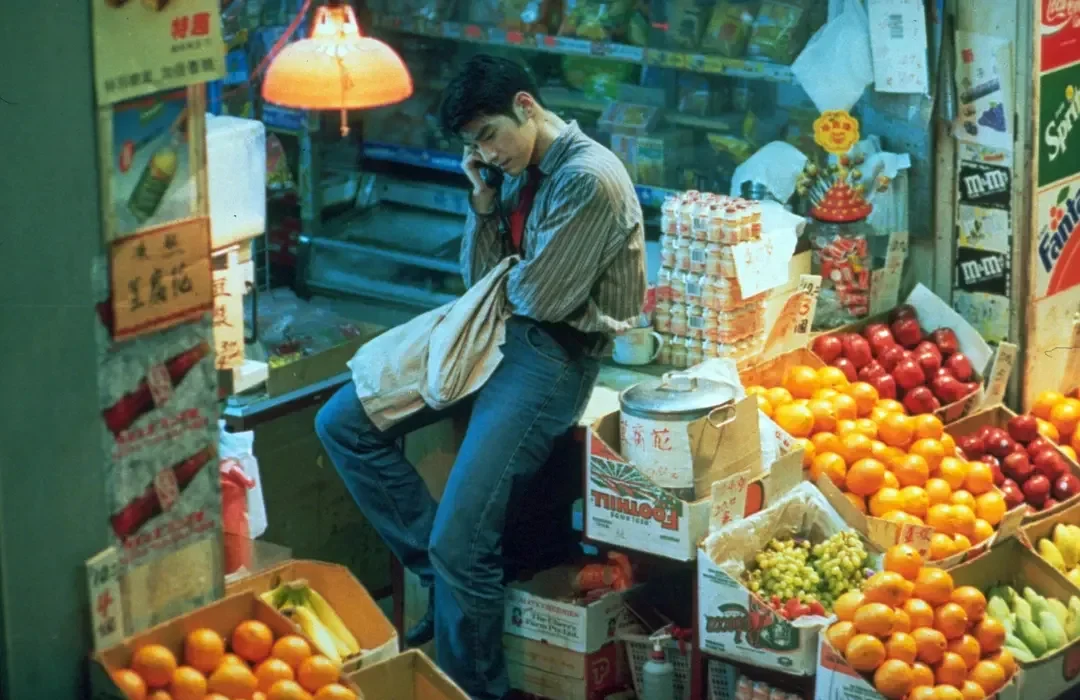
Chungking Express is not two unrelated romances joined by style. Both stories follow a person who cannot speak loss directly, so a deadline, food, a room, a song or a repeated route carries the feeling instead. The first story asks whether time can expire grief. The second asks whether a private space can change before its owner admits that he has changed.
Chungking Express in 60 seconds
| Question | Short answer |
|---|---|
| Original title | Chung Hing sam lam (重庆森林) |
| Director and writer | Wong Kar Wai |
| Release | 1994 |
| Language and place | Cantonese-language Hong Kong film |
| Structure | Two consecutive stories linked by police officers, heartbreak, food stands and urban passage |
| Main cast | Takeshi Kaneshiro, Brigitte Lin Ching Hsia, Tony Leung Chiu Wai and Faye Wong |
| Best reason to watch | Ordinary objects and pop songs become an exact emotional system |
| Common wrong shortcut | “A plotless vibe movie” or two films accidentally attached |
| East Moment verdict | Watch it, but track what each character transfers into an object |
The Criterion Collection's official film record identifies a 102-minute film shot by Christopher Doyle and Andrew Lau Wai Keung, with production design by William Chang Suk Ping and multiple credited editors. The speed, discontinuity and crowded frames are crafted, not evidence that the film lacks structure. The Wong Kar Wai guide maps that time system across films; the Tony Leung guide shows why Cop 663's comic looseness matters beside his later restrained roles.
Use the Chinese movies collection to place this film beside other Hong Kong and mainland gateways. This guide owns the two-story structure, objects and ending.
Why Chungking Express has two stories
The stories do not share one plot. They share one emotional grammar.

I love the film's speed because it never promises that speed will cure anyone. I reject the lazy “vibe movie” label: the pineapple cans, wet towel, boarding pass and borrowed key are a tighter emotional structure than many conventional plots. The mistake is to treat their charm as innocence. I believe Faye's secret entry must remain an intrusion even while it makes the apartment tender and funny. I insist on that discomfort because it gives the ending its best change: the next destination is finally asked for, not chosen behind somebody's back.
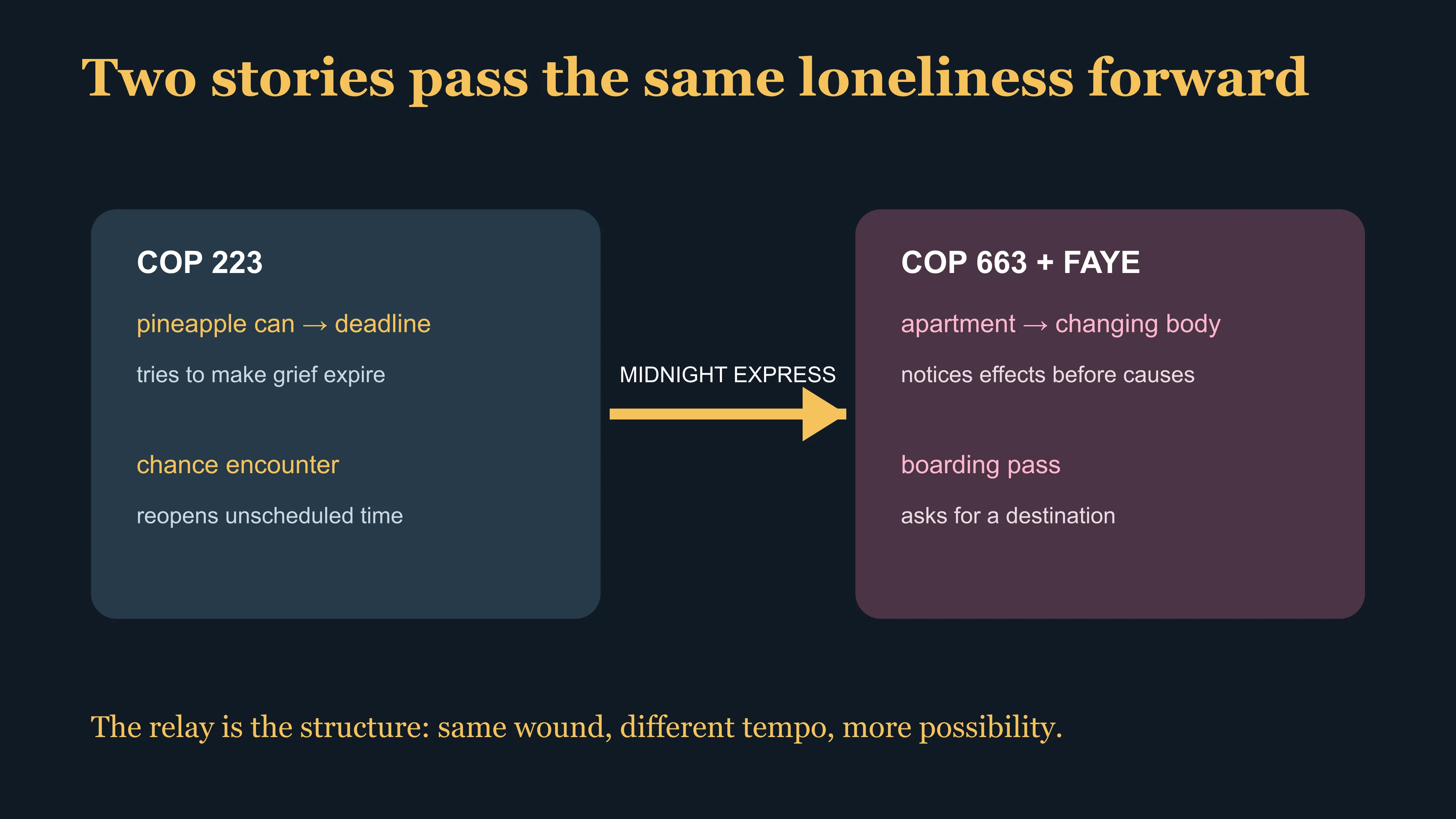
Cop 223 turns a breakup into an expiration system. Cop 663 speaks to household objects after his flight-attendant girlfriend leaves. Both men displace grief into things because things can be counted, addressed or replaced without risking a direct answer. Each then meets a woman whose movement exceeds his current understanding: one carries danger behind a blond wig and raincoat; the other quietly enters and alters a domestic space.
The transition occurs at Midnight Express, the food stand where routes cross. One protagonist leaves the film as the next enters. This is not a twist revealing a hidden connection. It is a relay: heartbreak remains, but its tempo, object and possibility change. Our Hong Kong food guide explains why compact counters and fast service are urban infrastructure rather than colorful cuisine scenery.
| Shared rule | Story one | Story two |
|---|---|---|
| Loss becomes an object system | Cans of pineapple dated May 1 | Soap, towel, toy, sardines and apartment furnishings |
| Time becomes a private rule | A birthday and expiration deadline | Repeated visits and an eventual one-year delay |
| A stranger interrupts the system | Woman in the blond wig | Faye at the food stand |
| City contact is partial | Pursuit and chance encounter | Service routine and secret entry |
| Ending opens rather than secures romance | A small message and renewed possibility | A changed destination, not a completed relationship |
Once those correspondences are visible, the split becomes the argument. The city does not give everyone the same story. It gives separate people similar emotional problems in adjacent spaces.
What happens without major spoilers
In the first story, Cop 223 has been left by a woman named May. He buys a can of pineapple with a May 1 expiration date each day, promising himself that if she has not returned by his birthday, the relationship has expired. Meanwhile, a woman in a blond wig navigates a dangerous drug-smuggling failure. Their paths meet late at night.
In the second, Cop 663 is left by a flight attendant. Faye, who works at Midnight Express, becomes fascinated with him. After receiving access to his apartment, she begins changing the space without announcing herself. He notices effects before recognizing their cause.
The actions sound whimsical in summary. On screen, whimsy remains ethically uneven. Secret entry is a violation even when staged as care; a criminal plot remains dangerous even when a lonely police officer does not understand it. The film's energy should not erase those boundaries.
Expiration dates are a failed attempt to command grief
Cop 223 chooses May 1 because it is both his birthday and a one-month limit after the breakup. The pineapple cans turn emotional ambiguity into inventory. A printed date offers the certainty May has withheld.
But expiry is a manufacturing rule, not an emotional one. Buying cans does not cause grief to finish on schedule. It reveals how urgently he wants an external system to make the decision for him. Eating them at the deadline is both comic and painful: the ritual proves commitment to a rule whose inadequacy he already feels.
The number also collapses person, month and commodity. “May” can be an absent woman, a period of waiting and a label on an object. Wong's method is not to hide one symbolic answer for viewers to decode. It is to let language and things become unstable under emotional pressure.
The apartment becomes Cop 663's emotional body
Cop 663 talks to a wet towel, exhausted soap, a dripping cloth and other household objects as though they are suffering his breakup. The joke is that he assigns his own condition to them while failing to identify it in himself.
Faye then changes the apartment: cleaning, replacing, rearranging and introducing new details. Cop 663 registers transformation as if the room were changing by itself. The apartment makes his delayed perception visible.
This does not turn Faye's secret access into a model relationship. The sequence works because care, fantasy and intrusion coexist. She tries to create a future inside his space before asking whether he wants one. He becomes available to change before he understands who has produced it.
Why California Dreamin' repeats so often
Faye plays “California Dreamin'” loudly and repeatedly. At the surface, it shields her from conversation and gives the food stand a private rhythm. At a deeper level, California names elsewhere: movement before a plan is complete, fantasy before departure is possible.
Repetition makes the song less like background and more like a room Faye can enter. Its meaning changes when imagined travel becomes actual travel and when return changes who controls the destination.
Faye Wong's Cantonese cover of the Cranberries' “Dreams” works differently. The voice belongs to the performer we are watching, blurring star image and character without turning them into the same person. Music lets interior possibility occupy public space before dialogue catches up.
Compare this with In the Mood for Love. There, recurring music formalizes restraint and lost timing. Here, pop repetition is more impatient: it keeps pressing toward a place the character has not reached.
How Hong Kong moves through the film
Chungking Mansions, nearby streets, escalators, snack counters and cramped apartments place radically different lives within physical proximity. People pass near one another without acquiring complete knowledge. The camera alternates between saturated stillness and step-printed motion in which a moving figure appears sharp against a smeared crowd.
That effect turns subjective time visible. A chase can feel both immediate and strangely isolated; one person occupies a different tempo from everyone around them. Urban density does not automatically produce intimacy. It produces chances for contact, many of which remain partial.
The English title combines Chungking Mansions from the first story with Midnight Express from the second, making the dual architecture explicit. The Chinese title, commonly rendered Chongqing Forest, points toward density of another kind. Neither title means the film is set in Chongqing municipality.
Use the Hong Kong culture guide for the living systems behind these frames. Do not treat a stylized 1994 film as a current map or assume every neon, counter and housing interior still exists unchanged. The film earns its city feeling because it transforms real pressures—limited space, repeated service, overheard lives and intersecting routes—rather than because every location has remained visually frozen.
If the film makes you want to walk the city, use the travel to Hong Kong guide to follow those pressures in the present: cross the harbor, ride one slow street-level route and stay in a working market long enough to see circulation rather than only light. This is deliberately not a filming-location hunt. A current tram or market photograph can prove density and movement; it cannot prove that a specific scene was shot there.
Is Chungking Express a romance?
Yes, but it is more convincing about romantic possibility than stable partnership. Chance meetings, secret attention and transformed routines generate desire. The film ends before either pair demonstrates the ordinary negotiation that a durable relationship requires.
That incompleteness is not a flaw to solve with imagined sequels. The film's subject is re-entry into possibility after loss. A character who can imagine a different destination has changed, even if arrival remains uncertain.
Chungking Express ending explained
Major spoilers begin here.
The first story closes after Cop 223 shares a hotel room with the exhausted woman in the blond wig without demanding romance or explanation. He cleans her shoes while she sleeps. Later, she sends a birthday message. The gesture does not establish a future couple. It breaks the closed expiration system: the day after his deadline contains contact he could not schedule.
In the second story, Faye misses a planned meeting and leaves for California. A year later she returns in a flight-attendant uniform and finds Cop 663 running the food stand. He produces her old, rain-damaged boarding pass and asks her to make another. When she asks where he wants to go, he gives the decision back to her.
The exchange reverses their earlier positions. Faye once changed his destination without permission by altering his home; Cop 663 once failed to recognize change. Now he recognizes her, preserves evidence of the missed departure and asks rather than assumes. She has traveled rather than only played a song about elsewhere.
The ending does not say where they go because destination has shifted from location to mutual authorship. My reading: the romance becomes possible only when fantasy stops entering through a borrowed key and the next route must be chosen in conversation.
Where to watch Chungking Express legally
Use the Criterion film page to verify the director-approved restoration, runtime and current US purchase or digital options, then check availability in your country. Catalogs change.
This page embeds no payment-gated movie or subscription player. Avoid unauthorized full-film uploads with uncertain subtitles, edit or image quality. Motion effects, music and timing are central evidence here, so a compromised copy changes more than appearance.
Final verdict
Chungking Express has structure, but its structure lives in transfers rather than plot mechanics: loss into food, feeling into objects, elsewhere into songs, and one interrupted story into the next. The film is joyful because those transfers keep emotion moving. It is honest because movement is not confused with a completed relationship.
Continue through the Chinese film guide for the industrial and regional context hidden by “Chinese cinema.” In the comments, choose one object or repeated song and identify the exact moment its meaning changes. That gives the community a claim it can compare against the scene.