Faye Wong's voice feels “ethereal” not because it escapes the body, but because she makes unusually clear decisions about weight, attack, breath and emotional distance. The mystery is crafted.
Faye Wong sounds free because the phrasing is controlled
Her official Apple Music catalogue is the practical listening map behind this argument; the point is not to turn the discography into a list, but to hear how weight, attack and distance change across recordings.
Faye Wong (王菲) is a Chinese singer and actor central to Cantopop and Mandarin pop. New listeners often encounter one adjective: ethereal. It is accurate as sensation and weak as explanation.
Listen to where a phrase begins. She can approach a note lightly, delay its emotional center, then let a consonant or change in pressure suddenly make the line personal. The voice does not float above meaning. It controls how close meaning is allowed to come.
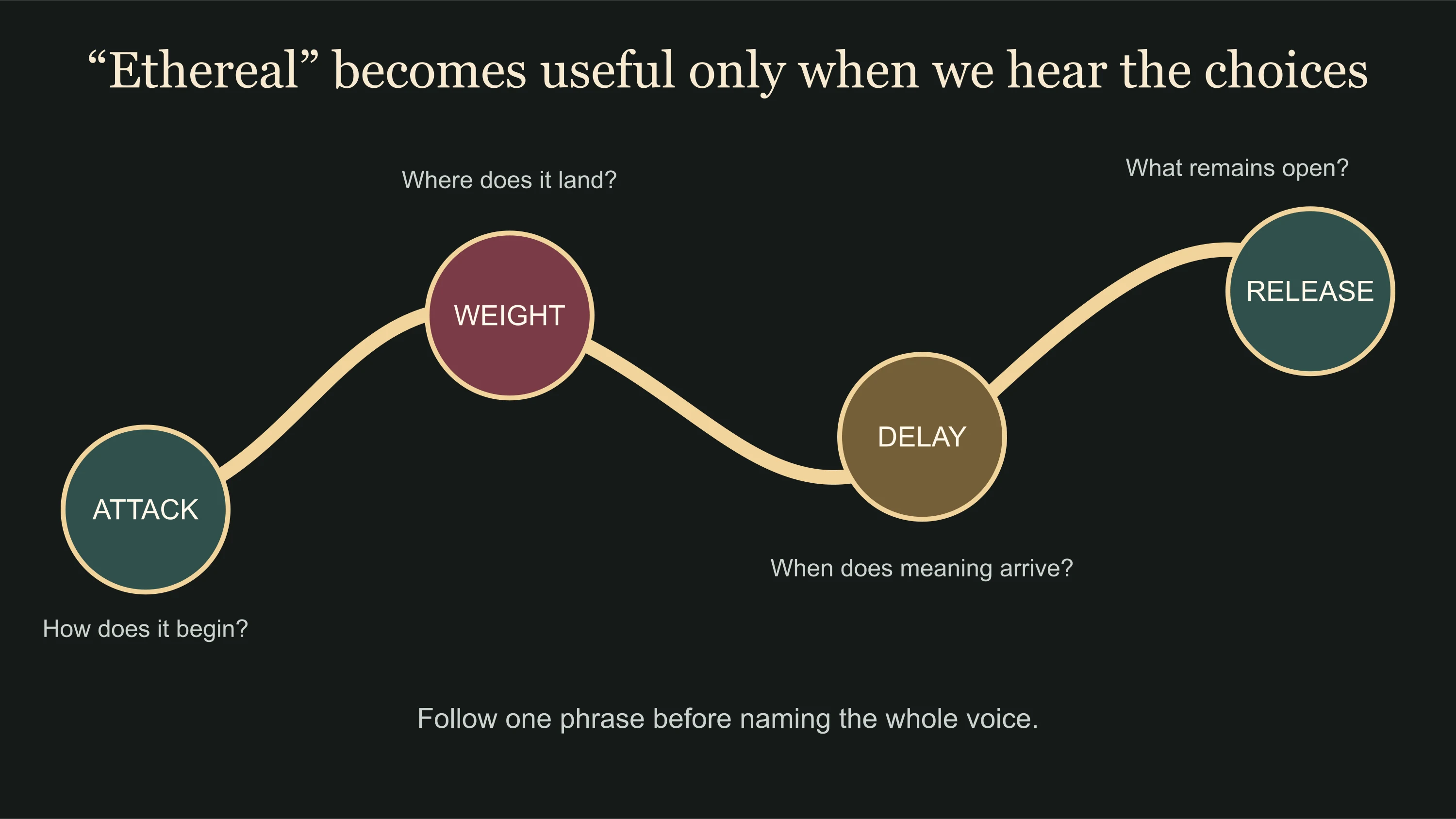
This is a listening instrument, not a portrait. I keep it inside the argument because it helps me follow one phrase from attack to release; it should never replace Faye Wong's actual face on the cover.
A listening route built from contrasts
Do not shuffle a greatest-hits list. Build contrasts:
- pair a dream-pop arrangement with a direct Mandarin ballad;
- compare a studio recording with a live performance where breath cannot be hidden;
- listen once for melody, then again for the exact point a phrase gains weight;
- notice when apparent coolness protects emotion and when it becomes style repeating itself.
Technical explanations of Faye Wong's voice are incomplete without her refusal to overperform accessibility. I hear a public attitude inside the sound: a strong sense of self that helps explain why her influence endures without pretending to reveal her private self.
My practical method is to follow one phrase rather than label the whole song “airy.” Where does the first consonant land? How much weight enters the sustained vowel? Does the line move closer at its loudest point, or does a small release carry the intimacy? Faye Wong often makes the emotional turn after the listener expects it. The delay creates space; the later change makes that space feel chosen rather than vacant.
Five Faye Wong recordings that explain the distance
A ranking is the wrong tool for Faye Wong. Her catalog makes more sense as five different decisions about how much feeling a song should reveal.
1. Dream Person: velocity can also create intimacy
Dream Person (夢中人), her Cantonese version of the Cranberries' Dreams, does not sound distant because it is quiet. It moves. The guitar, pulse and vocal lift give desire a body before the lyric can be reduced to a romantic statement. Criterion identifies the recording as part of Chungking Express, where the song and Faye's screen presence blur without becoming identical.
This is the fastest correction to the “ethereal singer” cliché. She can sound airborne while the rhythm remains urgent. Air does not mean weakness; it means she has chosen not to turn urgency into vocal weight.
2. Reserved: a Mandarin ballad does not need to beg
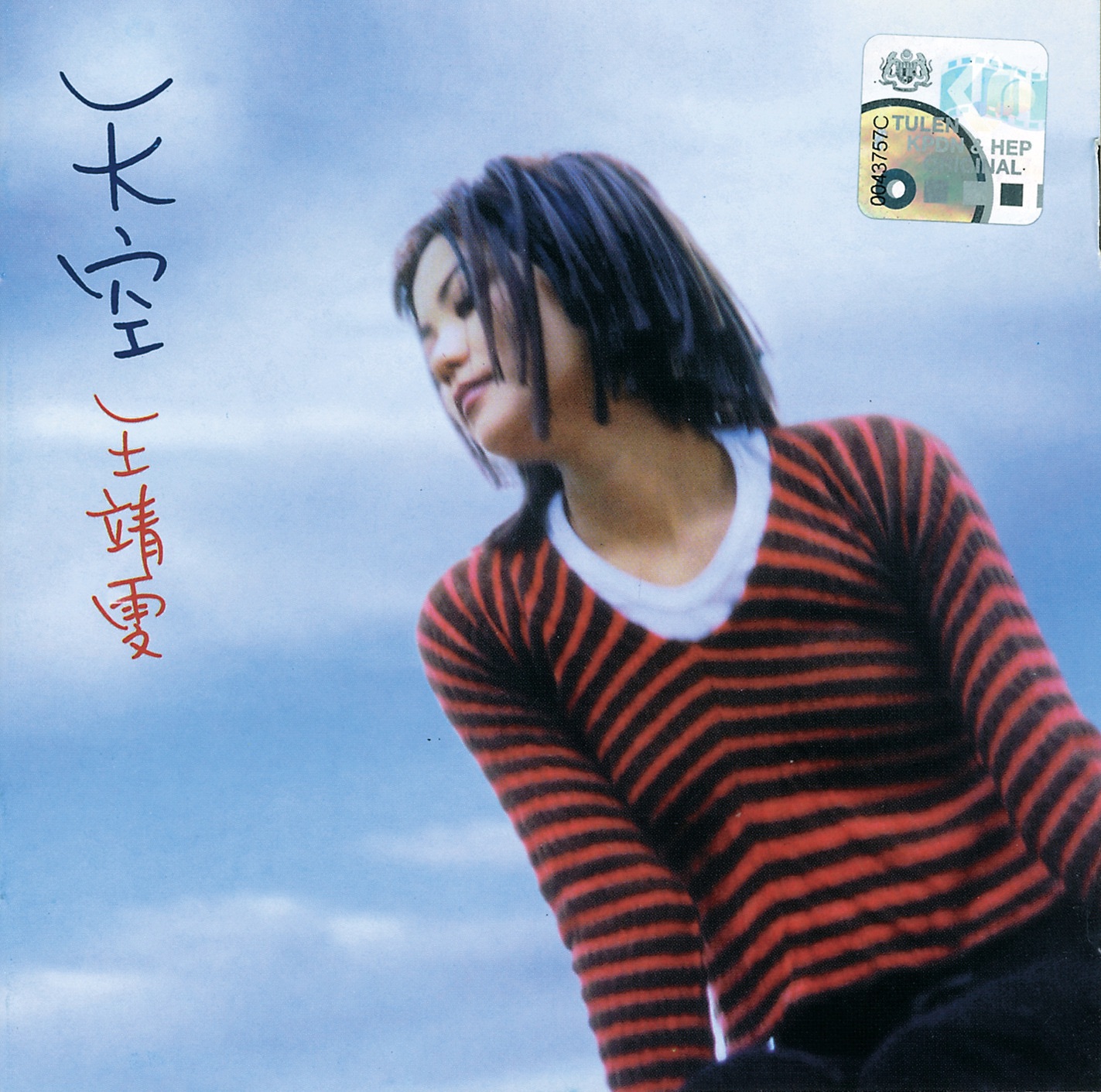
Reserved (矜持) belongs to the 1994 Mandarin album Sky (天空). The title can suggest restraint, reserve or holding oneself back. Faye does not solve that state through a huge final release. She lets self-control remain part of the emotion.
The official Sky album is the clearest entry into her Mandarin ballad voice. Its cover—now used at the top of this page—refuses grand diva staging: a blurred body, open sky and motion that never settles into a formal portrait.
I find that refusal more moving than an automatic climax. The singer protects dignity without denying desire. That balance is extremely difficult; many covers keep the melody and destroy the boundary.
3. Di-Dar: nonsense syllables become physical design
The 1995 Cantonese album and title track Di-Dar make sound itself part of the argument. Repeated syllables, electronic texture and clipped phrasing create a sensual surface that cannot be explained by translating a narrative. The song asks whether the mouth can become percussion without losing personality.

The official Di-Dar album places gesture and concealment inside the cover itself. The hand is not decorative coyness; it makes seeing partial, exactly as the music makes emotional access partial.
This is where “cool” becomes too vague. The performance is not merely detached. It is precise about contact: one phrase touches the beat, another glides past it, and the arrangement leaves negative space around the body.
4. Restless: artistic freedom must risk ugliness
Restless (浮躁), released in 1996, is the album I use to separate influence from image. Apple Music lists it as a ten-track, 35-minute project. Its value is not that every experiment is equally beautiful. Its value is that Faye Wong allowed a central pop career to become stranger, less obedient and less immediately decorative.

The official Restless album makes artistic risk visible in the body: the face is partly hidden, the framing is awkward and the image refuses polished availability.
I do not call that bravery merely because the music is experimental. The risk is commercial and aesthetic: a familiar star voice enters arrangements that do not always flatter it. Freedom without the possibility of an unattractive result is just branding.
5. Red Bean: familiarity survives because she underplays it
Red Bean (紅豆) from the 1998 Sing and Play era is a different test. The song is widely familiar, melodically generous and easy to turn into sentimental display. Faye's authority comes from resisting that temptation. She lets anticipation, duration and incompleteness do more work than vocal demonstration.
The song proves that accessibility is not the opposite of artistic control. A popular ballad can remain open-ended when the singer refuses to tell the listener exactly how much to feel.
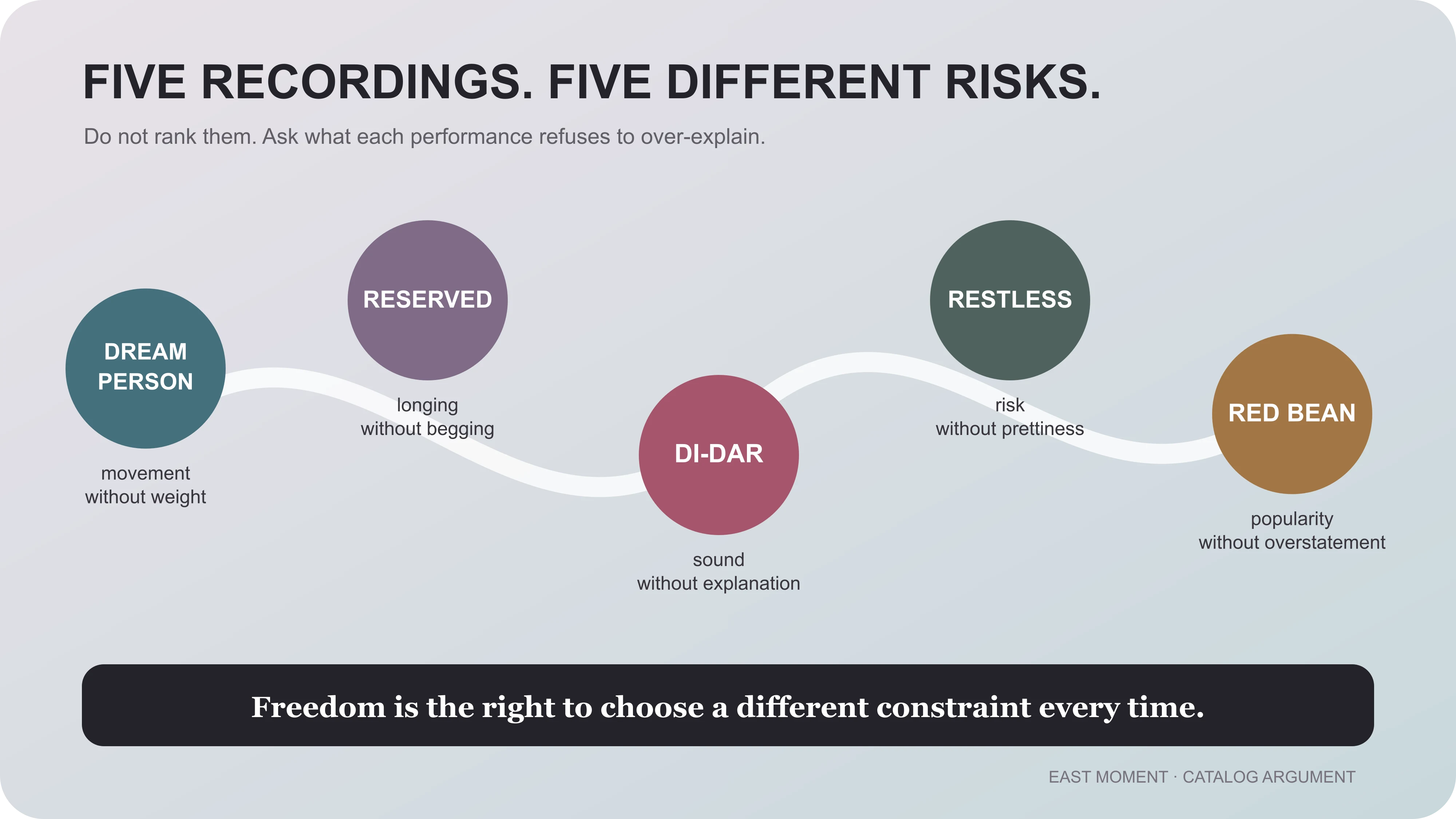
My route is not chronological worship. Each recording must solve a different problem: movement without heaviness, longing without begging, sound without explanation, experimentation without prettiness and popularity without emotional overstatement.
Cantonese and Mandarin do not carry the same distance
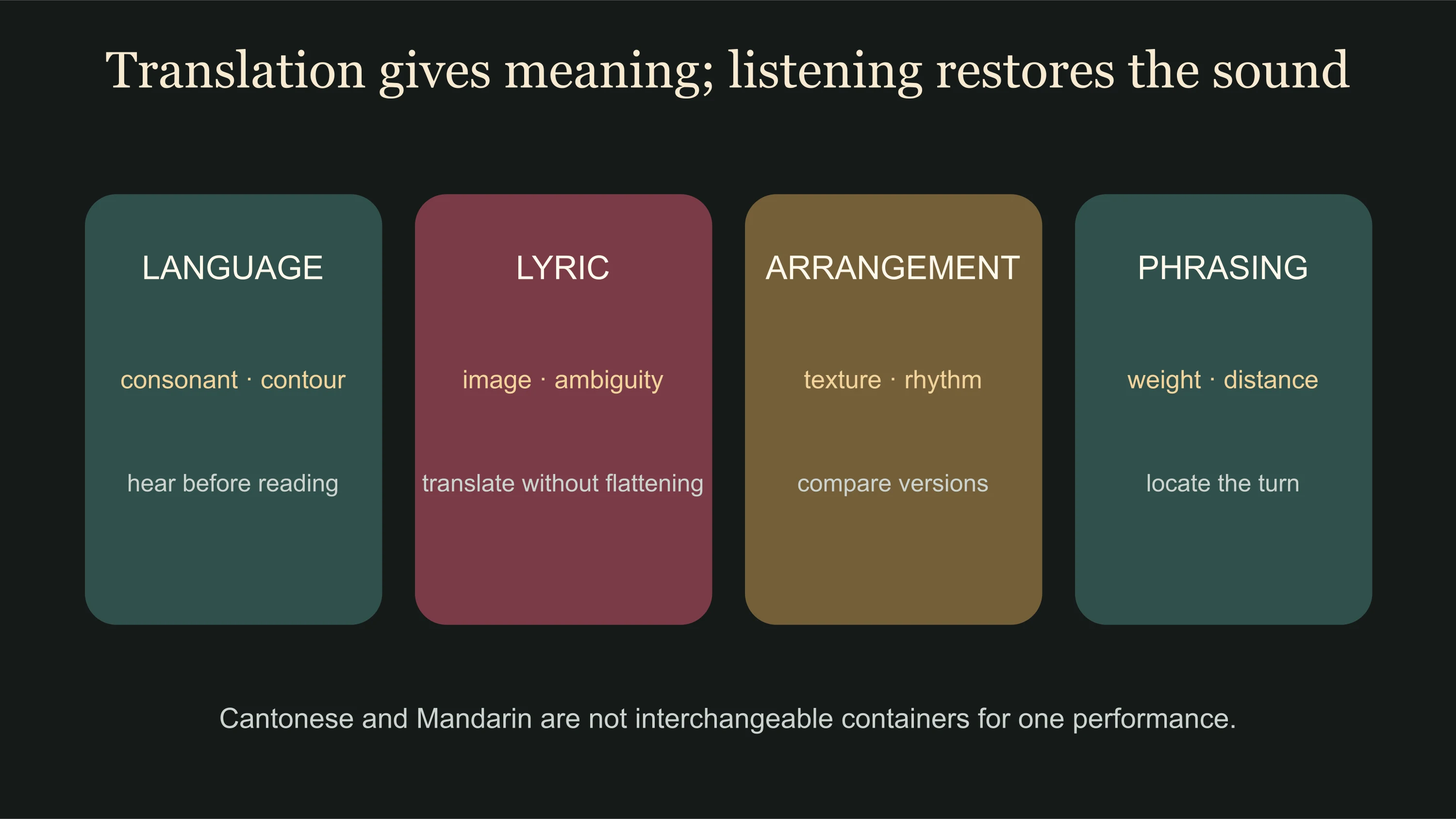
Faye Wong's bilingual catalogue should not be treated as two interchangeable lyric sets. Cantonese changes consonant density, contour and the relationship between a syllable and sustained melody. Mandarin opens different vowel space and lets a phrase travel with another kind of directness. The same singer can therefore appear cooler, sharper or more exposed without changing her basic instrument.
For an overseas listener, translation creates a second illusion: if the English meaning looks simple, the performance must also be simple. Listen before reading. Notice where she refuses to press emotional meaning into every syllable, then return to the translated lyric and ask why that distance makes the line more—not less—personal.
This is one reason her work resists the flattening category “Chinese diva.” Power is not always volume, melisma or an obvious climax. Sometimes authority is the decision not to prove that the singer can overpower the arrangement.
I therefore keep four layers separate when comparing recordings: the sound of the language, the literal lyric, the arrangement and the phrasing choice. A translated lyric can clarify meaning while erasing rhyme, consonant pressure and ambiguity. A cover may preserve melody while changing the emotional social world. The useful question is not which language is more authentic; it is what new distance the performance builds with the materials of each version.
Chungking Express makes the listening body visible
In Chungking Express, Faye's character listens, moves, watches and rearranges another person's apartment. The role is valuable here not because acting proves musical quality. It makes her public screen energy visible: distracted yet purposeful, physically loose, private inside crowded urban space.
Wong Kar Wai's film, Christopher Doyle's camera, editing and repeated music construct that energy with her. Criterion records the film as a 1994 Cantonese production and identifies Faye as the waitress at Midnight Express; it also credits Christopher Doyle and Andrew Lau for cinematography and William Chang among the editors. Our Chungking Express guide separates those contributions. Still, the character helps explain why “distance” in Faye Wong's music rarely feels empty. It feels like someone maintaining room to move.
I would never use the role as proof that the offstage person is quirky, avoidant or secretly like the character. That is precisely the biographical shortcut this page rejects. The film proves what her body can do inside a constructed work: turn repetition into curiosity, private space into choreography and pop listening into visible action.
Influence is not the same as imitation
Later singers may borrow light attack, breathiness or cool presentation, but surface resemblance misses the risk in Faye Wong's work. Her choices can make a polished song feel slightly uncontained. The voice is recognizable because it negotiates with the arrangement rather than simply decorating it.
I distrust tutorials promising three tricks to reproduce the sound. Vocal technique should not be diagnosed from clips, and imitation can erase the compositional context. Listen for decisions, not a recipe.
Her cultural influence includes permission to remain strange
Faye Wong's importance is not only that later singers adopted breath, dream-pop texture or cool styling. She enlarged the imaginable behavior of a Chinese pop star. A major woman singer could be commercially central without explaining every silence, smoothing every eccentric arrangement or performing constant gratitude for public attention.
That influence reaches beyond vocal color. It includes repertoire choices, refusal of constant emotional explanation and the sense that a woman performer may remain legible as an artist without becoming publicly available as a personality. I value the gap because it protects listening from biography. A song can attach itself to my own train ride, breakup or quiet room without requiring me to invent the singer's private experience as proof.
That permission matters because celebrity systems reward legibility. The audience is encouraged to believe it knows the person behind the voice. Faye's work repeatedly returns attention to the song while preserving a gap around the private individual. The gap became part of the art, but it should not be mistaken for evidence about her offstage personality.
Her appearance in Chungking Express gives this public distance a playful body: headphones, movement, curiosity and intrusion rather than frozen glamour. Film and music meet at the same idea—freedom is not absence of discipline; it is the ability to decide which rules the performance will obey.
The current catalog is not frozen in the 1990s
Apple Music's official artist record still presents an active sequence rather than a museum shelf. It lists Ru Yuan (如愿) in 2021, The World Has Gifted Me (世界贈予我的) in 2025 and Protagonist (主角) in May 2026 among the recent singles. Those releases do not automatically constitute a new album era, and I will not inflate them into one.
They matter for a different reason: a late Faye Wong recording arrives under the pressure of accumulated memory. The listener is not hearing one song alone. Decades of ballads, experimental albums, screen images and long intervals enter the first note. Nostalgia can make any restrained performance seem profound before it has earned the feeling.
My test remains identical to the early catalog. Does the phrasing make a new decision? Does the arrangement create a space the older records did not already occupy? Does distance carry a present emotional problem, or is the familiar voice itself doing all the work? Reverence is not listening. A living catalog deserves the same severity as a young one.
Distance is not absence
What I hear in Faye Wong is not emotional coldness but control over access. She can place feeling slightly behind the beat, thin the weight of a syllable or let breath remain audible without turning the song into confession. The listener moves closer because the performance does not explain everything.
That is why her screen presence in Chungking Express belongs in a music profile. The character listens, moves, repeats and rearranges private space; pop music becomes behavior. Her strangeness is playful rather than monumental, and it shows how a public figure can be vivid without making every emotion available for consumption.
Influence therefore includes permission: a Chinese-language pop singer can be technically exact, commercially visible and still preserve ambiguity. Many artists can imitate an airy tone. Fewer understand that the tone works because timing, language and distance are making decisions together.
My verdict
Faye Wong's achievement is disciplined distance. She can withhold emotional weight until a phrase suddenly makes the listener aware of wanting it. Start with contrasts rather than rankings, and let the catalogue reveal how that distance changes across language, arrangement and time.
Continue through the Chinese musicians collection and the Wong Kar Wai guide. In the comments, name the moment a Faye Wong performance moves closer or farther away. Join the East Moment community to compare the musical evidence and the memory attached to it.