Wong Kar Wai does not make films about beautiful people looking lonely under colored light. He makes emotion from wrong timing. A person arrives before they can speak honestly, after another has left, or at the exact moment a repeated object has changed meaning. Step-printing, music and saturated color matter because they give that missed timing a physical form.
Wong Kar Wai in 60 seconds
| Question | Short answer |
|---|---|
| Chinese name | Wong Kar Wai (王家衛) |
| Born | July 17, 1958, in Shanghai; raised in Hong Kong |
| Best first film | Chungking Express for speed, humor and the complete time system |
| Best second film | In the Mood for Love for restraint and repetition |
| Most abrasive relationship film | Happy Together |
| Best expansion of the memory system | 2046 |
| Martial-arts entry point | The Grandmaster |
| Wrong shortcut | Copying neon, slow motion and pop music without the temporal structure |
| East Moment verdict | Track what repeats, what is missing and who arrives too late |
Criterion's World of Wong Kar Wai provides an institutional film grouping and restoration context. It should not become a substitute for examining individual cuts, collaborators or the decisions a scene makes.
I reject the idea that loving Wong Kar Wai means surrendering to atmosphere. I insist on asking what the color, song or slow motion makes a character do—and what it prevents them from saying. If the answer is only “it looks like Wong Kar Wai,” the imitation has already emptied the style of its emotional machinery.
Best Wong Kar Wai movies by search intent
| What you want | Start with | Why |
|---|---|---|
| Understand the style quickly | Chungking Express | Voiceover, pop repetition, urban speed and two missed romances remain playful |
| Experience the emotional peak | In the Mood for Love | Repetition and restraint make every small variation consequential |
| See intimacy without romantic polish | Happy Together | Dependence, cruelty and care repeatedly exchange roles |
| Understand memory as architecture | 2046 | Rooms, numbers and returning characters refuse a clean past/future boundary |
| See early genre disruption | Days of Being Wild | Star bodies, drift and refusal interrupt familiar melodrama expectations |
| See the method inside wuxia | The Grandmaster | Lineage and history become fragments of gesture, weather and missed connection |
Do not start with a montage of “best shots.” Start with Chungking Express, then In the Mood for Love, then Happy Together. That route moves from playful temporal disorder to disciplined restraint to relational abrasion.
Wong Kar Wai style is a time system, not a filter
The recognizable visual surface includes saturated color, shallow focus, reflections, slow motion, step-printed blur, popular songs and enclosed rooms. None of those devices is sufficient.
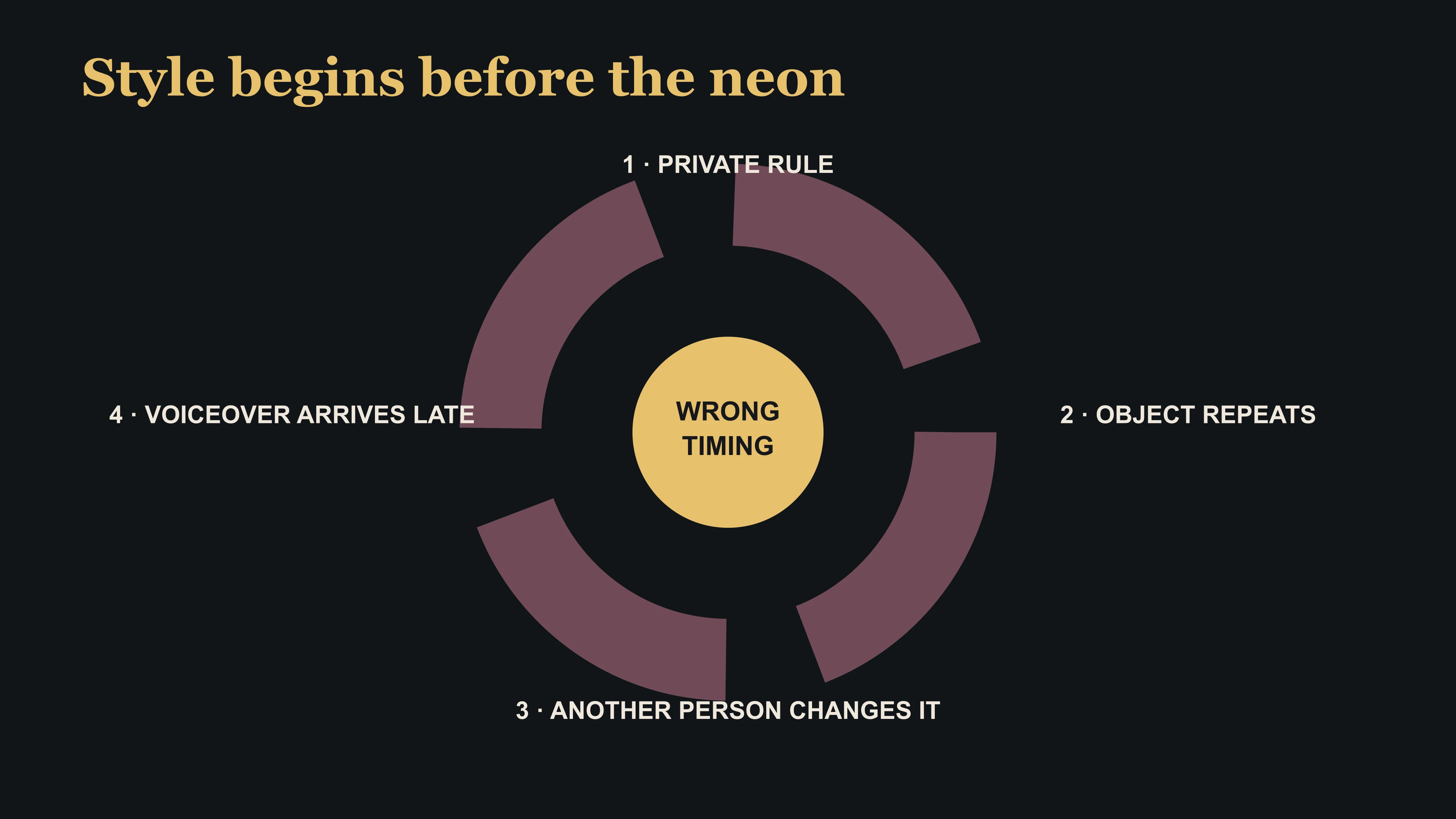
A useful Wong Kar Wai sequence usually has four parts:
- a person creates a private rule for surviving emotion;
- an object, route, song or date repeats;
- another person's timing changes the meaning of that repetition;
- voiceover explains too much, too late or from the wrong emotional position.
The style is produced by the gap between repetition and change. Copy the palette without that gap and you get an attractive advertisement.
Watch Wong Kar Wai addresses viewers in a public Criterion message Criterion's free public message identifies the director and restoration context. Retrospective statements are production evidence, not the only valid interpretation of a film.
Chungking Express makes time portable
The first policeman gives grief an expiration date through pineapple cans marked May 1. The date converts an uncontrollable breakup into a rule he can complete. In the second story, “California Dreamin'” repeats so loudly that Faye can remain inside fantasy while occupying a crowded workplace.
Objects carry emotion because the characters need something measurable: a date, song, towel, soap, boarding pass or snack order. The object does not have one symbol attached. Its function changes as another person enters the routine.
The full Chungking Express guide explains how two stories correct one another. The first treats a deadline as closure; the second discovers that a person can change while someone else is not looking.
In the Mood for Love makes repetition morally expensive
Chow Mo-wan and Su Li-zhen repeat noodle routes, music, hallways and rehearsed dialogue. But no repetition restores the earlier moment. Each return occurs after suspicion, knowledge or desire has changed what the action permits.
The film's restraint is therefore active. They are not simply too shy to begin a romance. They repeatedly choose what they will not become, and the cost grows as that boundary loses its original certainty.
Read the scene-led In the Mood for Love guide, then use the Tony Leung guide to see how reaction is edited inside the body before the film edits time around it.
Hong Kong is a cause, not a backdrop
Crowded apartments, corridors, food stands, hotels, streets and transport make privacy unstable. Chance encounter becomes plausible because routes overlap. Secrecy becomes difficult because walls are thin and neighbors share space. At the same time, density can intensify isolation: proximity supplies witnesses without guaranteeing understanding.
The films do not provide a sociological survey of Hong Kong. They construct specific emotional cities. Yet geography changes story mechanics. Replace the Midnight Express counter with an empty landscape and Faye's repeated observation no longer carries the same mixture of intimacy, work and intrusion.
Migration also matters. Wong was born in Shanghai and moved to Hong Kong as a child; films including Happy Together, 2046 and later Blossoms Shanghai complicate any claim that his city imagination belongs to one fixed origin. Our Shanghai culture guide explains the city's own habit of turning migration, commerce and outside forms into local language. That does not make Wong's Hong Kong films “Shanghai cinema.” It makes the distance between birthplace, childhood memory and working city part of the evidence. Place is remembered through language, media and absence as much as architecture.
The wider Hong Kong culture guide makes this causal link clearer: ferries, food counters, narrow rooms and overlapping routes are working systems before they become images. Wong's achievement was not making Hong Kong look cinematic. It was recognizing that the city's ordinary compression already edits people against one another.
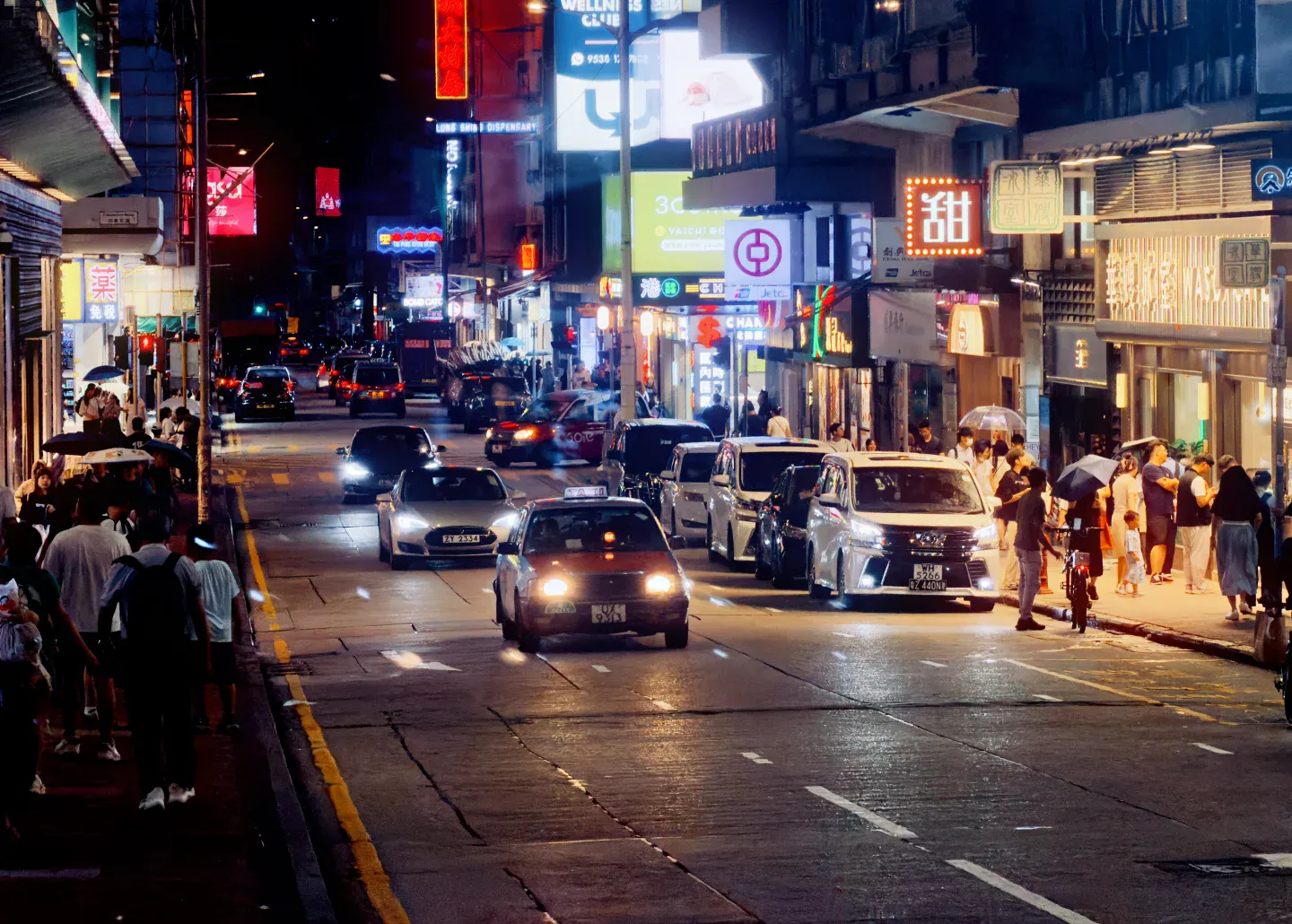
Look at the street without calling it “Wong Kar Wai vibes.” The evidence is structural: parked cars narrow the available lane; pedestrians collect under light; signs fight across several depths; windows and air conditioners turn the facade into accumulated private lives. A camera does not need to invent compression here. It chooses which layer will briefly become legible and which person will be swallowed by the next layer.
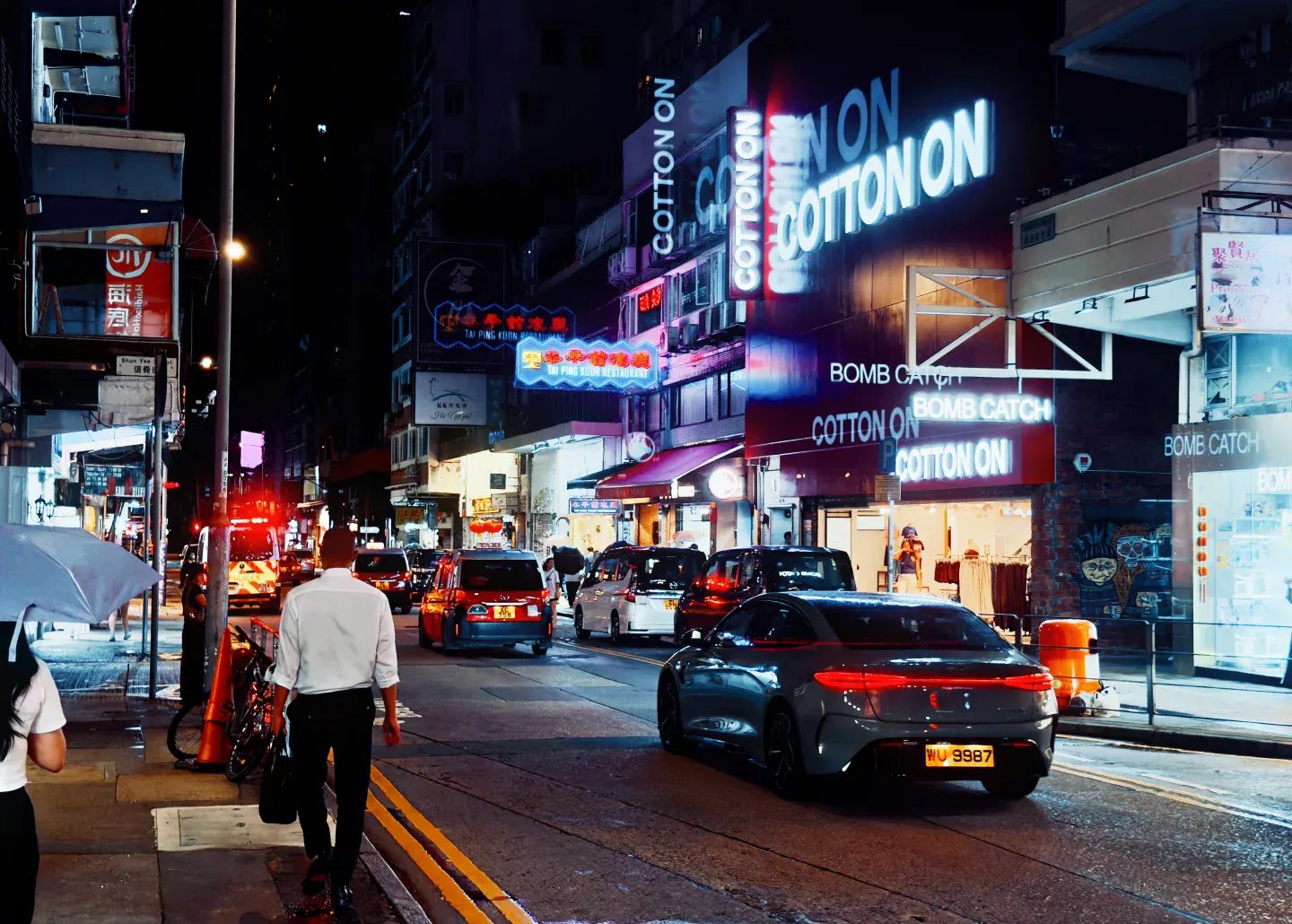
The taxi makes the second point. Hong Kong movement is rarely an escape into open space; it is a bright vehicle crossing one crowded enclosure toward another. That is why departure in Wong's films can feel emotionally unfinished even when somebody physically leaves. The city keeps supplying another window, route and witness. These contemporary Mong Kok photographs are not preserved film sets and do not prove what a 1990s scene meant. They do show the urban mechanics—compression, passage, interruption—that his cinema turns into feeling.
That distinction should change how a visitor follows the films. Our travel to Hong Kong guide uses tram, ferry, market and hillside transitions to read the present city; it is not a promise that every 1990s room or sign survives. Wong gives you a grammar of interrupted movement, not a checklist of coordinates. If a route produces only imitation screenshots, it has missed the very city pressure the films understood.
The collaborators are not footnotes to an auteur
“Wong Kar Wai style” can erase the people who made it materially possible. Christopher Doyle and later Mark Lee Ping Bing shaped cinematography; William Chang Suk Ping's production design, costume and editing are central to how rooms, clothes and temporal fragments connect. Actors supply behavior the image cannot manufacture alone.
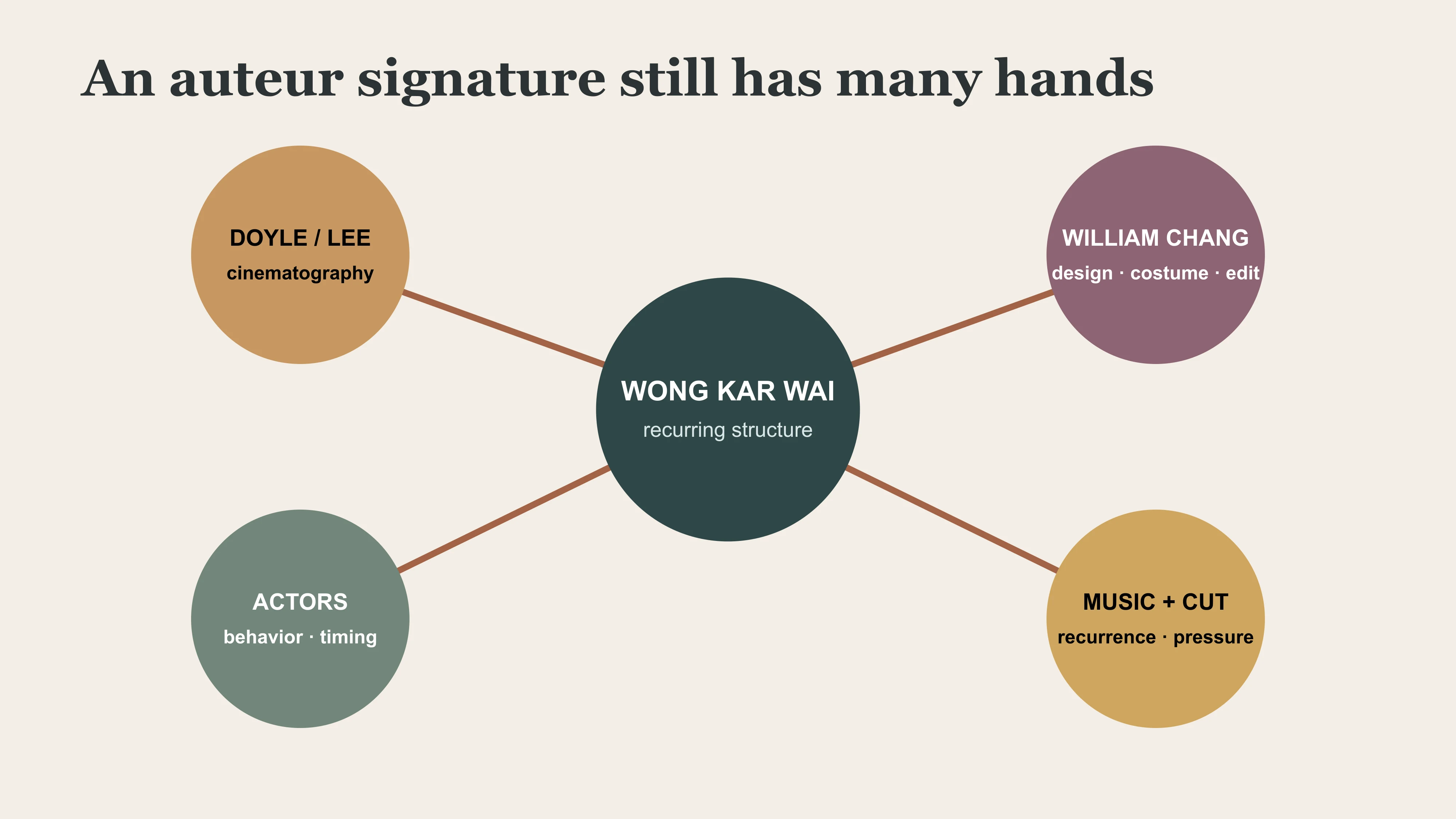
Authorship remains meaningful: recurring structures and production choices connect the films. But auteur language should organize collaboration, not replace it. The more recognizable the signature, the more important it is to ask which collaborator made a particular color, cut, costume or spatial relationship possible.
Criterion's free Under the Influence conversation with Barry Jenkins records one filmmaker's attributed critical response. It demonstrates a documented line of influence, not universal consensus or sole authorship.
Voiceover is intelligent and unreliable
Characters create dates, measurements and philosophical rules because narration gives emotional chaos a shape. The voice sounds authoritative. Its precision can be defensive.
A timestamp does not prove understanding. It may prove that someone needs pain to obey a calendar. A clever observation about an object may disclose more about the narrator than the person being described.
This is why Wong's films remain accessible despite fragmented plots. Voiceover offers a handrail, then the image reveals that the narrator is holding the wrong wall.
Music does not create mood by itself
Repeated songs become clocks. “California Dreamin'” protects Faye's private tempo. “Yumeji's Theme” returns Chow and Su to a social and emotional route that keeps narrowing. A Spanish-language song in Happy Together can make displacement sensual without resolving who controls the relationship.
The useful question is not “What is the soundtrack?” It is: who can hear or control the repetition, and what has changed since the last time? Music creates structure when recurrence makes difference audible.
The Grandmaster shows both the reach and danger of the method
Martial lineage, Republican-era history, rain, snow, trains and fragmented encounters become memory surfaces. The method can make one gesture carry extraordinary weight. It can also obscure chronology and reduce historical actors to beautiful fragments if a viewer lacks context.
Zhang Ziyi's Gong Er is the clearest anchor because obligation gives the fragments consequence. The Zhang Ziyi guide explains why her restraint is not passivity. The broader Chinese film guide keeps aesthetic experience separate from historical documentation.
How to watch one Wong Kar Wai sequence
- Name the repeated object, route, song or date.
- Identify who controls the repetition.
- Find the new information since its previous appearance.
- Compare voiceover with visible behavior.
- Credit the specific actor and craft collaborators creating the effect.
This turns “vibes” into an argument another viewer can test.
I also write down the collaborator responsible for the evidence I am using. If the claim concerns a costume cutting against wallpaper, William Chang matters. If it concerns a face holding still while the frame accelerates, the actor, cinematographer and editor share the result. Calling every visible decision “Wong Kar Wai style” may sound admiring, but it makes the work less precise and the people who built it disappear.
That precision changes the emotional reading. A repeated song is not automatically nostalgia; it becomes nostalgia only when the edit and the character's new knowledge make the return hurt. Step printing is not automatically loneliness; it creates loneliness when one body occupies a tempo the surrounding crowd does not share. The device has no meaning until the scene gives it a relationship.
The fastest test is to describe one sequence without color adjectives. If the scene still has a private rule, a repeated route, a timing change and a contradiction between narration and behavior, the method remains. If the description collapses once neon, dreamy and slow motion are removed, I have admired the surface without understanding the direction.
That is the difference between recognizing a signature and reading a film.
Final verdict
Start with Chungking Express, continue with In the Mood for Love, then watch Happy Together. Add 2046 after the first two so its returning rooms and identities carry memory rather than confusion. Choose The Grandmaster when you are ready to separate historical context from emotional fragmentation.
Wong Kar Wai's style matters because it makes wrong timing visible. The neon, blur and music are not the conclusion. They are instruments that let an audience feel a person becoming ready after the opportunity has changed.
My strongest recommendation is to resist the tribute edit after a first viewing. Rewatch one complete exchange with the sound, entrances and exits intact. Note who looks first, who controls the room, which object returns and what the cut withholds. Wong's images become less mysterious and more impressive when the mechanism survives close inspection. Beauty is the invitation; changed timing is the proof.
Continue through the Chinese directors collection. In the comments, name one repetition and its two meanings; the community can build a scene map instead of another screenshot board.