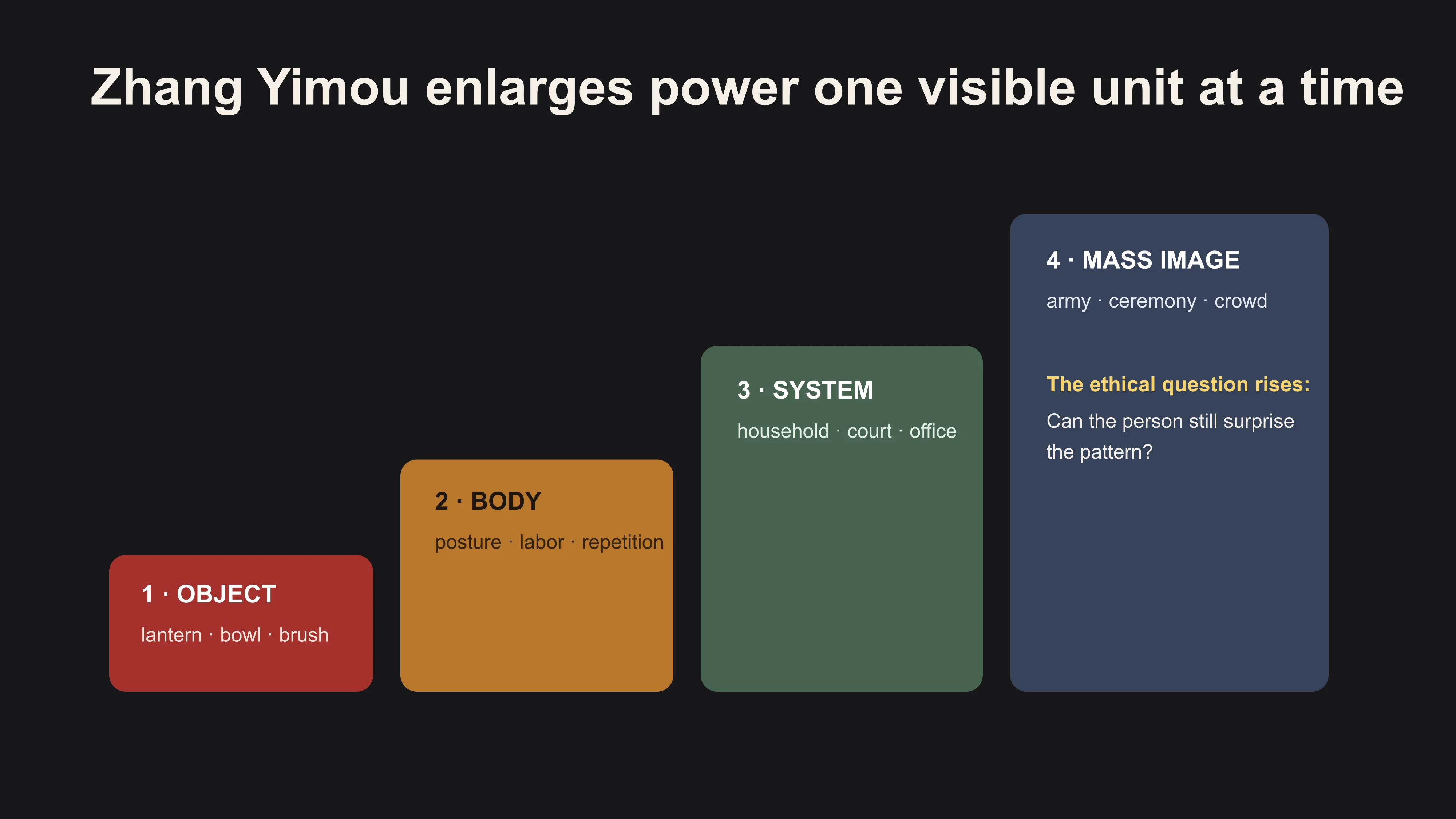
Zhang Yimou is not important because he “uses beautiful colors.” He is important because he builds visual systems so forceful that a red lantern, a line of soldiers, a courtyard rule or a wall of calligraphy can begin thinking for the characters. His best films then ask whether one person can remain morally visible inside that design. Start with Raise the Red Lantern, continue with To Live, then watch Hero and Shadow. That route reveals both the power and the danger of his method.
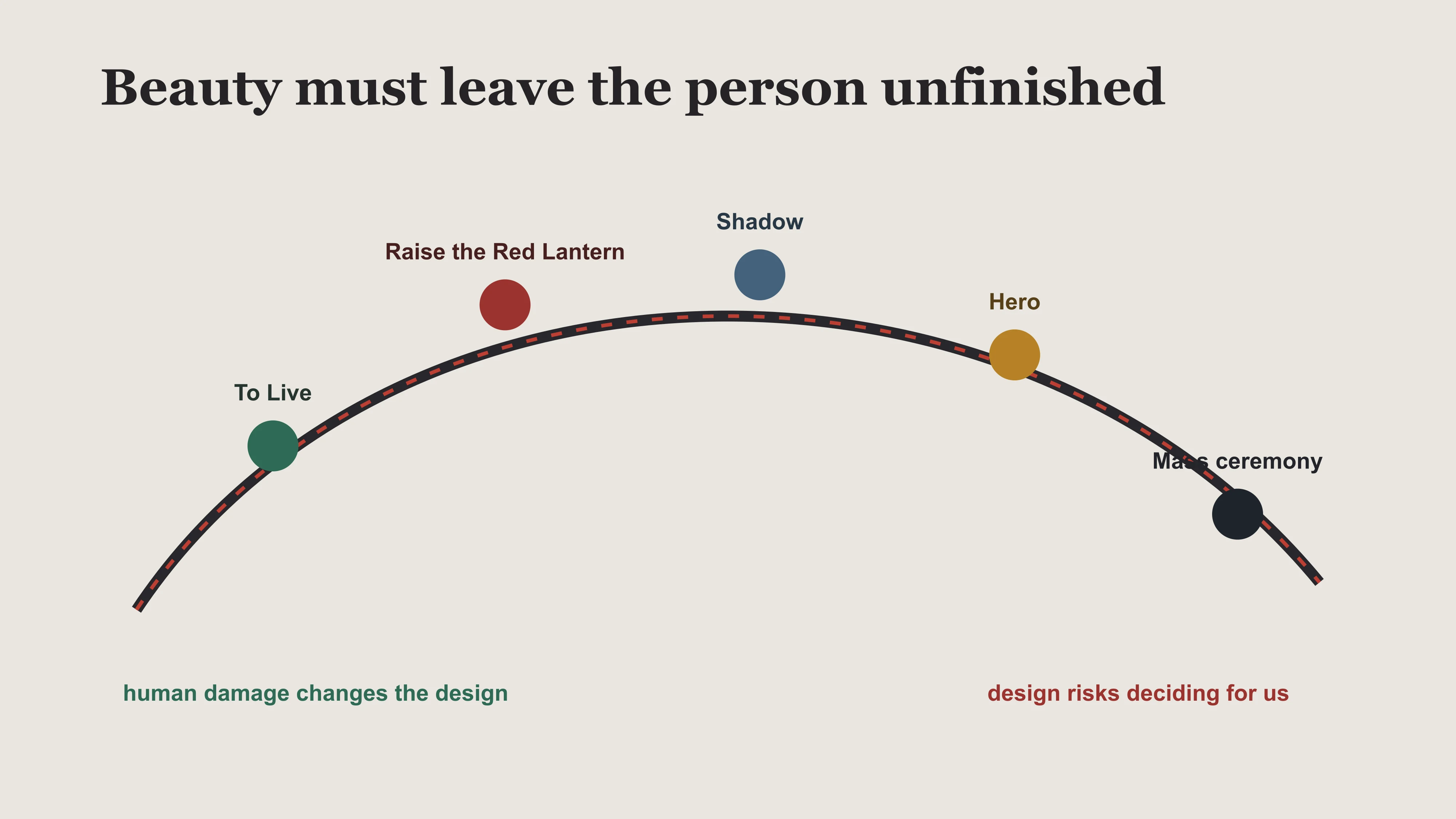
I reject the compliment that Zhang Yimou simply makes China look beautiful. I insist on asking who gains power when the frame becomes perfect. I keep the intimate damage of To Live beside the mass choreography of Hero because design must never be allowed to win the moral argument by scale alone. When a person can still surprise the picture, Zhang is extraordinary; when the picture has already decided what the person means, the beauty begins to feel authoritarian.
Zhang Yimou in 60 seconds
| Question | Short answer |
|---|---|
| Who is Zhang Yimou? | A Chinese film director and image maker whose career moves from intimate rural and domestic drama to wuxia spectacle, state-scale ceremony and contemporary genre filmmaking. |
| Best first film | Raise the Red Lantern for the clearest link between beauty, ritual and coercion. |
| Most emotionally direct | To Live, where history is felt through what one family loses and keeps doing. |
| Best visual argument | Hero, because its colors actively compete to control political meaning. |
| Best late formal experiment | Shadow, which turns ink painting into bodies, weather, screens and weapons. |
| Essential actor collaboration | Gong Li, across radically different women rather than one fixed “muse” image. |
| Main misunderstanding | That color and symmetry are the signature. The signature is organized power. |
| East Moment verdict | A major director whose form is most valuable when it exposes control, and most questionable when grandeur starts answering the moral question for us. |
The useful way into Zhang is not a ranked list. Imagine five rooms in one visual laboratory. Each room changes the pressure placed on a body.
Room one: an object becomes a law
In Raise the Red Lantern, the lantern is never merely red decoration. Its movement decides attention, privilege, service and status. Foot massage, meal choice and illumination become rewards inside a household whose rules encourage women to police one another.
The film's frightening achievement is that the system becomes easy to read. We understand where the master will sleep before he enters a room. Beauty produces administrative clarity.
The dedicated Raise the Red Lantern guide follows that ritual step by step. The MUBI film record securely identifies the film and premise; it does not make the fictional compound a documentary model of every Chinese household.
This is where Zhang's early work is often misremembered. The red is not impressive because it is saturated. It is impressive because everybody knows what it means and changes behavior before anyone issues an order.
Room two: Gong Li keeps changing the human temperature
Calling Gong Li “Zhang Yimou's muse” makes a long collaboration sound like one repeated face. The performances argue against that shortcut.
In Red Sorghum, the body can be defiant, erotic, exposed and tied to landscape. In The Story of Qiu Ju, persistence becomes physical through walking, waiting, carrying and asking again. In To Live, survival is not a heroic pose. It is the exhausting continuation of ordinary tasks after history has removed the future a family expected.
The Gong Li profile owns the actor's full route, including work beyond Zhang. Here the important point is directorial: the strong frame does not always require a still performer. Sometimes Zhang's system becomes clearest when an actor pushes awkwardly through it.
This tension corrects the fascination with the “type” of face Zhang selects. A face matters after blocking, costume, labor and social position give it consequences.
Room three: history arrives as damage, not a lecture

To Live is the necessary interruption in any account that reduces Zhang to visual monumentality. The film crosses political campaigns, but its scale remains a family table, a performance case, a bowl, a child and the terrible habit of adjusting to absence.
That restraint is a directing decision. The viewer is not asked to admire the size of History. We are asked to notice how a system enters domestic routine and changes what counts as a normal day.
Later films such as Coming Home return to memory, separation and recognition. They do not simply reproduce the earlier power. The risk is that suffering becomes too carefully arranged, with emotional signs placed as visibly as lanterns. Zhang is strongest when objects acquire meaning through repeated use. He is weaker when they arrive already labeled as symbols.
Room four: color tries to win an argument
In Hero, red, blue, white and green do not form a dictionary. They create competing accounts of an assassination plan. The same relationship can look jealous, strategic, grieving or politically transformed depending on who needs the story to be believed.
That is why the Hero (2002) guide asks who is narrating each color rather than what each color “means.” Beauty is not outside the political argument. Beauty is how the argument gains authority.
House of Flying Daggers makes a different trap. Color, costume, sound and movement encourage the viewer to believe a performance before the plot reveals who was watching whom. The film guide treats spectacle as evidence produced under surveillance, not a transparent window into character.
This is where admiration becomes disagreement. My live question around Zhang is: when does visual command sharpen judgment, and when does it replace judgment?
Room five: the crowd becomes a body

The opening ceremony scale changes the unit of direction. One performer has a face and fatigue. Ten thousand performers can become a line, wave, grid or clock.
Zhang understands how individual discipline produces collective legibility. That skill links courtyard ritual to palace formations and stadium choreography. It also creates the central ethical danger of his cinema: a perfectly organized crowd can make hierarchy feel natural because disorder has been designed out of view.
The right response is not to deny the achievement. Large-scale live images require astonishing collaboration. The response is to keep authorship plural and ask what the pattern asks bodies to surrender.
The shift from a courtyard to a stadium also changes responsibility. In a drama, a cut can return us to one face and let hesitation damage the pattern. In a ceremony, distance converts performers into pixels of a collective image. Zhang's control is undeniable in both spaces, but the moral experience is not interchangeable. A mass formation can communicate coordination, national confidence or shared occasion while making individual fatigue unavailable to the spectator.
That is why “he can direct thousands of people” is only a technical compliment. The artistic question is what those thousands are allowed to remain besides the picture they complete. Zhang's most honest large images retain some awareness that discipline has a body. His weakest invite us to love the pattern so completely that we stop asking about the people who hold it.
Shadow reduces the palette and keeps the control
Shadow appears to abandon Zhang's famous color. Rain, ink tones, translucent screens and the taijitu dominate. Yet the directing logic remains.
Bodies are doubles. Rooms conceal observers. A weapon looks like calligraphy until it opens into violence. The ruler, commander and “shadow” each occupy a role whose public image may matter more than the person inside it.
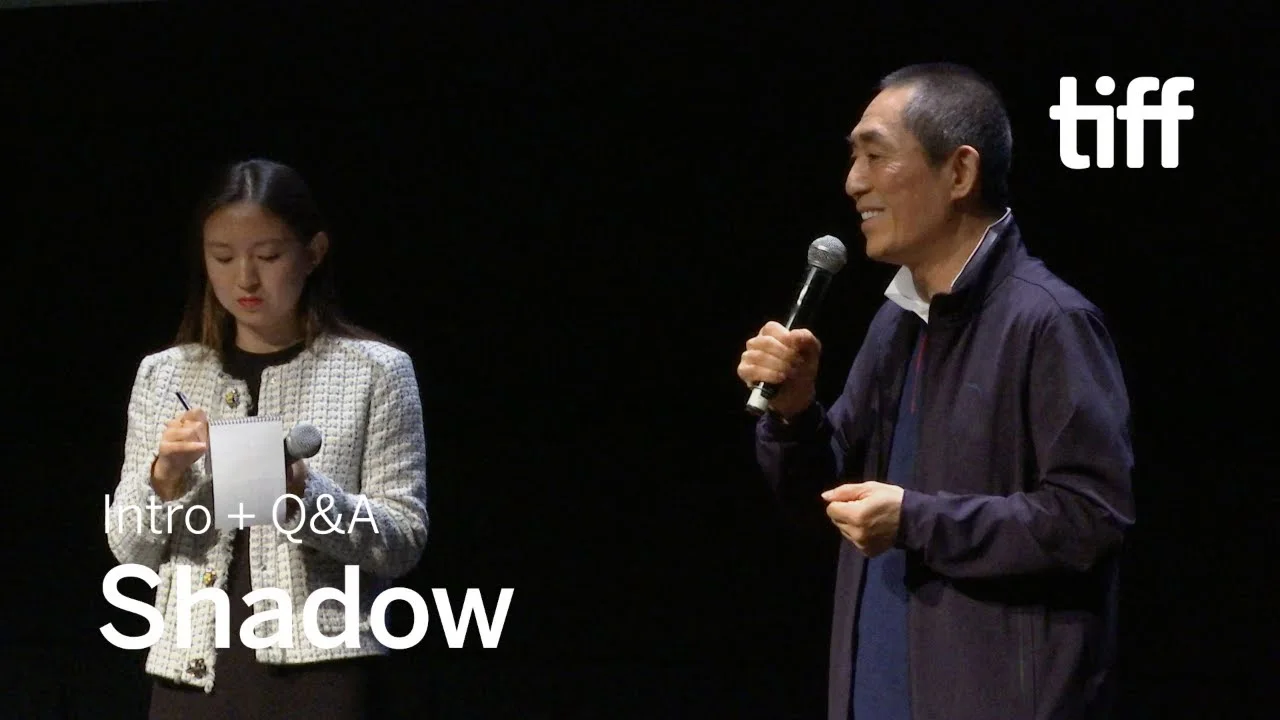
TIFF's free director Q&A gives viewers accountable production context. It should not be treated as the final interpretation. A director can explain a choice; the finished film can still create meanings and failures beyond that explanation.
The test is whether design leaves a person able to surprise us
Zhang's control is easiest to praise when every element appears intentional. Intentionality is not the final standard. A film can be perfectly organized and emotionally closed.
My test is whether a character can produce friction the design did not already announce. Qiu Ju's stubborn walking passes because her body keeps making bureaucracy awkward. Jiazhen in To Live passes because survival changes the temperature of scenes that history could otherwise flatten into illustration. Songlian passes because education, cruelty, fear and play do not settle into one emblem.
The risk rises when armies, palettes or monumental sets make the conclusion feel complete before the person has finished choosing. Hero deliberately approaches that edge. Its grandeur gives unification emotional force, while Nameless's execution exposes the cost. The movie remains alive because those two impressions refuse to merge cleanly.
This is the difference between an image with authority and an image that merely looks expensive. Authority creates a pressure you can question. Expense asks to be admired.
Zhang Yimou directs actors against the picture
The decisive performances in Zhang's cinema are not those that match the composition most beautifully. They are the ones that put a different rhythm inside it. Gong Li's Qiu Ju keeps walking after the bureaucratic pattern should have absorbed her. Ge You in To Live lets survival look shabby, frightened and practical instead of monumental. Jet Li's Nameless barely moves, but that restraint turns every permitted step toward the throne into an act of negotiation.
This is why I resist describing Zhang as a painter who happens to use actors. A painter controls the final surface; Zhang's strongest actors create friction between surface and time. A lantern can declare Songlian's status in one second, but her performance keeps changing what that status costs. A palace can dwarf Nameless immediately, but his stillness makes the king wait for an intention architecture cannot read.
The distinction also explains why some later spectacles feel colder. When costume, formation, score and camera all announce the same emotion, the actor has nowhere left to surprise us. Zhang is not weakened by beauty. He is weakened only when beauty closes the argument before a human being has had time to complicate it.
The best Zhang Yimou movies route
| If you want to understand | Watch | Notice |
|---|---|---|
| Ritual as control | Raise the Red Lantern | How objects distribute privilege before dialogue does |
| A performer moving through social systems | The Story of Qiu Ju | Walking, waiting and bureaucratic repetition |
| History at family scale | To Live | What ordinary labor carries after each rupture |
| Beauty as political persuasion | Hero | Who needs each color-coded account to be believed |
| Performance under surveillance | House of Flying Daggers | When a gesture changes after the watcher is revealed |
| Late formal concentration | Shadow | How a reduced palette still organizes bodies and power |
Do not begin with a completionist filmography. Begin with one directing problem, then compare how the problem changes.
My test for a Zhang Yimou film
Zhang Yimou's contribution is not “bringing Chinese beauty to the world.” That phrase turns a difficult body of work into cultural export packaging.
His real contribution is more useful and more uncomfortable: he makes systems visible. A household, a kingdom, a bureaucracy, an army or a ceremony becomes readable through objects and bodies. At his best, one stubborn, grieving or divided person remains visible inside the pattern. At his weakest, the pattern becomes so persuasive that the person is asked to disappear gracefully.
Continue through the Chinese directors collection, compare Zhang's actor system with the Zhang Ziyi profile, or put his controlled geometry beside John Woo's moving relationships in the John Woo guide.
In the comments, name one frame where Zhang's beauty helps you understand a person - and one where it starts doing the thinking for you. Then bring the comparison to the East Moment community, where readers can place exact scenes, screenshots and contradictory readings side by side.