House of Flying Daggers is not a love story decorated with spectacular color. Beauty is part of its deception system. Dance tests identity, combat creates false evidence, landscape offers temporary roles, and every declaration arrives from someone already performing for another audience. The tragedy is not simply that Mei loves the wrong man; it is that nobody can prove where performance ends soon enough to act honestly.
House of Flying Daggers in 60 seconds
| Question | Short answer |
|---|---|
| Original title | Shi mian mai fu (十面埋伏) |
| Director | Zhang Yimou |
| Release | 2004 |
| Main cast | Zhang Ziyi, Takeshi Kaneshiro and Andy Lau |
| Setting | A stylized late-Tang political conflict |
| Premise | Two officers use a blind dancer to locate the rebel House of Flying Daggers |
| Best reason to watch | Action, romance and visual design all test whether appearances can be trusted |
| East Moment verdict | Watch for changing evidence, not only the bamboo fight |
The official Sony Pictures page identifies the conflict among Mei, Jin and Leo and provides the public official trailer. That supplies a reliable production and synopsis anchor. The page's marketing language should not be mistaken for an explanation of the ending.
What House of Flying Daggers is really about
The government seeks the rebel organization known as the House of Flying Daggers. Officers Leo and Jin suspect that Mei, a blind dancer at the Peony Pavilion, can lead them to it. Jin adopts the identity of a wandering rescuer called Wind and stages her escape.
From that premise, nearly every important action has two audiences: the person inside the scene and the hidden observer for whom the scene is being performed. A rescue can be an arrest strategy. Vulnerability can be camouflage. Affection can begin as technique and become real without receiving a clean boundary between the two.
The film's controlling question is therefore not “Who is lying?” Everyone with institutional power lies. It is whether a feeling that began inside deception can become truthful before the deception determines its consequences.
I love this film precisely where its beauty becomes uncomfortable. I reject the safe compliment that it is merely “gorgeous,” because that word lets the viewer enjoy color without admitting how often looking becomes surveillance. My sympathy belongs to Mei: every man and institution around her wants her body to prove a story they have already chosen. The tragedy begins long before the snow, at the moment admiration is mistaken for knowledge.
The cast and deception map
| Character | Public role | Hidden obligation | What changes |
|---|---|---|---|
| Mei | Blind dancer and suspected rebel | Her relation to the House exceeds what Jin knows | A performed journey creates an unscripted choice |
| Jin / Wind | Fugitive rescuer | Government officer running an operation | Professional charm develops into attachment |
| Leo | Officer directing the pursuit | His connection to Mei is concealed | Control gives way to jealousy and desperation |
This map prevents a common viewing problem: later revelations can make earlier emotion seem entirely false. That is too simple. A person can begin by acting and still discover a feeling through the act. The uncertainty is not a puzzle error; it is the subject.
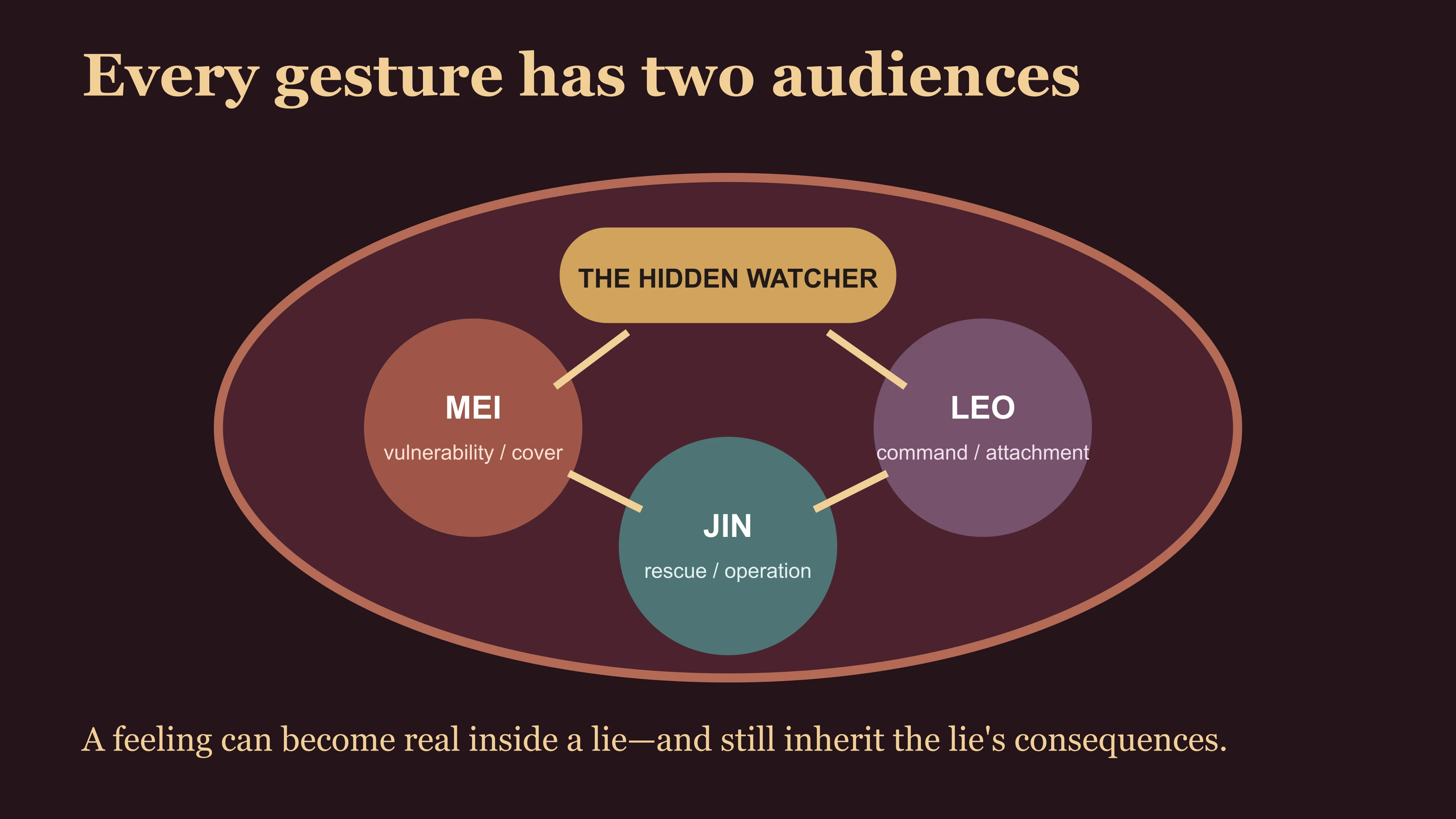
Jin's chosen alias, Wind, initially flatters his self-image: mobile, unattached and able to pass through danger. Mei's question about whether wind should stop for a flower sounds like romantic play, but it tests whether he can accept consequence. By the end, movement is no longer freedom. Every departure leaves someone positioned to interpret it as betrayal.
The Peony Pavilion turns beauty into evidence
Mei's dance and the echo game initially invite the audience to admire control, costume and sound. Leo tests whether she can respond to thrown beans and drum patterns. The sequence is entertainment, interrogation and staged identity at once.
The sleeves extend her movement through space. Sound appears to let another person direct her body. Yet what the officers infer from the performance depends on assumptions about blindness, allegiance and vulnerability that the film later destabilizes.
Zhang Yimou makes the viewer participate in the mistake. We treat a beautiful display as transparent access to character when it is actually evidence produced under surveillance.
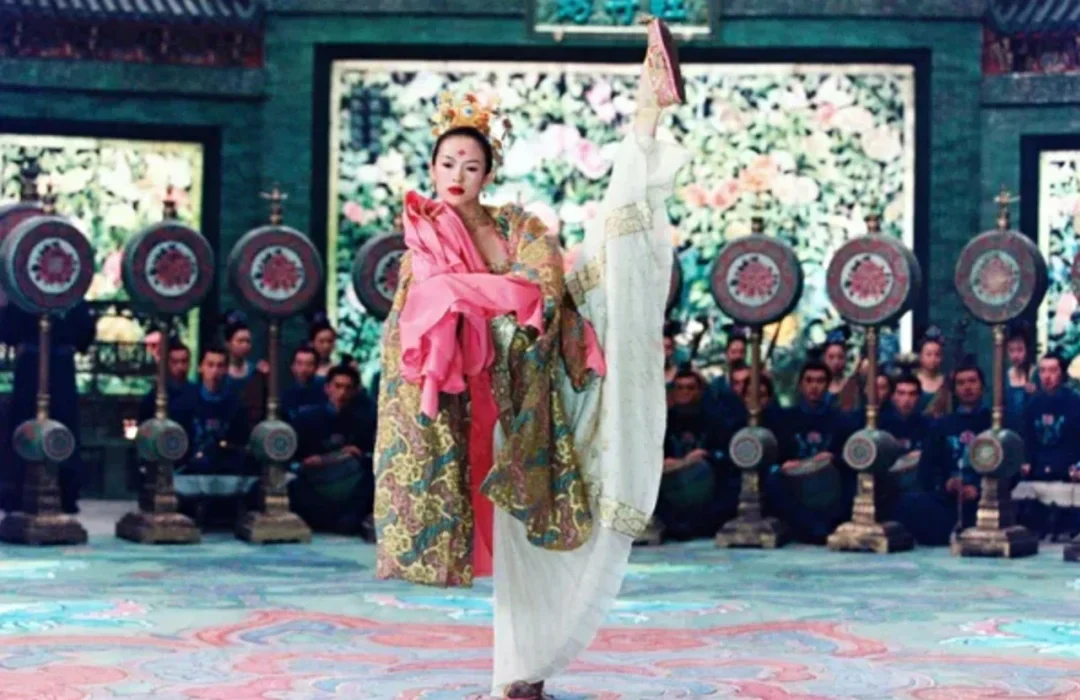
Look at what the room is doing before admiring the pose. Mei is centered, but she is not free: musicians, officers, drums, floor patterns and painted screens turn every movement into readable data. Her white trouser leg cuts through the layered pink and gold costume, so physical precision remains visible inside ornament. I do not read this as “beautiful ancient China.” I read it as a gorgeous room built to make observation feel harmless. The scene's real seduction is the fantasy that everyone watching understands what they see.
Mei controls the room by letting others misread her
Mei's performed blindness is not merely a twist inserted to make the plot clever. It reorganizes who believes they possess knowledge. The officers assume that sight gives them the superior position: they can watch her body, arrange the test and interpret each response without being watched back in the same way. Their confidence becomes the weakness she can use.
Zhang Ziyi has to sustain two layers without turning the earlier scene into a wink at the audience. Mei must appear vulnerable enough for the operation to continue while remaining physically exact enough for later knowledge to feel earned. A broad “secretly powerful” performance would collapse the tension. The useful details are smaller: when the head follows sound, when the body waits before committing, and when apparent dependence lets another character reveal what he intends.
That is why this role belongs in the wider Zhang Ziyi performance route without becoming its owner image. The actor page compares control across a career; this film page owns what the control means inside this specific deception.
The scene also clarifies Zhang Yimou's directing method. Color and choreography are not automatically depth. Here they become meaningful because the viewer's pleasure in looking is tied to the officers' confidence that looking equals knowing. Beauty creates the wrong certainty, then the plot charges interest on it.
That debt keeps accumulating outside the pavilion. Jin thinks proximity has converted performance into knowledge; Leo thinks duration has converted attachment into entitlement; Mei discovers that a role can produce a feeling the organization did not authorize. None of them is simply lying all the time. The sharper tragedy is that each tells enough truth to make the remaining deception lethal.
Why the bamboo forest scene matters
The bamboo sequence is often remembered as an isolated visual achievement. Structurally, it removes the apparent couple from the open road and encloses them inside vertical lines, hidden movement and attacks arriving from outside the frame.
Jin and Mei must coordinate physically even though neither possesses the full truth. Their survival makes cooperation real before trust is secure. The fight therefore does more than escalate danger. It produces evidence that their bond can function under pressure—while leaving open whether that bond can survive disclosure.
Compare Crouching Tiger, Hidden Dragon, where bamboo movement suspends fighters between discipline and freedom. Here the grove behaves more like an intelligence system: sightlines, sounds and bodies can be manipulated by an organization that owns the terrain.
What the changing colors mean
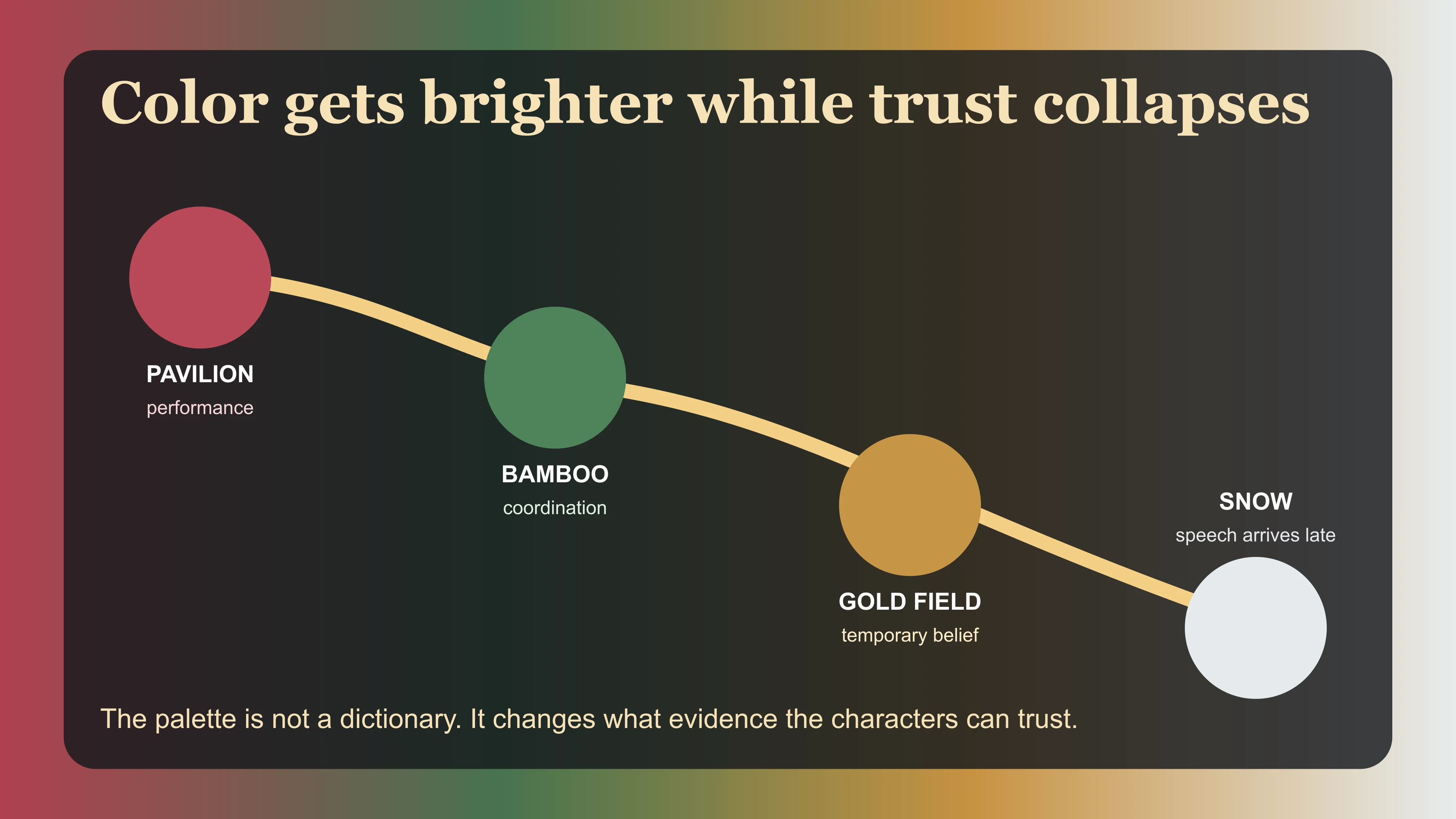
Green bamboo, golden fields and the final white snow do not form a code in which each color has one dictionary definition. They change the conditions under which bodies can be seen.
- The Peony Pavilion's saturated interior makes performance luxurious and controlled.
- Green bamboo hides attackers while exposing the pursued figures against repeated verticals.
- Open autumn fields briefly suggest escape and natural abundance, but provide little cover from truth.
- Snow drains the final confrontation of earlier warmth and arrives as time visibly collapses.
The last seasonal shift is famously abrupt. Realism is not its purpose. The environment externalizes a confrontation that has exceeded ordinary duration: desire, duty and injury continue after a practical future has disappeared.
Sound obeys the same principle. Beans striking drums at the Peony Pavilion make hearing appear measurable; rustling bamboo turns unseen position into threat; the final wind and snow reduce the world to breath, steel and delayed response. The film repeatedly asks viewers to trust sound, then reminds us that the source or intention behind a sound may be staged.
The official Sony trailer offers a free way to inspect this audiovisual method before choosing a full legal edition. Because trailers rearrange chronology, use it to evaluate tone and craft, never to settle plot order.
Is House of Flying Daggers historically accurate?
Treat the late-Tang frame as political premise, not documentary reconstruction. The weakened court, local resistance and secret organization create pressure on the characters, but the costumes, combat and landscapes are designed for cinematic expression.
Do not use the film to infer universal Tang clothing, policing, gender roles or martial technique. Its historical value lies in how a modern film imagines loyalty and rebellion, not in replacing institutional history.
House of Flying Daggers ending explained
Major spoilers begin here.
Mei chooses to leave with Jin rather than remain within the obligations surrounding her. Leo, whose long attachment and concealed position have turned into possessiveness, confronts them. The struggle ends with Mei gravely wounded. She rises to use the dagger she believes can save Jin, while Jin tries to stop her because the action will make her bleed to death.
The final exchange is built on uncertain trajectories and declarations arriving too late. Each person acts from a different model of what the others will do. Love is present, but it cannot repair the absence of trustworthy shared information.
My reading: Mei's final choice is not valuable because sacrifice proves love. It is tragic because the institutions around all three characters have trained them to communicate through feints, hidden weapons and tests; when direct speech finally matters, none can rely on it.
The title's “ten-sided ambush” names more than a rebel tactic. Every path is covered by an obligation, watcher or prior performance. The lovers do not fail to find an exit because the landscape is too large. They fail because each possible identity already belongs to someone else's plan.
That is also why the final weather cannot be dismissed as decorative excess. Earlier spaces let the characters borrow roles: dancer, rescuer, officer, lover, rebel. Snow removes the useful scenery and leaves three bodies acting on incompatible versions of the same moment. The visual world becomes simpler precisely when the moral situation becomes impossible.
The sequence is brutal because physical skill no longer solves anything. Jin can fight, Leo can anticipate and Mei can still choose, but none possesses reliable shared information. A conventional action climax turns competence into helplessness. This is the film's sharpest reversal and the reason its beauty earns emotional weight instead of remaining a production showcase.
Where to watch legally
Use Sony's official page to confirm the film and follow current licensed options in your territory. Check audio, subtitles and runtime before paying; catalogs change, and names may be romanized differently.
This page embeds no rental, subscription or payment-gated player. The free official Sony trailer can confirm tone and visual style, but its edit cannot support claims about full chronology or the ending.
Final verdict
House of Flying Daggers earns its beauty by making beauty unreliable. The dance is a test, the rescue is an operation, the forest is controlled space and the romance grows inside aliases. Its final violence is not an interruption of the love story. It is what happens when private feeling must travel through systems built for deception.
The film must be watched as an argument, not consumed as a moving postcard. Its most famous images matter because each one changes who can see, who can hide and who gets to define the truth.
Continue through the Chinese movies hub and Chinese film guide. In the comments, identify the earliest scene that changes meaning after a later revelation, then explain exactly what new fact changes it. That is more useful than voting on which color sequence looks best.