Crouching Tiger Hidden Dragon is not important because its fighters escape gravity. Ang Lee's film uses impossible movement to make restricted desire visible. Yu Shu Lien and Li Mu Bai possess discipline but have delayed a shared life; Jen Yu possesses mobility but mistakes refusal for freedom. Every major fight asks what a body can do and what a person is willing to be responsible for afterward.
Crouching Tiger Hidden Dragon in 60 seconds
| Question | Short answer |
|---|---|
| Original title | Wo hu cang long (卧虎藏龙) |
| Release | 2000 |
| Director | Ang Lee |
| Main cast | Chow Yun-fat, Michelle Yeoh, Zhang Ziyi, Chang Chen and Cheng Pei-pei |
| Language | Mandarin |
| Source | Adapted from a serialized novel by Wang Dulu; screenplay credited to Wang Hui-ling, James Schamus and Tsai Kuo-jung |
| Choreography | Yuen Woo-ping |
| Awards | Four Academy Awards, including the category then named Foreign Language Film; also nominated for Best Picture |
| Best reason to watch | Action reveals conflicts that polite dialogue keeps contained |
| Common wrong shortcut | “The martial-arts movie where everyone flies” |
The Sony Pictures Classics official film page confirms Ang Lee as director, the credited writers and principal cast, while the Academy provides the award record above. If you are deciding whether to watch, choose it for character-driven wuxia, not realistic combat instruction. The wire-assisted movement, historical setting and jianghu codes create a poetic world. They should not be mistaken for documentation of Qing-dynasty life or proof that Chinese martial practice literally works this way. The broader Chinese movies collection places it beside other useful starting doors without turning one crossover success into all of Chinese cinema.
What Crouching Tiger Hidden Dragon is really about
The film asks whether freedom without responsibility is freedom at all.
I love Jen's refusal to accept the life arranged for her, and I still reject the easy reading that every refusal is liberation. I believe Yu Shu Lien is the film's bravest person because she keeps adapting after each emotional and physical weapon breaks. The mistake is to confuse Jen's speed with self-knowledge or Shu Lien's restraint with cowardice. I insist that the film's best argument happens between these two women: freedom must include responsibility, while responsibility must not become a polite name for burying a life. That conflict is why I return to the weapons-room fight more often than the famous bamboo sequence.
Li Mu Bai wants to leave the warrior life but still pursues Jade Fox, who killed his master. Yu Shu Lien is independent and highly capable, yet loyalty to a dead fiancé and social codes have kept her love for Li unspoken. Jen Yu faces an arranged marriage and sees jianghu, the imagined world of martial wanderers, as an exit from aristocratic confinement.
All three have reasons to feel trapped. Their differences appear in what they do with that fact:
| Character | Desired freedom | Constraint | Cost the character avoids |
|---|---|---|---|
| Yu Shu Lien | A life with Li Mu Bai and moral coherence | Loyalty, reputation and learned restraint | Naming desire before time makes the choice impossible |
| Li Mu Bai | Retirement, love and release from vengeance | Teacher-student duty and unfinished revenge | Abandoning the identity that gives his skill meaning |
| Jen Yu | Movement, self-authorship and escape from marriage | Family position, gender rules and inexperience | Accepting that actions bind other people as well as herself |
The older pair have too much responsibility and too little declared desire. Jen wants desire without durable obligation. The tragedy comes from treating those positions as opposites when each is incomplete.
What happens without major spoilers
Li Mu Bai entrusts his celebrated sword, Green Destiny, to Yu Shu Lien so it can be delivered to Sir Te in Beijing. The sword is stolen. Suspicion falls around Jen Yu, the daughter of a governor preparing for marriage, and her governess, who is secretly connected to Jade Fox.
Jen's extraordinary ability begins to surface. Shu Lien tries to guide her without exposing or destroying her social position. Li sees both talent and the possibility of a worthy Wudang student. Jen sees mentorship as another claim on her freedom.
A desert history with the bandit Lo reveals that she has already experienced life outside her family role, but passion in open landscape does not solve what either person can sustain when social reality returns.
The plot is easy to follow if you track three things: who holds Green Destiny, who is trying to teach Jen, and whether a character's spoken rule matches the desire expressed in movement.
Green Destiny is authority made portable
The sword is a weapon, a reputation and a social credential. In Li's hands it signifies mastery recognized by the martial world. When Jen steals it, she acquires power without the relationships that traditionally regulate its use.
This is why the theft matters beyond property. Green Destiny lets Jen enter inns, challenge fighters and convert private frustration into public force. Its superiority can win an encounter before her judgment has matured.
The film does not argue that hierarchy is automatically wise. Jade Fox's history includes exclusion from Wudang knowledge, and gendered gatekeeping poisons the lineage that claims moral authority. But unjust exclusion does not make every later use of power responsible. Jen correctly detects hypocrisy and still causes harm.
Every major fight is a conversation
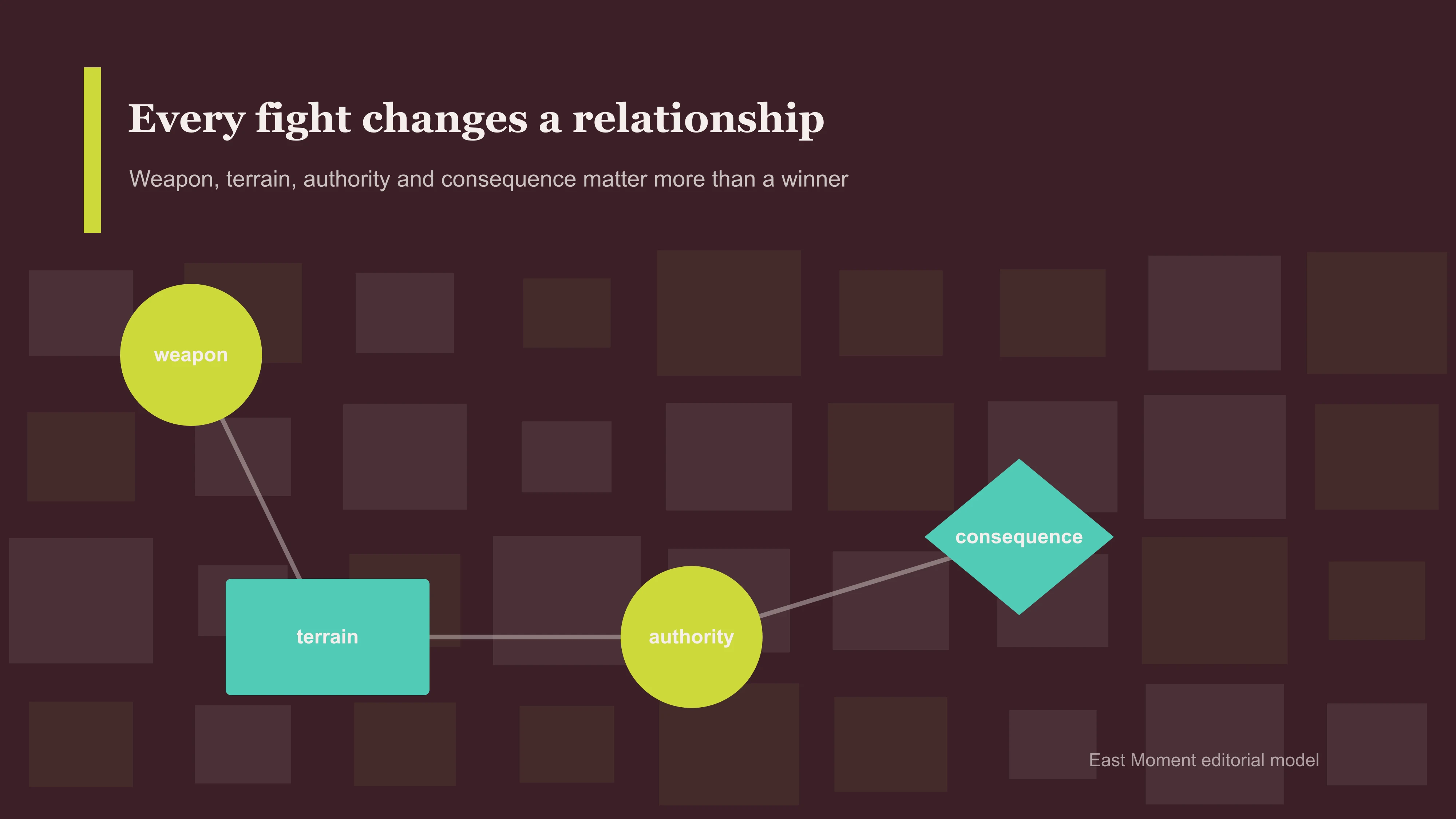
The choreography is clearest when read as changing relationships rather than a ladder of stronger opponents.
Rooftops: pursuit without mutual recognition
Shu Lien chases the masked thief across Beijing roofs. Their bodies seem nearly free of gravity, yet the scene is structured by evasion. One knows she is responsible for recovering the sword; the other experiences movement as escape. Physical closeness does not create honest recognition.
The weapons room: experience against unlimited refusal
Shu Lien cycles through weapon after weapon while Jen relies on Green Destiny. The sequence is thrilling because each broken weapon changes the argument. Shu Lien adapts, absorbs loss and continues. Jen's sword cuts through limits and reinforces her belief that superior force equals independence.
The fight also holds affection and frustration. Shu Lien is not trying only to defeat an enemy. She is confronting someone she wanted to protect and perhaps mentor. Jen reads protection as containment. Every strike carries a failed conversation.
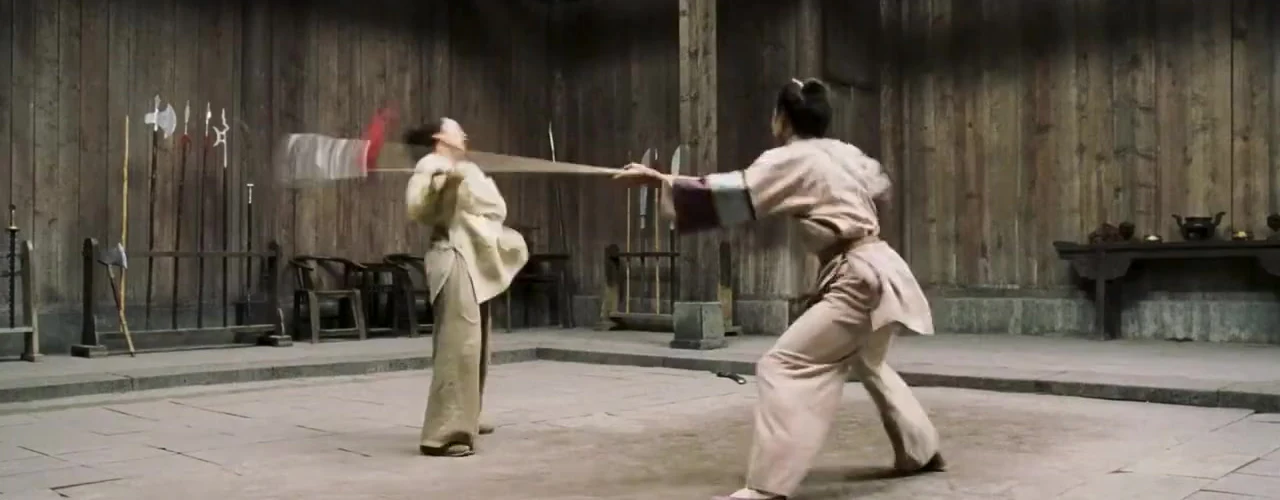
This authorized scene frame catches the argument in motion: Shu Lien changes tools and distance while Jen answers with Green Destiny's cutting advantage. One frame proves the visible opposition, not the full choreography or its outcome; watch the sequence to follow how every broken weapon changes their relationship.
Bamboo forest: mastery without stable ground
Li and Jen balance and move through bamboo while the plants bend beneath them. The scene reduces heavy impact and emphasizes control, distance and yielding support. Li appears calmer, but calm does not give him uncomplicated authority: he still wants Jen to enter a lineage whose failures the film has not erased.
“Flying” therefore has no single meaning. On rooftops it can be escape; in the weapons fight, domination; in bamboo, an argument about control. Movement becomes language because the same ability changes according to relationship.
Watch Sony Pictures Classics' public trailer for the official preview of the cast and movement language.
Jen Yu is not simply a feminist freedom symbol
Jen resists an arranged marriage and restrictions placed on an aristocratic young woman. That resistance matters. Reducing her to an irresponsible child would reproduce the film's dismissals of her intelligence and power.
But turning every refusal into liberation also flattens the story. Jen hides ability, steals, humiliates strangers, rejects instruction and moves between identities without fully accepting their consequences. She has been denied fair choices, yet some of her choices deny other people safety and agency.
Her power is real. Her understanding of freedom is incomplete. The film values her hunger enough to make it beautiful and questions it enough to make the beauty dangerous.
Zhang Ziyi's performance is central to that double reading. The dedicated Zhang Ziyi guide follows how precision and pressure work across her career rather than treating Jen as the whole actor.
Yu Shu Lien is the film's moral center, not its conservative obstacle
Shu Lien understands Jen's confinement better than Jen assumes. She has moved through jianghu, managed practical responsibilities and lived with the cost of subordinating desire to loyalty. Her warnings are not simply obedience speaking.
At the same time, Shu Lien's self-control is not presented as a complete solution. Her relationship with Li shows how honorable delay can become permanent loss. She can explain every reason for waiting and still be unable to recover the years.
Michelle Yeoh makes that conflict physical. Authority appears in balance, gaze and economy rather than loud dominance. Read the Michelle Yeoh guide for how this controlled physical intelligence connects Hong Kong action, wuxia drama and later mature roles.
Li Mu Bai cannot retire because his identity still needs an enemy
Li describes an experience during meditation in which profound stillness did not bring expected enlightenment. Something pulled him back. He interprets unfinished duties and feelings as reasons to return.
The Chow Yun Fat profile compares this restrained authority with the actor's socially open Hong Kong action roles; the contrast makes clear that calm is a role-specific decision, not his only screen instrument.
His pursuit of Jade Fox is just, but it also keeps the warrior identity intact. His interest in training Jen combines recognition, generosity and control. A student of her talent could continue the lineage and confirm the value of the knowledge that shaped him.
The film does not expose Li as a fraud. It shows that wisdom and attachment can occupy the same person. Ang Lee's wider filmography repeatedly places private desire inside a social form that both dignifies and confines it. Wuxia lets that conflict leave the dining room and take flight.
What the film gets from wuxia
Wuxia is not a synonym for realistic martial arts. It is a narrative tradition organized around martial heroes, skill, justice, loyalty, revenge, wandering and jianghu, a social world partly outside ordinary institutions. Different novels and films revise those elements differently.
Crouching Tiger, Hidden Dragon uses the tradition to ask who may enter that world and whether skill can release a person from class, gender and obligation. It also adapts material associated with Wang Dulu rather than presenting an original myth or literal historical case.
The film's international success does not make it the single authentic form of wuxia, nor does criticism of accents or cross-cultural address make it non-Chinese. Sony's own page republishes a review that notes sharply different early responses in Asia and the West. That contrast is useful only when attributed and kept specific; “Chinese audiences hated it” would be an indefensible simplification.
Use the Chinese martial arts guide to separate documented practice from screen fantasy, and the Chinese film guide to understand why language, region, financing and distribution resist one national box.
Crouching Tiger Hidden Dragon ending explained
Major spoilers begin here.
Li Mu Bai is poisoned during the confrontation with Jade Fox. Rather than use his final breath only to complete disciplined spiritual practice, he tells Shu Lien that he has always loved her. The confession is emotionally truthful and devastatingly late. Restraint has preserved honor but not time.
Jen obtains an antidote but returns too late. She goes to Wudang Mountain, where Lo waits. At the bridge, she asks him to make a wish. He recalls the desert story of a faithful man whose leap from a mountain made a wish come true. Lo wishes for them to return to the desert together. Jen jumps into the mist.
The film does not show a body or confirm one literal outcome. Three readings can coexist:
- Death or self-destruction: Jen cannot reconcile the damage, identities and social futures surrounding her.
- Wuxia transcendence: the leap belongs to a world where physical impossibility can express spiritual or narrative release.
- Wish and sacrifice: Jen offers herself to fulfill Lo's wish or repair what her freedom has cost, though the exact mechanism remains unstated.
My reading gives the ambiguity a clear function: Jen makes the first action that cannot be converted into another performance of superiority, but the film refuses to tell us whether that surrender becomes freedom, punishment or escape. A definite answer would restore the control she has sought and the audience expects. The mist removes control from both.
Where to watch legally
Use the Sony Pictures Classics film page to verify the official title, credits and distributor context, then check rental, purchase or subscription availability in your country. Catalogs change by region and date.
This page embeds only Sony Pictures Classics' free public trailer. It contains no rental, subscription or payment-gated movie player. Avoid unauthorized full-film uploads with uncertain cuts, subtitles and rights.
Final verdict
Crouching Tiger, Hidden Dragon works because action never suspends character; action reveals what etiquette has hidden. Shu Lien's adaptation, Li's control and Jen's refusal are different moral movements, not simply different fighting styles.
Its central conclusion is demanding: social rules can be unjust, but freedom is not proven by the ability to escape them. It is tested by what happens to other people after the escape.
In the comments, choose one fight and identify the precise movement that changes a relationship. The community can compare the rooftop, weapons room and bamboo sequence as arguments, not rank them only by spectacle.