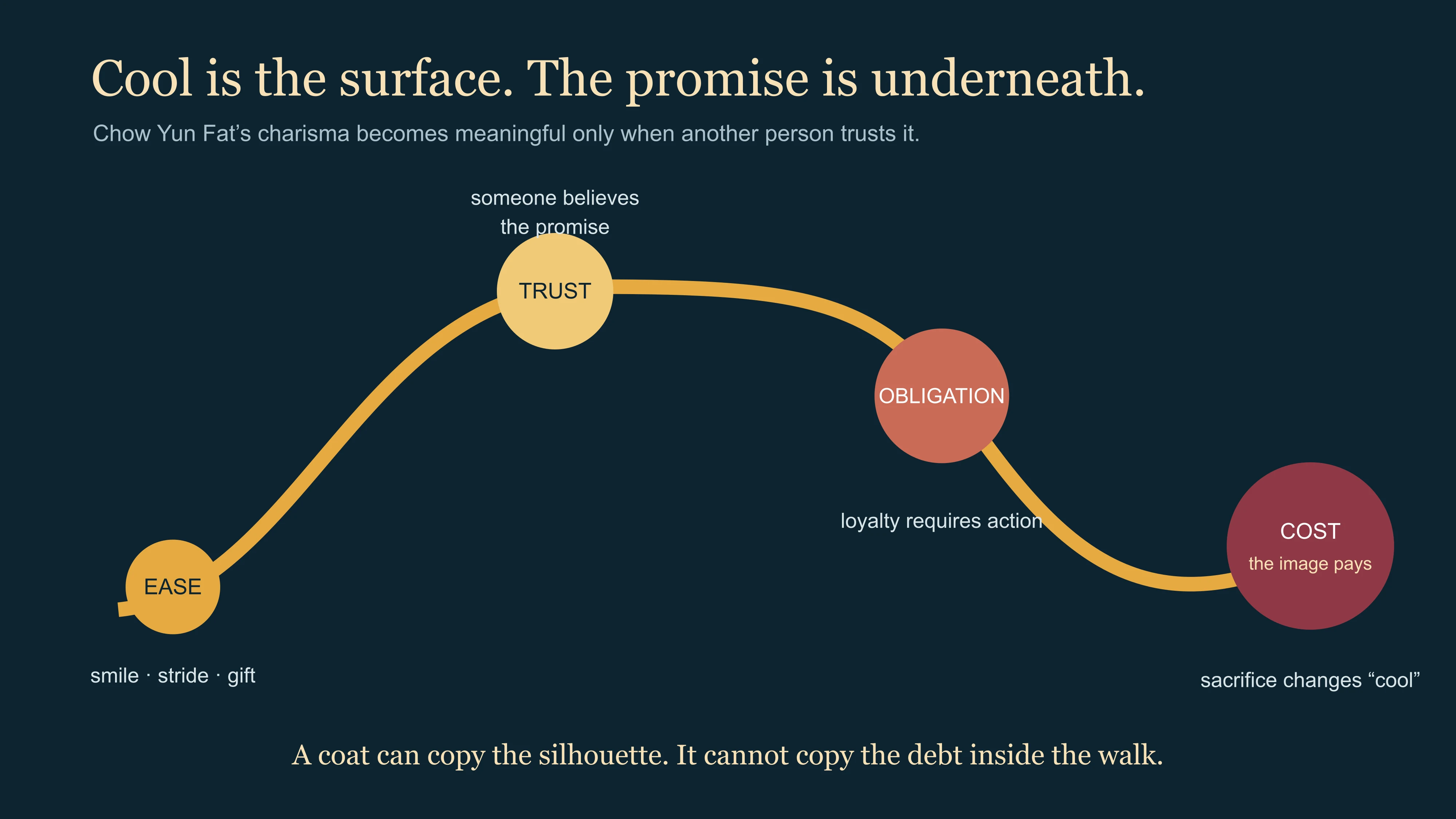
Chow Yun Fat is not compelling because he looks cool while holding a gun. He is compelling because ease creates trust before the film tests whether that trust can survive violence. A smile, loose shoulder or generous gesture makes power feel social rather than mechanical. John Woo then turns that openness into exposure; Ang Lee turns it into restraint. Start with A Better Tomorrow, continue with The Killer, then watch Crouching Tiger, Hidden Dragon to see how much authority remains after the swagger disappears.
I love Chow Yun Fat most when the famous coolness is about to fail him. I reject the poster version that leaves only sunglasses, coat and gun. I keep watching the half-second after the smile, when loyalty becomes a debt the body must pay. The best entrances make us trust him before the plot has earned that trust. A serious profile must therefore follow the promise from The Bund and God of Gamblers into John Woo's sacrifice and Li Mu Bai's restraint. This matters because the same ease that creates a star also makes loss feel personal.
For Lijun, however, Chow Yun Fat did not begin with an international-film syllabus. He began with the theme of The Bund and the instant mental picture of Hui Man-keung: slicked-back hair, long coat, a man walking into danger as if dignity were part of the costume. Then came Ko Chun in God of Gamblers, Mark Gor in A Better Tomorrow and the much quieter Li Mu Bai. Those roles do not form one type. Together they explain why “cool” is too small a word for him.
Chow Yun Fat in 60 seconds
| Question | Short answer |
|---|---|
| Chinese name | Chow Yun-fat (周潤發) |
| Born | May 18, 1955, on Lamma Island, Hong Kong |
| Best first film | A Better Tomorrow |
| Essential action peak | The Killer or Hard Boiled |
| Best restraint contrast | Crouching Tiger, Hidden Dragon |
| Essential genre contrast | An Autumn's Tale for romance and ordinary vulnerability |
| Key collaborator | Director John Woo |
| Main misunderstanding | That guns, coat and sunglasses explain the performance |
| East Moment test | Watch how quickly another character decides to trust him |
The useful question is not “How cool is this entrance?” It is “What promise does the entrance make, and what later choice makes that promise expensive?”
Best Chow Yun Fat movies by viewing intent
| Your goal | Start with | What it reveals |
|---|---|---|
| Understand the star image | A Better Tomorrow | Charm made vulnerable by loyalty and damaged status |
| See tragic action performance | The Killer | Professional control losing ground to moral obligation |
| Experience procedural force | Hard Boiled | Physical command inside chaotic public space |
| See authority without swagger | Crouching Tiger, Hidden Dragon | Stillness, teaching and renunciation |
| Test romantic range | An Autumn's Tale | Humor and generosity without heroic weaponry |
| Enter international studio work | The Replacement Killers | How Hollywood isolates the action image from its Hong Kong relationships |
This route changes the function of charisma. It is more informative than sorting a long filmography by box office or body count.
The Bund made Chow Yun Fat a face before cinema made him a gunman
For a generation of Chinese-speaking viewers, the opening bars of The Bund do not introduce a television title. They summon a posture. Hui Man-keung is polished because the world around him is unstable; the suit and hair are not vanity but a portable form of control.
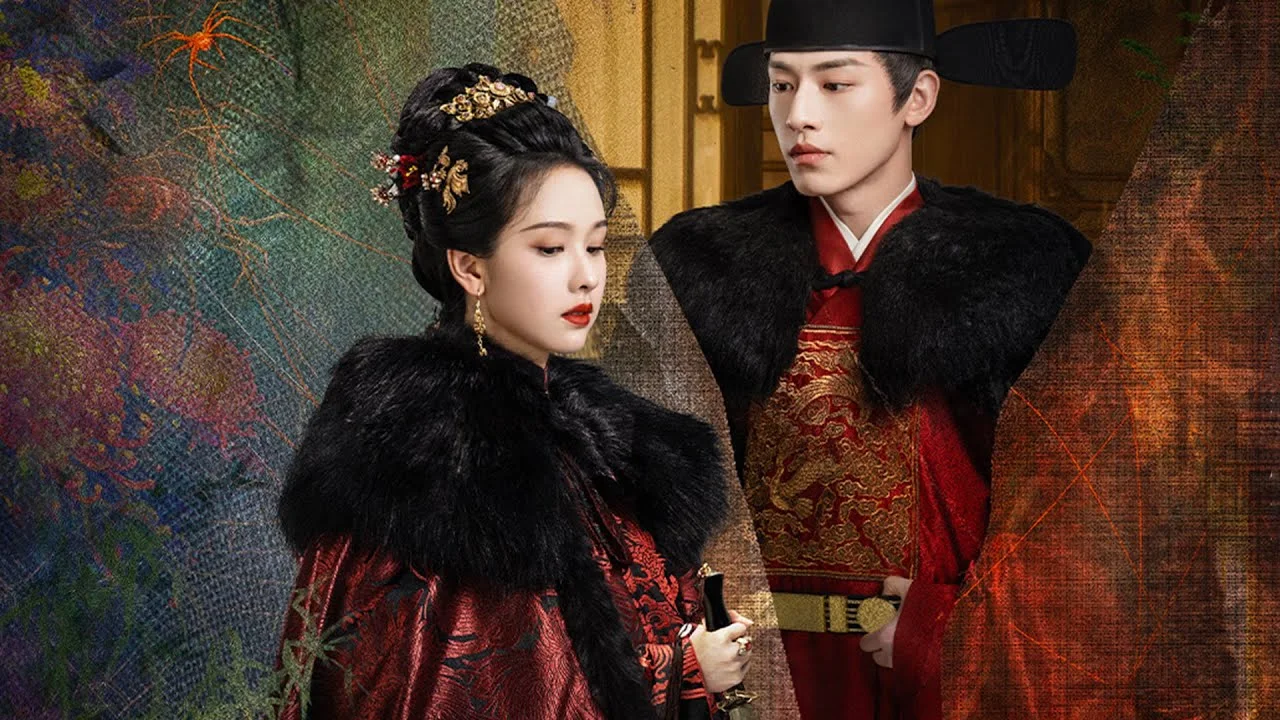
The opening portrait preserves the young leads inside the television drama's intimate relationship space. Chow's expressive eyes and the pairing's emotional hold are visible in the frame; the article's argument comes from comparing that openness with the controlled authority of his later roles.
That memory matters because it predates the later international shorthand of “Hong Kong action star.” Chow's screen authority was already relational: the viewer watched how a man carried friendship, ambition and danger through public space. The gangster silhouette came later than the emotional contract.
Lijun's memory is specific rather than universal. She hears the music and sees “the slicked-back Fa Gor.” Other viewers may enter through a different role. The useful point is that television made his face part of domestic life before restored action classics made it part of global film culture.
God of Gamblers proves the pose can also be a joke
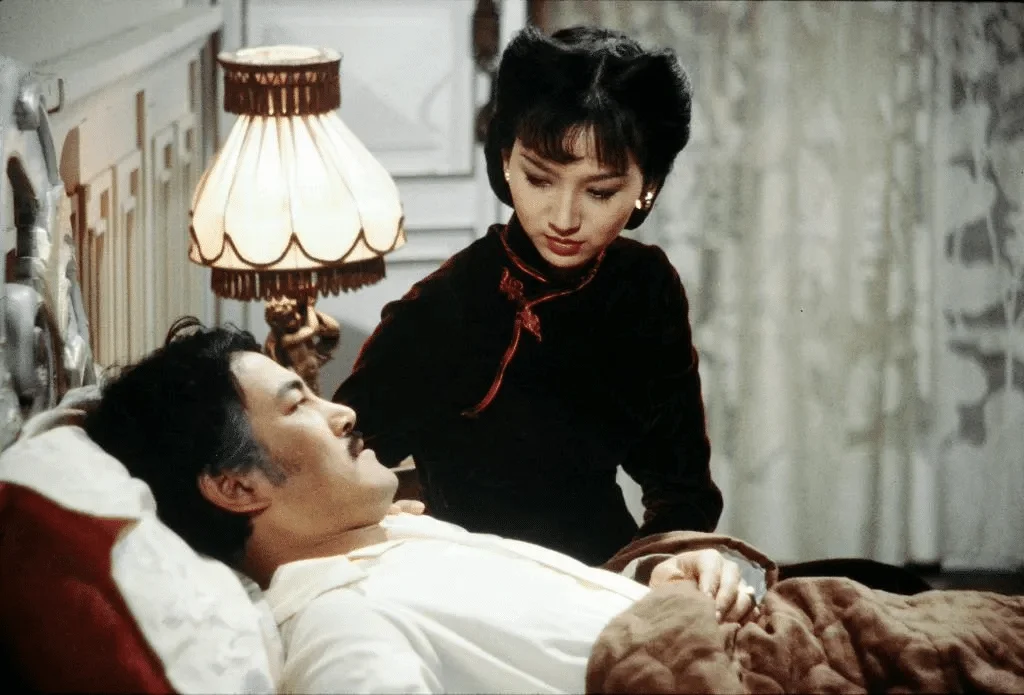
Ko Chun in God of Gamblers is an essential correction to the solemn Chow Yun Fat myth. The tailored confidence and ritual of the gambling table create an almost supernatural aura, but the film also lets identity, appetite and comic vulnerability puncture it.
That elasticity is why the image endured. Chow can make ceremonial control convincing, then survive its collapse without becoming a different performer. The audience is not simply admiring a winner. It is enjoying how quickly grandeur can become play and then recover its authority.
A Better Tomorrow makes coolness a promise
Mark Gor's coat, sunglasses and controlled movement became durable Hong Kong cinema images. But costume alone cannot explain why the character matters. Mark treats friendship as a claim on action. His ease suggests that danger can be managed because loyalty remains legible.

Money becomes a match and nonchalance becomes theatre. The gesture is unforgettable because Mark Gor makes contempt for money look like loyalty to a person, then spends the rest of the film paying for that promise.
The restored trailer from Fortune Star Media confirms the identified film and its action world. A trailer does not prove how the complete relationship develops, so the judgment here comes from the film's scene structure.
After Mark loses status and physical capability, the performance changes. The familiar looseness becomes work. Chow lets pride remain visible without turning injury into pure victimhood. The question is no longer whether he can dominate a room; it is whether the relationship that once gave dominance meaning still recognizes him.
That is why imitation often misses the point. A coat can reproduce silhouette. It cannot reproduce the social debt inside the walk.
This is the Mark Gor Lijun remembers: not a fashion reference, but a man whose loyalty feels exhilarating because it is excessive. “Too loyal” is both the attraction and the wound. The performance makes generosity look like freedom before the story reveals its price.
The Killer turns charm into moral exposure
Jeff begins as a professional assassin who appears able to separate competence from consequence. Accidentally injuring Jennie makes that separation impossible. The obligation is not abstract guilt: he repeatedly chooses to remain reachable by the person his work harmed.
Chow's warmth changes the action grammar. A conventional invincible killer seals himself off. Jeff forms a fragile connection with Jennie and a mirrored recognition with police inspector Li. Each bond gives enemies another way to reach him.
The official Fortune Star trailer for The Killer identifies the work. It cannot settle whether Jeff's sacrifice redeems his violence. The film makes redemption emotionally attractive while keeping the damage irreversible.
Hard Boiled puts protection inside the gunfight
Tequila is louder and more physically forceful than Jeff. Yet the hospital climax is not merely a display of ammunition. Patients, infants, corridors and fire turn action into a problem of moving vulnerable bodies through danger.
Chow's authority works because attention does not remain on his own pose. He scans space, responds to another officer and carries responsibility through motion. John Woo's long takes make competence visible, but the performance keeps competence connected to people who cannot fight.
The licensed frame identifies Tequila inside the film's hospital crisis and shows command expressed through attention and urgency rather than a detached star pose. One frame cannot prove the entire sequence's ethics or Chow's authorship of Woo's action design.
Read the John Woo guide for how action converts relationship into spatial choice. Actor and director create the system together; neither should be credited as sole author of the effect.
Crouching Tiger Hidden Dragon removes the swagger
Li Mu Bai wants to retire from the martial world but remains attached to vengeance, duty and an undeclared love with Yu Shu Lien. The role asks whether authority survives when charisma becomes quieter.
In the bamboo sequence, Li appears balanced while Jen spends energy resisting his control. The image makes distance, height and asymmetry visible. Yet calm is not automatically wisdom. Li's desire to teach Jen is entangled with lineage, authority and his own unfinished attachments.
The complete Crouching Tiger, Hidden Dragon guide reads each fight as a changing relationship. It also explains why the film's Mandarin-language wuxia world should not be mistaken for a continuation of Woo's Cantonese crime films merely because the same actor appears.
Chow Yun Fat and Tony Leung control exposure differently
Both actors can hold a close-up without obvious effort, but the viewer receives different information.
| Question | Chow Yun Fat | Tony Leung Chiu-wai |
|---|---|---|
| What arrives first? | Social ease and outward availability | Private reaction before public response |
| How does danger work? | Trust gives danger an emotional target | Surveillance makes disclosure dangerous |
| What does stillness do? | Establishes authority or generosity | Preserves competing impulses |
| Useful comparison | Mark Gor in A Better Tomorrow | Chan Wing-yan in Infernal Affairs |
Use the Tony Leung guide and compare the first ten seconds of each man's entrance. “Charisma” stops being a vague compliment once you identify how the scene distributes trust.
Hong Kong is not decorative context
Chow's television and film career developed inside a fast-moving Cantonese media system. Woo's heroic-bloodshed films drew power from brotherhood, institutional failure, genre memory and a city whose cinema circulated regionally and globally.
This does not make every performance a documentary about Hong Kong. It means language, production history and local star recognition affect what an entrance can communicate before plot explanation begins. The Hong Kong guide provides the wider linguistic and historical frame.
The star who can still belong to the pavement
The valuable part of seeing Chow running in Central is not the celebrity sighting itself. My instinct is to leave his private time alone. The ordinary high-neck athletic top, also associated with his public hiking habit, makes the distance between screen icon and daily life feel especially small.
That does not prove every story about his low-key life, and it is not permission to turn a passer-by clip into biography. It does show how a public image is negotiated in the city: people recognize him, photograph him, argue about boundaries and still describe him as part of ordinary Hong Kong movement rather than a sealed celebrity procession.
This is the most revealing contrast on the page. The man whose walk once announced danger can now be noticed for simply running. The ease remains, but the social meaning has changed from command to coexistence.
How to watch a Chow Yun Fat entrance
- Notice who sees him first.
- Identify the first sign of ease: smile, stride, voice or gift.
- Ask what trust the scene creates.
- Find the later choice that makes trust costly.
- Decide whether the image survives, matures or collapses.
Apply this to A Better Tomorrow, The Killer and Crouching Tiger, Hidden Dragon. The same star instrument produces different moral information.
Why Chow Yun Fat remains larger than cool
Chow Yun Fat's power is relational. The body appears relaxed enough for other people to believe in it; the film then asks what that belief requires him to risk. The Bund made the posture a household memory, God of Gamblers let the aura become playful, John Woo made loyalty expensive and Ang Lee asked whether authority could survive renunciation.
Start with A Better Tomorrow, continue with The Killer, then remove the guns with Crouching Tiger, Hidden Dragon. Continue through the Chinese actors collection only after you have priced one promise: identify the entrance that creates trust and the later action that makes that trust expensive. That is a useful community contribution; another list of “coolest scenes” is not.