John Woo does not make gunfights meaningful by filming more bullets. His best action scenes force a relationship to become physical: one person covers a doorway, crosses open space, exchanges a weapon or chooses whom to protect. Slow motion, doves and dual pistols are signatures, not the argument. Start with A Better Tomorrow, move to The Killer and Hard Boiled, then use Face/Off to see what survived the move into Hollywood.
John Woo in 60 seconds
| Question | Short answer |
|---|---|
| Chinese name | Woo Yu-sen / Wu Yusen (吳宇森) |
| Born | September 22, 1946, in Guangzhou; raised in Hong Kong |
| Best first film | A Better Tomorrow |
| Best tragic action film | The Killer |
| Best action-space lesson | Hard Boiled |
| Best Hollywood translation | Face/Off |
| Epic historical contrast | Red Cliff |
| Common label | Heroic bloodshed, associated with loyalty, sacrifice and stylized violence in Hong Kong crime cinema |
| Main misunderstanding | That doves, slow motion and two guns constitute the method |
| East Moment test | Track who moves for whom when the plan breaks |
If you remember only one rule, use this: a John Woo action beat matters when it changes the moral geometry, not merely the body count.
Best John Woo movies by what you want
| Your goal | Start with | What it demonstrates |
|---|---|---|
| Understand the Hong Kong breakthrough | A Better Tomorrow | Loyalty tested through damaged status and reciprocal sacrifice |
| See tragic mirrored opponents | The Killer | Assassin and police officer recognizing a shared code |
| Learn spatial action direction | Hard Boiled | Objectives, civilians and partnership sustained through moving space |
| See Hollywood melodrama at full volume | Face/Off | Identity exchange made physical through performance and family stakes |
| Test franchise compromise | Mission: Impossible II | Woo motifs inside an inherited star vehicle |
| See large historical scale | Red Cliff | Strategy, collective action and geography replacing urban brotherhood |
| Test dialogue-free communication | Silent Night | Whether images and action can carry grief without ordinary speech |
This route follows changes in the directing problem. It avoids treating a recognizable visual motif as proof that every film succeeds equally.
Heroic bloodshed is a relationship system
“Heroic bloodshed” is often used for Hong Kong crime films in which loyalty, honor, sacrifice and stylized gun violence collide. The term is useful only if it directs attention beyond wardrobe and weapons.
In A Better Tomorrow, Mark Gor's image matters because loyalty can be withdrawn, damaged and repaid. In The Killer, Jeff and Inspector Li begin on opposite institutional sides but recognize a code neither institution can fully protect. The action gives recognition a cost.
Fortune Star Media's restored A Better Tomorrow trailer and The Killer trailer provide accountable film identification. They do not establish a universal definition of the genre or replace complete-film analysis.
The Chow Yun Fat profile explains why his social ease is central to these films. Woo creates the arena; Chow makes trust available before violence attacks it.
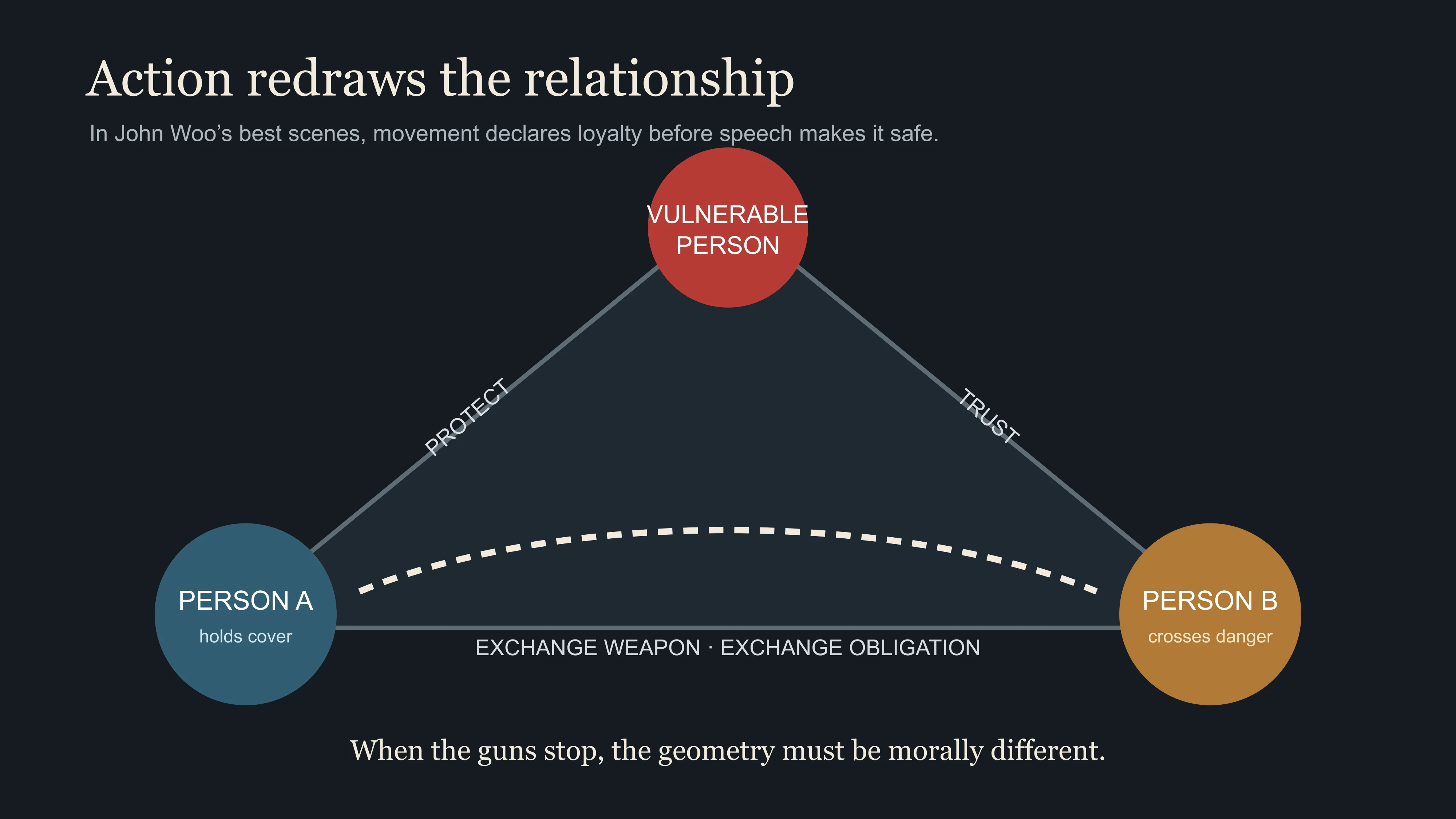
This is the point where I become blunt: copying the coat, dove and two pistols without the relationship is empty cosplay. It may look expensive. It may move quickly. It is not John Woo's achievement. His action matters because a body declares allegiance before a speech can make the declaration safe.
John Woo's melodrama is the engine, not an embarrassment
Some viewers treat the tears, vows, church imagery and impossible sacrifices as excess that must be tolerated to reach the gunfights. I think the opposite. The emotional excess is the reason the gunfights have shape. These men do not merely want to survive; they want loyalty to remain visible in a world where institutions have made loyalty irrational.
That conviction can become sentimental, and not every Woo film earns it. But removing the sentiment produces something worse: immaculate action with nothing at risk except continuation of the sequence. The Killer works because Jeff and Inspector Li recognize a moral resemblance that their jobs cannot officially admit. A Better Tomorrow works because damaged status does not erase a debt. The bullets are punctuation after the relationship has already written the sentence.
I love Woo most when sincerity becomes dangerous. He refuses the fashionable safety of irony. A character may look ridiculous for believing in honor, but the film still asks whether cynicism has built anything better. That is a sharper question than “Was the stunt cool?”
Hard Boiled turns space into an ethical map
The hospital sequence is famous for continuous movement and technical coordination. Its deeper value is legibility. Viewers need to know where Tequila and Alan are going, whom they must protect and why changing direction matters.
A corridor is not merely a background for gunfire. It distributes risk. An elevator creates a pause in which the partnership resets. Civilians and infants prevent tactical success from becoming the only measure.
Woo's long takes work because objectives remain readable inside chaos. Remove the vulnerable people and the sequence becomes an extraordinary demonstration with a weaker moral center.
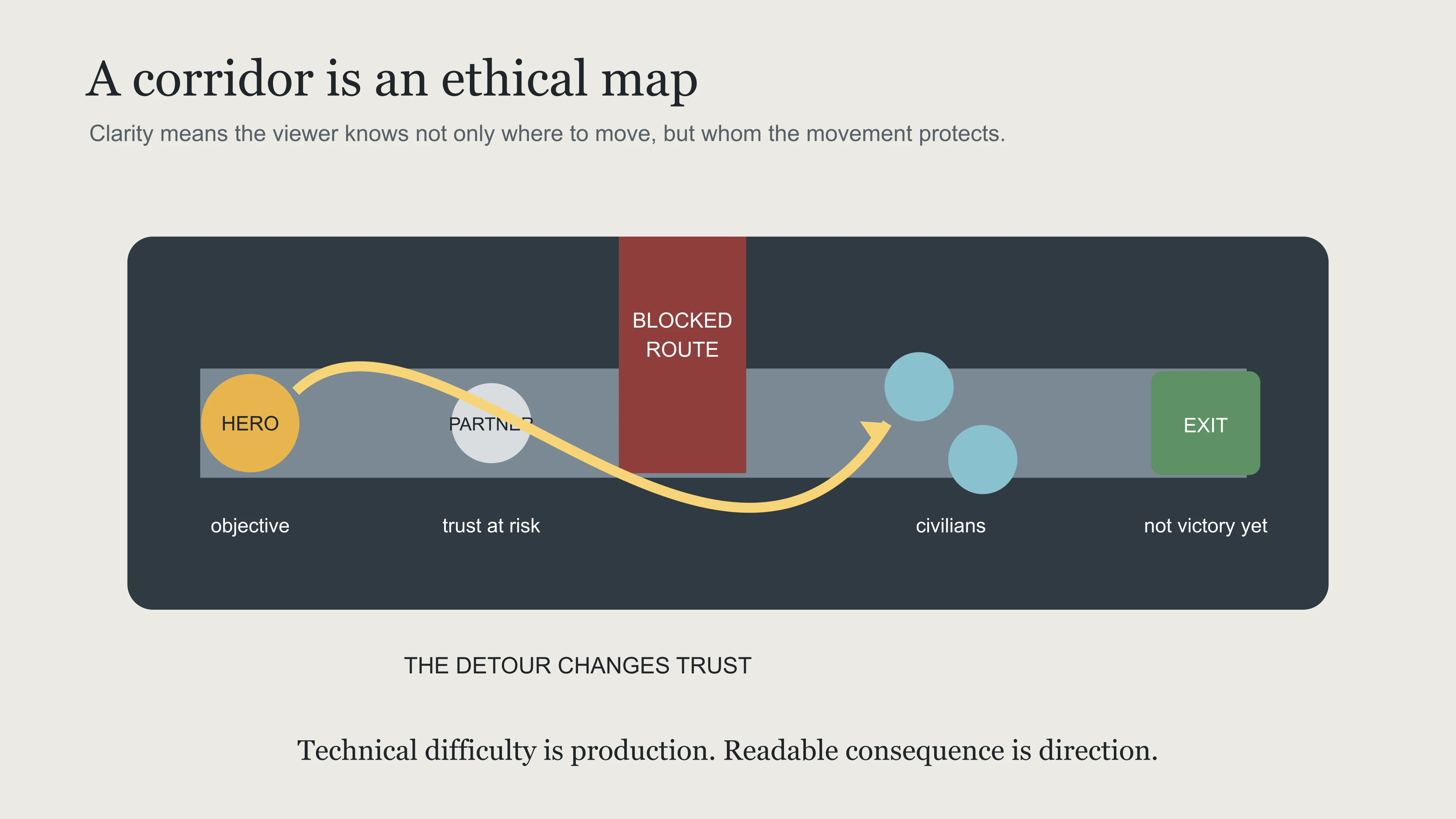
The continuous hospital movement is not valuable merely because it is difficult. Difficulty belongs to production. Meaning belongs to the viewer's ability to understand why direction changes. Tequila can advance, retreat, cover Alan, move a patient or protect an infant; each choice redraws the scene's moral center. Woo proves that clarity and intensity are not enemies. Directors who hide incoherent geography behind faster cutting have chosen noise, not speed.
Face/Off makes identity a performance problem
The premise exchanges the faces of FBI agent Sean Archer and terrorist Castor Troy. It could have remained a mechanical thriller device. Woo turns it into melodrama because each man must perform the other's place inside family, institution and desire.
Action scenes therefore test more than pursuit. A gesture can expose the wrong man inside a familiar face. Nicolas Cage and John Travolta do not simply imitate one another; they exaggerate how each identity occupies affection and power.
Woo's recurrent church imagery, slow motion and weapons remain visible, but the film works when style serves the stolen relationship. A dove cannot create that by itself.
Mission Impossible II shows where style becomes detachable
The official Paramount trailer displays motorcycles, wind, masks and heightened confrontation. It identifies the production and its action scale, not the quality of the complete film.
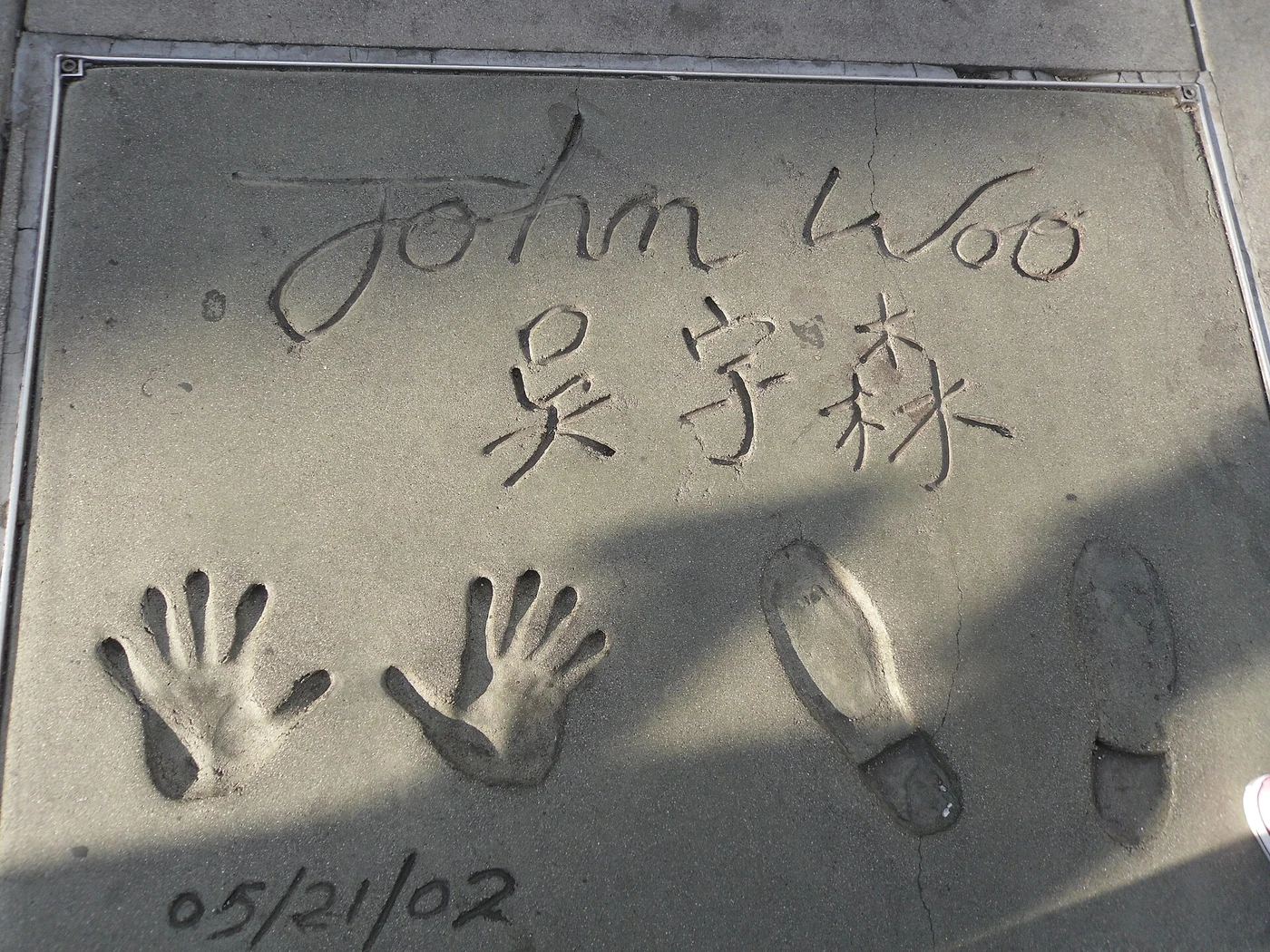
The 2010 forecourt imprint makes Woo's Hollywood recognition physically visible: an English signature above the Chinese name 吴宇森, with hands and feet pressed into the same concrete. I like the image because it records arrival without pretending that arrival solved the artistic problem. Hollywood could honor the filmmaker and still detach his surfaces from the Hong Kong relationships that gave them force. The concrete proves public canonization; the films still have to prove whether the emotional grammar survived translation.
Mission: Impossible II is useful because it reveals the danger of exportable signatures. A studio can reproduce slow motion, coat movement and face-to-face combat while weakening the dense social bonds that gave those devices pressure in Hong Kong.
This does not make the film culturally inauthentic by definition. It makes it a test: which choices still express loyalty, and which have become brand recognition?
My answer is not diplomatic: too much of Mission: Impossible II is brand recognition. The motorcycles, wind and face-to-face poses can be pleasurable, but the surrounding relationship does not always exert enough pressure to justify their grandeur. Face/Off survives Hollywood scale more completely because stolen identity penetrates family life; the action keeps touching a wound that spectacle did not invent.
Red Cliff replaces brotherhood with coordination
Red Cliff expands the field from urban crime to armies, weather, terrain and political alliance. Strategy matters because no single body can dominate the system.
The Red Cliff movie guide owns historical adaptation, different international cuts and the battle narrative. This director page asks a narrower question: how does Woo preserve readable human choice when the number of moving parts grows?
The answer is not perfect historical fidelity. It is repeated visual clarification: who observes, who interprets, who signals and which collective action follows. Spectacle becomes legible through decision chains.
Silent Night tests whether action can speak alone
Silent Night minimizes spoken dialogue, making it an unusually direct test of Woo's belief in visual communication. The free official Lionsgate trailer shows grief, preparation and violence connected through objects and repeated actions.
The experiment also exposes a limitation. Removing dialogue does not automatically create visual depth. The action must still reveal a changing relationship to grief, family and revenge. Style can carry information only when the information is specific.
That limitation matters because “pure visual storytelling” is often praised too easily. Silence does not make an image profound. A close-up, repeated object or burst of violence must change what we understand about grief. When the chain is clear, Woo can make movement speak. When it is not, silence becomes an empty claim of seriousness.
How to read a John Woo action scene
- Identify each person's objective before shooting begins.
- Map the vulnerable person, exit or object.
- Find the movement that changes trust.
- Notice when slow motion changes emotional time rather than merely speed.
- Ask what is irreversibly different when the guns stop.
Use this on the restaurant in A Better Tomorrow, the church in The Killer and the hospital in Hard Boiled. Different spaces make the same question visible: who will cross danger for another person?
Slow motion deserves the same discipline. It is successful when ordinary clock time can no longer contain the decision—when a glance, fall, weapon exchange or final crossing needs emotional duration. It fails when the director merely wants the audience to admire an image already understood. I do not give Woo a free pass because the motif is famous. The slowed moment must reveal a cost that normal speed would let us miss.
That test is brutally simple: pause before the slow motion and state the relationship; pause after it and state what has changed. If the answer is only “the pose looked cooler,” the scene has spent time without creating meaning. If trust, guilt, protection or surrender has become irreversible, the altered time earned its place.
John Woo's action must choose a person
John Woo's lasting contribution is not a kit of stylish objects. It is action as visible loyalty. The gunfight succeeds when movement makes an ethical choice impossible to hide.
Start with A Better Tomorrow, continue with The Killer and Hard Boiled, then watch Face/Off. Use the Chinese directors collection, Hong Kong guide and wider Chinese film collection for context.
In the comments, name one movement that changes a relationship. The community can map the scene instead of voting on the loudest explosion.
John Woo cuts action at the instant trust becomes visible
The gun is not the point. The point is who crosses open space for whom, who returns a weapon and who accepts exposure. John Woo makes action melodramatic because loyalty needs a body moving through danger.
Doves, slow motion and dual pistols became signatures, then clichés copied without their emotional geometry. A white bird proves nothing if the scene has not established what peace or innocence will cost.
His weaker work can let style outrun relationship. His best work makes every spectacular movement redraw trust. Watch the exchange before the explosion; that is where the director's real authorship lives.
The cut lands because somebody has already chosen whom to protect. Without that choice, slow motion is only slow.