Ang Lee is not best understood as a versatile director who happens to move from Taiwanese family comedy to Austen, wuxia, queer romance and digital spectacle. Versatility describes the surface. His deeper consistency is conflict between private desire and the social forms that make a person legible: family role, marriage, masculinity, honor, faith or public respectability. Genre changes how that conflict can move.
I keep returning to Ang Lee because he never lets rebellion remain a clean poster pose. I can admire the escape and still feel the family, body or social role pulling from the other side. I would rather begin with that pressure than praise his “range,” because the best Ang Lee films make radically different genres hurt in the same place. This matters because a filmography list can show movement between countries and formats while missing the emotional system that makes the movement his.
Ang Lee in 60 seconds
| Question | Short answer |
|---|---|
| Chinese name | Lee Ang (李安), with the family name first in Chinese order |
| Born | October 23, 1954, in Pingtung County, Taiwan |
| Best first film | Crouching Tiger, Hidden Dragon |
| Best starting trilogy | The Wedding Banquet, Crouching Tiger, Brokeback Mountain |
| Best family film | Eat Drink Man Woman |
| Best literary adaptation | Sense and Sensibility |
| Best spectacle | Life of Pi |
| Two directing Oscars | Brokeback Mountain and Life of Pi |
| Central method | Put desire inside a social rule, then let genre test the cost of disclosure |
If you watch one film, choose Crouching Tiger, Hidden Dragon. It contains the complete system: bodies can fly, but feeling remains trapped by duty. If you watch three, add The Wedding Banquet and Brokeback Mountain. The settings change completely; the pressure does not.
The best Ang Lee movies depend on what you want to understand
| Viewing goal | Start with | What the film reveals | Honest limitation |
|---|---|---|---|
| Understand his central conflict | The Wedding Banquet | Family love can protect and coerce at the same time | Broad comedy sometimes cushions the deception's damage |
| See domestic form at its richest | Eat Drink Man Woman | Food is labor, authority and a language for unsaid feeling | Its romantic resolutions are tidier than some conflicts |
| See adaptation as interpretation | Sense and Sensibility | Restraint becomes active emotional behavior | Heritage beauty can make economic pressure look gentle |
| Understand the global breakthrough | Crouching Tiger, Hidden Dragon | Wuxia movement releases socially forbidden desire | Viewers can mistake genre romance for literal history |
| See masculinity under enclosure | Brokeback Mountain | A social order can enter posture, speech and imagined possibility | Its cultural specificity should not be flattened into a universal slogan |
| Test belief through spectacle | Life of Pi | Digital wonder can make competing stories emotionally inhabitable | Beauty can encourage passive acceptance of the final framing |
| See the risk of technical pursuit | Gemini Man | Format experiments alter presence and action clarity | Technique is more memorable than dramatic necessity |
This is a route, not a ranking. Ang Lee's weaker films matter because they expose the condition of his success: technical or generic experiment needs a human rule to press against.
The Father Knows Best films begin with love that cannot speak plainly
Pushing Hands, The Wedding Banquet and Eat Drink Man Woman are often grouped as the Father Knows Best trilogy. The label is useful if it does not turn the fathers into fixed symbols of tradition. Each family is negotiating authority, migration, sexuality, modern work and the fear that honesty might dissolve care.
In The Wedding Banquet, the central arrangement tries to satisfy incompatible systems at once: private life, immigration practicality and parental expectation. Comedy grows from concealment, but the film does not treat family merely as an enemy. The parents' love gives their expectations force. Coercion is harder to reject when it arrives carrying sacrifice.
Eat Drink Man Woman makes this method material. Meals are not decorative proof of “Chinese culture.” Cooking is labor through which a father preserves authority and expresses care he cannot state directly. The daughters read the same table as obligation, habit, competence and love. When circumstances change, food changes meaning.
This is the first Ang Lee rule: never ask only what a character feels; ask which social form permits that feeling to become visible.
Sense and Sensibility proves restraint travels across cultures
Ang Lee's adaptation of Jane Austen is sometimes described as a surprising English-language turn. It becomes less surprising when viewed through his family films. Austen's world also organizes desire through inheritance, marriage, reputation and what a respectable person may say.
The official trailer represented by the opening image identifies the film's characters and heritage setting. The complete film shows why Lee fits the material: emotional restraint is not an absence of action. It is continuous decision-making under social observation.
Elinor's control has dramatic weight because the viewer sees the work required to preserve it. Marianne's openness appears freer, but it also makes her legible to a system ready to judge female feeling. Lee does not simply oppose repression and authenticity. He asks what each form of expression costs.
The result clarifies cultural translation. He does not make Austen “Chinese.” He recognizes a compatible dramatic machine and lets performance, framing and tempo reveal it.
Crouching Tiger turns the unsaid into movement
Crouching Tiger, Hidden Dragon is the best entry point because wuxia gives physical form to conflicts the earlier films keep around tables and inside rooms. Jen Yu's body can cross walls, roofs and social boundaries before her life can sustain the consequences. Yu Shu Lien's control makes competence and renunciation occupy the same posture.
The fight between Jen and Shu Lien works because it is also an argument about freedom, discipline and who understands consequence. Weapons break or change; the social disagreement remains. Action does not pause character. It makes character temporarily unable to hide. Sony Pictures Classics' public trailer previews that transformation; the dedicated film page owns the stills and the complete scene analysis.
Read the scene beside East Moment's Michelle Yeoh guide and Zhang Ziyi guide. Yeoh makes responsibility physical; Zhang makes refusal physical. Neither is reducible to choreography.
The broader Chinese martial arts guide helps keep the boundary clear: wuxia is a moral and literary imagination shaped for cinema, not transparent documentation of historical combat.
Brokeback Mountain moves the prison inside the body
The Academy records Ang Lee's directing award for Brokeback Mountain at the 2006 ceremony. The award is a milestone, but it does not explain the film's force. Lee's method is visible in what the characters cannot convert into a socially sustainable life.
Ennis does not merely conceal love from other people. Threat, masculinity, poverty and remembered violence have entered his posture and range of imaginable choices. A private truth is therefore not waiting intact behind a public mask. The public order has helped shape what the person believes survival allows.
This is where a simple “repression versus freedom” reading becomes inadequate. Jack and Ennis do not possess equal resources, temperaments or visions of a future. The film's tragedy grows from desire meeting different calculations of danger.
Lee's restraint is sometimes praised as neutral or universal. It is neither. The camera and performances make a firm judgment about lost possibility, while refusing to manufacture an easy act of liberation the characters' world has not made plausible.
Life of Pi uses spectacle to test the story we choose
The Academy records Lee's second directing Oscar at the 2013 ceremony for Life of Pi. Its digital ocean, tiger and impossible visual states can look like a departure from domestic restraint. They are another method of externalizing an inner problem.
The ending does not ask whether beauty proves factual truth. It asks what a story allows a listener to hold, and whether emotional usefulness changes moral responsibility. The spectacle earns its place when it makes belief inhabitable before the final comparison destabilizes it.
The limitation is real: visual wonder can make viewers accept the preferred story without examining suffering, substitution and who gets to frame testimony. Lee's strongest spectacle opens interpretation; it does not merely reward belief.
Why the technical experiments sometimes fail
High frame rate and digital imaging in Billy Lynn's Long Halftime Walk and Gemini Man pursue a different screen presence. The ambition is serious: change how faces, motion and space register rather than applying novelty after the fact.
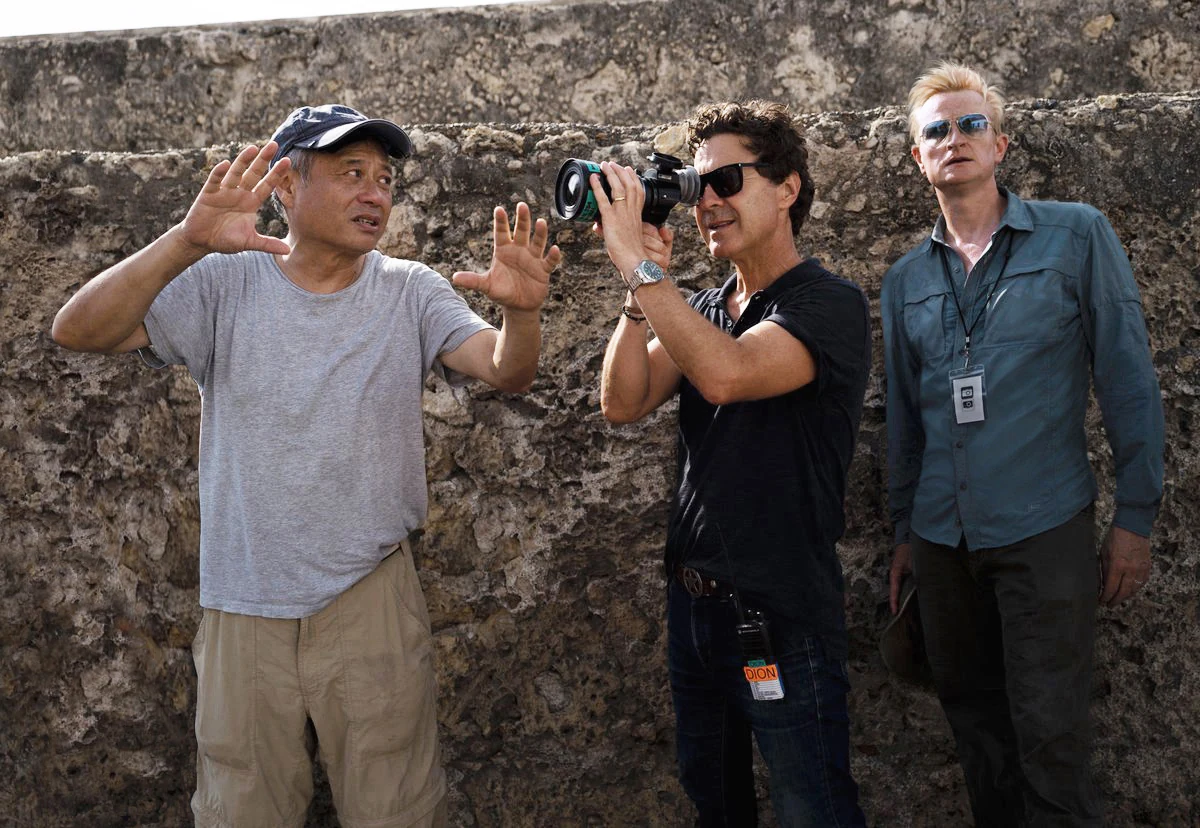
This is the Ang Lee image I trust more than a solitary red-carpet portrait. He shapes the frame with his hands while cinematographer Dion Beebe looks through the camera and production designer Guy Hendrix Dyas watches the same problem. Direction here is not a mystical signature issued by one famous man. It is a negotiation among performance, optics, space and technology. Gemini Man matters because Lee was willing to make that negotiation unusually visible—and it disappoints when the apparatus becomes more vivid than the human being inside it.
But technical visibility creates a hard test. If the viewer spends more energy noticing image format than revising an understanding of the character, method has escaped the drama it was meant to serve. Ang Lee is most persuasive when form carries a pressure already alive in the person.
This is the honest limitation of calling him endlessly versatile. Range is not automatically depth. Genre and technology become meaningful only when they reorganize duty, desire, identity or belief.
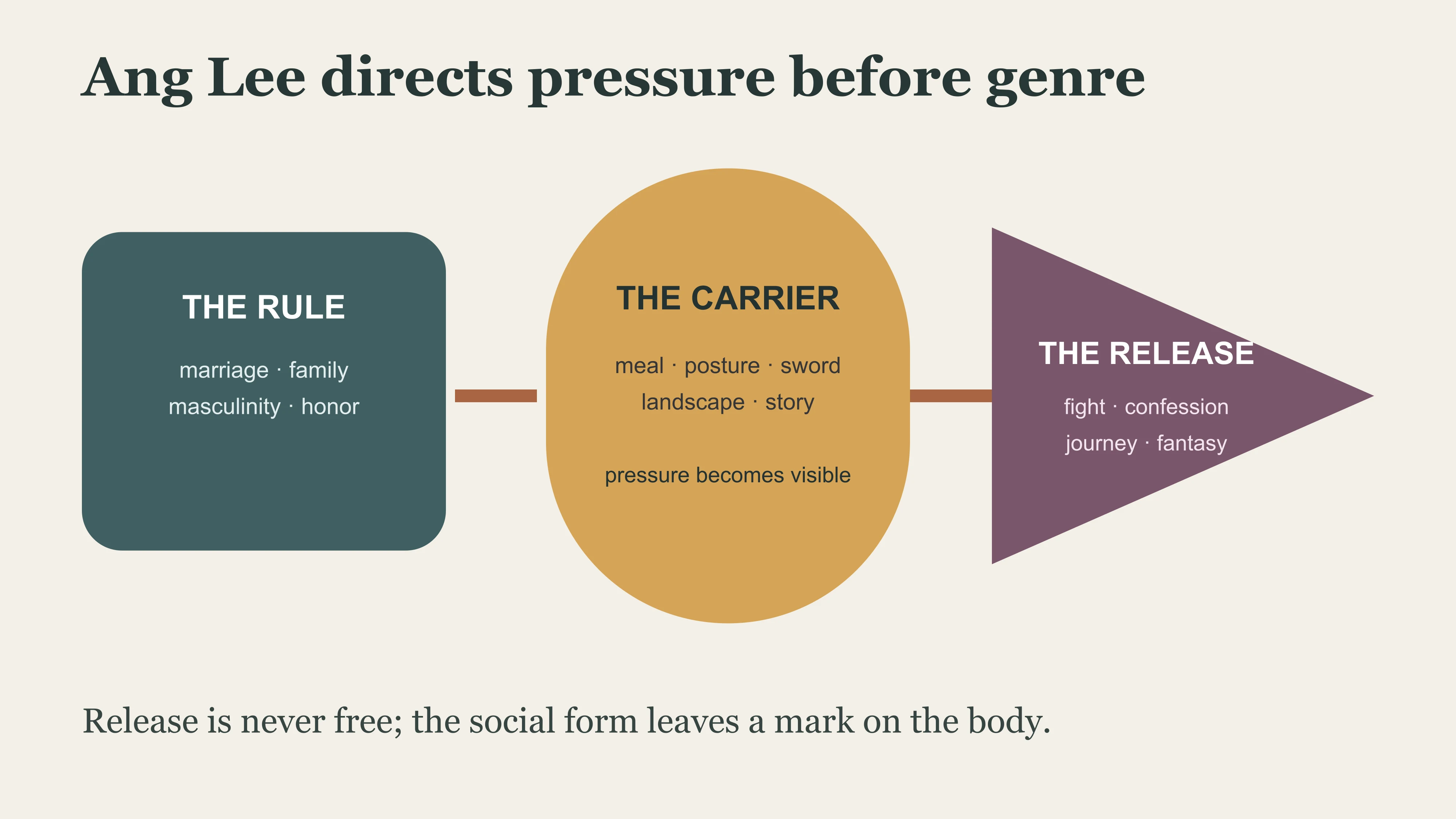
How to recognize an Ang Lee scene
- Find the social rule. Who is expected to marry, inherit, remain silent, appear masculine or preserve family order?
- Locate the private desire. What cannot yet be admitted without changing how the person belongs?
- Watch the carrier. Food, clothing, posture, landscape or action often speaks before dialogue.
- Notice the witness. The presence of family, community or imagined judgment changes behavior.
- Measure the release. Genre may allow a fight, confession, journey or fantasy, but release always has a cost.
This method connects films without claiming they are culturally interchangeable.
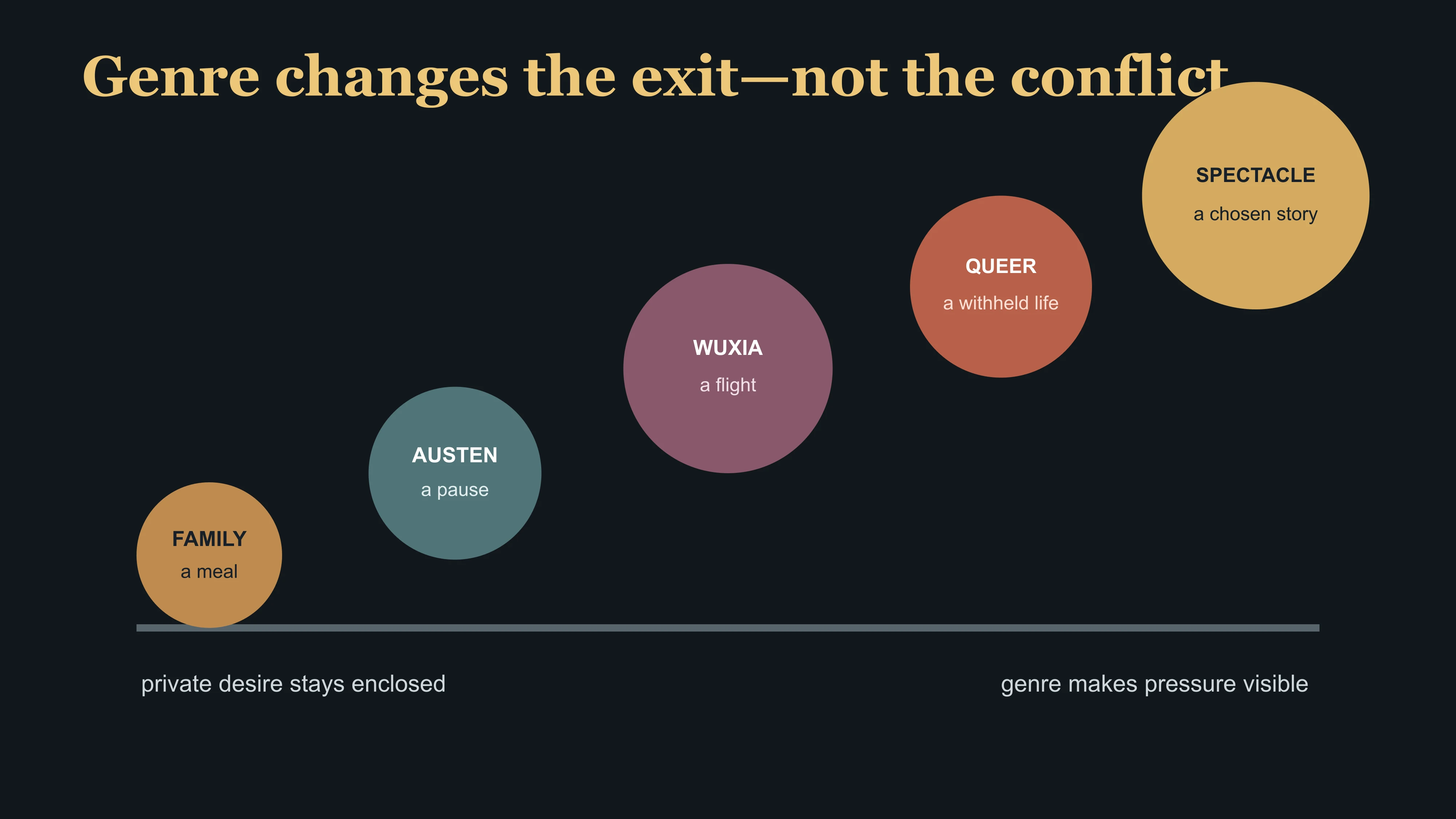
The sequence also gives a practical diagnostic for the experiments that divide viewers. When a new format sharpens the carrier—the face, body, landscape or story—it belongs to the drama. When the format becomes the main thing the viewer notices, the release no longer answers the rule. That is why technical bravery alone cannot be the final measure of an Ang Lee film.
Final verdict: where to start with Ang Lee
Start with Crouching Tiger, Hidden Dragon. Then watch The Wedding Banquet to see the domestic mechanism beneath the action, and Brokeback Mountain to see social threat settle into the body. Add Sense and Sensibility for adaptation and Life of Pi for spectacle.
Ang Lee's defining achievement is not crossing East and West as though each were a stable box. It is recognizing how different societies make people readable, then finding the genre capable of exposing the cost. His films ask a precise question: when private truth conflicts with the form that gives a life belonging, what can movement, speech or imagination actually change?
Continue through the Chinese directors guide and Chinese film collection. In the comments, bring one scene where a rule becomes visible without being explained. That gives the community something another viewer can test.
Ang Lee directs the rule before the rebellion
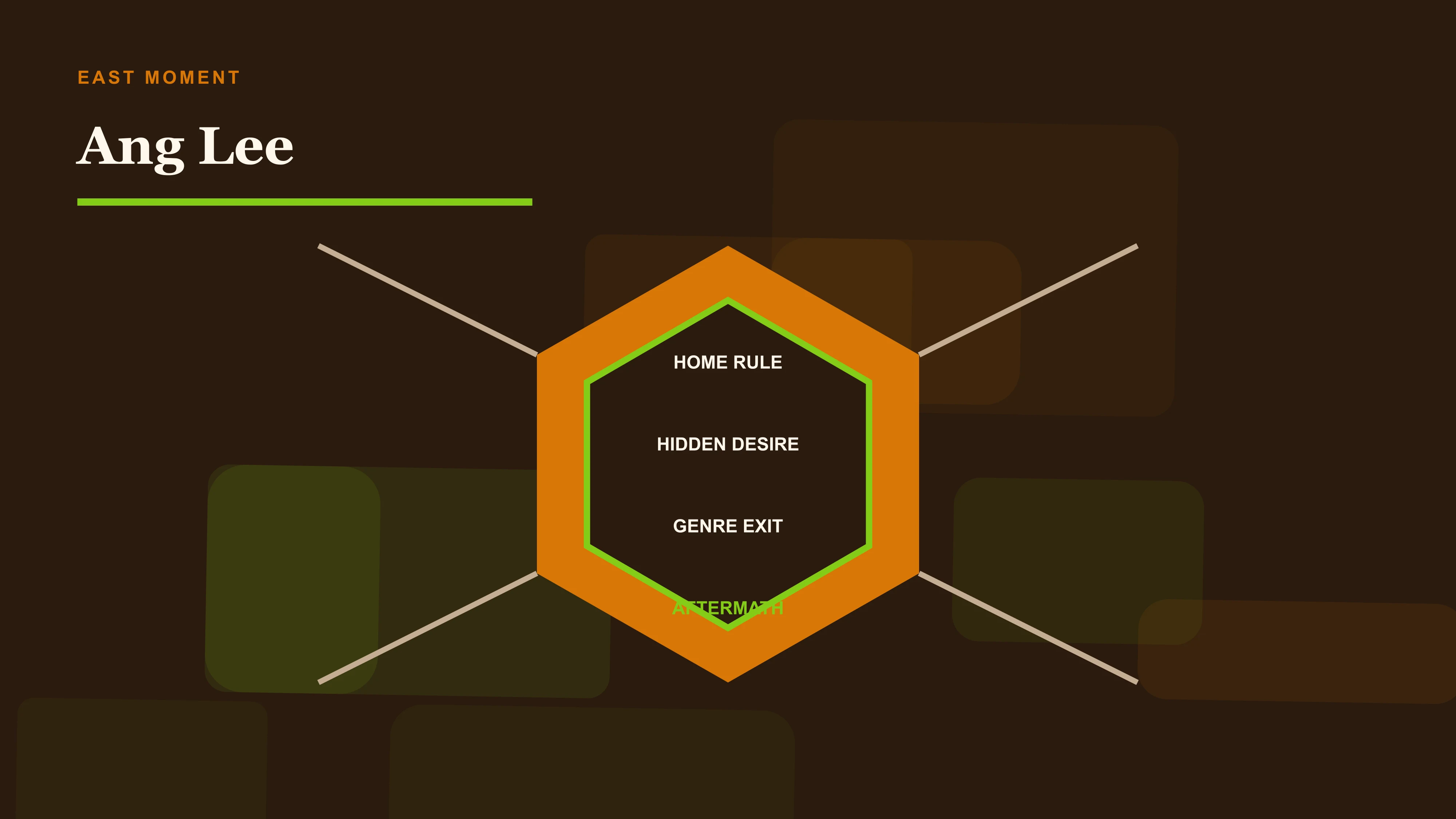
Across family comedy, Austen, wuxia and queer romance, Ang Lee first makes the social rule understandable. Desire becomes powerful because the viewer knows what it will disturb. Release then carries aftermath rather than functioning as a clean victory.
This is why calling him merely “versatile” is too soft. Genre changes; the pressure chamber returns. A meal, inheritance, martial code or marriage arrangement becomes the carrier of order.
His weaker experiments can let technology or prestige overwhelm intimacy. The career is not a flawless ascent. It is a repeated attempt to make private feeling visible without pretending the social world disappears when the character finally acts.
The aftermath is the signature. Escape opens a door; Ang Lee keeps the camera long enough to show what remains in the room.