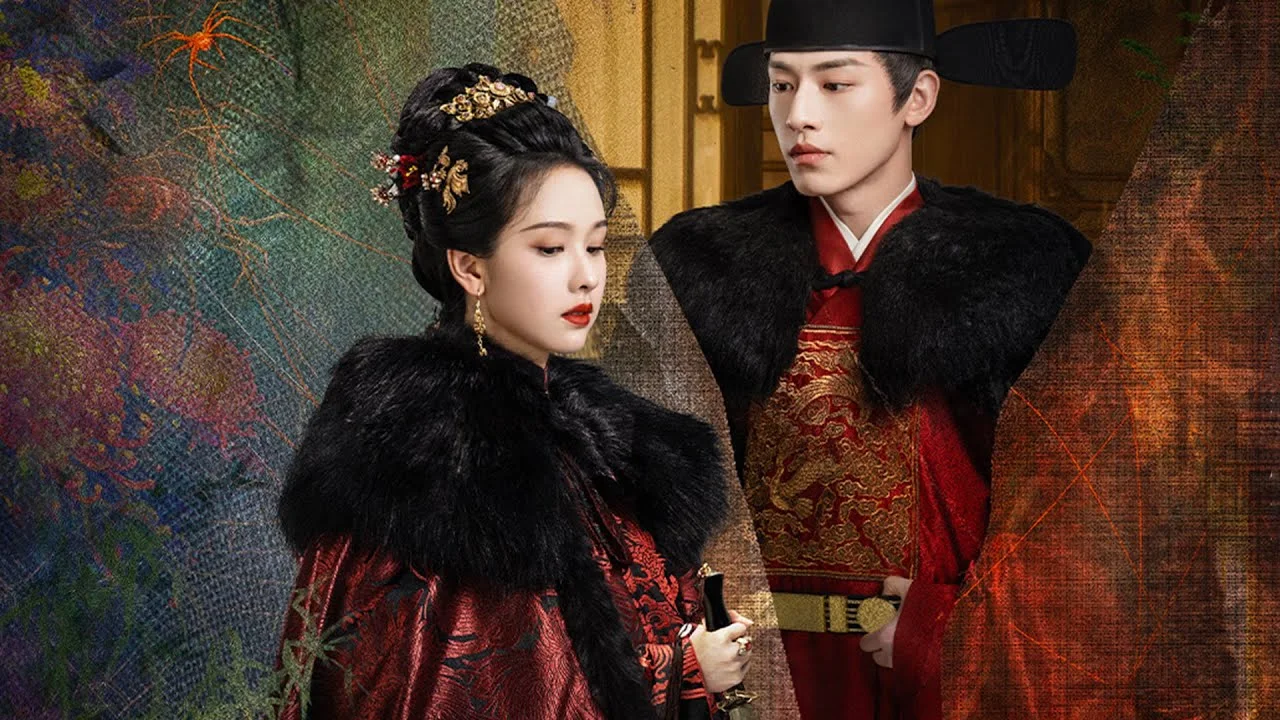
Michelle Yeoh's rare skill is not simply that she can perform action. It is that competence, physical cost and unspoken emotion remain believable in the same body. The 2023 Oscar did not suddenly make her important; it recognized a screen method developed across Hong Kong action, international supporting roles and decades in which cinema rarely gave an Asian woman of her age a lead complex enough to use all of it.
Michelle Yeoh in 60 seconds
| Question | Short answer |
|---|---|
| Chinese name | Yang Ziqiong (杨紫琼) |
| Born | August 6, 1962, in Ipoh, Perak, Malaysia |
| Age | 64 as of August 13, 2026 |
| What she does | Actor and producer; first established through Hong Kong action cinema |
| Best first film | Crouching Tiger, Hidden Dragon for the complete actor |
| Best action origin | Yes, Madam! and Police Story 3: Supercop |
| Best mature lead | Everything Everywhere All at Once |
| Academy recognition | Best Actress for Everything Everywhere All at Once at the 95th Oscars |
| Defining quality | Authority that stays readable even when the character is tired, grieving, restrained or afraid |
The short biography says Malaysian-born actor, Hong Kong action star, Bond ally, wuxia icon and Oscar winner. The useful question is what survives all those industrial labels. The answer is physical intelligence used as character, not as decoration beside it.
Which Michelle Yeoh movie should you watch first?
Choose by the part of her craft you want to understand.
| Your viewing goal | Start here | What to watch |
|---|---|---|
| See the complete actor | Crouching Tiger, Hidden Dragon (2000) | Controlled movement, withheld love and moral authority sharing one posture |
| Find the action origin | Yes, Madam! (1985) | A woman driving the physical story rather than waiting to be protected |
| Compare equals under pressure | Police Story 3: Supercop (1992) | Yeoh and Jackie Chan sharing danger, timing and comic consequence |
| See the Hollywood opportunity and limit | Tomorrow Never Dies (1997) | Wai Lin's competence, then how the Bond structure recenters its hero |
| Understand the mature lead | Everything Everywhere All at Once (2022) | Exhaustion, regret, comedy, action and family feeling in one performance |
| See social authority without fighting | Crazy Rich Asians (2018) | Stillness, judgment and the mahjong table as dramatic action |
| Test the post-Oscar franchise role | Wicked (2024) | Voice, hierarchy and institutional power rather than action-star nostalgia |
If you watch only one, choose Crouching Tiger, Hidden Dragon. If you watch three, add Yes, Madam! and Everything Everywhere All at Once. That route shows the physical origin, the restrained dramatic transformation and the mature role that finally needs both.
Before the Oscar, there was a woman refusing to leave the action frame
The Oscar image is emotionally powerful, but it creates a misleading starting point. Michelle Yeoh had already spent decades making herself impossible to treat as a ceremonial presence.
The Golden Globes profile records that she was born in Ipoh, Malaysia, and moved through Hong Kong action films before international roles including Tomorrow Never Dies and Crouching Tiger, Hidden Dragon. The career did not begin when American awards learned how to name it.
Hong Kong action gave Yeoh an unusually concrete form of agency. A character cannot merely be described as capable when the scene requires her to cross the room, read danger, absorb consequence and change the plan in real time. The body must complete the argument.
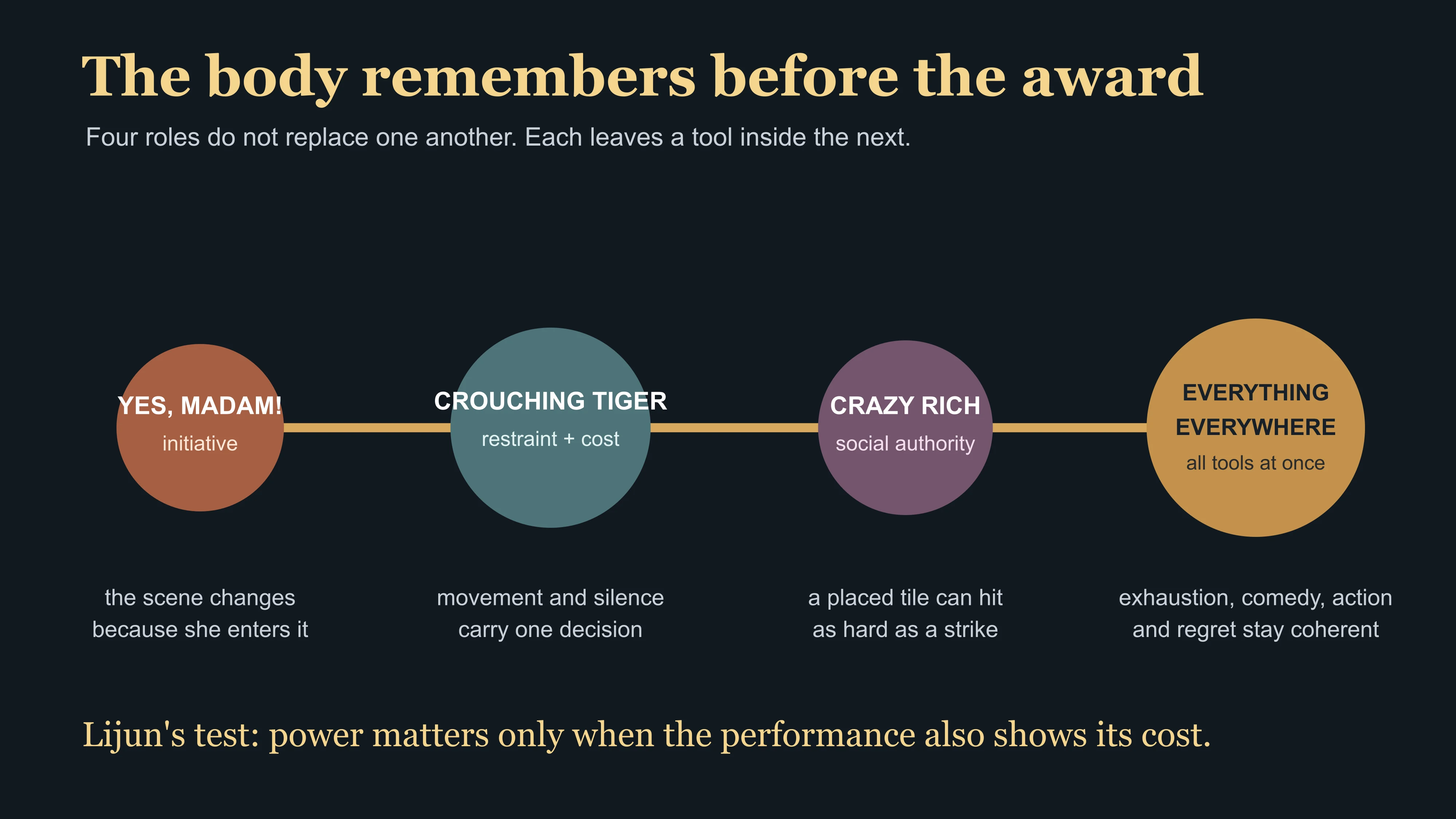
That does not make every stunt a documentary of uncontrolled risk, and it does not mean physical danger should be romanticized. Choreography, collaborators, camera position, editing and safety systems construct what viewers see. Her observable achievement is making the decision inside the movement legible.
Yes, Madam! makes competence the plot
In Yes, Madam!, Michelle Yeoh is not an exceptional woman temporarily admitted into a man's story. The official Eureka restoration trailer places her at the center of the film's identity and physical escalation.
Play Eureka's official trailer in place. Watch how often Yeoh begins an action, crosses into danger or changes the direction of a scene instead of functioning as a reaction shot.
The distinction matters. “A woman who can keep up with the men” still makes men the unit of measurement. Yes, Madam! is more useful when read as a film that lets women generate action knowledge: they identify the problem, enter the contested space and carry consequences.
Her early screen name, Michelle Khan, also belongs to this industrial phase. The name is a reminder that international legibility was often manufactured before a performer controlled what audiences knew about her. The work outlasted the packaging.
Supercop is not Jackie Chan plus a capable guest
Police Story 3: Supercop offers the clearest comparison because Jackie Chan's screen method is already so strong. He turns failed plans, props, pain and improvisation into comic character. Yeoh does not copy that rhythm. Her authority is more vertical and controlled; the scene believes she has assessed the danger even when the danger proves larger than expected.
Eureka's official trailer preserves the film identity and its large-scale physical world. The best scenes do not merely allow Yeoh to “keep up.” They need two different intelligences. Chan's body makes improvisation visible; Yeoh's makes commitment visible.
Continue with the Jackie Chan guide and compare one shared sequence. Ask who detects the problem, who changes the route and whose reaction tells you what the danger cost. That produces a better conversation than ranking private fighting ability.
Crouching Tiger turns restraint into action
Yu Shu Lien in Crouching Tiger, Hidden Dragon is the role that best reveals why “action star” is too small a description. Her physical control and emotional control are the same dramatic problem.
Sony Pictures Classics identifies Yeoh in the central ensemble and frames the story around the stolen Green Destiny sword, duty and concealed desire. Yet plot description cannot explain the performance. Shu Lien often looks as if she has already calculated what she wants, what social order permits and what another choice would cost.
Use Sony Pictures Classics' public Crouching Tiger, Hidden Dragon trailer to watch her face immediately before and after movement. The important action is often the decision she does not permit herself to complete; the film page retains the scene stills because this profile owns the career comparison, not the film's visual evidence.
This is why the sword fights do more than interrupt the drama. They release information that conversation has been containing. Shu Lien's authority comes from discipline, but the discipline is also the source of loss.
The film therefore connects two kinds of choreography:
- Bodies move through rooms, roofs and courtyards according to physical rules the camera establishes.
- Feelings move through etiquette, duty and silence according to social rules the characters understand.
Yeoh makes both systems readable without explaining either one aloud.
Tomorrow Never Dies shows access and limitation at once
Wai Lin in Tomorrow Never Dies was a major international visibility point. She is competent, resourceful and physically credible beside James Bond. The role refuses the simplest helpless-partner function.
But visibility is not the same as authorship. The Bond structure still belongs to Bond. Wai Lin's competence enriches his film while the narrative ultimately protects his centrality.
This is not a reason to dismiss the role. It is a way to read career movement accurately:
- Hong Kong action could place Yeoh inside the machinery of the scene.
- A global franchise could use that authority while containing how much of the story it reorganized around her.
International success therefore created both reach and a new ceiling. The question was no longer whether audiences could believe Michelle Yeoh as capable. It was whether an industry would make capability emotionally consequential rather than commercially useful support.
Crazy Rich Asians proves stillness can be combat
Eleanor Young does not need a chase or weapon to control a room. In Crazy Rich Asians, Yeoh transfers the same skills of timing, appraisal and economy into social power.
The mahjong scene works because every placed tile carries information about family, class, sacrifice and who understands the game more deeply. Yeoh does not play Eleanor as simply cold. The stillness is active: she watches, withholds and revises her judgment while protecting a system she believes has protected her family.
In a BAFTA career interview, Yeoh discusses initially turning down the film before the character and project changed enough to deserve reconsideration. Her first-person account matters because it turns “representation” from a slogan into a role decision: what kind of mother, authority and Asian family would the film actually make visible?
This is the bridge to Everything Everywhere All at Once. By then, the mature Asian mother is no longer the obstacle another character must defeat. She becomes the exhausted center through whom the whole world is experienced.
Everything Everywhere needs the entire earlier career
A24 describes Evelyn Wang as an exhausted Chinese American woman who cannot finish her taxes. That mundane pressure is not a joke the action later replaces. It is the emotional ground that makes every alternate universe matter.
Play A24's official trailer in place. Notice how quickly posture and rhythm distinguish overwhelmed Evelyn from her alternate selves. The effects change the world; the body tells you which life you are watching.
The role needs skills that film industries often separate:
- Action credibility: The viewer must believe alternate Evelyns can acquire and express physical knowledge.
- Comic precision: Absurd objects and tonal changes need commitment rather than apology.
- Melodramatic openness: Family pain must remain sincere after the film has made reality ridiculous.
- Middle-aged exhaustion: The lead cannot feel like a young action hero wearing tax problems as a costume.
- Cultural translation: Evelyn's language, migration, marriage and parent-child conflict shape choices without turning the character into a lesson.
Yeoh's earlier career is not trivia surrounding the performance. It is material the film activates. The audience recognizes the disciplined fighter, glamorous international star, strict mother and woman denied uncomplicated possibility. Evelyn feels fragmented because the career image can plausibly contain all those lives.
The Oscar recognized convergence, not reinvention
At the 95th Academy Awards, Michelle Yeoh won Best Actress for Everything Everywhere All at Once. The official acceptance video records the recognition and her own public words. The page's opening image comes from that moment.
The award matters historically and emotionally, but the most accurate critical conclusion is narrower: the institution recognized a performance in which action, comedy, age, Asian family experience and leading-role interiority converged.
Awards can distort the story by making validation look like creation. The statue did not give Yeoh range. It gave a major institution a visible occasion to acknowledge range that film industries had used selectively for decades.
This distinction also protects future judgment. A post-Oscar role is not automatically good because it confirms status. It still needs to give her character a present-tense problem, choices that alter the story and something more demanding than inherited authority.
Wicked and Section 31 reveal the new problem
After recognition, Michelle Yeoh can enter major franchises as an institution herself. Madame Morrible in Wicked and Emperor Philippa Georgiou in Star Trek: Section 31 turn her accumulated authority into casting shorthand.
That creates a new risk. Earlier films sometimes limited her by treating her as highly capable support. Later films can limit her by treating her presence as automatic significance.
Judge these roles with three questions:
- Does the character want something specific now, or merely represent power?
- Does Yeoh receive a change of rhythm, vulnerability or contradiction?
- Would the scene still carry the same meaning if any respected veteran occupied the role?
The name above the role is no longer the problem. The depth inside it is.
Michelle Yeoh, Jackie Chan and Donnie Yen solve different screen problems
| Viewing question | Michelle Yeoh | Jackie Chan | Donnie Yen |
|---|---|---|---|
| Core dramatic force | Authority carrying cost and withheld feeling | Improvisation surviving pain and hostile space | Distance and rhythm revealing tactical control |
| Typical vulnerability | Duty, emotional restraint and the burden of competence | Failed plans, bad luck and physical consequence | Character pressure when control of range breaks |
| Best first film | Crouching Tiger, Hidden Dragon | Police Story | Ip Man or Flash Point |
| What to watch | What does posture refuse to say? | What object changes the plan? | What range or tempo changes the exchange? |
Use the Donnie Yen guide to compare action authorship without turning films into evidence of private combat rankings. Each actor makes a different kind of information visible.
How to watch one Michelle Yeoh scene closely
Choose the Crouching Tiger tea-house conversation, the Crazy Rich Asians mahjong scene or one Evelyn transition.
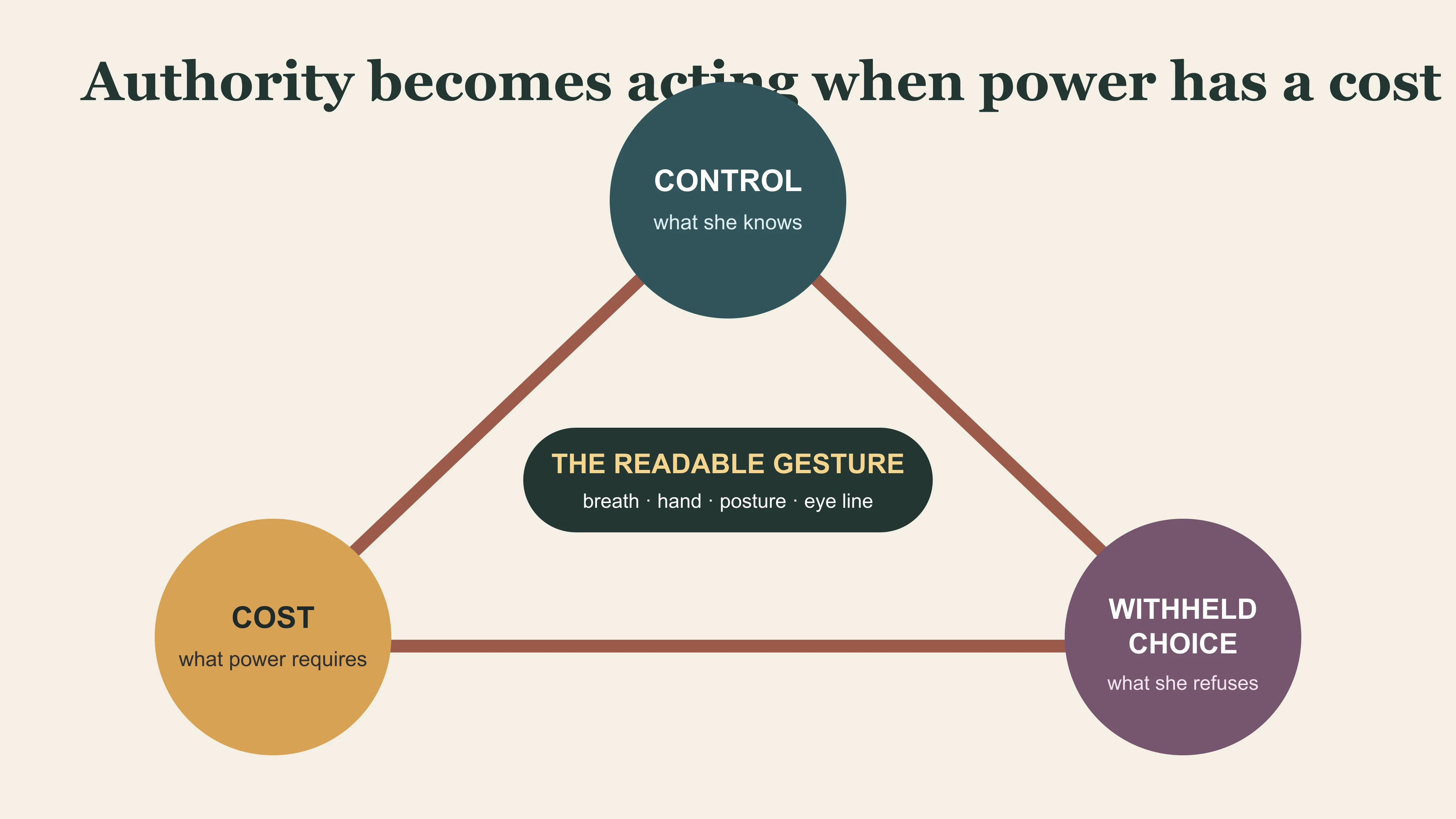
- Identify the authority. What does the character know or control before she speaks?
- Find the cost. Which breath, pause, injury, look or delayed response shows what competence requires?
- Track one gesture. Follow a hand, posture change, placed object or shift of eye line.
- Separate action from editing. Ask what Yeoh performs and what camera, sound, cut and collaborator add.
- Name the withheld choice. What could the character do but decides not to do?
This method works in a fight and at a mahjong table. It explains why her action history matters even when no one throws a punch.
Global recognition compresses four decades into one night
Not every Michelle Yeoh film gives her authority a meaningful cost. Some productions use competence as branding: the audience recognizes that she is formidable, and the screenplay treats recognition as completed characterization.
Her career is also easy to flatten into an inspirational timeline. Beauty pageant, action breakthrough, international franchise, prestige film and Oscar can become a sequence in which every obstacle exists only to prove eventual triumph. Real careers contain compromise, uneven roles and work whose value does not point neatly toward an award.
Finally, official institutions and distributors are strong sources for awards, credits, public interviews and film identity. They are not neutral judges of artistic quality. The interpretation of posture, restraint, cost and career convergence is East Moment editorial analysis of the cited work.
Final verdict: her strength is never only strength
Michelle Yeoh lasts because physical authority does not erase emotional consequence. The fighter can be tired. The mother can be wrong. The elegant woman can be furious. The respected elder can still face a role too thin for her.
Start with Crouching Tiger, Hidden Dragon, return to Yes, Madam! and then watch Everything Everywhere All at Once. The order reveals a career-long method: make the body credible, make the decision readable and let power carry a cost.
Continue through the Chinese actors collection and the wider Chinese film guide. In the comments, name one exact Michelle Yeoh gesture and explain what it reveals that dialogue does not. Specific scene evidence can build a community archive worth returning to; milestone praise alone cannot.