Mahjong becomes much easier when you stop trying to memorize every regional rule at once. Learn the shared engine first: recognize the tile families, draw one tile, discard one tile and shape a hand toward four groups plus a pair. Then ask the table which scoring system, flower rules and claim rules are in force. The beginner mistake is not forgetting a rare score. It is assuming that “mahjong rules” means one universal rulebook.
Mahjong in 60 seconds
| Question | Short answer |
|---|---|
| Chinese name | Majiang (麻将) |
| Players | Usually four |
| Core action | Draw one tile, evaluate the hand, discard one tile |
| Common hand size | 13 tiles between turns; a standard winning shape contains 14 |
| Basic winning shape | Four groups plus one pair |
| Groups | Sequence, triplet or four-of-a-kind, with rule-specific handling |
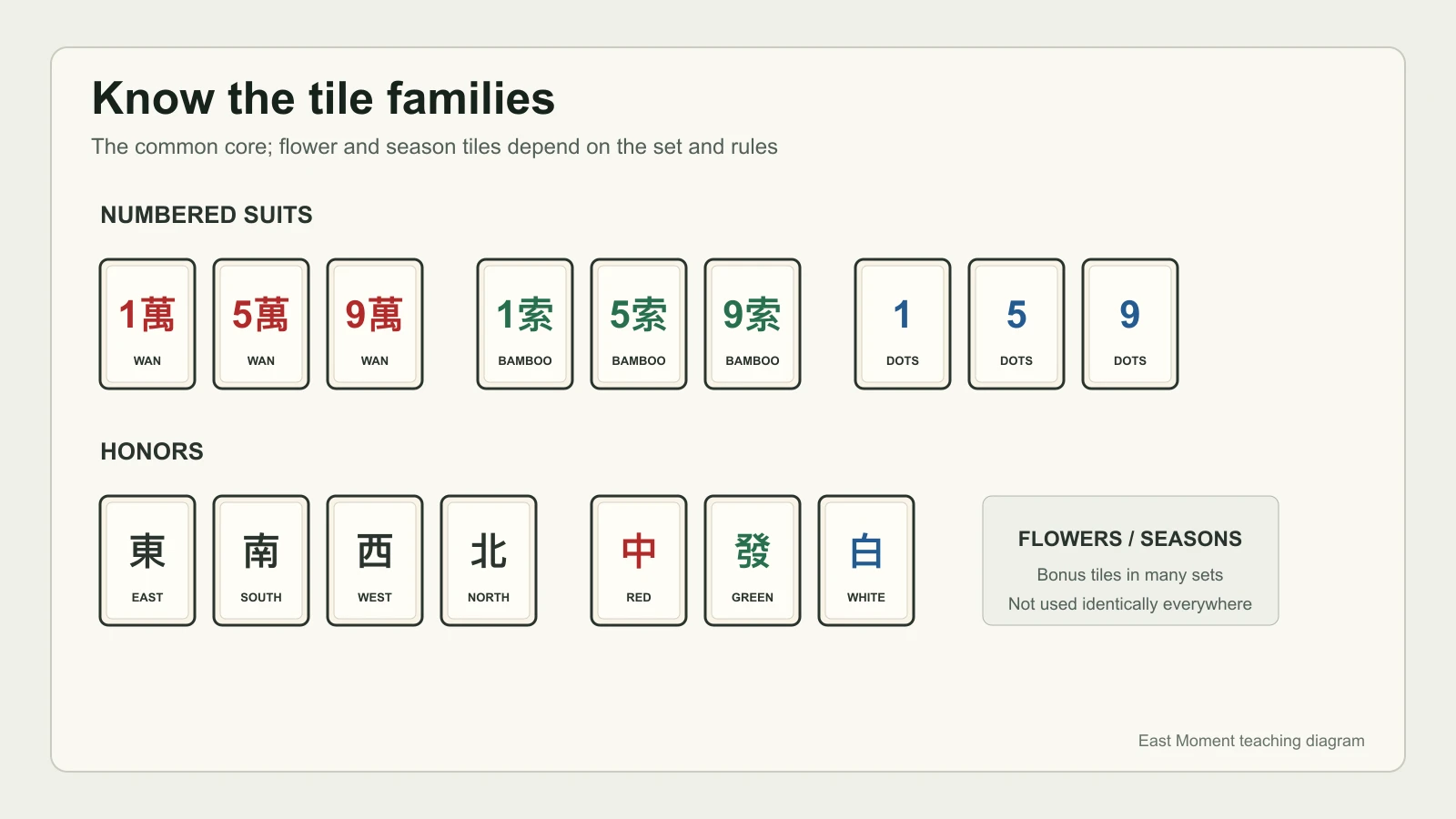
| Main tile families | Characters, bamboo, dots, winds and dragons |
| Variable elements | Flowers, seasons, jokers, claims, minimum score and payment |
| First question at a table | “Which rules are we playing?” |
| Not the same game | Mahjong solitaire, the matching puzzle played alone |
This guide teaches a portable beginner core, not a fictional universal scoring system. Chinese family tables, Hong Kong styles, Sichuan rules, Mahjong Competition Rules, Japanese riichi and American mahjong can share tiles while making materially different decisions about winning and scoring.
If you are comparing mahjong with other traditions before choosing a first table, begin at the Chinese games hub and the Chinese board games guide. Mahjong is the right choice when you enjoy partial information and social rhythm more than a completely visible duel.
What you need before the first hand
You need four players, a complete set appropriate to the chosen rules, a flat table and agreement on the rule set. Dice, wind markers, racks, chips or scoring sticks may be used depending on the table.
Many sets contain 144 tiles because they include four copies of the 34 suited and honor tiles plus eight flower and season tiles. Some rules use 136 tiles by omitting bonuses; American sets add jokers. Count and function therefore belong to the rules, not to the decorative box.
The three numbered suits run from one to nine:
- Characters / wan: number tiles associated with the character 萬.
- Bamboo / suo: green stick-like motifs; one bamboo often uses a bird design on physical sets.
- Dots / tong: circular coin-like motifs.
Honors are the four winds—east, south, west and north—and three dragons, commonly represented as red, green and white.
The hero diagram uses simplified marks for recognition. Real tile calligraphy and art vary by maker; do not reject a set merely because its one-bamboo or white-dragon design looks different.
How to play mahjong: the turn loop
At the beginner level, keep one loop stable:
- Draw one tile from the wall unless a legal claim has changed the turn.
- Evaluate 14 tiles. Can you declare a legal win under this table's rules? If not, which tile least helps your developing groups?
- Discard one tile face up, returning the concealed hand to 13 tiles.
- Play passes according to the agreed direction and claim rules.

This is the stable rhythm. Calls from another player's discard, exposed groups, replacement draws after a kong, flowers and robbed-kong situations alter it. Learn those only after you can look at 13 tiles and see possible groups.
The three group shapes
Sequence: three consecutive suited tiles
A sequence—often called a chow—is three consecutive numbers in the same numbered suit, such as 2-3-4 bamboo. Winds and dragons cannot form sequences. 8-9-1 does not wrap around.
Triplet: three identical tiles
A triplet—often called a pung—is three copies of the same tile. It can use a suited tile, wind or dragon.
Kong: four identical tiles
A kong is four copies of one tile. Its declaration and replacement draw affect hand accounting and scoring, so use the exact table procedure. Do not simply place four tiles in a group and continue as if nothing changed.
English spellings vary because Cantonese, Mandarin, Japanese and older romanization systems entered international play at different moments. Learning what a group does matters more than winning an argument over whether a table says chow or chi.
A complete beginner hand
The most useful visual formula is:
3 + 3 + 3 + 3 + 2 = 14 tiles
The four groups can be sequences or triplets in many basic hands; the final two identical tiles form the pair, sometimes called the eyes.

The diagram is a shape lesson, not an automatic declaration that the hand wins everywhere. Some systems require a minimum score or valid pattern beyond structural completion. Special hands can also break the four-groups-plus-pair model. Learn exceptions after the ordinary shape becomes instantly visible.
How to improve a hand instead of collecting pretty tiles
Beginners often keep isolated honors and terminals because they look important. A better first question is: how many useful future tiles connect to this piece?
- A 4-5 bamboo shape can improve with 3 or 6 bamboo.
- A 4-6 bamboo gap improves directly with 5 bamboo.
- A lone 5 bamboo connects to 3, 4, 6 and 7 in different developing shapes.
- A lone east wind can become only a pair or triplet unless a special pattern values it.
This does not mean honors are weak. Their value depends on seat wind, prevailing wind, dragons and the scoring system. It means an isolated tile should justify the space it occupies.
Count flexibility before counting points. A beginner who reaches a ready hand repeatedly learns faster than one who chases a spectacular pattern without recognizing ordinary improvement.
Calling a discard changes more than speed
When rules allow you to claim another player's discard for a group, you gain certainty and usually expose information. The decision has three costs:
- The exposed group can no longer change.
- Opponents learn part of your structure.
- Some scoring systems reward a concealed hand or restrict which player may be called for a sequence.
Do not call merely because you can. Call because the group advances a legal plan under the current rules.
This is where real tables diverge quickly. Ask who may claim a sequence, how competing claims are prioritized and whether a declaration must be spoken before touching the tile.
The rule differences you must settle before playing
| Question | Why it changes the game |
|---|---|
| Are flowers and seasons used? | They may be bonuses requiring replacement draws, or absent entirely |
| Is there a minimum winning score? | Four groups and a pair may not be enough |
| Which discards may form a sequence? | Turn order and claim rights change |
| Are there jokers or a card? | American mahjong uses a distinct hand-building system |
| How is a kong declared? | Tile count, replacement draw and robbing rules matter |
| What happens when the wall ends? | Draw procedure and dealer continuation vary |
| How are payments calculated? | Strategy changes when self-draw, dealer or discarder pays differently |
The European Mahjong Association's competition document is valuable because it defines one complete, testable rules environment. Its precision does not make it the hidden law of every table in China.
Chinese mahjong is a family of rules
The phrase “Chinese mahjong” helps distinguish the four-player draw-and-discard game from solitaire, but it still covers enormous variation. Sichuan tables may remove one suit and use continuous play after a player wins. Hong Kong styles use their own scoring thresholds and payment customs. Competition rules standardize a broad pattern list for tournament play. Family rules may simplify or preserve local habits.
This diversity is not a defect waiting for one website to repair. Mahjong remained alive because people could carry a recognizable game into different cities, languages, households and communities.
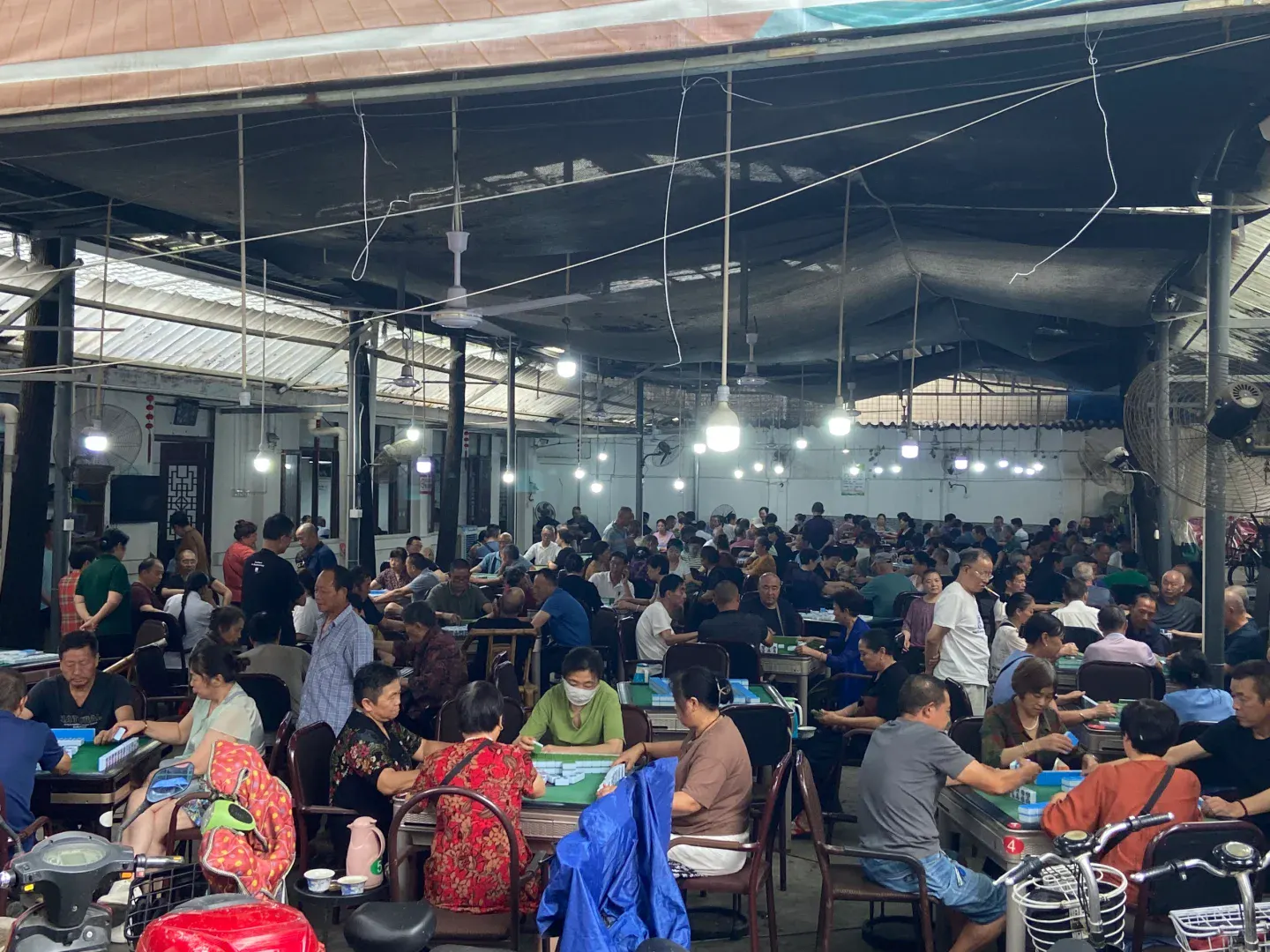
This Chengdu room explains local variation better than a list of regional rule names. Dozens of tables can share the same tile language while each group carries its own pace, jokes, tolerances and remembered procedure. Nobody enters such a room by announcing that one international PDF has overruled every table. A newcomer earns clarity by asking what changes here, then listening closely enough to play the same game as the people in front of them.
I take a firm position here: a variation is not noise around the “real” game. Variation is how mahjong lives. The moment tiles enter a household, they acquire a pace, a preferred vocabulary, rules about advice and memories of who taught whom. Standardization is useful when strangers need a fair tournament. It becomes dishonest when a rulebook is used to tell a grandmother that the table she has maintained for forty years is counterfeit.
That does not mean every claim at a family table is historically accurate. It means history and hospitality are different questions. Confirm published competition rules when a formal result matters. At home, state the house rules before the wall is built and let everyone consent to them. Clarity is more respectful than pretending there is one invisible authority in the room.
The Smithsonian Libraries record for Annelise Heinz's Mahjong: A Chinese Game and the Making of Modern American Culture is useful here: the game's movement across the Pacific produced Chinese American and Jewish American social histories, not merely a copied ruleset. American mahjong's card and jokers should be understood as a distinct living tradition, not dismissed as playing “wrong.”
Mahjong solitaire is not this game
The single-player matching puzzle found on computers uses stacked tiles as visual pieces. Players remove matching exposed pairs. There is no draw-discard hand, no four-player information problem and no attempt to build four groups plus a pair.
Both may be enjoyable. Only one teaches you to sit at a mahjong table.
What mahjong reveals beyond rules
Mahjong creates a social technology around repetition. Four people face one another long enough for speech, silence, appetite, money and temperament to become visible. The table can host family intimacy, rivalry, neighborhood routine or serious competition.

At a market-side Chengdu teahouse photographed in the late afternoon, the tables were active before grandparents left to collect children. That detail matters more to me than another romantic sentence about “slow life.” Mahjong fits between errands, care work and neighborhood recognition. Leisure is not outside ordinary responsibility; it is stitched into the same afternoon. The tiles create a reason to sit together, but the clock still belongs to family life.
In Chengdu, the click of tiles beside tea is part of a public leisure rhythm; that observation does not mean every Chengdu resident plays or one local ruleset defines the city. In In the Mood for Love, neighboring adults share mahjong and meals because domestic privacy is scarce. In Crazy Rich Asians, discussed in the Michelle Yeoh guide, tile choices turn family power and sacrifice into visible action.
Films use mahjong well when the game creates decisions, not when tiles merely decorate “Asian atmosphere.”
Your first-table checklist
Before the wall is built, ask:
- Which rules are we using?
- Are flowers, seasons or jokers included?
- What is the minimum legal win?
- How do we call chow, pung and kong?
- How does payment work?
- May a beginner keep the scoring reference visible?
During play, announce uncertainty before moving a claimed tile. Never rearrange another player's exposed group. Keep discards visible. A patient host should explain the table's procedure; a respectful beginner should not insist that an app's rules override the people actually playing.
The sentence I want every beginner to keep is: “Tell me what changes at this table.” It is better than apologizing after every turn. It tells the host that you know a shared engine exists, that local procedure matters and that you are ready to learn without surrendering your right to understand. That is not merely game etiquette. It is social fluency.
Final verdict
Mahjong is not difficult because it has mysterious Chinese tiles. It is difficult because one shared engine supports many rule systems, and beginners are often handed local exceptions before they understand the engine.
Learn the tiles. Learn draw, evaluate, discard. Learn four groups plus a pair. Then ask the table what changes. That order turns a wall of symbols into a playable social game.