Chinese board games are often introduced as a list of exotic names. That is the least helpful way to meet them. A table tells you more: who waits, who interrupts, what counts as information, whether conversation is part of the play and whether a beginner can lose without being pushed away. Start with the kind of attention you enjoy, then choose the game.
Chinese board games are different ways of sharing a table
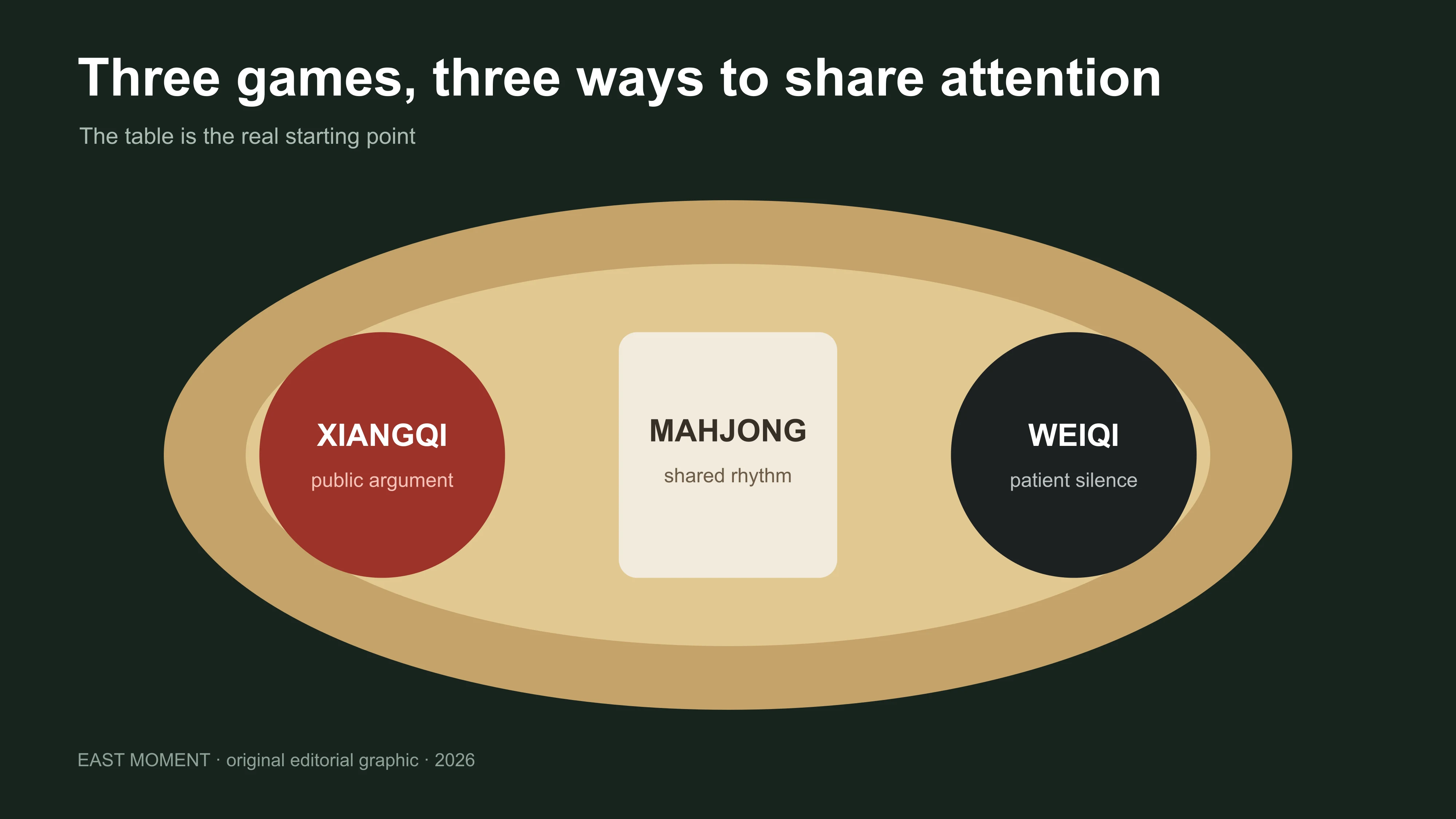
The short answer is that the most useful entry points are xiangqi (Chinese chess), mahjong and, for a slower abstract experience, weiqi (Go). They are not interchangeable versions of “Chinese strategy.” Xiangqi is a two-player battle of roads, screens and restricted zones. Mahjong is a four-player draw-and-discard game in which probability, memory and table etiquette mix. Weiqi builds influence across open space and rewards a different patience.
If I had to seat a first-time reader at one table, I would start with xiangqi. Not because it is the easiest game, but because the river, palace and blocked horse leg make Chinese ideas about space visible immediately. Once that pressure makes sense, mahjong and weiqi feel like different conversations rather than a pile of unfamiliar names.
The scene matters. A xiangqi board can invite a quiet duel between two people who barely speak. A mahjong table can be noisy, generous and socially demanding before anyone has completed a hand. The “best” game is often the one whose tempo matches the people willing to teach you.
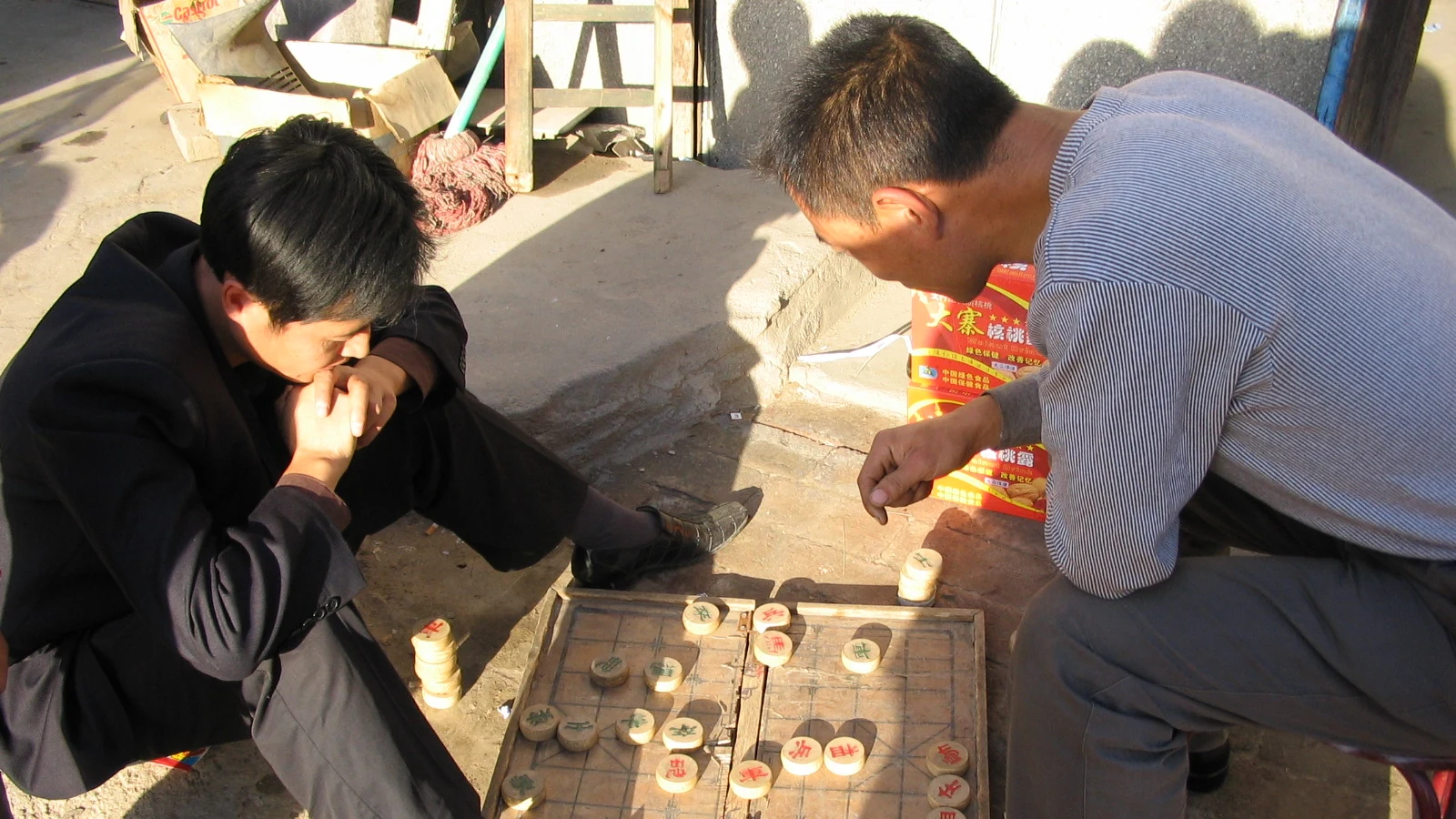
The Datong photograph above proves something the diagram cannot: a board game is also posture, waiting, worn equipment and another person's attention. It records one outdoor xiangqi table in 2005, not every Chinese game table or a national preference.
Chinese board games: choose by the decision you want to feel
| If you want to feel… | Begin with… | The table asks you to notice… |
|---|---|---|
| Direct pressure and tactical traps | Xiangqi | Roads, blocked movement, cannon screens and the safety of the general |
| Probability, memory and social reading | Mahjong | Discards, claims, changing information and local scoring rules |
| Long quiet influence | Weiqi | Shape, territory, connection and the value of empty space |
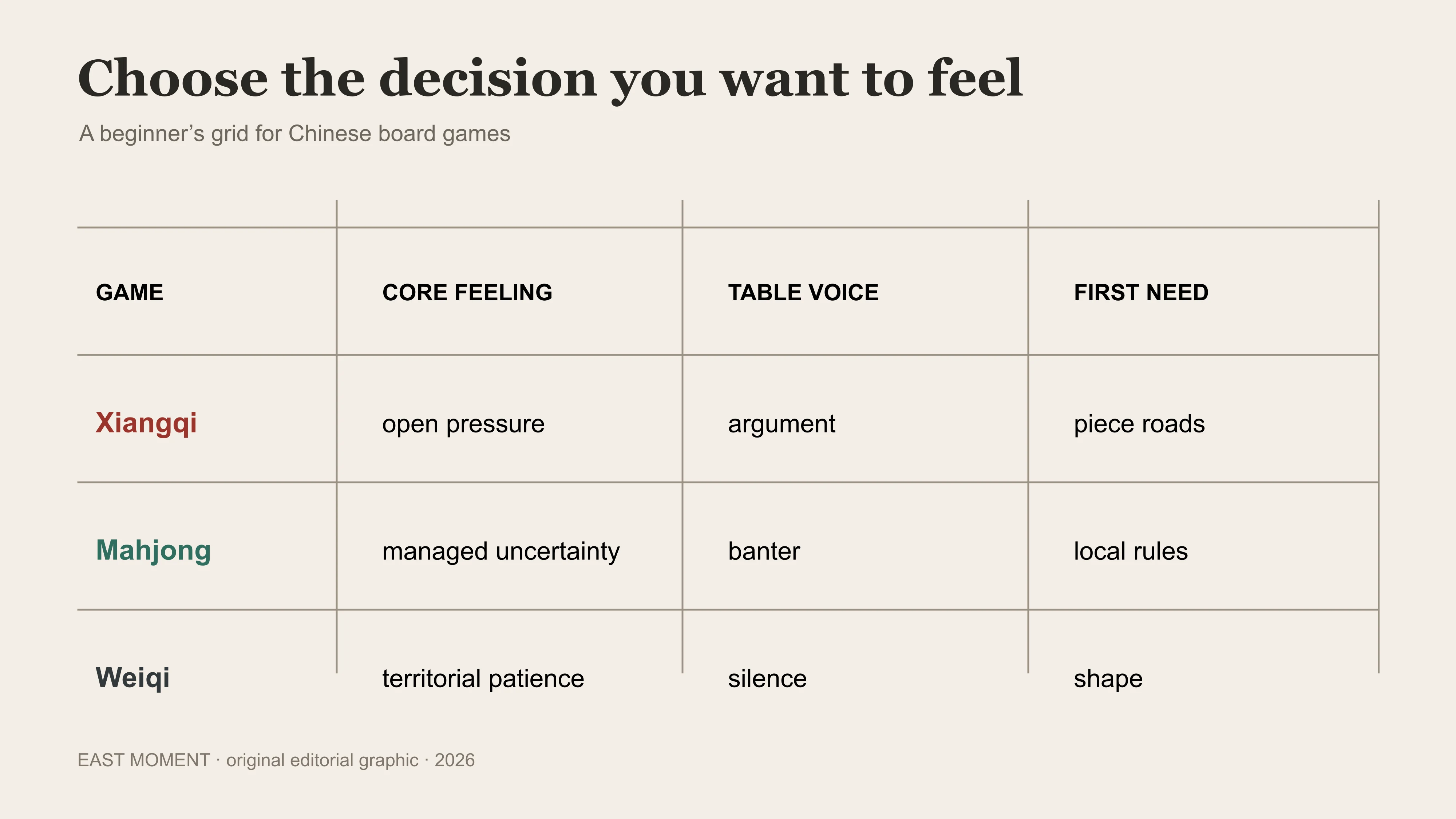
Choose the kind of attention you want to practise. A useful first game is not the one with the grandest history; it is the one whose decisions you can feel before somebody begins lecturing you.
This is a learning map, not a historical ranking. “Chinese board games” can include games with different origins, regions and modern communities. Chinese checkers is a useful search-term warning: despite its name, it is not a traditional Chinese game. Jianzi and shuttlecock games are worth exploring, but they are physical games rather than board games, so I keep them outside this page's main list.
Ready to compare a real table? Bring your game, city and house rule to Moments after you choose an entry point; the context is more useful than a decontextualized ranking.
Xiangqi turns the board into a road network
In our Chinese chess guide, the quickest route to understanding is the board itself. Pieces sit on intersections, a river divides the field, each general stays inside a palace, and a cannon captures only by jumping over a screen.
Those rules create a particular kind of drama. The chariot sees an open file but cannot cross a piece. The horse looks mobile until its first orthogonal step is blocked. The cannon appears quiet until another piece turns into a temporary bridge. A beginner who memorizes piece names without seeing these permissions will feel that every move is arbitrary.
What makes xiangqi so public is that danger can be shared. A spectator sees an open file, a trapped horse or the screen that suddenly activates a cannon and leans closer. Advice may arrive before it is invited. That can feel rude at a tournament and affectionate at a familiar street table. The board does not decide the etiquette; the people around it do. This is why I refuse to reduce xiangqi to a vocabulary sheet. The Chinese characters matter, but the living game is the moment several people recognize the same road and disagree about who owns it.
The World Xiangqi Federation is the right place to confirm the international rules vocabulary. Local clubs may explain the same rule with different language, and casual games can carry house habits. The source gives a standard reference; it does not erase the social life of a Hong Kong park or neighborhood club.
Mahjong is a board game even when the board disappears
Mahjong has no flat board in the way xiangqi does. The walls of tiles, the seats, the discard area and the shared center of the table become a temporary map. That is why I include it in this guide: the game is spatial, but its geography is made by hands and memory.
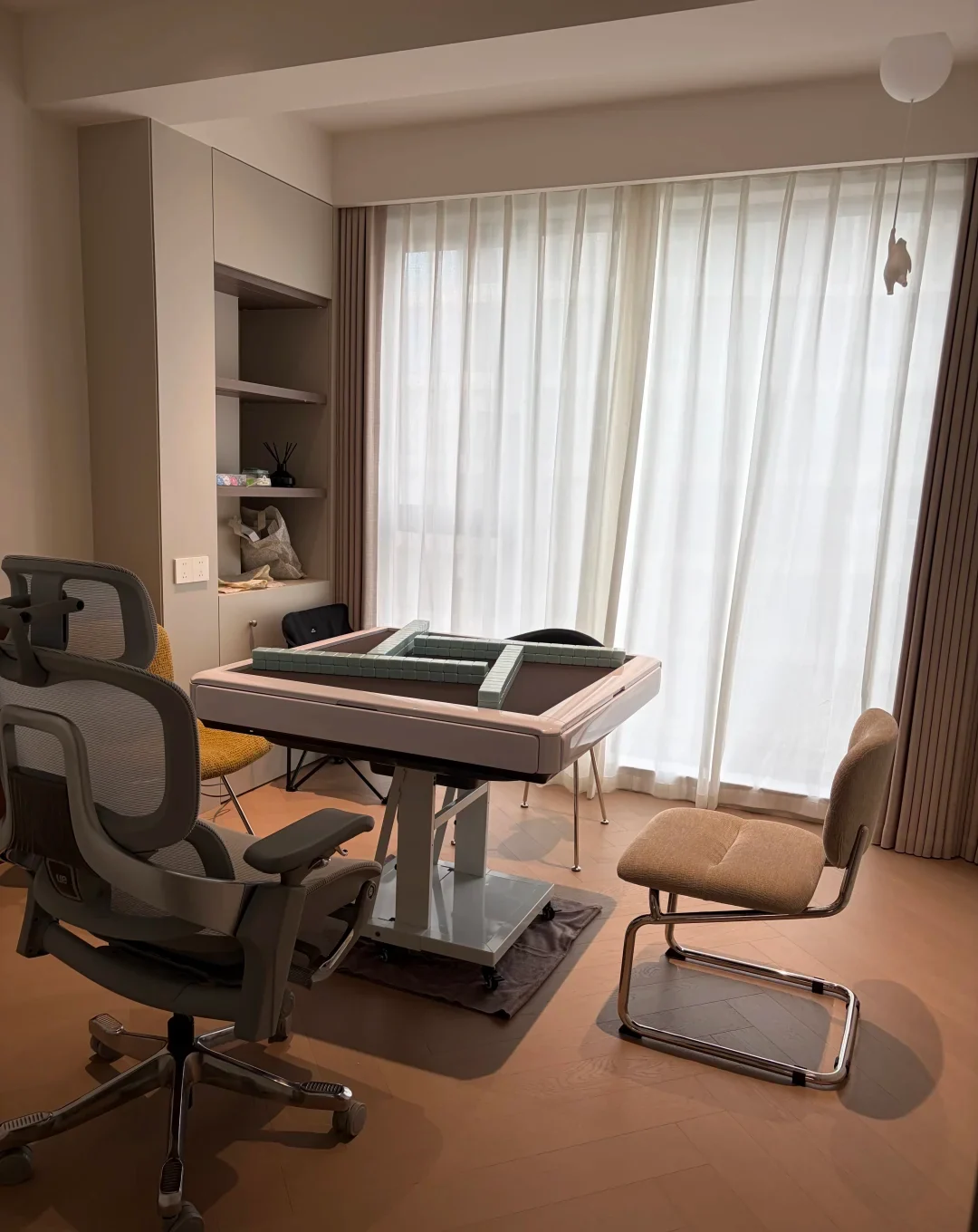
The mahjong table does not merely fit into this room; it reorganizes the room. Four seats face inward, circulation bends around the table and daylight is given to a game that may occupy hours rather than minutes.
This domestic scene catches something rules diagrams miss. An automatic table is furniture, machine and social appointment at once. It claims permanent floor area even while nobody is playing. The mismatched chairs also matter to me: this is not a showroom fantasy of perfect symmetry. It is a room prepared for bodies that will sit differently, reach across the same center and stay long enough to need comfort. One photograph cannot tell us how often the household plays or which scoring system it uses. It can show that mahjong is important enough to shape the architecture of an ordinary home.
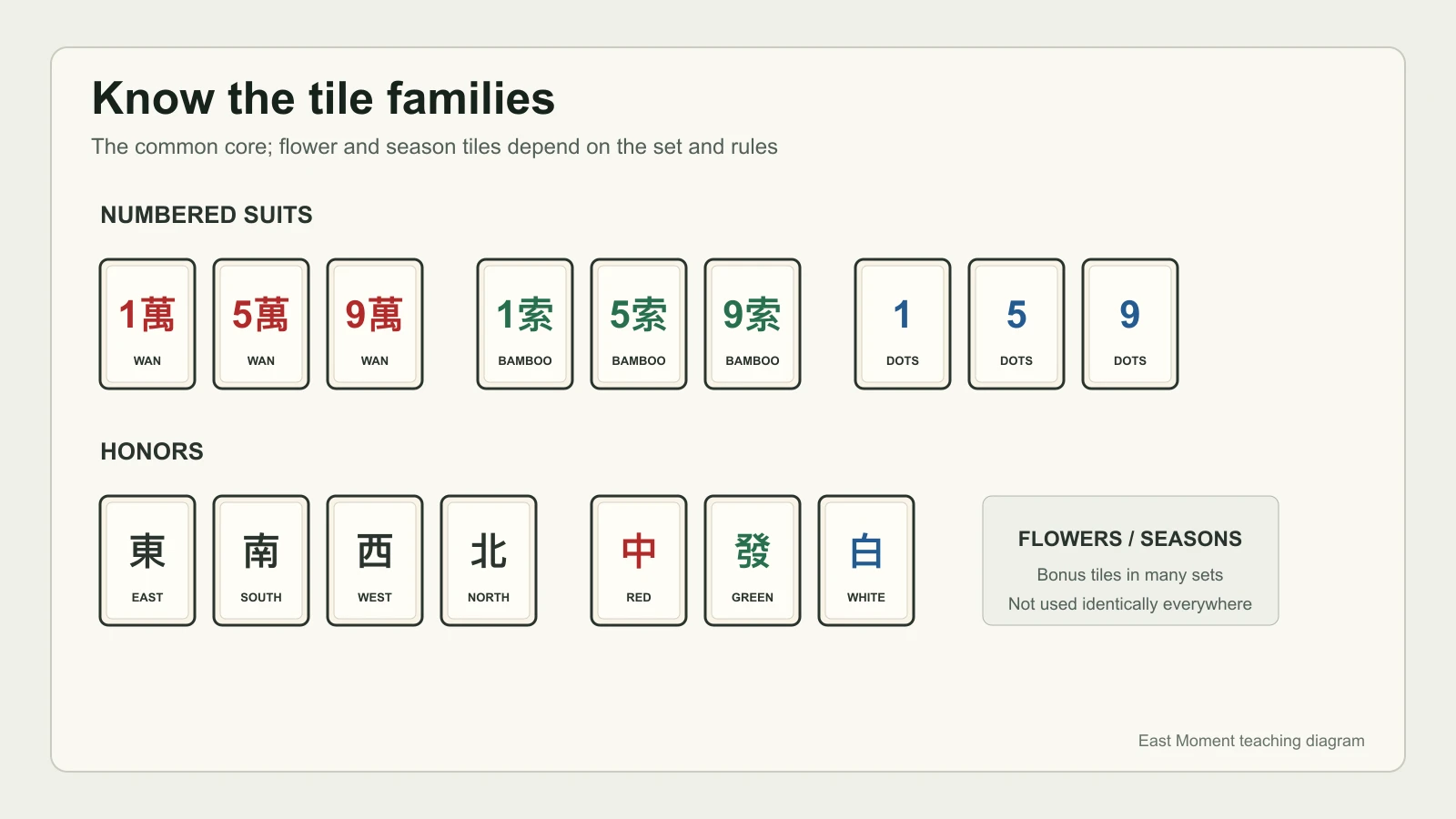
The shared engine is simple enough to state: draw one tile, decide what information to reveal, discard one tile and shape a hand toward a winning pattern. The difficulty arrives from variation. Chinese family rules, Hong Kong styles, Sichuan play, competition rules, Japanese riichi and American mahjong can share tile families while changing scoring, claims, flowers and strategy.
Mahjong creates a more private kind of pressure. Most of the useful information is incomplete: what I keep, what I expose, which discard I hesitate over and what the other three players remember. Correction therefore feels different from xiangqi. Pointing at an open chess line can clarify a public fact; reaching toward another person's concealed tiles violates the table. A good teacher explains the turn, lets the beginner make an imperfect discard and saves the long scoring argument for the end of the hand. A bad teacher turns inherited house rules into a trap and then laughs when the visitor cannot guess them.
That distinction is personal for me. I can enjoy losing to a stronger player; I cannot enjoy a table that treats hidden procedure as proof of cultural belonging. “Which rules are we using?” is not an embarrassing foreigner's question. It is the sentence that protects the game from gatekeeping.
The Smithsonian Libraries record is valuable because it follows mahjong into modern American social history rather than treating migration as a footnote. Britannica provides a concise general reference. Neither source should be used to declare that one family's table is the only authentic version.
Weiqi teaches patience through empty space
Weiqi, known as Go in English, is often described as the most ancient or profound Chinese board game. Those adjectives can frighten beginners before they have placed a stone. The more useful entry is visual: stones surround, connect, separate and leave deliberate gaps. The board becomes a changing landscape rather than a battlefield with a single king. Britannica's Go overview is a useful rules starting point; it should not be mistaken for a complete account of Chinese playing communities.
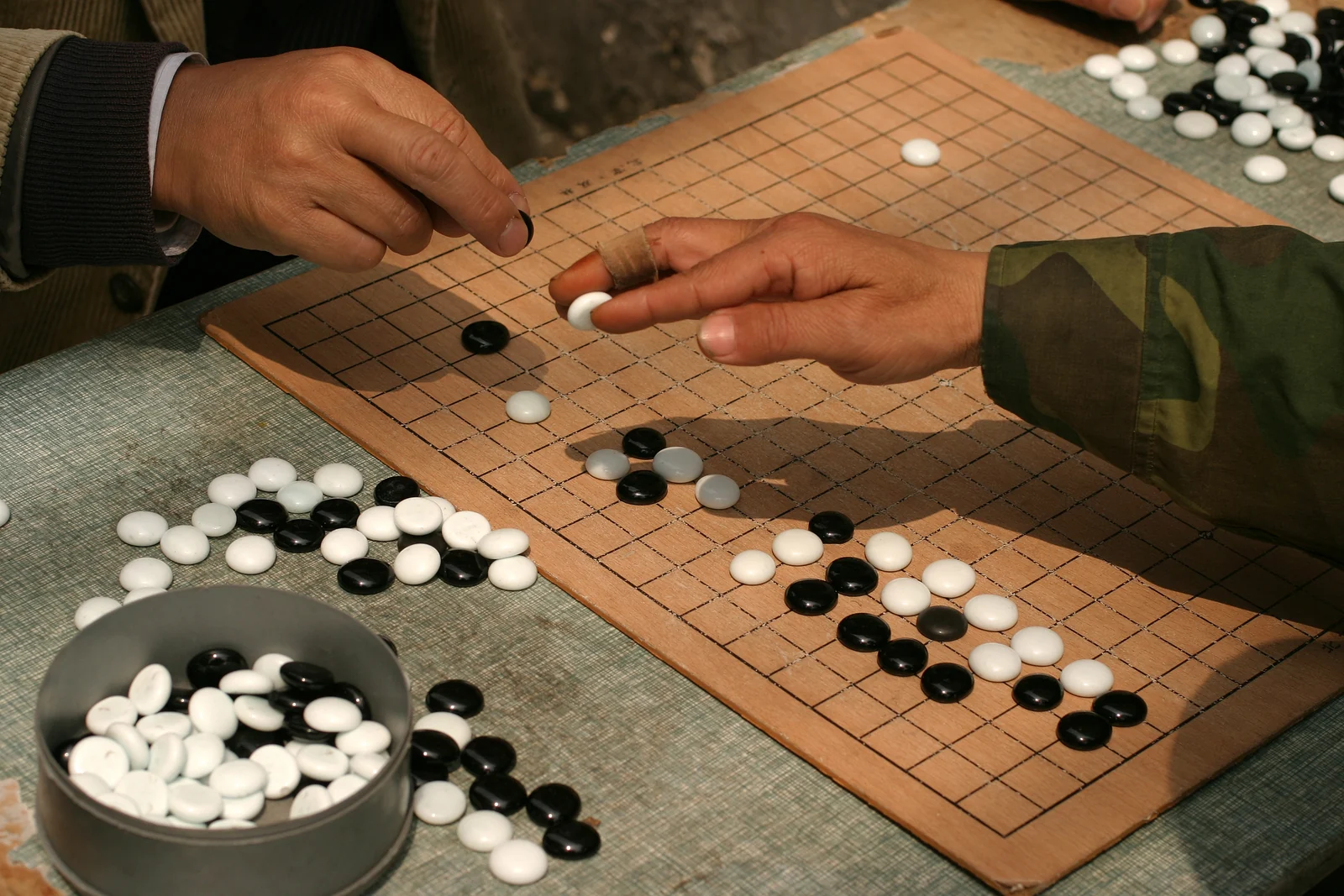
A move is held between two hands in this Shanghai game. The loose stones, worn wooden board and crowded edge make patience physical rather than philosophical.
I would not put weiqi and xiangqi on the same first lesson. Xiangqi makes threat legible through pieces and lanes; weiqi makes threat emerge from relationships among empty points. If you enjoy revising a plan slowly, weiqi may feel more welcoming than its reputation suggests. If you need a visible character to tell you where the danger is, start with xiangqi.
The empty intersections are not a lack of action. They are future connections, escape routes and boundaries that have not yet hardened. Beginners often chase every stone because capture looks like progress. Stronger play can allow a small group to go, protect the larger shape and make an apparently quiet move that changes the whole board. I find that emotional lesson more demanding than the rules: not every local loss deserves rescue. Weiqi asks whether you can stop defending a piece merely because it belongs to you.
Chinese board games live in cities, not only in rulebooks
The most important visual difference between an online rules page and a real table is the surrounding life. In Chengdu, mahjong can sit beside tea, shade and long conversation. In Hong Kong, xiangqi tables can make a public corner feel like a club with no membership desk. These observations are not claims that every resident plays. They are reminders that games survive through places and repeated invitations.
Ask before photographing a live table. A game is not automatically public property because it is being played outdoors. The best image is often the board after someone explains why a move mattered, with permission and enough context to show the people rather than turning them into scenery.
Migration keeps changing these tables. A family carries tiles to a new country, loses one scoring habit, preserves another and teaches the next generation in a mixture of languages. A park table gathers people who may share no biography beyond the ability to recognize a cannon screen. That is culture in motion, not a damaged copy of an original. I am suspicious whenever a guide asks which version is “most Chinese” before asking who still plays it, who teaches it and whether a newcomer is allowed to return.
This also explains why the surrounding city belongs in the evidence. Tea cups, folding stools, handwritten score sheets, apartment acoustics and the distance between spectators tell us how a game fits ordinary life. The rules describe what moves are legal. The room reveals what kind of relationship the game can hold.
How to join a table without making the beginner mistake
Before you sit down, ask four questions:
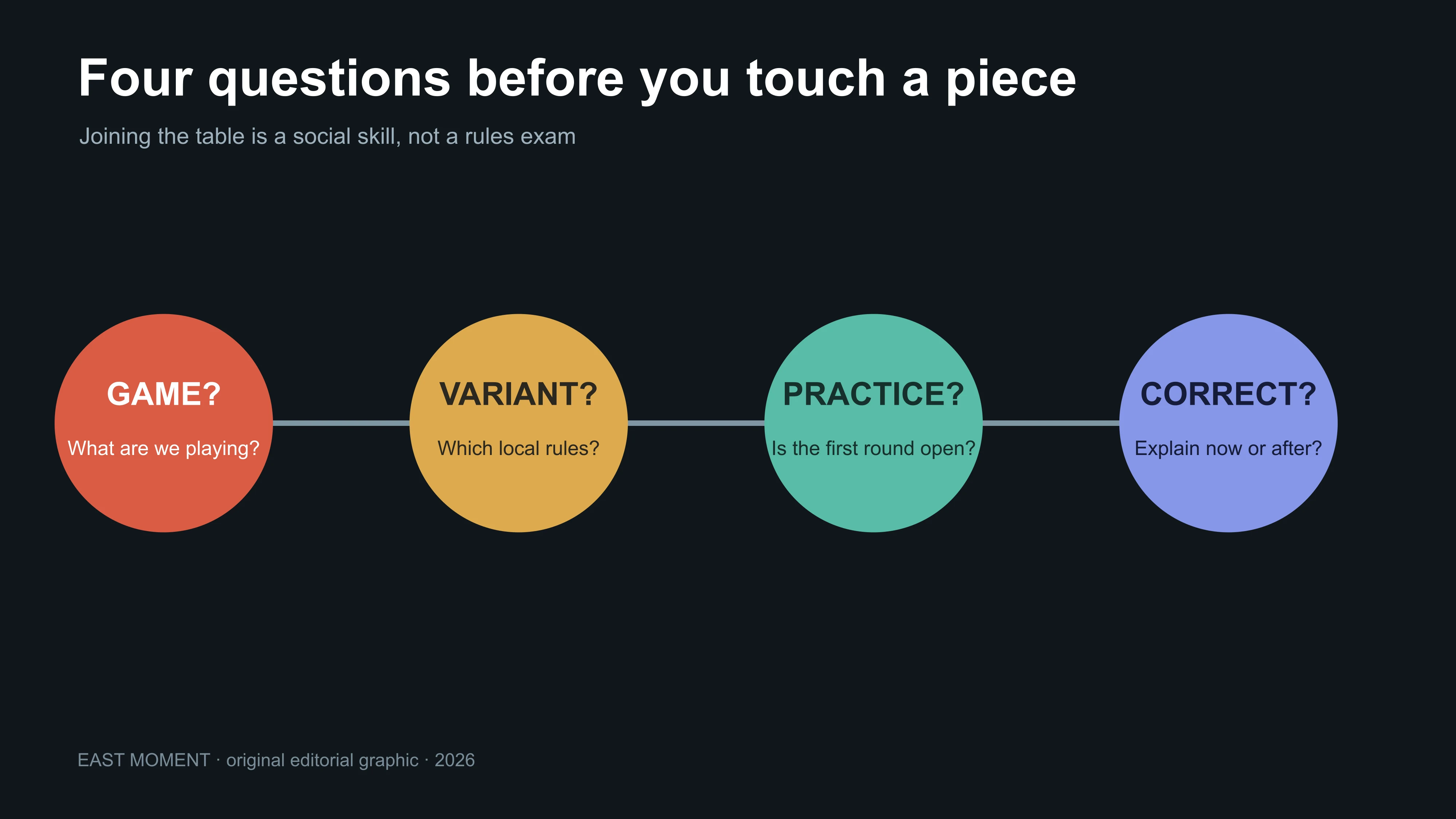
Name the game, name your level and ask for the house rules. That small act prevents more friction than pretending to understand.
- Which game and rule set are you playing? “Mahjong” is not a complete answer.
- Is this a lesson, a casual game or a serious match? The same mistake is received differently in each setting.
- What should I do when I am unsure? Some tables want you to ask; others prefer a pause between hands.
- Is money involved? Confirm before playing. This guide is about cultural play and learning, not gambling strategy.
Then learn one loop. For xiangqi, make legal moves while watching the river, palace and blocked horse leg. For mahjong, identify the tile families and complete one draw-discard cycle before worrying about rare scoring. For weiqi, place stones and learn capture on a small board.
Do not perform humility so intensely that the host must carry you. Set up the pieces, keep the discard area readable, return captured stones or tiles to the agreed place and ask one precise question at a time. Bring attention, not a speech about how ancient the game is. The fastest way to be welcomed back is to make the table easier for everyone after you arrive.
I would also reject the tourist habit of treating a public game as free entertainment. Watching is participation at the edge of the table. Stand where you do not block regular players, keep your phone down until permission is clear and do not announce the move you think somebody missed. A photograph can record a board; restraint shows that you understood the social technology around it.
The East Moment verdict: the game is a social technology
The value of Chinese board games is not that they contain an ancient secret unavailable to outsiders. Their value is that each game trains a different way of attending to other people.
Xiangqi makes a promise visible and then tests whether the road remains open. Mahjong turns partial information into a rhythm of speech, silence, memory and risk. Weiqi lets empty space become a decision. The rules matter because they create the conditions for those relationships.
Start with the complete Chinese games hub, choose one game, and play slowly enough to notice who teaches you. Then share the table in Moments: tell us the city, language, rule set and the one move that changed how you saw the game.