Chinese chess, or xiangqi (象棋), becomes understandable when you stop translating every piece into Western chess and start reading the board as roads, blockades and pressure on the general. The river and palace are not decoration. The cannon needs another piece as a screen, the horse can be physically blocked, and the two generals may never stare down an empty file. Learn those spatial ideas first and the characters stop looking like a wall of symbols.
Chinese chess in one playable picture
Two players command 16 pieces each on a board of nine files and ten ranks. Pieces sit on line intersections, not inside squares. Red commonly moves first. You win by checkmating the opposing general; under standard play, leaving the opponent with no legal move also wins rather than producing Western chess stalemate.

The fastest way to begin is not to memorize 32 Chinese characters. Set up the back rank symmetrically, place the two cannons on their marked points, put five soldiers on alternating files, then learn what the board prevents.
| Piece | Count per side | How it moves | Restriction that matters |
|---|---|---|---|
| General | 1 | One point orthogonally | Stays inside the palace; cannot face the other general |
| Advisor | 2 | One point diagonally | Stays inside the palace |
| Elephant | 2 | Exactly two points diagonally | Cannot cross the river; midpoint can be blocked |
| Horse | 2 | One orthogonal then one diagonal | The first orthogonal point, its “leg,” can be blocked |
| Chariot | 2 | Any distance orthogonally | Cannot jump |
| Cannon | 2 | Moves like a chariot when not capturing | Must jump exactly one screen to capture |
| Soldier | 5 | One point forward | After crossing the river it may also move sideways; never backward |
Red and black use different characters for several equivalent pieces. Learn the job and location first; character recognition follows through repetition.
This is the first place many English guides lose the learner. They present sixteen translated nouns, test whether you remember them, and only then allow the board to move. I teach the opposite way. Find the palace, river and open roads. Touch the piece whose movement changes at that boundary. The characters become memorable because they are attached to a physical consequence. Memorization without pressure is homework; recognition inside a position is play.
The board is a map of permissions
The blank board explains more than a page of notation.

The crossed diagonal lines at each end form the nine-point palace. Generals and advisors live inside it. The open band across the middle is the river. Elephants cannot cross it; soldiers gain sideways movement after they do.
The river therefore changes the value of pieces without behaving like a wall. Chariots, horses and cannons cross freely. A soldier that reaches the far bank does not promote to another piece. Its reward is mobility, not transformation.
The two generals create one more invisible boundary: they cannot face one another on the same open file. A piece between them may be pinned because moving it would expose an illegal face-to-face line. In real play, that rule turns the center into a source of pressure long before a beginner expects it.
Read every piece as permission plus obstruction. A chariot is not simply “worth a lot”; it is worth the road it can actually use. A horse in the center may threaten several points, yet one adjacent blocker can erase half its reach. A cannon needs a relationship with a screen. Even the slow advisor matters because the palace is small enough for one diagonal to decide whether a check has an answer. Xiangqi becomes coherent the moment value stops being a number printed beside a piece and becomes access to space.
Four rules that make xiangqi feel like xiangqi
The cannon captures through one screen
A cannon moves along open ranks and files like a chariot. To capture, however, it must jump over exactly one intervening piece and land on the enemy piece beyond it. The screen can belong to either side.
That split identity is the soul of the piece. An empty file gives the cannon mobility but no capture. Add one piece and a distant target suddenly becomes vulnerable. Add a second blocker and the line closes again. Do not ask only “what does my cannon attack?” Ask “which piece is making that attack possible?”
I insist that a beginner touch the screen piece before calculating the capture. That small gesture breaks the habit of treating the cannon as a magical jumper and makes the actual relationship visible: attacker, screen and target form one temporary machine.
A screen is temporary, which is why cannon tactics feel theatrical. The innocent soldier between attacker and target may advance; the attack disappears. Another piece may enter the line; it returns. Beginners stare at the cannon, while experienced eyes keep checking the whole file. The danger does not live inside one disc. It lives in the arrangement.

The horse has a leg that can be blocked
The horse's destination resembles a knight move, but it does not jump. It first moves one point orthogonally, then one point diagonally outward. If the adjacent orthogonal point is occupied, the horse cannot reach either destination on that side.
This is why a horse near the board edge or crowded by its own pieces can feel useless. Before counting its possible destinations, inspect its four legs.
The blocked leg is also the cleanest cure for the lazy phrase “the horse moves like a knight.” Its destination may resemble the Western chess knight, but its journey has a body. Put one soldier at the joint and two destinations vanish. Once you have physically blocked and unblocked that leg, the rule becomes unforgettable.
The elephant has an eye
An elephant moves exactly two points diagonally and cannot cross the river. The midpoint is its “eye.” Any piece on that midpoint blocks the move. Elephant defense is therefore about maintaining connected routes inside your own half, not chasing attackers across the board.
The generals cannot face
If both generals occupy the same file with nothing between them, the position is illegal. A blocking piece on that file may be unable to move. Conversely, clearing a file can deliver check from a surprising distance. The general is weak as a roaming fighter but powerful as a line constraint.
Your first opening: clear roads, do not launch everything
For a first game, make three modest improvements:
- Move a central cannon or develop a horse without blocking its leg.
- Open a chariot's rank or file so the strongest long-range piece can participate.
- Keep enough palace and elephant structure that one forcing check does not decide the game.
Do not push several soldiers simply because forward is legal. Do not move the same cannon repeatedly while both chariots remain trapped. Do not copy an opening name before you understand what line it opens.
I reject the beginner theatre of imitating ten named openings without understanding one. I prefer a player who develops one imperfect plan and can explain it. Ask what your first move released. Did a horse gain a leg, did a chariot receive a file, or did a cannon obtain a useful screen? If the answer is “nothing, but the move looked aggressive,” the position is teaching you impatience. Xiangqi is fast, yet urgency is not the same as rushing.
Xiangqi develops quickly because the cannons begin active and soldiers do not form a solid wall. Checks, pins and exchanges can appear early. The correct beginner response is not fear; it is to look at every open rank and file after each move.

How to read a position before touching a piece
Use this order:
- Checks: Can either side check immediately?
- Exposed lines: Which chariot or cannon line changed after the last move?
- Blocked joints: Which horse leg or elephant eye is occupied?
- Loose pieces: Which piece is attacked more times than it is defended?
- General file: What happens if the central blocker moves?
This short scan prevents the most humiliating beginner losses. It also reveals why people lean over a board for so long after an apparently small move: a single disc has changed several roads at once.
After that scan, name the two duties of the piece you want to move. A central soldier may block the generals and screen a cannon. A palace defender may guard an escape point and keep a chariot from entering. If you see only the attack you are making, you will miss the defense you are abandoning. This overlapping labor is why a quiet move can provoke louder discussion than a capture.

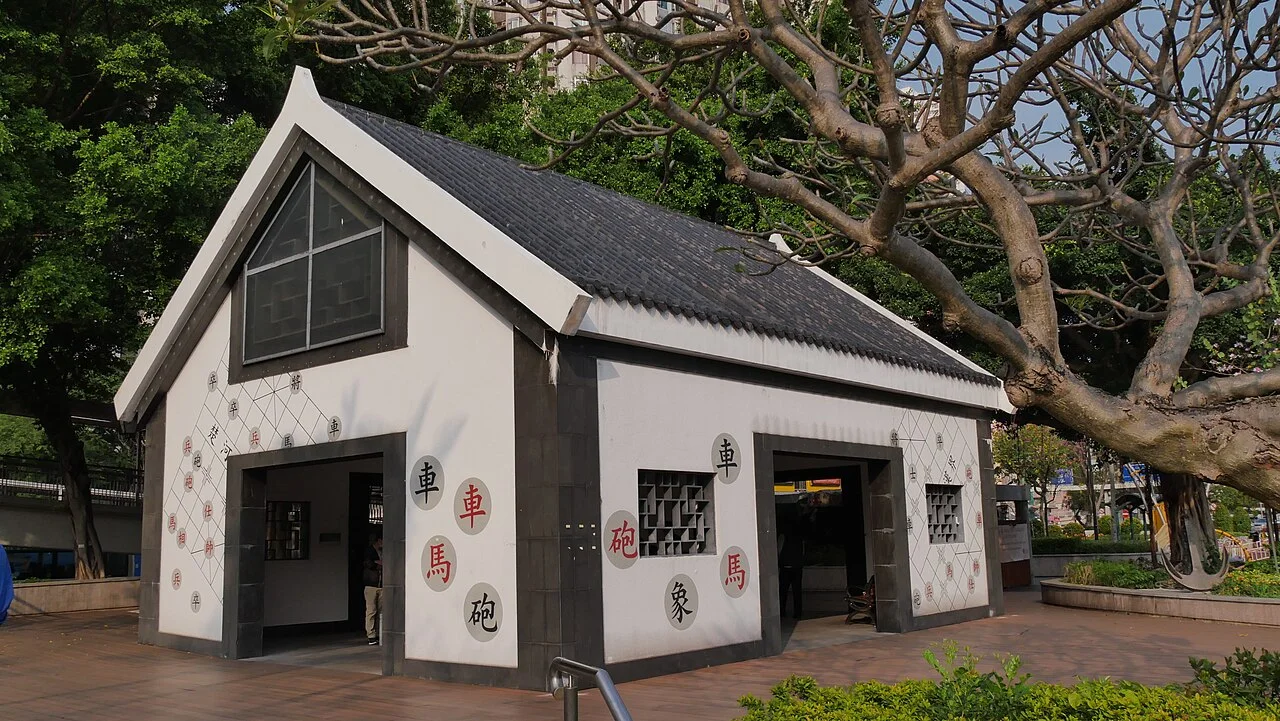
The Columbus Park table matters here. Xiangqi travels well because the equipment is compact, but its social language travels too: spectators stand close, point at lines and replay alternatives. A board can become a temporary public room. The same pattern appears in a Hong Kong club, a Kunming park or a Chinese diaspora neighborhood without making those places identical.
The common beginner mistakes
- Treating the cannon as a jumping chariot. It jumps only while capturing and needs exactly one screen.
- Forgetting blocked horse legs. A destination that looks geometrically available may be illegal.
- Sending the general out of safety. It never leaves the palace.
- Assuming stalemate is a draw. Under standard xiangqi rules, a player with no legal move loses.
- Expecting promotion. A soldier gains sideways movement after the river but never becomes another piece.
- Ignoring the face-to-face rule. Moving a central defender may expose the two generals.
- Trading chariots casually. Equal material is not equal position if one side's remaining roads are open.

What Chinese chess is not
Xiangqi is related to the wider chess family, but “Chinese version of chess” is only a doorway. The river, palace, cannon screen, blocked horse and flying-general line create a different information system. Importing Western piece values and opening instincts without adjustment hides the game you are trying to learn.
Nor is xiangqi one frozen antique. The World Xiangqi Federation governs international competition, while clubs, parks, apps and family tables keep the game ordinary and conversational. Its rules belong beside a playable beginner explanation such as Xiangqi.com's illustrated guide: the first supplies a formal authority, while the second helps a new player see the board. Neither explains every local habit around clocks, takebacks or advice from spectators.
It is equally wrong to use the game as a shortcut to a national personality. Xiangqi does not prove that Chinese people are naturally patient, tactical or collective. It proves that generations of players found durable pleasure in this particular system of constrained roads. The culture is visible in the vocabulary, material design, places of play and habits of teaching—not in a personality test imposed on millions of people.

The best route into your first real game
Use a board that displays both Chinese characters and English labels if character recognition slows you down. Play without a clock. Ask your opponent to point out illegal moves but not to rescue strategic mistakes. After the game, replay the first position where a cannon line, horse leg or exposed general surprised you.
If the roads and blockades excite you, stay with xiangqi. If they feel too exposed, use the Chinese board games guide to choose a table by the kind of decision you enjoy instead of by cultural prestige. Then read the mahjong guide for the opposite kind of Chinese table intelligence: probabilistic hand-building rather than perfect-information warfare. Browse the Chinese games hub when you want to compare what different games make visible about memory, calculation and social play.
A 10-minute first game of Chinese chess
You do not need a tournament opening, an app rating or a Chinese-speaking opponent to make the first game useful. You need a small experiment with a clear purpose. This is the route I would give to a visitor who has just sat down at a park table.
Minute 1: set the board and name the boundaries. Put the river between the two armies, check that each general is inside a palace, and point to the five soldier marks. Say the words river, palace and road aloud. They are more useful than trying to remember every piece name before the first move.
Minutes 2–3: make one road. Develop one horse while checking that its leg is not blocked, or move a central cannon to a square from which it can see a useful file. Do not move a cannon simply because it can move far. Identify the screen it would need to capture and whether that screen belongs to you or your opponent.
Minutes 4–5: open a chariot. Move one piece that currently traps a chariot. The point is not to “attack” immediately; it is to give a long-range piece an honest line. After your move, look down the file and ask whether the opposing cannon now has a screen, whether a general is exposed, and whether your own back rank became loose.
Minutes 6–8: make every move answer three questions. What checks exist now? Which horse leg or elephant eye changed? If I move this blocker, will the generals face? This is a complete beginner's tactical scan. It prevents the common mistake of seeing only the piece you want to move.
Minutes 9–10: stop before the first dramatic capture. If a capture is available, explain the relationship that makes it legal. For a cannon, name the screen. For a horse, name the leg. For a general, name the palace and the line. If you cannot explain the move, do not make it yet. A slower legal move teaches more than a spectacular illegal one.
I prefer this small experiment to a memorised opening because it creates a memory attached to a consequence. You will remember the horse that could not move because a soldier occupied its leg. You will not remember the seventh move of an opening whose purpose was never visible. The best first lesson in how to play Chinese chess is therefore not a list of moves. It is learning to notice what each move releases and what it closes.
Chinese chess vs. Western chess: the differences that change your thinking
Searching for “Chinese chess vs chess” often produces a table of piece names. That is a useful orientation, but it misses the reason the games feel different after ten moves. The decisive contrast is the shape of permission.
| Question | Chinese chess / xiangqi | Western chess |
|---|---|---|
| Where do pieces stand? | On intersections of nine files and ten ranks | Inside 64 squares |
| What divides the armies? | A river that changes soldiers and stops elephants | No river boundary |
| Where is the king-like piece? | The general stays inside a palace | The king can travel across the board |
| Can a piece jump? | The cannon jumps only to capture through one screen | The knight jumps as part of every move |
| Can a pawn change identity? | A soldier gains sideways movement after crossing, but does not promote | A pawn can promote on the far rank |
| What happens with no legal move? | In standard xiangqi, having no legal move loses | In standard chess, stalemate is a draw |
| What line rule surprises beginners? | The two generals may not face each other openly | No equivalent flying-general rule |
These are not trivia differences. They change what “safety” means. In Western chess, a king may hide behind pawns, escape to another square or castle under the rules of the position. In xiangqi, the general is a protected command point inside a compact palace. A file that looks quiet can become a direct threat when one blocker moves. The cannon makes a defended piece dangerous in a way that does not have a simple Western equivalent: the screen is both an obstacle and the mechanism of attack.
The river also changes the emotional rhythm of a game. A soldier crossing it has not become a new piece, but it has gained the ability to move sideways and enter the opponent's structure. An elephant, by contrast, must remain on its own side. One boundary therefore gives a small piece new ambition while denying another piece a route entirely. That asymmetry is why the middle of the board can feel open and constrained at the same time.
My view is that “Chinese chess is more aggressive” is too blunt to be useful. Early cannon activity and exposed lines can make the opening look violent, but the real skill is managing access. A player who opens every road without checking the palace has not become brave; they have donated the map. Xiangqi rewards initiative, but only when initiative leaves a defensible return path.
How to read a Chinese chess position after the game
Beginners often remember the winner's final check and forget the move that made the check possible. A short post-game review should run backwards from the first irreversible change.
- Find the first opened line. Which move gave a chariot, cannon or general a new file?
- Mark the first blocked joint. When did a horse leg or elephant eye disappear?
- Locate the missing defender. Which piece moved away from a palace point, soldier chain or cannon screen?
- Replay the first check one move earlier. Was the check visible, or did the previous move make it inevitable?
- Write one sentence, not a verdict. “I lost because I moved the screen” is more useful than “I am bad at tactics.”
This method works whether the game was played in a club, on a phone or beside a street table. It also gives the conversation a better shape. Instead of asking who blundered, ask which road changed. Experienced players may disagree about the best continuation, but they can usually point to the same physical facts: a line opened, a leg was blocked, a palace square was abandoned.
For readers who want to learn the Chinese characters, copy the pieces from one completed game rather than drilling a disconnected chart. The red general is 帥 and the black general is 將; the red advisor is 仕 and the black advisor is 士. The two colors use different characters for equivalent roles, which is one reason a translated diagram can be helpful at first. Character recognition should support seeing the position, never replace it.
The final lesson is simple: xiangqi pieces are not mysterious because they carry Chinese characters. They feel mysterious only while you are looking at the discs instead of the roads between them.