Jackie Chan's defining invention is not that he performs dangerous stunts. It is that he makes danger reveal a person. His hero hesitates, grabs the wrong object, fails, hurts and tries again. The action remains impressive, but the visible problem-solving is why it becomes funny, tense and emotionally legible at the same time.
Jackie Chan in 60 seconds
| Question | Short answer |
|---|---|
| Chinese name | Cheng Long (成龙) |
| Birth name | Chan Kong-sang |
| Born | April 7, 1954, in Hong Kong |
| Age | 72 as of August 12, 2026 |
| What he does | Actor, stunt performer, director and action filmmaker |
| Best first film | Police Story if you want his full method in one film |
| Best early contrast | Drunken Master for comic form; Project A for physical authorship |
| Hollywood entry | Rush Hour is accessible, but it is not the complete Jackie Chan method |
| Major recognition | Academy Honorary Award presented at the 2016 Governors Awards |
| Most recent verified film here | Karate Kid: Legends (2025), returning as Mr. Han |
The quick answer to “why is Jackie Chan famous?” is incomplete if it stops at martial arts. His real subject is the vulnerable body navigating an uncooperative world. A chair is not set dressing. A staircase is not background. Every object can rescue him, betray him or expose how quickly he thinks.
Which Jackie Chan movie should you watch first?
Choose by the question you want the film to answer.
| Your viewing goal | Start here | What to watch |
|---|---|---|
| Understand the complete method | Police Story (1985) | Urban space, emotional clarity, escalating danger and comic reaction |
| See how props become choreography | Project A (1983) | Bicycles, rails, clocks and vertical space changing each decision |
| Understand the comic breakthrough | Drunken Master (1978) | Rhythm, humiliation and an imperfect student becoming a distinctive hero |
| See ensemble craft at full scale | Police Story 3: Supercop (1992) | Jackie Chan and Michelle Yeoh sharing risk, timing and screen authority |
| Understand American discovery | Rush Hour (1998) | Partnership, language friction and personality inside a Hollywood structure |
| See the older mentor image | The Karate Kid (2010) | Restraint and grief replacing the frantic underdog rhythm |
| Check the current legacy role | Karate Kid: Legends (2025) | Mr. Han positioned as teacher within a cross-generational franchise |
If you watch only one, choose Police Story. If you watch three, add Project A and Drunken Master. That route explains his cinema before Hollywood explains his celebrity.
Police Story 3: Supercop also belongs to Michelle Yeoh's story, not only Chan's franchise. The Michelle Yeoh guide explains how her controlled authority and willingness to carry physical consequence create an equal screen intelligence rather than a capable guest beside the hero.
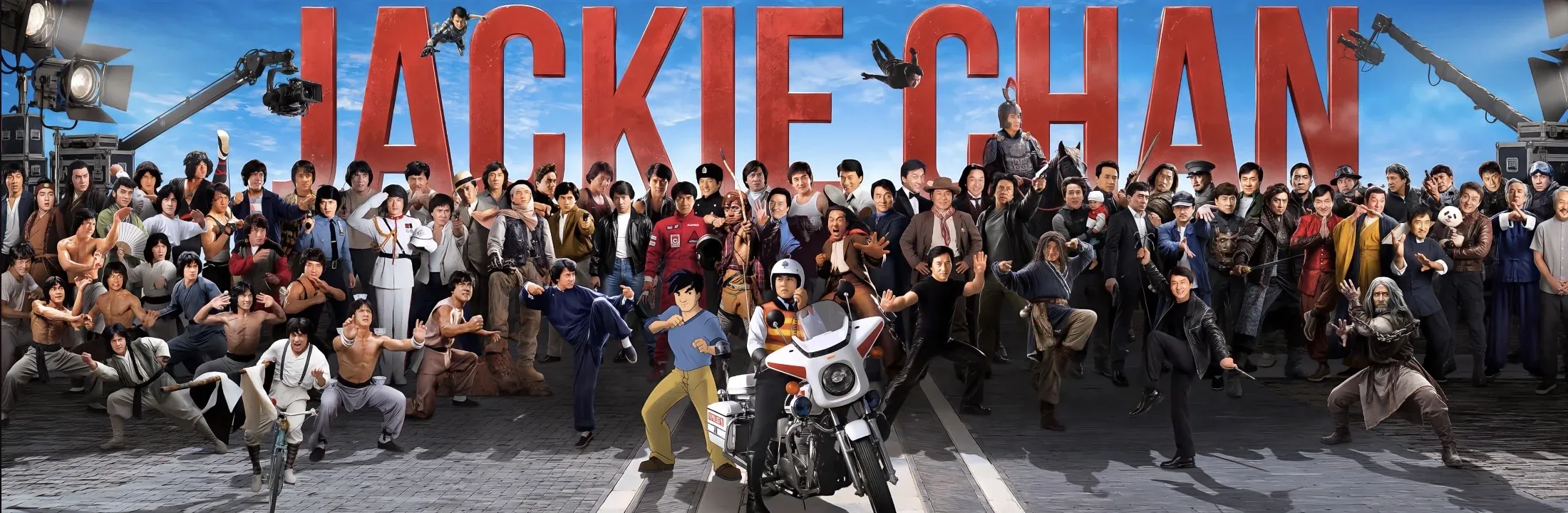
My preference is less forgiving. I would rather show a reader three films that explain how Chan thinks than list thirty titles that merely prove he has been famous for a long time. Police Story, Project A and Drunken Master are not interchangeable “best movies”; together they show the urban problem-solver, the architectural daredevil and the humiliated student. Only after that route does Rush Hour become interesting as a translation of an already complete screen language.
The stunt is not the story; the decision inside it is
Many action scenes ask, “Can the hero win?” Jackie Chan's best scenes keep asking smaller questions: Where can he put his foot? What can he grab? How much did that landing hurt? What mistake creates the next problem?

Play Criterion's official trailer in place. Ignore the number of hits on the first viewing. Watch the chain of looks, failed grips, collisions and recoveries that lets the audience understand why each movement happens.
This is the first principle of his screen language: cause and effect must remain visible. The camera often gives the body and obstacle enough room to share the frame. A successful move then feels earned because the viewer saw the problem before the solution.
Danger alone cannot produce this effect. A spectacular fall without a readable setup is an event. Jackie Chan turns setup, failure and recovery into a sentence.
Why pain makes the comedy stronger, not weaker
The common description “he does his own stunts” can flatten the work into a courage statistic. Physical commitment matters, but the more distinctive choice is what happens after impact. He shakes a hand, checks a bruise, loses balance or looks briefly terrified. The hero does not become invulnerable just because the performer is skilled.
That visible pain performs three jobs:
- It preserves stakes. The audience understands that the next obstacle matters.
- It produces recognition. The reaction resembles how an ordinary person imagines responding.
- It resets rhythm. A pause after impact creates room for the next escalation.
This is why laughter does not automatically cancel danger. The joke often comes from the body's honest objection to what the plot requires it to do.
The method should not be confused with safety advice. A finished scene is the product of choreography, rehearsal, camera placement, editing, professional teams and risk management. East Moment does not provide instructions for imitating any stunt.
Props are partners, not decoration
In weaker action, an object waits for the hero to use it. In strong Jackie Chan action, an object has behavior. A ladder swings beyond control. A chair blocks one line but opens another. A wall limits escape while creating leverage. The object changes the scene rather than merely receiving a strike.
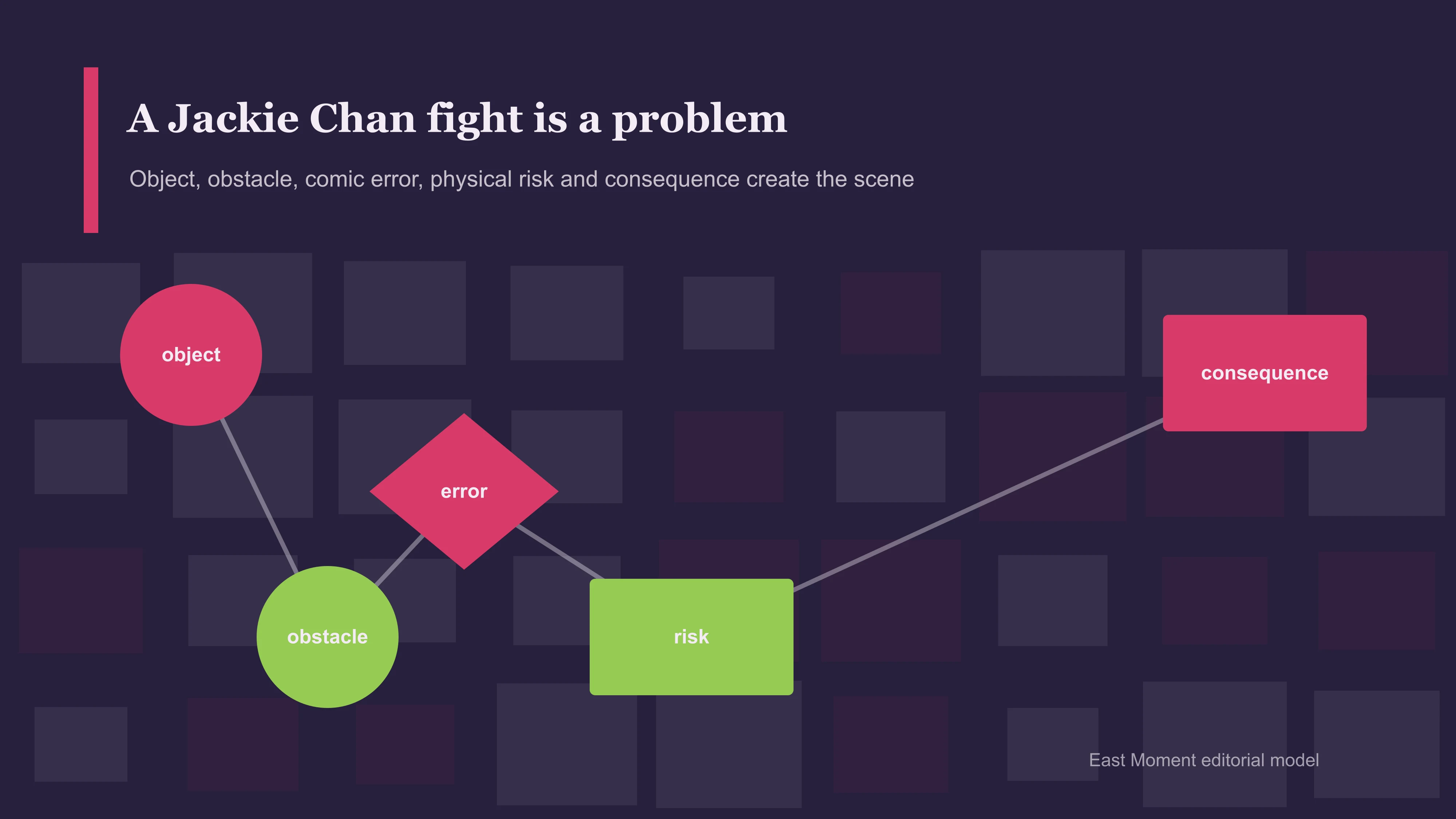
The useful unit is not “cool move.” It is a three-part exchange:
- Problem: space or an opponent removes the obvious option.
- Improvisation: the character tests an object or route.
- Consequence: the solution creates a new risk, joke or piece of information.
This structure lets choreography reveal intelligence. The character is not simply stronger than everyone else. He survives by noticing the room faster.
Project A shows Jackie Chan becoming an author of action
Project A matters because it joins performance, comic timing, period adventure, vertical danger and control of the larger film. It is not merely a container for a famous clock-tower fall. The film teaches the audience how to read the character before asking the body to take the decisive risk.

Eureka Entertainment's official restoration trailer identifies the films and their physical world. Use it as a viewing doorway, not as proof of every production detail surrounding an individual stunt.
The crucial shift is authorship. Jackie Chan is not only a body placed inside someone else's action design. His mature Hong Kong work coordinates star image, gag construction, camera distance, location and escalation around one consistent proposition: skill is most entertaining when it remains vulnerable to circumstance.
Police Story is the best single demonstration
Police Story brings the method into a modern city. Glass, vehicles, shopping-mall levels, poles and crowds turn familiar urban structures into escalating physical choices. The scale is large, but the scene geography stays unusually legible.
It also reveals why expressive acting matters. Jackie Chan's face communicates calculation before movement and consequence afterward. Remove those reactions and the same stunt becomes less funny and less personal.
This is the film to use when someone calls him only a martial artist. Martial skill is present, but filmmaking determines what the audience knows, anticipates and feels.
Rush Hour made him globally familiar by reducing part of the method
Rush Hour is important. The partnership with Chris Tucker, conflicting rhythms and language-based frustration made Jackie Chan newly accessible to a large American audience. His warmth and physical clarity survive the production system.
But it should not be mistaken for the origin or fullest form of his cinema. The Hollywood star vehicle gives less control to extended physical problem-solving and more weight to buddy chemistry, dialogue and franchise pacing.
That distinction is not a dismissal. It explains two different search intents:
- Watch Rush Hour to understand the international celebrity.
- Watch Police Story and Project A to understand the filmmaker the celebrity came from.
The best comparison is not “Hong Kong good, Hollywood bad.” It is authorship versus adaptation: which parts of a highly specific screen language remain when another industry changes the production grammar?
Jackie Chan and Donnie Yen solve different screen problems
Comparing action stars by asking who would win in real life produces speculation, not criticism. Compare what their films make visible instead.
| Question | Jackie Chan | Donnie Yen |
|---|---|---|
| Primary dramatic engine | Improvisation under pressure | Control of range, rhythm and impact |
| Relationship to space | The room continually creates new problems | Distance reveals tactical advantage |
| Comic body | Frequently vulnerable, frustrated and off balance | Usually more controlled and compressed |
| Best entry point | Police Story | Ip Man or Flash Point |
| Useful viewing question | What object changes the decision? | What rhythm or range change controls the exchange? |
Continue with the Donnie Yen guide to apply the comparison to specific scenes. Neither page ranks private fighting ability. Both treat screen combat as authored performance.
Bruce Lee creates a different contrast. Lee compresses stillness into direct release and makes adaptation to an opponent the dramatic event; Jackie Chan lets the room interrupt him until failed plans become character. Read the Bruce Lee guide to compare Fist of Fury with Police Story without turning either performance into an unprovable private-fighting hierarchy.
The Academy award recognized a film career, not a stunt count
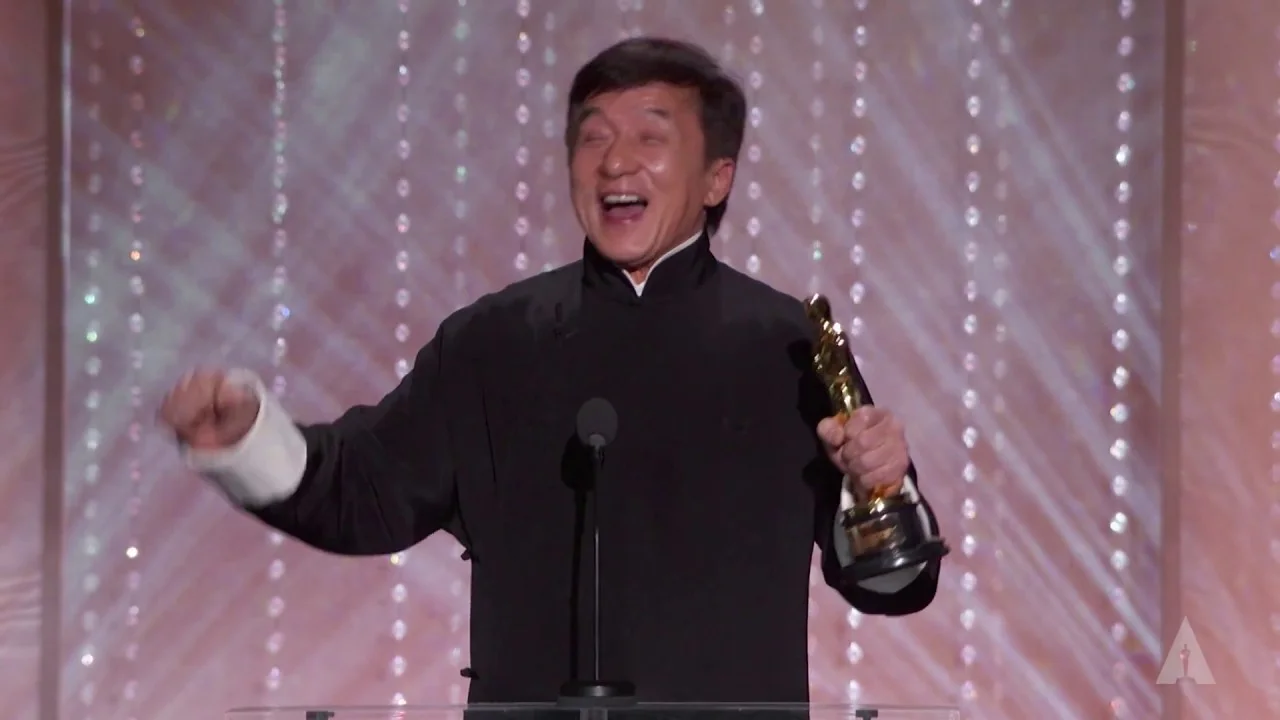
At the 2016 Governors Awards, the Academy presented Jackie Chan with an Honorary Award. The official acceptance video matters because it places the achievement inside a lifetime of filmmaking rather than a viral compilation of dangerous moments.
The Academy's official acceptance video, represented by the opening image, verifies the presentation and preserves Jackie Chan's own public response. It does not need to become a claim that every film or stunt is equally accomplished.
Recognition can also distort a career by compressing it into “lifetime legend.” The better use of the award is to return to the work and identify the method being honored: physical performance joined to directing, choreography, comic construction and a screen identity that crossed languages without becoming anonymous.
What changed as Jackie Chan became older?
Jackie Chan was born on April 7, 1954, making him 72 on August 12, 2026. Age should not be treated as a countdown to one more dangerous fall. The useful question is how a screen language built around recovery changes when speed and risk can no longer carry the same proportion of the performance.
Later mentor roles shift attention toward stillness, memory and instruction. In The Karate Kid (2010), Mr. Han's authority is deliberately quieter than the frantic underdog of the classic Hong Kong films. The body carries history before it demonstrates technique.
That change can produce depth, but it can also reduce him to a symbol of wisdom. A strong late role must give the older character a present-tense problem, not merely ask his face to certify someone else's journey.
Karate Kid: Legends is the verified 2025 chapter
Sony Pictures identifies Karate Kid: Legends as a 2025 film and Jackie Chan as Mr. Han, guiding Li Fong alongside Ralph Macchio's Daniel LaRusso. It connects two franchise lineages and positions Chan as a teacher rather than the young body discovering how to survive the room.

Sony's official trailer verifies the current role and visual relationship. The critical test is whether Mr. Han receives choices and vulnerability of his own, or functions mainly as inherited authority.
Do not use an announced or rumored project to prove that Jackie Chan is “still at his peak.” Current relevance and physical peak are different claims. His late-career value lies in whether experience becomes performance rather than branding.
How to watch a Jackie Chan scene closely
Use this five-step method on one complete scene:
- Map the room. Identify height, exits, loose objects and surfaces before the action accelerates.
- Find the first failure. Notice the move or plan that does not work; it usually defines the character's next choice.
- Track one prop. Follow how its function changes from obstacle to tool or from tool to threat.
- Watch the reaction. Pain, surprise or embarrassment should alter timing, not disappear between cuts.
- Read the final consequence. Ask what changed in the character or situation beyond the defeated opponent.
This method separates film analysis from stunt worship. It gives readers something verifiable to discuss together instead of repeating a list of injuries or impossible rankings.
The stunt mythology can hide the acting
The Jackie Chan formula can become mechanical when a production copies its visible ingredients without the underlying decisions. A ladder, grimace and fast exchange do not automatically create character. The scene needs a clear problem, an evolving relationship to space and consequences that survive the gag.
Some later films also rely on the accumulated affection attached to his name. Nostalgia can make a familiar gesture feel more meaningful than the surrounding movie earns. Respect for the career should not eliminate judgment of the current work.
His global image carries another simplification: viewers may know the friendly Hollywood partner while missing the controlling filmmaker behind the Hong Kong classics. A serious profile must hold both identities together without pretending they are the same.
Final verdict: why Jackie Chan still matters
Jackie Chan changed action cinema by refusing the fantasy that skill must look invulnerable. His hero can be frightened, unlucky and physically outmatched while remaining inventive. That combination turns environment into story and pain into evidence that the body belongs to a person.
Start with Police Story, then watch Project A and Drunken Master. Use Rush Hour to understand the global adaptation and Karate Kid: Legends to judge the current legacy role. The sequence explains more than a ranked list of his highest-grossing films.
Continue through the Chinese actors guide, distinguish screen craft from practice through the Chinese martial arts guide, and place the films inside the wider Chinese film collection. For a comedy built from a different star and directorial system, compare Kung Fu Hustle.
In the comments, name one scene and one object, failed move or reaction to pain. Explain what it reveals about the character. That level of specificity can become a useful community archive of action filmmaking rather than another unprovable “greatest fighter” debate.