Bruce Lee matters because he refused to let a form become an identity. His films, martial method and public philosophy keep returning to the same discipline: observe the actual problem, test a direct response, discard what has become rigid and adapt without losing purpose. That is more useful than treating him as an unbeatable legend or a collection of motivational quotes.
Bruce Lee in 60 seconds
| Question | Short answer |
|---|---|
| Chinese name | Li Xiaolong (李小龙); born Lee Jun-fan |
| Born | November 27, 1940, in San Francisco |
| Raised | Hong Kong, where he acted as a child and began martial-arts training |
| Died | July 20, 1973, in Hong Kong, aged 32 |
| What he did | Actor, martial artist, teacher, writer, director, producer and choreographer |
| Martial method | Jeet Kune Do, or “Way of the Intercepting Fist” |
| Best first film | Fist of Fury for star power; The Way of the Dragon for authorship; Enter the Dragon for the global image |
| Central idea | Simplicity, directness, freedom and continuous adaptation |
| Wrong first question | “Could he defeat every other martial-arts star?” |
Bruce Lee was born in the United States, raised in Hong Kong and buried in Seattle. He became an international film star through Hong Kong cinema and a Hollywood co-production. No single national label explains the whole person; movement among places is part of the story.
I refuse to begin with the cardboard Bruce Lee: the invincible scream, the poster quote and the yellow tracksuit separated from a changing mind. I want the child actor, the impatient teacher, the comic filmmaker and the man who kept testing his own answers. The icon is easy to recognize. The unfinished person is much harder, and far more useful.
Which Bruce Lee movie should you watch first?
Do not begin with a ranked list. Choose the film that answers your question.
| Your viewing goal | Start here | What to watch |
|---|---|---|
| Meet the explosive star image | Fist of Fury (1972) | How stillness holds anger before movement releases it |
| See Lee control the whole argument | The Way of the Dragon (1972) | Writing, directing, producing, choreography, comedy and the Colosseum duel |
| Understand the international icon | Enter the Dragon (1973) | How a Hong Kong star becomes legible inside a global genre machine |
| See the breakthrough before refinement | The Big Boss (1971) | The transition from ensemble worker to overwhelming screen center |
| Study the unfinished legacy problem | Game of Death | Surviving footage with a strict awareness that Lee did not complete the released film |
If you watch one film, choose Fist of Fury. It gives the clearest first encounter with the emotional force behind the movement. If you watch three, add The Way of the Dragon and Enter the Dragon. That route moves from star, to author, to global image.
Game of Death needs a warning, not hype. Lee interrupted work on it to make Enter the Dragon and died before completing it. The later released feature cannot be read as an uninterrupted final statement under his control.
He was a Hong Kong actor before he was an action icon
The origin story often begins with martial-arts training and jumps directly to international stardom. It leaves out the camera.
The Bruce Lee Foundation records that Lee appeared in more than 20 films as a child actor in Hong Kong before returning to the United States at 18. That experience does not prove every later performance choice came from childhood work, but it corrects a major misunderstanding: the camera was not a late visitor to an otherwise complete martial artist.
Acting helps explain why his speed remains readable. Lee does not merely move quickly. He prepares movement with a look, a held posture, a shift in breath or an unmistakable change of intention. The audience receives the decision before the body completes it.
Play Criterion's official collection trailer in place. Watch once without counting strikes. Notice the alternation between held stillness, sudden direction and a final pose the camera can read.
The useful insight is not “Bruce Lee was fast.” It is he made acceleration carry intention. Raw speed can hide information. Screen speed matters when the viewer knows what changed and why.
That is what I watch for now. I do not count how many strikes fit inside a second. I wait for the stillness before them, because the held body tells me what the release means. Without that pressure, speed is only footage moving quickly.
The body is an argument, not a fight statistic
Bruce Lee's screen body communicates extreme concentration: light footwork, alert eyes, compressed readiness and explosive release. Sound, editing, framing and opponents all participate in that effect. A movie scene is designed truth, not uncontrolled combat evidence.
This distinction protects the article from two bad conclusions.
- Calling the performance “fake” ignores the real skill required to make movement clear, repeatable and expressive for a camera.
- Calling the performance proof of an unbeatable private hierarchy ignores choreography, collaboration and filmmaking.
Judge what the films actually show: timing, balance, dramatic intention, screen presence and the ability to make a physical decision legible. Claims about who would win outside the production belong to speculation unless a controlled source can support them.
Jeet Kune Do is a method against becoming rigid
Jeet Kune Do (截拳道) is often presented as another fixed martial-arts style. The Bruce Lee Foundation's own explanation points in the opposite direction. Lee coined the term in 1967 but resisted naming his expression because a name could encourage “crystallization” and limitation. The foundation identifies simplicity, directness and freedom as guiding principles and emphasizes individual cultivation over organized style.
That does not mean “anything works.” Adaptation without testing is improvisational vanity. The method demands a harder sequence:
- Observe what is actually happening rather than defending a preferred label.
- Remove motion or habit that does not solve the present problem.
- Intercept intention where possible instead of waiting passively for its finished form.
- Keep a technique because it works under the relevant conditions, not because it belongs to an identity.
- Continue revising; yesterday's useful answer can become today's obstacle.
This page explains the idea. It does not provide combat training. Readers seeking physical instruction should use qualified, accountable teachers rather than copy film movement or a weekend summary.
For the wider histories and differences among Chinese systems, continue to the Chinese martial arts guide. Jeet Kune Do belongs in that conversation, but it should not swallow every other practice into Lee's vocabulary.
“Be water” is an instruction to read conditions
“Be water” survives because it is compact, visual and easy to detach from context. That is also why it is easy to empty out.
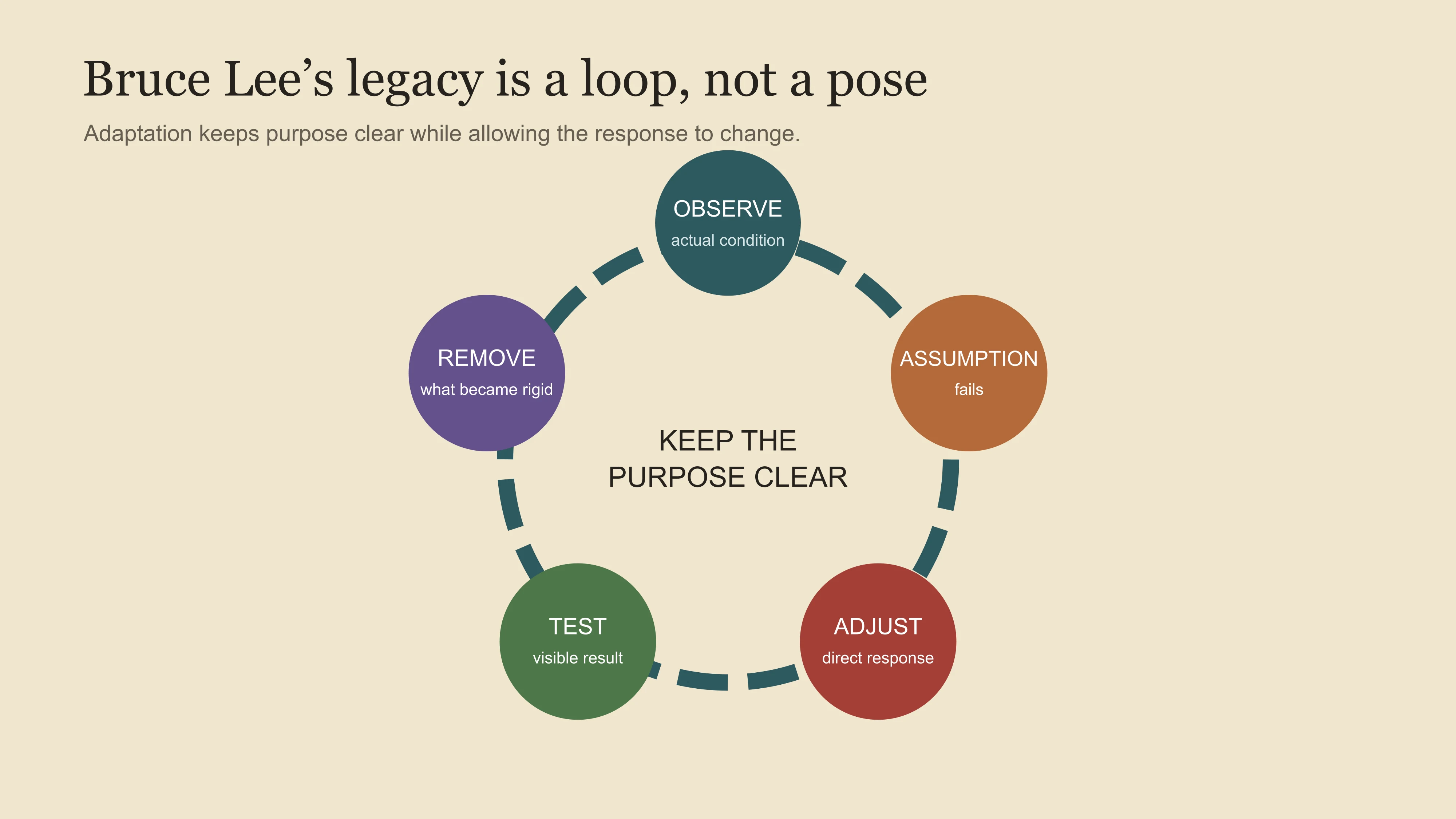
Water is not valuable because it has no character. It responds precisely to conditions. It can fill, flow, concentrate force or move around resistance. The practical translation is not “stay vague.” It is:
Keep the purpose clear while allowing the form of the response to change.
Applied to watching a scene, ask what new information forces Lee to adjust. Applied to creative work, ask whether a familiar format still serves the audience. Applied to disagreement, separate the outcome you need from the posture you are defending.
The phrase becomes useful only when it changes a decision. If it merely decorates a wall while every habit remains protected, it has become the rigidity it was supposed to challenge.
I dislike how comfortably “be water” now sits inside motivational décor. Lee's idea should disturb a protected habit. If it asks nothing to be discarded, tested or changed, we have preserved the shape of his language while refusing its demand.
The Way of the Dragon is the clearest test of authorship
The Bruce Lee Foundation credits Lee as writer, director, producer, choreographer and star of The Way of the Dragon. Those roles make the film the best place to ask what happens when his method reaches beyond performance into the construction of the film itself.
The famous Colosseum confrontation is not useful because it settles a fantasy ranking. It is useful because it changes. Distance, rhythm and confidence do not remain fixed. Lee's character encounters a larger problem, receives information through failure and adjusts.
Watch the scene in three passes:
- First, map distance. Who can act safely at each range?
- Then, track adaptation. Which early response fails, and what replaces it?
- Finally, watch respect. How does the ending treat the opponent as more than an obstacle?
The scene makes the article's thesis visible: form is tested by conditions. The character who reads the changing exchange survives it; the viewer who only counts hits misses the drama.
Enter the Dragon made the image global, not complete
Enter the Dragon is the easiest international entry because it places Lee inside a recognizable espionage-and-tournament structure, surrounds him with an international cast and concentrates his star image. Warner Bros.' official 4K trailer still sells that immediate legibility: watchfulness, sudden speed, scars, mirrors and controlled intensity.
The page's opening image comes from Warner Bros.' official 4K trailer. In the mirror-room images, multiplying the body also multiplies false information. The problem becomes perception before it becomes force.
The film's importance can create a false chronology in the viewer's mind: Hollywood discovers an unknown man and gives him a global form. The earlier Hong Kong films tell a more accurate story. By 1973, the intensity, economy and star authority were already developed; the co-production changed reach and framing.
Watch Enter the Dragon first if access is the priority. Do not stop there if understanding is the priority.
Hong Kong, Seattle and Hollywood are one moving identity
Bruce Lee's geography is often turned into a claim of ownership: Chinese icon, Hong Kong star, Asian American pioneer or Hollywood legend. Each phrase illuminates something and conceals something.
- Hong Kong gave him childhood screen experience, formative martial-arts study, the films that established his stardom and the public culture that continues to remember him.
- Seattle belongs to education, teaching, school-building, family life and the formation of his public thought in the United States.
- Hollywood gave him television visibility and eventually a global co-production, while also showing the limits and opportunities facing an Asian American performer in that system.
In an interview preserved by the Bruce Lee official channel, Lee refuses a narrow division between Chinese and American identity and returns to being human. The clip is valuable because it records his public answer. It should not be inflated into a complete theory of race, citizenship or private feeling.
The stronger conclusion is not that place did not matter. Place mattered repeatedly. Lee's distinctiveness came from translating among contexts without letting any one of them freeze the whole person.
Bruce Lee and Jackie Chan make opposite vulnerabilities visible
The lazy comparison asks who was the better real-world fighter. The useful comparison asks what each screen body makes dramatic.
| Viewing question | Bruce Lee | Jackie Chan |
|---|---|---|
| Main dramatic pressure | Can perception become a direct response? | Can improvisation survive a hostile environment? |
| Screen rhythm | Stillness compressed into explosive release | Repeated problem, failure, recovery and escalation |
| Relationship to objects | Removes distraction; seeks the decisive line | Turns props and architecture into changing partners |
| Vulnerability | Error, rigidity and misreading the opponent | Pain, bad luck, imperfect plans and physical consequence |
| Best first comparison | Fist of Fury | Police Story |
Bruce Lee is not “serious Jackie Chan,” and Jackie Chan is not “comic Bruce Lee.” They organize action around different questions. Continue with the Jackie Chan guide to see why pain, props and failed moves become a separate filmmaking philosophy.
The Donnie Yen guide offers a third route: distance, rhythm and impact changing with character and production system. The Jet Li guide provides the most precise Chen Zhen comparison: Lee compresses anger into direct release, while Li makes observation and technical adaptation more visible in Fist of Legend. Comparing observable screen methods is criticism. Declaring a private combat winner is content without evidence.
His death froze an evolving method into an icon
Bruce Lee died in Hong Kong on July 20, 1973, aged 32. The Bruce Lee Foundation attributes the death to an allergic reaction to pain medication. This article does not repeat alternative theories because notoriety is not evidence.
The cultural consequence is more important than speculation: an artist committed to continuous revision was frozen at the moment of international breakthrough. The yellow tracksuit, the cry, the nunchaku and the stripped torso became endlessly repeatable signs. Repetition made Lee recognizable while working against the unfinished, adaptive quality of his method.
This is the central tension in his legacy. The world preserved the form because the philosophy warned against preserving form.
I find that contradiction more moving than every fantasy tournament built around his name. We wanted a permanent winner; he left a method that refuses permanence. The honest tribute is not to freeze him at the top, but to keep observing where his own answers were still changing.
The Hong Kong statue is memory, not biography

The East Moment photograph places a permanent fighting pose against a harbor skyline that keeps changing. That contrast is the entire problem of Lee's memory: the city moves while the icon is required to remain ready forever.
The statue on Hong Kong's Avenue of Stars condenses a moving life into a familiar combat pose. The skyline behind it changes while the bronze body stays permanently ready. That contrast explains both the power and danger of public memory.
A monument needs instant recognition. A serious article needs to reopen what recognition has closed: the child actor before the icon, the teacher behind the slogan, the filmmaker inside the fighter and the cross-cultural person behind competing ownership claims.
Explore the wider Hong Kong cultural guide to understand the city as more than a backdrop, and use the Chinese film collection to place Lee among other industries, genres and screen traditions.
How to watch one Bruce Lee scene closely
Use this method on the Colosseum duel or the mirror-room sequence:
- Name the initial condition. Record distance, obstacles, available information and the character's apparent plan.
- Find the first failed assumption. Identify the moment the original response stops working.
- Mark the adjustment. Look for a change in rhythm, stance, target, route or attention.
- Separate performance from production. Ask what the actor does and what framing, editing, sound and the collaborator add.
- State the consequence. Explain what the adjustment reveals about character, not only who wins.
This gives the comments a useful standard. Name the exact scene and choice. “He was the fastest” is admiration; “he changes rhythm after learning that the first range fails” is an observation other readers can test.
The archive is smaller than the legend
Bruce Lee's surviving body of completed star vehicles is small. That makes every scene carry unusual interpretive weight and encourages later audiences to turn fragments into a complete system.
His public philosophy is also vulnerable to selective quotation. A sentence can be authentic and still become misleading when removed from the practice, revision and self-cultivation surrounding it. This page translates the ideas into a viewing method, not a universal solution for every life problem.
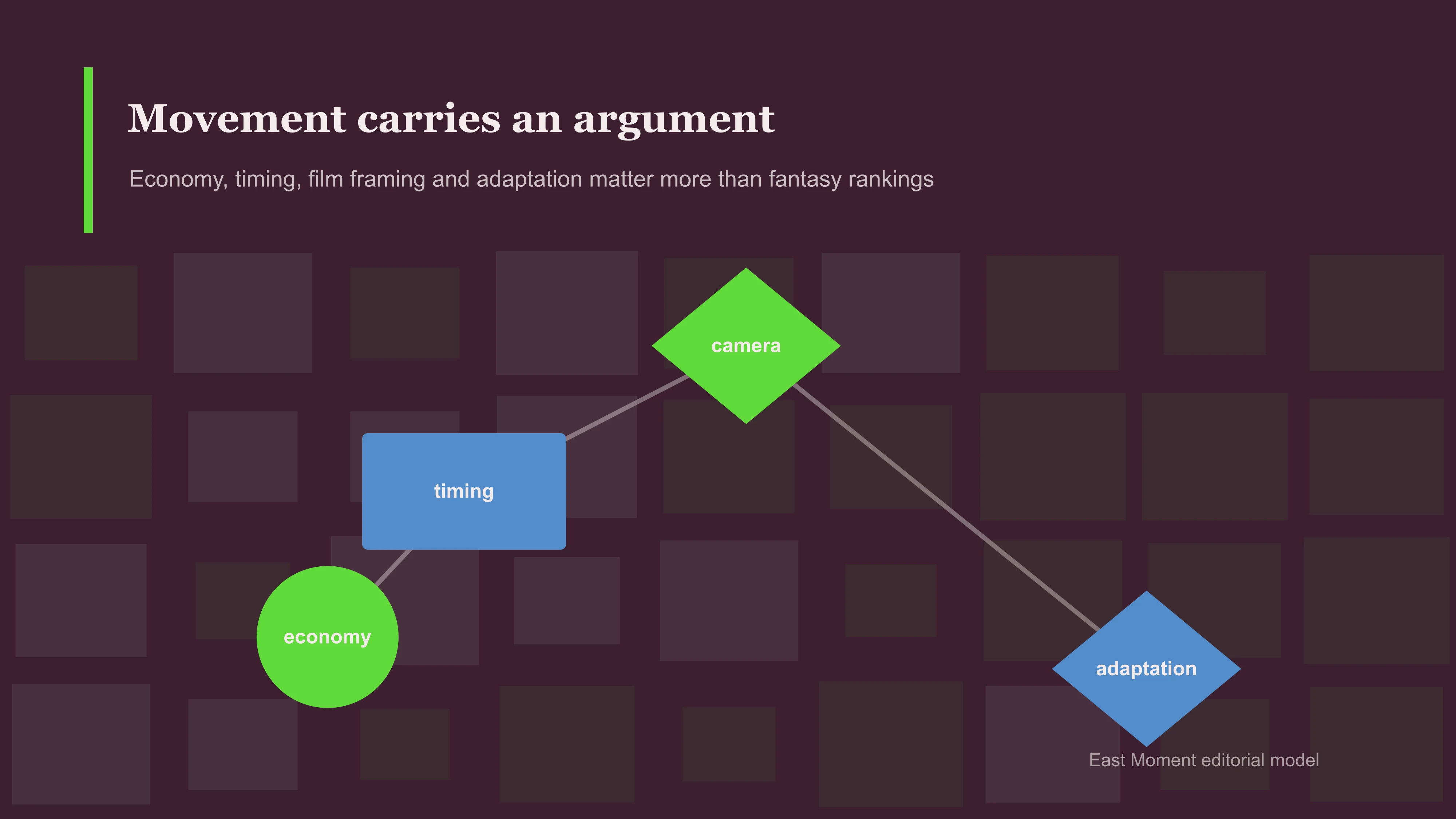
Finally, official foundation material is essential for chronology and Lee's articulated method, but it preserves a legacy rather than offering detached criticism. East Moment uses it for attributable facts and first-party framing, then labels the film analysis and conclusions as editorial judgment.
Bruce Lee's real legacy is a verb
Bruce Lee should not be reduced to “fighter,” “movie star,” “philosopher” or “Asian icon.” Each noun tries to finish a person whose most useful idea was continuous adaptation.
Start with Fist of Fury, then watch The Way of the Dragon and Enter the Dragon. Read Jeet Kune Do as a discipline of testing rather than a frozen syllabus. Treat “be water” as a demand to read conditions, not permission to remain vague. Separate what films demonstrate from what legends claim.
His real legacy is not a pose. It is the repeated action of observing, removing, intercepting and changing. Continue through the Chinese actors collection without reducing the other performers to copies or successors.
In the comments, choose one scene where Bruce Lee adjusts. Name the failed assumption and the visible response. The strongest answers can become a community close-reading archive rather than another ranking nobody can prove.