Kung Fu Hustle is not a serious kung fu film interrupted by jokes. Comedy is the method that strips false authority from gangsters, would-be heroes and martial legends until action can mean responsibility again. Stephen Chow's film works because humiliation and transformation belong to the same body: Sing must stop performing power before he can use it.
Kung Fu Hustle in 60 seconds
| Question | Short answer |
|---|---|
| Original Chinese title | Kung Fu (功夫) |
| Release | 2004 |
| Director and lead | Stephen Chow |
| Is it a Chinese movie? | Yes: a Hong Kong/Mainland China co-production made in Chinese and rooted in Hong Kong screen comedy and wuxia traditions |
| Setting | A stylized, deliberately unreal 1940s Shanghai |
| Best reason to watch | Physical comedy and martial mythology repeatedly change what power looks like |
| Main characters | Sing, Bone, the Landlady, the Landlord and the Beast |
| Spoiler-free premise | A failed criminal performance brings real violence to a poor community full of hidden skill |
| Wrong shortcut | Treating it as either random parody or an accurate record of historical martial arts |
If you are deciding whether to watch, the answer is yes if you enjoy elastic reality, broad comedy and fights that reveal character. Skip it if cartoon violence, sudden tonal changes or genre references without explanation prevent immersion.
Is Kung Fu Hustle a Chinese movie?
Yes. Kung Fu Hustle is a Chinese-language Hong Kong/Mainland co-production directed by Hong Kong filmmaker and performer Stephen Chow. Sony Pictures distributed it internationally, which can make search results look like a Hollywood title, but international distribution does not change its production identity or screen lineage.
The useful nuance is that “Chinese film” is not one industrial category. This film combines:
- Hong Kong mo lei tau comedy, built from verbal absurdity, deflated status and rapid tonal collision;
- wuxia and kung fu cinema, where extraordinary skill carries moral or social meaning;
- Shanghai popular imagery, reconstructed as a deliberately artificial genre city;
- international cartoon and musical grammar, including bodies that stretch, accelerate and survive impossible impacts.
Calling it “Chinese” is accurate. Calling every element traditionally Chinese would be false. Its originality comes from collision.
What Kung Fu Hustle is about, without major spoilers
Sing wants the visibility and protection he imagines the Axe Gang can provide. He arrives at Pig Sty Alley pretending to possess criminal authority, but the performance attracts actual violence. The residents who appear poor, comic or ordinary begin to reveal capacities that the gang, Sing and the viewer have misread.
The plot then escalates through competing masters, hired killers and the Beast. Yet the underlying movement is simple: Sing repeatedly chooses the appearance of power over responsibility, discovers that power without moral direction produces only another hierarchy of fear, and must decide what kind of person his capacity will serve.
This makes Pig Sty Alley more than a collection of colorful side characters. It is the film's moral test. Who deserves protection when dignity is not visually impressive? I reject readings that treat the residents as comic furniture waiting for Sing's heroism. They are the reason his power eventually needs a direction.
Pig Sty Alley hides value in plain sight
The alley is crowded, shabby and designed for comic interruption. Its residents argue over rent, water and daily inconvenience. Gangster cinema trains viewers to look elsewhere for importance: tailored clothes, weapons, cars, numbers and reputation.
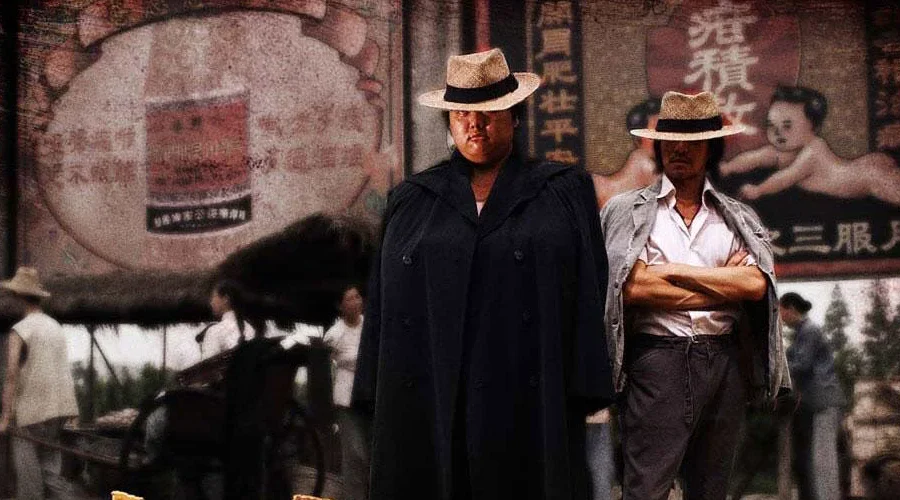
The Axe Gang's costume is a portable stage. Hat brim, long coat and synchronized movement demand that the street acknowledge them before they use force. Yet the ordinary traffic behind the pose keeps leaking into the frame. Chow understands something painfully familiar: intimidation works partly because everyone agrees to stop daily life and become an audience. Pig Sty Alley breaks that agreement. Laundry, quarrels, work and bodies that refuse elegance keep interrupting the gang's fantasy of total control.
Kung Fu Hustle reverses that visual hierarchy. Skill survives inside laboring bodies, domestic irritation and people who have chosen anonymity. The three early masters do not advertise lineage. Their competence appears only when collective life faces destruction.
The public excerpt makes the reversal immediate: bodies the gang has already dismissed become the neighborhood's defense. The reveal is satisfying because the film has taught us to look in the wrong place. I insist that this reversal is the film's deepest kung-fu idea: mastery can survive without branding, while branded power collapses the moment ordinary people stop performing fear.
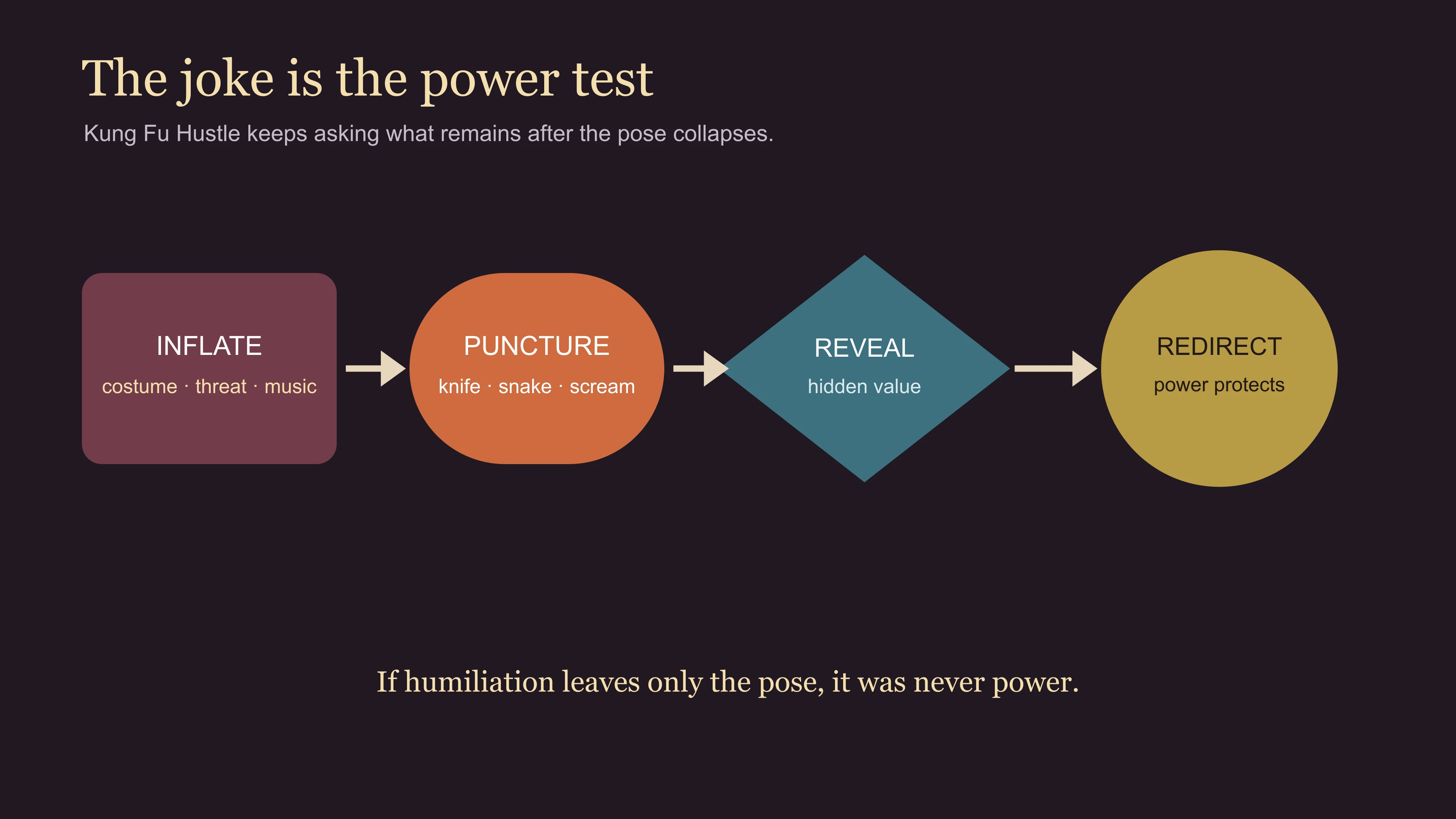
This is why I refuse to separate the “funny parts” from the “real kung fu.” The joke is the test. Anyone can look invincible while music, costume and frightened bystanders cooperate. Chow waits for a knife, snake, slipper, scream or landlady to destroy the arrangement. What survives that humiliation is the character's actual power.
Their reveal is satisfying because it changes an earlier judgment. Ordinary posture was not evidence of insignificance. The film does not say every humble person is secretly invincible; it attacks the viewer's habit of equating spectacle with worth.
The Landlady and Landlord are the film's real center of gravity
The Landlady initially appears tyrannical: loud, impatient and physically excessive. The Landlord appears evasive and unserious. Both are comic types before they become martial authorities.
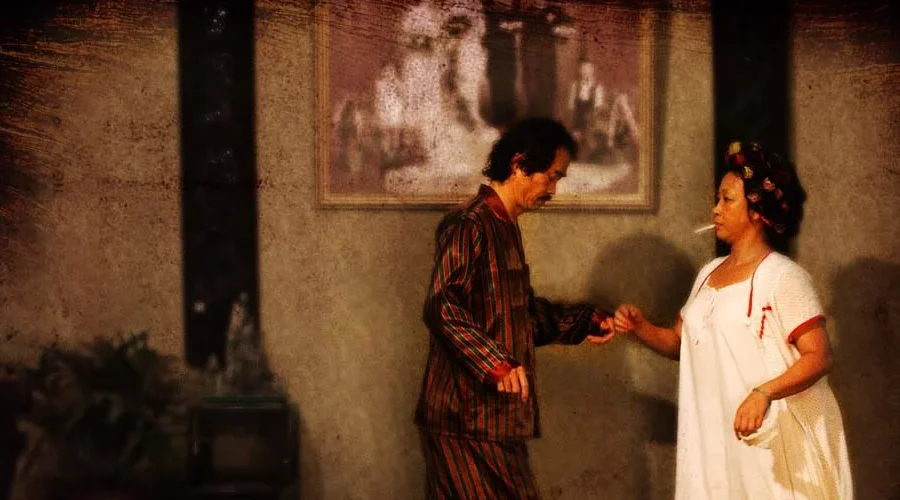
That reversal is not merely a surprise. It changes the meaning of their domestic behavior. Their abrasiveness, concealment and reluctance to return to violence come from a history the first impression cannot contain. Authority has withdrawn from public display.
The Movieclips Landlady excerpt shows the film converting pursuit into live-action cartoon rhythm. The scene proves visible comic staging, not the character's complete history.
The Landlady's Lion's Roar and the couple's later musical reference language place them inside a larger martial imagination. But the emotional reason they matter is clearer: they know skill does not protect a person from loss. Their reluctance gives action consequence.
I love that the film refuses to dress them for the reveal. Their authority does not arrive with a beauty upgrade. Pajamas, curlers, cigarette and slouched posture remain part of the body that can defeat professional killers. The joke is not that unattractive people are secretly strong. The joke is on a visual culture that needed tailored black suits before it knew where to look for power.
Why the comedy makes the fights stronger
Most action cinema spends time building the hero's dignity. Stephen Chow repeatedly destroys Sing's. Knives, snakes, traffic, failed intimidation and impossible chases turn his body into evidence against his self-image.
The laughter performs three jobs:
- It exposes imitation. Sing knows the visual language of gangsters before he possesses courage or purpose.
- It resets scale. A terrifying threat can become ridiculous, then become dangerous again from a new direction.
- It prepares transformation. Because the body has been humiliated, later grace cannot be mistaken for the same empty pose with stronger effects.
This connects Stephen Chow to, but does not duplicate, the screen methods in East Moment's Jackie Chan guide. Chan often makes improvisation, pain and failed plans reveal character. Chow pushes failure further into absurdity until genre itself seems embarrassed by its heroic habits.
The martial-arts references are a memory system, not a syllabus
The film draws on names, weapons, techniques and archetypes familiar from wuxia novels, comics and earlier screen traditions. Viewers may recognize the Buddhist Palm, Lion's Roar, qin music used as a weapon, hidden masters and the wandering beggar selling a secret manual.
These references are not presented as a reliable historical genealogy. They function as compressed cultural memory. A name arrives carrying the feeling of childhood reading, old television reruns, martial fantasy and the pleasure of recognizing a rule just before the film bends it.
The Beast is introduced as terrifying partly because he sits outside respectable heroic presentation. His speed and violence mock visual expectations. The final confrontation then asks whether supreme ability means domination or the capacity to stop dominating.
Use the Chinese martial arts guide to separate documented practice from wuxia imagination. Use the Bruce Lee guide to see how another screen body made philosophy, speed and global identity legible without assuming that all kung fu cinema follows one tradition.
The 1940s Shanghai setting is deliberately artificial
The film's Shanghai is not documentary reconstruction. Gangster suits, dance numbers, crowded tenements and period signs create a remembered movie-city. Pig Sty Alley itself behaves like a stage on which social classes and genre types can collide quickly.
That artificiality matters. It frees the film to move between crime picture, musical, silent comedy, wuxia and cartoon without pretending that one realistic register governs everything. The city is an archive of screen memories.
The risk is that international viewers may read every object as direct cultural evidence. A set can tell us what a 2004 production wants 1940s Shanghai to feel like; it cannot prove how the historical city looked or how ordinary residents lived.
Kung Fu Hustle ending explained
Major spoilers begin here.
Sing survives catastrophic violence and emerges with extraordinary ability. The change is not meaningful simply because he has become the strongest fighter. Earlier, he wanted gang membership and a famous technique because each promised an identity other people would fear. In the final battle, power becomes valuable when it no longer needs humiliation to confirm itself.
His use of the Buddhist Palm completes a childhood promise but changes its moral direction. The technique first appeared through a fraudulent street transaction and a boy's wounded belief. It returns as real capacity joined to mercy. When the Beast is defeated, Sing does not reproduce the Beast's logic by proving endless domination.
The sweet shop and reunion with the mute girl restore the emotional thread the gangster performance had buried. The ending is deliberately fairy-tale simple. That simplicity is not proof that all harm has vanished; it shows Sing choosing creation, memory and connection over the identity of feared outsider.
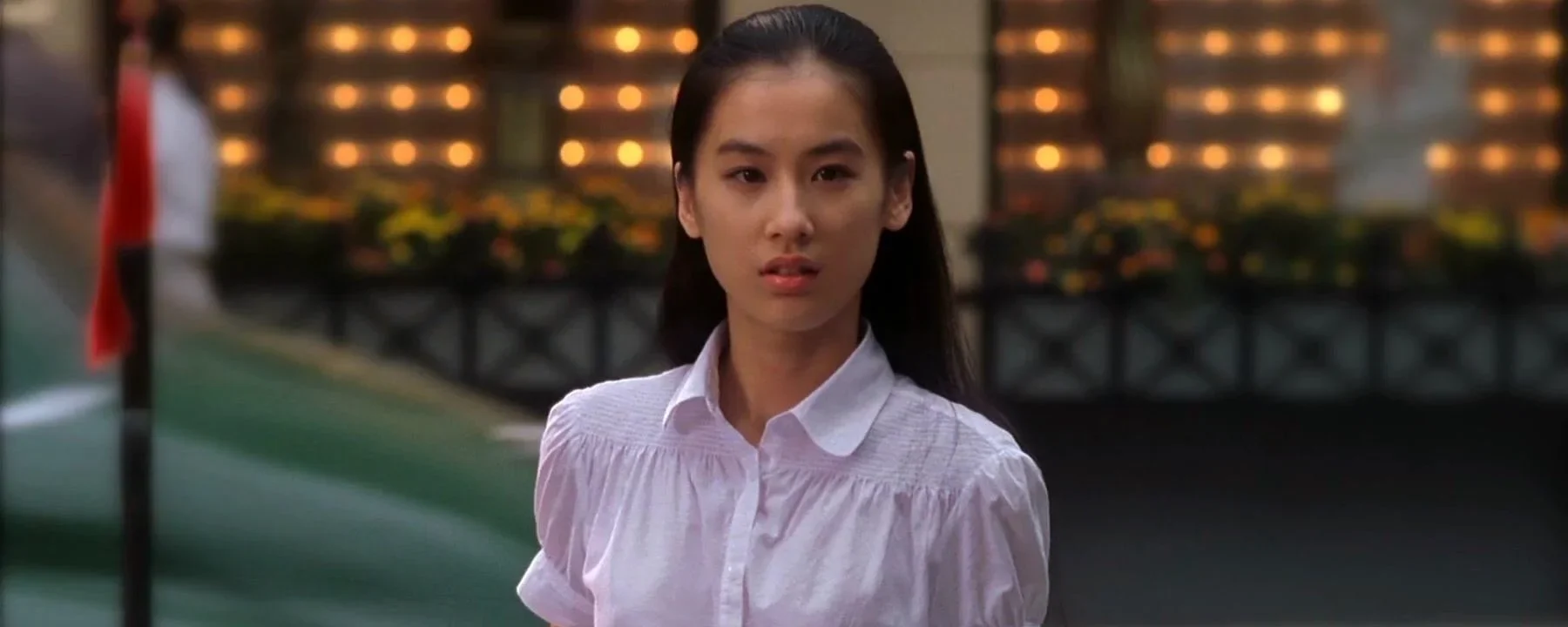
This quiet face matters more than another victory pose. She remembers the boy who tried to help when he had no power, while Sing has spent the film trying to erase that powerless self. The lollipop is sentimental, absolutely—and the sentiment works because the film has mocked nearly every other symbol of importance. The childhood gesture was clumsy and ineffective, but it was morally real. His adult transformation becomes complete only when he can recognize that earlier self without shame.
The final appearance of multiple martial manuals preserves the joke. Myth remains available, commerce remains suspect and another child may begin the cycle of belief. The film does not close the door between fraud and wonder.
Where to watch Kung Fu Hustle legally
Use the official Sony Pictures film page to verify the title and current distributor context. The page's official banner, used as the opening image here, makes Sing's attempted gangster affiliation visible without substituting for the plot. Then check a reputable availability service or the film's listing in your country. Rental, purchase and subscription catalogs change by region and date.
This page embeds no payment-gated movie, rental or subscription player. The linked public trailer and scene excerpts are evidence and previews, not substitutes for the complete film. Avoid unauthorized full-film uploads whose subtitles, edit and rights status cannot be verified.
Why Kung Fu Hustle still works
Kung Fu Hustle works because comedy is not afraid of martial mythology; it is how the film tests whether mythology still deserves belief. Hidden masters matter after their ordinary surfaces have been dismissed. Sing's power matters after his heroic pose has failed. Mercy matters because the final victory could have repeated domination. The moment I keep returning to is not the largest strike but the instant an apparently ridiculous person changes the moral weight of the room.
Its weakness is the same speed that gives it life. Supporting residents and losses can become functions in Sing's transformation, and reference density can reward recognition more than reflection. Yet the central conclusion remains firm: the film restores wonder only after making false importance ridiculous.
Continue through the Chinese film guide or compare its wuxia freedom with the Ang Lee guide. In the comments, identify the exact joke that changes a power relationship. The community can then map why the scene works, not merely repeat that it is funny.