
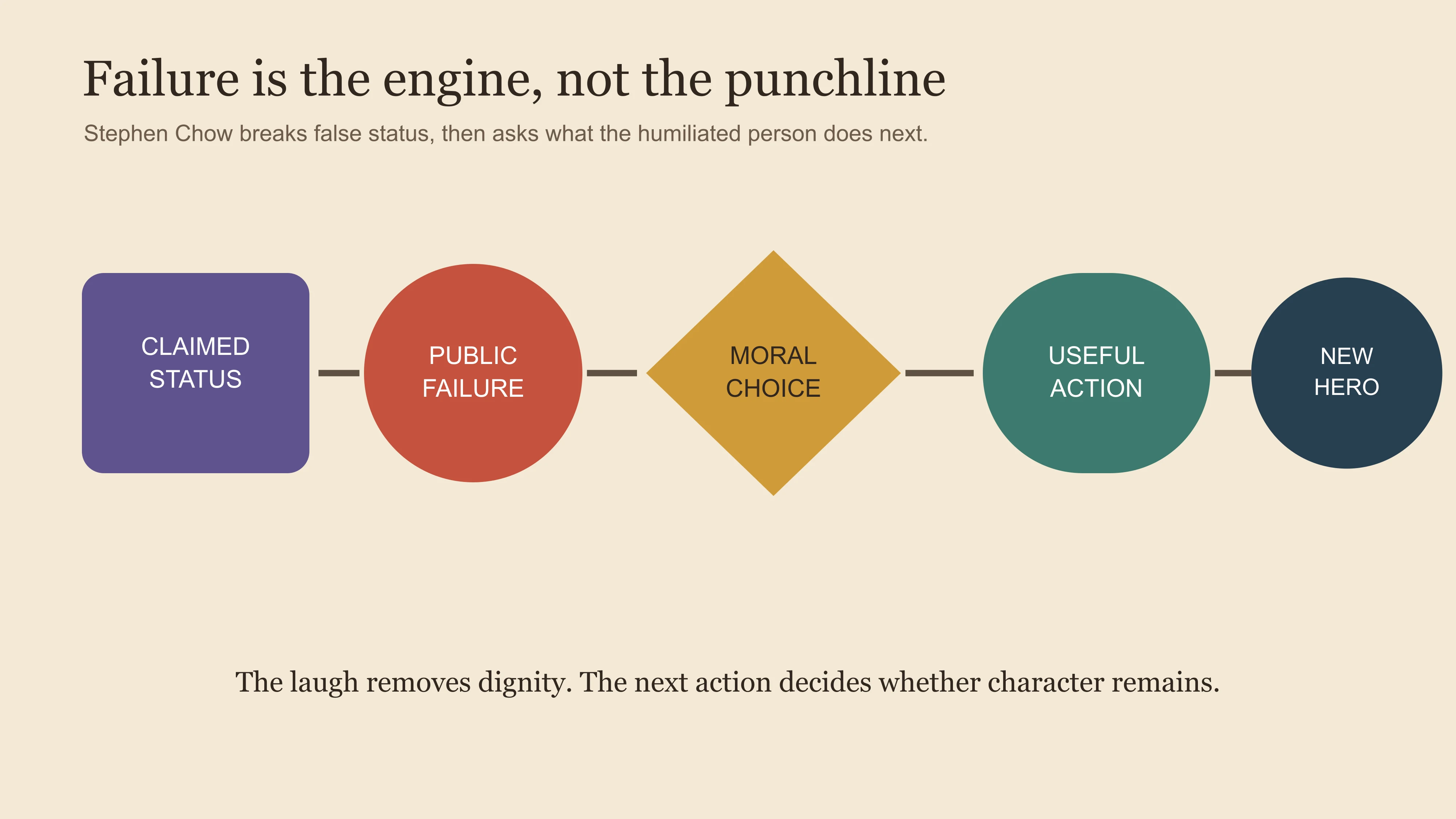
Stephen Chow does not add jokes to heroic stories. He uses failure to test whether the hero deserves the story at all. A boast collapses, a body loses dignity and an inherited genre pose becomes impossible to maintain. Only then can skill become useful to another person. Start with Shaolin Soccer, continue with Kung Fu Hustle, then return to The God of Cookery or King of Comedy to see the same mechanism without confusing
mo lei tauwith random nonsense.
I did not grow up thinking of Stephen Chow as a “comic system.” Fight Back to School first brought back the thrill and embarrassment of school life; its romance made the classroom feel close to first love. All for the Winner was my first encounter with cinematic supernatural power. His Wai Siu-bo was cunning, lustful and money-loving in a way that made classical cunning feel alive rather than respectable. Years of these films shaped the humor and optimism with which I meet ordinary embarrassment. That personal influence is why I reject any profile that begins in 2001 with Shaolin Soccer.
Stephen Chow in 60 seconds
| Question | Short answer |
|---|---|
| Chinese name | Chow Sing-chi (周星驰) |
| Born | June 22, 1962, in Hong Kong |
| What he does | Actor, director, writer and producer |
| Comedy term | Mo lei tau (无厘头 / 無厘頭), a Cantonese comic mode associated with non sequitur, collision and broken logic |
| Best first movie | Shaolin Soccer for the cleanest teamwork argument |
| Best global second movie | Kung Fu Hustle for genre density and transformation |
| Essential earlier contrast | King of Comedy or The God of Cookery |
| Defining screen figure | A man performing importance while the world exposes his smallness |
| Main misunderstanding | That absurdity means the jokes have no structure |
| East Moment test | Find what the humiliation forces the character to do next |
Stephen Chow's face can remain intensely serious while the scene dismantles every reason for seriousness. That gap is not decorative style. It is the machine.
Best Stephen Chow movies by what you want
| Your goal | Start with | What it demonstrates |
|---|---|---|
| Enter the comedy with a clear story | Shaolin Soccer | Private talent becomes useful only through teamwork |
| See the fullest genre collision | Kung Fu Hustle | Gangster film, wuxia, cartoon and moral transformation inside one body |
| Understand false status | The God of Cookery | Celebrity authority destroyed before craft can be relearned |
| See ambition without power | King of Comedy | Performance, humiliation and sincerity sharing the same scene |
| Hear rapid Cantonese wordplay | Fight Back to School | School, authority and genre identity broken by verbal timing |
| Test romance and time | A Chinese Odyssey | Comic evasion acquiring tragic consequence |
Watch in Cantonese with reliable subtitles when that version is legally available. A translation can deliver plot and still miss puns, register shifts, borrowed catchphrases and the speed with which solemn language crashes into ordinary speech.
Fight Back to School turns school memory into heroic embarrassment
The series works because Chow Sing-sing is both overqualified and completely misplaced. A trained police officer can handle danger but cannot smoothly re-enter student life, classroom authority or youthful romance. The joke is not simply “adult pretends to be student.” It is the humiliation of bringing one kind of competence into a world that refuses to recognize it.

The public Hong Kong theatrical-trailer artwork places Chow's alarmed adult face above teachers, classmates and undercover chaos. It is useful evidence of the film's ensemble school identity, but not a literal single scene or proof of how every joke lands.
That is why the films can trigger school memories even for viewers whose classrooms looked nothing like the screen. Rules feel arbitrary, teachers control small territories, friends exaggerate status and a glance from the person you like can matter more than the official mission.
The bullet-catching sequence is handsome not despite his failure to catch it, but because he still completes the counterattack under an impossible premise. I believe that is Stephen Chow's heroic method in miniature. Failure does not cancel the pose; failure tells us what the pose is worth.
All for the Winner makes power feel newly possible
For Lijun, All for the Winner was the first time screen comedy made supernatural power feel reachable. The film does not present ability with solemn mythic distance. It lets miraculous skill collide with rent, greed, competition and foolish human desire.
That mixture matters. A child can be thrilled by the power while an adult sees how quickly power becomes another social transaction. Chow's innocent seriousness keeps both readings alive.
Royal Tramp gives classical cunning a shameless body

The collection image puts Chow inside Wai Siu-bo's world of costume, appetite and danger. The performance earns its place without needing a borrowed claim about an author's private preference.
Wai Siu-bo is not purified into a noble hero. He wants money, beauty, safety and advantage; he survives by reading weakness faster than powerful men read him. Chow makes calculation physical: the eyes move, the mouth flatters, fear interrupts confidence and opportunism becomes comic rhythm.
That is more faithful to the character's energy than treating cleverness as a list of schemes. We do not state the frequently repeated claim that Jin Yong named this his favorite adaptation without a verifiable primary source. The performance is strong enough without borrowed endorsement.
Mo lei tau is not random
The Cantonese phrase mo lei tau is frequently translated as “nonsensical.” That translation identifies the surface surprise but hides the construction.
Chow's comedy often brings incompatible systems into one exchange:
- A gangster pose meets a practical object that refuses to cooperate.
- Ancient martial authority enters wage labor, football or food service.
- A solemn speech uses the rhythm of prestige cinema, then lands on a bodily need.
- A social nobody speaks as if genre rules guarantee his importance.
The joke appears illogical because the scene changes rulebooks without warning. It remains precise because the collision exposes status. Someone believed costume, title, technique or language would protect them. It does not.
This is why word-for-word translation is insufficient. International viewers need to know not only what a line says, but which kind of speech it interrupts.
Shaolin Soccer makes private talent answerable to a team
Sing possesses kung fu and conviction but cannot make either socially useful. His public demonstrations and songs ask strangers to recognize a mission without giving them a reason to participate.
The complete Shaolin Soccer guide shows how football supplies rules, positions and consequences. Mighty Steel Leg matters only when another player's movement gives the kick a function.
Miramax's official film page identifies Chow as Sing and the film's heightened sports world. It cannot prove that Shaolin practice historically belongs in football or that the international cut preserves every joke.
The emotional architecture is exact:
- Sing declares a large mission.
- Public failure makes the mission ridiculous.
- Former practitioners reveal skills separated from purpose.
- Football turns different skills into mutual dependence.
- Mui's tai chi and Sing's kick create a final action neither can complete alone.
The comedy does not distract from teamwork. It removes the fantasy that one gifted believer already constitutes a movement.
Kung Fu Hustle turns humiliation into moral preparation
Sing in Kung Fu Hustle wants the Axe Gang image before he possesses either criminal competence or heroic responsibility. He performs danger because being feared appears easier than being useful.
The full Kung Fu Hustle guide traces Pig Sty Alley, the hidden masters and the Buddhist Palm. For Chow's method, watch the failures: knife throwing, snake bites, chase physics and attempts at intimidation. The body becomes evidence against the identity Sing is trying to sell.
His eventual power matters because the failed pose has been exhausted. If he became the strongest fighter while preserving the need to humiliate, the film would merely upgrade a gangster fantasy. Mercy changes the meaning of ability. Sony Pictures' official Kung Fu Hustle page can establish the released film and its studio framing; my judgment is sharper: strength without mercy would destroy the entire transformation.
The serious face keeps the joke from becoming cheap
Chow frequently refuses to signal that he knows the scene is absurd. The character's commitment lets two interpretations coexist:
- We laugh because the self-image is wildly disproportionate to reality.
- We care because wanting dignity is not itself ridiculous.
This balance separates humiliation from contempt. King of Comedy is essential because the aspiring performer may be deluded, inconvenient and socially powerless, yet the desire to perform remains real. The film can expose technique without declaring aspiration worthless.
Chow's close-up often delays surrender. The world has already proved him wrong, but the face needs one more beat to accept it. That beat is where pride becomes character.
The God of Cookery destroys the title before testing craft
Celebrity, branding and public authority make Stephen Chow's God of Cookery appear complete. The fall reveals that image and ability were never identical.
The film's exaggerated food world is not a reliable guide to Chinese cooking. It is a satire of how commerce converts taste into status, slogans and staged expertise. Relearning requires contact with labor and people the celebrity system rendered invisible.
This pattern recurs across Chow's work: a title is granted or claimed too early, stripped away publicly and then returned only after its meaning changes.
That repeated recovery became personal for me. Stephen Chow did not teach me that everything is a joke. He made it possible to be laughed at, lose status and remain open to the next scene. The truth is that his best humor recovers movement; it never pretends pain is absent.
Hong Kong language and class shape the speed
Stephen Chow's comedy grew through Hong Kong television and Cantonese cinema. Its linguistic pleasure includes code-switching, borrowed idioms, homophones, formal registers used in undignified contexts and local speech moving too quickly for subtitles to reproduce every layer.
The social figure is equally local: the small person navigating institutions, property, work and prestige systems that do not recognize him. Chow's characters are not always morally admirable, but they understand exclusion well enough to imitate power badly.
Use the Hong Kong guide for the city's historical and linguistic context. Do not treat a comedy set as documentary proof of ordinary Hong Kong life.
Stephen Chow and Jackie Chan solve different failures
Both performers let bodies lose dignity, but the cause and result differ.
| Question | Stephen Chow | Jackie Chan |
|---|---|---|
| Why does the plan fail? | The character's claimed identity collides with reality | Space, objects and opponents disrupt an improvised plan |
| What creates laughter? | Status collapse and incompatible genre rules | Timing, pain, recovery and practical invention |
| What changes afterward? | The character may need a new moral role | The body needs a new route through the environment |
| Best comparison | Kung Fu Hustle | Police Story |
Read the Jackie Chan guide and compare one failed intimidation with one failed stunt plan. The joke carries different information.
Director, actor and editor increasingly become one comic system
Chow's later globally visible films make authorship easier to see because performance, staging, effects and editing all support the same rhythm. A body may stretch like animation; a cut may complete the insult; music may grant grandeur exactly long enough for reality to revoke it.
This does not mean he creates alone. Choreographers, co-writers, performers, cinematographers, designers and editors build the films. “A Stephen Chow movie” names a strong organizing sensibility, not sole authorship.
It also creates a risk: scale can reproduce a proven rhythm without the social sting that made it necessary. I insist on this distinction because effects are funniest when they expose a human claim, not when they merely demonstrate that the production can become louder.
Where to start
- Shaolin Soccer for the clearest emotional and tactical structure.
- Kung Fu Hustle for the richest collision of Hong Kong comedy, martial memory and visual scale.
- King of Comedy for aspiration after dignity has been removed.
- The God of Cookery for celebrity status versus practical craft.
- A Chinese Odyssey when you want comic evasion to acquire romantic and temporal cost.
This route moves from accessible spectacle back toward the earlier emotional mechanism. It is more useful than ranking thirty titles by laughs.
Why Stephen Chow's failures stay with me
Stephen Chow's comedy is not meaningless because it refuses ordinary logic. It replaces prestige logic with consequence. The school infiltrator misses the impossible catch, the gambler's power enters a grubby social world, Wai Siu-bo survives through shameless appetite, and the false masters of Shaolin Soccer and Kung Fu Hustle must become useful to other people.
Start with the team, then the hidden masters. Shaolin Soccer explains the social rule; Kung Fu Hustle makes it mythic.
Continue through the Chinese actors collection only after naming the failure that changed you. For me, Chow's deepest gift was never permission to laugh at losers. It was permission to lose face, remain open and attempt the next scene without pretending the pain did not happen.