Shaolin Soccer works because Stephen Chow gives its fantasy a hard rule: private talent is worthless until it becomes useful to other people. Sing begins with kung fu, conviction and no social function. Football forces six former Shaolin brothers to turn isolated techniques—and the humiliations attached to them—into positions inside a team. The movie is absurd, but its argument is exact.
Shaolin Soccer in 60 seconds
| Question | Short answer |
|---|---|
| Original title | Siu lam juk kau (少林足球) |
| Director | Stephen Chow |
| Release | 2001 Hong Kong film |
| Main cast | Stephen Chow, Ng Man-tat, Zhao Wei, Wong Yat-fei, Karen Mok and Cecilia Cheung |
| Premise | A disgraced former football star recruits a Shaolin practitioner and his brothers for a tournament |
| Genre | Sports comedy, martial-arts fantasy and underdog film |
| Best reason to watch | Every exaggerated ability eventually acquires a precise team function |
| East Moment verdict | Watch the Hong Kong cut with reliable subtitles when legally available |
The official Miramax film page credits Stephen Chow as director, writer and star and describes the alliance between Sing and former player Fung. The Hong Kong Film Archive's Stephen Chow record independently places the film in his 2001 career and records its Hong Kong box-office and awards significance. Those sources establish production and reception context. They do not explain why the film's ridiculous football is emotionally coherent.
What Shaolin Soccer is really about
Sing believes Shaolin kung fu should return to daily life. His problem is not lack of faith; it is that he treats faith as a sales pitch. He sings in public, performs demonstrations and imagines kung fu transforming society, yet strangers cannot see what his skill does for them.
Fung gives the belief a testable form. Football has rules, positions, opponents and a result. A technique can no longer be admired in isolation. It must create space, protect a teammate, stop a shot or move the ball.
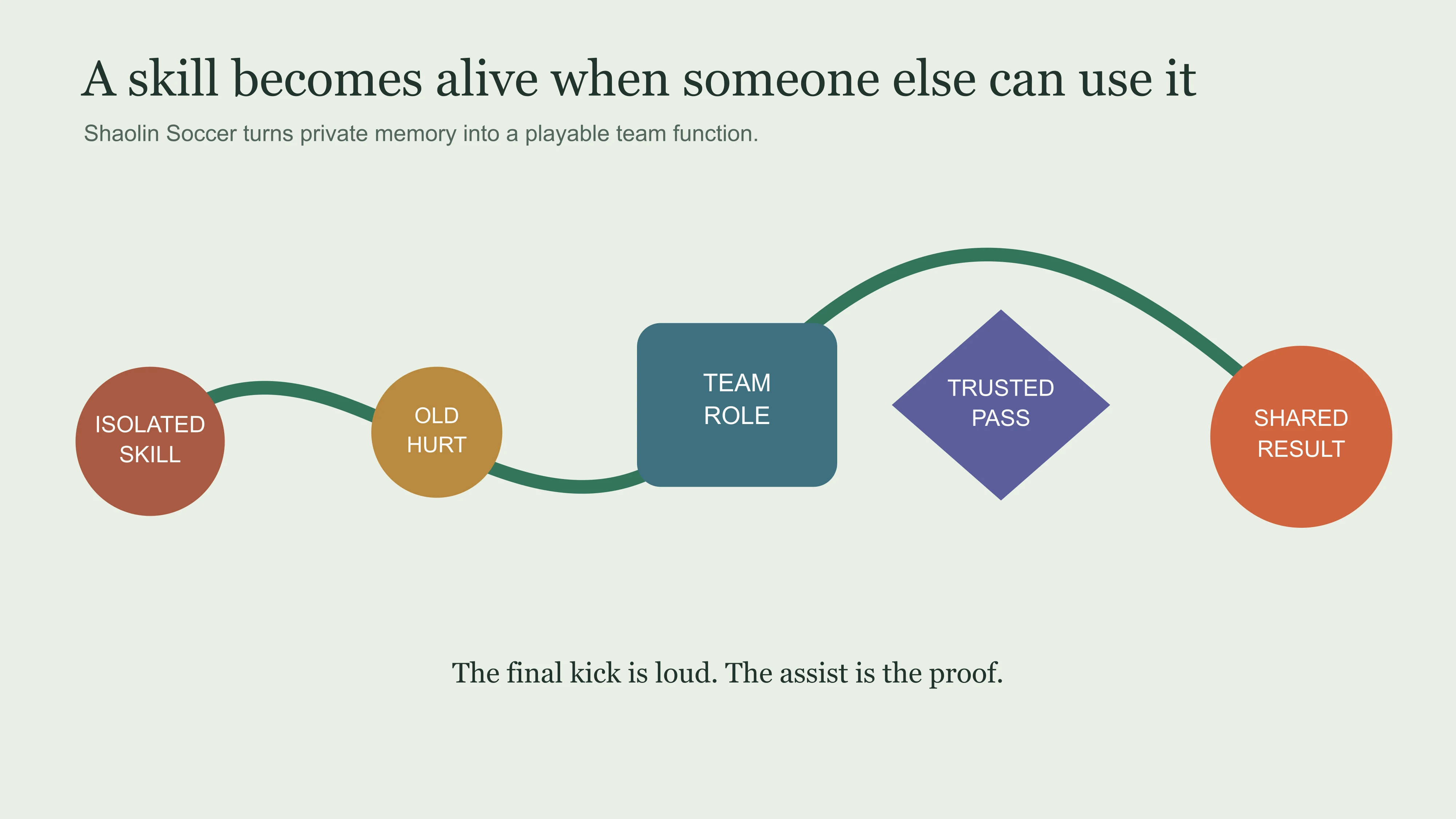
That conversion is the film's central movement: identity becomes valuable when it accepts a role inside collective action. Sing does not abandon Shaolin. He discovers the environment in which other people can recognize and depend on it.
The Shaolin Soccer cast forms a tactical system
The brothers first appear as separated adults whose bodies and confidence have been worn down by work. Reuniting them does not instantly restore greatness. Training reveals that remembered identity is not the same as usable ability.
| Character | Ability | Football value | Emotional change |
|---|---|---|---|
| Sing / Mighty Steel Leg | Extraordinary kicking power | Finishing, range and propulsion | Learns that a mission needs collaborators |
| Iron Head | Head technique | Aerial control and resilience | Stops treating humiliation as his only public role |
| Hooking Leg | Ground technique | Ball recovery and disruption | Converts dormant skill into timing |
| Empty Hand | Goalkeeping | Protection and reaction | Becomes responsible for a shared result |
| Light Weight | Speed and movement | Width, escape and transition | Uses mobility toward a common destination |
| Iron Shirt | Physical resistance | Holding space under pressure | Turns endurance from passive suffering into defense |
The positions are deliberately cartoonish, not a realistic coaching manual. Yet the logic is sound: a team is not six copies of its strongest player. Difference becomes strength only through coordination.

Why the comedy does not weaken the underdog story
Stephen Chow's comedy repeatedly lets dignity and embarrassment occupy the same shot. A declaration of greatness can be followed by a practical failure; an apparently pathetic figure can reveal impossible force. The joke does not cancel sincerity. It protects sincerity from becoming pompous.
Fung's damaged leg and lost career give the tournament a revenge structure, but the film refuses to make revenge sufficient. If winning only reproduces the cruelty of Team Evil, then the team has learned nothing. The decisive contrast is not pure versus impure martial arts. It is cooperation versus power engineered to make other people disposable.
The visual effects have aged unevenly as simulation, but they remain legible as comic grammar. A flaming ball, transformed field or airborne body shows what a player feels the action to be. Photorealism would not automatically improve that subjective clarity.
The early street-song sequence is the useful counterexample. Sing possesses conviction and rhythm, but the performance recruits no durable collaborator. Later training sequences repeat the same evangelism under constraints: teammates must receive, adjust and respond. The film moves from spectacle addressed to strangers toward signals understood by a group.
The exhausted brothers are the film's emotional proof
The brothers matter before they become funny football positions. Each has carried a once-important skill into adult work that no longer recognizes it. Their bodies remember more than their social lives permit them to use. I find that painful because it is not really about kung fu. It is about watching an ability become embarrassing when the surrounding world has no place for it.
Chow refuses the respectable version of an underdog story. The brothers do not recover dignity through a solemn speech, a heritage certificate or public nostalgia. They look ridiculous first. They fail together. Only repeated coordination turns memory into something another person can trust.
That makes the training montage more than preparation for spectacle. It is a negotiation over whether these men can believe in one another without pretending the lost years never happened. The film's optimism is not “talent always wins.” It is unused talent can become alive again when a group builds a real function for it.
Mui is not simply a makeover subplot
Mui uses tai chi to shape steamed buns with exceptional control. Sing recognizes the skill before he understands the person. That matters: the movie establishes her competence in work, not through romantic approval.
Her later makeover is intentionally uncomfortable and comic, but it should not be read as proof that beauty unlocks her value. When Mui enters the decisive action, appearance is irrelevant. Her movement, timing and composure matter. Like the brothers, she becomes visible when an everyday technique enters a shared problem.
The stronger reading is therefore not “Sing's love gives Mui confidence.” It is that Sing's football experiment creates a public arena where a skill already present can no longer be dismissed because of the worker carrying it.
Shaolin Soccer ending explained
Major spoilers begin here.
Team Evil's chemically enhanced players overwhelm the Shaolin team through force designed to injure as well as win. When the goalkeeper can no longer continue, Mui replaces him. She redirects the attack through tai chi; Sing converts that controlled return into the final strike.
The goal matters because no solitary hero creates it. Mui receives and transforms force. Sing completes the action. The sequence answers the film's opening problem: kung fu enters modern life not as a museum label or street sermon but as knowledge transferred between people under pressure.
The final newspaper montage shows martial abilities spreading into ordinary civic life. It is not realistic policy. It is the completion of Sing's original dream after the film has corrected it. He wanted everyone to practice kung fu; the ending imagines everyone using embodied skill to make daily life more capable.
My conclusion is definite: the tournament is not the proof that Sing was right. The assist is. His idea succeeds only when another person's distinct practice can join it.
Even the exaggerated final newspaper works because the film has earned this correction. At the beginning, Sing wants a culture to admire the label “Shaolin.” At the end, people use skills without requiring ceremonial distance from ordinary work. The fantasy argues for living practice rather than heritage displayed behind glass.
This is also where the film's emotion becomes personal for me. I do not love the final kick because it is enormous. I love it because Sing cannot create it alone. Mui receives violence without copying its direction, changes the force and gives somebody else a playable ball. The movie's loudest image is built on an act of listening.
Which version and language should you watch?
Release cuts, dubbing, subtitles and music can differ by territory. Prefer the original Hong Kong version in Cantonese with subtitles that preserve character names and jokes where legally available. Before paying, check runtime, audio language and cut rather than assuming every listing is identical.
The Miramax page links current commercial options, but availability changes by country. This page embeds no rental, subscription or payment-gated player. Official public clips are useful for sampling tone; they are not a substitute for the full film.
Language matters here because Chow's comedy changes register at speed. A grand declaration can collapse into street-level irritation before a subtitle has room to explain why the collision is funny. Cantonese delivery also lets the brothers sound like tired Hong Kong men before the fantasy restores their mythic identities. A dub may preserve the plot and still smooth away the social distance the joke needs.
Do not turn this into purity policing. Watch the version you can legally access. But if a joke feels arbitrary, compare the Cantonese track and another subtitle rather than assuming mo lei tau means “nothing makes sense.” The scene usually knows exactly which status, slogan or heroic rhythm it is breaking.
I am especially firm about the cut because teamwork needs time. Remove too much embarrassment, failed practice or ordinary conversation and the brothers become instant powers waiting for activation. The longer social route is the point: a team is built from damaged people, not assembled from six effects.
Is Shaolin Soccer worth watching now?
Yes. Some effects and gender comedy belong visibly to their period, but the construction remains unusually disciplined. Every player introduced as a joke later becomes a solution. Spectacle grows from character function rather than interrupting it.
Watch Kung Fu Hustle next to see Stephen Chow reverse the scale: a failed individual enters a community already organized around hidden masters. Use the Chinese movies collection, Hong Kong guide and Chinese film guide for context without treating one commercial comedy as a documentary of either place or tradition.
In the comments, name the pass, save or off-ball action that most clearly converts an individual technique into team value. That scene-based claim gives the community something it can test.
Shaolin Soccer works because humiliation is converted into shared play
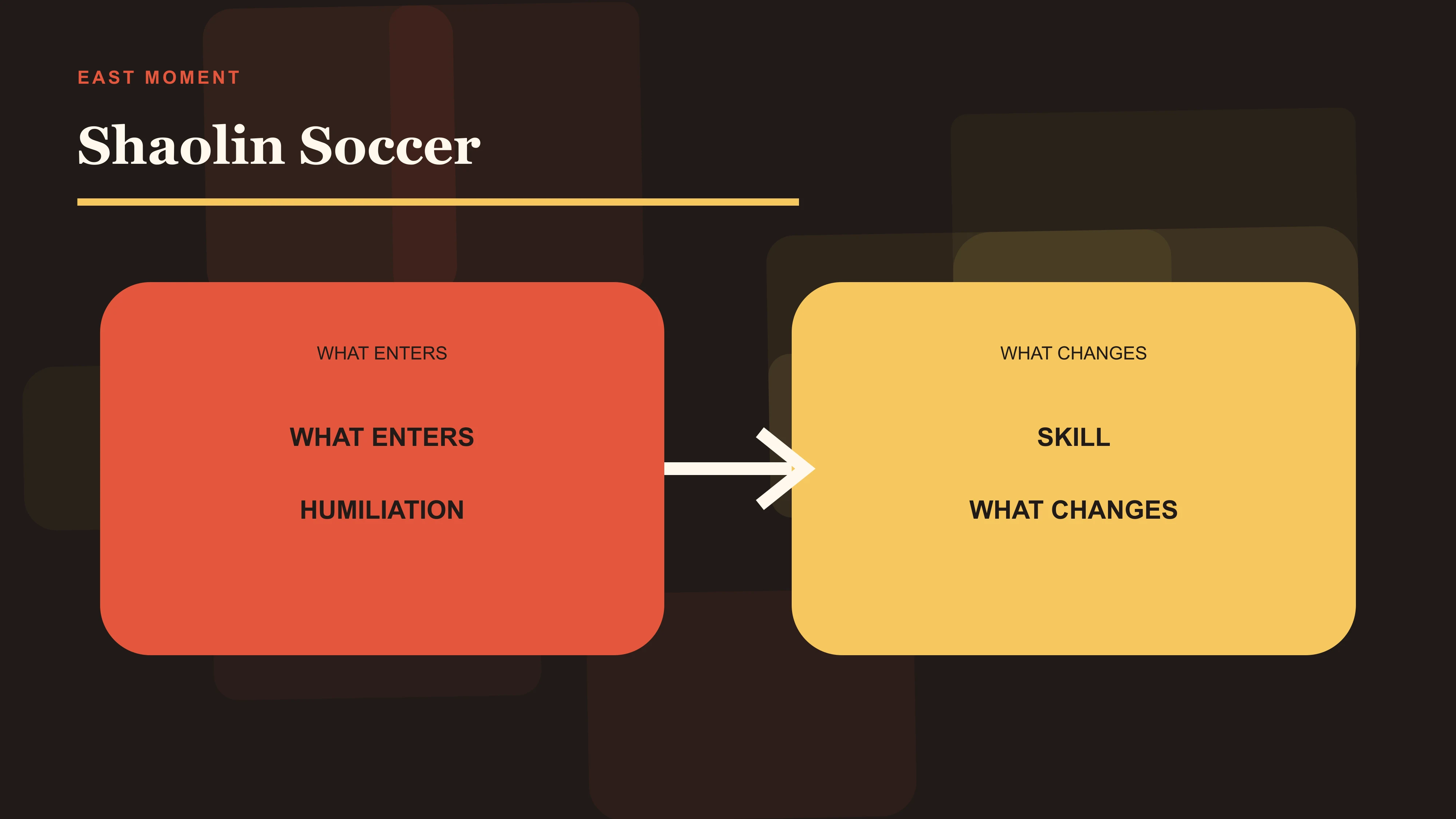
Stephen Chow does not merely paste kung fu onto football. Each impossible skill begins as an isolated body and becomes useful only when the team finds a role for it. The joke carries pain: people who have been dismissed, injured or made ridiculous discover that ability can still create collective joy.
The film is not a manual for Shaolin practice or football physics. Its truth is emotional and cinematic. Exaggeration makes humiliation visible enough to be defeated in public.
That is why the final match matters less as victory than as conversion. Shame becomes play, private talent becomes a pass, and a team finally makes room for bodies that ordinary life treated as failures.
The comedy is loud because the wound is not small. Stephen Chow lets absurdity return dignity without pretending humiliation never happened.
That emotional conversion—not a realistic account of kung fu—is the film's lasting truth.