The best kung fu movies do not simply show who can win a fight. They make character visible through distance, rhythm, balance, injury, comic failure and restraint. Start with the kind of movement you enjoy, then watch closely enough to see what the body is arguing.
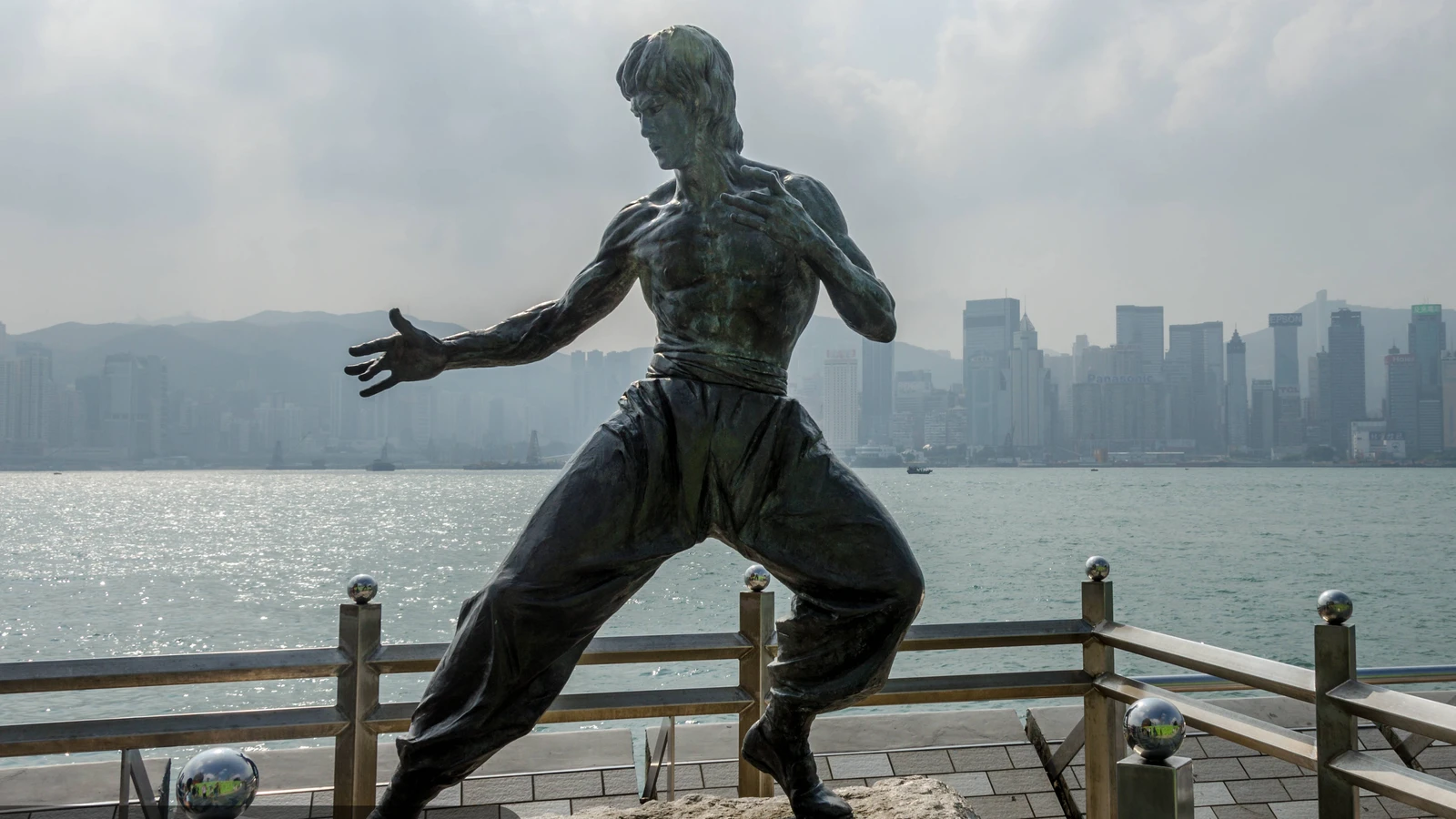
The Bruce Lee memorial on Hong Kong's Avenue of Stars tells us how completely one screen body entered the city's public memory. Yet the statue is also a warning against letting one perfect silhouette swallow the genre. Jackie Chan's panicked improvisation, Michelle Yeoh's tensile calm, Donnie Yen's compressed lines and Stephen Chow's comic collapses demand different eyes.
That is the useful way into a genre too often treated as one giant pile of flying kicks. “Kung fu movie” can mean a Bruce Lee confrontation, a Jackie Chan disaster machine, a poised Donnie Yen screen myth, a wire-assisted wuxia tragedy or Stephen Chow turning a gag into a moral test. They do not ask for the same kind of attention.
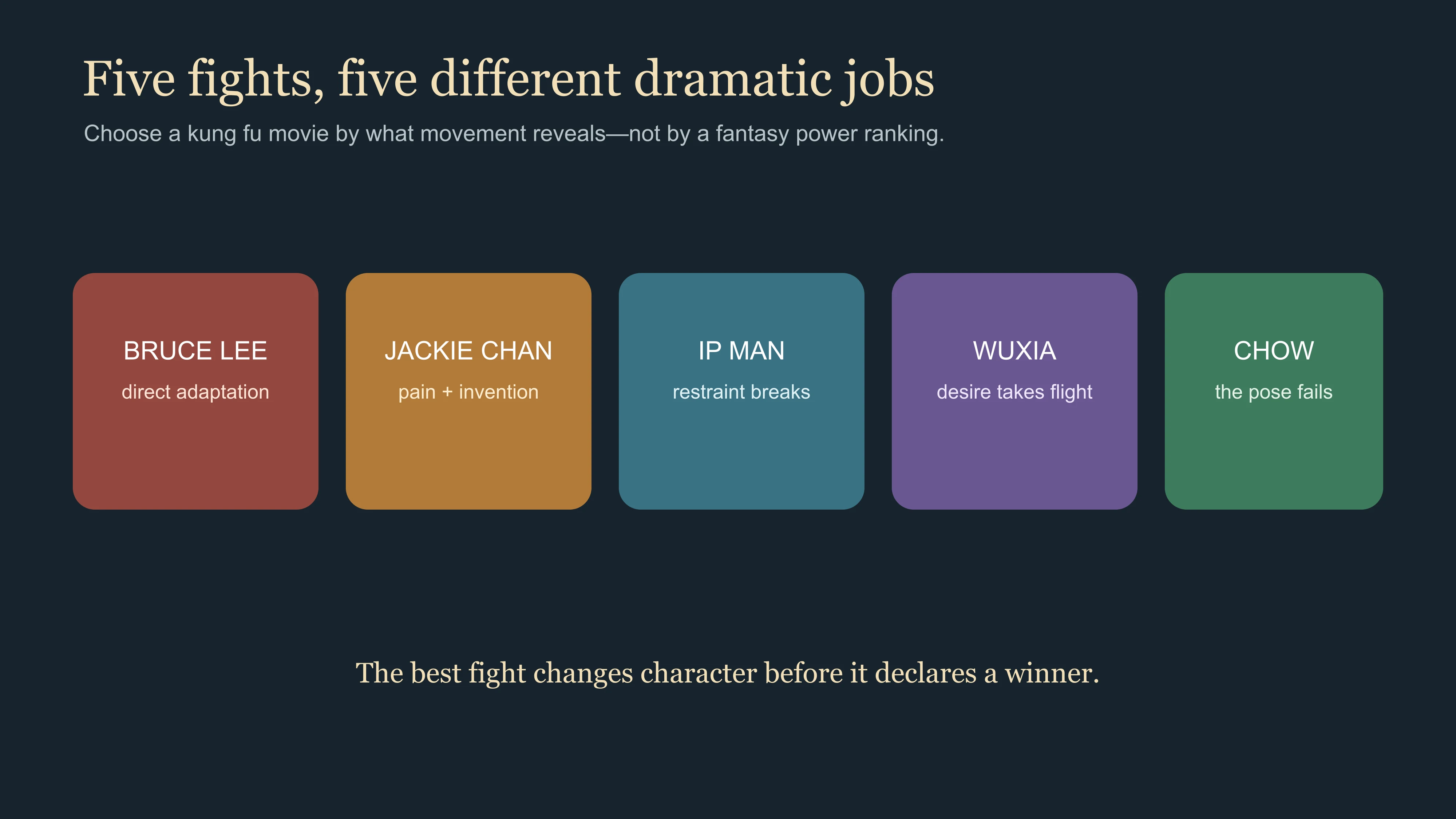
This guide is therefore a route, not a ranking. Move sideways between these films. Bruce Lee makes intention visible; Jackie Chan makes survival inventive; Ip Man turns restraint into moral pressure; Crouching Tiger, Hidden Dragon lets impossible movement expose social confinement; Kung Fu Hustle laughs fake authority out of the room. The pleasure comes from noticing how radically different bodies solve different dramatic problems.
What are kung fu movies?
Kung fu movies are Chinese-language martial-arts films in which fighting is a major storytelling language. They draw on real martial traditions, opera performance, stunt craft, wuxia fiction, Hong Kong action cinema, comedy, regional styles and modern filmmaking. A screen fight may borrow visible techniques from a martial art, but it is built first to communicate character, danger and rhythm to an audience.
That distinction saves you from two bad reactions. One says every beautiful move is documentary evidence of combat history. The other says that because films are staged, they have nothing to teach about martial culture. Both miss the point. Cinema transforms training and myth into a language of bodies; the transformation is where the art becomes worth watching.
Bruce Lee's screen presence is a good first lesson. The force of the image is not a catalogue of techniques. It is timing: stillness makes speed legible, and the body seems to decide before the opponent has finished posing. The Bruce Lee guide follows the person and screen legacy behind that visual grammar.
My strict test is simple: remove the action and ask what disappears. If only noise and spectacle vanish, the scene was decoration. If pride, fear, tenderness, class, responsibility or a relationship becomes unreadable, the fight was doing narrative work. The finest kung fu movies pass this test before the first strike lands; posture, distance and refusal have already told us who these people are.
Start with the promise you want from a fight
Do not begin with a ranked “greatest ever” list. Begin with what you want a fight to do for you.
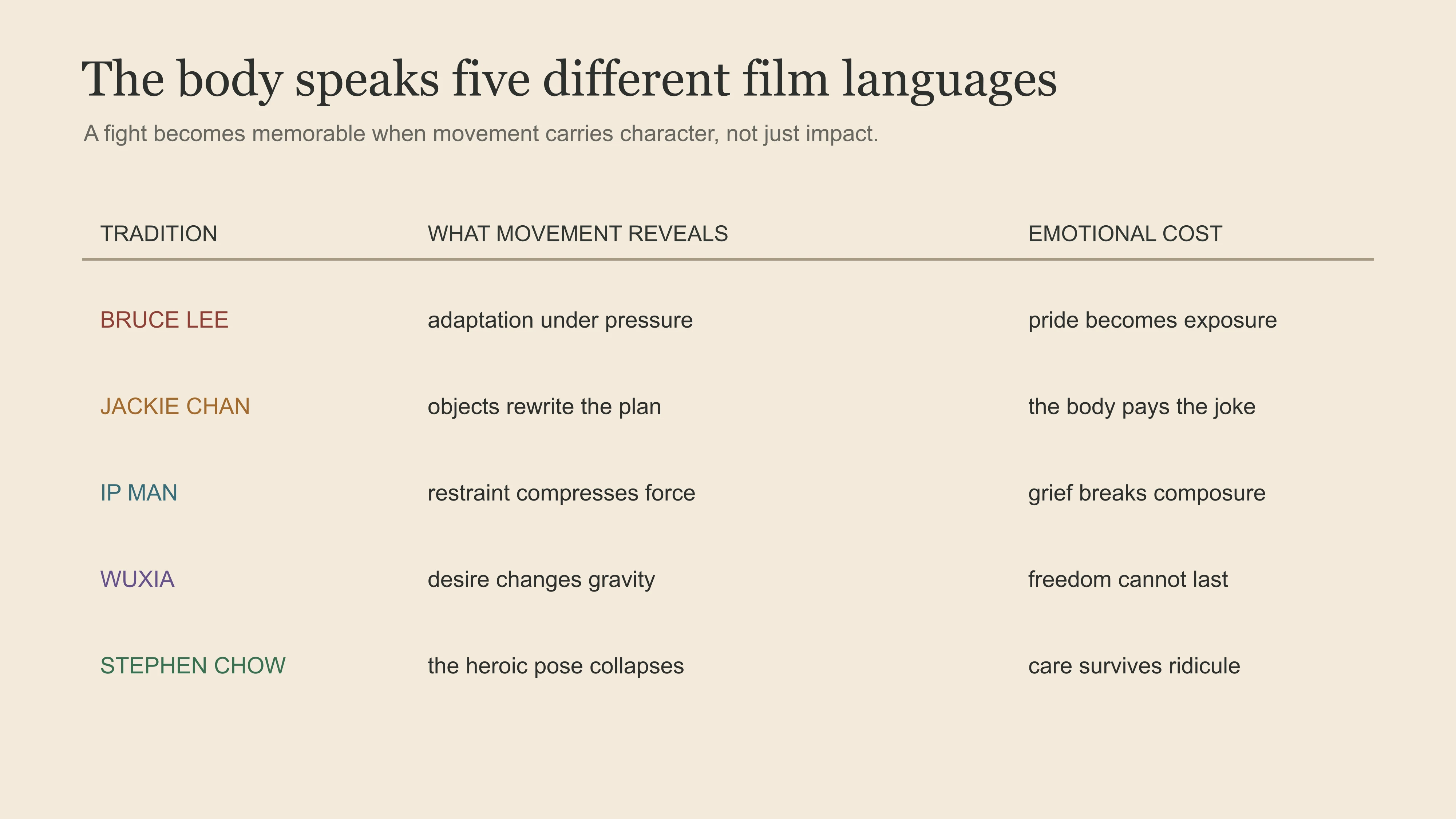
| If you want… | Start here | What the fight reveals |
|---|---|---|
| A direct challenge to pride and power | Enter the Dragon | Pauses, eye contact, explosive release and how a fighter controls the room before the exchange begins |
| Danger that turns into physical comedy | Police Story | How Jackie Chan lets props, gravity and failure become choreography |
| Moral calm made visible under pressure | Ip Man | Compact lines, economical movement and why restraint makes the eventual violence register |
| Desire, status and loss written in impossible motion | Crouching Tiger, Hidden Dragon | The contrast between airborne freedom and the social rooms characters cannot escape |
| A comic demolition of fake toughness | Kung Fu Hustle | How jokes strip status from gangsters and turn hidden skill into a question of responsibility |
The table is a route, not a final verdict. A classic becomes useful when it gives you a new pair of eyes, not when it wins a fight against every other classic.
Bruce Lee: combat as refusal of performance
Bruce Lee remains an essential entrance because his screen fighting hates empty display. A prolonged pose, a smug opponent or a rigid rule becomes something to puncture. His body reads as alert rather than ornamental: the camera often lets a pause build pressure, then makes a short action feel irreversible.
That is why his films travel so easily across languages. The story may be culturally specific, but the feeling is immediate—someone refusing to let hierarchy decide what a body can do. Watch the feet, not only the hands. Notice how often a fighter's certainty becomes the opening that defeats him.
Do not make the opposite mistake and treat every Lee scene as a technical syllabus. Film framing, editing, performance and myth-making create an image of mastery. The genre is honest about that in its own way: it gives us an ideal body, then makes us feel the cost of trying to become one.
Lee's clarity was also collaborative cinema, not solitary magic. Opponents, camera distance, sound, editing and choreography made his timing readable. Recognising that collaboration does not reduce him. It explains why screen presence is more than athletic ability: the entire frame learns to wait for his decision.
Jackie Chan: the room is part of the opponent
Jackie Chan changes the question from “Who is strongest?” to “How can this person survive the next ten seconds?” His greatest action sequences turn ladders, chairs, railings, umbrellas, windows and staircases into partners with bad intentions. The choreography is funny because competence keeps colliding with an environment that will not cooperate.
In Police Story, a space is never neutral background. The scene asks you to feel weight, friction and embarrassment. This is a different kind of martial imagination: triumph is not clean, the body takes the joke, and improvisation matters as much as the first plan. The Jackie Chan profile gives the wider route through stunt work, comedy and career scale.
This is life made choreographic. A normal object keeps its ordinary purpose while becoming a temporary problem, shield, trap or escape route. Chan's vulnerability is essential: pain arrives, plans fail and dignity rarely survives intact. I care more about that bruised resourcefulness than effortless invincibility because it lets the audience imagine intelligence under pressure, not merely a body born above consequence.
Ip Man: the body carries a moral myth
The 2008 Ip Man makes Wing Chun screen language feel almost like a form of punctuation—small movements, close lines, rapid controlled bursts. Donnie Yen's performance works because the film establishes restraint before it establishes dominance. When pressure finally breaks that restraint, a fight can carry grief and rage without becoming random spectacle.
The official Well Go page identifies the film, its principal creative team and distributor record. It does not turn the film into a biography of the historical teacher. Watch Ip Man for choreography and screen myth; read the film guide for the boundary between its real-person inspiration and its dramatic invention.
Crouching Tiger, Hidden Dragon: flight does not mean freedom
Some viewers arrive at Crouching Tiger, Hidden Dragon looking for a “kung fu movie” and are surprised by how much of its power comes from longing, etiquette and silence. That surprise is useful. Wuxia action is not only about defeating an opponent; it can make inner conflict spatial.
The fighting here repeatedly stages the gap between what a character can do and what a character is permitted to choose. The bamboo sequence is not just a pretty interruption. Flight makes the ground rules of class, desire and obligation more painful when the characters have to return to them. Our Crouching Tiger guide follows that emotional architecture without reducing the film to a plot summary.
A body must become readable before the camera makes it spectacular
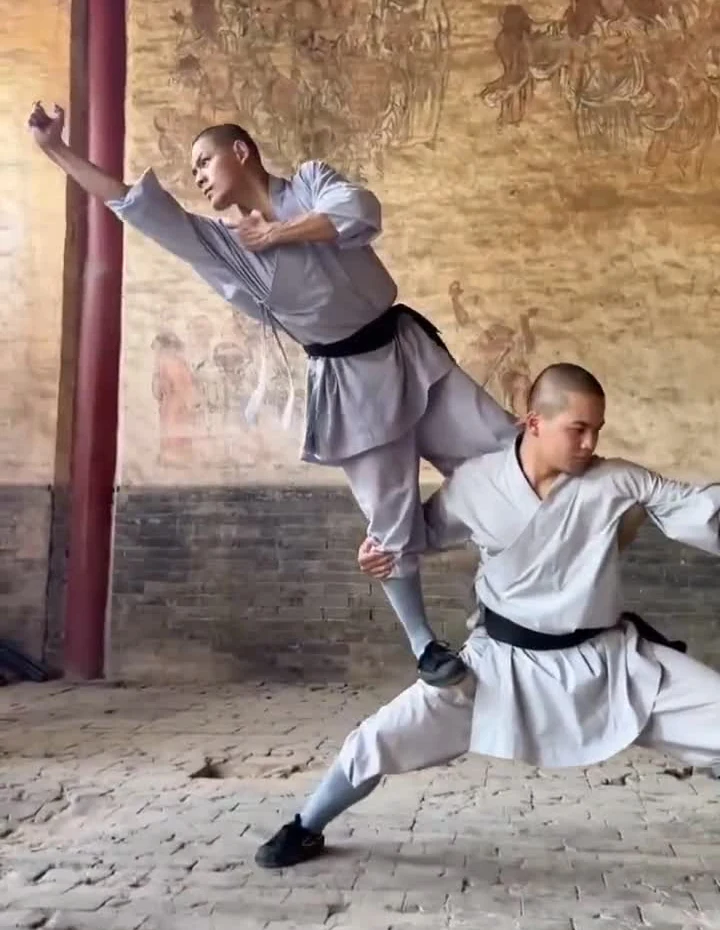
One performer becomes the other's floor. The held shape makes weight, trust and imbalance readable before editing or sound can tell the audience how to react.
This authorized field frame is not a movie still, and that is exactly why it belongs here. The pose has been organized for an observer: one diagonal body rises while the supporting body drops and widens its base. The action is legible because the two silhouettes do different jobs. Cinema can intensify that line with a closer lens, a cut or music, but the visible argument already exists in the bodies.
I distrust action scenes that hide every transition. If a cut arrives whenever weight must actually move, the sequence may still be exciting, but the performer has stopped being the source of our understanding. The opposite extreme is no better: a long unbroken take is not automatically honest or beautiful. Duration matters only when it lets us read preparation, transfer, recovery and consequence. The question is not “Was there a cut?” It is “Did the scene let the body finish its sentence?”
Kung Fu Hustle: comedy is a form of martial criticism
Kung Fu Hustle understands something many solemn action films forget: fake power is already funny. Stephen Chow lets gangsters, would-be heroes and cinematic masters inflate themselves until a joke reveals the weakness in the pose. Then he makes the fight matter because someone has finally stopped performing strength and chosen whom it should protect.
The visible clash is impossible in the ordinary-world sense, but it is precise in another one: a neighborhood's dignity becomes the reason for action. The Sony Pictures record confirms the production's official identity; the full guide explains why the film's jokes are not breaks from kung fu but its method of judging power.
Five things to notice before you call a fight “good”
- Distance: Is the fighter claiming space, protecting a center line, escaping, cornering or refusing a challenge?
- Rhythm: Does the scene breathe through pauses and resets, or does it rely on a continuous rush of cuts?
- Environment: Is a table, roof, alley, weapon or crowd changing the body's possibilities—or just decorating the frame?
- Cost: Who gets hurt, humiliated, exhausted or morally changed? A fight without cost is often only a demonstration.
- Decision: What does the character choose when skill becomes available—status, revenge, escape, care or restraint?
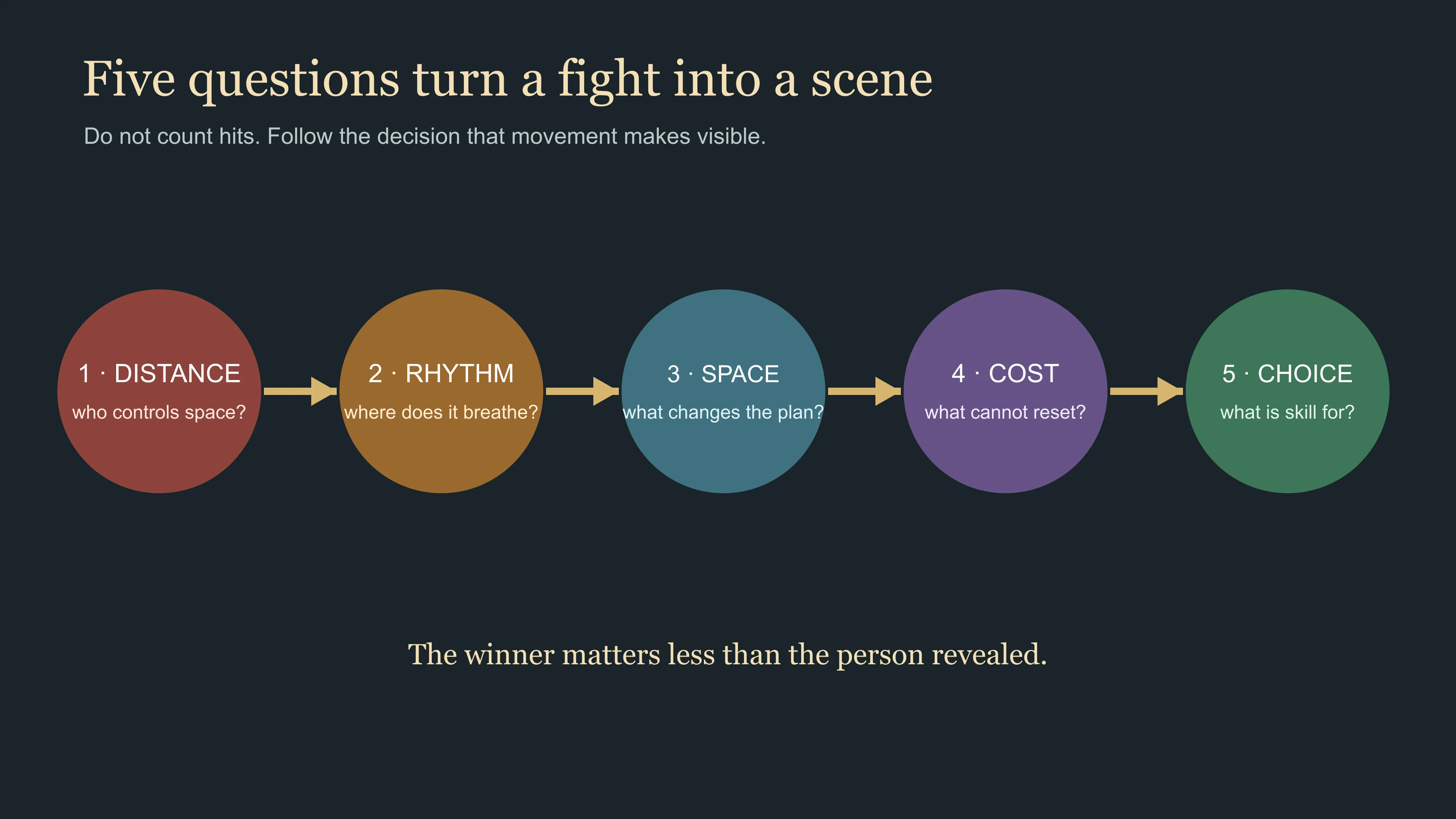
These questions improve a first viewing and make a rewatch much more rewarding. They also separate cinema from a “move compilation,” which removes the very reactions and consequences that make the movement intelligible.
The shot after impact is often the real fight
Do not stop watching when the blow lands. The next face, breath, stumble or silence tells us what the action meant. A frightened witness can turn technical victory into moral failure. An opponent who rises changes the rhythm from display to ordeal. A hero who looks ashamed after winning reveals more than a dozen clean combinations.
Editing decides whose pain counts. When a film rushes past every consequence, bodies become disposable punctuation. When it stays with exhaustion, damaged furniture, a broken friendship or the absurd effort of standing again, violence gains weight. On a rewatch, follow the reaction shots and you will often discover that the “best move” was never the scene's real subject.
Where kung fu cinema meets martial culture—and where it stops
Kung fu films have carried Chinese martial arts around the world. They introduced rhythms, weapons, styles, heroes and body ideals that a textbook cannot make thrilling. But a movie cannot certify a lineage, teach a safe technique or settle the history of a style.
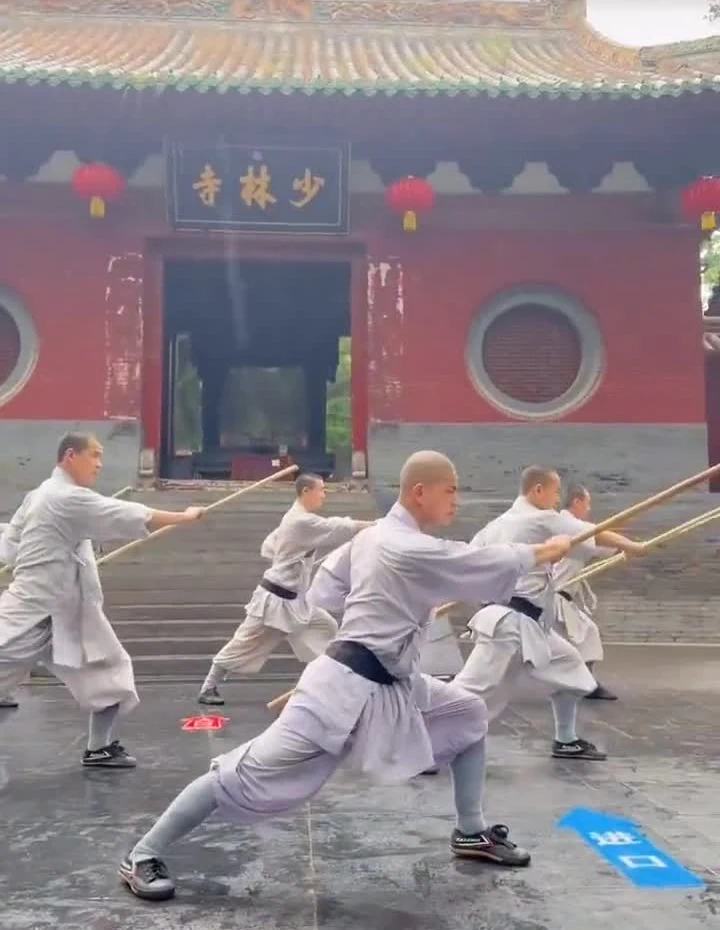
The staffs point in one direction, but the real work is between the performers: shared timing, matched distance and enough control to keep a group line coherent.
This courtyard sequence makes the boundary clearer than another abstract warning. The movement is already public performance, not a hidden combat archive. It depends on spacing, repetition and the viewer's ability to read a group pattern. Those same qualities can feed screen choreography, while a film adds framing, editing, stunt design and dramatic stakes. Calling the performance “fake” would be lazy. Calling it documentary proof of how people fought in another century would be equally lazy. It is a living visual practice with its own audience and purpose.
For that, move from the screen to the Chinese martial arts hub, the history of kung fu and the kung fu styles guide. The films will become richer once you stop asking them to be something they are not.
The real gift of kung fu movies is not the fantasy that we could all win a fight. It is the sharper pleasure of seeing a body reveal a choice before dialogue has time to explain it.
I love the instant a crowded room goes quiet because one person has decided not to retreat. I reject the empty version of that image—the hero pose without fear, cost or somebody worth protecting. A kung fu movie must make courage visible as a decision, not sell invulnerability as a personality. That is the line separating a scene I remember from a sequence I merely admire.
Choose one exchange and bring it to East Moment's community as a decision: identify the pause, move or failure that changed your judgment of the character. A clip title tells us who fought. Your reading should tell us why the scene had to exist.
That is how a kung fu movie becomes more than a list entry: it teaches your eyes to read consequence, character and the moral temperature of a room.
That reading is the real reason to return for another viewing.