The Ip Man movie released in 2008 is an excellent martial-arts drama and an unreliable biography. Its achievement is turning Wing Chun's compact movement into an instantly readable moral identity: Ip Man absorbs pressure, wastes little motion and uses force only after restraint fails. Watch it for how choreography builds character, not as a documentary record of the real man.
Ip Man movie in 60 seconds
| Question | Short answer |
|---|---|
| Which film? | Ip Man (2008), the first Donnie Yen film in the main series |
| Director | Wilson Yip |
| Action direction | Sammo Hung |
| Main cast | Donnie Yen, Simon Yam, Lynn Hung, Fan Siu-wong and Hiroyuki Ikeuchi |
| Setting | Foshan before and during the Japanese occupation |
| Is it a true story? | Inspired by a real Wing Chun teacher, but major plot events and fights are dramatized |
| Best reason to watch | The fights make ethics visible through rhythm, distance and restraint |
The Well Go USA official film page identifies Wilson Yip, Donnie Yen and the distributor's synopsis. Its promotional biography should not be treated as independent historical documentation.
What the first Ip Man movie is about
In 1930s Foshan, Ip Man is respected for Wing Chun but avoids running a public school or turning every challenge into spectacle. The first act builds a prosperous martial-arts town where reputation travels through visits, gossip and demonstrations.
War destroys that social order. Ip's family loses its home and food becomes scarce. A Japanese general stages matches between Chinese martial artists and Japanese military practitioners. The film moves from private tests of skill to public violence controlled by occupation power.
The transformation is effective because Ip does not begin as an aggressive avenger. His calm has already been established as choice rather than weakness. When the famous ten-man fight arrives, rage changes the tempo of a body the audience has learned to read as economical.
Foshan must feel socially alive before the myth can break
The prosperous first act is sometimes treated as material the film should hurry through. That is wrong. The teahouse talk, domestic negotiation, visits from challengers and factory friendship give Ip's restraint a social environment. He is not calm in an empty temple. He is calm while reputation, family and other martial artists continually invite him to perform superiority.
War then destroys more than comfort. It destroys the network that made refusal possible. Hunger narrows choices; armed occupation changes a challenge into coercion; public combat becomes propaganda. If we skip this social transition, the ten-man fight becomes a clip designed for applause. Keep it, and the same rhythm feels like the collapse of a moral arrangement.
I admire the scene, but I do not celebrate it as proof that one Chinese master could defeat any number of enemies. That reading is childish. The power comes from watching a disciplined screen body lose access to its earlier form of restraint.
The Ip Man cast is organized by movement
The characters are easier to understand through how they occupy space than through a conventional cast list.
| Character | Performer | Movement or social function |
|---|---|---|
| Ip Man | Donnie Yen | Compact action, controlled posture and authority without public display |
| Cheung Wing-sing | Lynn Hung | Domestic limits and the cost that martial reputation imposes on family life |
| Chow Ching-chuen | Simon Yam | Friendship, factory labor and the ordinary community affected by violence |
| Jin Shanzhao | Fan Siu-wong | Large, direct northern-style force and status gained through challenge |
| General Miura | Hiroyuki Ikeuchi | Military hierarchy converting combat into occupation spectacle |
This design makes Ip visually distinctive before anyone explains philosophy. He does less, but the less is exact.
Why the Wing Chun looks so clear on screen
Film fighting must communicate to viewers who cannot inspect foot placement in a real exchange. The choreography gives Ip a small visual vocabulary and repeats it under changing pressure:
- elbows stay comparatively close and hands protect the center;
- rapid straight strikes create a distinct percussive rhythm;
- deflection and attack appear connected rather than separated into large beats;
- short movement contrasts with opponents who swing, charge or display power across more space;
- the wooden dummy makes repetition and line visible before combat gives those patterns consequence.
These observations describe screen language, not a universal technical manual. Editing, camera position, performer skill and action design make the movement readable. A serious Chinese martial arts guide must distinguish lineage, practice and historical evidence from what a film needs an audience to see.
The compact posture is easy to read because the film keeps the body at human scale. The movement becomes meaningful only when the established economy later changes.
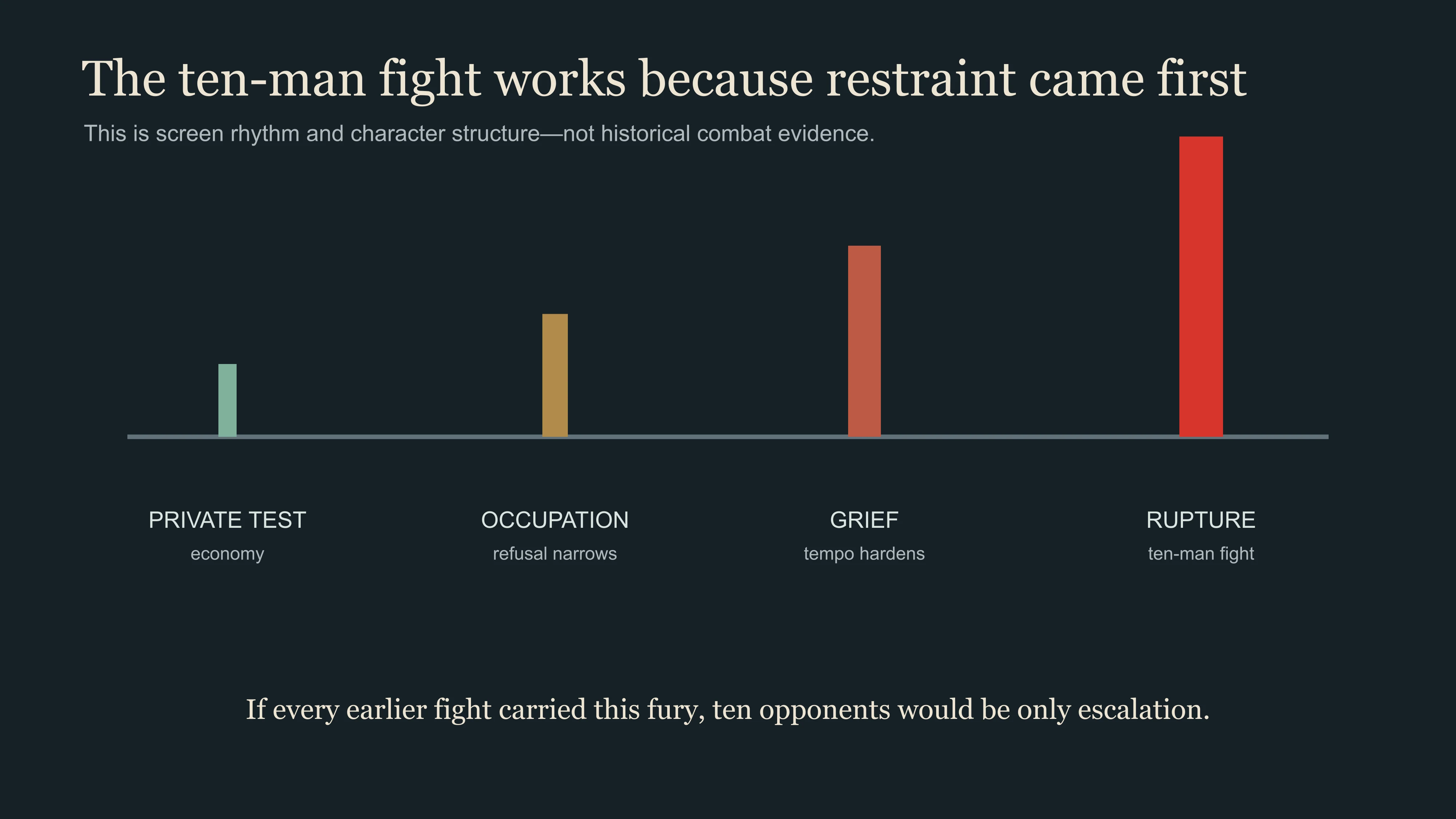
The ten-man fight is powerful because it breaks the established rhythm
“I want to fight ten” is remembered as a dominance line. Its real force comes from grief and institutional imbalance.
The matches are not neutral sport. The occupying military chooses the room, opponents, reward and consequences. After violence against Chinese fighters, Ip enters a system designed to turn bodies into proof of Japanese authority. Fighting ten opponents reverses the spectacle for a moment, but it does not remove the soldiers or feed the town.
Ip's strikes become harder and the choreography permits more visible damage than in the earlier private challenges. The scene feels like character rupture because restraint was carefully built first. If every previous fight had carried the same fury, ten opponents would be only escalation.
The organized opposition makes the imbalance visible. What matters is not a numerical boast but the moment controlled repetition hardens into punishment.
Is the Ip Man movie a true story?
Ip Man was a real martial artist associated with Wing Chun and later teaching in Hong Kong; Bruce Lee studied with him. That biographical core does not authenticate the movie's central conflict.
The 2008 film compresses time, creates and combines characters, dramatizes occupation-era suffering and builds decisive fights around a national-resistance arc. The ten-man match and final public duel should be understood as cinema unless a reliable historical source documents the specific event. The film itself and distributor marketing cannot validate their own inventions.
This distinction does not reduce the movie's value. It clarifies it. The filmmakers are building a usable screen ancestor: modest in prosperity, dignified in deprivation and explosive only when collective humiliation makes restraint impossible.
That myth has consequences. It can inspire interest in Wing Chun and distort expectations of what one teacher's life proves. The responsible position is neither “all true” nor “therefore meaningless.” It is to identify what kind of truth a scene is offering.
Why viewers remember the screen myth as a person
The wordplay joining Wing Chun (咏春) to the impossibility of remaining forever young or forever present (永春) stays with me. It shifts the question away from who won a fight. What I feel instead is the loss of the composed figure Donnie Yen made familiar.
This does not authenticate the film's biography. It shows how a screen performance can become the container through which many people feel attachment to a historical name. The more emotionally complete the movie's Ip Man feels, the more important it becomes to separate three layers: the documented teacher, the film's nationalist-era plot and Donnie Yen's restrained screen persona. Respect for the feeling requires that separation; it does not require turning feeling into evidence.
The Japanese characters and national framing
General Miura receives some discipline and respect for martial skill, while Colonel Sato represents arbitrary cruelty. That difference gives the occupation story more texture than a single faceless enemy, but the film still organizes its moral world through national humiliation and resistance.
Viewers should not convert its characters into claims about whole populations. Nor should they pretend the occupation setting is decorative. Scarcity, forced spectacle and armed power determine who can refuse, who can leave and what a victory costs.
The family scenes are the necessary brake on nationalist spectacle. Cheung Wing-sing does not exist merely to admire a master's restraint. She sees the time, danger and social disruption that martial reputation brings into the home. Ip's controlled public body is therefore never cost-free; somebody else has to live beside the invitations to challenge it.
I prefer this domestic pressure to another speech about honor. A hero who is disciplined only in front of enemies is easy to manufacture. The harder test is whether skill can remain answerable to dinner, fear, marriage and a child who did not choose symbolic duty. The film does not solve that tension completely, but without it Ip would be a national poster rather than a person the audience can mourn.
The best comparison is not a hypothetical real fight between styles. It is how different films turn movement into an ethical proposition. Crouching Tiger, Hidden Dragon makes flight carry conflicting ideas of freedom; Ip Man makes economy carry disciplined character. The Donnie Yen guide traces how his screen fighting changes across roles rather than treating Ip as his complete identity.
Ip Man movies in order
For the Donnie Yen main series, watch:
- Ip Man (2008)
- Ip Man 2 (2010)
- Ip Man 3 (2015)
- Ip Man 4: The Finale (2019)
Start with the first film even if a later clip led you here. It establishes the restrained movement and family context that make later escalation intelligible. Spin-offs and other actors' Ip Man films are separate branches, not required chapters inside this four-film arc.
Why the first Ip Man movie remains the strongest entry
The first Ip Man remains the strongest entry point because its choreography has grammar. Small movement means control. Repetition means discipline. A sudden increase in force means something has changed inside the character and around him.
Its biography is compressed into legend, and readers should say so plainly. But the film earns its emotional authority through form: before Ip Man becomes a symbol, the camera teaches us how he chooses to move.
Explore the Chinese movies collection for more scene-led guides, or compare Jet Li's very different use of stillness in the Jet Li guide.
Ip Man must remain two people at once: historical subject and screen character
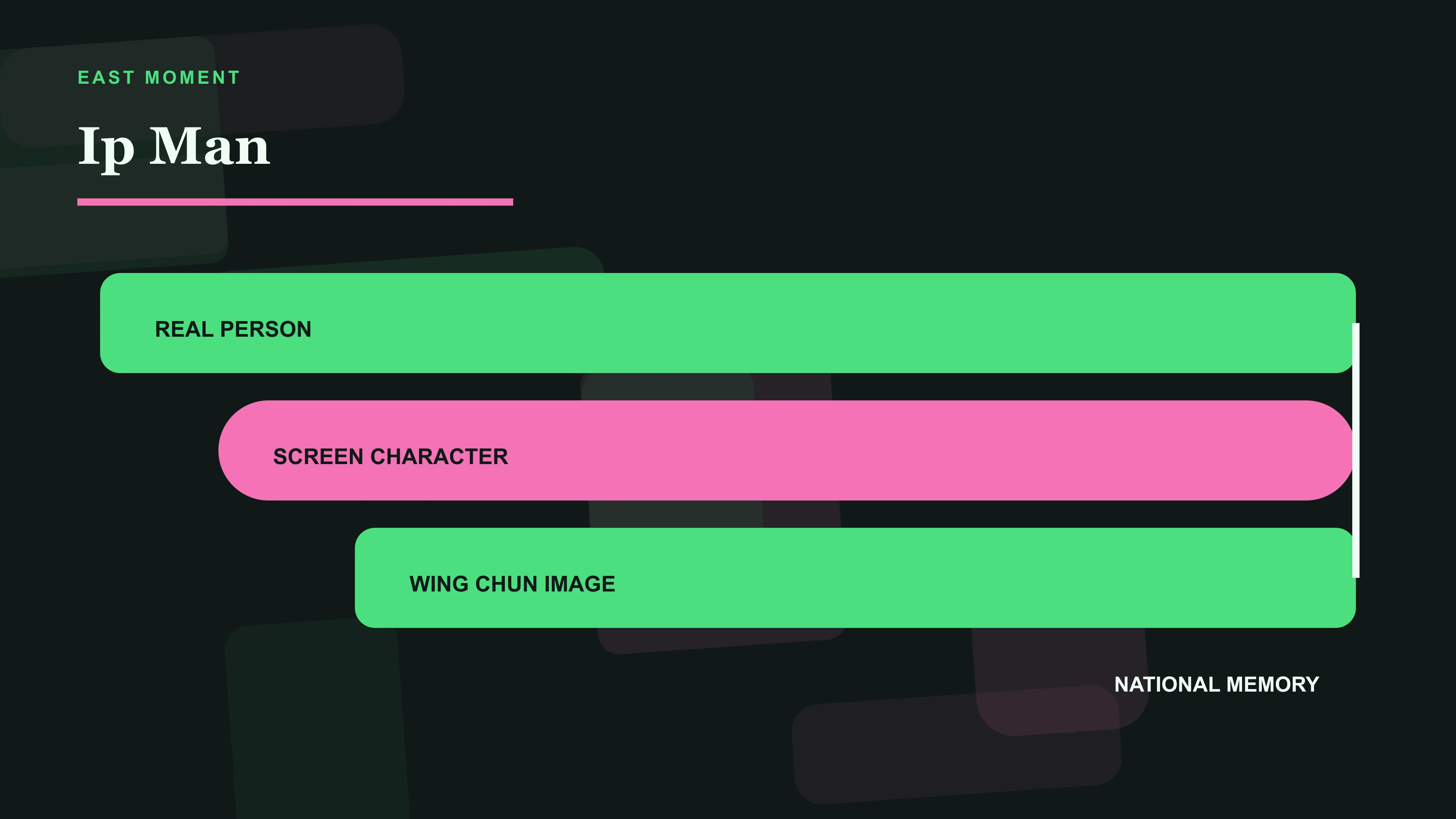
Donnie Yen's Ip Man is controlled, morally legible and designed for cinema. The historical Ip Man taught Wing Chun and later became surrounded by biography, lineage claim and popular memory. A film scene can reveal the character's ethics; it cannot document a fight merely because a real name appears in the title.
The ten-man sequence works through a broken rhythm: restraint has been established, grief and occupation pressure rupture it, and repeated short strikes become emotionally excessive on purpose. That is screen language, not neutral demonstration.
My boundary is firm: admire the performance, verify history separately, and never use choreographed victory as proof of ethnic or martial superiority.
That separation protects both subjects. The film can remain emotionally powerful, while the historical teacher is allowed to be more complicated than a national icon built from perfect restraint.