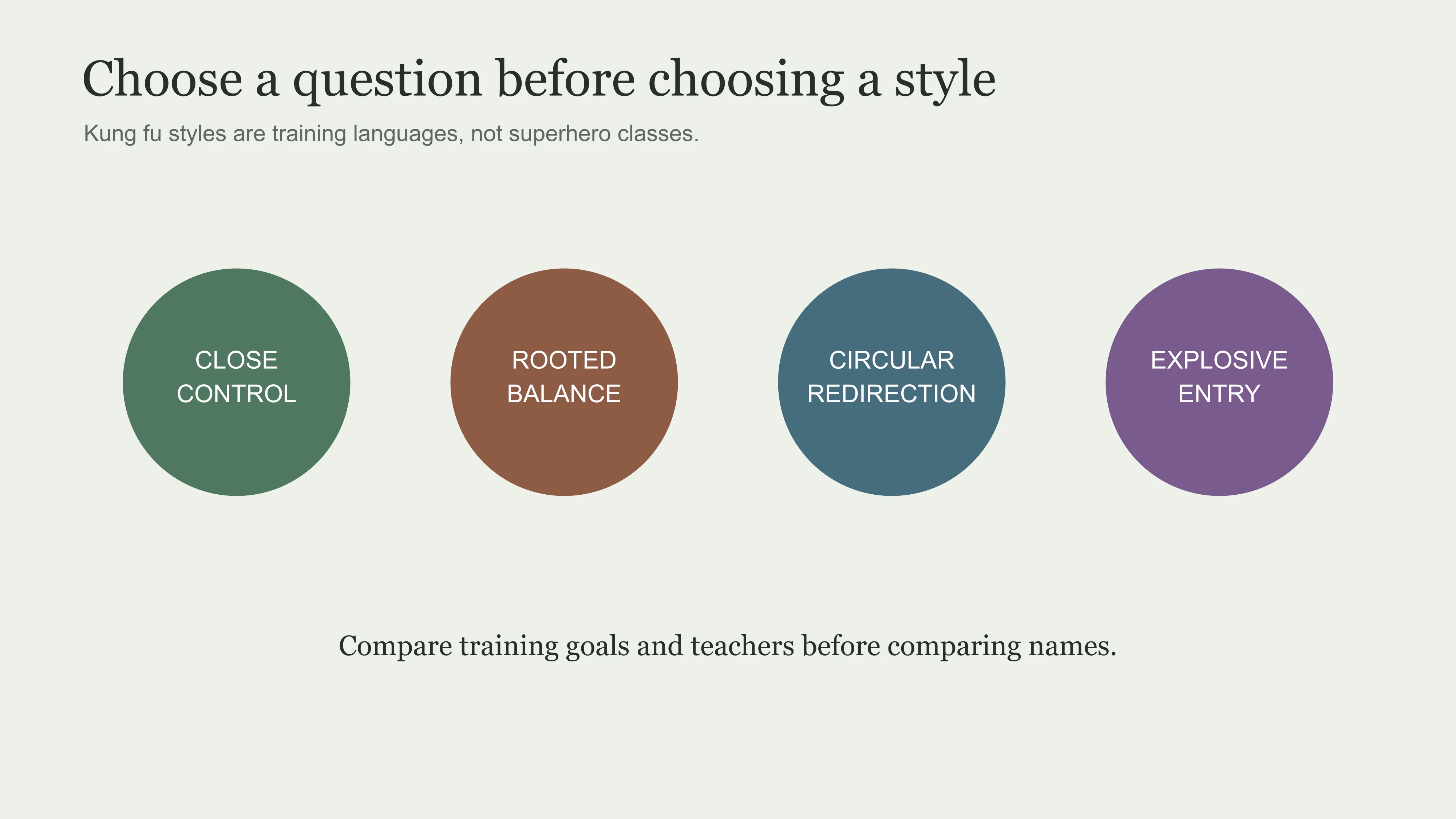
A list of kung fu styles can become a wall of Chinese names very quickly. I would rather give each style one readable question: does it seek close-range control, long-range power, circular redirection, rooted balance, explosive entry or competitive precision?
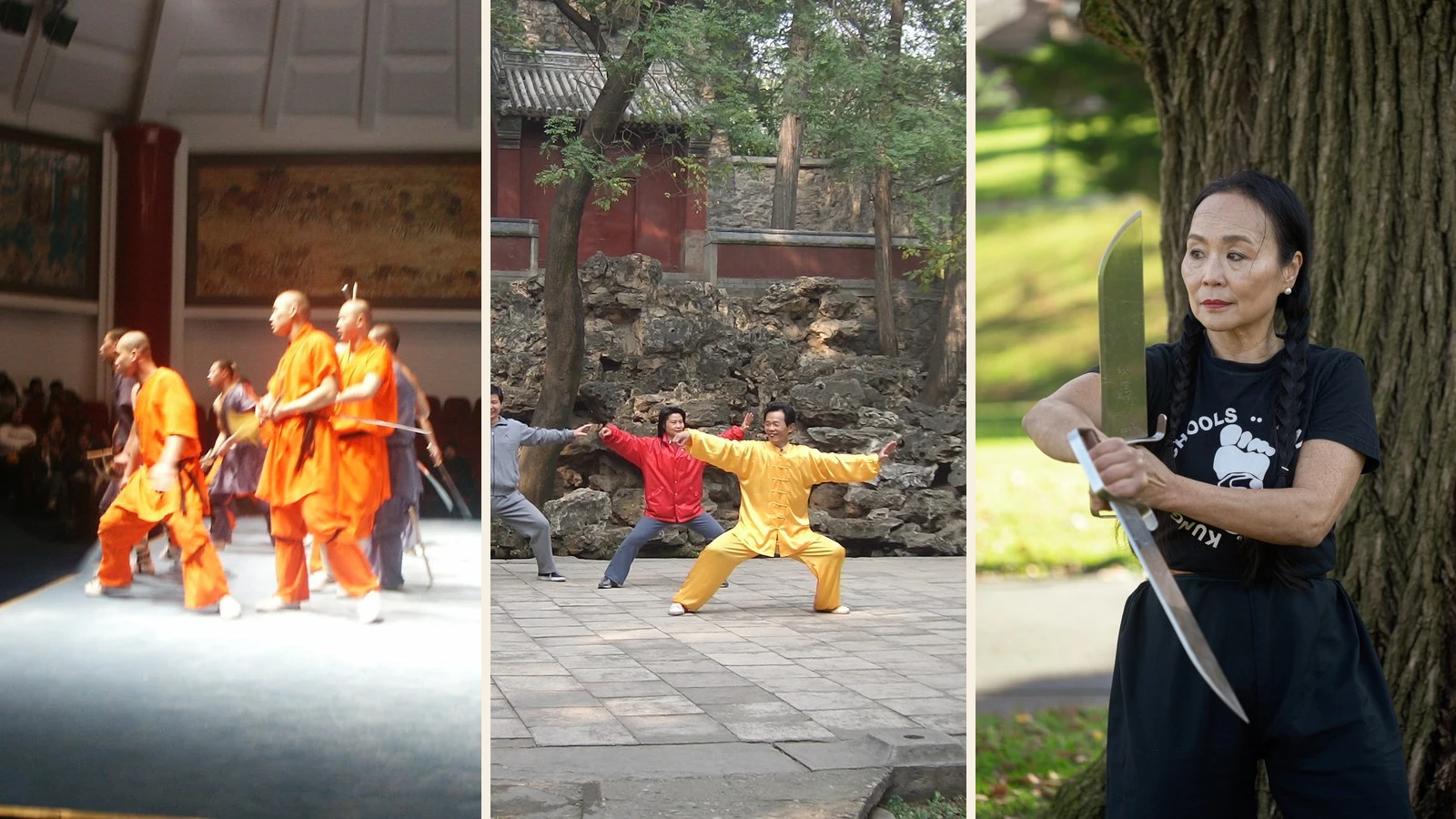
The cover is an explicit three-source comparison: a staged Shaolin exhibition in Dengfeng, a Chen-style taijiquan class in Beijing and Anne Pang training Wing Chun weapons in a park. The pictures prove distinct bodies, rooms, equipment and group structures—not the superiority, completeness or ancient purity of any style.
Kung fu styles are training languages, not superhero classes
The names below do not describe interchangeable “powers.” They describe lineages, teaching priorities and ways of organising the body. A school can contain several methods, and the same name can look different in different teachers' hands.
The film image is useful because it shows proximity: Wing Chun's visual drama is not a distant flying kick but the question of what happens when two bodies have no room to waste.
The Chinese martial arts collection is the wider route through history, sport and screen culture. This page owns the choosing problem: how to compare a style without pretending its name tells you what one actual school teaches.
The most useful beginner map
| Style or family | Movement idea | Why people recognise it |
|---|---|---|
| Shaolin kung fu | A broad training culture combining forms, conditioning and Buddhist institutional memory | Temple demonstrations and cinema |
| Wing Chun | Close-range lines, centre control and economical hand techniques | Ip Man films and Hong Kong teaching lineages |
| Tai Chi (Taijiquan) | Slow practice, structure, balance and changing force | Park practice and internal-martial discussion |
| Bajiquan | Short explosive power and decisive entry | Strong hip and shoulder drive in demonstrations |
| Bagua Zhang | Circular walking, angle changes and evasive stepping | Turning around an opponent rather than meeting force head-on |
| Xingyiquan | Direct intent, alignment and forward issuing power | Simple-looking lines with demanding structure |
| Modern wushu | Standardised performance, speed, flexibility and competition scoring | High-flying forms and international sport |
This is a map, not a ranking. “Internal” and “external” are often used too rigidly in English explanations; real training cultures do not always respect that neat split.
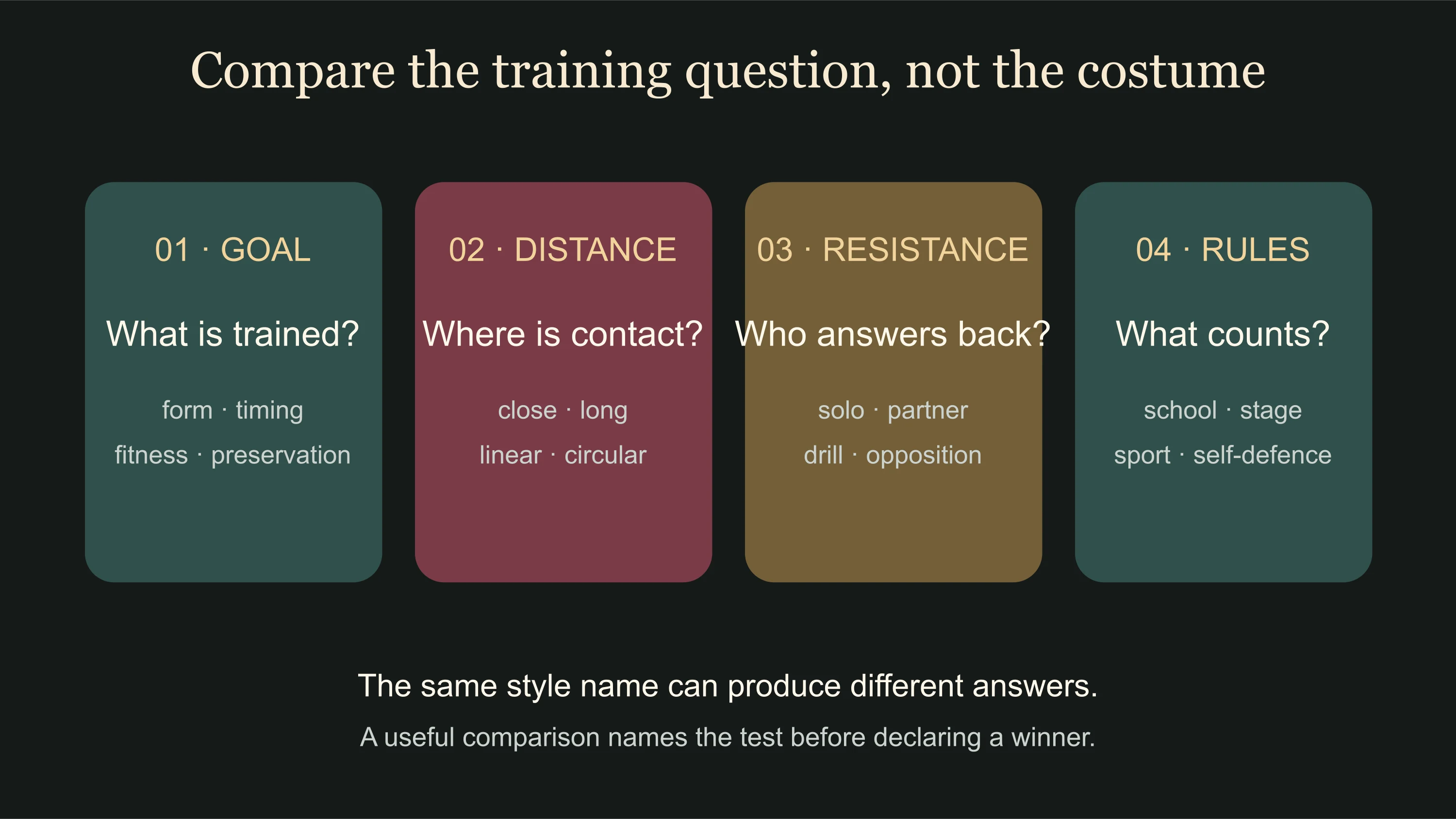
I trust four questions more than a lineage slogan: What is being trained? At what distance? Against what kind of partner or resistance? Under which rules? The answers may change inside one school across beginner form, partner drill, competition and performance.
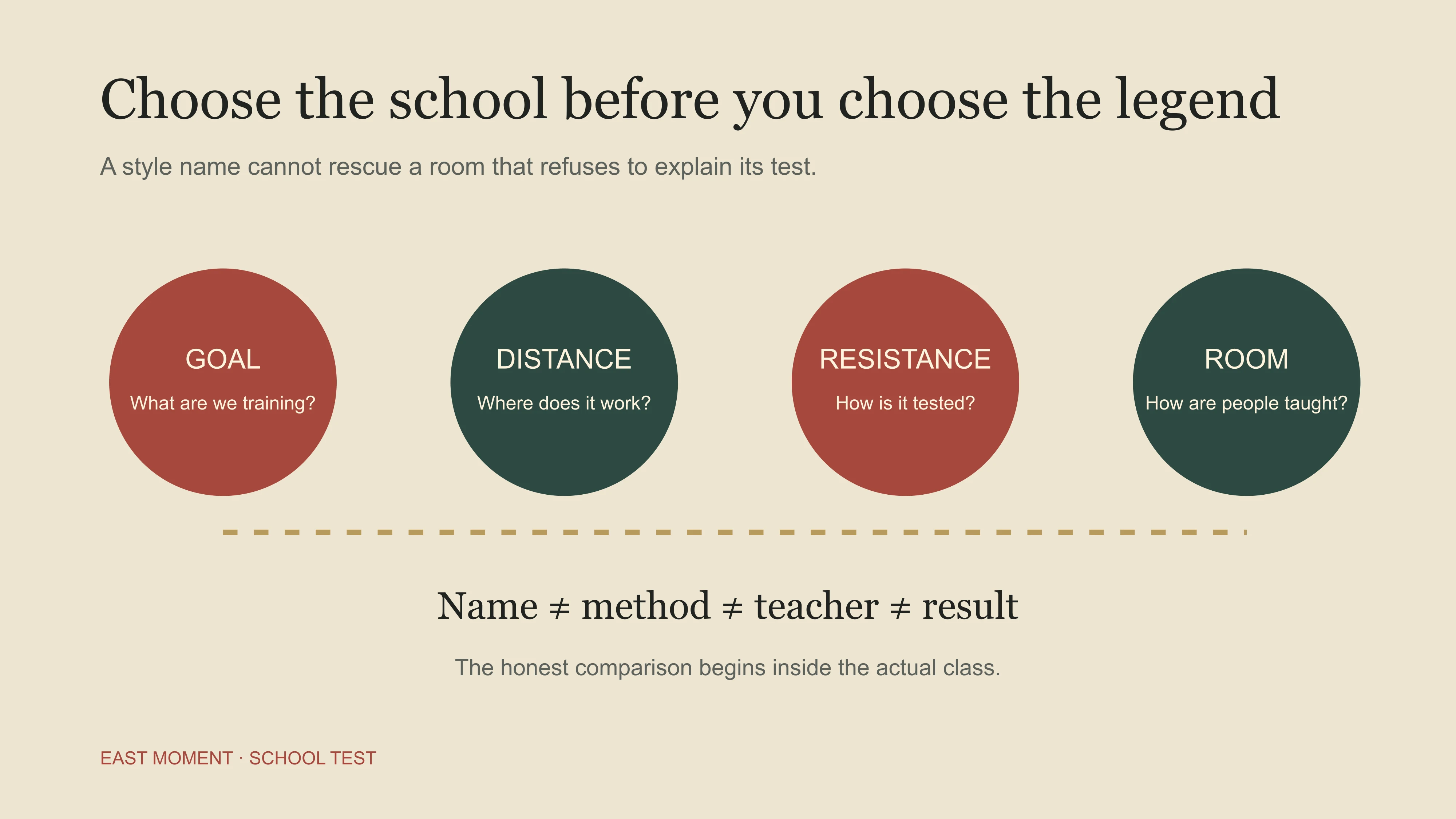
A famous style cannot rescue a room that refuses to explain its goal, distance, resistance and teaching culture.
The school is the style you will actually experience. Two doors carrying the same lineage name can lead to completely different weeks: one room may spend months on structure and partner feedback; another may prepare performance routines; a third may train for rules-based competition. None is automatically fraudulent, but each owes the student an honest description. I would choose the plain teacher who can show progression over the charismatic teacher who sells inherited superiority.
This is why “Which style is best?” is usually the wrong first question. Best for what body, what age, what schedule, what risk tolerance and what kind of pleasure? Someone who loves exact close-range drills may hate a curriculum built around acrobatic performance. Someone drawn to weapons and large movement may feel trapped by compact hand work. A good choice creates the desire to return next Tuesday. A legendary name cannot practice on your behalf.
This is my hardest judgment on style shopping: choose the school before the legend. A modest teacher who explains progression, corrects without humiliation and states what a drill cannot prove is more valuable than a celebrated name pasted over chaos. Lineage can preserve serious knowledge. It can also become branding. The difference appears in how people train, not in the length of the family tree printed on a wall.

The Shaolin Wushu Museum is a blunt reminder that a style reaches us through institutions, exhibitions, tourism and public education as well as private training. This East Moment archive photograph proves the modern museum setting, signage and visitors. It does not show what any school teaches or turn a public label into evidence of one complete lineage.
I like this untidy public scene more than another immaculate stance portrait. Umbrellas, statues, ticketed space and people walking in different directions expose the machinery around a famous name. A style is never only its ideal movement; it is also who teaches it, how it is packaged, which room receives beginners and what an institution chooses to display. If a school cannot explain those present-day choices, an ancient pedigree will not save it.
Shaolin is a place and institution, not one choreography
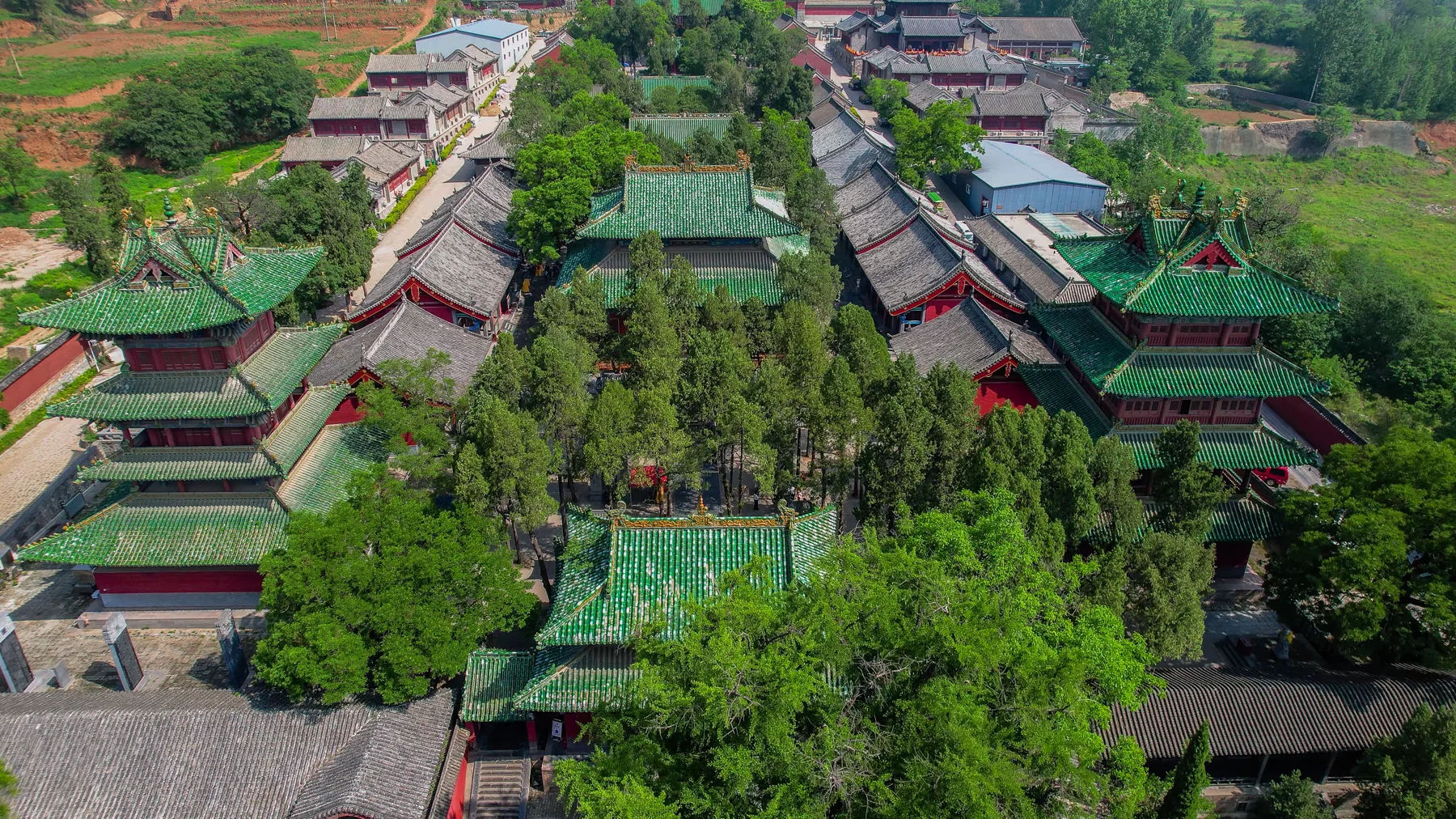
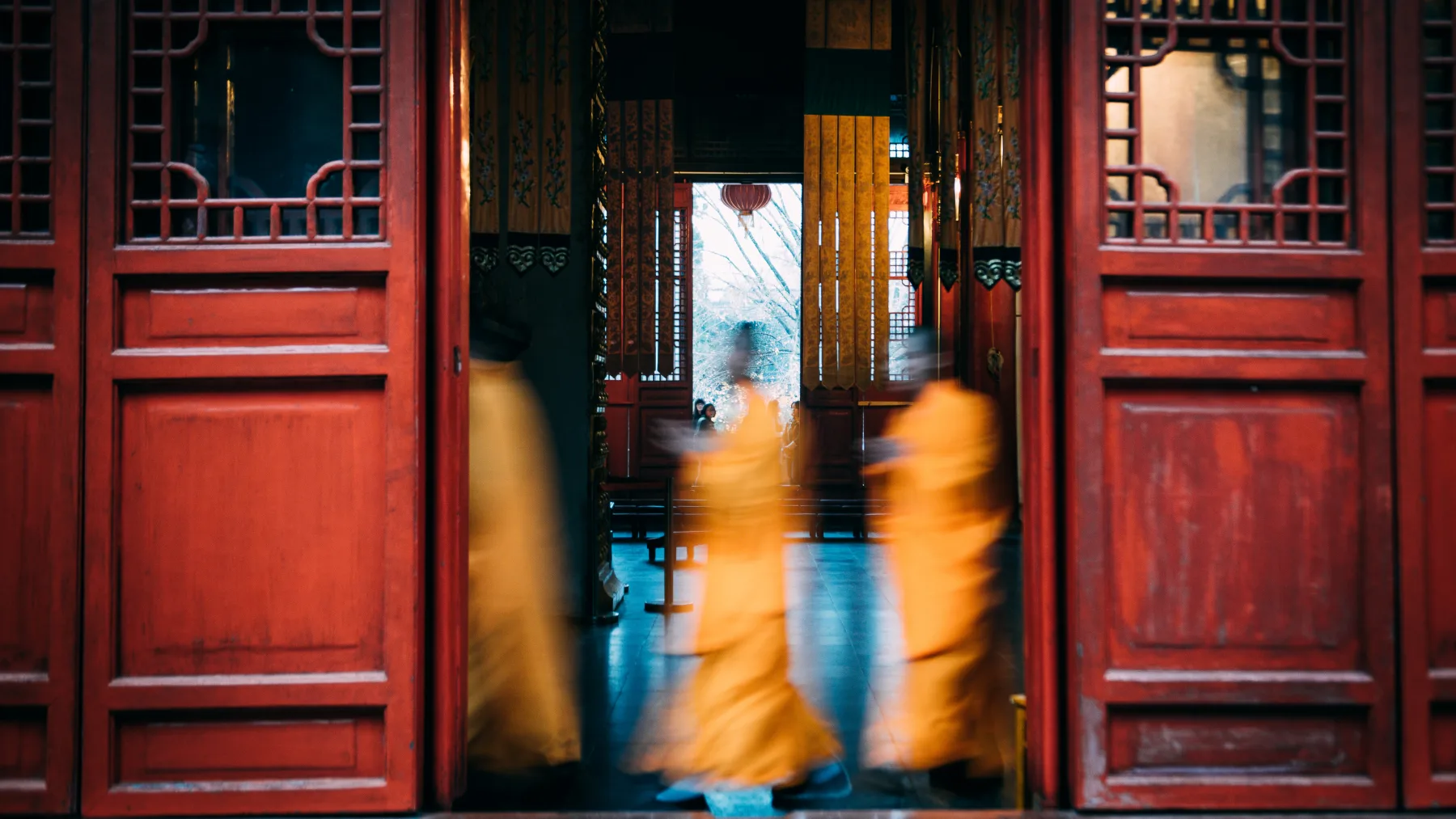
Shaolin's influence is easiest to understand through place, ritual, teaching and public performance. The monastery became a global shorthand for Chinese martial arts, but “Shaolin style” can refer to different modern curricula and demonstrations.
Read the dedicated Shaolin kung fu guide alongside kung fu history. The history page explains why the association matters; this page is about how to compare movement languages without treating every monk demonstration as proof of an ancient universal system.
Styles change when the training goal changes
The same outward movement can be taught for form performance, partner sensitivity, fitness, self-defence, competition or lineage preservation. Those goals change speed, distance, contact and what counts as success. A beautiful solo routine may reveal coordination without showing how the movement behaves against resistance.
This is why “Does it work?” is too vague. Work for what: winning under a sport ruleset, developing balance, preserving a form, performing on stage or handling a specific self-defence problem? The honest answer begins by naming the test.
Resistance must be named just as carefully. A cooperative drill can teach alignment or timing because the partner temporarily makes one problem clear. It cannot establish what survives unscripted opposition. Free exchange can test adaptation, yet its rules still shape distance, targets and acceptable risk. Neither mode is shameful. The fraud begins when one test quietly claims the authority of another.
A school should be able to explain its goal without insulting every other branch. Grand claims that one style defeats all others usually reveal marketing before they reveal method.
Wing Chun makes distance feel like a moral decision
Wing Chun is often presented through its compact centreline actions. Whether a film reproduces training accurately is a separate question, but the screen image communicates something real about the style's appeal: there is nowhere to hide behind distance.
That is why Ip Man remains such a useful gateway. Its best scenes are not simply “cool moves.” They turn restraint, dignity and controlled force into a public answer to humiliation.
The film also creates a trap: viewers can mistake a beautifully compressed screen grammar for the totality of Wing Chun. Real schools disagree, lineages branch and training priorities vary. I love the close-range dramatic idea, but I will not use Donnie Yen's framing to certify a teacher. Let the movie open curiosity; let the class supply evidence.
Tai Chi is not just slow exercise in a park
Tai Chi's public image often stops at slow movement. The slowness is a training method and visual language, not the whole martial claim. It makes weight transfer, balance and continuity visible to a beginner who might otherwise only see speed. The UNESCO Taijiquan record identifies circular movement, breath regulation, several schools and both routines and partner push-hands; that official description is already richer than the flattened image of anonymous park exercise.
East Moment does not give medical or exercise advice here. For training, readers need a qualified local teacher. For cultural understanding, start with our Tai Chi guide and notice how breath, posture and attention are described without turning tradition into a wellness slogan.
Bajiquan, Bagua and Xingyi show why “lesser-known” is not “less important”
Bajiquan's reputation for close, explosive power, Bagua's circular footwork and Xingyi's direct issuing all challenge the assumption that Chinese martial arts have one visual grammar. The styles are harder to identify from a movie thumbnail because their meaning lives in training method and teacher explanation, not only in a signature pose.
Their familiar labels—explosive, circular, direct—are useful only as first questions. Bajiquan is not one shoulder strike, Bagua is not walking a decorative circle and Xingyi is not charging forward without intelligence. A social-media clip isolates the moment most likely to be shared. A serious comparison asks what exercises produced it, what body relationship it trains and what happens when timing fails.
That is precisely why a good style guide should resist fake certainty. A single viral clip cannot represent a whole lineage. Look for the institution, teacher, context and purpose behind the demonstration.
Weapons reveal structure that empty hands can hide
A staff lengthens mistakes in angle and timing. A straight sword makes the relationship between wrist, line and footwork visible. A broadsword changes momentum and recovery. Weapons are not decorative accessories added after the “real” style; in many traditions they preserve movement ideas that also organise empty-hand practice.
Use the Chinese martial arts weapons guide to compare those objects without treating film props as technical evidence. The useful connection is not “which weapon is deadliest?” It is what the object forces the body to learn about distance, alignment and consequence.
Modern wushu changed what the world expects to see
Modern wushu brought Chinese martial arts into international competition with standardised routines, judging and spectacular athletic skills. It is a real contemporary practice, but it is not a neutral museum window onto every traditional style.
Competition footage can prove visible extension, balance demand and performance scale. It cannot prove that every routine shares one lineage or that athletic visibility is less serious than close-range partner work.
This is why the old “internal versus external” split is a poor shopping filter. The terms carry intellectual and lineage histories, but beginners often hear a cartoon: soft mystical force on one side, hard muscular force on the other. Actual bodies need structure, timing, relaxation, conditioning and contact in different proportions. A school that promises secret internal power without a visible learning process deserves suspicion, not reverence.
A five-minute school observation is worth more than fifty style rankings
Watch who receives attention. Are beginners taught where to stand and why, or abandoned to imitate the front row? Does the teacher distinguish form, application, performance and resistance? Can a student ask what success looks like? Does correction make the body safer and more intelligible, or merely demand obedience?
Then inspect the emotional room. A style can be culturally rich and the local school can still be wrong for you. If every question is treated as disrespect, every discomfort as weakness and every claim as untestable mystery, leave. Kung fu is supposed to cultivate skill through work. A room that prevents understanding is working against the meaning of the word.
I also watch the students when the teacher is not demonstrating. Do advanced students help beginners without displaying dominance? Can someone ask why a drill exists? Does correction become more specific over time, or does every failure receive the same command to “relax”? The social body of a school reveals its method. Skill is not only what the teacher can perform at the front; it is what the room consistently teaches other people to become.
The International Wushu Federation is the right place to understand the sport's institutional structure. Compare it with film choreography and traditional school practice rather than asking which one is “real kung fu.” They answer different questions.
My verdict
The best way to choose among kung fu styles is not to ask which one is strongest. Ask what movement teaches you to notice: the centre, the angle, the ground, the breath, the distance or the moment before force arrives. If you are still deciding whether you need a style, history, place or screen-culture answer, begin with Chinese kung fu.
Then continue to martial arts anime to see how animation turns those ideas into character, and bring one style you want to understand to East Moment's community.
A good comparison should leave you with a better observation, not a winner. “This clip keeps changing angle before contact” is useful. “Bagua defeats Wing Chun” tells us almost nothing about teacher, rules, bodies, training goals or the test being imagined.