Martial arts weapons are not a catalogue of sharper tools. In Chinese stories, a weapon changes the space between people. A staff can keep a crowd back, a straight sword can make restraint visible, and a spear can turn one person's decision into a line the whole battlefield must respect.
Martial arts weapons are movement languages
The fastest way to understand a Chinese weapon is not to memorise its name. Watch what it asks the body to do. Does it extend distance, protect the centre, redirect force, create rhythm or announce rank?
The Chinese martial arts collection holds the wider history, sport and screen map. This guide owns a more physical question: what line does an object draw through a room, and how does that line change everybody else's choices?
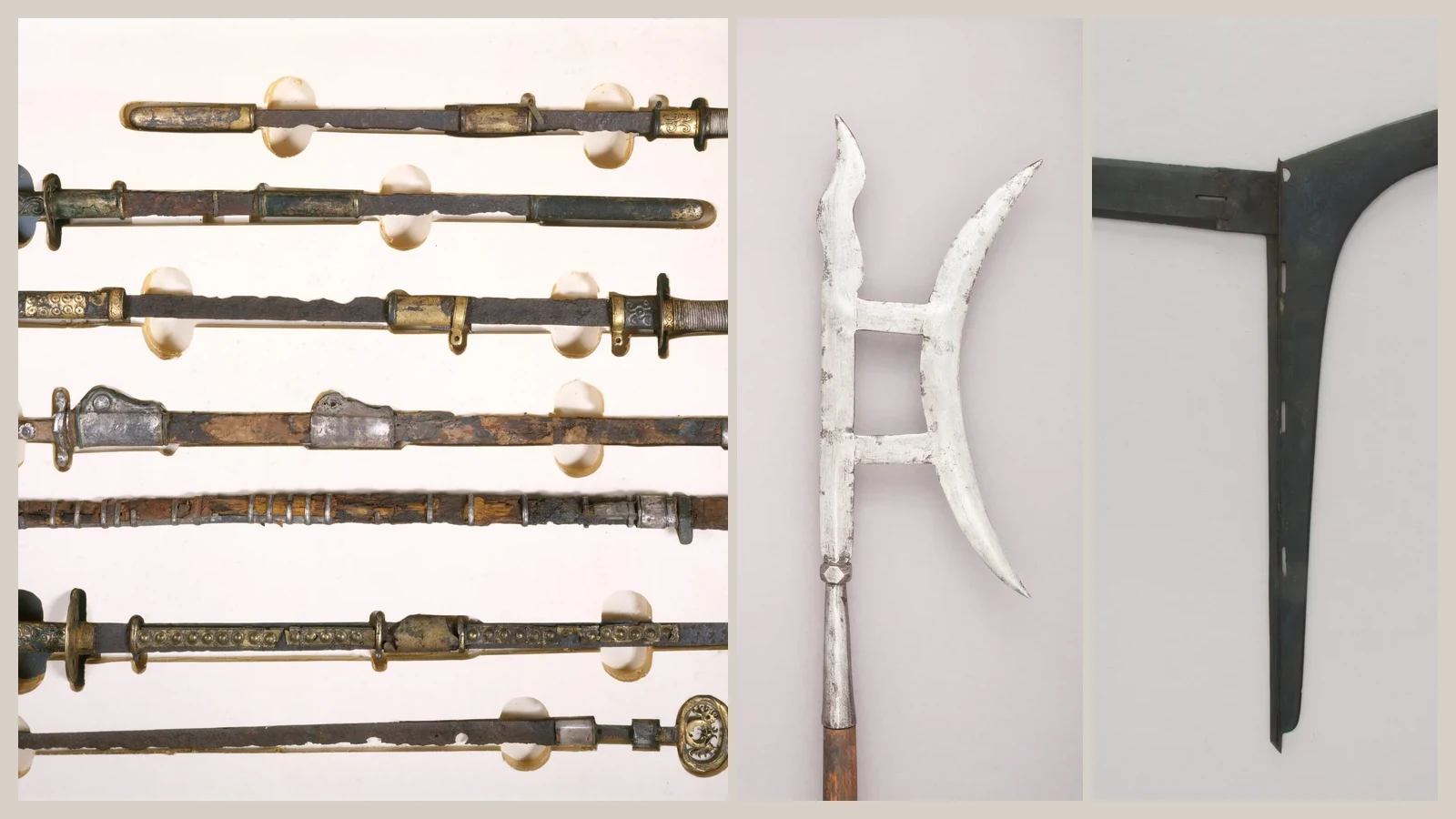
The cover begins with three separate museum records, not a fantasy inventory: a group of early Chinese swords, an eighteenth-century spear and a pair of Warring States dagger-axes. Their corrosion, fittings and radically different profiles matter. “Chinese weapon” was never one timeless silhouette waiting for cinema to animate it.
The staff in Black Myth: Wukong feels powerful before the player knows every stance because the ends of the weapon keep changing the fight's geometry. Sun Wukong's staff is also a literary object: an impossible weight and size that becomes intimate in his hands.
The four names an overseas beginner should know
| Chinese term | Common English name | Movement impression | Story association |
|---|---|---|---|
| Jian (劍) | Straight double-edged sword | Precision, balance and controlled lines | Scholar-hero, wandering swordsman, wuxia honour |
| Dao (刀) | Single-edged sabre or broadsword | Cutting power, commitment and visible momentum | Soldiers, rebels and direct force |
| Gun (棍) | Staff | Reach, rhythm and adaptable defence | Monks, travellers and Sun Wukong's magic staff |
| Qiang (槍) | Spear | Long-range thrust, footwork and battlefield control | Military skill and decisive entry |
These labels cover families, not one universal design. A movie prop, a competition weapon and a historical object may share a name while serving different purposes.
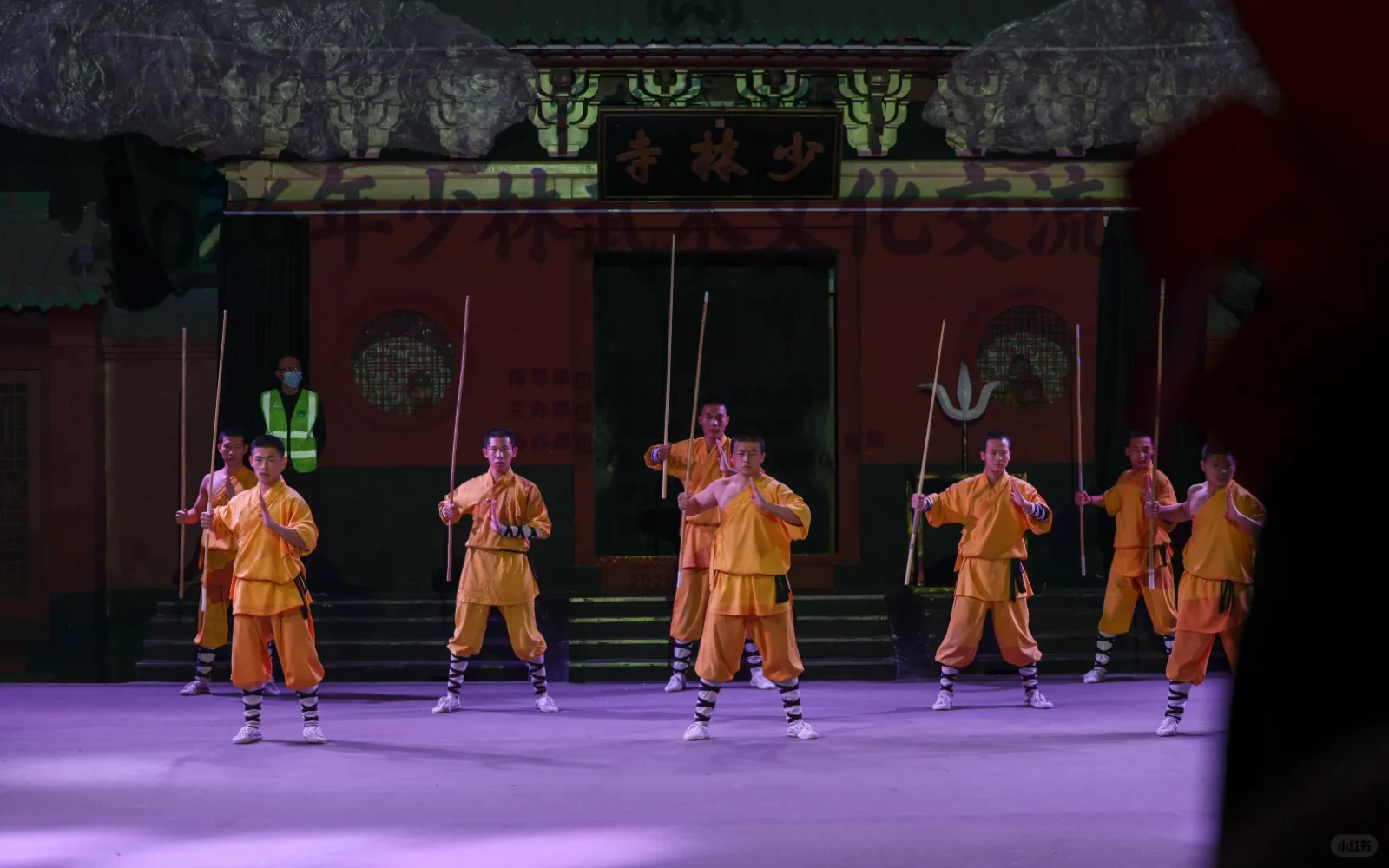
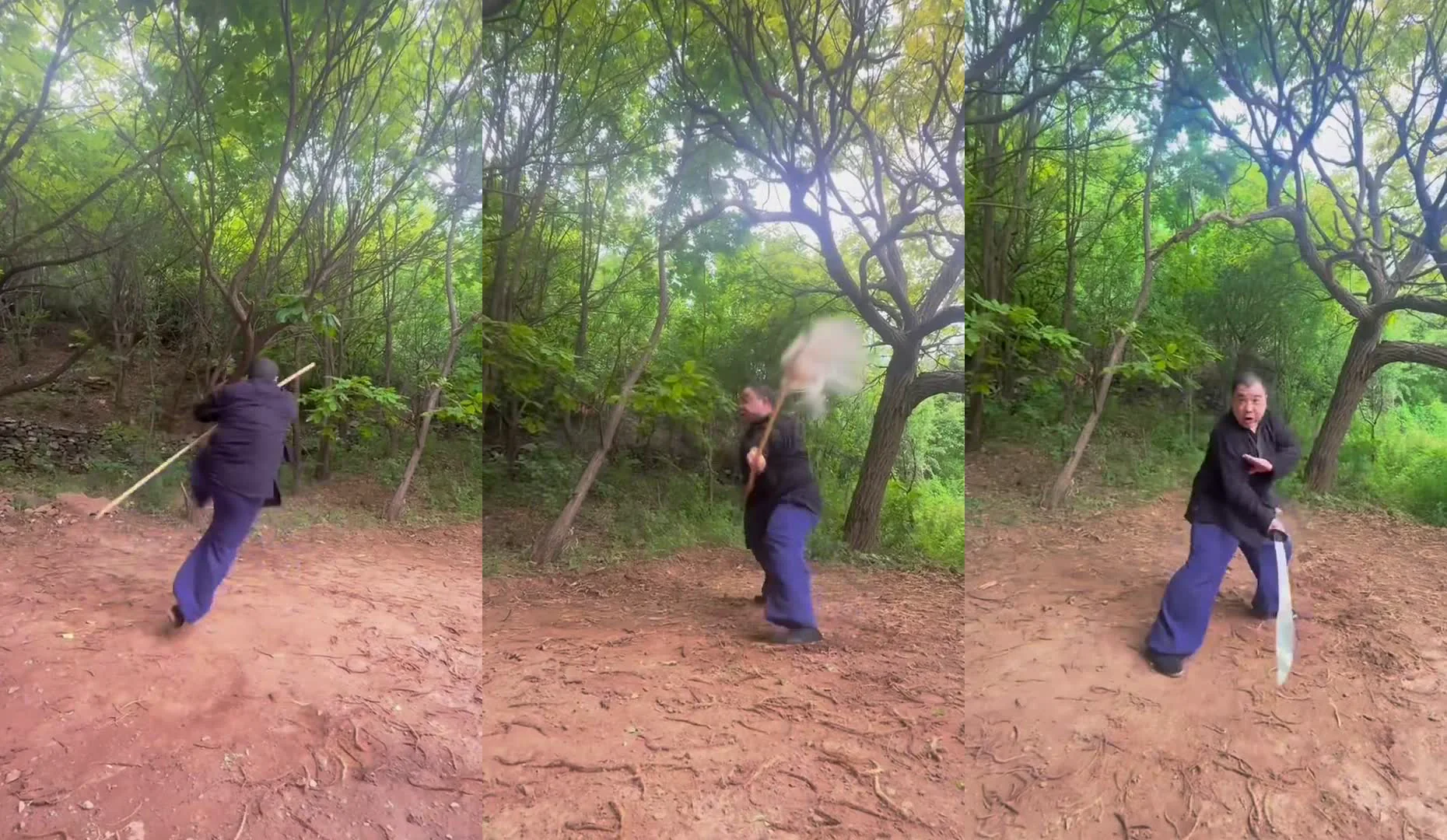
This is where the catalogue finally becomes human for me. The long pole forces the whole body to negotiate a larger radius; the blade pulls the action closer and makes the cutting line impossible to ignore. The useful difference is not which object looks more “powerful.” It is what happens to the feet, shoulders, free hand and empty space. A weapon earns its name through form, but it earns dramatic meaning through the distance it makes everyone respect.
Do not turn the familiar phrase “eighteen weapons” into a sacred shopping list. Historical and popular enumerations vary, and the number often signals breadth of martial skill rather than one permanently standardized inventory. That is why a four-object entry map is more honest for a beginner than a false claim to completeness. Jian, dao, staff and spear teach edge, reach, two-ended control and the concentration of force into a point. Once those spatial ideas are visible, hooks, chains, halberds, paired weapons and flexible weapons become meaningful differences instead of exotic names.
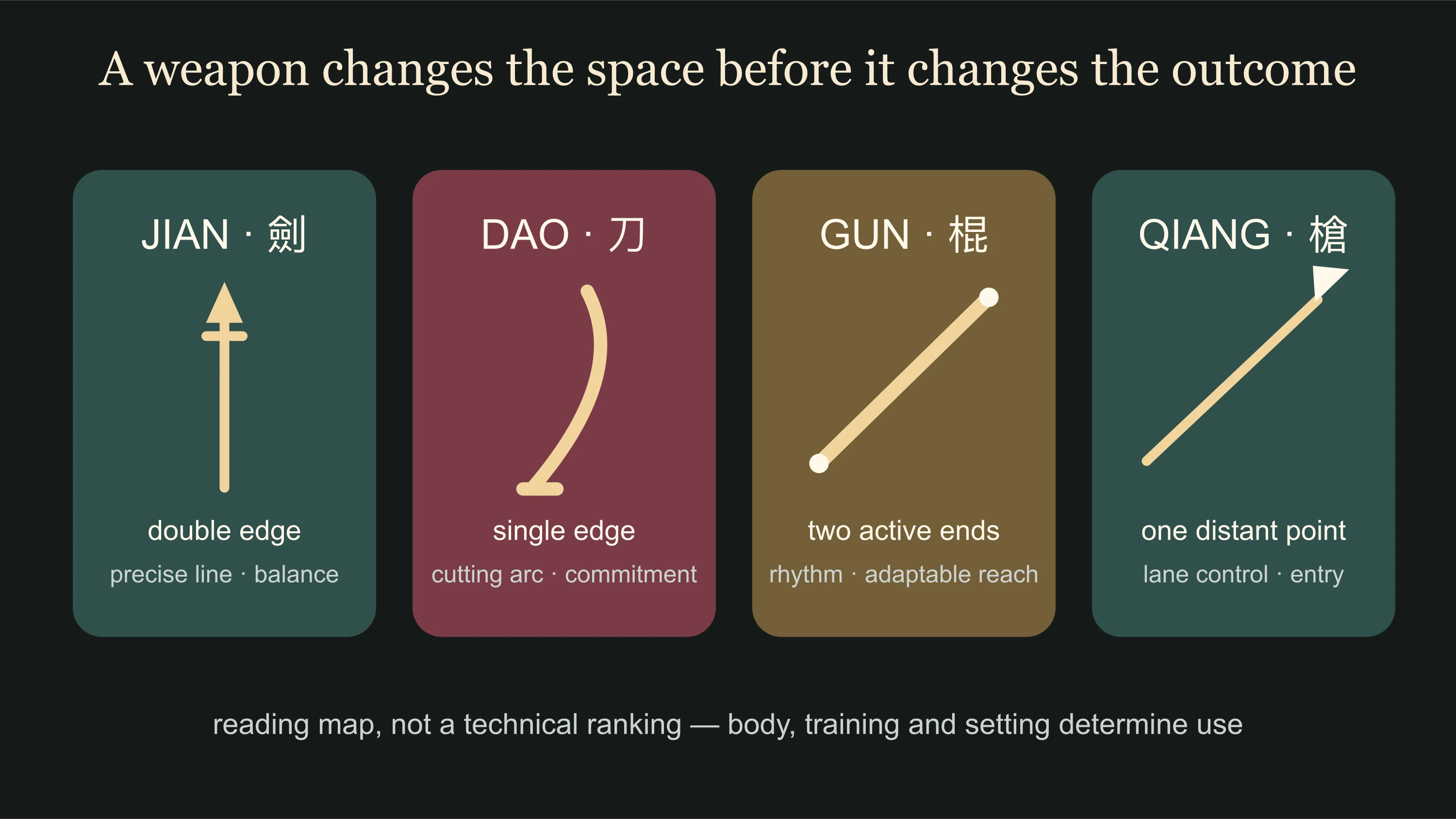
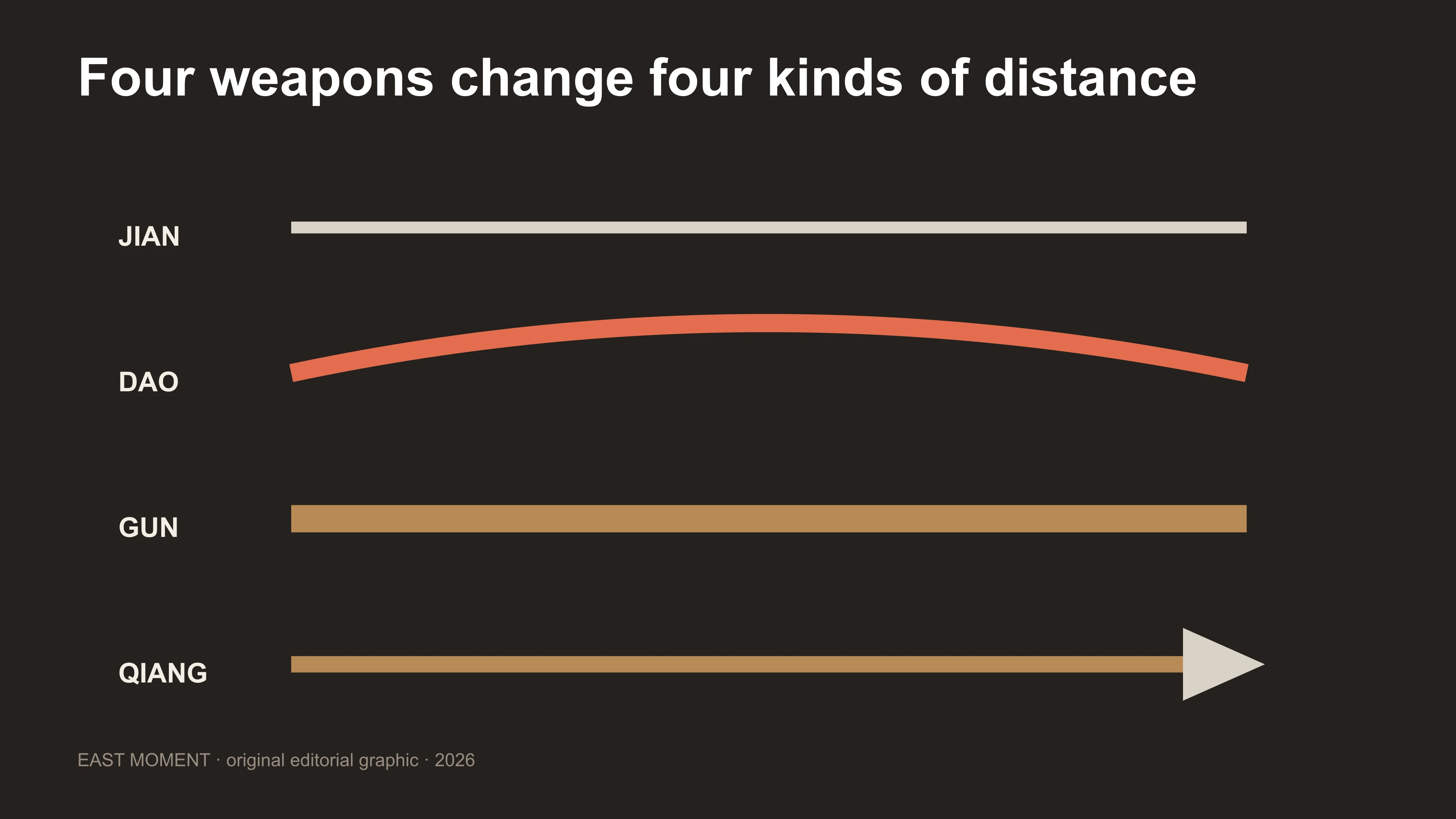
The diagram is not a technical manual. It is a reading tool. A double edge changes how a jian is framed; a dao's cutting profile makes commitment visible; a staff creates two active ends; a spear concentrates attention into one distant point. The body still determines what the object can do.
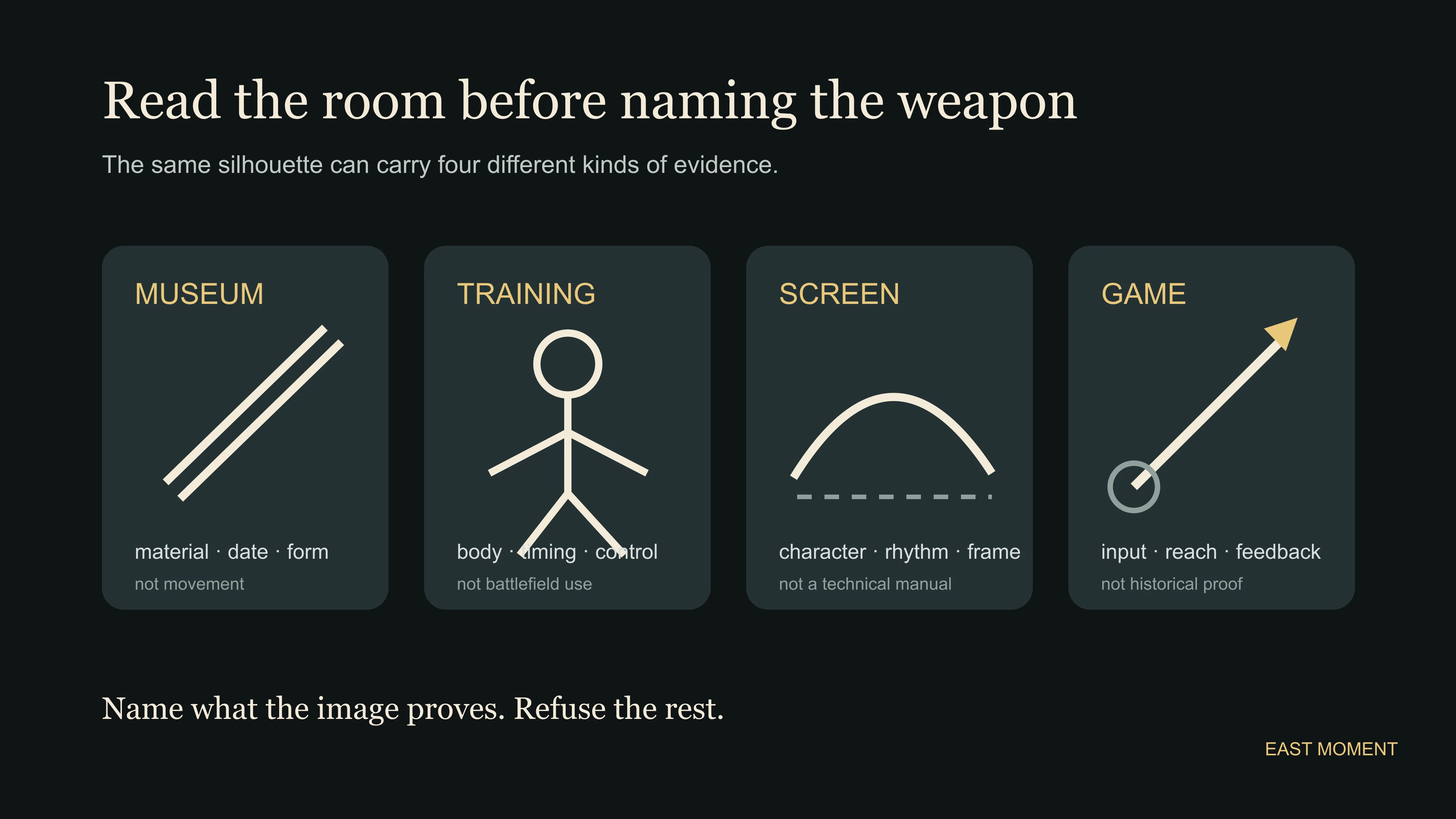
A weapon image is evidence only after its room is named. Museum objects prove material form; training proves controlled movement; screen and game images prove designed meaning.
Jian: why the straight sword carries moral pressure
The jian is the weapon most likely to be treated as a personality test. Its straight, double-edged form invites stories about balance, education, restraint and cultivated identity. That does not mean every jian wielder is a noble scholar. It means the visual code gives filmmakers a language for a person who wants power to remain precise.
In wuxia, a sword often belongs to a relationship before it belongs to a hand: a teacher's gift, a family heirloom, a rival's recognition. Read what wuxia means alongside the object. The weapon's emotional meaning comes from the promise attached to it.
Dao: the blade that makes commitment visible
The dao's single edge and broader cutting profile are frequently used on screen to make force look immediate. A dao swing has a different visual grammar from a jian thrust. It can feel less like writing a line and more like clearing a path.
That impression is not a complete technical history. Cinema exaggerates weight, speed and contact for clarity. The useful question is what the adaptation wants the viewer to feel: directness, soldierly practicality, anger or the danger of losing control.
Gun: the staff is humble until it owns the frame
The staff is visually democratic. It can be a walking aid, a training tool, a monk's weapon or a cosmic object. That range is why it travels so easily between comedy and myth.
In Where Winds Meet, a long weapon makes the player's relationship to crowds and terrain legible. In Black Myth: Wukong, the staff inherits Sun Wukong's literary memory and turns it into game feel. The same object can mean humility in one scene and impossible authority in the next.
Qiang: the spear turns distance into a decision
The spear is often less famous in English-language fantasy than the sword, but its visual logic is extraordinarily clear. The point controls a long lane. Footwork, timing and courage decide whether that lane remains open.
That lane is never neutral. A long weapon can protect a doorway without touching anyone, prevent several bodies from approaching, or become dangerously awkward after distance collapses. This is why “which weapon is strongest?” is usually the wrong question. Strongest in a corridor, on horseback, inside a performance carpet, against armor, in a crowded film frame or in the hands of a game avatar? Change the room and the answer changes before the weapon does.
On screen, a spear can make a character look military, disciplined or frighteningly efficient. In a story about a wandering hero, it also reminds us that martial skill grew from institutions, armies and practical survival—not only from romantic mountains.
The dedicated Chinese spear guide follows that line through an Eastern Zhou spearhead, an eighteenth-century museum object, modern qiangshu, the red tassel and screen design. It is the next page when “long-range thrust” is no longer a complete answer.
Pair the weapon with the room, not a personality quiz
I distrust lists that say the sword is elegant, the saber fierce and the staff humble as if a weapon assigns a permanent character type. Meaning comes from use. A jian hidden at a banquet creates different pressure from the same form carried across an open battlefield. A staff in a temple story, a village defense scene and a fantasy boss fight does not perform the same social job.
For screen analysis, draw the space before naming the technique. Where are the exits? Who must protect another person? What distance can the weapon control, and what happens when that distance collapses? Then watch the sound: a heavy impact, a scrape, an empty swish or sudden silence tells the audience how to imagine force.
This method keeps cultural reading separate from imitation. Film and games can show design, rhythm and symbolic association; safe physical instruction belongs with a qualified teacher and appropriate equipment.
The weapons room in Crouching Tiger, Hidden Dragon makes my point better than any catalogue. Jen keeps changing weapons, yet the scene is really measuring discipline, impatience and trust between two women. The still proves the room's abundance and their opposing positions; only the full sequence reveals how each change of object alters rhythm and authority.
Screen, sport and history are three different questions
The same weapon name can appear in a museum label, a wushu routine, a film fight and a game loadout. That does not mean all four are making the same claim.
| What you are seeing | What it can show you | What it cannot settle |
|---|---|---|
| A historical object | Material, form, scale and a documented collection context | How every person used it, or whether a movie reproduces it accurately |
| A contemporary wushu performance | Timing, body control, presentation and a sports rule set | What an historical battlefield looked like or what is safe outside training |
| A film or animation scene | Character, emotional distance, visual rhythm and dramatic force | A reliable technical lesson or the full physical reality of the object |
| A game mechanic | How a designer wants a player to feel reach, weight and risk | Historical handling, real-world effectiveness or safe use |
This distinction makes the images more interesting, not less. A weapon can be exquisitely designed for a stage silhouette. A historical spear can carry institutional military history. A game staff can make inherited myth feel intimate. Each deserves its own kind of attention.
It also keeps a cultural guide from becoming bad advice. I do not use screen choreography, online arguments or competition routines to recommend an object for self-defence. Real weapons and training carry legal, physical and safety consequences that this page cannot assess. Here, the question is narrower and more rewarding: what does this object make a viewer feel about distance, authority and character?
Five things a still frame can reveal
Pause a film, animation or game image and look before reading the caption. A single frame can reveal more than a weapon name if you ask the right questions:
- Line: Does the object draw the eye outward, upward, across the body or toward one point? A spear often creates a lane; a staff can split attention between two ends.
- Distance: Who can reach whom, and who has been pushed out of reach? A weapon is often a social boundary before it is an object of violence.
- Centre: Is the character protecting their own body, another person, a doorway or an idea of status? The same blade can look defensive, ceremonial or possessive.
- Room: Does the setting make the object practical, absurd, sacred or theatrical? A jian inside a weapons room, at a banquet or on a mountain ridge tells three different stories.
- After-effect: What changed immediately before this frame, and what will someone have to answer for after it? Without consequence, an impressive pose is only a pose.
This is the kind of visual literacy I want a weapons page to offer. It respects the craft of screen movement while refusing to turn a still image into a claim about history, mastery or personal safety.
It also restores consequence to spectacle. I lose interest when a weapon exists only to produce a louder impact effect. The object becomes memorable when another person must step back, a promise becomes harder to keep, a doorway changes ownership or a fighter discovers that impressive reach cannot solve close responsibility. Distance is plot. A weapon that changes no relationship is only inventory.
The image should deepen attention, never manufacture expertise the viewer has not earned.
Weapons in film and games are evidence, not training manuals
The best fight scenes use weapons to reveal character. Ip Man uses close-range hands and compact weapons to make dignity under pressure visible. Where Winds Meet lets weapons interact with terrain and exploration. Black Myth: Wukong makes inherited myth feel physical through stance, timing and weight.
None of these images should be mistaken for a safe instruction manual. A beautiful film prop does not establish historical accuracy, and a game mechanic does not describe how a real weapon behaves. For the adjacent boundary between historical blades, spears and supernatural fabao, continue to XianLore's specific guide to Chinese sword types and mythical weapons. It is an East Moment sister project and a worldbuilding extension, not an independent authority for the historical claims on this page.
My own test is to mute the scene for ten seconds. If the weapon still explains who controls distance, who is trapped and who must move first, the choreography has built a readable spatial argument. If only impact sounds make it feel powerful, the object may be functioning mainly as spectacle.
That distinction matters for screenshots. One frozen frame can prove weapon shape, grip position and relative distance. It cannot prove the full exchange, historical method or whether the performer could reproduce the movement safely.
My verdict
The best martial arts weapon is the one that changes how a character relates to space. The jian makes restraint visible. The dao commits. The staff adapts. The spear controls a line before anyone crosses it.
When a fight scene feels memorable, look at the object before you look at the special effect. Ask who gave it meaning, what distance it creates and whether the character is using it to protect, dominate or escape. Then bring that frame to East Moment's community.