Black Myth: Wukong is not a digital summary of Journey to the West. It is what happens when the pilgrimage has already become a glorious legend, the victors have acquired sacred titles, and a nameless successor must walk through what the legend left behind. The combat gives the game momentum. Its real subject is inheritance: can anyone receive Sun Wukong's strength without inheriting the system that tried to control him?
Black Myth Wukong is a Journey to the West aftermath, not a retelling
If you arrive expecting to escort Tang Sanzang west with Pigsy, Sandy and the Monkey King, the game will feel strangely familiar and wrong at the same time. The staff, spells, yaoguai and Buddhist language are present, but the famous journey is already in the past. Its moral certainty has cracked.
The official description makes the distinction carefully. You set out as the Destined One, not simply as Sun Wukong, to uncover “the obscured truth beneath the veil of a glorious legend from the past.” That sentence is the game's contract with the player. The legend is not false, but glory has covered something.
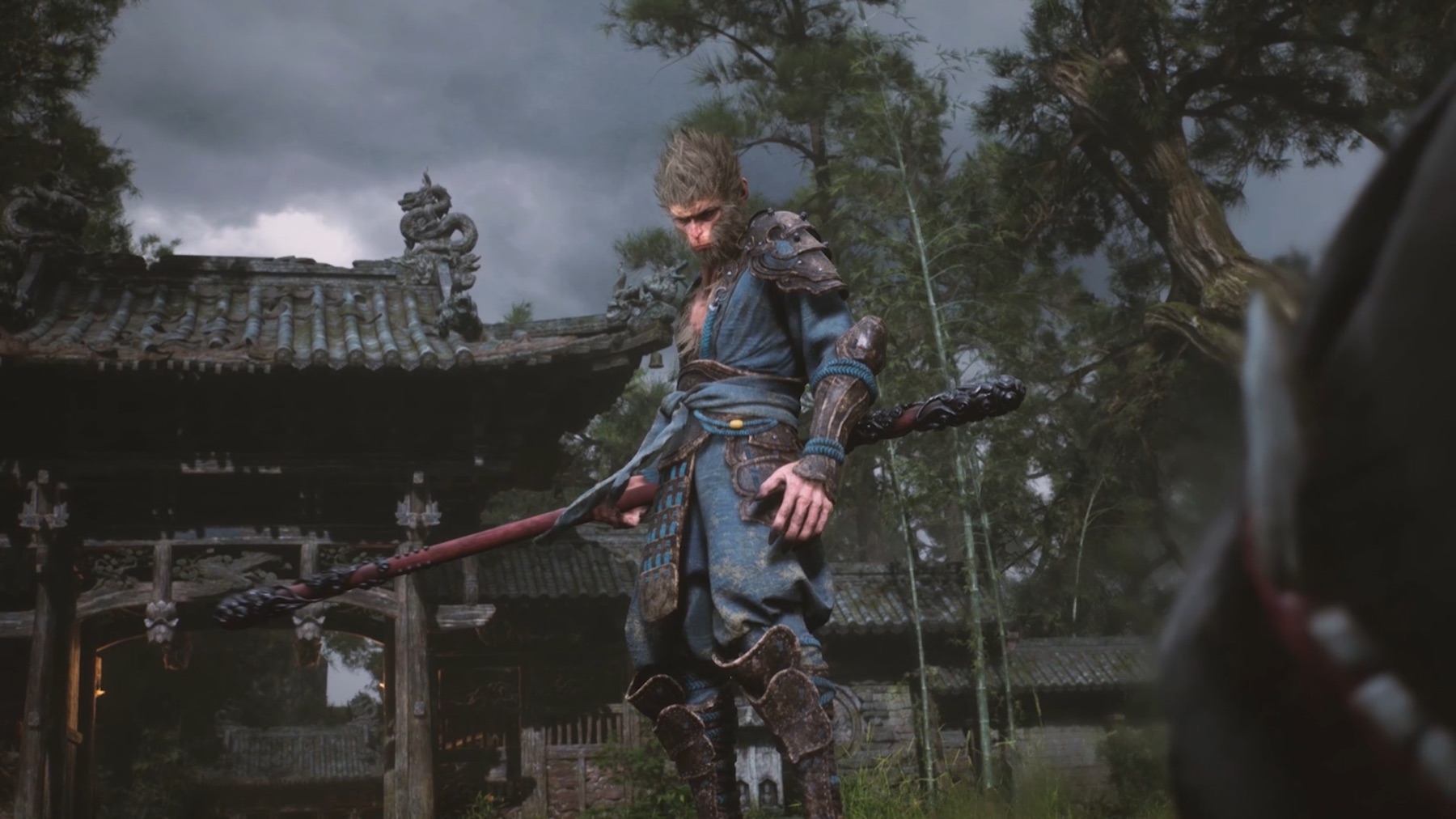
The staff makes the inheritance visible before the game explains it, while the weathered courtyard places that inherited body inside a world already carrying age and consequence. XianLore / East Moment title archive; the frame establishes character and setting, not a fixed identity with Sun Wukong.
This is why the hero's lack of a personal name matters. “Destined One” sounds grand in English, yet it also removes individuality. He is a candidate, an instrument and a body onto which other characters project an old story. Every familiar ability creates a new doubt: am I recovering Wukong, replacing him, or being trained to become a more acceptable version of him?
I reject the lazy praise that calls every darker adaptation “more mature.” Darkness is cheap when it only lowers the light and makes institutions corrupt. I believe Black Myth: Wukong earns its best moments when beauty and suspicion occupy the same shrine—when I want to stay and look even after the story has taught me not to trust the authority that built it.
That question gives the boss fights more meaning than a sequence of impressive creatures. Defeating an opponent proves that the Destined One can use power. It does not prove that he understands what the power is for.
The four things to know before you play
| Question | Direct answer |
|---|---|
| What is it? | A single-player action RPG developed and published by Game Science. |
| When was it released? | August 2024 for Windows and PlayStation 5. |
| Who do you play? | The Destined One, a monkey protagonist following traces of Sun Wukong. |
| Is it the story of Journey to the West? | No. It builds a later world from the novel's characters, objects and unresolved tensions. |
| Do you need to read the novel first? | No, but knowing Wukong's rebellion, punishment and pilgrimage makes the game's choices much sharper. |
| Is this a beginner combat guide? | No. This page explains the story, cultural language and real places; builds and boss tactics belong elsewhere. |
If you want to see how cinema compresses the same pilgrimage before entering this game's aftermath, use the Journey to the West movie guide. Its version compass separates childhood familiarity, romantic regret, ensemble pilgrimage and spectacle instead of declaring one Monkey King universally best.
The shortest useful preparation is this: Sun Wukong is born from stone, acquires immense abilities, rebels against Heaven, is imprisoned beneath a mountain, then joins the monk Tang Sanzang's pilgrimage to retrieve Buddhist scriptures. He reaches the end and receives a sacred title. That sounds like a completed moral arc.
Black Myth: Wukong asks whether completion was also containment.
Sun Wukong was never only a superhero
International pop culture often reduces the Monkey King to four portable features: a staff, a cloud, transformations and a rebellious grin. Those details are real, but they remove the pressure that gives him shape.
Wukong repeatedly refuses the name and rank assigned to him. Heaven attempts to absorb his dangerous ability into bureaucracy. The Buddha stops his rebellion through a wager and mountain imprisonment. The pilgrimage then turns a disruptive body into a disciplined protector. He learns restraint, but the reader is never allowed to forget how restraint was enforced.
That is why the game does not need to make him into a modern freedom slogan. The conflict is already inside the old story: power wants recognition; authority offers a title; discipline can become wisdom or obedience depending on who controls it.

Sun Wukong also lives outside books and screens as the Great Sage in temple practice. This shrine image prevents the game from becoming the only frame through which we see him. Photograph by 阿道, CC BY-SA 4.0.
The shrine changes the scale of the conversation. Wukong is not merely intellectual property waiting for a premium adaptation. Across different Chinese communities, he has been performed in opera, invoked in ritual, printed in children's books, replayed on television and treated as a protective divine figure. No single version owns him.
That living instability is exactly what Game Science inherits. Its Wukong can be fierce, wounded, comic, sacred and politically inconvenient because the character has carried those tensions for centuries.
The buildings are not Chinese-style wallpaper
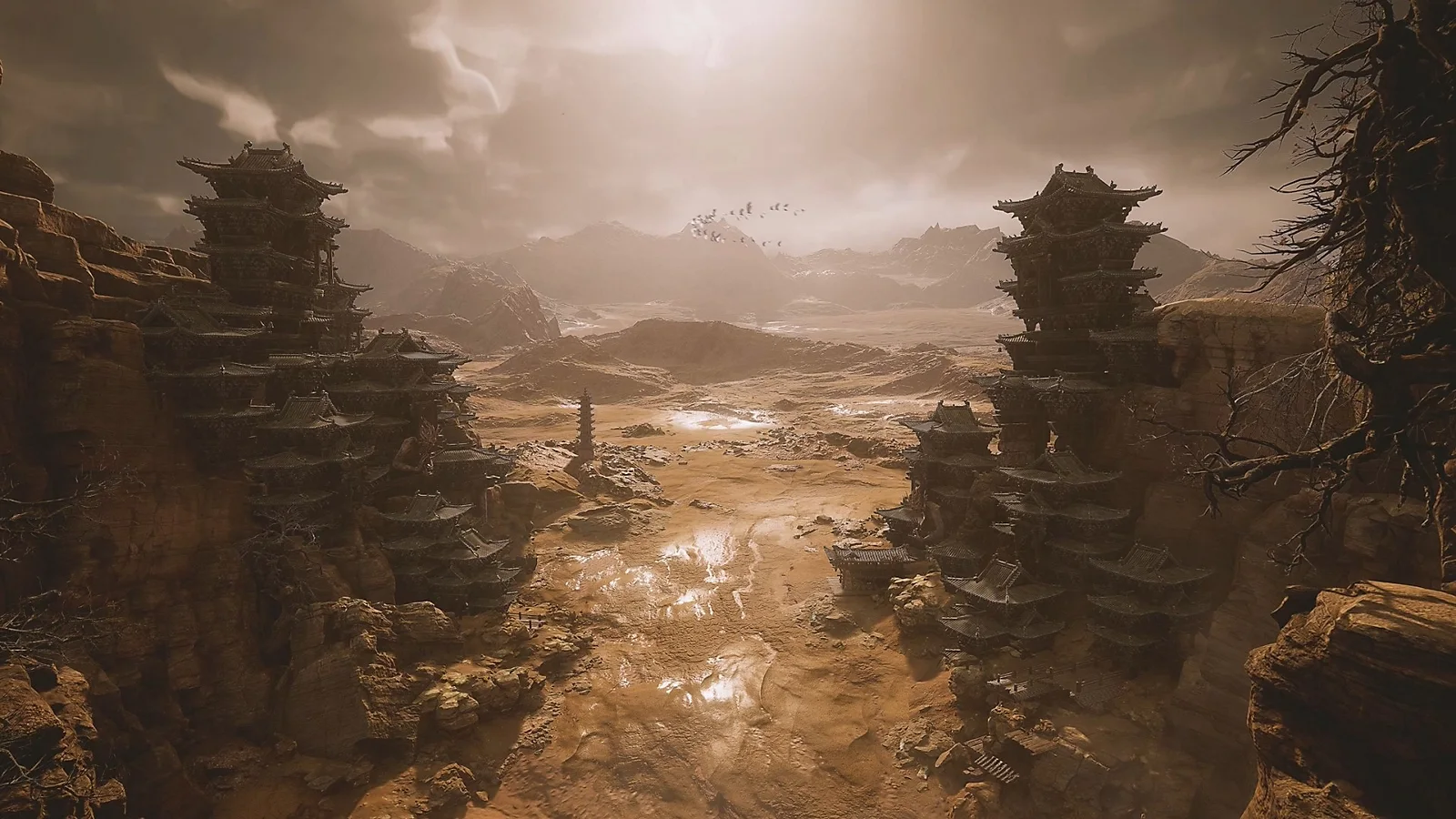
The strongest visual decision in Black Myth: Wukong is not higher polygon count. It is the refusal to make old Chinese architecture clean.
Roof lines sag into shadow. Paint has darkened. Statues crowd one another rather than posing against empty museum walls. Timber, cliff, dust, gold and damaged surfaces tell you that belief has occupied these spaces for a long time. The world feels inherited because it looks used.
The game enlarges architecture into a navigational and emotional force. Official Black Myth: Wukong screenshot via PlayStation.
Shanxi is central to that achievement. A provincial-government report published after launch said the province contributed 27 of the game's 36 surveyed scenes, many connected to Buddhist and Daoist heritage. Treat those figures as evidence of the production's location work, not a license to identify every virtual roof with a monument.
Two verified examples show why the distinction matters.
Xiaoxitian in Xi County is famous for an overwhelming interior of suspended sculpture. Beijing's municipal government describes the temple as an inspiration for the game and records 1,978 surviving Ming-dynasty sculptures. The number is less important than the physical effect: figures do not sit politely in a row. They accumulate across walls and overhead space until the room feels populated by an entire cosmology.

Xiaoxitian's density is not an invented fantasy texture. This institutional exhibition view lets the sculptures remain historical objects rather than game props. Image via Beijing Municipal Government / The Beijing News.
Xuankong Temple near Datong, built into a cliff face, supplied another documented architectural reference. Its drama comes from structure before mythology: thin horizontal buildings appear to negotiate with vertical rock. A fantasy artist could invent a floating palace, but the real temple is more unsettling because human construction is visibly holding on.

Xuankong Temple shows why the game's landscapes feel physically argued rather than decorated. Photograph by BRUNNER Emmanuel, public domain.
This is the page's most important visual boundary: the game is not a virtual heritage record. It combines scans, references, relocation, invention and dramatic lighting. Visit the real sites to meet architecture, sculpture and religious history on their own terms, not to confirm that reality successfully resembles a screenshot.
Yaoguai are people caught inside appetite
“Monster” is often the least useful translation for yaoguai (妖怪). It tells an English reader what to fight but not what kind of being is standing there.
In Chinese stories, a yaoguai may be an animal, plant, object or spirit that has cultivated power, transformed, acquired desire, entered a hierarchy or stolen a shortcut to immortality. Some are murderous. Some are comic. Some want status, marriage, recognition, a human body or freedom from a stronger master. Their danger is moral and social, not merely biological.

The creature's scale creates spectacle; its place inside a network of masters, desires and debts creates Chinese narrative meaning. Official Black Myth: Wukong screenshot via PlayStation.
Journey to the West repeatedly complicates the category. A terrifying creature may turn out to belong to a celestial owner. Capture can restore the master's property while leaving earthly victims to absorb the damage. A low-status demon may be punished more finally than a powerful being with the correct connection.
The game understands this inequality. Its creatures do not all stand outside order. Many are products of order, leftovers from it or minor figures trying to survive beneath it. That makes the world darker than a simple war between gods and monsters. Heaven, temple, court and cave are connected institutions.
This is also where the game is most recognizably contemporary. Players know what it feels like to be offered advancement inside a system that may erase them. They know that a title can be both reward and leash. The old vocabulary remains mythic; the pressure does not feel old.
The quiet objects carry more truth than the loudest boss
Spectacle sells the game, but small things persuade me.
A worn incense burner implies repeated offerings. A mural that extends beyond the camera suggests a story the protagonist did not begin. A headless statue makes damage part of the sacred landscape rather than an optional horror effect. A shrine, gourd or piece of armor can connect combat mechanics to bodily habits and ritual memory.
These details work because they do not stop the game to announce “Chinese culture.” They let culture determine what a room contains, where a body kneels, how authority dresses and what kind of object can hold power.

Not every encounter is scaled like a boss arena. Faces, clothing and distance let the game's moral world become personal. Official Black Myth: Wukong screenshot via PlayStation.
The end-of-chapter animations push this further by changing visual language rather than merely repeating game-engine scenes. They feel like interpretation after action: the fight has ended, then another form asks what the victory meant. That structure gives the player a pause between achievement and understanding.
It also reveals the limit of reading the game through combat clips. A perfect dodge can show technical control. It cannot show what the chapter believes about desire, punishment or release.
Where the adaptation is strongest, and where it resists you
The game is strongest when it trusts uncertainty. The Destined One walks through a world where old names still have power but no longer guarantee moral clarity. Architecture, music and fragmented testimony allow the player to feel the missing history before fully understanding it.
It is weaker when cultural density becomes opacity. English subtitles can translate a sentence without translating the web of titles, Buddhist ideas, Daoist language, opera rhythm and novel callbacks around it. A collectible portrait may provide lore after the encounter, but after-the-fact explanation cannot always repair an emotion that never arrived in the scene.
The answer is not to demand a lecture before every boss. It is to approach the game with two speeds:
- During play, follow action, atmosphere and relationships without pausing for every unfamiliar name.
- After a chapter, read the portraits, revisit the animation and trace one object or character back to Journey to the West.
That second pass turns “I recognize the Monkey King” into actual cultural reading.
A darker Wukong is an argument, not an automatic improvement
The sharpest disagreement around Black Myth: Wukong is not whether it is allowed to alter Journey to the West. Of course it is. A living classic survives because opera, children’s editions, television, temple practice, comics and games keep testing it from new angles.
The harder question is what an adaptation does with the old story’s direction. In the novel, Wukong is unruly, vain, violent and brilliant; he is also changed by a journey that forces action, discipline, friendship and repeated confrontation with suffering. The game starts after a sacred ending and suspects that the ending may have been a cage. That is a compelling reversal. It makes inheritance feel dangerous rather than celebratory.
But reversal creates a debt. If every institution is only a conspiracy and every discipline is only submission, the player gets a mood before they get an argument. I look for the moments when the game earns its darkness: a creature damaged by the hierarchy it serves, a holy place that protects and confines at once, a character whose choice cannot be explained away by a single villain. Those moments let the game question the old legend without pretending that distrust itself is wisdom.
This is why I cannot read the Destined One merely as a replacement Monkey King or as a vessel for a pre-approved rebel fantasy. He is interesting only if he can make a different choice from the figure whose power he inherits. Otherwise the game’s most beautiful idea becomes a loop: the system produces its own rebellion, then produces the next body to repeat it.
The same test makes the quieter scenes more important than the loudest cutscenes. Pause after a chapter animation or a portrait entry and ask: whose desire has been made legible, whose suffering remains background texture, and what would release look like here? The answers will not always be satisfying. That incompleteness is not a reason to dismiss the game; it is the place where an adaptation becomes worth discussing rather than merely consuming.
A better route into Black Myth: Wukong
Start with Game Science's official store description and trailers. They establish the Destined One and the game's intended mystery without requiring a plot recap. Then learn the compact Wukong arc in our Chinese mythology guide: birth from stone, rebellion, imprisonment, pilgrimage and sacred title.
While playing, keep three questions beside the health bar:
- Who gave this character a name or rank?
- What does this creature want besides survival?
- Is the sacred building protecting people, containing them or remembering them?
Do not confuse Sun Wukong with the Monkey in the Chinese zodiac. The zodiac sign belongs to a calendrical classification system; Wukong is a literary, theatrical and religious figure with his own long history. The shared animal does not make the meanings interchangeable.
For a different modern myth adaptation, compare the game's inheritance problem with Ne Zha 2. Nezha's modern screen life often asks whether a child can refuse a destiny imposed from outside. Black Myth: Wukong asks what happens when destiny arrives disguised as the restoration of someone you already admire.
That is why the game matters beyond sales records and visual prestige. It does not prove that Chinese mythology has finally become globally valuable. The mythology never needed that permission. It proves that a Chinese studio can make international players enter the argument without removing the parts that require patience.
For the chapter structure, bosses, locations and artifacts that this cultural reading deliberately does not catalogue, continue into XianLore's Black Myth: Wukong world guide.
Browse the Chinese games hub for the wider cluster. Then bring one screenshot, temple detail, translation problem or Journey to the West connection to East Moment's community. The useful question is not “Did the game represent China correctly?” It is narrower and harder: what did this particular image, creature or choice inherit, and what did it change?