My verdict on Chinese mythology: do not begin with a family tree of gods. I reject that bloodless diagram because it removes the decision that made the story survive. Begin when the sky breaks, ten suns burn the earth, the flood refuses to stop, the sea takes a child or heaven separates two people who refuse to forget each other. Chinese myth becomes unforgettable at the moment somebody decides the impossible situation is still worth fighting.
That decision is the heartbeat of Chinese myth.
What is Chinese mythology?
Chinese mythology is the enormous, untidy and still-expanding world of creation stories, divine figures, culture heroes, monsters, transformed animals, local legends and literary characters told across Chinese history. I insist on “untidy” because no honest guide can merge regional worship, early texts, later novels and modern animation into one official universe without destroying the very differences readers came to understand.
It has no single Bible, no final cast list and no universally accepted timeline. Stories appear in early texts such as the Classic of Mountains and Seas (Shanhaijing), the Huainanzi and the Liezi. They also live in temple traditions, poetry, opera, regional storytelling, novels, paintings, festival customs, family memories, comics, animation, film and games.
This is exactly why Chinese mythology can feel confusing to overseas readers. Search results often promise a clean “Chinese gods list,” then place Nüwa, the Jade Emperor, Guanyin, Sun Wukong and a dragon in one imaginary office chart. That chart looks efficient. It is also wrong.
My rule is simple: do not force every supernatural Chinese character into one pantheon. Ask where the figure comes from, what kind of story they inhabit and which version you are actually watching.
The wider Chinese culture guide shows how myth sits beside food, cities, philosophy, art and daily practice. This page owns a narrower task: it gives you a working map of Chinese mythology without flattening every story into one divine family tree.
Chinese mythology is a network, not one Chinese Olympus
Greek mythology is often introduced through the Olympian gods. Norse mythology arrives through Asgard and Ragnarök. Overseas readers therefore expect Chinese mythology to offer one equally neat divine headquarters.
It refuses.
China's stories developed across many centuries, regions, communities and systems of belief. Myth overlaps with ancestor traditions, Daoism, Buddhism, local religion, political memory, moral fable and literature, but those categories are not interchangeable. Guanyin's Chinese story involves Buddhist religion. The Jade Emperor belongs strongly to popular religion and later narrative worlds. Yu the Great stands between flood myth, culture hero and dynastic memory. Sun Wukong is a literary character who acquired a life far beyond one novel.
Use the dedicated Chinese mythology gods map when you need names and roles, and the Jade Emperor guide when the question is specifically about heaven's administration. Use this map instead of a fake ranking:
| Story layer | What it does | Famous examples | What not to assume |
|---|---|---|---|
| Creation and cosmic repair | Explains how the world began, separated or survived disaster | Pangu, Nüwa | China has only one creation story |
| Culture heroes | Turns survival skills into memorable human figures | Fuxi, Shennong, Yu the Great | Every culture hero was a documentable historical person |
| Defiance myths | Makes impossible effort emotionally meaningful | Jingwei, Kuafu, Hou Yi | Failure makes the character unimportant |
| Religious worlds | Connects divine figures to worship, ritual and communities | Jade Emperor, Mazu, Guanyin, local gods | All deities belong to one stable bureaucracy |
| Literary legends | Builds unforgettable personalities through novels and performance | Sun Wukong, Nezha, Jiang Ziya | A famous novel is the original source of all Chinese myth |
| Mythical creatures | Gives landscape, danger and transformation a body | Dragon, fenghuang, qilin, nine-tailed fox | Every creature is either purely good or purely evil |
The boundaries remain porous. That is not a defect to fix. It is the reason a character can move from an old text into a temple mural, then into opera, television, streetwear and a game without becoming unrecognizable.
People often say Chinese mythology is “messy” because they are measuring it with a family-tree ruler. The apparent disorder comes from survival through several carriers at once. A transmitted text preserves one wording. A temple gives a figure a local title and ritual neighborhood. A novel rearranges older names into plot. A court, village, opera troupe, animation studio or game developer then emphasizes a different relationship.
I do not romanticize every contradiction as profound. Some modern charts simply combine incompatible versions carelessly. But the cure is not to appoint one editor-in-chief for three thousand years of stories. The cure is to label the layer. Once text, practice, place and adaptation are visible, “chaos” becomes a map of how culture kept moving.
That is the system East Moment uses: not a throne chart, but a provenance network. It tells you why two versions disagree and who needed each version to exist.
Use four labels before you call something “Chinese mythology”
Readers often ask for a system because a system promises relief: Who is above whom? Which god belongs to which faction? Is this creature Buddhist, Daoist or “just myth”? A chart can be useful, but only when it behaves like a filing cabinet rather than a royal throne room.
When I meet a figure, I keep four labels in view:
| Label | The question it answers | Why it prevents a bad shortcut |
|---|---|---|
| Text | Which source or version is speaking? | A character in the Classic of Mountains and Seas is not automatically the same character in a Ming novel or a modern film. |
| Practice | Is this tied to worship, ritual or a living community? | A temple title cannot be reduced to a costume or combat ability. |
| Place and period | Where and when does this version matter? | Local gods, festival forms and iconography do not all travel unchanged across China. |
| Adaptation | What has a game, animation or drama deliberately changed? | A new story can be creative without being mistaken for an ancient transcript. |
This does not make mythology less magical. It makes the magic more precise. A player can enjoy a beautiful dragon boss while asking whether it comes from a classical creature record, a local water tradition, a Ming novel, or a studio’s original design. A viewer can love a rebellious Nezha while knowing that a film’s Demon Orb continuity is not a temple manual. Precision protects pleasure from turning into costume-shop knowledge.
The labels can overlap. That is expected. A figure can pass through a text, a ritual world and an adaptation without becoming fake in any one of them. The task is not to police a single pure version. It is to name the version in front of us, then let it speak on its own terms.
The universe is broken, and somebody has to act
The strongest Chinese myths rarely offer a clean world managed by flawless gods. The sky collapses. The pillars of heaven fail. Suns behave like an environmental emergency. Floodwater ignores political authority.
Nüwa's best-known story begins after cosmic damage. The sky is torn, the earth is broken and destructive forces spread. She melts five-colored stones to repair the heavens, uses the legs of a great turtle as supports and restores order. The dedicated Nüwa guide separates this repair from her clay-creation story and later paired imagery with Fuxi.
The modern instinct is to call this a creation myth. I think “repair myth” is more revealing. Nüwa is powerful because she inherits disaster and works with what remains. She does not create a flawless universe and leave. She performs emergency maintenance on existence.
That idea feels extremely current. Most young people do not believe they are entering a perfect world. They are inheriting climate pressure, broken systems, technological disruption and social problems built before they arrived. Nüwa's answer is not passive optimism. Pick up the materials. Repair the sky.
Hou Yi faces another cosmic malfunction. In the familiar version, ten suns rise together and burn the land. The archer shoots down nine, leaving one sun to continue its proper course.
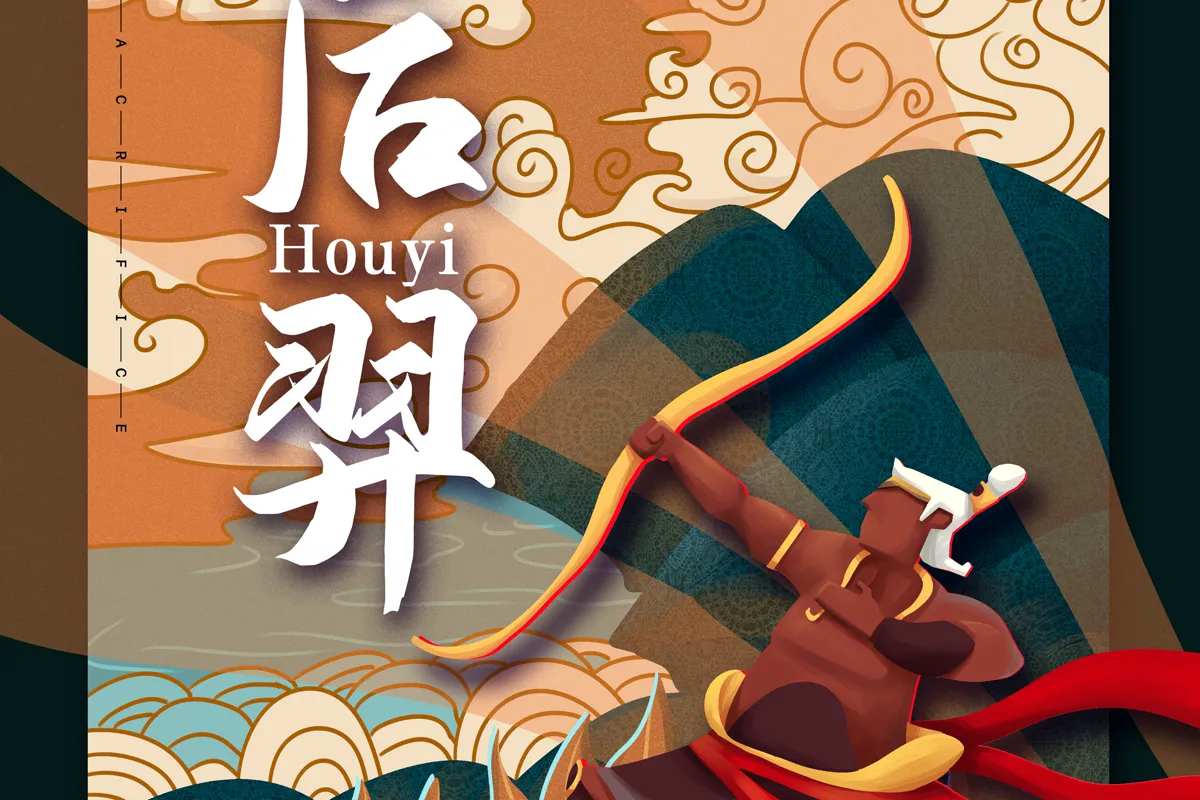
Hou Yi is remembered through the decisive image: one archer aims at a disaster spread across the entire sky. East Moment media archive.
The visual equation is unbeatable: one human-scale body, one bow, ten suns. It is why Hou Yi survives so easily in posters, animation and games. You understand the stakes before anyone explains the genealogy.
But the story is not only a power fantasy. Hou Yi's shot restores limits. One sun is necessary; ten are catastrophic. The hero does not destroy nature. He stops excess from making life impossible.
Chinese mythology respects impossible persistence
Western summaries often treat a hero who fails as a tragic warning. Chinese culture keeps returning to characters whose effort looks mathematically ridiculous.
Jingwei is the clearest example. In the Classic of Mountains and Seas, a daughter of the Yan Emperor drowns in the Eastern Sea and becomes a small bird. She repeatedly carries twigs and stones to fill the sea that killed her.
The girl's name in the text is written 女娃, often translated as Nüwa or “the girl.” She must not be confused with the creator goddess Nüwa, written 女娲. English spelling can make two different figures look identical. They are not.
Jingwei cannot realistically fill an ocean one stone at a time. That is the point. The story transforms grief into permanent action. She does not “move on,” accept the scale of the sea or wait for a motivational speech. She returns with another stone.
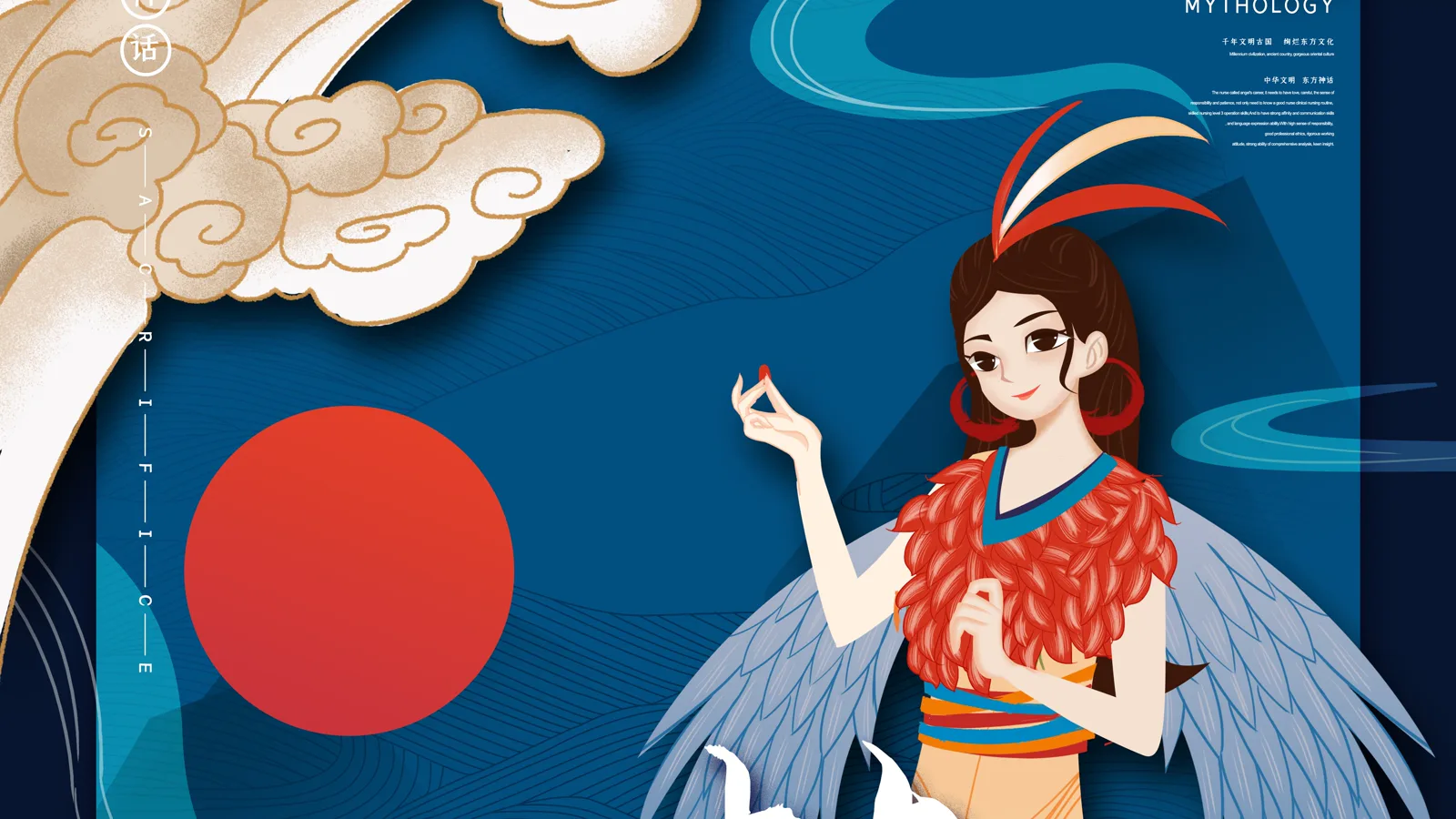
Our hero image shows Jingwei as a winged young woman rather than the small bird described in the old text. That is a modern visual interpretation, and it reveals how mythology changes: contemporary art gives the transformed girl a human face because modern audiences want to see the will inside the bird.
Kuafu is equally unreasonable. He chases the sun, suffers overwhelming thirst and dies before completing the pursuit. In a famous ending, his discarded staff becomes a forest.
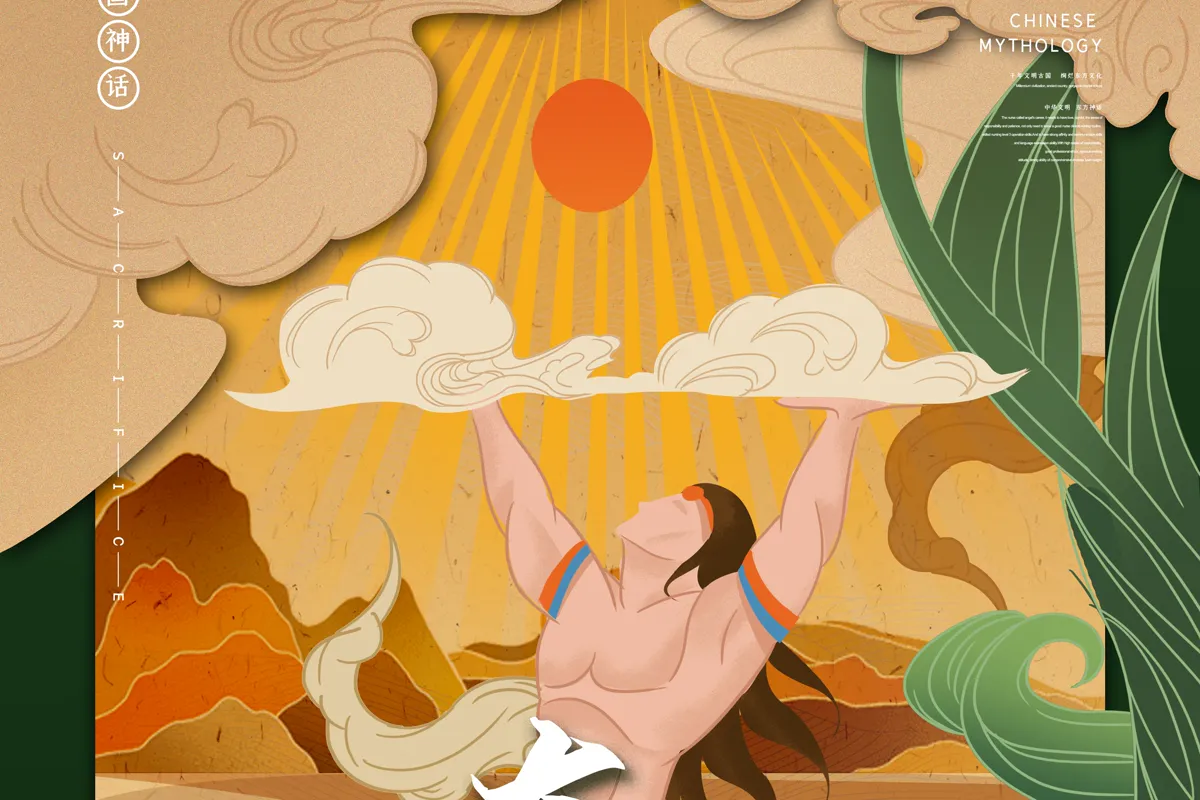
Kuafu makes ambition visible by trying to close the distance between one body and the sun. East Moment media archive.
Calling Kuafu foolish misses the emotional value. Nobody remembers the sensible person who looked at the sun and stayed home. Kuafu turns impossible ambition into landscape. Even the failed chase leaves shade for other travelers.
That is a strong Chinese myth pattern: effort can matter after victory becomes impossible. Jingwei does not need to empty the sea for the story to work. Kuafu does not need to catch the sun. Their refusal becomes the achievement.
Culture heroes turn survival into civilization
Some Chinese mythic figures do not defeat monsters. They make human life workable.
Shennong, the Divine Farmer, is associated with agriculture, plants and medicinal knowledge. Popular storytelling says he tasted many herbs, sometimes suffering repeated poisoning, so that people could learn what nourished and what harmed.
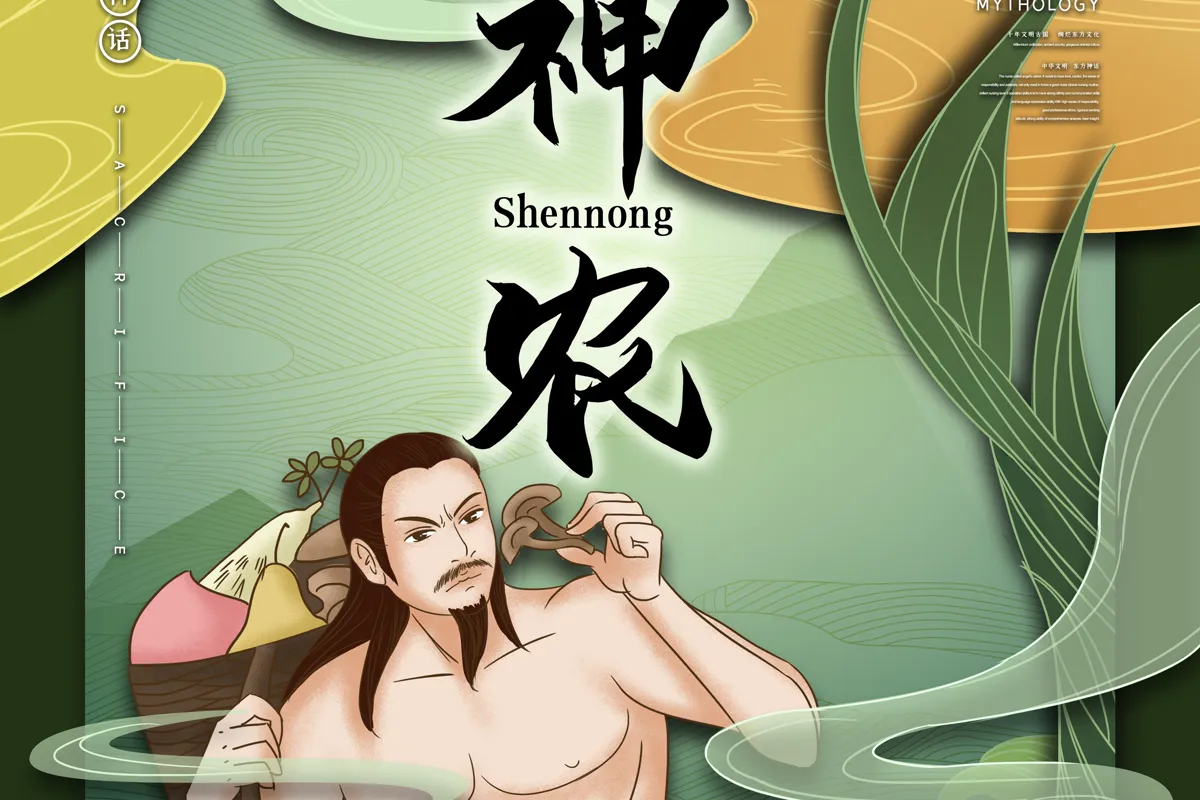
Shennong turns knowledge into bodily risk: somebody has to test what the landscape can give. This is a modern archive interpretation, not evidence of ancient clothing or appearance. East Moment media archive.
Do not read this as a literal laboratory record. Read the story's cultural claim: food, farming and medicine are knowledge earned through attention, experiment and danger. Civilization is not delivered as a download from heaven. Someone learns the environment plant by plant.
Fuxi is connected in different traditions with ordering human society, divination, fishing, hunting and the trigrams later associated with the Yijing. He and Nüwa sometimes appear together as paired culture creators. The details shift because a culture hero is less like one biographical person and more like a name attached to foundational knowledge.
Yu the Great faces the flood. Earlier efforts try to block the water; Yu succeeds by channeling and directing it. The story connects environmental intelligence, labor, sacrifice and political legitimacy. Later tradition also makes him the founder of the Xia dynasty, which is why he stands on the unstable border between mythology, early history and state memory.
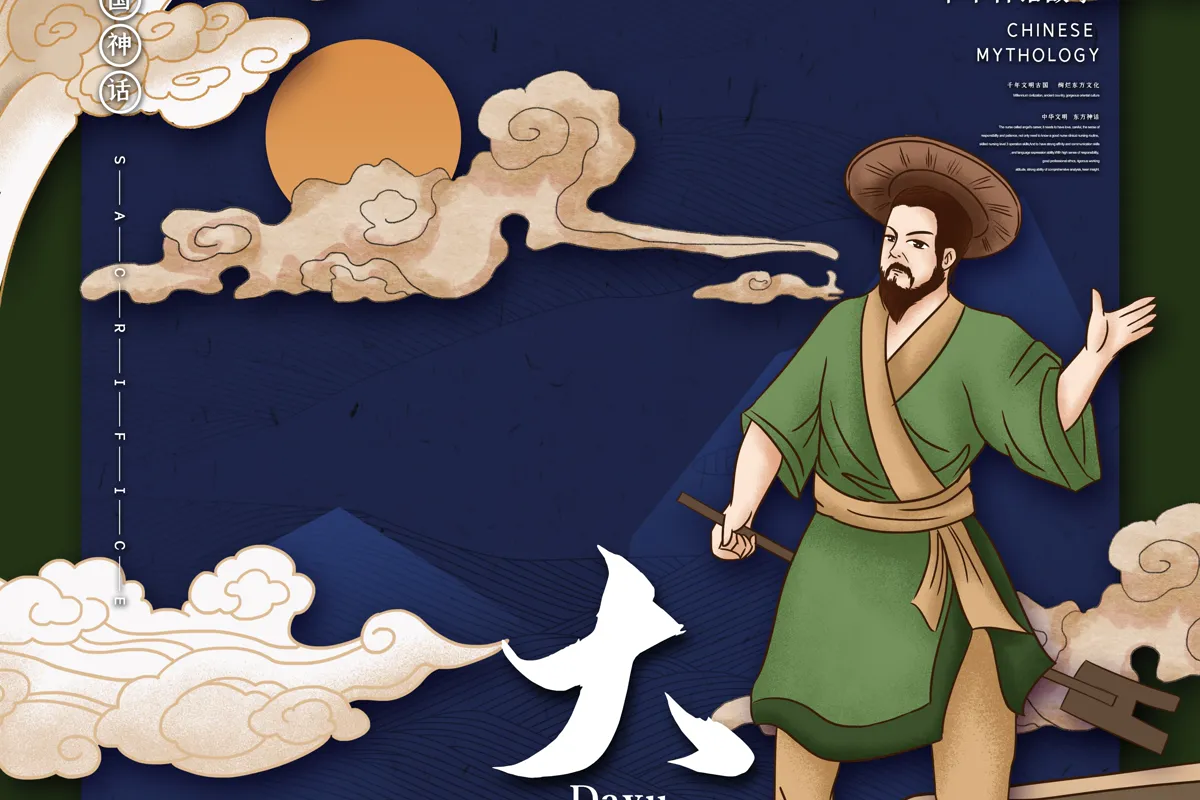
Yu's defining action is not overpowering water but giving it a route. East Moment media archive.
This distinction matters. A flood hero who punches the river would be spectacular for thirty seconds. Yu is remembered because he understands flow. His power is infrastructure.
That may be the least glamorous sentence in mythology, but it is one of the most Chinese: the person who makes the system work becomes legendary.
The moon keeps the emotional damage
Hou Yi solves the sun crisis, but his story does not end in victory. It turns toward Chang'e and the moon.
Versions differ over motive, blame and the elixir of immortality. In one early account, Chang'e takes the medicine and flees to the moon. Later versions may make her selfish, frightened, protective or tragically separated from Hou Yi. Modern retellings often soften judgment and focus on loneliness.
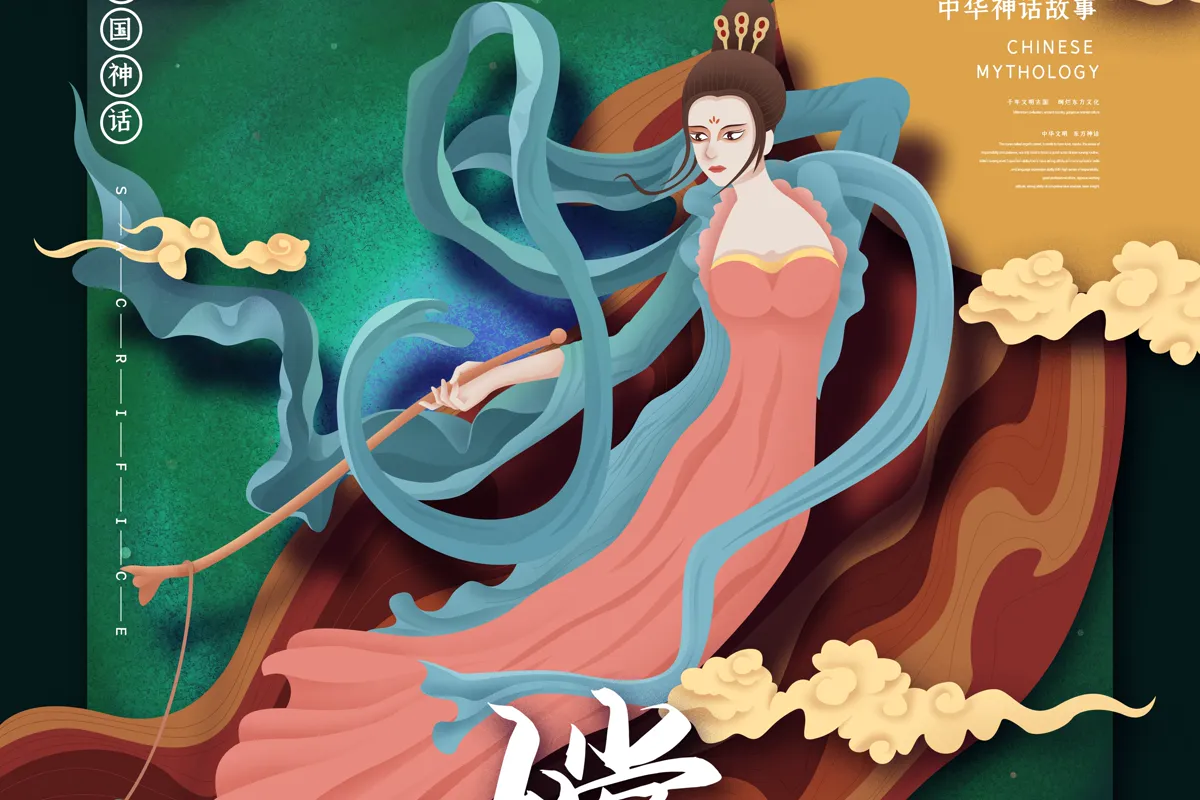
Chang'e has become the emotional face of the moon: beautiful, distant and permanently separated. East Moment media archive.
There is no reason to flatten these versions into one “correct” personality. The changes show what each audience wants from Chang'e. A moral warning needs a thief. A romance needs a separated lover. A modern heroine needs agency. The moon remains stable while the emotional interpretation changes beneath it.
Chang'e is closely associated with the Mid-Autumn world of moon viewing and reunion, although festival practice is larger than one myth. Her name also travels through modern science: China's lunar exploration program is called Chang'e. Few cultural figures move more smoothly from an immortality story to spacecraft.
The Cowherd and Weaver Girl, Niulang and Zhinü, create a different cosmic separation. Zhinü is associated with weaving and the heavens; Niulang is a mortal cowherd. Their relationship is divided by the Milky Way, and in the best-known telling they reunite once a year across a bridge formed by magpies.
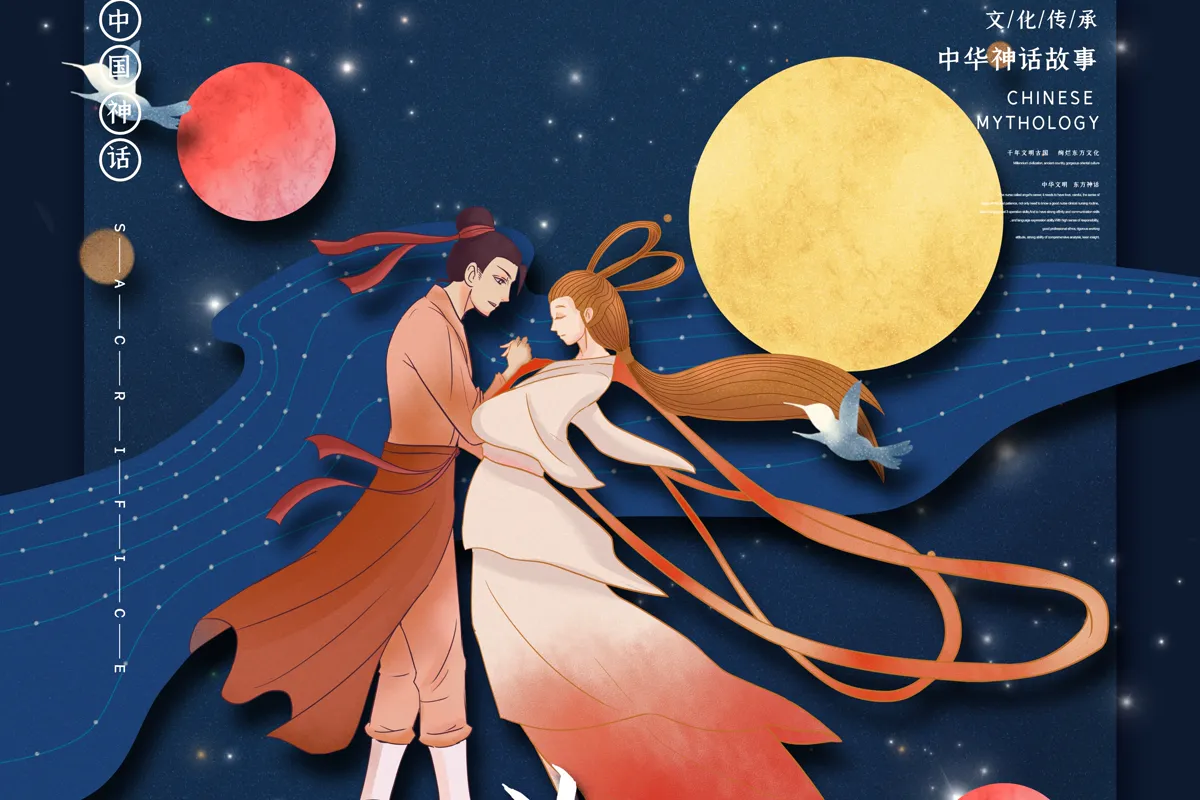
The Cowherd and Weaver Girl story turns the night sky into emotional geography: love is visible as distance. East Moment media archive.
The story is associated with Qixi Festival, sometimes sold overseas as “Chinese Valentine's Day.” That label is convenient and shallow. Qixi carries histories of women's skills, weaving, wishes and changing festival practice alongside romance. Calling it Valentine's Day with magpies removes the texture that makes it Chinese.
Rebellion keeps Nezha and Sun Wukong alive
Nezha and Sun Wukong dominate modern global attention because they do something polite cultural symbols rarely do: they cause trouble.
Nezha is the permanently rebootable child rebel. His story combines divine power, family conflict, violence, sacrifice, rebirth and a refusal to accept the identity assigned to him. The familiar weapons and fire wheels create instant visual recognition, but the emotional engine is stronger than the equipment: what happens when a child believes the world has judged him before he has chosen who to become?
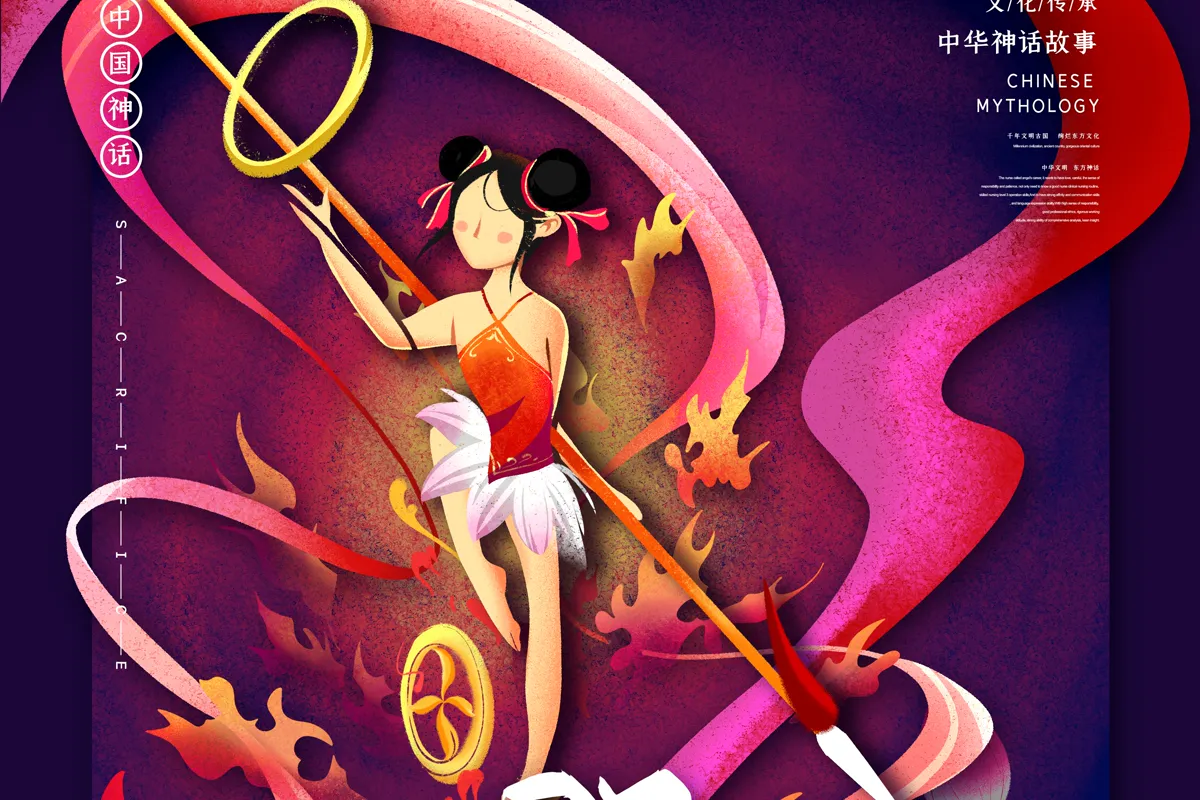
Nezha's silhouette already behaves like animation: circular weapons, long ribbons and a body moving against authority. East Moment media archive.
Ming-period fiction, especially Investiture of the Gods, powerfully shaped Nezha's popular narrative, while temple religion, opera, animation and cinema kept rewriting him. There is no final Nezha. That is his superpower. The Ne Zha mythology guide follows those religious, literary and cinematic births without declaring one sole original.
Jiao Zi's films provide a useful modern test of that reinvention. The dedicated Ne Zha 2 guide separates inherited symbols from the Demon Orb / Spirit Pearl film continuity, then asks how the sequel turns assigned identity into an institutional problem. Use it for the movie's verdict, ending and current legal viewing routes; keep this page as the broader mythology owner.
Sun Wukong works the same way. He is not a convenient representative of every ancient Chinese monkey myth. His globally familiar identity comes from Journey to the West: born from stone, self-trained, impossible to manage, punished beneath a mountain and later sent on a Buddhist pilgrimage. The novel matters because the monkey does not travel alone; rebellion, appetite, fear and patience have to become a damaged family before any sacred destination means anything.
The Monkey King is funny because his ego is enormous and compelling because heaven's institutions often deserve the disruption. He can be selfish, loyal, violent, ingenious and spiritually unfinished in the same story. He is not a clean role model. He is a personality strong enough to survive translation.
This is also why the Chinese zodiac Monkey sometimes borrows his staff and attitude in modern design even though the zodiac sign is not automatically Sun Wukong.
Dragons, foxes and creatures refuse simple morality
Chinese mythological creatures are regularly damaged by one-word translations. The Chinese mythology creatures field guide pairs each major being with a text or dated object so the image does not float free of evidence.
The Chinese dragon is not simply the Western dragon with a longer body. It is connected with water, rain, transformation, authority and auspicious force across different contexts. It can be imperial, local, divine, dangerous or celebratory. “Dragon equals lucky” is no more complete than “dragon equals monster.”
The fenghuang is often called a Chinese phoenix, but it does not need to die and rise from ashes to be itself. The qilin is regularly compared with a unicorn, although its body, moral associations and visual history follow another path. Translation helps readers enter; it should not replace the creature after they arrive.
The nine-tailed fox is even less interested in one moral alignment. Early textual appearances can present it as a strange or auspicious being. Later stories connect fox spirits with transformation, seduction, intelligence, danger and spiritual cultivation. Modern games and dramas can turn the fox into a villain, lover, antihero or fashion icon.
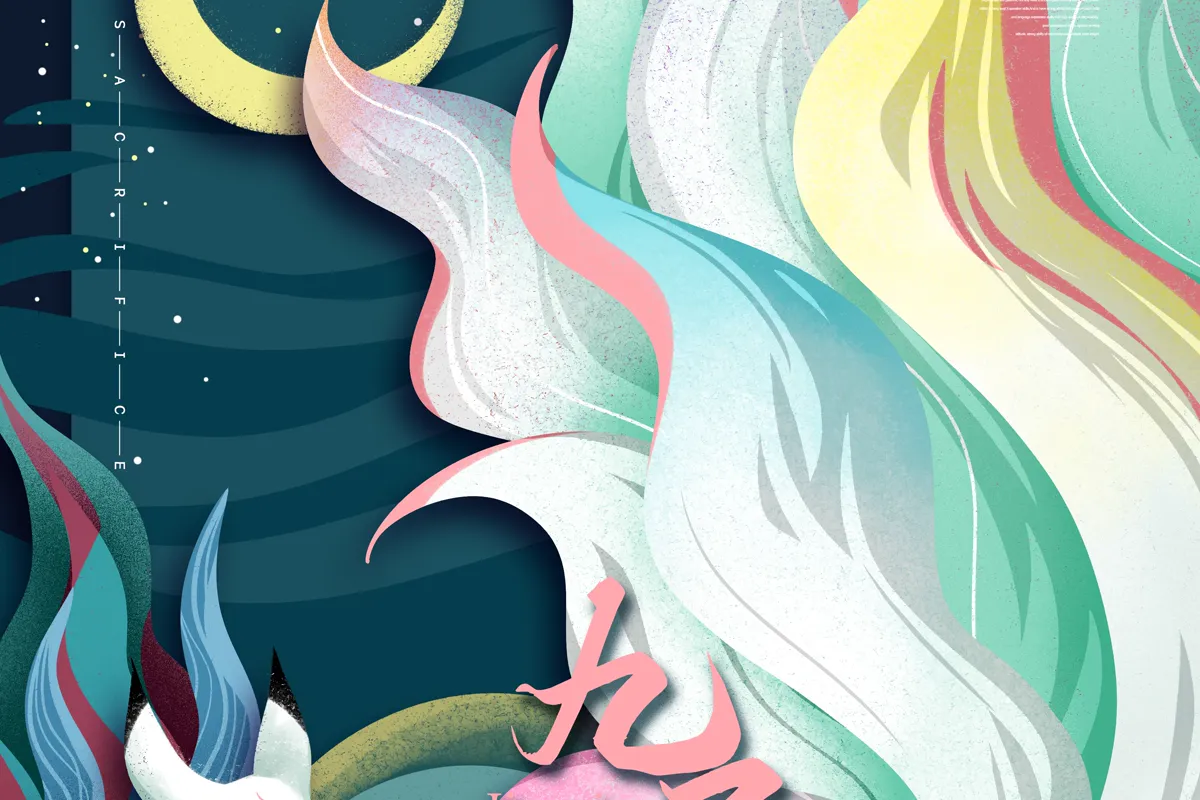
The nine-tailed fox survives because transformation is more interesting than a permanent alignment of good or evil. East Moment media archive.
Never ask only, “What does this creature mean in Chinese culture?” Ask: in which text, century, region, religion, artwork or game? Mythical creatures change jobs.
How to start exploring Chinese myths
Do not memorize a list of fifty gods. Choose the emotional door you actually want to open.
For cosmic disaster, begin with Nüwa repairing the sky and Hou Yi shooting the suns. These stories establish the scale immediately.
For pure refusal, read Jingwei filling the sea and Kuafu chasing the sun. They are short, strange and impossible to forget.
For love under pressure, follow Chang'e and Hou Yi, then Niulang and Zhinü. Compare versions instead of demanding one official romance.
For rebellion and entertainment, begin with Nezha and Journey to the West. Then watch how animation, film and Chinese games change costume, power and personality while preserving the central conflict.
For creatures, enter the Classic of Mountains and Seas. Do not expect a modern fantasy encyclopedia. It is a difficult collection of geography, ritual information, peoples, plants, animals and extraordinary beings. Its strangeness is the experience.
Most importantly, keep a version label in your head. “In the Huainanzi...” is useful. “In a later popular telling...” is useful. “In this film...” is useful. “Chinese mythology says...” is often too broad to mean anything.
Why Chinese mythology owns the modern screen
Chinese mythology was built for remix culture long before the phrase existed.
Its stories contain recognizable cores but unstable details. Nezha remains rebellious even when his age, world and emotional arc change. Sun Wukong remains difficult to control even when a game makes him darker. Chang'e remains connected to distance, immortality and the moon even when a science program borrows her name. The nine-tailed fox remains transformable because transformation is already the concept.
That flexibility is creative fuel. A fragile story breaks when adapted. A strong myth absorbs a new visual language and asks what else it can become.
The danger is empty “Chinese style”: red clouds, dragons, random characters and a famous name pasted onto generic fantasy. Visual beauty is not enough. A meaningful adaptation understands the original tension. Nüwa repairs. Jingwei refuses. Yu redirects. Nezha rejects a verdict. Sun Wukong challenges control. Keep the tension and the character can survive almost any redesign.
My strongest conclusion is this: Chinese mythology is not valuable because it is ancient. It is valuable because it still produces emotional voltage.
The sky breaks. Somebody repairs it.
The ocean wins. A bird returns with another stone.
Heaven writes a rule. A child on fire wheels asks who gave heaven the right.
That is not dead heritage. That is living entertainment.
East Moment follows the emotional and cultural argument; the accountable text of the Classic of Mountains and Seas at the Chinese Text Project anchors one early textual route, while XianLore's visual guide to Chinese mythology provides the complementary route through gods, creatures, legends and adapted fantasy worlds.
Frequently asked questions about Chinese mythology
What is Chinese mythology?
Chinese mythology is the large, changing body of creation stories, culture-hero legends, divine tales, strange creatures, local traditions and literary characters that developed across Chinese texts, religions, oral storytelling and popular entertainment. It has no single official canon.
Who is the main god in Chinese mythology?
There is no single main god across all Chinese mythology. Different stories and religious traditions center figures such as Nüwa, the Jade Emperor, the Queen Mother of the West, Guanyin, local gods and culture heroes. Treating them as one fixed hierarchy creates a false system.
What is the Chinese creation myth?
There is more than one. Pangu separates heaven and earth in a famous later account, while Nüwa creates humans in some traditions and repairs the damaged sky in another major story. Chinese creation is better understood as several overlapping explanations than one authorized version.
Are Sun Wukong and Nezha ancient Chinese gods?
Both belong to Chinese religious and storytelling traditions, but their globally familiar personalities were powerfully shaped by later literature, opera, animation, film and games. Sun Wukong is inseparable from Journey to the West, while Nezha's modern image draws heavily on Ming fiction and continuous reinvention.
What book should I read for Chinese mythology?
Start with a reliable translation of the Classic of Mountains and Seas for strange landscapes and creatures, then read selected myths from the Huainanzi. Journey to the West is essential for Sun Wukong, but it is a novel rather than a complete Chinese mythology handbook.
What are famous Chinese mythological creatures?
Famous creatures include dragons, phoenix-like fenghuang, qilin, nine-tailed foxes, moon rabbits and many beings recorded in the Classic of Mountains and Seas. Their meanings change across period, text and modern adaptation.
Is the Chinese zodiac part of Chinese mythology?
The zodiac overlaps with mythology and folklore, especially through the Great Race story and modern character design, but its twelve-year calendrical cycle is not simply a list of mythological creatures. Only the Dragon is conventionally supernatural within the animal set.
Why is Chinese mythology popular in games and animation?
Its characters already contain strong visual identities, supernatural abilities, moral conflict and multiple versions. Creators can preserve a recognizable core while changing the world, costume, personality and stakes, making the stories ideal for animation, film, comics and games.