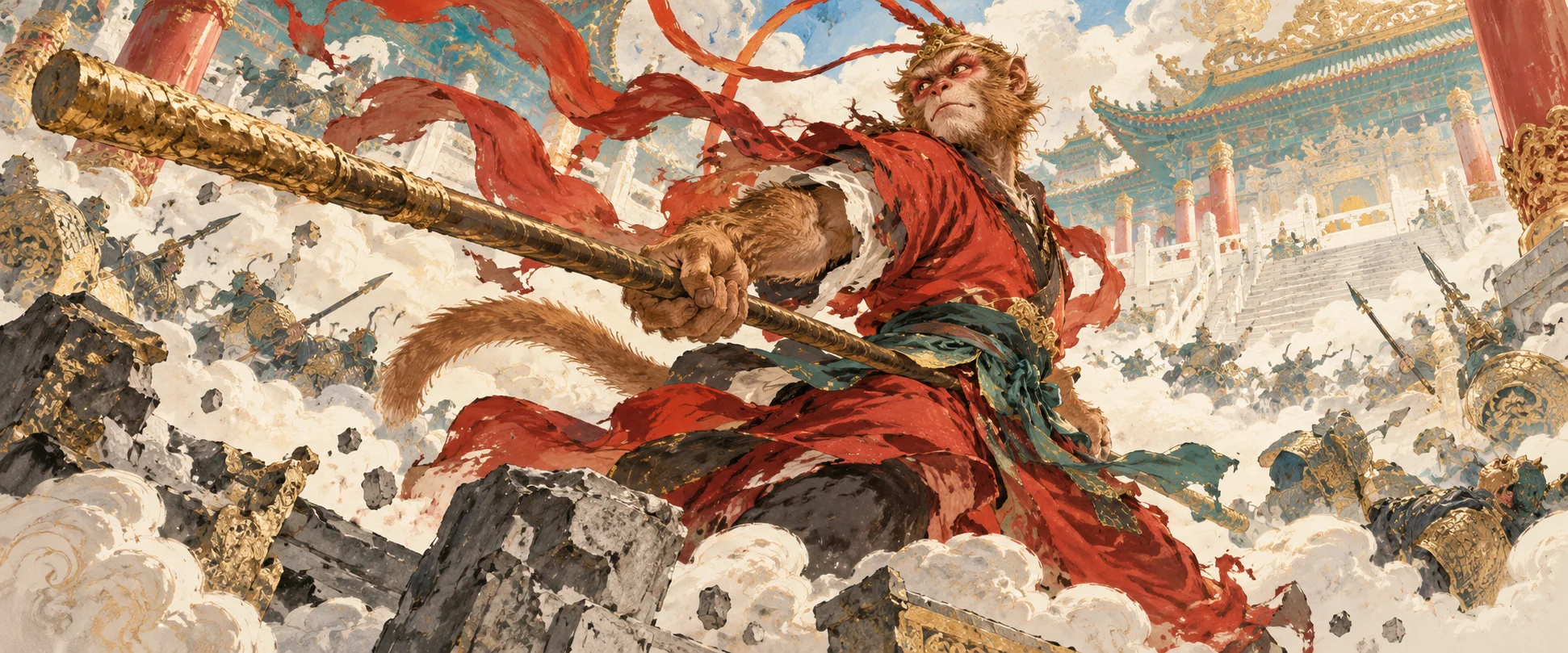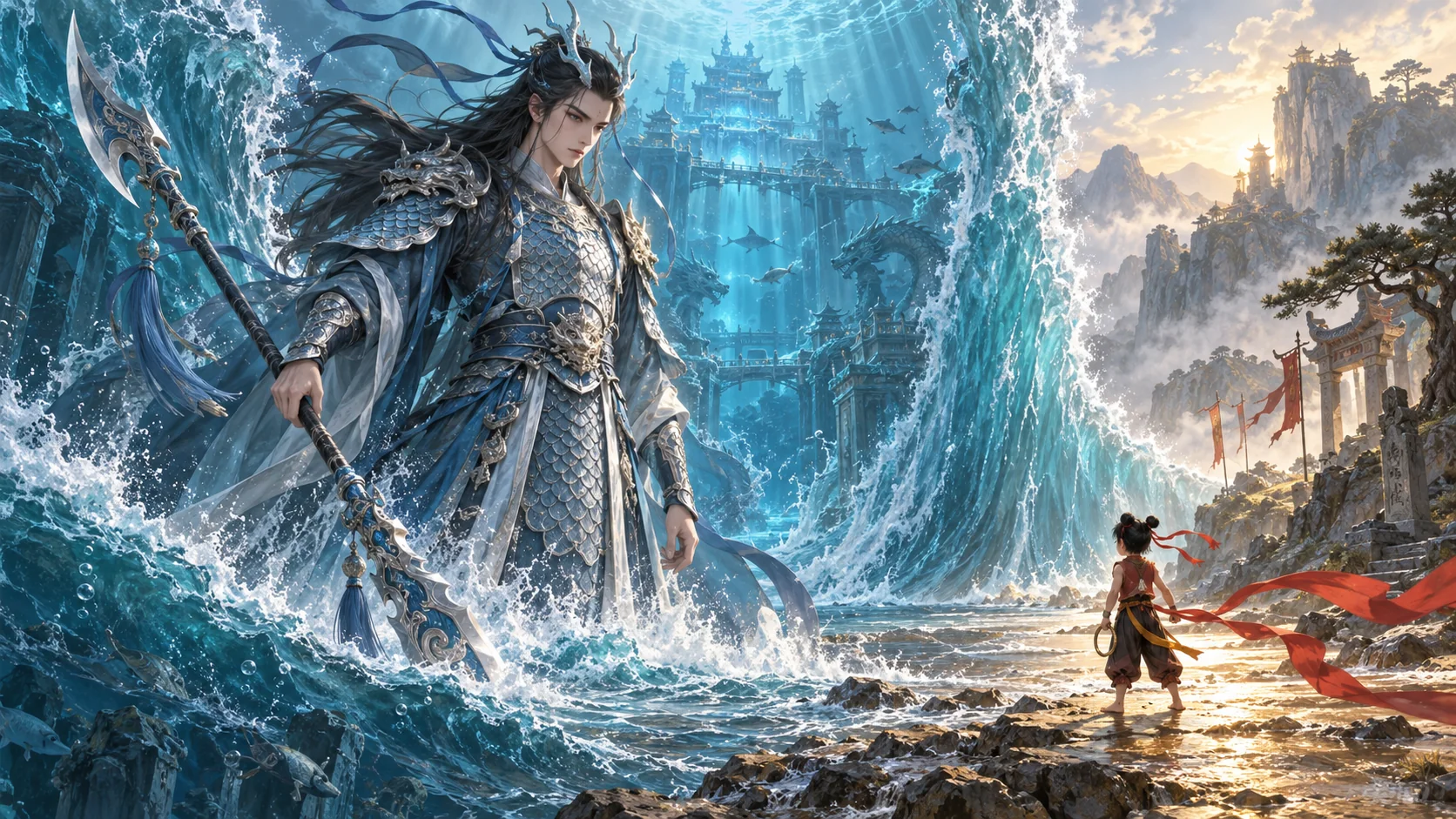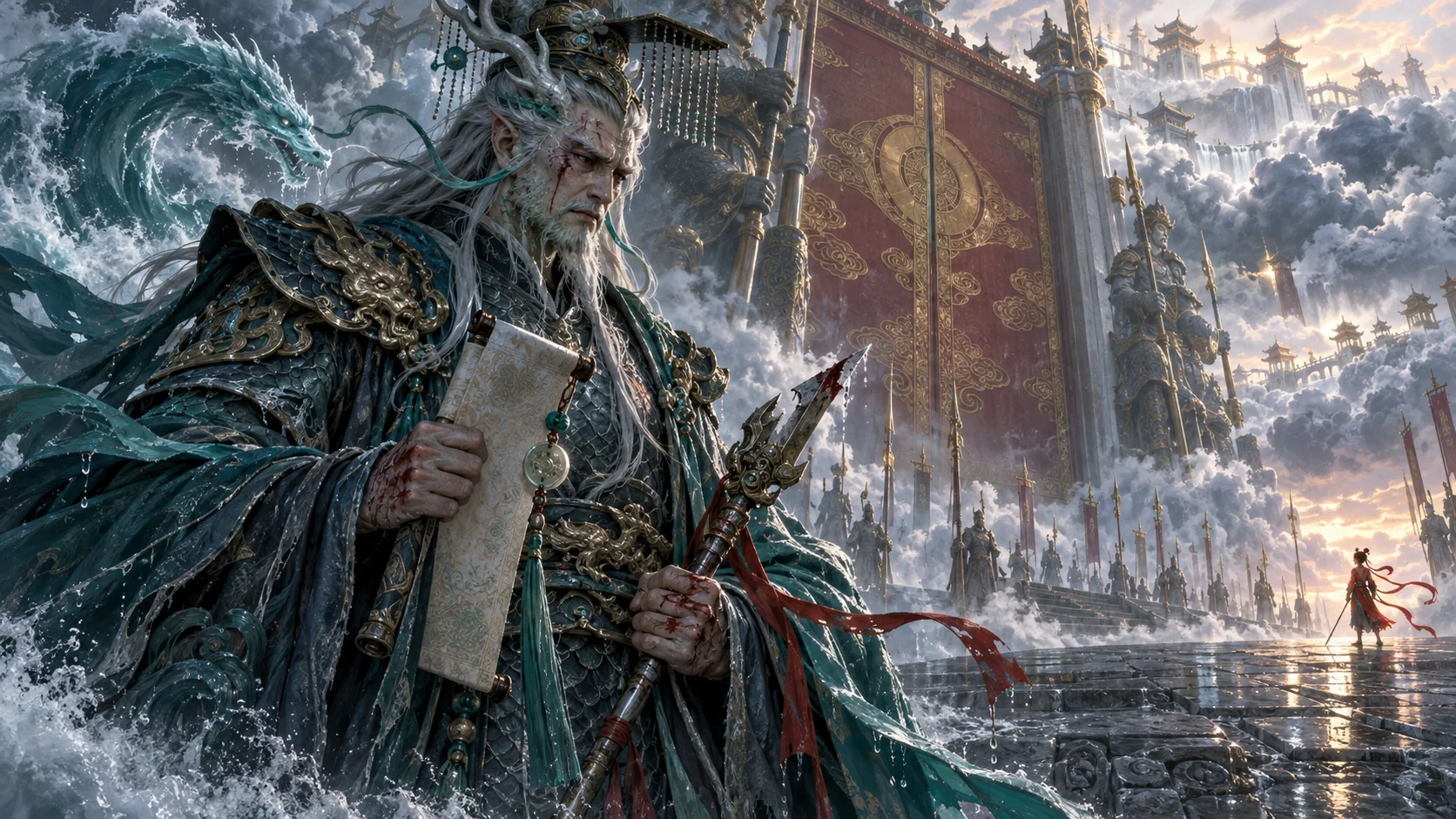
Journey to the West is often introduced as the adventure of a magical monkey. That gets a reader through the door and leaves the best part outside. The novel works because four damaged travelers are forced to become a family while performing a task none could finish alone. Sun Wukong supplies impossible action. Tang Sanzang gives the journey moral direction and maddening vulnerability. Zhu Bajie makes appetite honest. Sha Wujing turns endurance into care.
Journey to the West tells how rebellion, desire, fear and patience learn to travel together
The basic destination is simple: the monk Tang Sanzang travels west to obtain Buddhist scriptures. The road is not simple. Demons want his flesh, rulers and spirits test the group, celestial institutions interfere, and his three disciples carry histories of punishment.
Sun Wukong rebelled against Heaven and was imprisoned beneath a mountain. Zhu Bajie fell from celestial office and now drags appetite, complaint and comic desire into every crisis. Sha Wujing also lives under punishment, quieter but not empty. Tang Sanzang has spiritual purpose without the physical force to cross the world safely.

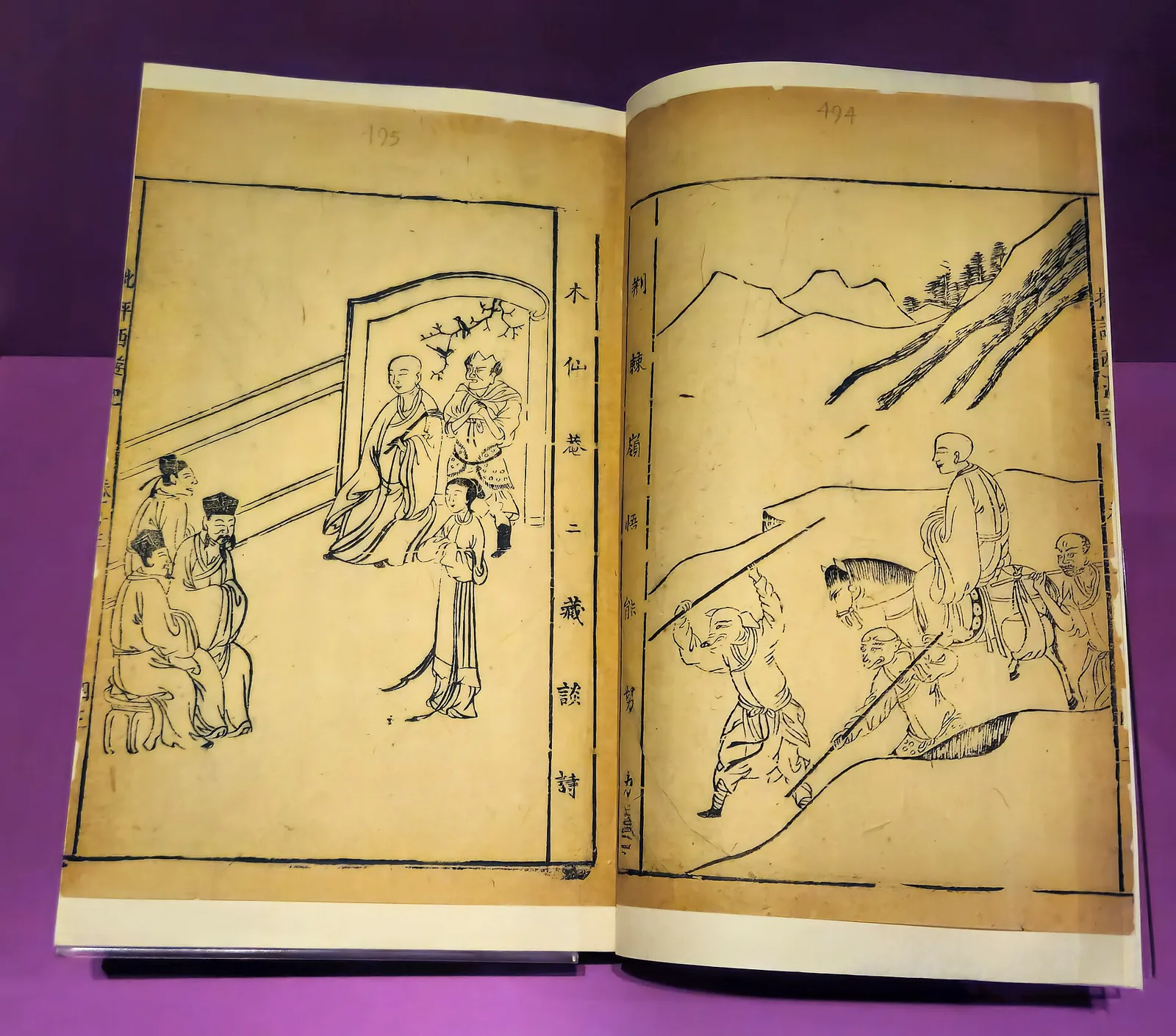
The group is the unit. Horse, luggage, weapons and different bodies turn a sacred mission into the practical problem of moving together. Public-domain illustration via Wikimedia Commons.
No one has the complete virtue required by the journey. That is the design.
The direct answer: book, characters, story and meaning
| Question | Direct answer |
|---|---|
| What is Journey to the West? | A long Chinese novel from the Ming period, traditionally attributed to Wu Cheng'en, that transforms the historical monk Xuanzang's pilgrimage into an episodic religious, comic and fantastical adventure. Britannica's work overview supplies the compact literary reference; this page argues for the relationships that a reference entry cannot make you feel. |
| What is the Chinese title? | Xi You Ji (西游记), literally a record or account of journeying to the west. |
| Who are the main characters? | Tang Sanzang, Sun Wukong, Zhu Bajie, Sha Wujing and the White Dragon Horse. Guanyin repeatedly shapes and rescues the pilgrimage. |
| Is Tripitaka a person? | In many English adaptations, “Tripitaka” names Tang Sanzang. The word also refers to the Buddhist canon, so context matters. |
| Are Pigsy and Sandy their real names? | They are familiar English adaptation names for Zhu Bajie and Sha Wujing. Translations vary. |
| Is it mythology or religion? | It is literature that draws creatively on Buddhist, Daoist, folk and bureaucratic cosmologies. A novel character is not a complete description of a living religious figure or practice. |
| Do I need to read all one hundred chapters? | No. Begin with Wukong's origin and rebellion, the formation of the pilgrimage group, then read selected ordeals before deciding whether to continue in full. |
Sun Wukong's freedom is real, and so is the damage it causes
Wukong is born from stone, learns extraordinary arts, acquires the staff Ruyi Jingu Bang, erases his name from the registers of death and refuses the minor position Heaven offers him. His rebellion is exhilarating because celestial order often looks like a bureaucracy protecting rank rather than justice.
But rebellion does not make every action wise. Wukong can be proud, violent and unable to accept limits that do not flatter him. The Buddha's palm episode exposes the scale of that self-confidence.

The episode turns cosmic space into a lesson about perception: Wukong travels an impossible distance and still has not left the hand he dismissed. Public-domain illustration via Wikimedia Commons.
The mountain imprisonment and later headband are uncomfortable for a reason. Discipline can become wisdom, but it is also enforced through pain and authority. The novel does not offer modern freedom in a clean package. It asks whether a being built to resist control can learn responsibility without being spiritually erased.
I do not read Wukong's final sacred title as proof that rebellion was childish. I read it as a transformation in what his power serves. Early Wukong demands recognition. Pilgrim Wukong increasingly acts for companions, strangers and a mission larger than his wounded status.
Tang Sanzang is not useless because he needs protection
Viewers raised on action adaptations often become frustrated with Tang Sanzang. He misjudges monsters, mistrusts Wukong and can appear helpless beside the disciples he commands.
That frustration contains part of the point. Moral aspiration without worldly perception is vulnerable. Tang Sanzang wants compassion to be possible, yet the road includes predators who perform innocence. Wukong sees danger but can answer too violently. Their repeated conflict stages a hard problem: how do you protect mercy without making it suicidal, and how do you use force without letting suspicion rule everything?
Tang Sanzang also gives the group a destination. Wukong can cross huge distances; that does not mean he knows where a life should go. The monk's weakness forces strength into relationship.
This is why the group feels like family. They do not merely combine abilities. They expose one another's unfinished character.
Zhu Bajie says what everyone else is trying not to say
Zhu Bajie is hungry, desirous, jealous, lazy and quick to imagine an easier route. He can behave badly. He is also the person who makes the pilgrimage honest about the body.

Zhu Bajie's broad body and rake disturb the clean silhouette of a holy procession. That disruption is narrative value, not merely comic appearance. Public-domain image via Wikimedia Commons.
A spiritual journey still includes food, sleep, fear, attraction, sore feet and resentment about labor. Bajie voices the wish to divide the luggage and go home. Every long group project has contained that thought, even when nobody says it aloud.
His comedy therefore performs moral work. Wukong's arrogance can look heroic because it moves quickly. Bajie's appetite is harder to romanticize. By making weakness visible, he prevents the group from pretending it has already transcended ordinary desire.
He also contributes real strength and moments of loyalty. A character can be ridiculous without being disposable. That balance is one reason he survives adaptation after adaptation.
Wukong and Bajie become brothers by surviving each other's worst habits
It is tempting to call Sun Wukong and Zhu Bajie enemies because they bicker so efficiently. Bajie complains about Wukong, exaggerates danger, longs for a softer life and sometimes hopes the more demanding disciple will disappear. Wukong teases him, calls out his laziness and can make every mistake feel public. The friction is real.
But friction is not the opposite of attachment. The two repeatedly return to one another when the road becomes dangerous. Bajie can mock Wukong precisely because he expects him to answer; Wukong can scold Bajie because he knows the group still needs the strength, labor and comic refusal Bajie brings. Their relationship becomes less like a pair of flawless moral symbols and more like the sibling bond inside a difficult household: irritation records familiarity, while rescue reveals the line neither will cross.
That distinction changes how I read their comedy. A joke is not automatically kindness, and an argument is not proof that affection has failed. The question is whether the scene lets one character remain only a target, or whether both are allowed to affect the other. Wukong becomes more human when Bajie's ordinary needs interrupt his heroic speed. Bajie becomes more than appetite when he stays, fights and carries responsibility after he has every excuse to leave.
This is why the pilgrimage cannot be reduced to a powerful Monkey King escorting weaker companions. The novel keeps testing whether strength can accept complaint, whether appetite can become loyalty, and whether a family can remain a family after everybody has seen the least impressive part of everyone else.
Do not turn the pilgrims into a corporate team poster
It is tempting to assign modern office labels: Tang Sanzang is “vision,” Wukong is “execution,” Bajie is “morale” and Sha Wujing is “operations.” The analogy is quick, shareable and almost useless. It keeps each character's function while removing punishment, religion, appetite, fear, violence and the moral damage of the road.
They are not four competencies assembled by a sensible manager. They are compromised beings placed inside an ordeal whose authority they repeatedly question. Tang Sanzang can be wrong. Wukong can save everyone and still terrify the person he protects. Bajie can expose hypocrisy while creating new trouble. Sha Wujing's steadiness can become so useful that readers stop seeing the person carrying it.
The family reading is harsher and more generous than the business reading. A company can replace a weak role. A family must decide what to do with a person whose failure has become familiar. The pilgrims change because leaving, rescuing, forgiving and returning acquire memory across many ordeals. No management diagram can substitute for that accumulated relationship.
Sha Wujing is the labor that keeps adventure possible
Sha Wujing rarely dominates the famous clips. He carries luggage, maintains formation and absorbs tension between more theatrical personalities. In a weaker reading, that makes him “the boring one.” In a family reading, it makes him infrastructure.
Every group depends on work that does not produce the heroic image. Someone remembers the load, continues after the argument and makes tomorrow possible. Sha Wujing's steadiness prevents the pilgrimage from becoming only a series of clashes between Wukong and Tang Sanzang or jokes around Bajie.
The White Dragon Horse belongs in this same correction. A transformed being becomes transport, which makes sacrifice easy to overlook precisely because it is continuously useful. The novel's world is full of persons trapped inside functions, titles and punishments. The pilgrimage can liberate them only if we remember they are more than the service they provide.
Monsters reveal the inequality inside Heaven
The English word “monster” can make every yaoguai (妖怪) sound like an alien species born evil. The novel is stranger. Animals, plants, objects and spirits may cultivate, transform, acquire desire or escape a celestial owner. Some are horrifying. Some have patrons.
That last fact changes the moral landscape. A creature connected to a powerful master may be retrieved; a low-status being may be destroyed. Earthly victims do not always receive equal justice. Heaven can look less like perfect moral order and more like an institution managing its own relationships.
This is one reason Journey to the West remains alive. Its religious imagination does not eliminate bureaucracy, favors, incompetence or status. The cosmos is sacred and satirical at the same time.
For international readers, the correction is important: Buddhism and Daoism are not two teams in a fantasy franchise. The novel borrows, transforms and jokes within a much larger cultural field. Use East Moment's Taoism guide to begin separating living traditions from literary machinery.
The 1986 television memory is part of the work's modern life
For many Chinese families, Journey to the West is not first a silent page. It is an opening theme, a monkey face, a cloud-like leap, a familiar voice and a television that returned during school holidays. Repetition turned episodes into shared family memory.
I value this because it explains why adaptation debates become emotional. People are not comparing neutral products. They are comparing new faces, music and rhythms with a version embedded in childhood rooms.

A London arena production shows how far the story travels and how completely a new medium can redesign it. The photograph documents that production, not Chinese opera as a whole. Public-domain photograph via Wikimedia Commons.
Opera, animation, comics, television and games each isolate different strengths. Opera can make gesture and costume carry identity before realism. Television gives a family recurring faces. Animation releases bodily transformation from physical limits. Games convert discipline and combat into player action.
No adaptation “replaces” the novel because each one selects a different journey.
I reject the idea that fidelity is a contest in counting retained demons. I insist on a harsher test: does the adaptation preserve the pressure that makes these four damaged people need one another? A version may change costume, episode order or even tone and still understand the book. A visually faithful procession that turns every companion into furniture has already lost it.
Use the Journey to the West movie guide to choose among comic, romantic, animated, spectacle-led and aftermath versions without confusing a film's emotional contract with the novel's full architecture.
Black Myth: Wukong begins after recognition, not before it
Black Myth: Wukong assumes that the Monkey King already carries enormous cultural memory. The game can fragment the story, darken institutions and ask what remains after Wukong because the old arc is present even when not retold.
That makes the novel the better source for one question and the game the better site for another. Read Journey to the West to understand how the pilgrimage group disciplines desire through relationship. Play Black Myth to encounter a modern Chinese studio's argument about inheritance, containment and the unstable afterlife of a hero.
Do not confuse Sun Wukong with the Monkey of the Chinese zodiac. One is a literary, theatrical and religious figure with a specific narrative history; the other belongs to a calendrical classification system. Search results often place them together because both are monkeys. Cultural meaning does not work by image match.
My best route into the book
Start with Wukong's birth, training, rebellion and imprisonment. Then read how Guanyin assembles the pilgrimage and how each disciple joins. Choose several ordeals that test recognition, appetite and loyalty rather than reading only fight summaries. Return to the ending after you understand what each pilgrim had to change.
If a translation's English names confuse you, keep this small map nearby:
| Chinese name | Common English name | What to remember |
|---|---|---|
| Sun Wukong (孙悟空) | Monkey King | Rebellion learning responsibility |
| Tang Sanzang (唐三藏) | Tripitaka | Moral purpose learning worldly judgment |
| Zhu Bajie (猪八戒) | Pigsy | Appetite becoming honest companionship |
| Sha Wujing (沙悟净) | Sandy | Endurance and uncelebrated care |
| Bai Long Ma (白龙马) | White Dragon Horse | A person whose sacrifice becomes infrastructure |
For characters, artifacts, locations and adaptation-reference depth, continue to XianLore's Journey to the West world archive. For the broader cultural family, enter East Moment's Chinese mythology guide and compare another rebellious child through Ne Zha.
Then join East Moment's community with the memory only you can supply: which pilgrim held the family together in the version you grew up with, and which scene made you realize it?