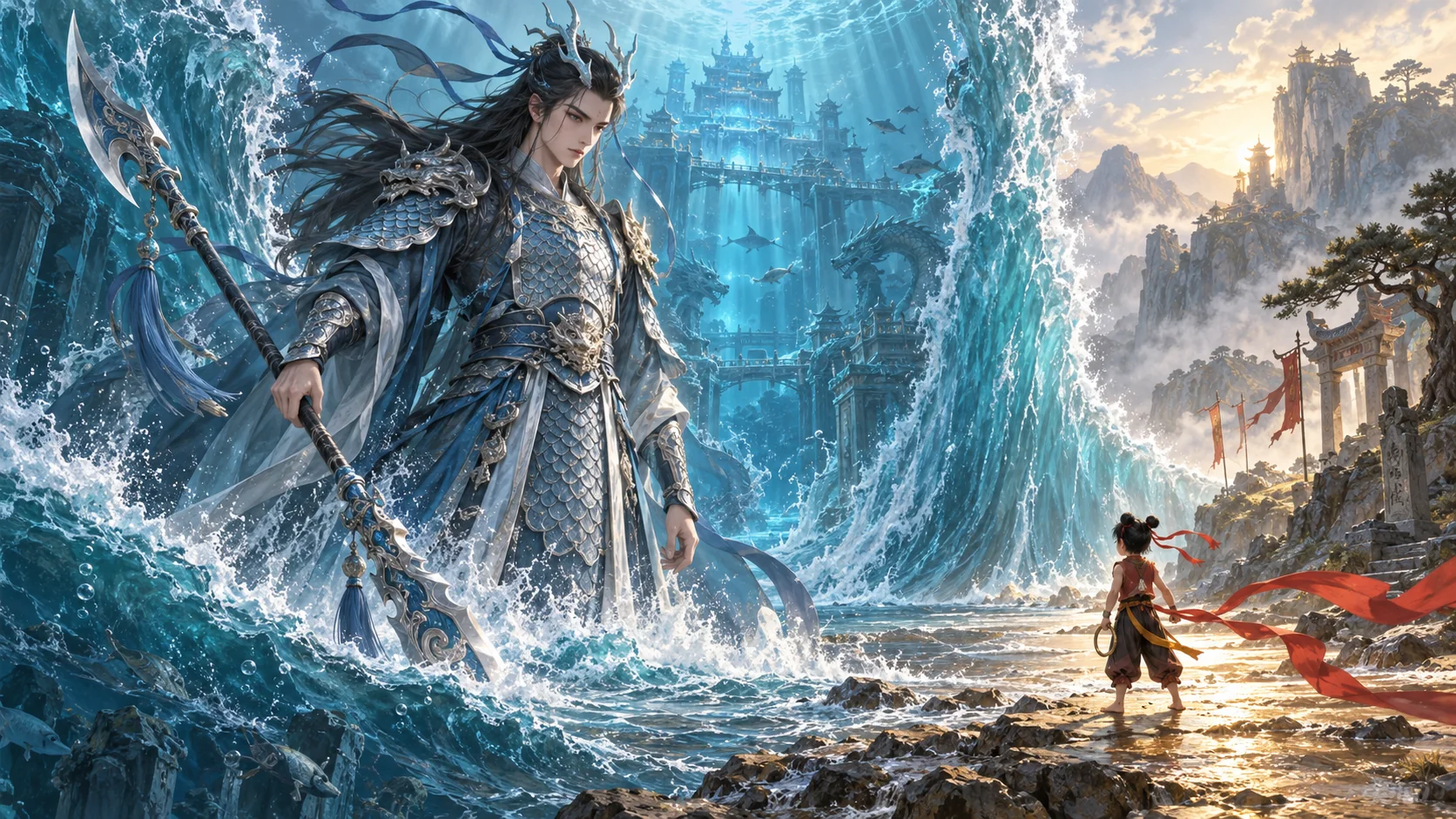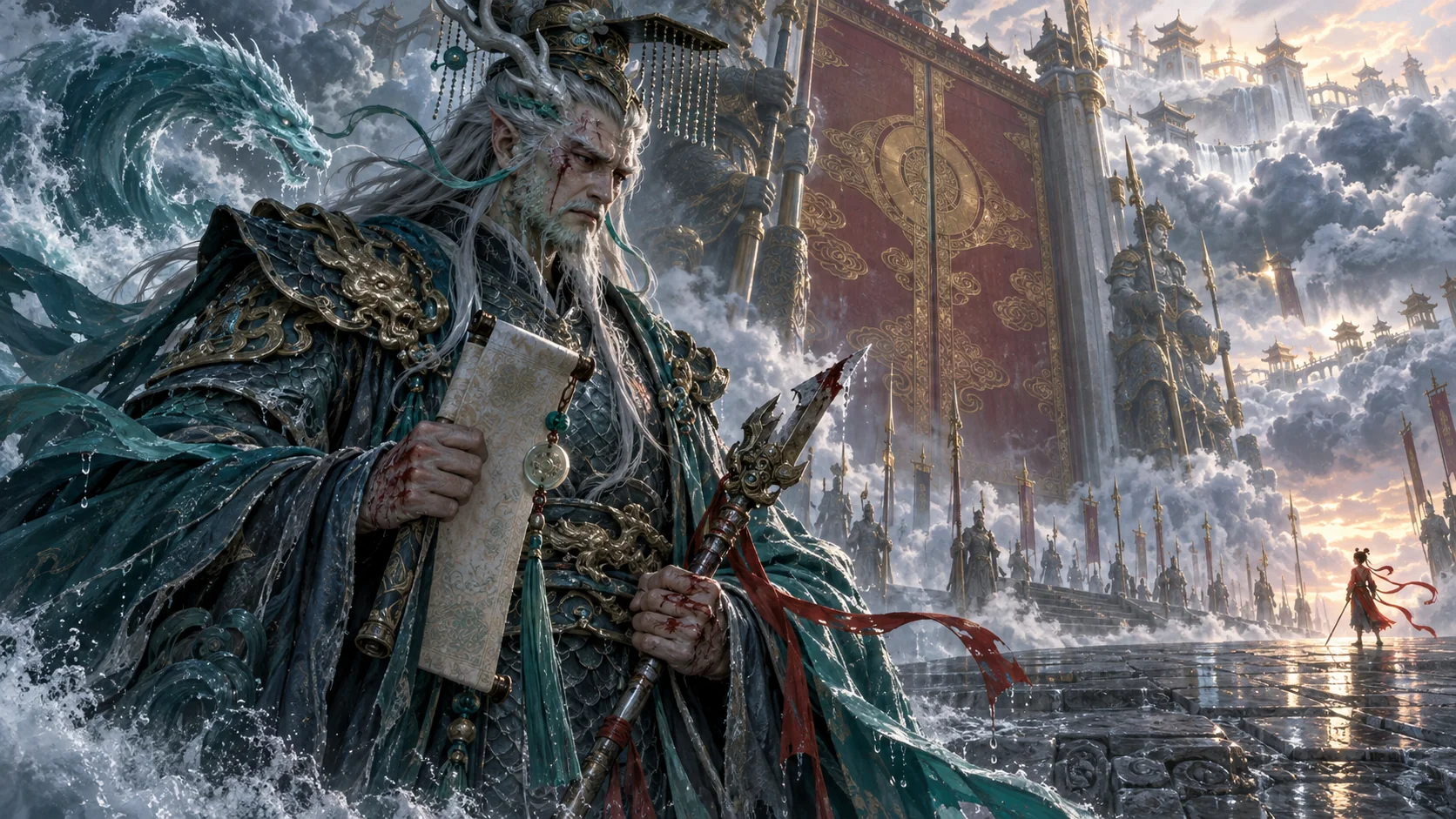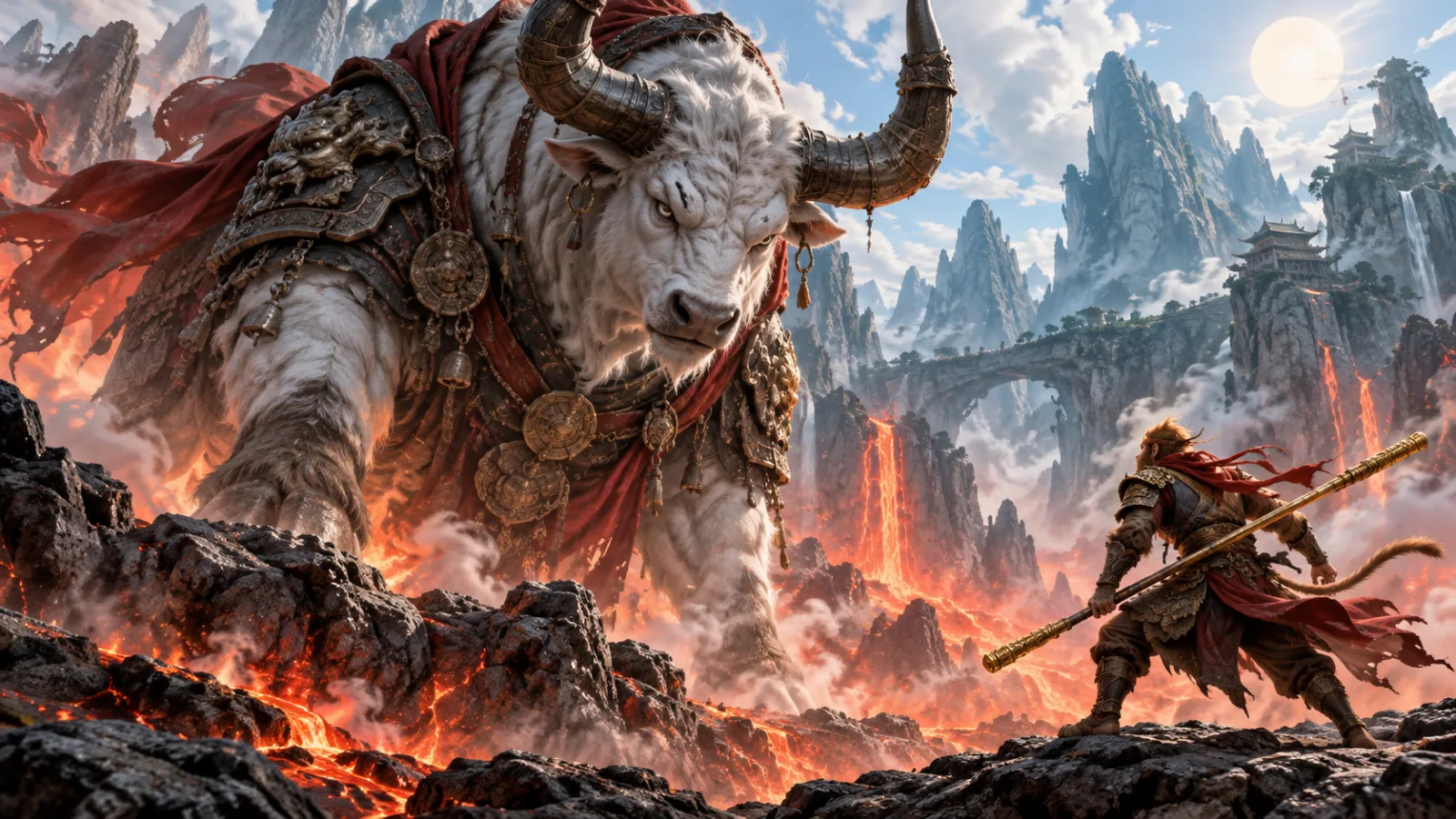
Ne Zha mythology has no single original edition waiting behind the movies. Nezha formed through Buddhist transmission, Chinese religious imagination, Ming fiction, temple worship, opera, animation and film. The familiar child with fire wheels is real as a cultural figure precisely because every era rebuilds the argument between family debt and selfhood.
Ne Zha mythology begins with three births
Nezha is famous for a miraculous birth and a lotus rebirth. Culturally, he has at least three larger births:
- Religious formation: a guardian figure develops through the Chinese transformation of Indic and Buddhist materials.
- Literary embodiment: Ming fiction, especially Investiture of the Gods, gives the child deity a violent family drama, weapons and memorable scenes.
- Modern emotional rebirth: animation and cinema repeatedly turn Nezha into the child who refuses an identity assigned before he can speak for himself.
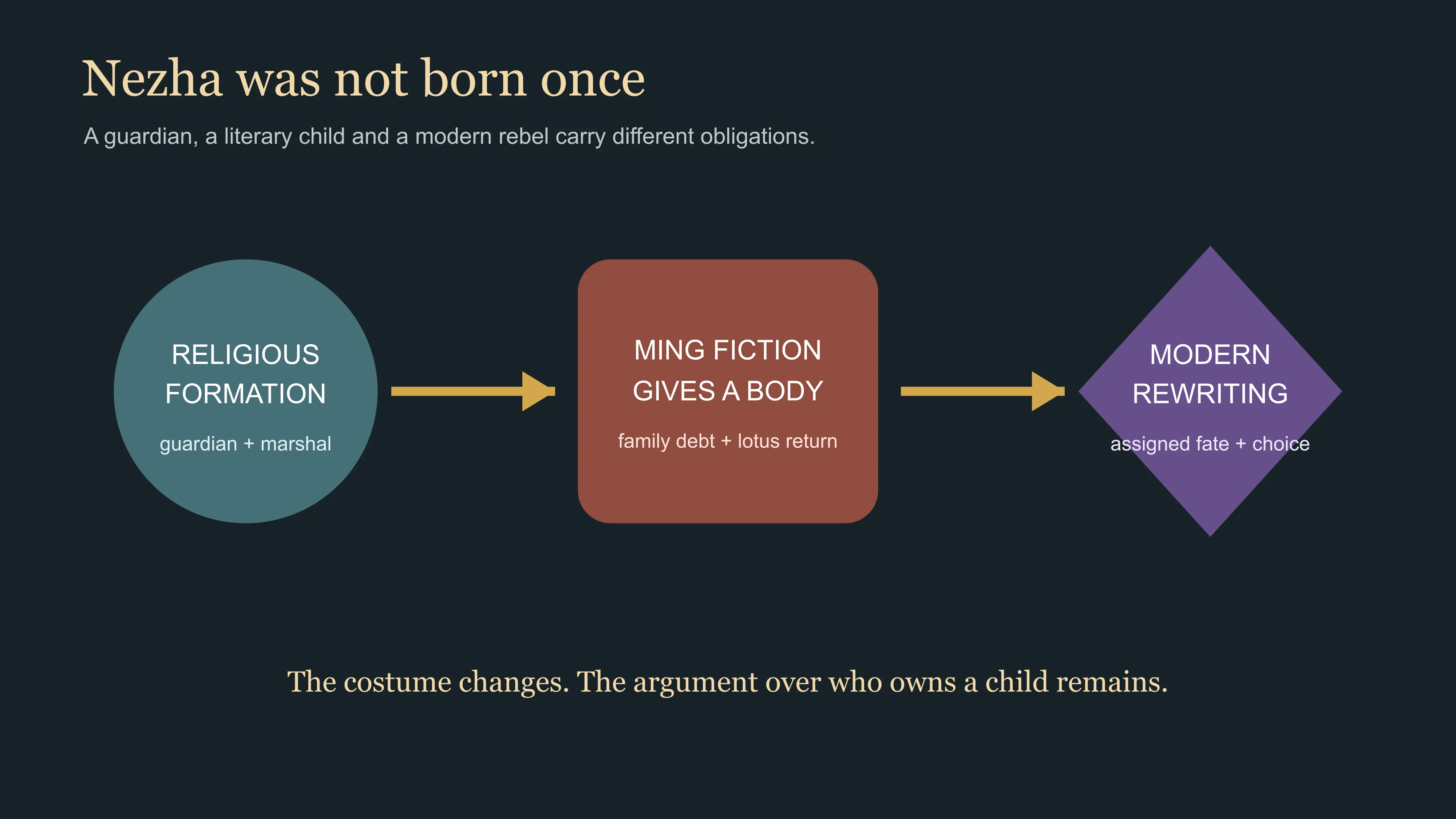
The three-birth route organizes this page's argument; it is not a claim that Nezha has only three historical forms or that transmission occurred in a clean straight line.
Meir Shahar's academic study Oedipal God: The Chinese Nezha and His Indian Origins is the strongest corrective to the idea that one Ming novel invented the figure from nothing. “Origin” here means a history of transmission and transformation, not a clean franchise launch date.
The questions I keep encountering are the right ones: is the older source Buddhist, is the novel's Nezha nearly a villain, and why does each film feel so different? Readers are not asking only for plot. They want permission to reconcile the beloved child hero with a much rougher textual history.
First birth: a guardian crosses languages and religions
Nezha's name and early formation are connected by scholarship to Indic figures such as Nalakuvara and to Buddhist guardian traditions. As the figure travels, pronunciation, family relationship, religious function and visual identity change.
This is not a story of China passively copying a finished foreign god. Cultural translation is productive. The imported material enters Chinese kinship, ritual, military protection and storytelling until Nezha becomes unthinkable outside China.
That distinction matters for overseas readers. Saying “Nezha is originally Indian” is as incomplete as saying “Nezha has no Indian background.” One erases Chinese transformation; the other erases transmission.
The honest sentence contains both.
Second birth: the Ming novel gives rebellion a family body
In Investiture of the Gods, Nezha is born into the household of the military commander Li Jing. The child's extraordinary power creates consequences faster than family or authority can contain them. Conflict with the Dragon King's world escalates. Nezha returns flesh and bones to his parents, dies and is reconstituted through lotus materials under the guidance of Taiyi Zhenren, whose protection is more morally complicated than a simple rescue.
Modern summaries often clean this into “a brave boy defeats an evil dragon.” The novel is more disturbing. Its Ao Bing episode gives the Dragon King a dead son and makes Ne Zha's victory much harder to celebrate without qualification.
Nezha can be arrogant, lethal and difficult to love. Li Jing's story is not simply that of an abusive father inserted to make rebellion morally easy. Their conflict carries impossible questions: What does a child owe for receiving a body? Can returning that body cancel kinship? Who is responsible when supernatural ability outruns moral development?
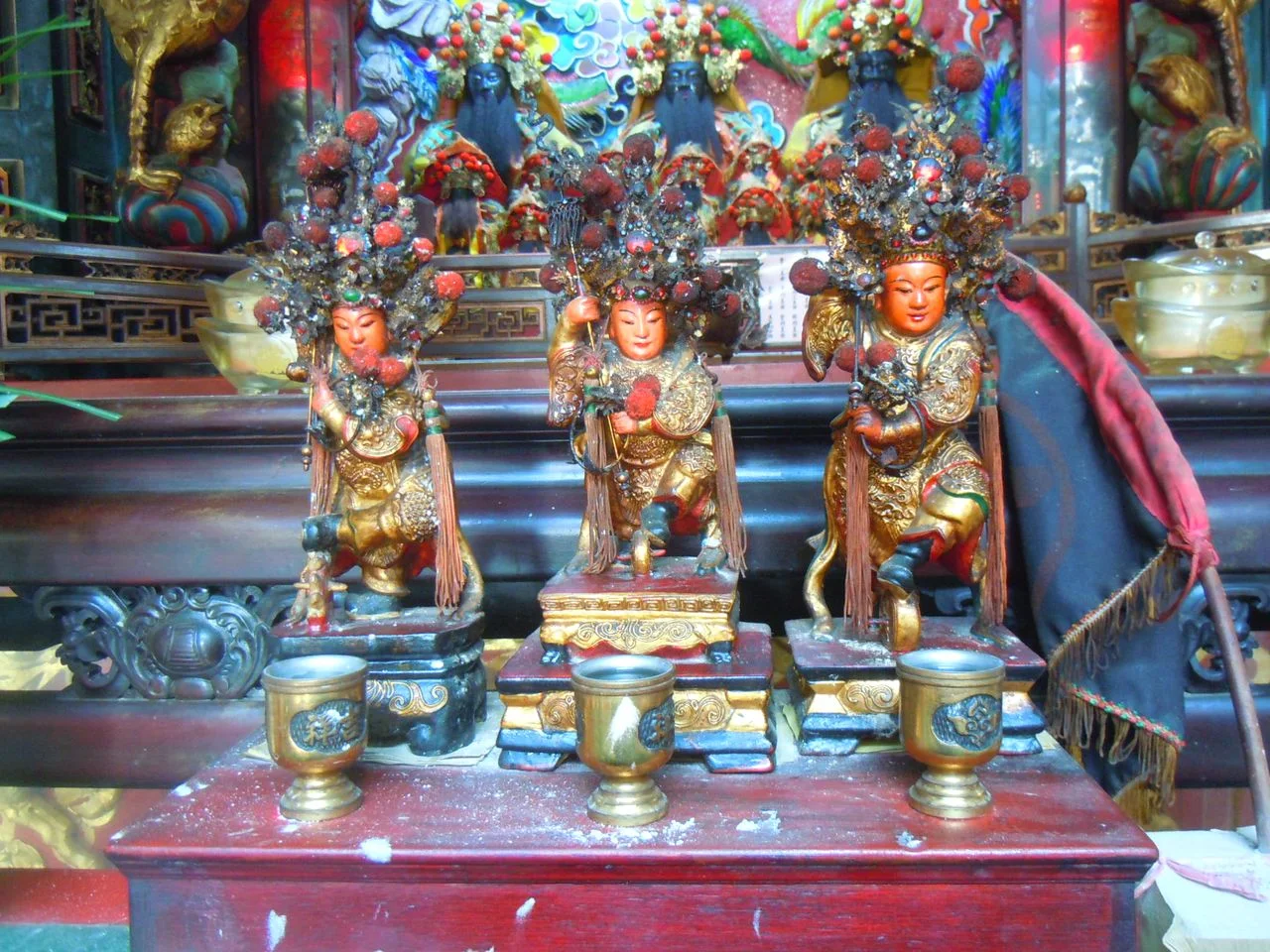
The page's opening temple portrait matters here. Nezha is not a movie rebel frozen at the instant of defiance; he stands inside worship, title and protection. That difference is exactly why the devotional figure cannot be collapsed into one novel scene.
This is the Nezha modern films often soften. They preserve the rejected child and rebuild the moral contract around him.
The body is the argument
Nezha mythology is unusually physical.
- A prolonged or miraculous birth makes the body a family crisis.
- Violence turns supernatural talent into public debt.
- Returning flesh and bone treats the body as something owed to parents.
- Lotus rebirth creates a self no longer dependent on ordinary birth.
- Multiple arms and heads make capacity visible.
- Wheels remove the child from the ground and household.
This is why Nezha adapts so well to animation. Philosophy becomes silhouette.
The circular wheels and trailing fabric turn refusal into motion. This is a modern synthesis, not a historical costume reconstruction.
My reading is that lotus rebirth does more than restore life. It imagines an extreme solution to family debt: if the first body belongs to the parents, build another body from ritual and plant matter.
Freedom arrives, but not peacefully.
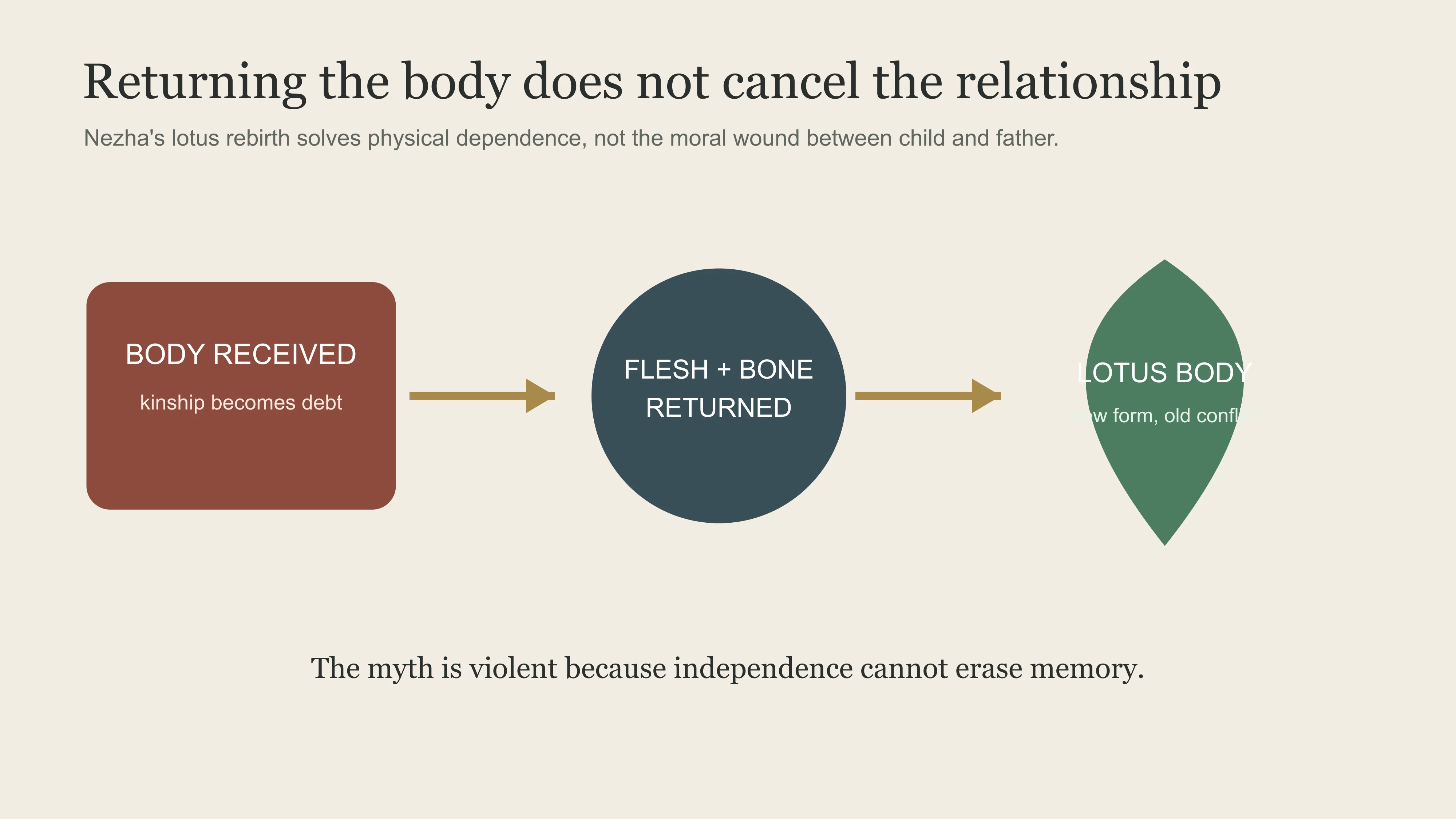
I used to read the return of flesh and bone as a clean heroic severance. I no longer can. It is a child's desperate attempt to make relationship behave like an account: return the principal, cancel the debt, leave. The horror is that kinship does not disappear when the body does. Lotus rebirth gives Nezha another body, but it cannot give him a childhood in which power, anger and parental fear never wounded one another. That failed cancellation—not a slogan about independence—is the scene's deepest pain.
The weapons are not accessories
Names and sets vary across sources and adaptations, but several objects remain visually central:
| Object | Common English rendering | What it does in the imagination |
|---|---|---|
| Wind Fire Wheels | Fenghuo Lun | Turns escape and attack into circular motion |
| Fire-Tip Spear | Huojian Qiang | Extends the child's reach and martial identity |
| Universe Ring | Qiankun Quan | Makes cosmic naming portable and throwable |
| Red Armillary Sash | Huntian Ling | Gives soft fabric violent force and animated rhythm |
| Lotus body | Lotus incarnation | Separates rebirth from ordinary biological descent |
A poor adaptation treats these as collectible equipment. A strong one asks what each object does to the child's relationship with control.
The wheels matter because Nezha cannot be grounded. The sash matters because restraint becomes a weapon. The ring matters because a child can hold an object named after the cosmos.
Temple Nezha is not only the angry child
In living worship, Nezha may appear as the Third Lotus Prince, Marshal of the Central Altar or a protective youthful deity. Local titles and ritual roles matter.

The page opens on devotional plurality; this closer altar view makes the title legible. Nezha can protect a household without becoming the harmless child an institution would prefer.
The temple image complicates the modern idea that Nezha is valuable only as anti-authority rebellion. A marshal protects order. A rebellious child can become a guardian.
That is not hypocrisy. It is development.

The face, costume and posture differ from the Sanfeng figure. That variation is not noise. It is evidence that a living deity is carried by local hands rather than enforced by a franchise style guide.
The 1979 animated Nezha made sacrifice unforgettable
For many Chinese viewers, Nezha Conquers the Dragon King is not an old content asset. It is childhood moral memory.
Its hand-drawn design, violence and sacrifice gave the child hero a tragic dignity. The story taught generations that a young person could confront inherited authority at terrible personal cost.
That version helped establish the emotional route modern cinema would later reopen: Nezha is loved not because he is obedient, but because he takes responsibility in a world where adults have failed to make responsibility fair.
The modern Demon Orb films change the contract
Jiao Zi's films do not simply animate the old plot with better technology. They create a new continuity around Demon Orb and Spirit Pearl identities, institutional prejudice and friendship.
The crucial modern shift is moral. The child is judged before action because the world believes his assigned essence predicts his future. Rebellion becomes the refusal of classification.
That is why “I am the master of my fate” resonates beyond myth trivia. The line gives contemporary viewers a language for resisting class labels, family expectation, school judgment and algorithmic identity.
The dedicated Ne Zha 2 guide owns the sequel's plot, ending, streaming route and institutional reading. This page owns the cultural layers that the film changes.
“My fate” only means something when adults stop writing it for a child
The slogan attached to modern Nezha is easy to remember because it sounds like clean rebellion: a child rejects the label placed on him before he has done anything. But the films become moving only when that rebellion stops being a solitary pose.
Nezha is surrounded by adults who love him, fear him, need him to redeem a family, or believe they know the safest road for him. Ao Bing carries a different burden: he is trained to become the answer to a people’s humiliation, so obedience can look like virtue even when it removes his capacity to choose. Neither boy is free simply because he has power.
This is the pressure I find most human in the modern adaptation. Protection is not the same as possession. Experience can be offered without becoming a script. A parent, teacher or institution may genuinely want a child to survive, yet still make the child’s life into proof of its own plan. The most generous adult act is not abandoning responsibility; it is admitting that care cannot decide another person’s future for them.
That gives the Demon Orb continuity a different emotional center from the Ming-novel conflict. In Investiture of the Gods, Nezha’s body is an unbearable account between child and parents. In the newer films, identity is an account opened by systems before either child can consent. The question shifts from “What do I owe the body I was given?” to “Who gets to decide what that body means?”
I do not read the answer as “children need no guidance.” That would make freedom as shallow as the fate the films oppose. The better answer is harder: guidance becomes worthy of trust when it leaves room for refusal, apology and revision. That is why the strongest family moments are not declarations of perfect love. They are moments when an adult stops treating obedience as evidence that love has worked.
So what is the original Nezha story?
There is no one answer that remains honest without qualification.
- For religious formation, follow the scholarship on Buddhist and Indic transmission.
- For the most influential extended family narrative, read the Nezha episodes in Investiture of the Gods.
- For another major literary role, compare Journey to the West.
- For modern Chinese childhood memory, watch the 1979 animated film.
- For the Demon Orb continuity, start with the 2019 film and continue to Ne Zha 2.
- For living religious presence, look at a named temple and title rather than a generic illustration.
My verdict is that the search for one “real Nezha” misunderstands the character. Nezha stays alive because each version must decide what a child owes the body, family and world that named him before he could answer.
The answer keeps changing. The argument does not.
Continue through the Chinese mythology pillar, place Nezha among the Chinese mythology gods map, or follow his very different literary job beside Sun Wukong in Journey to the West. For a modern ensemble adaptation of the Ming mythic world, continue to Creation of the Gods.
To compare the modern film continuity's characters, story and visual designs in one place, continue to XianLore's Ne Zha world archive.
In the comments, name the Nezha version that shaped you and the exact scene that defines his rebellion. Then bring a passage, temple image or animation memory to the East Moment community so different Nezhas can disagree without one being declared fake.