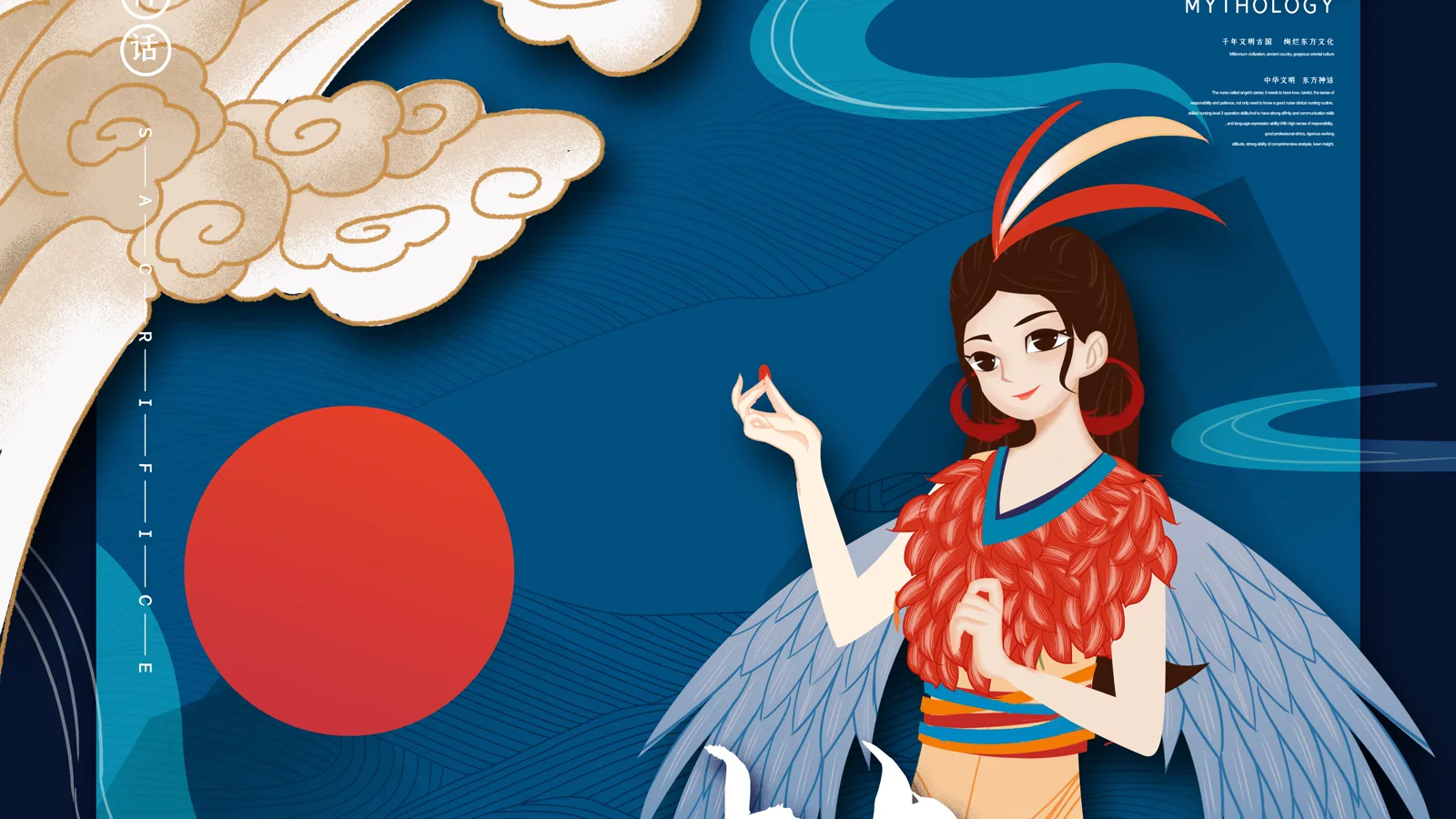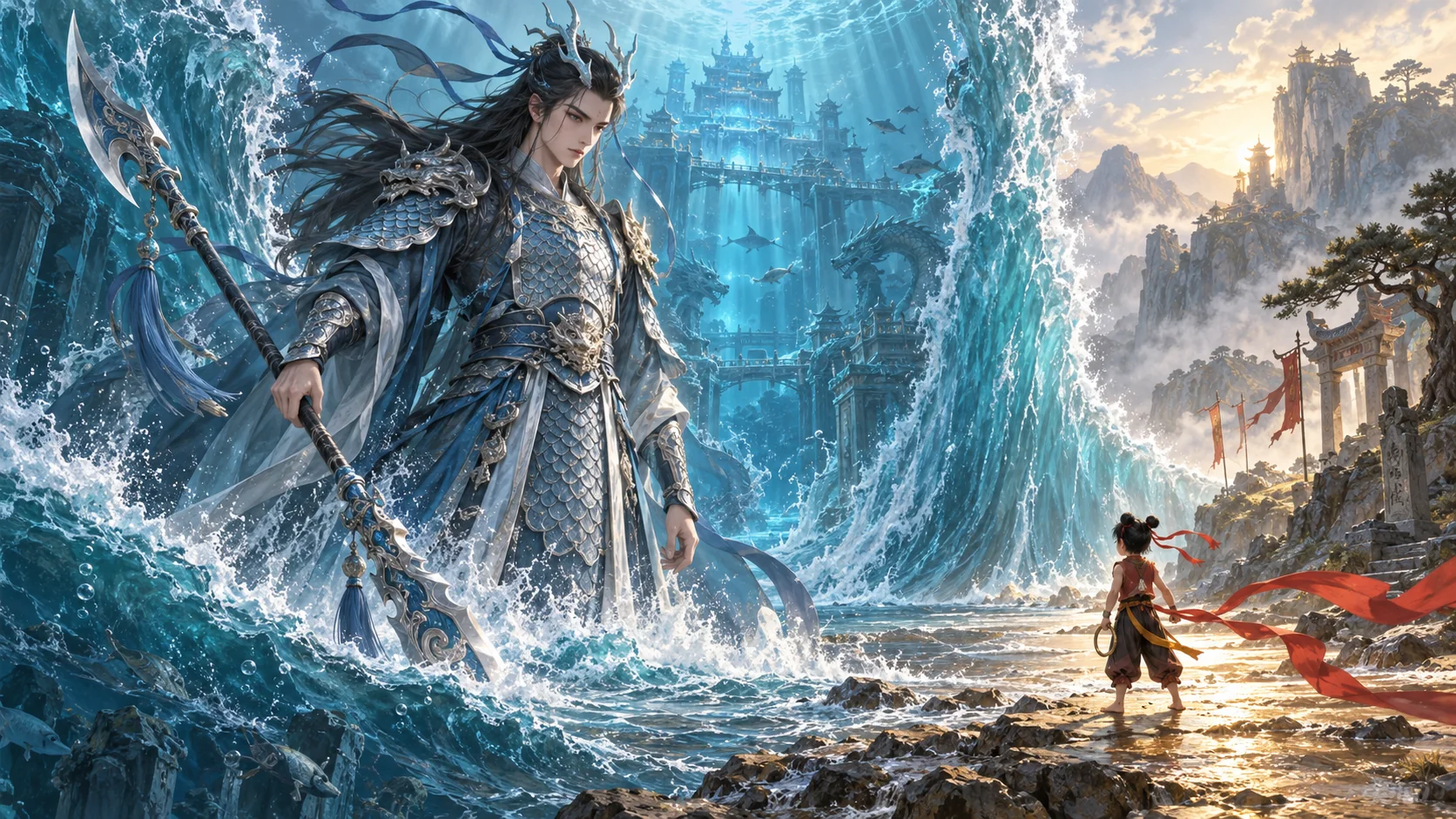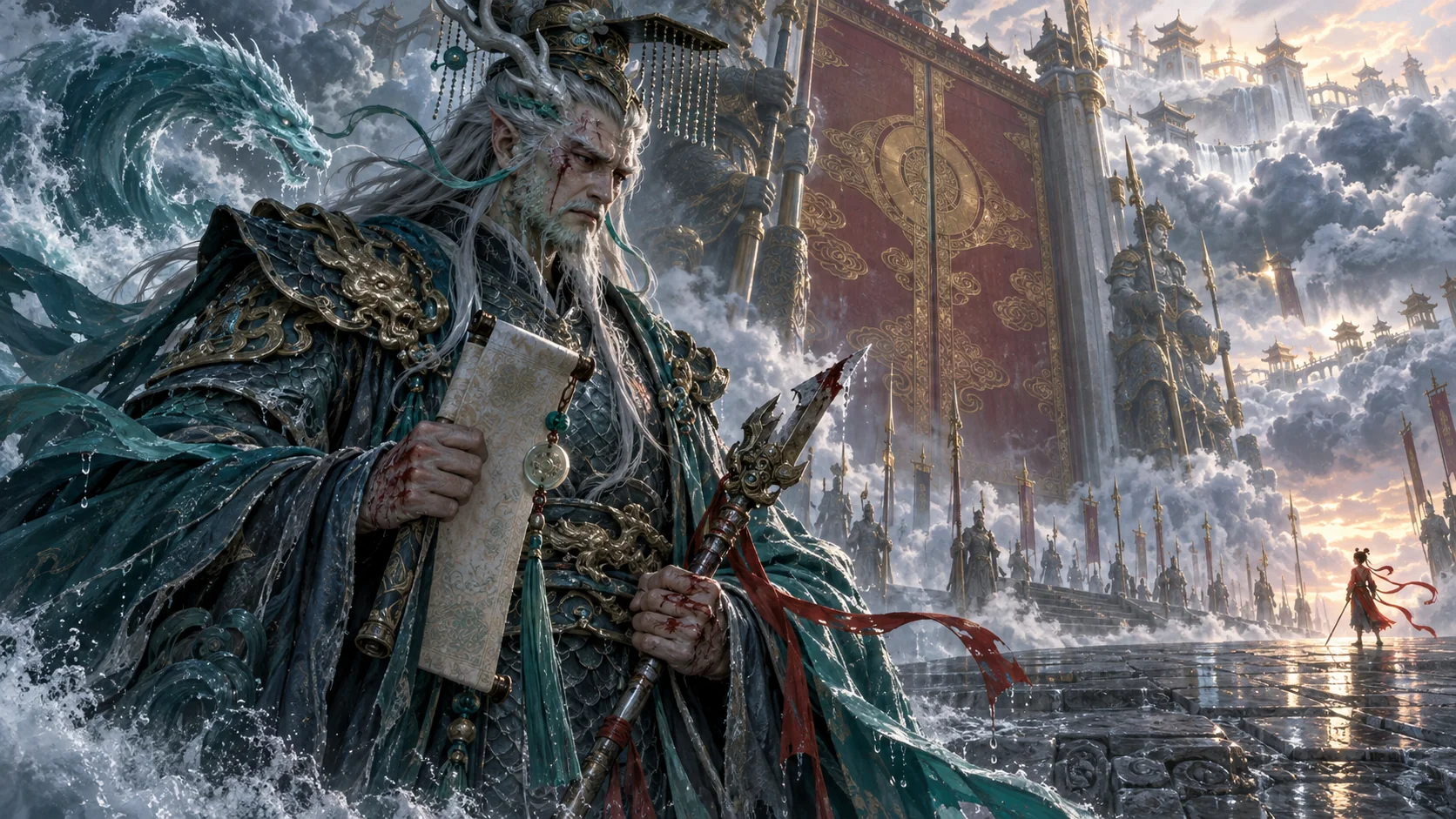
Chinese mythology gods do not form one stable pantheon. The useful map has several overlapping layers: early mythic figures, Daoist deities, Buddhist figures in Chinese life, local and occupational gods, ancestors and literary characters who became culturally or religiously active. If a chart puts everyone under one CEO without naming its source, it is attractive misinformation.
Chinese mythology gods: start with four questions
Before asking what a deity controls, ask:
- Where does this figure appear? An early text, Daoist ritual, Buddhist scripture, local temple, household practice, novel, opera or game?
- What does the figure do there? Create, protect, judge, heal, teach, report, bless, punish or carry a story?
- Who relates to the figure? A religious community, locality, profession, family or audience?
- Does the image belong to the same period as the claim? A Ming sculpture cannot prove a deity looked that way in antiquity.
These questions sound slower than a ranking list. They are much faster than unlearning a false one.
I understand why readers want a relationship map, a ranking and a clear answer to “who is strongest?” People need an entrance into a crowded divine world. My objection is to the false family tree that makes the entrance look like the whole building.
I reject any chart that makes Guanyin, Nüwa, Mazu and the Jade Emperor employees of one permanent heavenly corporation. I insist on keeping the overlaps and contradictions visible because they record something a neat list destroys: Chinese people met divine figures through different coasts, trades, households, temples, books and emergencies. The apparent mess is not failed organization. It is the evidence of lived religion.
Gate one: mythic makers and repairers
Nüwa, Fuxi, Shennong and Yu the Great are often called gods in English lists. “Mythic or culture hero” is frequently more precise.
Nüwa makes humans in some traditions and repairs the sky in another. Fuxi becomes attached to foundational skills and forms of order. Shennong embodies agricultural and medicinal knowledge. Yu directs the flood and becomes linked to political legitimacy.
Their stories answer civilizational questions: how did humans arrive, how did the broken world continue, where did crucial knowledge come from, and why does political order deserve trust?
They do not require one heavenly employment contract.
The dedicated Nüwa guide separates clay creation, cosmic repair and later paired imagery with Fuxi. Use that page for her stories; keep this one as the map.
Gate two: celestial administration
The Jade Emperor is the most recognizable administrator of heaven. City gods govern and judge within local jurisdictions. The Kitchen God enters household life and, in popular accounts, reports on family conduct. Star deities connect bodies, time, fate and celestial pattern.
This is where bureaucratic metaphor becomes genuinely useful. A jurisdiction explains why a deity matters without requiring that deity to be the creator of everything.
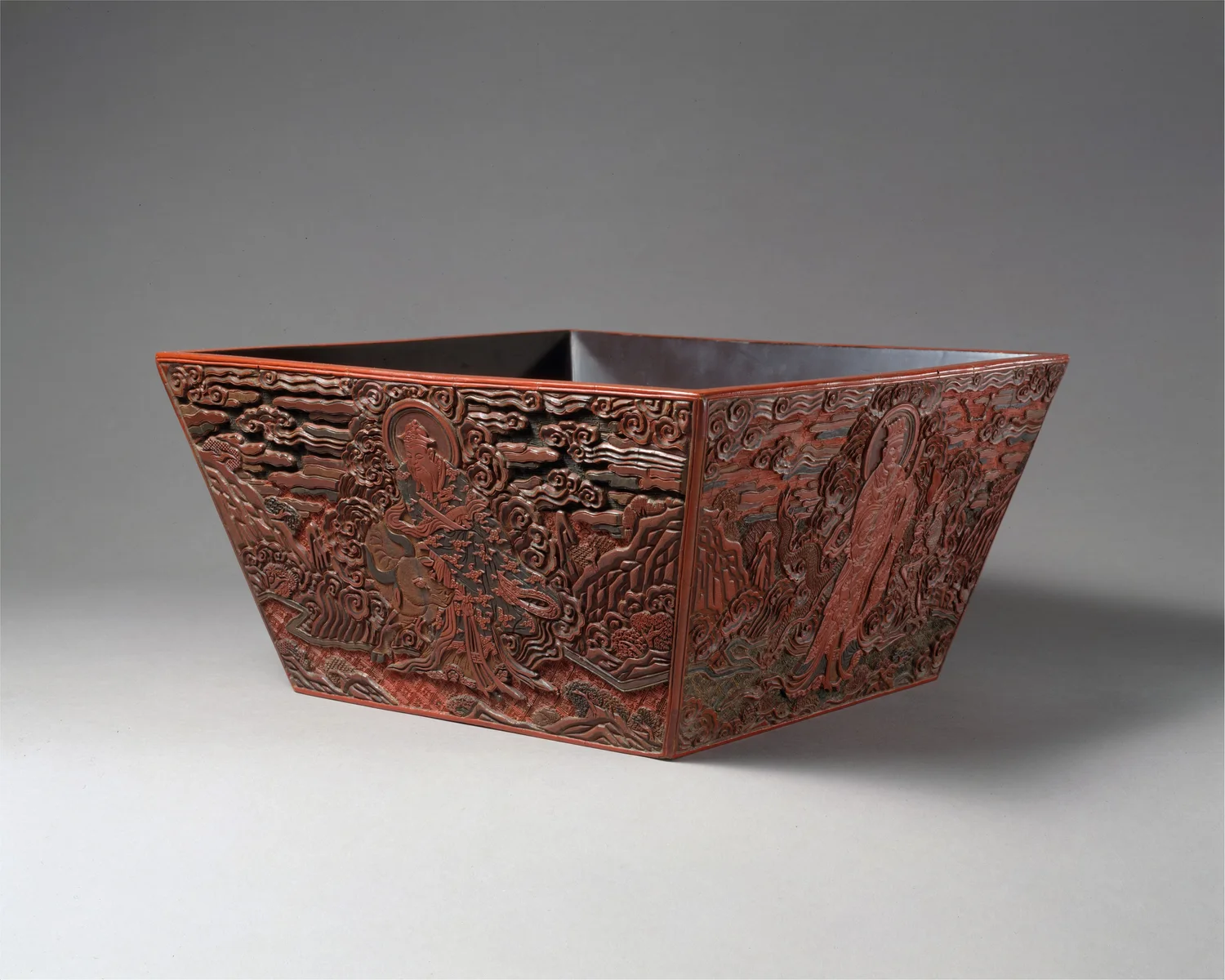
The Met identifies this 16th-century lacquer rice measure and its four constellation deities. A practical measuring object carrying celestial figures is the point: divine order is not isolated from material life.
The Jade Emperor guide explains why “presides over heaven” is not the same as “single supreme creator.” It also untangles his fictional relationships with Buddha and the Queen Mother of the West.
Gate three: Daoist divine worlds
Daoism is not just philosophy plus a few immortals. Religious Daoist traditions developed ritual lineages, revelations, sacred mountains, priests, cosmic registers and changing divine assemblies.
Zhenwu, the Perfected Warrior, is a strong example. His identity becomes associated with the north, martial protection and Wudang. In art he may appear with loose hair and bare feet, accompanied by tortoise and snake imagery.

The Met object securely identifies a 17th-century representation of Zhenwu. It shows how porcelain makes a divine grouping portable and visible; it does not prove one origin story or every ritual meaning.
Kui Xing offers a completely different divine body. Associated with examinations and literary success, he is often shown in a dynamic, contorted pose related visually and linguistically to the Big Dipper.

This is not a generic demon. The Met identifies the figure as Kui Xing. Context changes the reading from “monster” to embodied literary aspiration.
That is why image-only deity lists fail. Without name, object record and function, unusual posture becomes exotic decoration.
Gate four: Buddhist figures in Chinese life
Guanyin is one of the most loved divine figures in Chinese religious culture, but calling Guanyin an originally Chinese mythology goddess erases the figure's Buddhist identity and transregional history.
Guanyin is the Chinese form of Avalokiteshvara, the bodhisattva of compassion. Across time, Chinese representations moved through different gendered appearances and local stories. The figure became deeply Chinese without becoming proof that every Chinese deity has the same origin.

The damaged body is valuable evidence. The Met's careful “probably” preserves scholarly uncertainty instead of forcing identification for a cleaner caption.
That word - probably - is an editorial model. When an institution cannot securely name an object, East Moment should not become more certain because certainty sounds better in a title.
Gate five: local, maritime, occupational and household gods
Mazu cannot be understood as merely “another goddess.” Her maritime protection is tied to coastal communities, migration networks and seafaring risk. City gods take shape through locality. Door gods live at thresholds. Caishen gathers changing ideas of wealth. Lu Ban is important through crafts and trades.
Local specificity is not a lower tier beneath cosmic theology. It is often where divine relationships become most intimate.
A fisherman asking Mazu for protection and a student asking Kui Xing for examination success are not choosing two skins for the same game mechanic. Each relationship carries a different social world.
Gate six: literary characters who escaped their books
Sun Wukong and Nezha are the dangerous cases for any taxonomy because literature, performance and worship do not stay separated.
The Monkey King's globally familiar personality is inseparable from Journey to the West, yet his cultural life exceeds silent reading. Nezha draws from religious formation, Ming fiction, temple worship, opera, animation and film. Calling either “just fictional” is as flattening as calling every version an ancient god.
The Ne Zha mythology guide follows those layers without inventing one original screenplay. The Creation of the Gods film guide owns one contemporary adaptation and its father-son politics.
A working map of major Chinese gods and divine figures
| Figure | Best first category | What to notice | Common mistake |
|---|---|---|---|
| Nüwa | Mythic creator and repairer | Clay, colored stones, paired imagery | Treating one story as China's only creation account |
| Jade Emperor | Celestial sovereign | Administration, petition, order | Calling him the sole Chinese creator god |
| Guanyin | Buddhist bodhisattva in Chinese life | Compassion, changing iconography | Erasing Buddhist transmission |
| Zhenwu | Daoist deity | North, martial protection, Wudang | Reading one image as a generic warrior |
| Mazu | Maritime goddess | Coast, migration, dangerous travel | Detaching her from communities of the sea |
| City God | Local administrative deity | Jurisdiction and civic identity | Assuming every city has the same story |
| Kitchen God | Household deity | Domestic ethics and reporting | Treating humorous tales as one doctrine |
| Kui Xing | Examination and literary deity | Stars, writing, aspiration | Calling his dynamic body demonic |
| Xiwangmu | Queen Mother of the West | Immortality, western paradise, peaches | Reducing her to the Jade Emperor's wife |
| Nezha | Religious and literary child deity | Family debt, rebirth, weapons, motion | Treating the 2019 film plot as ancient canon |
The East Moment rule: provenance before power
If a page tells you “the twelve main Chinese gods,” check what was excluded to make the number work. If it presents a complete family tree, ask which text supplies the marriages. If it gives a power ranking, ask whether the comparison comes from ritual, scripture, a novel or fan debate.
The Met's Daoism essay and object records model the better approach: identify the work, period, material and religious context before announcing meaning.
My conclusion is not that Chinese divine worlds are too complicated to explain. They become explainable when we stop demanding that they behave like one franchise.
Continue through the Chinese mythology pillar, then use the creatures field guide to keep deities, animals, monsters and motifs from collapsing into one “mythological beings” bucket.
For a visual index organized around named divine figures rather than a fabricated pantheon ranking, open XianLore's Chinese gods and goddesses guide.
In the comments, name the deity you have never known how to categorize and the source that introduced them. Then bring the object, temple, passage or screen scene to the East Moment community so the map grows through provenance rather than confident repetition.
Chinese gods form a network of relationships, not one official cast list
English searches often ask for “the Chinese gods” as though one stable pantheon could be arranged like a film franchise. Chinese religious life is messier and more alive. Deities move across Daoist institutions, Buddhist traditions, local temples, family practice, literature and regional history.
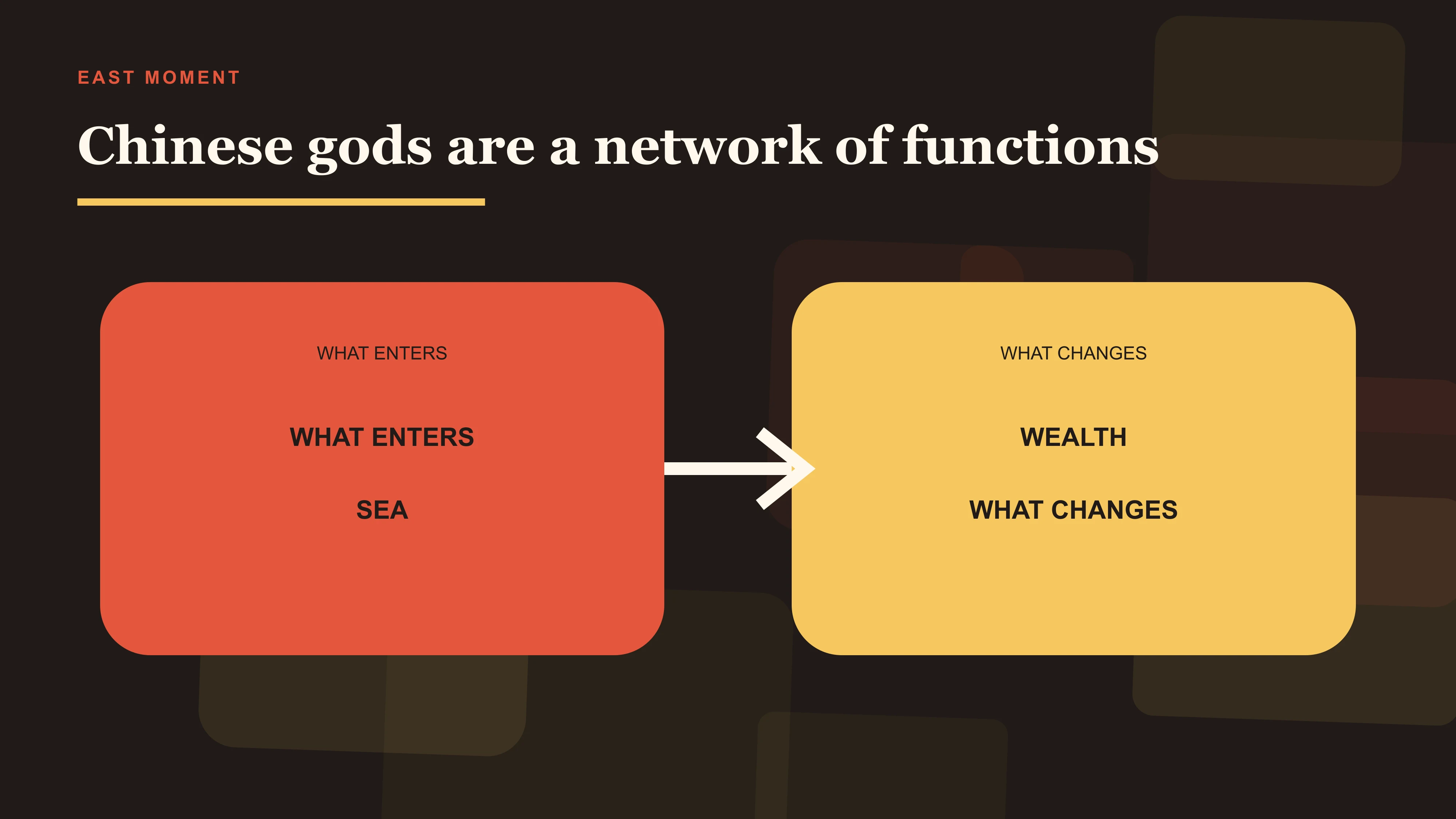
Function is the best first route. Mazu becomes meaningful through sea travel and coastal community; Caishen through wealth rites and New Year imagery; Guanyin through Buddhist compassion and changing Chinese forms; Kui Xing through examination culture. A name should lead to a relationship and practice, not a collectible power ranking.
Identity follows attributes and context
Crown, weapon, animal, attendant, inscription and altar position help identify a figure. Costume resemblance is not enough. The same deity may have multiple forms, while different figures may share robes or seated postures.
Myth, worship and literature are separate evidence layers
A novel can popularise a god without defining temple practice. A temple can worship a figure differently from a television drama. A museum object can establish date and iconography but not tell us what every contemporary devotee believes.
The British Museum collection and other institutional catalogues help verify specific objects. Living practice needs temple and community sources.
My judgment is simple: learn Chinese gods by what relationships they organise—sea, household, illness, examination, locality—then follow names. The network respects difference and makes the page useful without pretending one chart governs all China.
Syncretism is not confusion
A devotee can visit a Buddhist temple, recognise a Daoist festival and maintain a local household practice without experiencing the categories as mutually exclusive memberships. Western survey questions often expect one religious identity; lived practice may be organised by occasion and relationship.
That does not mean every difference disappears. Institutions have texts, clergy, lineages and rules. The point is to avoid forcing a single-choice model onto a plural field.
A deity page must identify the scale
Some figures travel across regions and media. Others remain tied to a town, trade, mountain or ancestral story. Search demand favours famous names, but local scale is not lesser cultural value.
A useful entry should state where the evidence comes from: an altar, a dated object, a ritual, a novel or an interview. Then it should refuse to make that source universal.
Images need names before interpretations
Do not begin with “this looks like the god of war.” Begin with the museum title or temple inscription. Then examine weapon, posture, face, attendants and location. Identification is a chain of evidence.
This method slows the first caption and prevents a much larger error. It also lets readers compare figures without turning them into a fantasy ranking. Power in worship is relational: protection for whom, in what place, through which practice?
That question is the compass for the entire mythology cluster.
For the figure many families recognize immediately, continue to the Guanyin guide. It keeps Buddhist iconography, household memory, porcelain and popular storytelling in view without assuming that every home image proves a religious identity.