Nuwa is often introduced as the Chinese goddess who created humanity. That is true inside an important group of stories, but it is not the reason I find her unforgettable. Her strongest image comes after creation fails to stay safe: the sky breaks, fire and flood spread, and Nüwa gathers materials to repair a world she did not promise would remain perfect.
Who is Nuwa in Chinese mythology?
Nüwa (女娲) is an ancient Chinese mythic figure associated with the creation of human beings, the repair of heaven and, in later visual traditions, a paired civilizing order with Fuxi. She appears through multiple texts and images rather than one complete authorized biography.
That last sentence matters. Search results often splice together every known detail and call the result “the original story.” Myth does not work like a character database.
The Chinese Text Project's Huainanzi provides a responsible route into early textual material, including the famous repair of the broken sky. It does not give us a modern novelistic Nüwa with one psychology, childhood and timeline.
Three objects offer a better way into her changing meanings: clay, five-colored stones and the measuring tools held with Fuxi.
Calling Nüwa a “goddess” is a useful English doorway, but it can quietly import the wrong building. She is not one department head inside a single Chinese Olympus. Her stories and images are older, later, textual, local and devotional in different combinations. She can appear as creator, repairer, paired culture figure and worshipped Niangniang without every version supplying the same family tree or heavenly rank.
I insist on this distinction because a tidy pantheon makes Nüwa smaller. Her authority does not come from winning an office beneath the Jade Emperor. It comes from being present at the level where human life, cosmic support and social order are still being made possible.
First object: clay, because humans begin close to the ground
In widely told creation stories, Nüwa shapes human beings from yellow earth or clay. A later social distinction sometimes appears: carefully formed figures become elites, while droplets or clumps produced more quickly become ordinary people.
That hierarchy should not be repeated as timeless Chinese social truth. It is one narrative explanation carried by particular retellings.
What survives emotionally is the material choice. Humans are not carved from flawless crystal. They come from wet earth touched into form.
Clay is vulnerable, local and repairable. It cracks. It can be reshaped. It holds fingerprints.
This is why I resist describing Nüwa only as an all-powerful mother goddess. The story's intimacy comes from scale: a cosmic figure bends down to ordinary material.
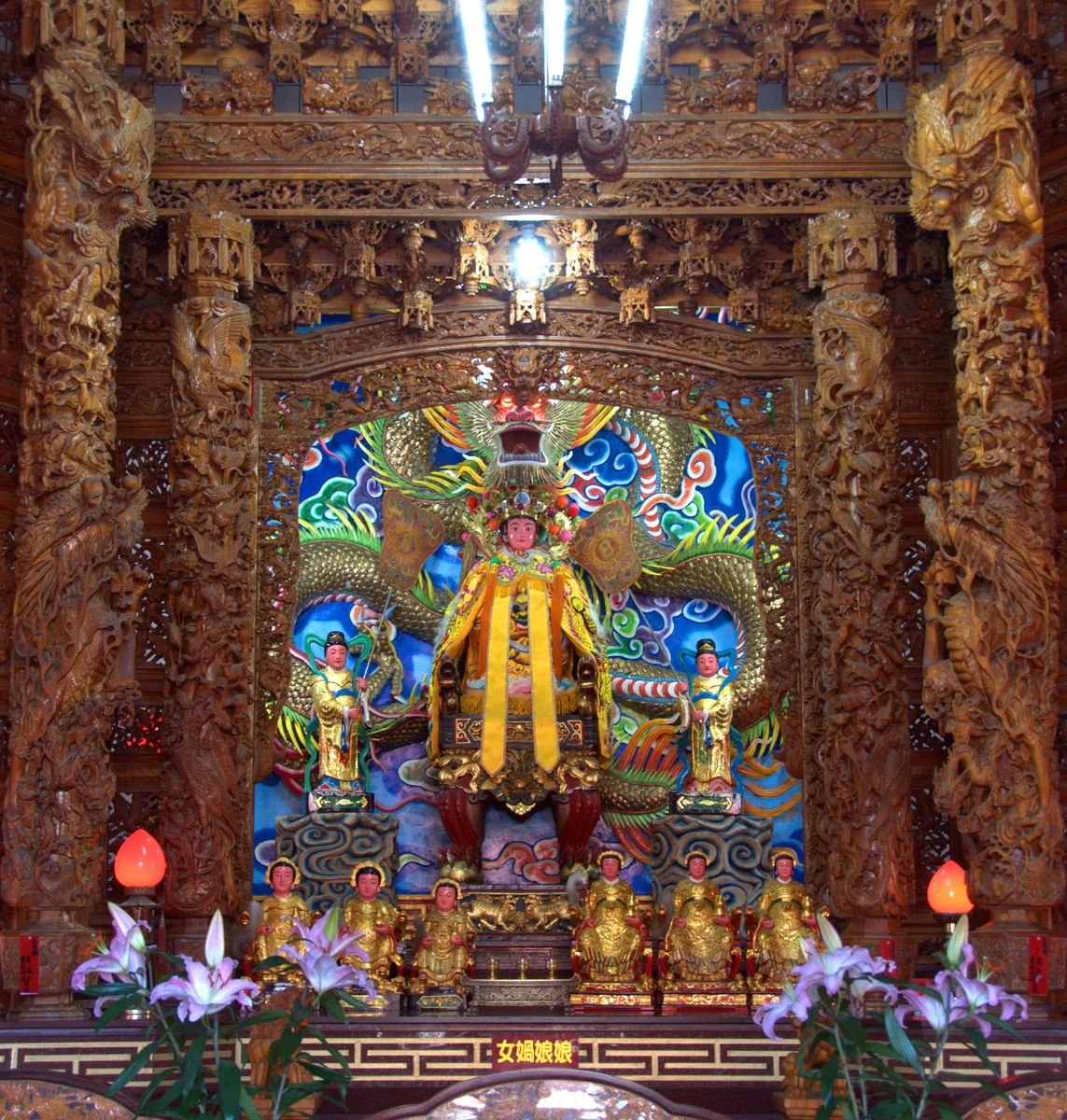
The altar above does not reproduce an ancient description. It proves something different and equally important: one community still gives Nüwa a present devotional body, surrounds her with attendants and names her Nüwa Niangniang. Mythology is not only what survives in translation. It is also what people continue to place, address and care for.
Second object: five-colored stones, because creation is not the final job
The repair story begins with catastrophe. The pillars supporting heaven fail; the sky is damaged; destructive fire and water threaten the inhabited world. Nüwa melts five-colored stones to mend heaven, uses the legs of a great turtle as supports and restores conditions in which life can continue.
The sequence matters more than the special effects. The Huainanzi account does not give Nüwa one magic gesture that resets the universe. Materials answer different failures: colored stones mend the sky, supports re-establish the directions, and reed ash checks the uncontrolled water. The world is repaired as a system. This is not the fantasy of pressing one glowing button. It is diagnosis followed by several kinds of labor.
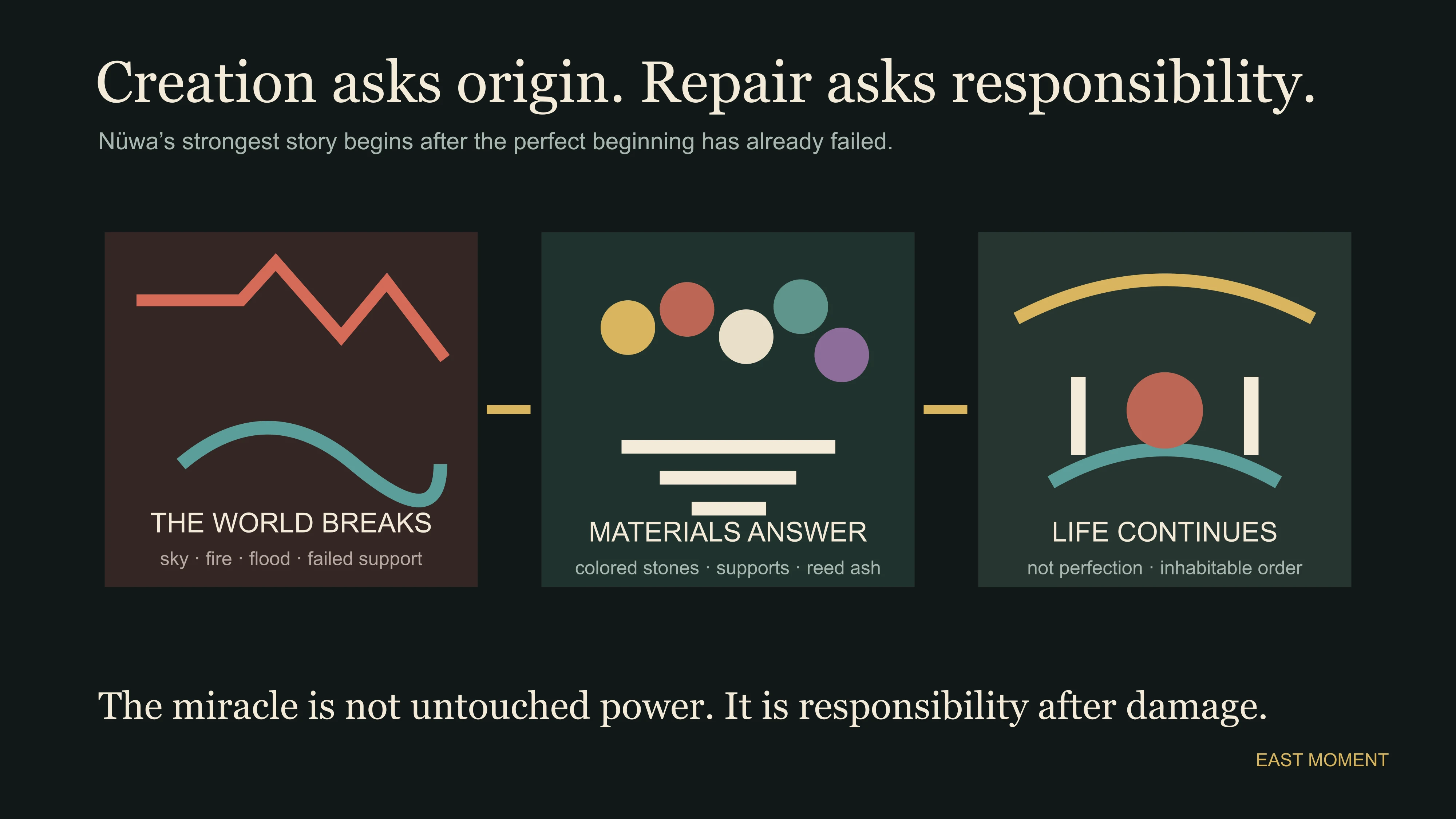
Read the repair as matched labor, not one glowing spell: damage to sky, support and water receives different material answers. The diagram is an East Moment interpretation of the sequence, not archaeological evidence or a claim that every retelling uses identical steps.
I reject the viral urge to turn colored stones into lost technology, the turtle into machinery or a damaged sky into proof of alien intervention. Those theories sound respectful because they insist the story “really happened,” but they actually distrust mythology. They cannot accept that an image can carry civilizational thought unless it is disguised engineering documentation.
Nüwa does not need fake archaeology. The emotional fact is already enormous: power is measured by willingness to remain after catastrophe.
My reading is direct: Nüwa matters because maintenance becomes divine work. Hero stories love a clean victory. Repair is messier. It starts after somebody else's violence, accepts damaged materials and produces a world that can continue rather than a world that was never hurt.
That is a powerful myth for people inheriting climate pressure, exhausted institutions and technology they did not design. “Repair the sky” is not passive hope. It is responsibility without the comfort of innocence.
Creation gives prestige to the first designer. Repair gives responsibility to the person who sees failure clearly and refuses abandonment. I find the second role harder and more honorable. A creator can leave after the launch. A repairer must understand stress, shortage, consequence and the lives depending on an imperfect structure.
That is why Nüwa feels contemporary without being forced into a motivational slogan. The myth does not promise that care prevents every break. It says care becomes most visible when prevention has already failed.
Third object: compass and square, because Nüwa changes beside Fuxi
Historical images often pair Nüwa and Fuxi with intertwined serpent-like bodies. They may hold instruments interpreted as a compass and carpenter's square, connecting the pair with cosmic and civilizational order.

The paired bodies and raised instruments are visible evidence of one historical iconographic tradition. The image does not prove that every creation story originally featured the couple together.
This Nüwa is not alone with clay or stones. She participates in paired order: circular and square, heaven and earth, complementary bodies, cosmic measurement.
Modern viewers often jump immediately to “husband and wife” or “brother and sister.” Some textual and regional traditions do frame the pair through marriage or sibling relations. The image itself cannot settle every genealogy.
The better question is what pairing accomplishes. It converts creation from one miraculous act into pattern, relation and continuity.
The compass-and-square imagery also changes how we read authority. Nüwa and Fuxi are not simply posing as a romantic couple for modern viewers to classify. The tools place order in their hands. Bodies intertwine while instruments distinguish curve and line, relation and measure. Whether a particular object emphasizes kinship, cosmic pairing or civilizational order depends on its date and context, but the visual argument is never merely decorative.
This is where I become impatient with character cards that reduce Nüwa to “element: earth” or “power: creation.” Clay, stones and measuring tools are not three accessories from one costume pack. Each object belongs to a different question: What are humans made from? Who repairs cosmic damage? How does a world acquire pattern?
Nuwa is not Jingwei - English spelling creates a trap
One early story in the Classic of Mountains and Seas names the drowned daughter of the Yan Emperor as 女娃, often romanized Nüwa or translated as “the girl.” She becomes the bird Jingwei and repeatedly carries twigs and stones to fill the sea.
The creator-repairer Nüwa is 女娲.
Same-looking English spelling, different Chinese characters, different figures.
This is not a tiny scholarly footnote. It demonstrates why an English mythology page needs Chinese names. Without them, a reader can accidentally merge cosmic repair with a bird's impossible revenge against the sea.
Both stories value persistence, but they do not share one identity.
Was Nuwa a real queen, tribe or alien engineer?
There is no accountable evidence allowing East Moment to present those claims as fact.
Myths can preserve memories of environment, kinship, migration, technology and social order. That possibility invites research. It does not authorize a viral post to point at one motif and announce a lost civilization.
A temple statue proves worship or representation in a particular place and time. An excavated painting proves an image existed in its archaeological context. A transmitted text proves wording was preserved through a textual history. None of those alone proves that Nüwa was a documentable individual who physically repaired the atmosphere.

The Macau statue gives the myth a local devotional presence. It cannot be backdated into the appearance of an ancient person.
The desire to say “the myth was real” often comes from respect. People fear that calling something myth means calling it childish or false.
That fear is unnecessary. A story can be culturally true - capable of organizing values, rituals and imagination - without becoming a disguised lab report.
How Nuwa's image keeps changing
The 1922 English-language book Myths and Legends of China included an illustration titled “Nü Kua Shih.” It belongs to a modern publishing moment shaped by older Western romanization and explanatory habits.
That publishing history is part of the evidence, not background clutter. The Library of Congress Chinese Rare Book Collection preserves Chinese printed works across dynasties and subjects, making one point impossible to ignore: stories reach us through editions, illustrations and cataloguing choices. A late printed Nüwa can show how one era pictured her; it cannot climb backward through time and become her original face.

This image is evidence of how Nüwa was presented to English readers in 1922, not evidence of her ancient appearance. The source is useful partly because its age and limitations are visible.
Contemporary animation and games often emphasize a grand mother goddess, serpent body, colored stones or magical technology. Those choices can be excellent design. Each one selects a layer.
The responsible question is never “Is this the real Nüwa?” It is “Which inherited signs did this version choose, and what new problem does it make her solve?”
How to identify a Nuwa image without pretending certainty
Begin with the label supplied by the temple, museum, book or creator. Then look for a human upper body joined to a serpent-like lower body, paired presentation with Fuxi, measuring instruments, colored stones or an explicit repair scene. None of those signs alone is a universal password. A serpent body can belong to other figures; a beautiful woman holding a gem can be an entirely modern fantasy design.
The decisive evidence is the relationship among image, name and context. A named temple altar can prove a living devotional identification. A museum record can secure an object's date, material and catalogued subject. A 1922 book can prove what English readers were shown in 1922. A game design can prove what one studio chose. This discipline does not kill imagination. It prevents one attractive image from rewriting two thousand years of difference.
The Nuwa reading route
| If you want | Start with | Watch for |
|---|---|---|
| The strongest myth | Repair of heaven in Huainanzi traditions | Materials, sequence and restored limits |
| Human creation | Clay-making accounts | How different retellings handle class and labor |
| Historical imagery | Paired Fuxi-Nüwa paintings | Bodies, tools and cosmic order |
| Living presence | A named Nüwa temple | Local title, altar neighbors and ritual context |
| Modern adaptation | Animation or game version | Which layer is kept and which personality is invented |
My verdict is that “Chinese creator goddess” is an accurate search answer and an incomplete cultural answer. Nüwa's greater gift is not making a perfect humanity. It is showing that the person who repairs a damaged world may matter more than the person who claims to have designed it.
Continue through the Chinese mythology pillar, compare Nüwa's pre-bureaucratic authority with the Jade Emperor, or use the Chinese mythology gods map to keep creator, deity, culture hero and literary character distinct.
In the comments, tell us whether clay, colored stones or the paired instruments change how you understand Nüwa. Then bring the exact image or story version to the East Moment community so interpretation can remain emotional without becoming fake archaeology.