Creation of the Gods is worth watching because it makes Chinese myth physical before it makes it spectacular. Young men train, kneel, ride, bleed and learn to call a ruler “father”; bronze-colored halls turn family obedience into state power. The gods and monsters matter, but Part I lives or dies with Ji Fa recognizing that Yin Shou's version of fatherhood consumes sons. Watch it for that political coming-of-age story, not as a Chinese copy of a Hollywood superhero team.
Creation of the Gods in 60 seconds
| Question | Short answer |
|---|---|
| Full English title | Creation of the Gods I: Kingdom of Storms |
| Chinese title | Fengshen Diyi Bu: Chaoge Fengyun (封神第一部:朝歌风云) |
| Director | Wuershan |
| Release | 2023; Well Go USA lists a September 22, 2023 US release. |
| Main cast | Yu Shi as Ji Fa, Kris Phillips / Fei Xiang as Yin Shou, Naran as Daji, Li Xuejian as Ji Chang, Huang Bo as Jiang Ziya and Chen Muchi as Yin Jiao. |
| Basic plot | A warrior king seizes power with a fox demon beside him while Ji Fa, raised among hostage princes at court, begins to see what his adopted loyalty costs. |
| Is it historical? | No. It uses historical names and dynastic transition inside a mythic-literary adaptation shaped strongly by Fengshen Yanyi. |
| Is it the whole story? | No. It is Part I of a trilogy project. Part II received a US release in 2025; no Part III date is asserted here. |
| East Moment verdict | Watch it. The bodies, objects and father-son conflict give the myth weight; some creature spectacle is less emotionally precise. |
The official Well Go USA page securely identifies Wuershan, the listed cast, US release date and distributor synopsis. Its marketing cannot prove historical reconstruction, audience consensus or the quality of the complete film.
First, forget “Chinese Avengers”
That comparison feels efficient because the film has gods, a magic object, multiple heroes and a planned series. It also sends attention in the wrong direction.
The film is not introducing independent superpowers who will later assemble. It is reorganizing a dense story world of kingship, kinship, heavenly mandate, demons, immortals and named figures inherited through literature, opera, storytelling, television and popular worship.
The important object, the Fengshen Bang or Investiture list, does not simply grant power. It is tied to cosmic and political legitimacy. The conflict is not “which hero is strongest?” It is who is fit to hold order when family and state have both become predatory?
Use the Chinese mythology guide for the larger distinction between early textual fragments, later literary systems and living popular traditions. A film adaptation does not represent one frozen, universally agreed mythology.
The hostage princes give Creation of the Gods its body
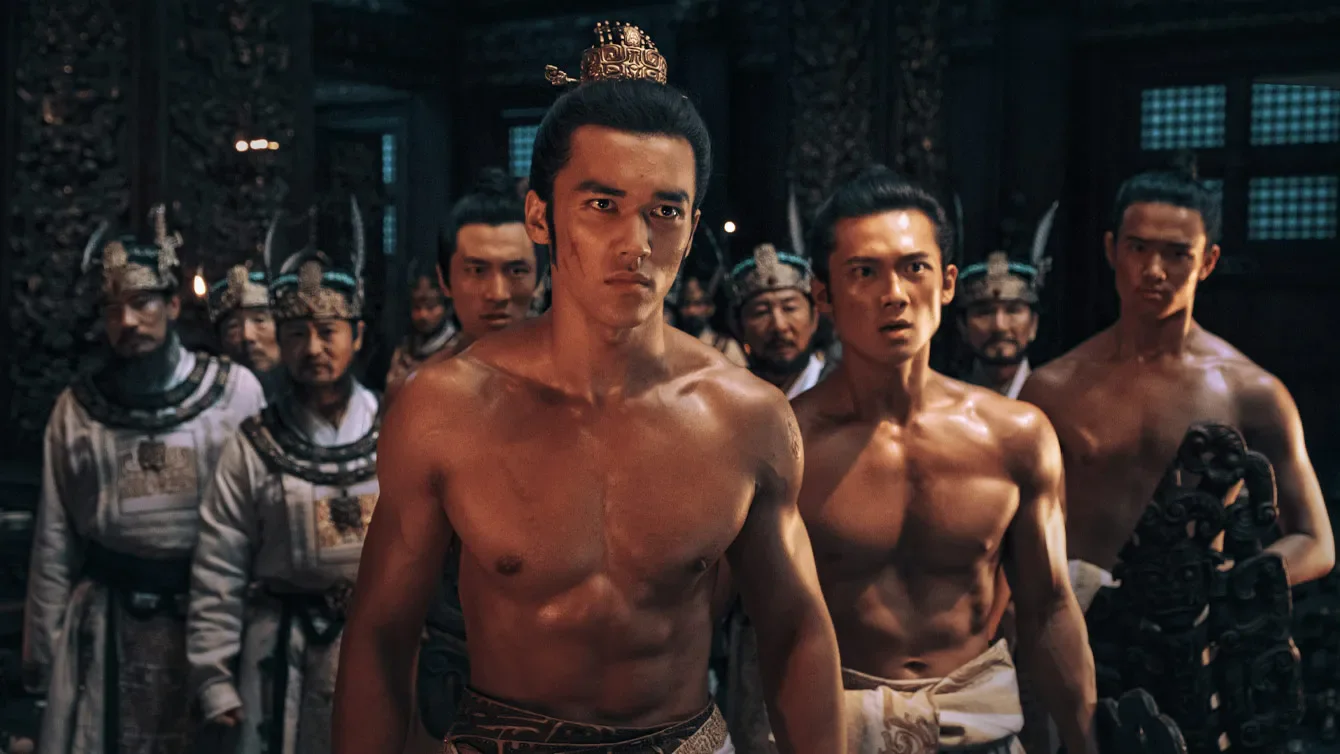
Watch the hostage princes stand together after physical training in a Well Go USA official still Well Go USA's still identifies the trained ensemble and their physical presentation. It cannot prove ancient military practice or off-screen training claims by itself.
The film's smartest adaptation decision is the hostage-prince system.
Sons from the four cardinal regions are raised at the Shang court. They train together and learn to admire Yin Shou as commander, king and surrogate father. Their bodies show the institution before dialogue explains it: similar posture, similar exposure, similar readiness to answer an order.
This is why the much-discussed “hostage group” is not only casting spectacle. The physical sameness is political. A prince's body has been separated from his biological father and redesigned as proof of central authority.
I keep returning to the group's relationships, training and the moment each son faces his actual father. The film's bodies are family evidence, not merely muscle. Ji Fa's resistance to Yin Shou matters because intimate betrayal, rather than abstract tyranny, gives the conflict its hold.
My judgment is firm: the training works when it makes obedience visible. It becomes empty whenever the camera treats the body as a reward detached from that pressure.
Yin Shou turns charisma into a family weapon

Kris Phillips plays Yin Shou at a scale large enough to explain devotion. He looks like the strongest man in a world where strength appears to settle legitimacy. He can command a room, ride into danger and make young warriors feel chosen.
That is exactly why the betrayal works.
Yin Shou does not merely demand military obedience. He teaches the hostage princes to reinterpret violence against their fathers as proof of adulthood. He takes a private bond, empties it, then offers himself as the replacement.
The palace is therefore a family system enlarged into government. A ruler who consumes sons eventually consumes ministers, wife, brother and country under the same logic: proximity creates obligation, and obligation authorizes sacrifice.
I cannot watch Yin Shou ask whether he is satisfied with such a son without feeling the cost of his treatment of wife and family. The betrayal is intimate before it becomes political.
Ji Fa's story is not rebellion; it is recognition
Ji Fa does not begin as a secret revolutionary. He begins as somebody who believes the wrong father has made him valuable.
That makes his change more convincing. Each contradiction accumulates: Yin Shou says sons must transcend fathers, but protects his own power; he promises sacrifice, but redirects the cost; he calls violence duty, but duty always leaves him on the throne.
Ji Fa's most important ability is not combat. It is comparison. He can compare the father who trained his body with the father who recognizes his life.

This distributor still establishes the production's mass ritual and spatial hierarchy. It cannot verify Shang ritual, costume or architecture as archaeology.
The court makes obedience look enormous. Ji Chang makes care look small. That difference is the film's moral scale.
I agree that without Ji Chang the film could not fully become Fengshen. Its loudest world needs one man whose authority does not depend on consuming another body.
Ji Chang changes the meaning of fatherhood
The Ji Chang material is not sentimental relief from the “real” plot. It is the counter-government.
He does not defeat Yin Shou through a larger performance of masculinity. He recognizes, waits, suffers and preserves relation under humiliation. The famous food sequence is horrifying because political domination enters the body as forced consumption. Grief cannot remain private when the king controls what enters the mouth.
Ji Fa's return toward Ji Chang is therefore more than filial obedience. It is a choice between two models of power:
- One father says: prove you are mine by destroying where you came from.
- The other says: your life remains yours even when I cannot command the world around you.
That distinction gives the myth a human center no creature can replace.
Daji is desire, survival and a writing problem

Naran's Daji is not framed simply as the woman who corrupts an innocent king. The fox spirit recognizes a ruler whose desire and violence already make room for it.
That change matters. Blaming national collapse on one seductive woman is an old and convenient political story. The film gives Yin Shou agency in his own brutality.
Yet Daji remains less fully written than the father-son conflict. Her movement, gaze and animal alertness create presence; her access to motive and choice is narrower. The character is visually central but morally under-articulated.
This is where spectacle outruns clarity. A fox spirit can embody appetite, transformation, survival and danger. The film often prefers the quickest image among those possibilities.
Objects make the myth material

Well Go USA's still identifies the film's magical-object register. It cannot explain the complete literary history or prove one canonical design.
The production gives abstract authority handles, surfaces and weight. The Fengshen list must be carried and protected. Armor limits bodies. Gates determine access. Bows convert recognition into irreversible action. Food can be weaponized. A throne raises one man while making everyone else look arranged around him.
This material density is why I want to rewatch the film through objects and gestures. Not every detail is intentional, but the objects give the family conflict weight.
The deeper point survives: viewers want to rewatch the film through objects and gestures. That is a stronger foundation for a franchise than asking only which monster will be larger next time.
What comes from Fengshen Yanyi, and what did the movie change?
Fengshen Yanyi - often translated as Investiture of the Gods - is a large late-imperial novel that organizes older names, deities, legends and dynastic transition into an expansive narrative. The movie inherits major figures and the fall-of-Shang / rise-of-Zhou horizon, then compresses and reorganizes causality for a trilogy.
The hostage princes become a particularly strong cinematic spine. Ji Fa receives a modern coming-of-age arc with Yin Shou as admired commander and counterfeit father. Daji's relation to Yin Shou shifts responsibility away from a simple seductress explanation. Gods and immortals enter gradually so that human politics can establish weight first.
Do not use the movie to learn exactly what happened at the end of the Shang dynasty. Do not use one English translation of a name to assume a stable Western genre equivalent. And do not call every bronze-colored surface “historically accurate” because it feels ancient.
The adaptation deserves praise when invention clarifies a moral relationship. It deserves skepticism when designed antiquity is sold as evidence.
Creation of the Gods ending explained
Major spoilers begin here.
Ji Fa finally turns against Yin Shou, helps break the court's control and escapes toward Xiqi. Yin Shou appears defeated, but Daji uses supernatural power to restore him. The tyrant survives because the film has separated a human victory of recognition from the larger mythic war still to come.
Yin Jiao suffers catastrophic punishment, but Nezha and Yang Jian intervene and carry his body toward Kunlun, keeping another thread open. Jiang Ziya and the Fengshen mission move westward. The story has not completed the change of dynasty or the investiture of the gods.
The ending is satisfying at character scale: Ji Fa now sees. It is deliberately incomplete at cosmic scale: seeing is only the beginning of resistance.
What order should you watch the trilogy?
Watch in release order.
- Creation of the Gods I: Kingdom of Storms (2023)
- Creation of the Gods II: Demon Force (2025)
- Part III only after an accountable distributor or production source confirms its release
Well Go USA lists Part II with a January 31, 2025 US release. As of this page's August 15, 2026 review, East Moment is not asserting a Part III date.
That restraint matters. Planned-franchise language is not the same as a released film.
Final verdict
Watch Creation of the Gods I for the hostage princes, Yin Shou's counterfeit fatherhood, Ji Chang's quieter authority and the way objects make political myth tactile.
The creatures are not the main event. Whenever the film remembers that, it feels culturally specific and emotionally modern without begging comparison to Hollywood. Whenever it forgets, scale becomes noise.
For another modern myth adaptation, the Ne Zha 2 guide asks how assigned identity becomes an institutional conflict. Continue through the Chinese movies collection for film-first routes rather than a generic ranking.
In the comments, name the moment Ji Fa's idea of “father” changes. Then bring an exact gesture, object or subtitle choice to the East Moment community, where readers can compare the film with the novel, earlier screen versions and their own cultural memory without pretending there is only one canonical Fengshen.