My verdict on the Chinese zodiac: use it as a calendar before you use it as a personality test. The animal is memorable, but the year boundary and Earthly Branch are the structure. Get the birth date right first; enjoy personality and compatibility stories as folklore, not as measurements of a human being.
Chinese zodiac answer in 30 seconds
The twelve Chinese zodiac animals, in order, are Rat, Ox, Tiger, Rabbit, Dragon, Snake, Horse, Goat or Sheep, Monkey, Rooster, Dog and Pig. The cycle repeats every twelve years.
Three rules prevent nearly every common mistake:
- Do not change signs on January 1. Use the date of Chinese New Year for the relevant year.
- If you were born in January or early February, check your full birth date against an authoritative calendar.
- Do not confuse the annual animal with a complete Chinese astrology chart. A birth-year animal is one layer, not a full reading.
Our calculator uses published Chinese New Year dates for 1901–2100. It deliberately does not guess outside that range.
Chinese zodiac years, animals and Earthly Branches
The Chinese name shengxiao (生肖) refers to the birth-animal cycle. Each animal is paired with one of the twelve Earthly Branches, an older sequence used to organize time. This is why a serious zodiac table should show more than animal mascots.
| Order | Animal | Earthly Branch | Recent years | Common cultural association |
|---|---|---|---|---|
| 1 | Rat | 子, Zi | 1996, 2008, 2020, 2032 | Resourcefulness and adaptability |
| 2 | Ox | 丑, Chou | 1997, 2009, 2021, 2033 | Labor, steadiness and endurance |
| 3 | Tiger | 寅, Yin | 1998, 2010, 2022, 2034 | Courage, authority and protection |
| 4 | Rabbit | 卯, Mao | 1999, 2011, 2023, 2035 | Alertness, gentleness and social grace |
| 5 | Dragon | 辰, Chen | 2000, 2012, 2024, 2036 | Power, rain, transformation and auspice |
| 6 | Snake | 巳, Si | 2001, 2013, 2025, 2037 | Strategy, reserve and transformation |
| 7 | Horse | 午, Wu | 2002, 2014, 2026, 2038 | Movement, independence and vitality |
| 8 | Goat, Sheep or Ram | 未, Wei | 2003, 2015, 2027, 2039 | Care, artistry and sensitivity |
| 9 | Monkey | 申, Shen | 2004, 2016, 2028, 2040 | Intelligence, invention and mischief |
| 10 | Rooster | 酉, You | 2005, 2017, 2029, 2041 | Timing, confidence and directness |
| 11 | Dog | 戌, Xu | 2006, 2018, 2030, 2042 | Loyalty, vigilance and protection |
| 12 | Pig | 亥, Hai | 2007, 2019, 2031, 2043 | Abundance, generosity and ease |
The years in the table identify cycles, not January-to-December blocks. For example, the 2026 Horse year begins on February 17, 2026. Someone born on February 10, 2026 remains in the preceding Snake year under the Chinese New Year boundary.
For longer date ranges, use the Chinese zodiac years table. For a single birth date, use the Chinese zodiac calculator.
Original cultural asset: Chinese zodiac and Earthly Branches cycle
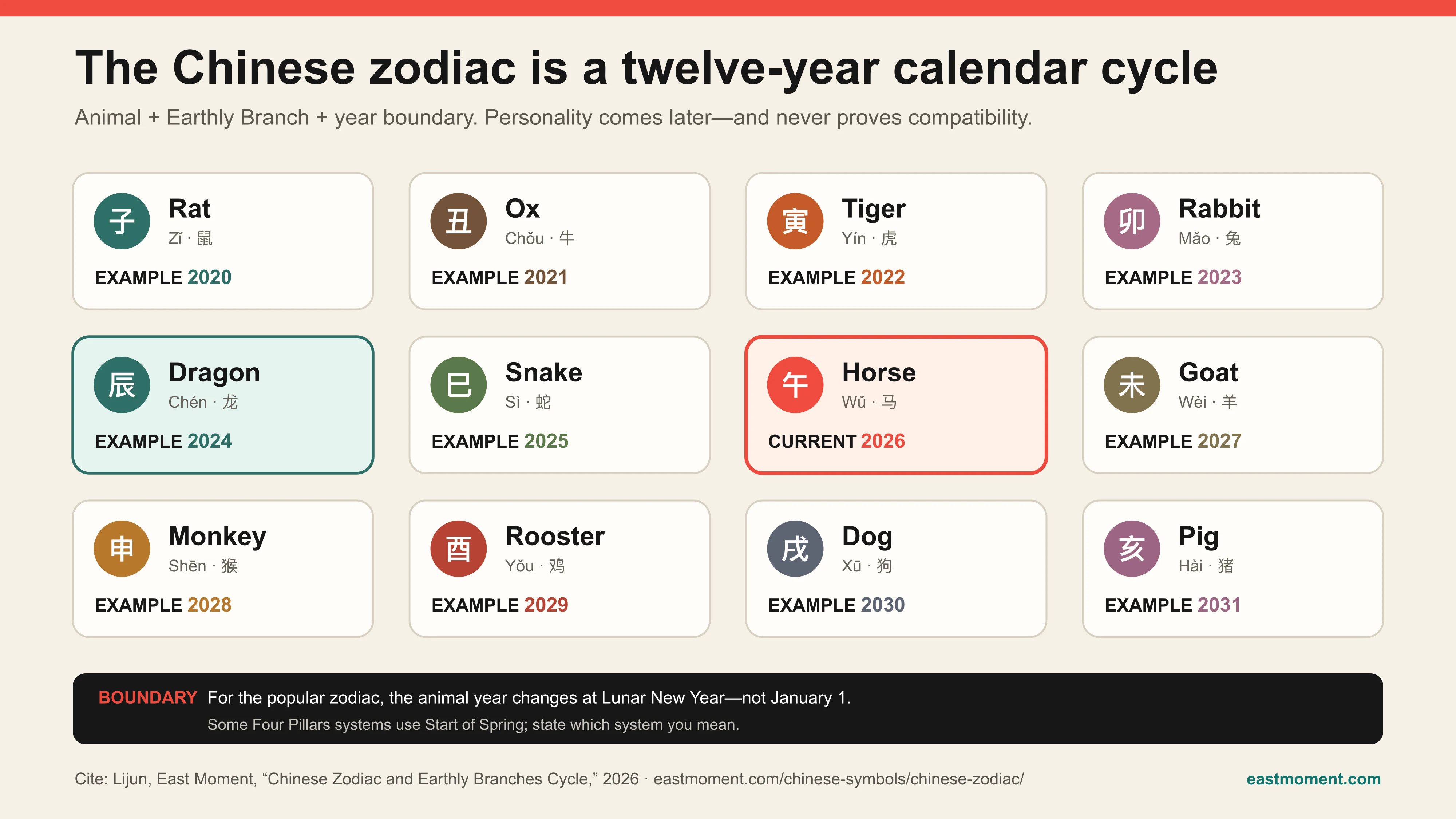
The chart keeps the three facts most quick zodiac graphics separate: cycle order, animal and Earthly Branch. The example years run from 2020 to 2031. For the popular zodiac, a year changes at Lunar New Year rather than January 1; Four Pillars traditions may use Start of Spring and must be labeled separately.
Download the high-resolution raster image · Download the structured CSV
Cite this asset: Lijun. “Chinese Zodiac and Earthly Branches Cycle.” East Moment, 2026.
https://eastmoment.com/chinese-symbols/chinese-zodiac/#user-content-original-cultural-asset-chinese-zodiac-and-earthly-branches-cycle
What the animal layer actually represents
The animals are memorable labels attached to the Earthly Branch sequence. Rat is the everyday animal 鼠, but its branch is 子. Ox is 牛, while its branch is 丑. The distinction matters because the branches also participate in systems for months and traditional two-hour periods.
The Hong Kong Observatory describes the ten Heavenly Stems and twelve Earthly Branches as the components of a sixty-term cycle. Pairing stems and branches in sequence produces sixty combinations before the same pairing returns. The twelve animals make one part of that timekeeping structure easy to recognize in public life.
This leads to a firm conclusion: the zodiac was not built as twelve modern personality profiles. Personality descriptions accumulated around animals whose primary role was to mark positions in a calendar cycle.
Look at 卯, 辰 and 巳 beside Rabbit, Dragon and Snake in the chart above. None of those branch characters is a drawing of the animal it names in the zodiac. If a design prints 辰 beside a dragon, it is showing the animal's place in a time sequence, not providing evidence about the temperament of someone born in that year. The difference seems small until a gift, museum label or search result quietly turns a calendar sign into a claim about a person.
What each group contributes to the system

The groupings organize branches; they do not prove that three strangers will share a temperament or become friends.
Short trait lists are popular, but visual and historical associations explain more than adjectives alone.
Rat, Ox and Tiger: resourcefulness, labor and protection
Rat begins the sequence. Popular interpretation emphasizes intelligence and adaptability, reinforced by Great Race stories in which Rat reaches first place through strategy rather than physical strength.
Ox carries the memory of agricultural labor. Its modern traits, such as patience and dependability, make more sense when connected to the practical importance of cattle in farming and transport.
Tiger is not merely “brave.” In Chinese material culture it can function as a protective image. Tiger hats, shoes and other children's objects use fierceness to guard a vulnerable wearer. That protective role gives the sign more cultural depth than a generic confidence label.
Rabbit, Dragon and Snake: alertness, cosmic power and change
Rabbit combines softness with speed and vigilance. The zodiac Rabbit may overlap visually with the Moon Rabbit in modern designs, but they are not the same system: one marks a branch of the zodiac and the other belongs to lunar mythology.
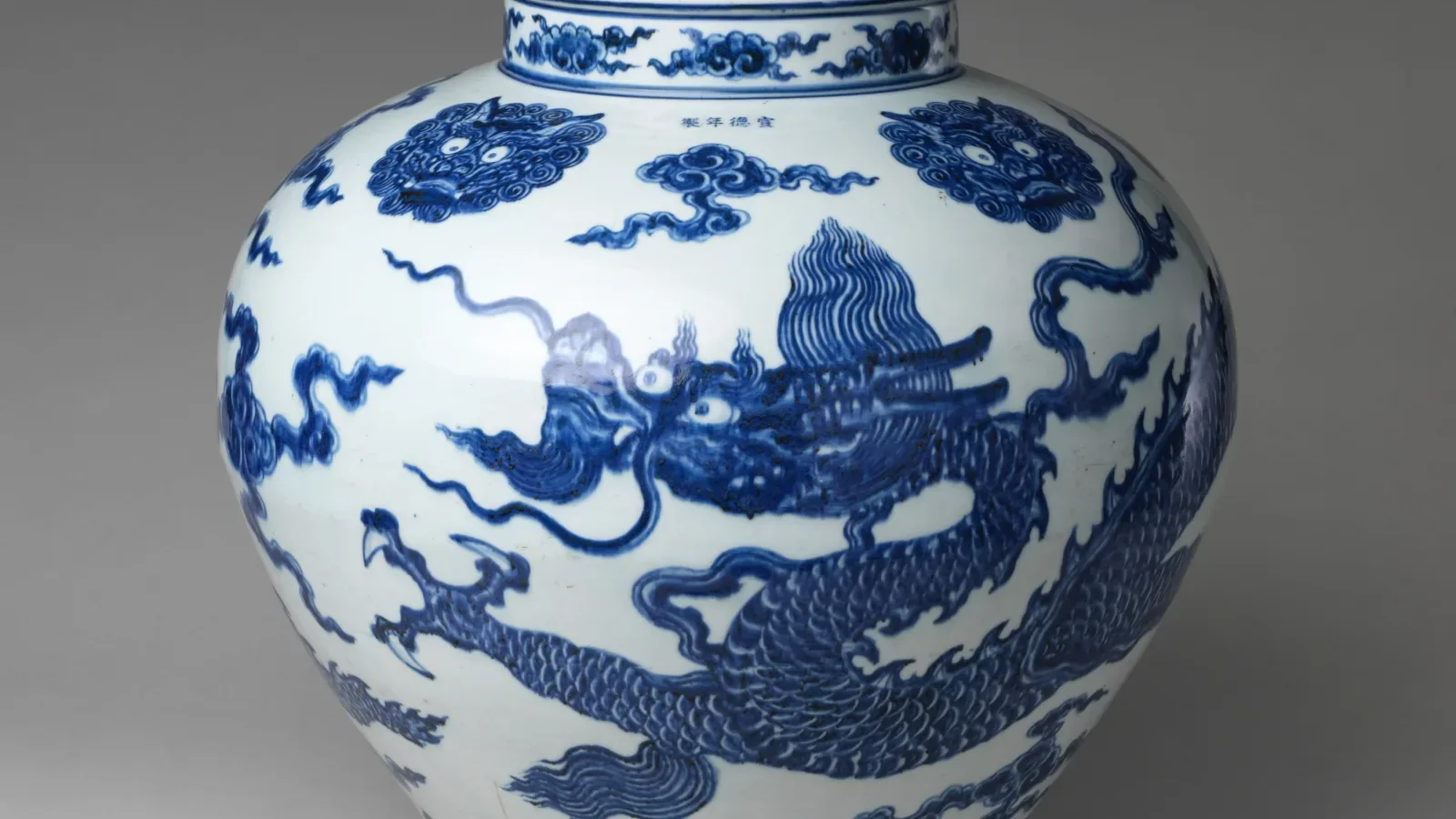
Dragon is the only conventionally mythic animal in the sequence. Its importance is not explained by “confidence” alone. Chinese dragon imagery connects with water, rain, transformation, political authority and auspicious power. This helps explain the heightened social attention often given to Dragon years.
Snake is associated with reserve, perception and change. Skin shedding makes transformation an intuitive interpretation, while its difficult-to-read movement supports both positive ideas of strategy and negative ideas of secrecy. These are cultural readings, not claims about everyone born in a Snake year.
Horse, Goat and Monkey: motion, care and invention
Horse suggests travel, speed and independence because horses materially enabled movement and communication. The 2026 animal is therefore not simply an annual logo; it carries a long association with momentum.
The eighth sign exposes a translation problem. 羊, yang, can refer broadly to caprine and ovine animals. “Goat,” “Sheep” and “Ram” can all be defensible. Use the animal shown when describing a specific artwork; use “Goat or Sheep” when discussing the sign generally.
Monkey represents quick intelligence and rule-testing. Modern designs sometimes borrow the staff, posture or rebellious energy of Sun Wukong, but the zodiac Monkey and the Monkey King are different cultural figures. Similar imagery does not make them historically identical.
Rooster, Dog and Pig: time, boundaries and abundance

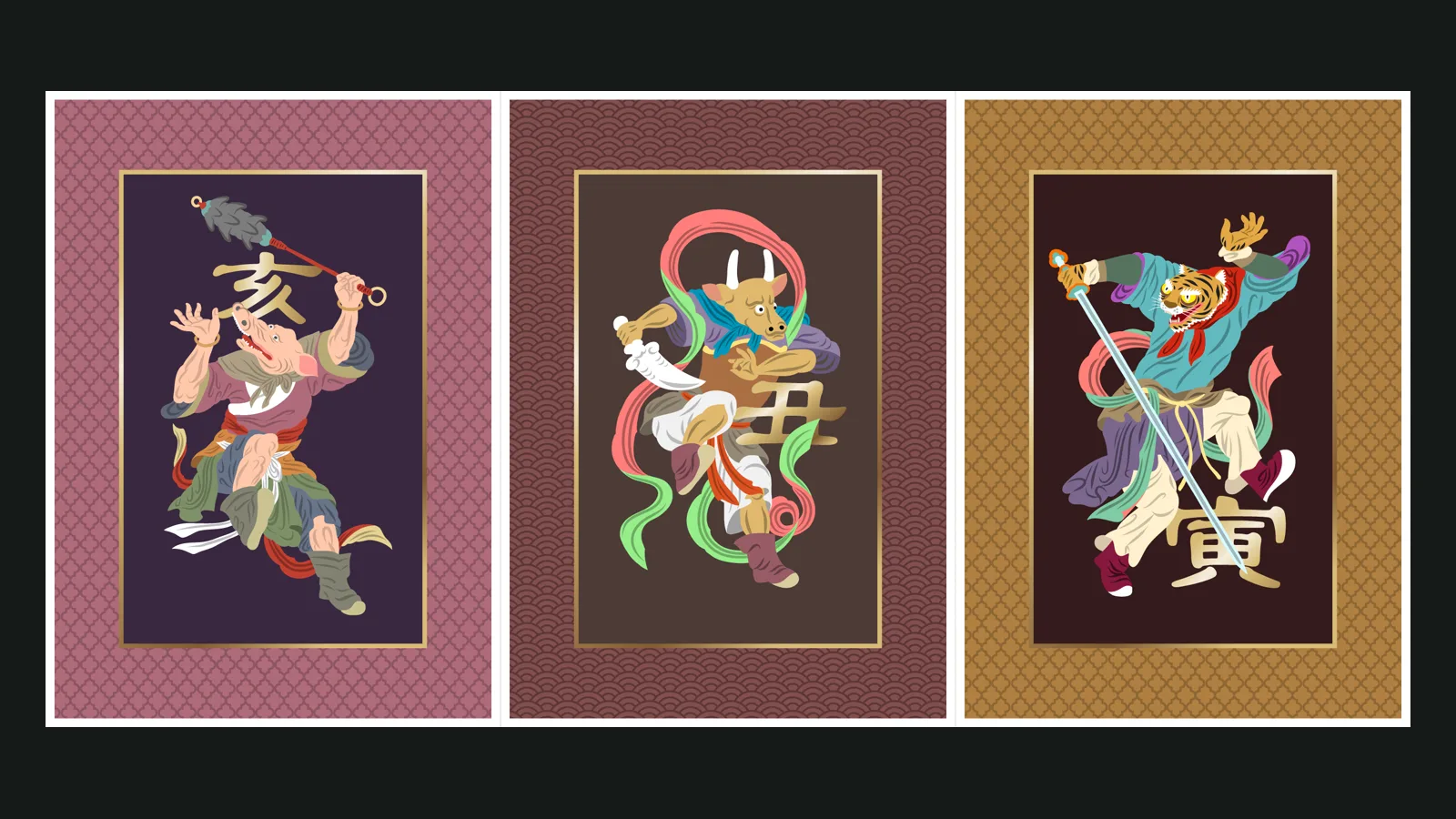
Rooster, Dog and Pig close the cycle through 酉, 戌 and 亥. East Moment first-hand media archive.
Rooster naturally evokes announcing time and the start of daily activity. Dog carries household vigilance, fidelity and boundary protection. Pig closes the sequence with associations of food, domestic resources and material ease. In English, “pig” can sound insulting; that connotation should not be projected automatically onto an auspicious zodiac image.
These associations explain why the signs remain visually productive. They are not twelve interchangeable personality labels. Each animal brings a recognizable relationship with work, danger, time, movement, food or the natural world.
Read a zodiac image before reading a person
A sign on a red envelope and a sign in a birth-date result may name the same animal, but they do different jobs. The envelope celebrates a year shared by millions. A dated result places one birthday within that year. Neither can tell you whether its recipient is generous, stubborn or good at handling conflict. I would rather ask why an artist chose a watchful Dog than ask whether every Dog-born person watches over a household.
Here is a better way to look at an unfamiliar zodiac object. First identify the animal and any accompanying branch character; a horse image without 午 may be a horse in art rather than a reference to the Horse year. Then ask whether the object marks a festival, tells a Great Race story, expresses a wish for protection or simply plays with an animal's appearance. Finally, look for the date or maker before assigning it to a particular zodiac year. These questions let a reader appreciate a Chinese symbol without treating its owner as a character in a horoscope.
There is a real limit here. A modern illustration may deliberately mix a zodiac Dragon with dragons from other stories, or dress a Monkey like Sun Wukong. The crossover can be clever. It cannot, on its own, establish that the two figures have the same origin. I enjoy the visual play more when the calendar, the artwork and the story are allowed to remain different things.
The Great Race explains the order, but it is not history
The best-known story says a ruler, often identified as the Jade Emperor, called animals to a race. Rat rode on Ox and jumped ahead at the finish. Tiger came third after fighting the current. Rabbit crossed on stones or a floating object. Dragon stopped to help others. Snake startled Horse. Goat, Monkey and Rooster cooperated. Dog became distracted in the water, and Pig arrived after eating or sleeping.
Versions differ by region, retelling and audience. The Great Race should therefore be described as a popular explanatory legend, not as the documented origin of the calendar system.
The story succeeds because it converts an abstract sequence into causation: every place becomes the result of an animal's behavior. It also explains the absent Cat in later retellings, usually through Rat's betrayal. That episode is memorable folklore, not evidence that a historical selection event occurred.
Five elements: why the same animal is not the whole year name

The animal wheel answers only half the year name. A Heavenly Stem supplies yin or yang and one of the five phases, which is why two Horse years can carry different complete labels.
The animal cycle repeats every twelve years, but the stem-branch cycle also introduces yin and yang and five phases commonly translated as Wood, Fire, Earth, Metal and Water. This produces labels such as Wood Dragon, Fire Horse and Metal Rat.
A complete stem-branch pairing returns after sixty years. That is why 1966 and 2026 can both be Fire Horse years, while 2014 is a Wood Horse year. The animal matches after twelve years; the full pairing does not.
Use the Chinese zodiac elements guide when the search intent is “What element is my sign?” The year element is not assigned by choosing whichever element description feels most accurate.
How the zodiac is used in Chinese life
The zodiac remains useful because it moves easily between calendar, conversation, family custom and design.
Age and generation
Naming an animal gives a set of possible birth years twelve years apart. Context can narrow the likely age, which is why asking for a sign can be a less direct age question. It never identifies age by itself: a Dragon could be 12, 24, 36 or another multiple of twelve years apart.
New Year imagery and gifts
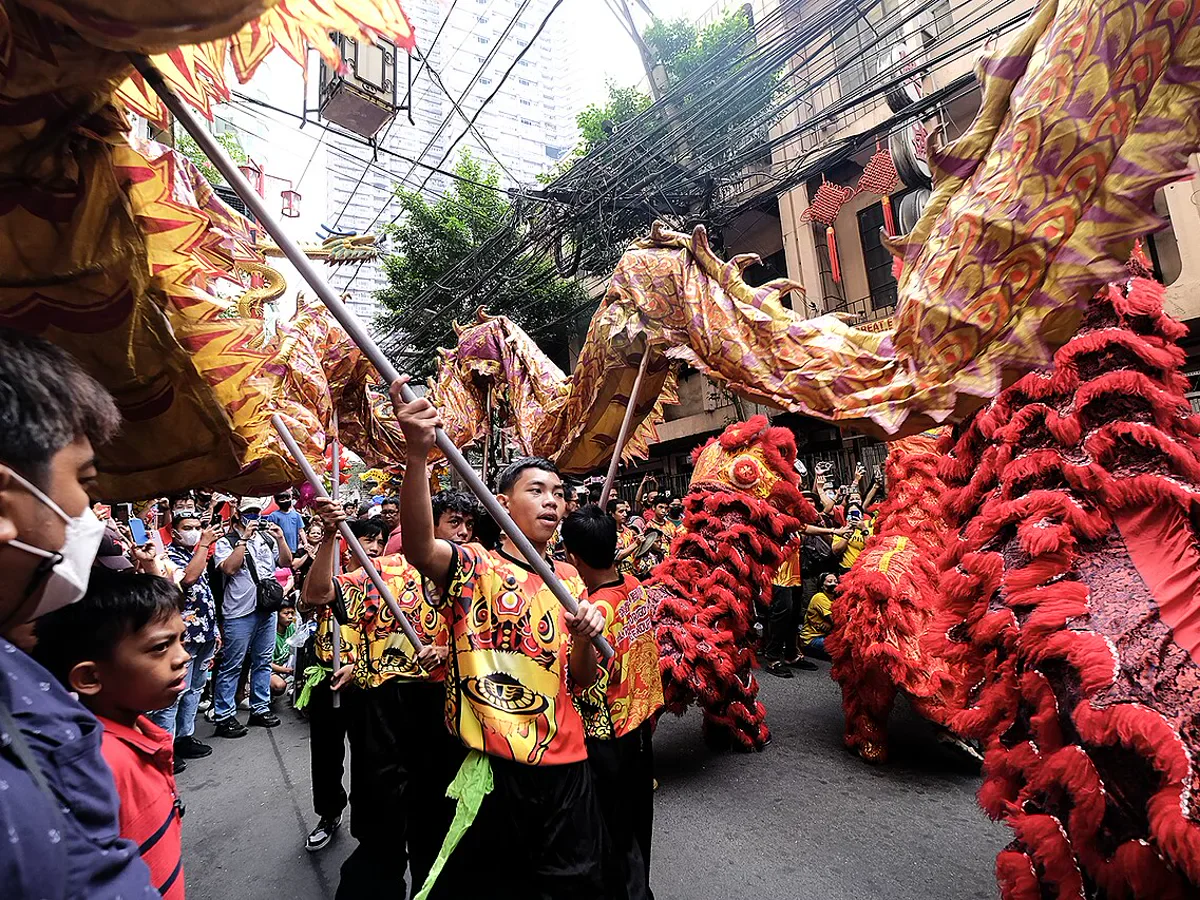
Each Spring Festival creates demand for the incoming animal across red envelopes, stamps, jewelry, clothing, toys and brand campaigns. UNESCO's inscription of the Spring Festival emphasizes a broad body of social practices around the traditional New Year; zodiac imagery is one visible part of that larger celebration, not the entire festival.
Birth-year conversation
Some families favor certain signs, especially the Dragon, or discuss the expected temperament of a child through the annual animal. The importance varies by household. It is accurate to say these ideas are socially visible; it is inaccurate to imply that all Chinese families plan births by the zodiac.
Benmingnian
Benmingnian (本命年) is the year when the current animal matches one's birth-year animal, usually at ages 12, 24, 36 and so on, depending on how age is counted and whether the birthday has passed. It is not automatically considered the luckiest year. Popular custom may treat it as a period requiring caution, with red clothing or accessories worn for protection.
The strength of belief varies. The durable cultural fact is the act of care: giving a red belt, bracelet or pair of socks can express protection even when the recipient treats the custom lightly.
Compatibility is a traditional classification, not a relationship score

Six Harmonies names six exact pairings. The chart classifies branches; real relationship quality still depends on conduct, safety and shared decisions.
Traditional compatibility systems identify named relationships among branches, including Six Harmonies, Three Harmonies and six direct oppositions. Those structures are more defensible than internet percentages because they state the traditional classification without pretending to measure a couple.
Use the Chinese zodiac compatibility guide to identify a pair. The result should be read as cultural context. It cannot establish whether two people communicate well, share values or behave safely. A harmonious pairing is not evidence of a healthy relationship, and an opposing pair is not evidence that a relationship will fail.
The marriage conversations people actually have
I am a Rooster, and I have heard the marriage version of zodiac talk in ordinary Chinese family conversations: not as a laboratory test, but as a shorthand for whether two people are thought to fit. The saying “chicken and dog do not get along” (鸡犬不宁) is often used to frame Rooster–Dog pairings as troublesome, while some traditional matching lists describe Ox and Horse as more compatible. These examples belong to folk classification, not a scientific prediction system.
That distinction matters. A family may mention a pair before a wedding, yet the relationship still has to be built through communication, boundaries, trust and shared decisions. I can describe myself as a Rooster and still refuse to let an animal pairing decide whether two people should marry. The most useful reading is cultural literacy: understand what an elder means, then return the decision to the people living the marriage.
Historical evidence looks different from modern zodiac graphics
The Metropolitan Museum of Art catalogs a Tang-dynasty set of twelve zodiac figures in which each figure has a human body and an animal head. The coordinated set matters because it shows the complete sequence embodied in material form, not merely a modern circle of icons.
It also establishes a useful visual principle: there has never been only one correct graphic style for the zodiac. Animals can appear naturalistically, as branch labels, as human-animal guardians or as contemporary characters while still representing the same ordered cycle.
Choose the right level of answer
Use the zodiac at the level your question actually requires:
- To identify an animal, enter a full birth date rather than using a bare Gregorian year.
- To compare year ranges, consult a date table with Chinese New Year boundaries.
- To understand Wood, Fire, Earth, Metal or Water, calculate the stem-branch year rather than guessing from personality.
- To discuss compatibility, name the traditional relationship and keep it separate from real-world relationship judgment.
- To interpret an artwork, identify both the animal and its Earthly Branch when visible.
The central conclusion is simple: an accurate Chinese zodiac answer begins with the calendar, becomes meaningful through cultural context, and stops before folklore is presented as science.
Continue through the Chinese symbols collection to see how animals, flowers and colors carry meaning in different systems. Then bring one dated three-generation line to Moments. A family memory with a year and an object can correct this guide; another “Rabbits are gentle” verdict cannot.
Explore the individual signs: Rat, Ox, Tiger, Rabbit, Dragon, Snake, Horse, Goat, Monkey, Rooster, Dog and Pig.
For the cycle's mythological animals and their later fantasy afterlives, see XianLore's Chinese zodiac mythology guide; return here for calendar boundaries and individual year calculations.