2026 is the Year of the Horse, but it does not begin on January 1. Under the Chinese New Year convention used in everyday zodiac life, the Fire Horse year begins on February 17, 2026. Anyone born from January 1 through February 16, 2026 is still a Snake.
Year of the Horse dates and exact boundaries
Recent Horse years are 1930, 1942, 1954, 1966, 1978, 1990, 2002, 2014 and 2026. The cycle repeats every twelve years, but the sign changes at Chinese New Year rather than at the start of the Gregorian year.
| Horse year | Begins | Ends | Element |
|---|---|---|---|
| 1990 | January 27, 1990 | February 14, 1991 | Metal |
| 2002 | February 12, 2002 | January 31, 2003 | Water |
| 2014 | January 31, 2014 | February 18, 2015 | Wood |
| 2026 | February 17, 2026 | February 5, 2027 | Fire |
This boundary is the first thing to check. A person born on February 10, 2002 is a Snake, not a Horse. Use the Chinese zodiac calculator if the birthday falls in January or February.
The complete Chinese zodiac guide explains Horse's seventh position and the calendar structure shared by all twelve animals.
Source note: The 2026 date follows the Hong Kong Observatory's official Gregorian-lunar conversion table.
Our conclusion: the Horse means usable movement, not generic freedom
Most English zodiac pages reduce the Horse to three adjectives: energetic, independent and adventurous. Those words are not completely invented, but they explain very little.
The stronger interpretation is this: the Horse represents movement that changes what a society can do. In Chinese history, a horse was not simply a beautiful animal. It could extend military reach, carry official messages, accelerate travel and connect courts with distant regions. Speed mattered because it moved information, people and power.
That history makes the popular idea of Horse “freedom” more concrete. It is not only a personality that dislikes staying home. It is the cultural memory of an animal that collapses distance.
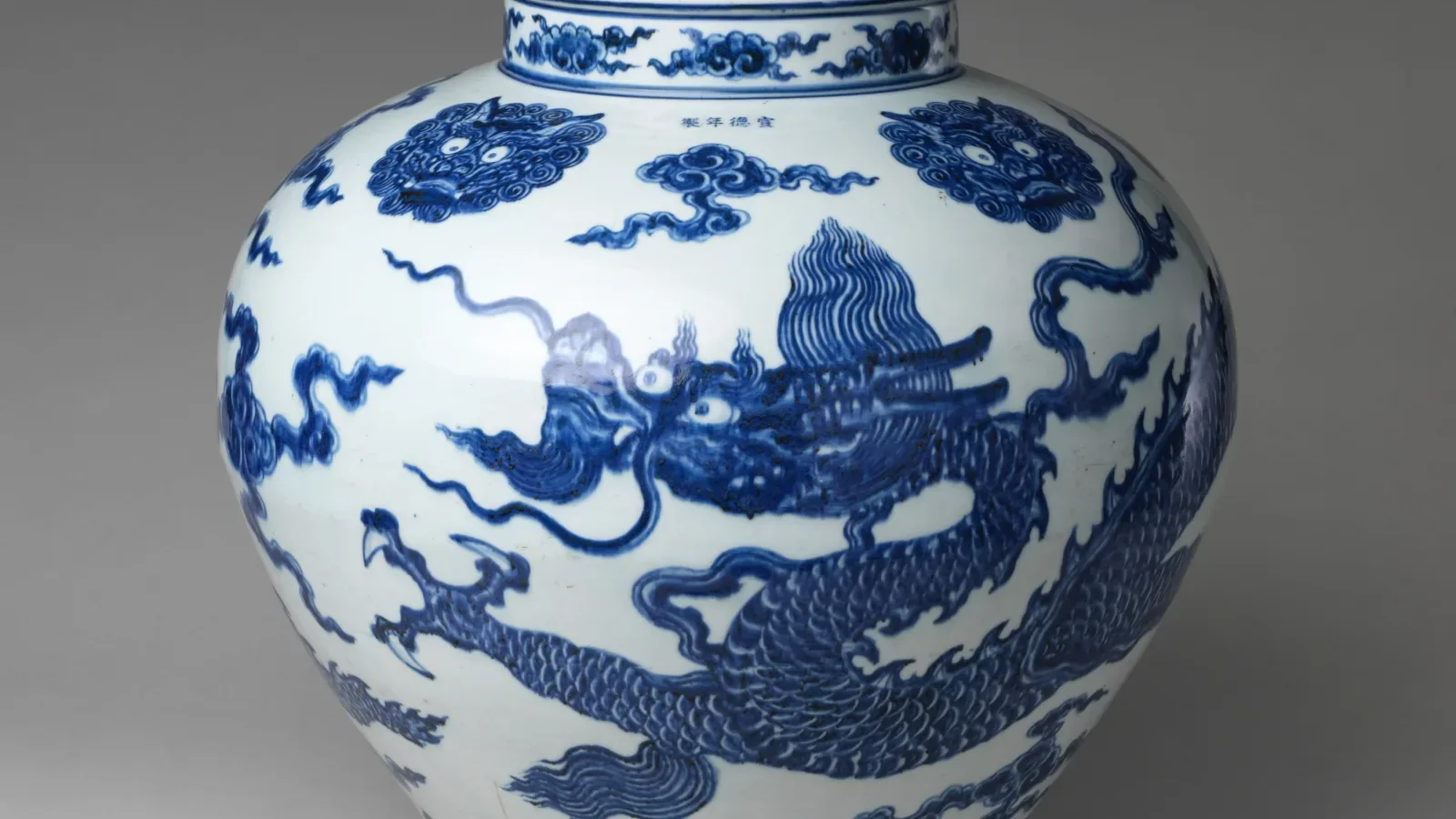
The Metropolitan Museum of Art's overview of horses in China traces their importance through art, warfare and contact with Central Asia. Look at historical horse images and the body usually does the argument: lifted legs, turning necks and stretched movement make energy visible before a label tells you what it means.
A tethered horse shows why movement is not the same as freedom

Detail of Han Gan's Night-Shining White, ca. 750, handscroll, ink on paper. The Metropolitan Museum of Art, public domain.
The Met attributes Night-Shining White to Han Gan, an eighth-century painter known for horses associated with the Tang court. The animal is tied to a post, yet the picture refuses stillness: its raised head, widened eye, open mouth and braced legs turn restraint into visible force.
This is not a zodiac image, and it does not explain the branch wu. It supports a narrower historical point: Chinese horse imagery could make access to speed, training and controlled power legible. That tension improves the modern “freedom” slogan. A valuable horse was mobile because people invested in breeding, handling and infrastructure; its movement was useful precisely because it could be directed.
Why the picture says Wu, not horse
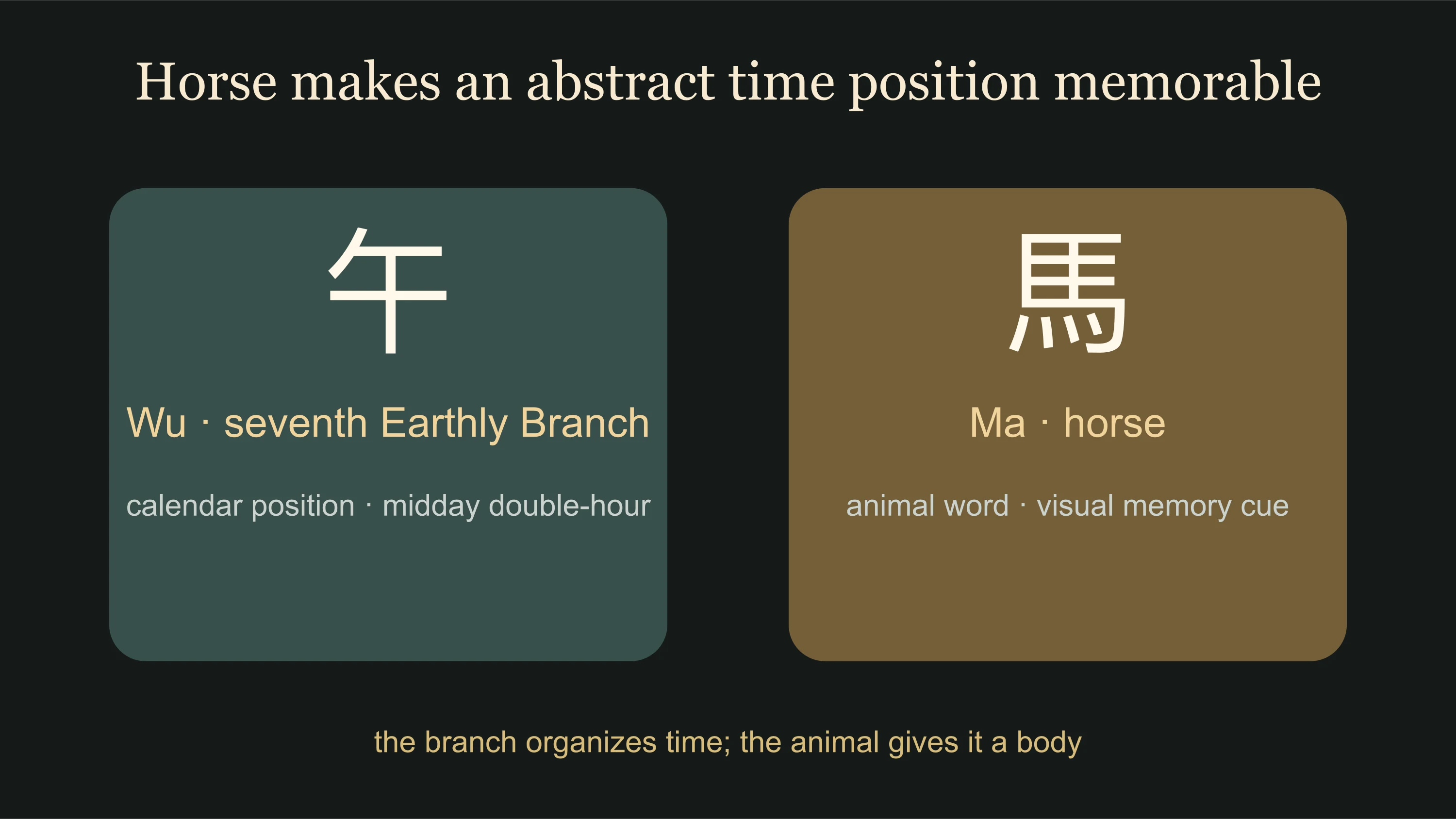
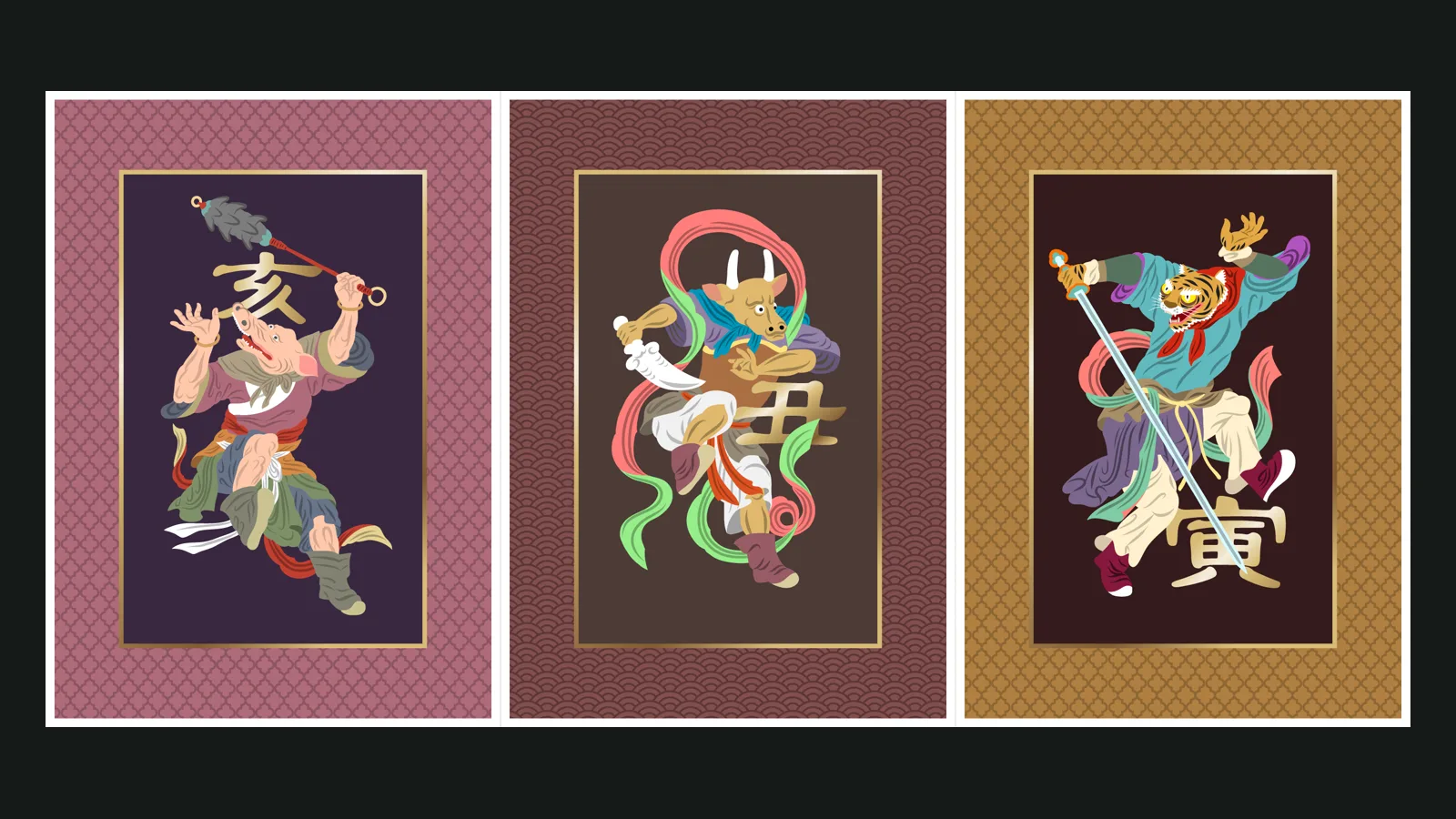
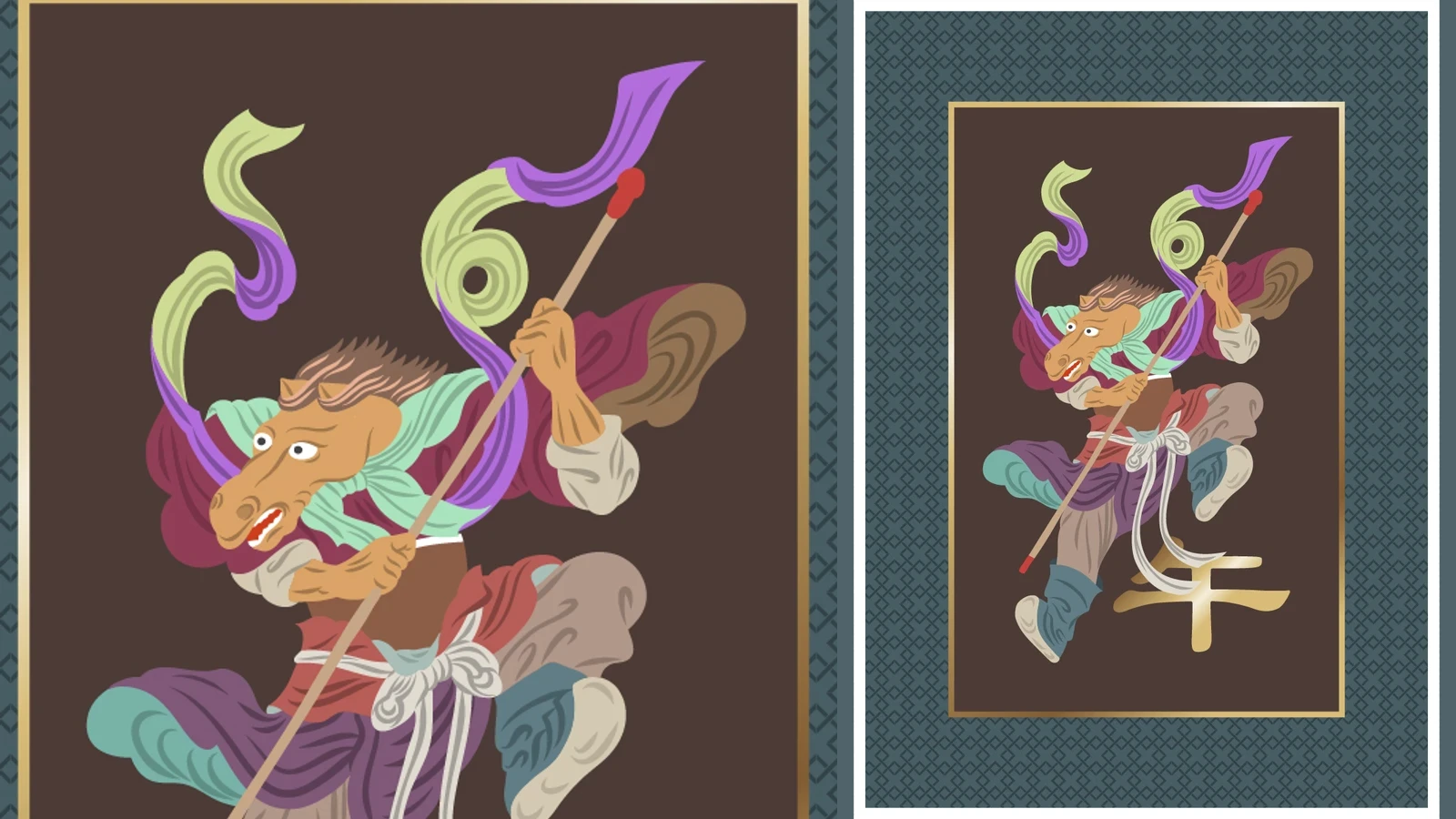
The Horse panel in our authorized illustration carries 午 (wu), the seventh Earthly Branch. It is not 马 (ma), the everyday Chinese word for horse.
That distinction is the key to understanding the zodiac as a time system rather than a cast of mascots. The twelve animals are memory-friendly partners for twelve branches. Wu occupies the seventh position, corresponds to the Horse and is traditionally associated with the double-hour from roughly 11 a.m. to 1 p.m. The branch organizes time; the animal makes the system memorable and visual.
Our illustration pushes the Horse diagonally across the frame, with cloth and mane moving in different directions. That is a contemporary design choice, not an ancient artifact. What it proves is how easily Horse imagery still turns the abstract branch wu into momentum.
Why 2026 is specifically a Fire Horse year
The twelve animals are only one wheel in the calendar. A second wheel uses ten Heavenly Stems. Combining ten stems with twelve branches produces a sixty-year cycle.
In 2026, the stem is Bing (丙) and the branch is Wu (午). Bing is associated with yang Fire, so 2026 is called a Fire Horse year. The previous Fire Horse year was 1966; the next will be 2086.
This does not mean everyone born in 2026 has a scientifically measurable “fiery” personality. It means their year has a specific position in a calendrical system richer than the familiar twelve-animal loop. Calling 2026 merely “Horse” is correct; calling it “Bing-Wu Fire Horse” is more precise.
What Horse personality descriptions can and cannot tell you
Popular descriptions tend to call Horse people sociable, quick, restless and self-directed. They work best as folklore and conversation prompts. They are not personality tests, and they should not be used to explain someone's career, relationships or moral character.
A useful reading keeps the symbolism while rejecting the diagnosis:
| Popular claim | Better cultural reading |
|---|---|
| Horses are restless | Movement is the sign's central visual and historical logic |
| Horses hate rules | Independence is folklore, not a fact about millions of people |
| Fire Horses are extreme | Fire identifies the 2026 stem-branch combination; “extreme” is interpretation |
| Horse signs need certain partners | Compatibility is a traditional matching game, not relationship evidence |
The point is not to drain the zodiac of fun. It is to use it accurately. Symbolism becomes more interesting when we stop pretending it is laboratory psychology.
What to notice during the 2026 Horse year
The Horse will appear everywhere during Spring Festival: red envelopes, public installations, packaging, fashion accessories, phone stickers and family gifts. Do not only ask whether the design looks cute. Ask three better questions.
First, does it show the animal or the branch 午? Their presence together reveals the link between image and calendar. Second, how does the artist make movement visible? A standing Horse communicates differently from one that twists, gallops or seems to leap out of the frame. Third, does the design borrow historical visual language or invent a contemporary character? Neither is automatically better, but they make different claims.
For someone born in a Horse year, 2026 is their benmingnian—the return of their zodiac animal, usually every twelve years. Red clothing and accessories are commonly used as protective, auspicious responses. This is a living social practice, not evidence that the year is objectively unlucky.
The mistake to avoid
The biggest mistake is not choosing the wrong lucky color. It is assigning the wrong animal because a birthday falls before Chinese New Year.
Start with the full date, then understand the branch, then enjoy the stories. That order turns the Year of the Horse from a personality meme into what it actually is: one vivid entrance into Chinese ideas about time, movement and recurring identity.
The Year of the Horse is a problem of directed energy
The Year of the Horse is usually sold as freedom, speed and success. That is the easy poster. A horse is valuable in Chinese history because its force can be directed across distance: carrying a message, pulling a load, crossing a frontier or turning a battle. Motion without purpose is not heroic. It is only expenditure.
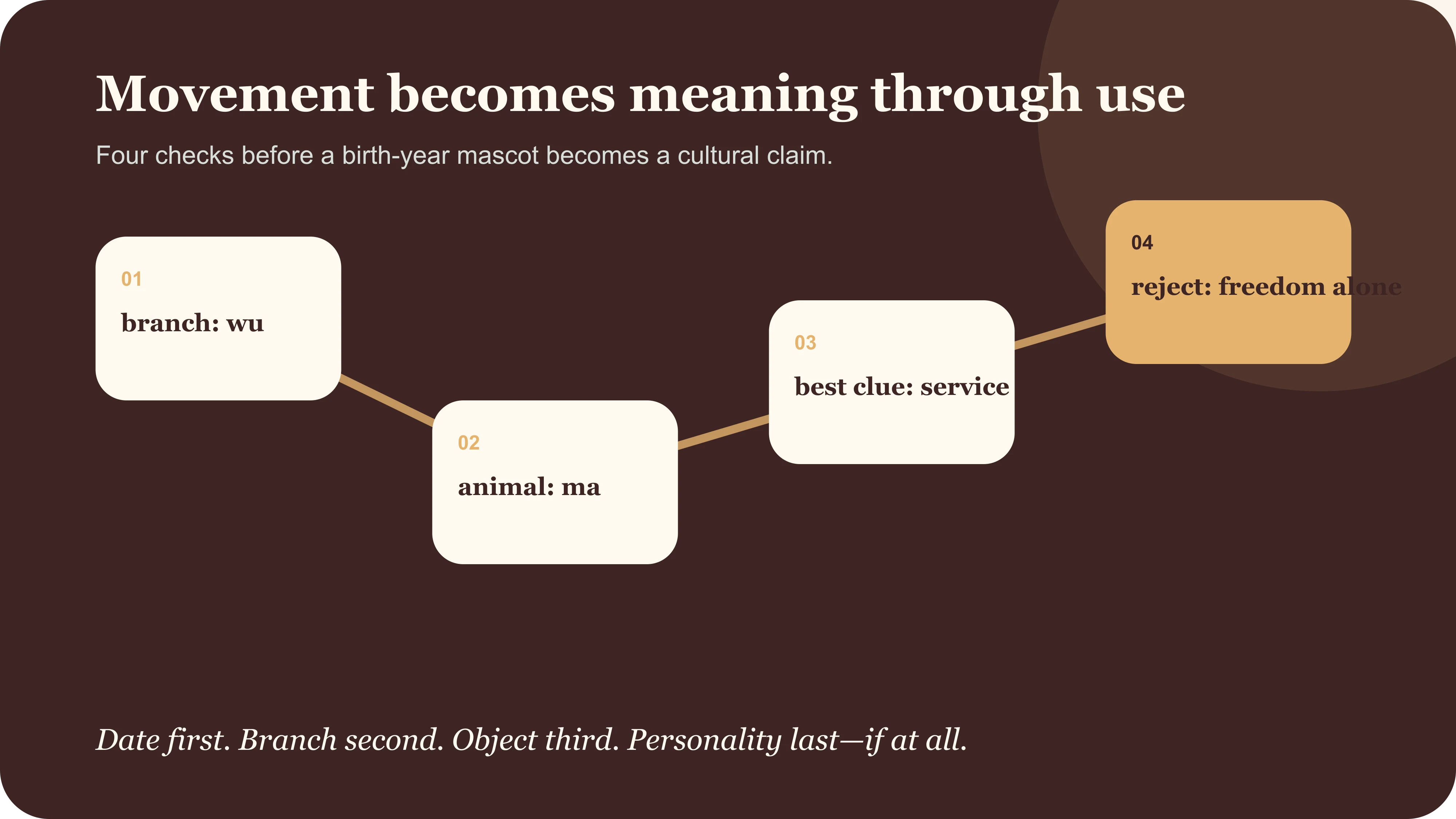
This is why I read Horse imagery through four questions. Direction: where is the body going? Burden: what does it carry? Heat: is the animal working, fighting, racing or merely posing? Recovery: who provides water, shade and rest? These questions return agency and cost to an image that modern branding often reduces to a streak of red.
I insist on the recovery question because speed without return is just extraction dressed as optimism. A Horse-year image must show us more than acceleration if it wants to say anything useful about a human life.
The Chinese character ma (马) names the animal; the zodiac position is the earthly branch wu (午). They overlap in the zodiac system but are not interchangeable in every inscription, painting or historical document. A museum label that names a horse painting is evidence of an equine subject, not automatically evidence of a Horse-year custom.
Fire Horse is a calendar pairing, not a verdict on a child
The 2026 year is Bing-Wu, conventionally rendered Yang Fire Horse. The Fire correspondence gives designers an obvious palette and gives conversation an image of intensified movement. It does not prove that every child born in the year will be volatile, unlucky or unusually gifted.
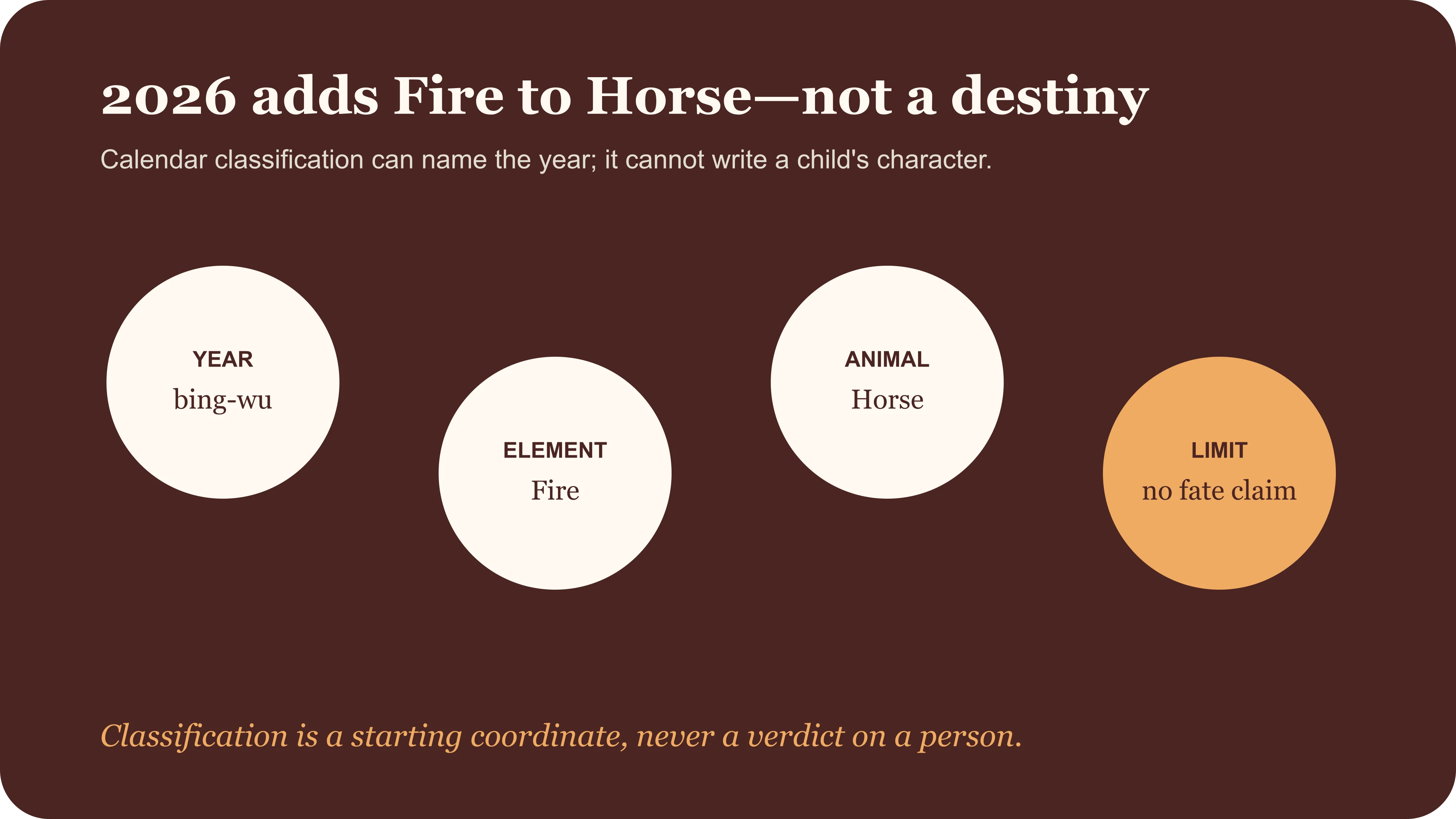
The Hong Kong Observatory's 2026 calendar fixes the New Year boundary at February 17. That date is the useful fact. Predictions attached to the pairing belong to belief, family custom and historical anxiety. I refuse to turn them into a medical or psychological label.
Fearful stories about Fire Horse children are a warning about interpretation itself: labeling a child before observing their actions can change how adults treat them. This page does not claim that the 2026 pairing changes birth rates or predicts a girl's character. Either claim would require evidence beyond a stem-branch name. A dated calendar can establish when a Fire Horse year begins; it cannot establish what any child born within it will become.
What a good Horse-year image must let us see
Look for reins, saddle, rider, road and ground. A rearing horse communicates a different relation to control from a horse lowering its head after work. A court painting, a tomb figure and a red paper-cut use the same animal for different jobs. The date, material and setting decide the reading.
My strongest Horse-year image is not the one with the most flames. It is the one where movement has a visible destination and a visible cost. That distinction also makes the animal useful beyond zodiac decoration. It opens a route into Chinese horse painting and into the full Chinese zodiac sequence. Read the preceding Year of the Snake beside it: Snake stores and redirects force; Horse makes force travel. Neither needs to become a personality diagnosis.
The limitation is simple: one object cannot carry the entire history of horses in China. Use a zodiac figure to discuss calendrical identity, a dated artwork to discuss artistic convention and a historical source to discuss transport or war. When those layers are kept separate, Horse becomes richer, not smaller.
A horse at rest completes the symbol
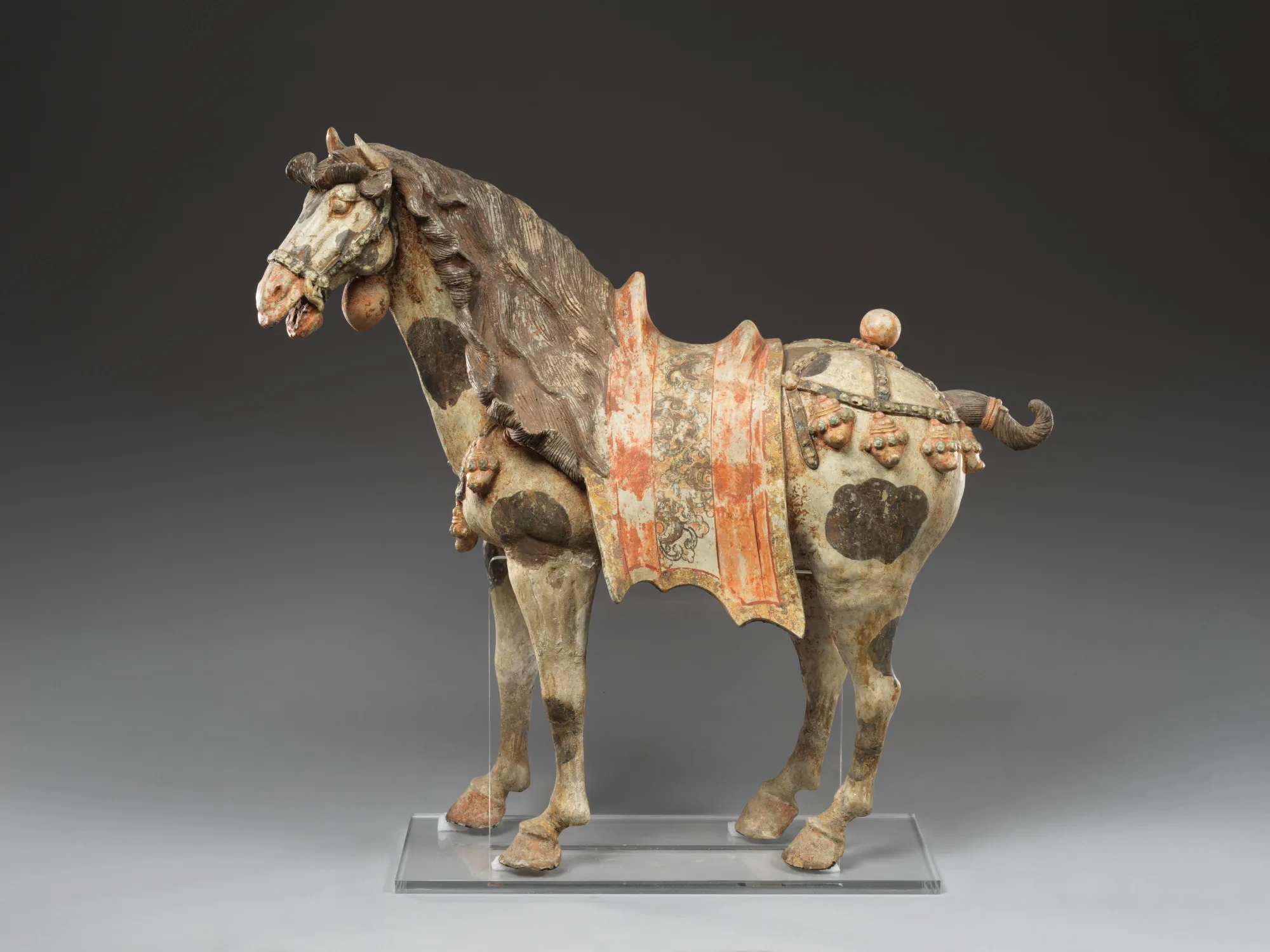
Horse, late 7th–early 8th century, earthenware with pigment and gilding. The Metropolitan Museum of Art, public domain.
Zodiac galleries favour galloping because speed photographs well. Yet rest is not the opposite of horse power; it is what makes repeated movement possible. Water, grooming, shelter and release from tack belong to the same history as the dramatic ride.
The Metropolitan Museum's overview of horses in Chinese art places equine images across court, military and artistic histories. It is a necessary correction to the idea that every Chinese horse exists merely as a zodiac mascot.
The Tang figure stands rather than charges, but its tack, decorated saddle cloth and carefully modelled body still make organized mobility visible. This was not an anonymous streak of speed. It was an animal shaped by equipment, training, status and human care. The object does not prove a Horse-year ritual; it proves why historical horse imagery cannot be reduced to the modern slogan “be free.”
This is the counterimage I want beside every Fire Horse slogan. Heat and acceleration may energise a festival design, but a culture of endless motion turns the animal into a machine. The Horse becomes more humanly useful when it makes recovery visible.
A birth-year sign cannot tell someone to move faster. It can ask whether motion has direction, whether the burden is chosen and whether return is possible. That is a sharper and kinder conclusion than promising success to everybody born under a galloping logo.
The rider changes the politics of the image
An unmounted horse can express animal form, readiness or release. Add a rider and questions of rank, gender, military power and control enter immediately. Add an attendant and labour becomes visible around elite mobility.
This is why famous horse paintings should not be stripped into motivational posters. Their inscriptions, patrons and historical settings may tell a story far more specific than “run toward success.”
The zodiac page can borrow their visual intelligence without claiming every horse artwork as zodiac evidence. That boundary lets art history and calendar culture strengthen one another instead of competing for the same simplified symbol.
Place the three images on this page side by side in your mind. The modern Horse beside 午 explicitly names a zodiac branch. Han Gan's tethered horse shows an animal's force under restraint, not a dated Horse-year identity. The Tang earthenware figure makes saddle and harness visible, but its presence in a museum cannot tell us that it was made for a Fire Horse celebration. I would not sacrifice those differences for a punchier caption. Together they explain why this page needs both images and words: the date tells you which year, the objects make you question what people mean when they praise the Horse's speed.
To check whether a particular birthday belongs to this cycle, go to the Chinese zodiac calculator; to see why Bing supplies Fire while Wu supplies Horse, use the Chinese zodiac elements guide. Those are two different questions, and the Horse is more interesting once neither is made to answer for the other.