A correct Chinese zodiac calculator needs your full birth date, not just your birth year. The animal changes at Chinese New Year, so a January or February birthday can belong to the previous Gregorian year's sign.
What this Chinese zodiac calculator tells you
The result gives four connected pieces of the traditional calendar:
- Animal, the familiar Rat-to-Pig identity.
- Earthly Branch, the formal position underlying that animal.
- Element, derived from the year's Heavenly Stem.
- Yin or yang, also derived from the stem.
The calculation happens in your browser. The birth date is not submitted to East Moment or stored by this tool.
After calculating, look beneath the animal name. The result now shows the exact Chinese New Year date it checked, the year stem and branch, and a link to that animal's own guide. Those fields let you reproduce the answer instead of accepting a sign as an unexplained verdict. Copying the calculation copies only the year and calendar rule, not the private birth date you entered.
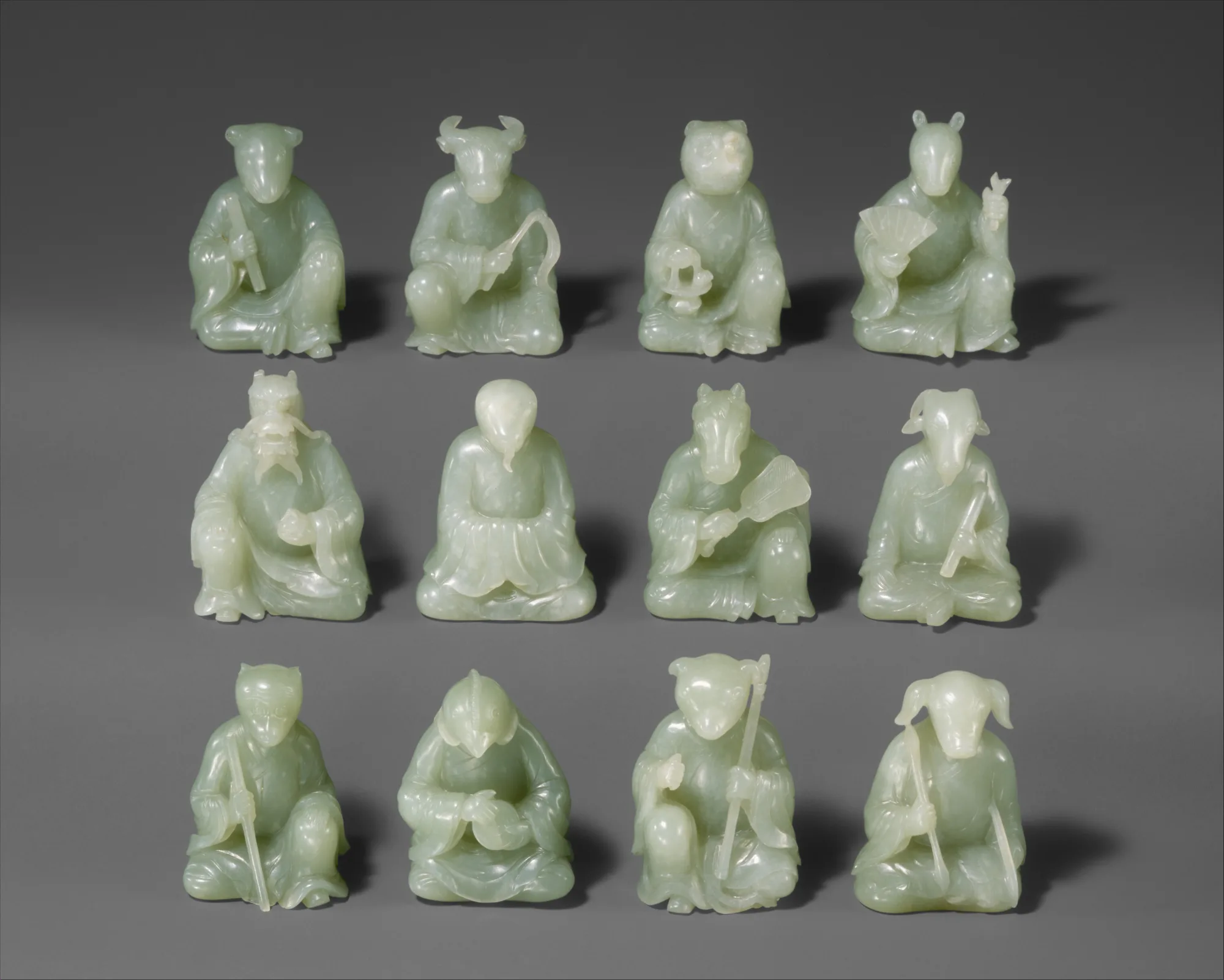
The jade figures above show twelve animals of the Chinese zodiac in one 18th–19th-century set at the Metropolitan Museum of Art. A result is one position inside that complete cycle. The figures do not prove a person's character or determine a January birthday's sign; they make the twelve-part structure visible, including the return from Pig to Rat after the final position.
Why birth year alone gives wrong answers
Chinese New Year does not occur on January 1. Its Gregorian date moves between late January and February.
Take 2026. The Horse year begins on February 17. A person born on February 10, 2026 is still in the Year of the Snake; a person born one week later is a Horse. A year-only calculator would label both people Horse and confidently return one wrong answer.
This is not a rare technical exception. Roughly three to seven weeks of birthdays can sit before the annual boundary. Any tool that asks only for a four-digit year is choosing convenience over accuracy.
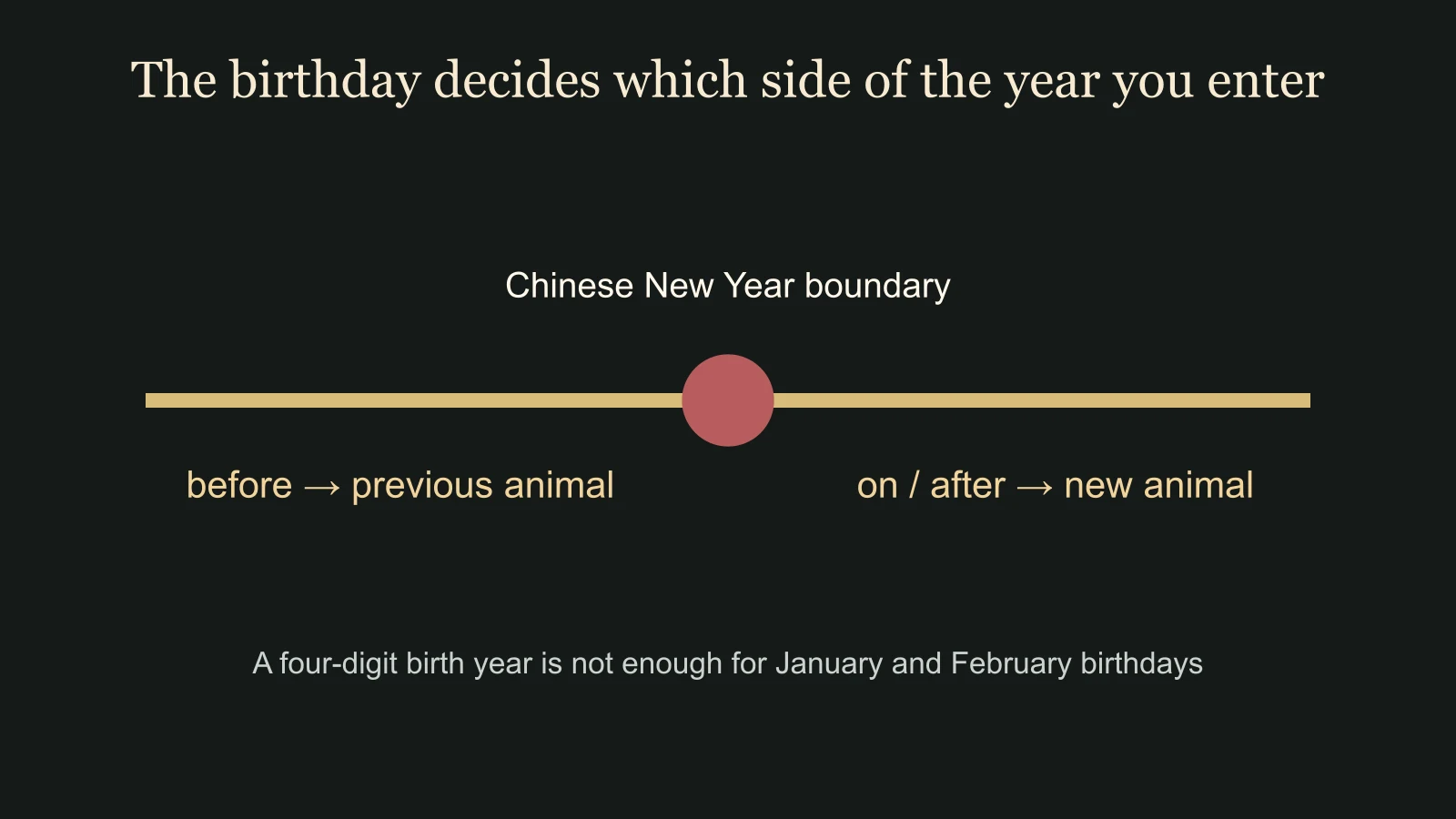
The line describes the calculation this tool performs: a birthday before Chinese New Year retains the previous animal, while the boundary date itself belongs to the new animal. The date must still be checked against that year's calendar.
The convention we use
East Moment changes the zodiac sign at Chinese New Year, the convention used in general family conversation, Spring Festival imagery and popular zodiac identity.
Some systems of bazi and Chinese metaphysics use Lichun, the Beginning of Spring solar term around February 3–5, as the annual boundary. That is a legitimate specialist convention. It can disagree with the Chinese New Year result for dates between the two boundaries.
Our position is simple: there is no honest “universal” calculator unless the boundary is stated. This tool answers the everyday cultural question, “What is my Chinese zodiac animal?” It does not produce a professional fate chart.
How the result is calculated
The tool compares the entered Gregorian date with that year's Chinese New Year boundary. Its 1901-2100 boundary table was checked year by year against the Hong Kong Observatory's Gregorian-Lunar Calendar Conversion Tables. The animal is then found from the repeating twelve-branch cycle. The stem supplies the yin-yang and element label.
The Hong Kong Observatory's guide to the Heavenly Stems and Earthly Branches documents the paired naming cycle behind that result. This matters because the animal is only the memorable surface. The actual year label combines one stem with one branch, and the full pairing repeats every sixty years rather than every twelve.
For example, 2026 is Bing-Wu (丙午):
- Bing is the third Heavenly Stem and is associated with yang Fire.
- Wu is the seventh Earthly Branch and is paired with the Horse.
- The combined result is Yang Fire Horse.
Ten stems and twelve branches return to the same pairing every sixty years. That is why the previous Fire Horse year was 1966, even though ordinary Horse years recur every twelve years.
Read the branch carefully
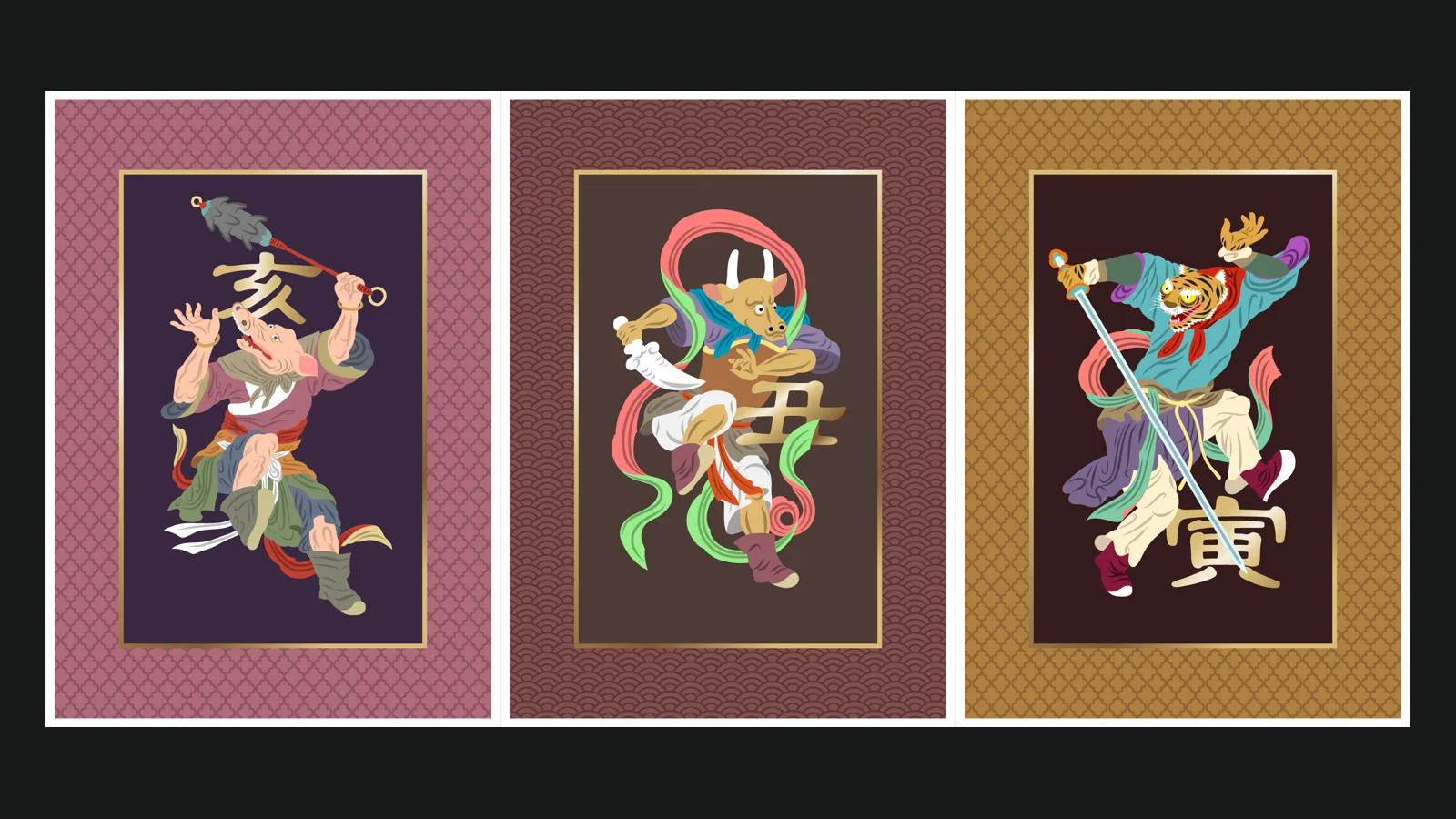
The calculator's output is deliberately narrow: it identifies a calendar position, not a personality. In zodiac art, the large Chinese character beside an animal is often an Earthly Branch, not the animal's ordinary written name.
| Animal | Branch | Animal word |
|---|---|---|
| Dragon | Chen 辰 | Long 龙 / 龍 |
| Snake | Si 巳 | She 蛇 |
| Horse | Wu 午 | Ma 马 / 馬 |
This is not a decorative difference. The branch is part of the calendar's organizing framework; the animal is its memorable visual partner. Learning both prevents the common misunderstanding that the zodiac is simply twelve animals assigned to years without a deeper time system.
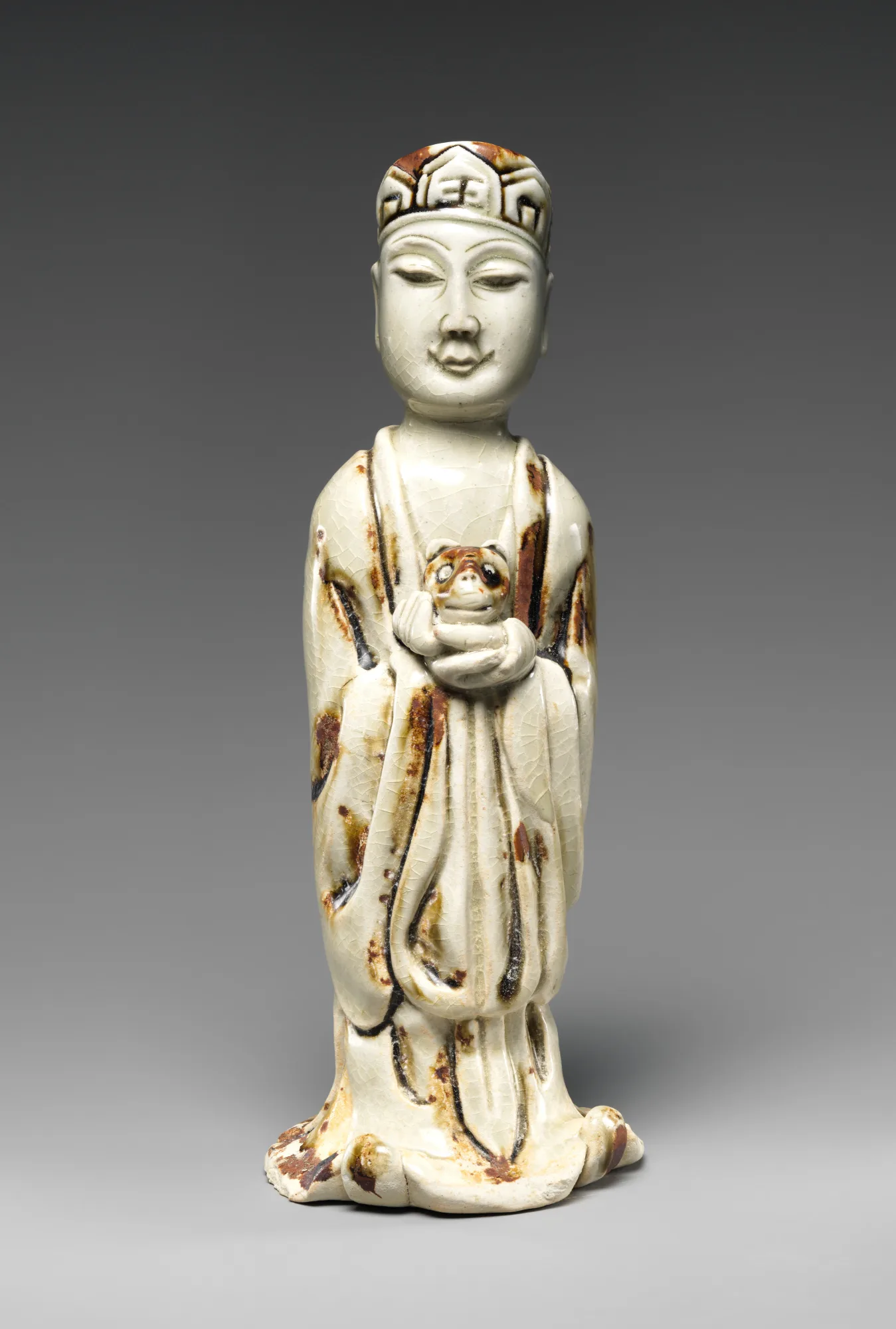
Chinese zodiac figure of a tiger, 11th century, Jingdezhen qingbai porcelain. The Metropolitan Museum of Art, public domain.
This figure identifies Tiger without turning the whole body into a tiger mascot: the robed person holds the small animal at the chest. It is a useful correction to the modern app icon. A zodiac sign can be encoded by an attribute, a branch character or a place in a sequence; the animal face is only one visual solution. The museum object supports that historical claim, not a horoscope attached to Tiger-year births.
What the result cannot tell you
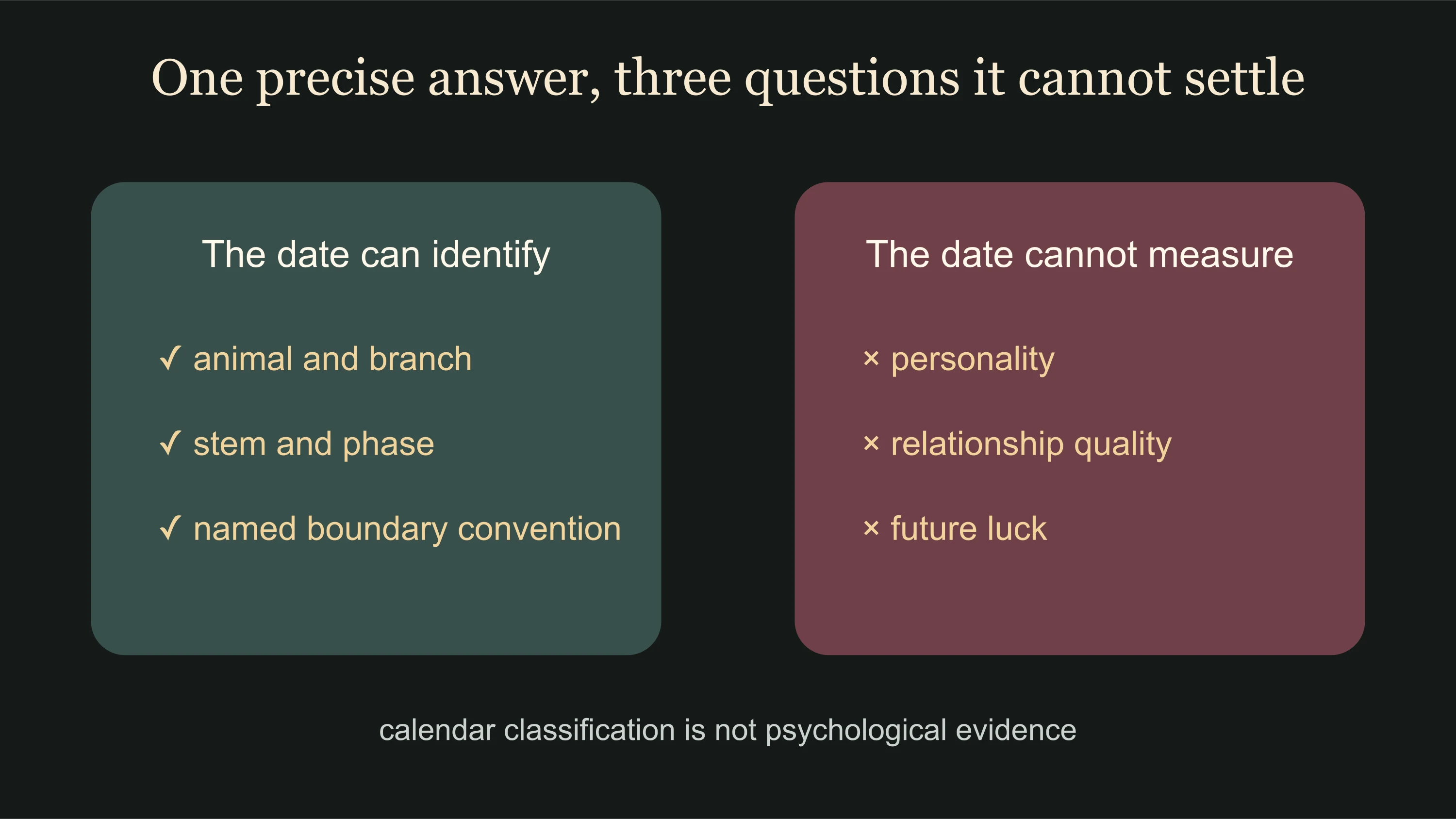
The calculator can identify a calendrical sign. It cannot measure personality, predict luck or decide relationship compatibility.
Descriptions such as “Dragon people are ambitious” or “Snake people are mysterious” belong to popular folklore. They can be enjoyable cultural shorthand, especially in family conversations and New Year design, but millions of people born across an entire year do not share one psychology.
Use the result as an entrance into Chinese culture, not as a verdict about yourself. The Chinese zodiac years chart lets you verify the cycle, while our complete zodiac guide explains how the animals, branches and living traditions fit together.
Dates outside the calculator range
The tool accepts dates from January 1, 1901 through December 31, 2100. A date before Chinese New Year in 1901 can correctly return the preceding 1900 Rat year, but the input range begins where the cited annual conversion tables begin. Historical Chinese calendar conversion can involve calendar standards and source-specific reconstruction. For dates outside the supported range, consult a specialist calendar rather than extending a modern algorithm and pretending the answer is certain.
That limit is deliberate. A useful cultural tool should be transparent about the convention, the calculation and the point where its confidence ends.
A Chinese zodiac calculator is only as honest as its inputs
The fast version asks for a year and returns an animal. The honest version needs more discipline. A birth date sits inside a civil calendar, a time zone and a chosen boundary convention. Most people born in March or October will receive the same result from every competent tool. People born in January or February are exactly where shortcuts become confident and wrong.
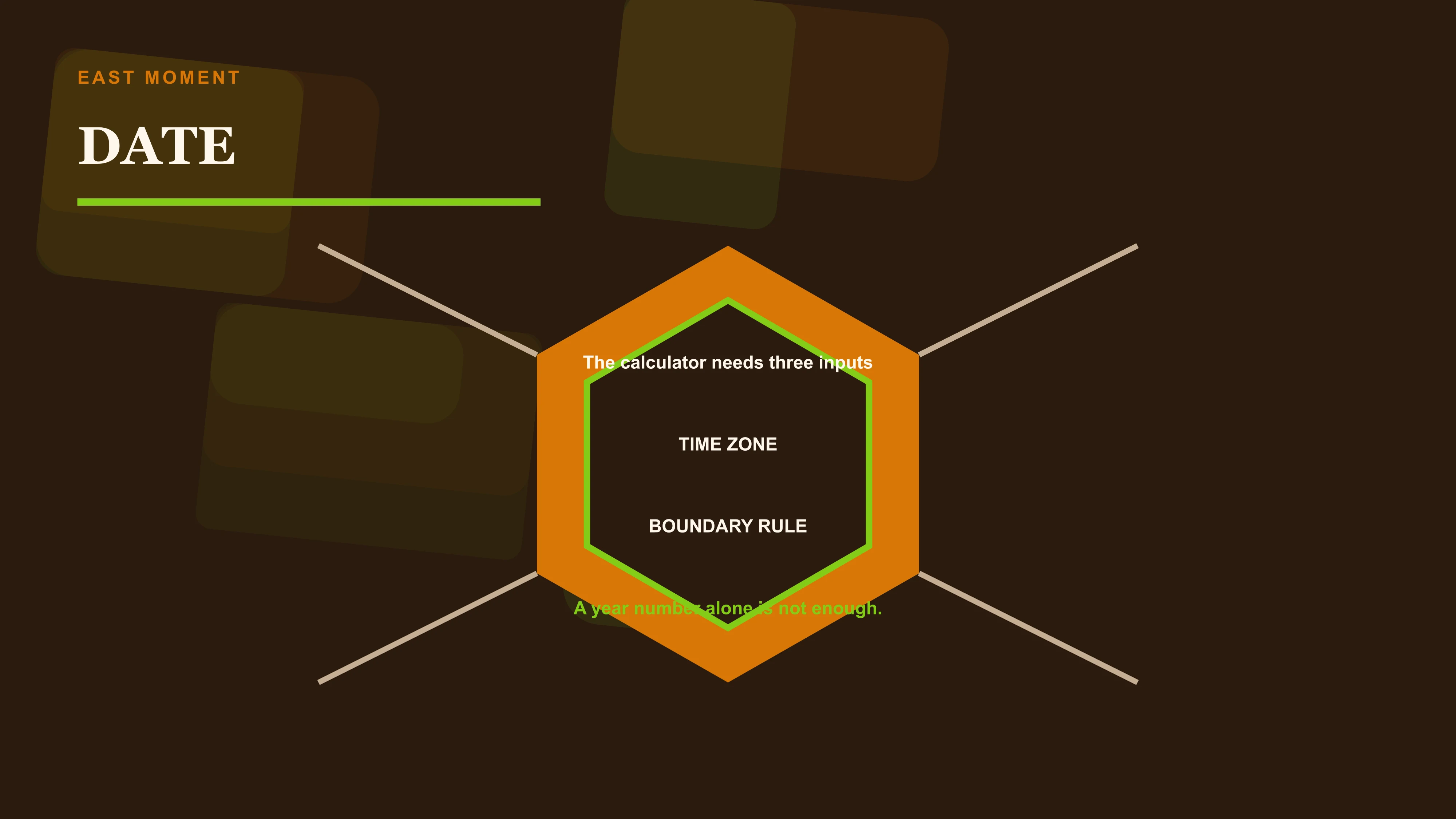
This calculator uses Lunar New Year as its public-facing year boundary because that is the convention most readers mean when they ask for a zodiac animal. It does not silently switch to Start of Spring, an astrological convention used in some systems. That distinction is not pedantry. A person born between those two boundaries can receive two different answers from two tools that are each following a stated system. The failure begins when a tool hides the system and presents its result as universal.
Use the date exactly as recorded at the place of birth. Do not move a late-night birthday into another date because you currently live in a different country. This page is a cultural calendar tool, not a full Four Pillars chart, so it does not attempt hour-branch calculation or local solar-time correction. That narrower promise makes the answer more trustworthy.
The January-February boundary is where calculators reveal their quality
Lunar New Year moves within the Gregorian calendar. It is not January 1, and it is not a fixed February date. The Hong Kong Observatory conversion tables are the authority used here to verify the annual boundary instead of estimating it from a repeating shortcut.
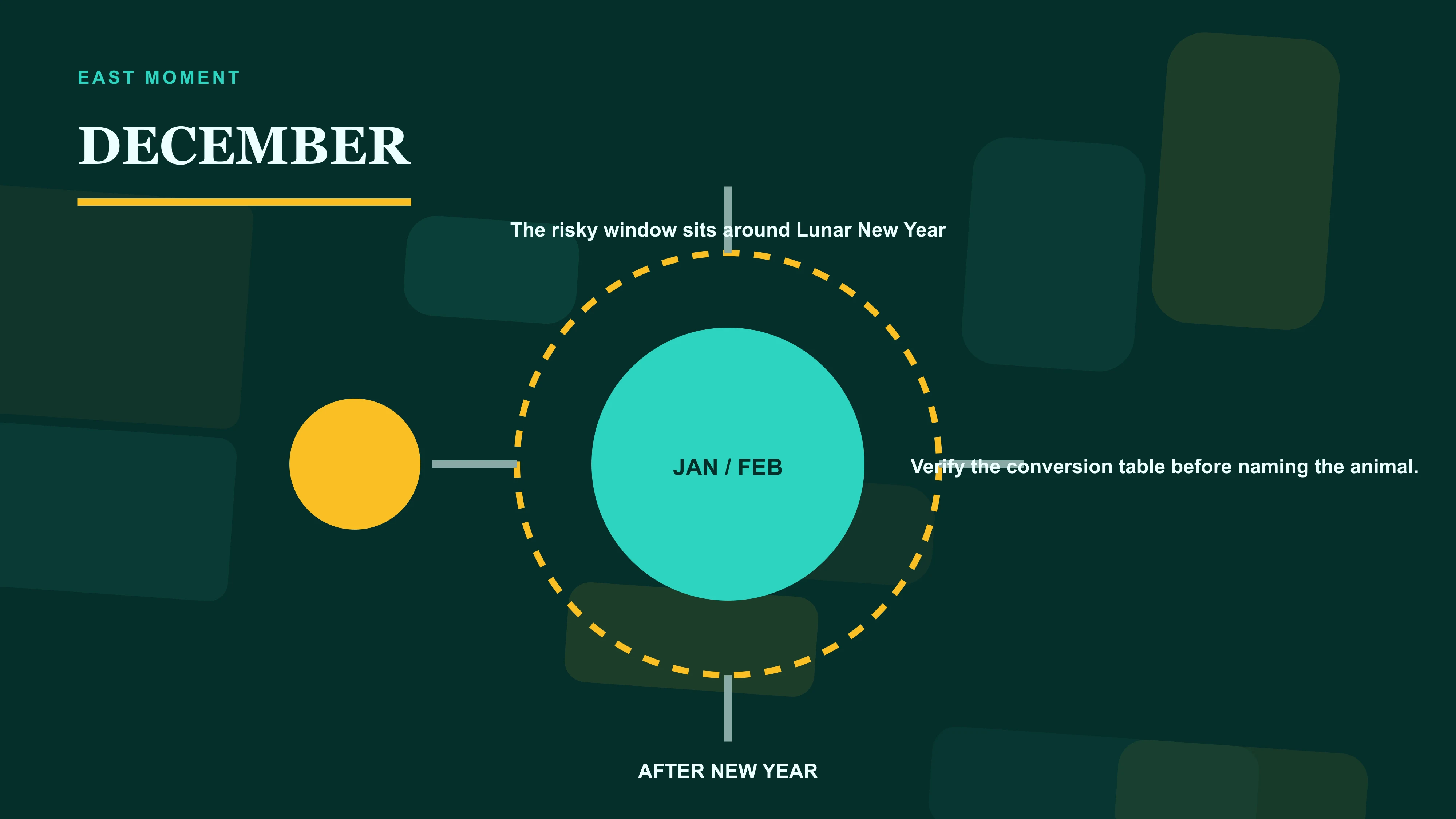
Take a child born on February 1 as the test. In one year, Lunar New Year may already have begun; in another, it may still be days away. The Gregorian year printed on the birth certificate therefore cannot settle the zodiac result. A reliable calculation compares the full date with the verified New Year date for that specific year.
The practical rule is blunt: if the birthday falls in January or February, inspect the boundary. If it falls on the boundary date itself, confirm the local date and do not rely on a search snippet. If a family record uses a lunar date, convert that record directly rather than guessing the corresponding Gregorian birthday from memory.
Read the result in layers, then stop before personality diagnosis
The animal is one layer of a sixty-year system. The earthly branch supplies the repeating twelve-part position; the heavenly stem contributes an elemental and yin-yang classification; the pair names a specific year. A result such as Fire Horse therefore says more than Horse, but it still does not provide a psychological test.
This is where I draw a hard line. A date conversion is calculable. Claims that the result proves loyalty, intelligence, marriage compatibility or career fate are cultural interpretations, entertainment or divination claims. They should not be smuggled into the output as if the calendar measured a personality. The zodiac years guide explains the repeating sequence; the Chinese zodiac hub separates calendar structure from the stories and symbols later attached to it.
Use the result to locate a year, ask how a family remembers it and enter the relevant animal page. Do not use it to rank children, reject a partner or outsource a decision. The calculator earns trust by knowing exactly where calculation ends.
Before you trust the result, test the input
A calculator result is only as precise as the date entered. Use the local civil date recorded for the birth, not a rough family memory such as “around Spring Festival.” For births close to midnight, the everyday animal-year answer normally follows the civil calendar date; a professional bazi reading may also ask for time zone, birth hour and a different year boundary. Those are different tasks.
The result layers should also stay separate. Animal is not element. The year's element is not a complete personal element balance. Compatibility folklore is not a relationship diagnosis. I want the tool to give a clean coordinate, then stop before it invents authority.
If your birthday falls in the boundary window, open the cited Observatory table and verify the New Year date yourself. That extra minute is worth more than a beautifully designed answer based on January 1. For a second reading system, see the zodiac compatibility guide only after the sign itself is correct.
A worked boundary check is better than a lucky guess
Suppose a birth certificate says 28 January 1990. The familiar Gregorian year suggests Horse, but Chinese New Year did not begin until 27 January that year, so Horse is correct by one day. Move the date to 26 January and the result changes to Snake. The two people can be born forty-eight hours apart and receive different zodiac animals. That is the exact problem a date-aware calculator solves.
For the first date, the tool should display 1990, Geng (庚), Wu (午), Yang Metal Horse and show January 27 as the boundary it checked. For the second, it should show 1989, Ji (己), Si (巳), Yin Earth Snake while still displaying the 1990 boundary used to decide which side of the line that birthday fell on. That distinction matters: the checked boundary belongs to the Gregorian input year, while the returned stem and branch belong to the resulting Chinese calendar year. A user should be able to audit both without guessing which number the interface means.
Now consider 4 February, when Lichun may fall near the same week. A specialist using the solar-term convention could label the year differently from a family using Spring Festival. Neither result should be presented without naming the convention. If two calculators disagree, compare their boundary rule before assuming one has broken arithmetic.
The tool also has a hard scope. It does not infer lunar birthday, fortune, health, career or marriage. A Gregorian-to-zodiac conversion is one calendrical operation. The moment a result page claims more, ask what additional inputs and interpretive school produced the claim. Precision includes knowing when to stop.
The answer should survive a family calendar
The final verification is deliberately old-fashioned. Put the reported birth date beside a printed or institutional Chinese calendar for that year. If the date falls before the first day of the first lunar month, keep the previous animal; if it falls on or after that day, use the new one. A transparent rule should survive outside the interface.
This also protects families whose remembered lunar birthday was later converted into a Gregorian date. Do not enter the lunar month and day as though they were Gregorian numbers. Convert first, then calculate. Mixing calendar systems can produce an answer that looks exact while being built from the wrong date.
For years outside 1901–2100, the tool refuses to improvise. That refusal is a feature. Use a specialist ephemeris or an institutional historical calendar, especially where local timekeeping and calendar reform matter. A smaller honest result is better than false universal coverage.