Chinese zodiac compatibility charts describe relationships among the twelve Earthly Branches. They do not measure communication, trust, attraction or safety between two people. Use them as a traditional symbolic map and conversation ritual—not as permission to enter, leave or judge a relationship.
Chinese zodiac compatibility chart
Three patterns produce most popular answers: a close Six Harmonies partner, a three-animal Three Harmonies group and the branch directly opposite in the twelve-part cycle.
| Animal | Six Harmonies partner | Three Harmonies allies | Opposite branch |
|---|---|---|---|
| Rat | Ox | Dragon, Monkey | Horse |
| Ox | Rat | Snake, Rooster | Goat |
| Tiger | Pig | Horse, Dog | Monkey |
| Rabbit | Dog | Goat, Pig | Rooster |
| Dragon | Rooster | Rat, Monkey | Dog |
| Snake | Monkey | Ox, Rooster | Pig |
| Horse | Goat | Tiger, Dog | Rat |
| Goat | Horse | Rabbit, Pig | Ox |
| Monkey | Snake | Rat, Dragon | Tiger |
| Rooster | Dragon | Ox, Snake | Rabbit |
| Dog | Rabbit | Tiger, Horse | Dragon |
| Pig | Tiger | Rabbit, Goat | Snake |
This table answers the search question, but it does not prove that one column predicts real outcomes. The rest of the page explains what the geometry is doing.
If either birth animal is uncertain, first identify it from the complete Chinese zodiac cycle and verify the lunar-year boundary in the Chinese zodiac years guide. Element labels belong to a separate stem layer explained in the Chinese zodiac elements guide.
What if your two animals appear in none of the three columns together? That is an ordinary result, not a missing score. This chart selects three named relationships from a twelve-position cycle; it does not assign every possible pair a single verdict. Check both animals' rows before concluding they have no named relationship, since one row may list the other under a trine. Even if they are absent from all three, “not classified here” does not mean incompatible.
Our conclusion: compatibility charts map a system, not a couple
Most online tools jump from two birth years to sentences such as “perfect match” or “avoid.” That certainty is not earned.
The chart starts with twelve positions. Pairings, triangles and oppositions create memorable relationships across that circle. Animals then give those branch positions personalities and stories. The result is a symbolic grammar. It can structure a conversation, but it cannot observe the relationship being judged.
A chart cannot know whether two people listen, repair conflict, share values or respect boundaries. Those facts outrank animal pairing every time. The Hong Kong Observatory's explanation of Heavenly Stems and Earthly Branches establishes the calendrical naming system; it does not claim to measure a couple's future.
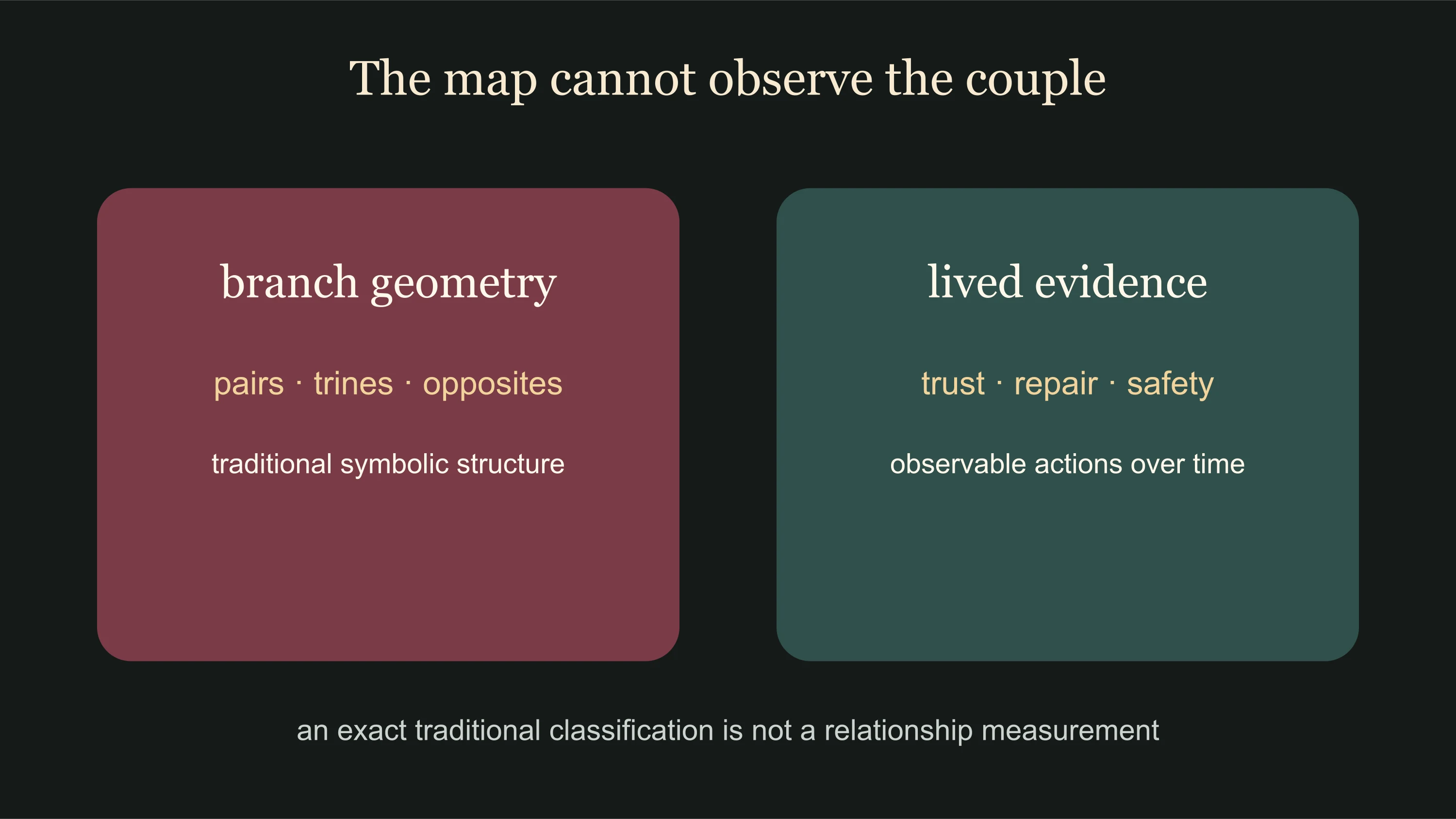
I understand why a percentage feels satisfying. “87%” appears to settle anxiety that conversation cannot. But no measurement occurred: the tool did not observe an apology, a broken promise, shared work or fear. A clean number can therefore be less honest than a cautious question.
Six Harmonies: six close pairs
The six pairings are Rat-Ox, Tiger-Pig, Rabbit-Dog, Dragon-Rooster, Snake-Monkey and Horse-Goat.
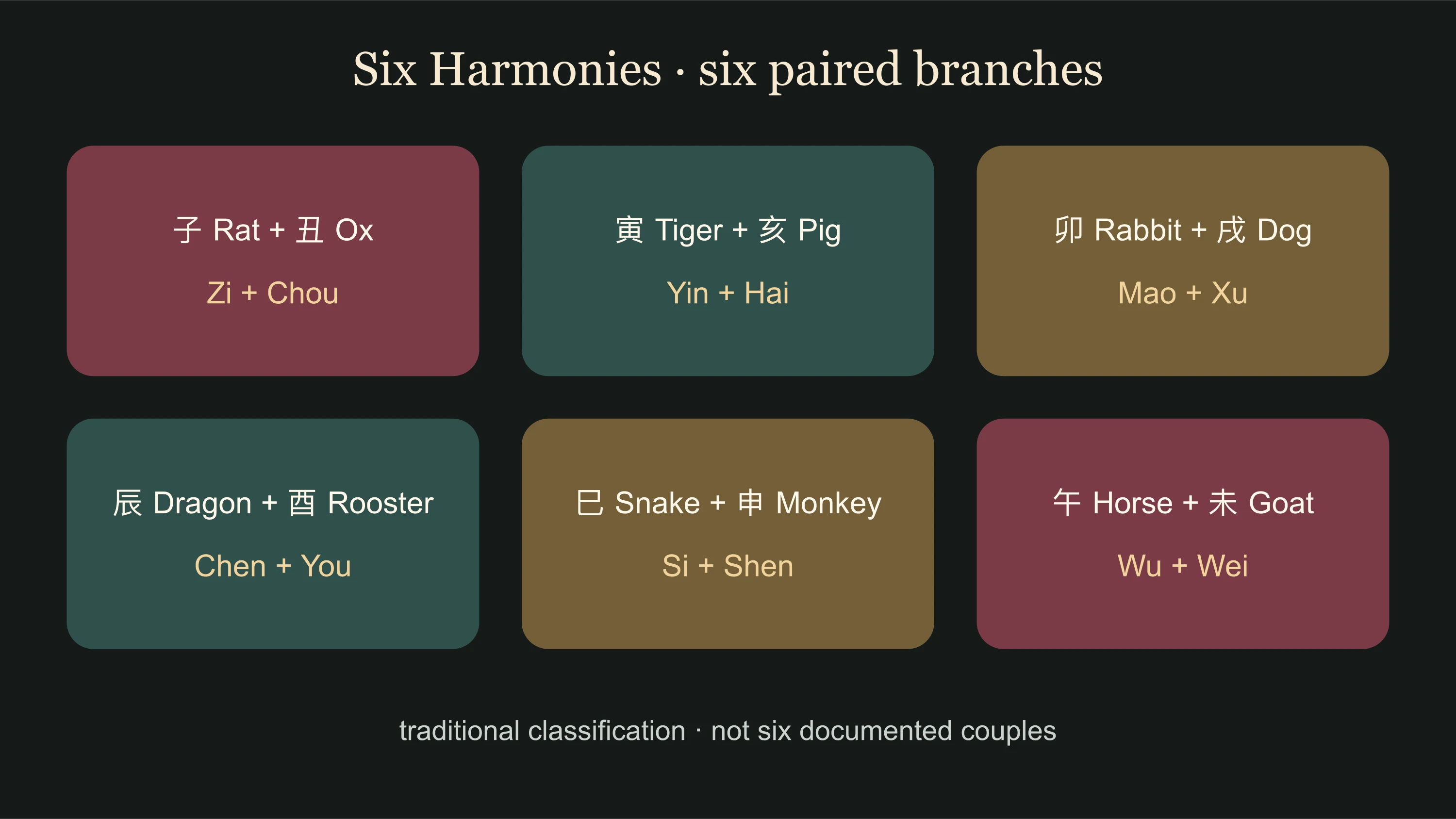
These are often marketed as “best matches.” A better label is paired branches. The pattern joins the twelve positions into six relationships without leaving an animal unpaired.
A Xingtang County government record of local marriage customs lists these same six animal pairs under liuhe. Just as importantly, the record describes the old practice as fortune-telling and says such taboos broke apart good marriages. It documents that the classification was used; it does not validate the verdicts people drew from it.
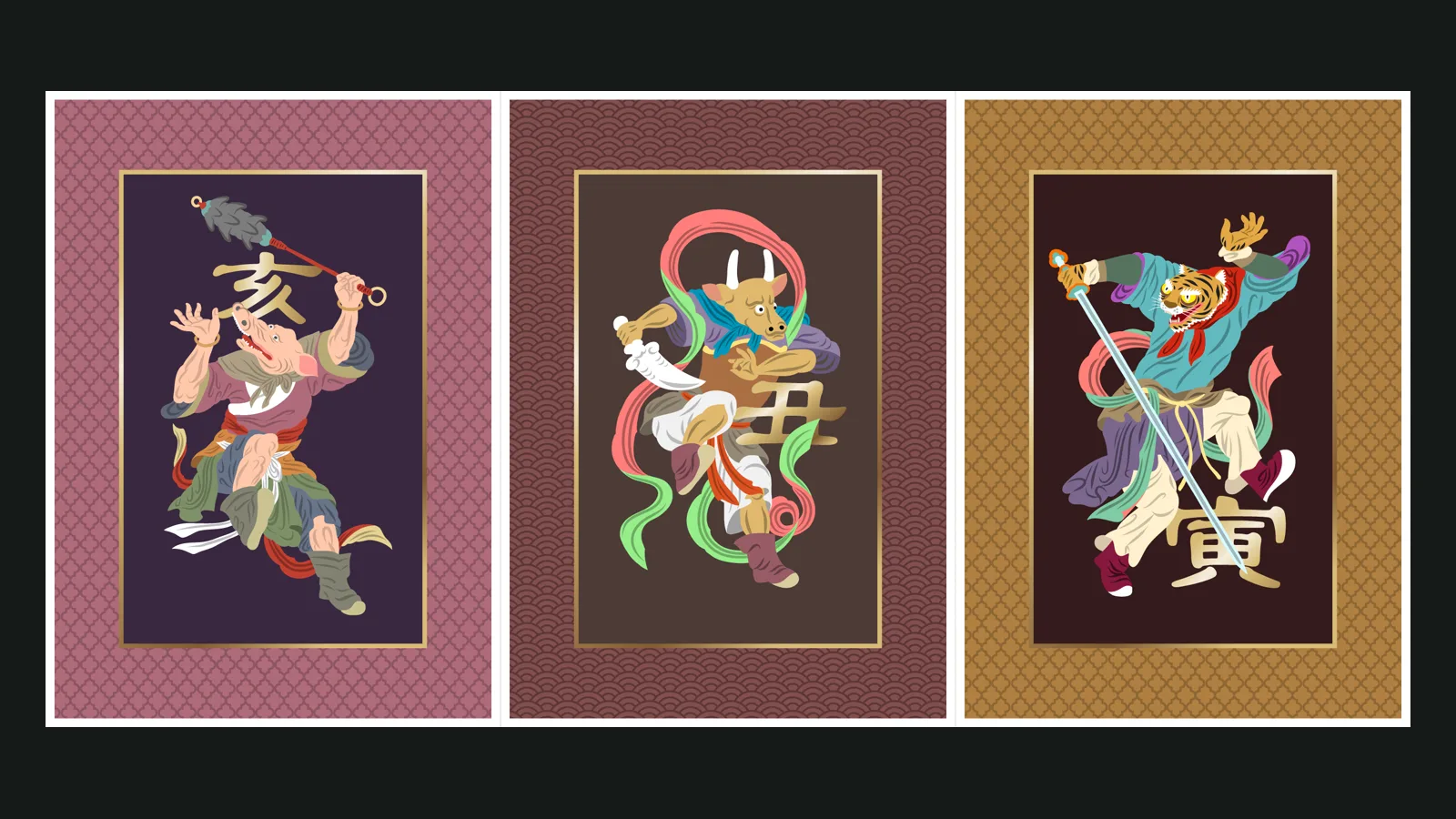
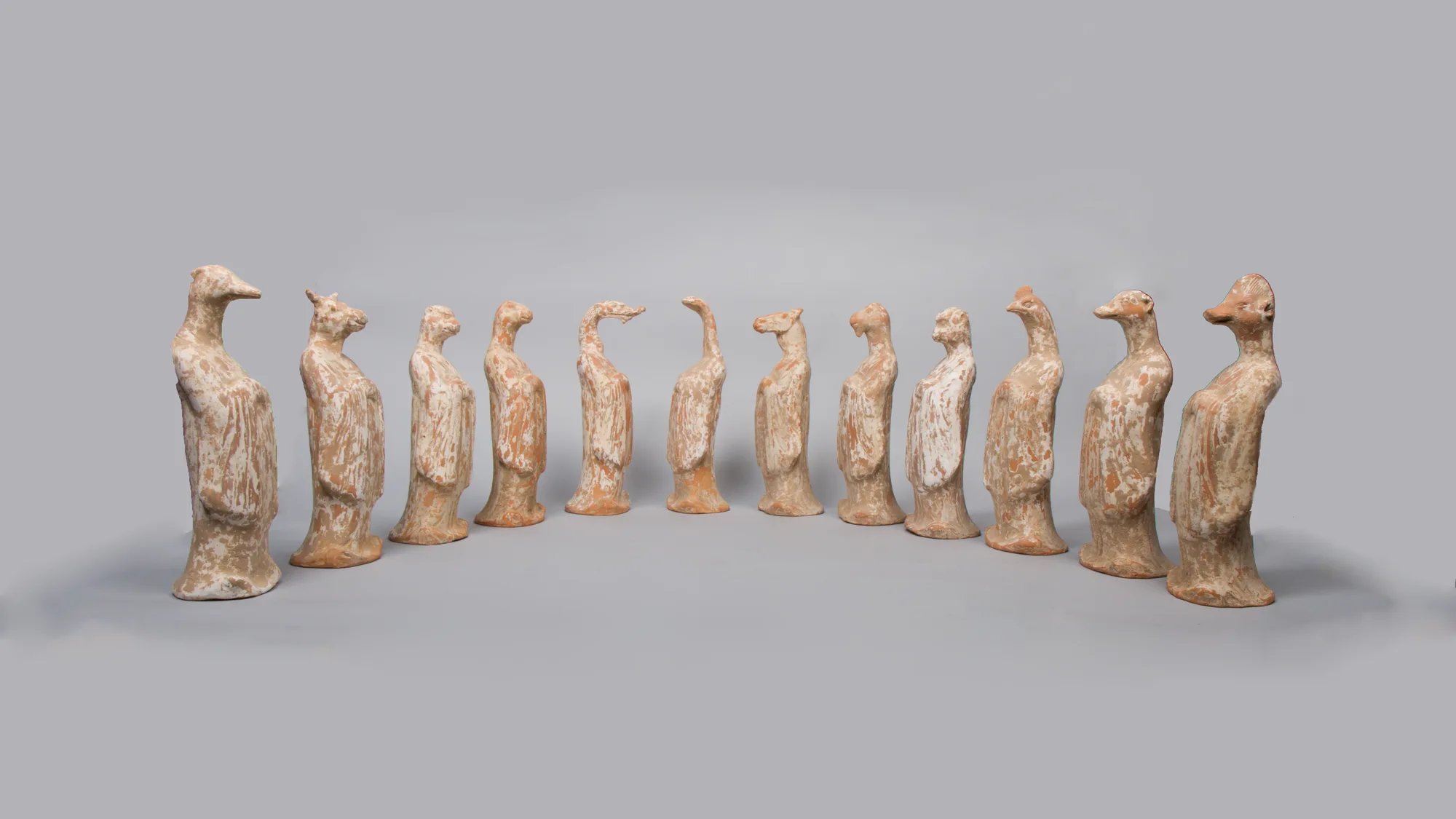
The image makes the structure visible, but it does not document six historical couples or prove emotional compatibility. Its evidence is diagrammatic: these are the six pairings the article is discussing.
Three Harmonies: four larger groups
The four trines are:
- Rat, Dragon and Monkey.
- Ox, Snake and Rooster.
- Tiger, Horse and Dog.
- Rabbit, Goat and Pig.
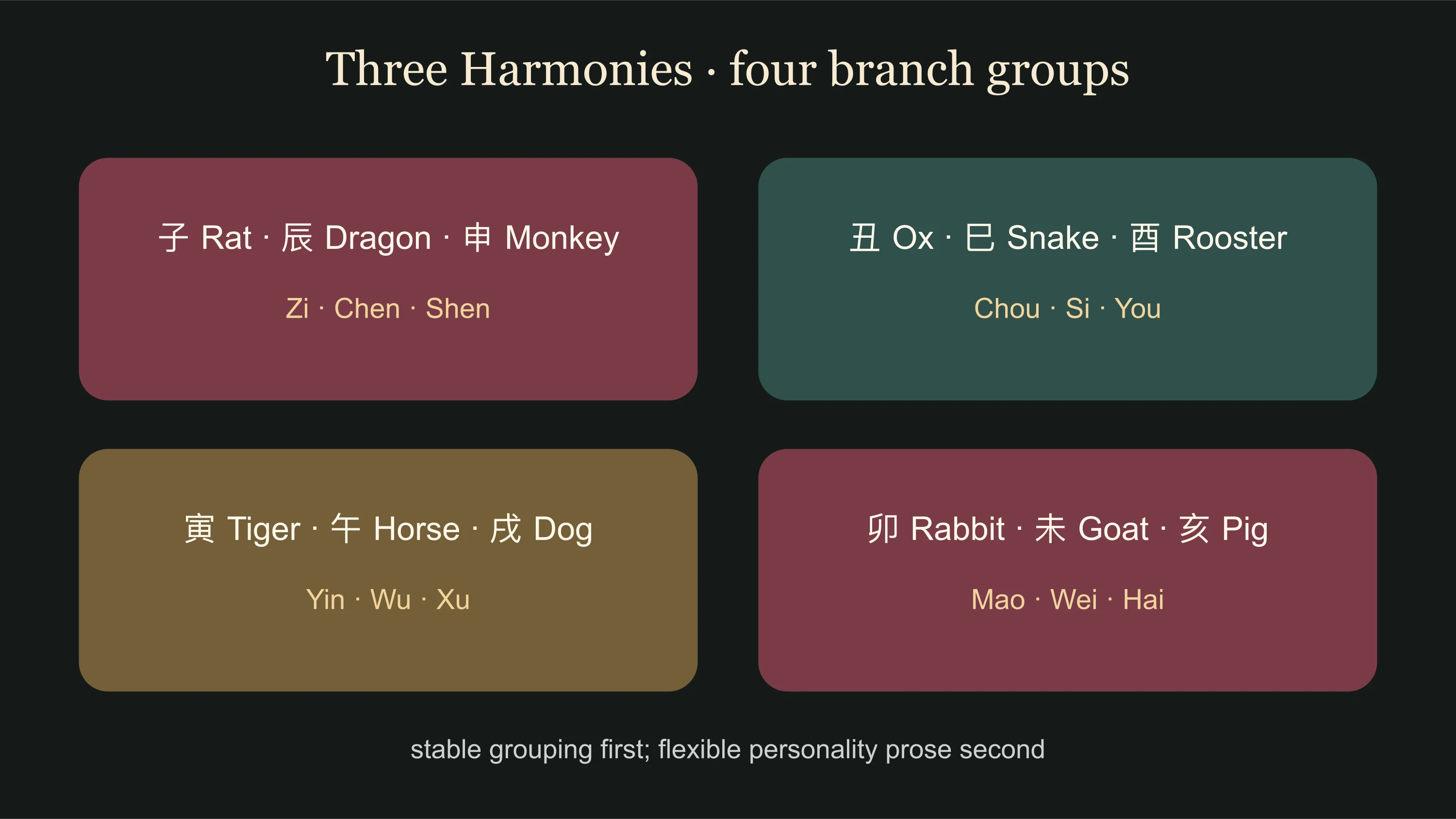
Each group connects three branches spaced through the cycle. Popular interpretations give each trine shared qualities, but those descriptions vary by source. The stable part is the grouping; personality copy is the flexible layer added on top.
The term has a documented technical meaning beyond modern love-match copy. Taiwan's Ministry of Education dictionary defines sanhe as a branch-and-Five-Phases grouping built from three positions. A passage in the Huangdi Neijing groups the same four sets of branches as years whose qi “meet together”: Yin-Wu-Xu, Mao-Wei-Hai, Chen-Shen-Zi and Si-You-Chou. Read through the animal layer, those are the four rows above. This is evidence for the branch groups, not for personality traits or romantic outcomes.
This explains why a sign can have more than one “compatible” answer. A Rat may be paired with Ox under Six Harmonies while grouped with Dragon and Monkey under Three Harmonies. The systems are not necessarily contradicting each other; they are drawing different shapes.
Opposites do not mean doomed relationships
The six oppositions are Rat-Horse, Ox-Goat, Tiger-Monkey, Rabbit-Rooster, Dragon-Dog and Snake-Pig. They sit across the branch cycle and are often described as clashes.
“Clash” is a structural label before it becomes a relationship verdict. Opposing positions can be narrated as tension, contrast or change. Turning that into “these people should never marry” is an unjustified leap.
Real relationships can be harmed by contempt, coercion, dishonesty or incompatible goals. None of those conditions can be inferred from a zodiac opposition.
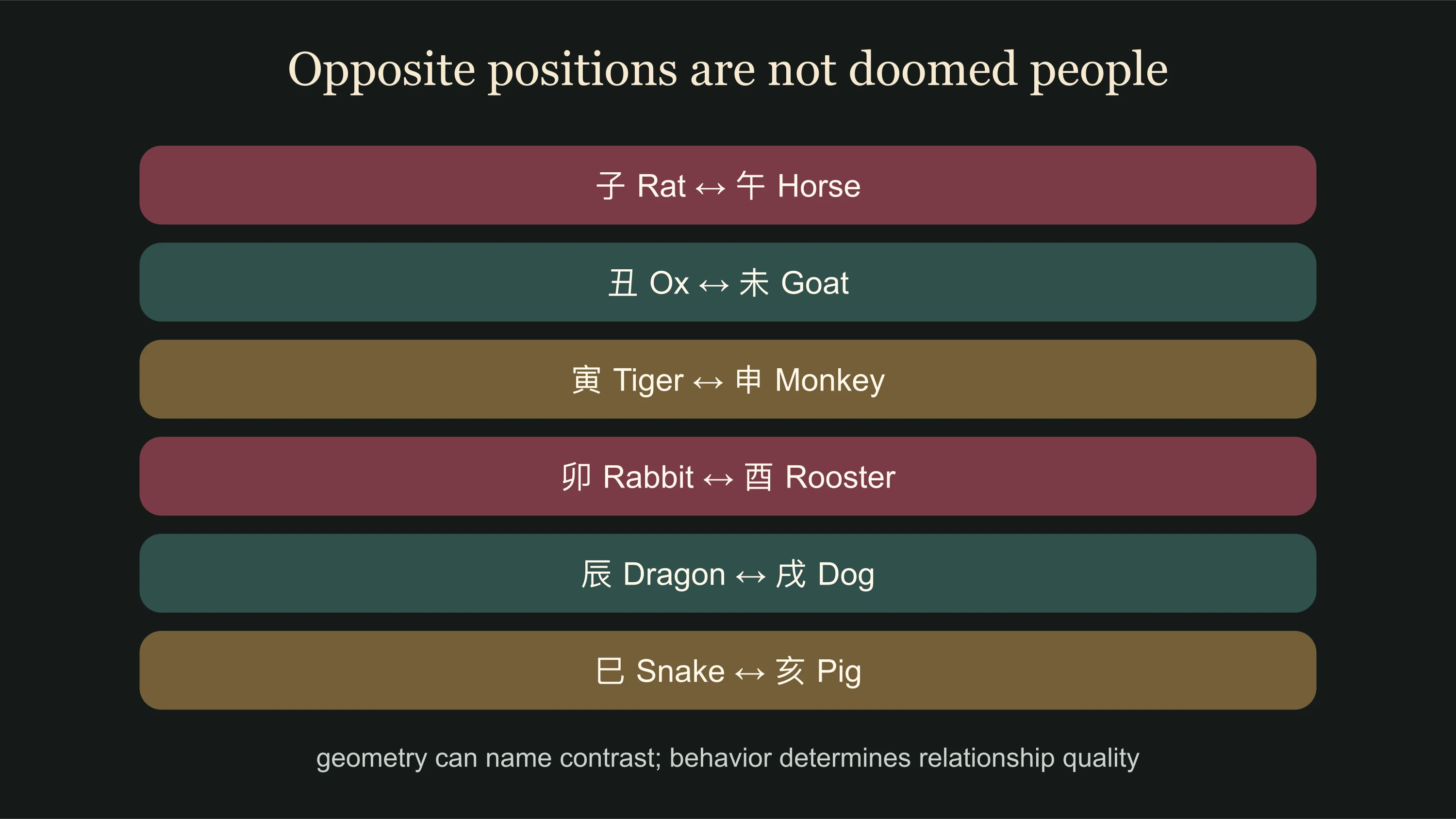
Opposition can still be useful as narrative material. A family may use it to name differences, tease a couple or explain a decoration. The responsible move is to return from symbol to behavior: what is the actual conflict, how do the people respond and is anyone unsafe? The branch map cannot answer those questions for them.
Why two compatibility sites disagree
Disagreement usually comes from one of four causes:
- One site uses Six Harmonies while another emphasizes Three Harmonies.
- One includes elements and full birth charts; another uses the birth-year animal only.
- A January or February birthday has been assigned the wrong animal.
- Personality prose has been invented around a stable pairing table.
Start by verifying both signs with full birth dates. Then ask which matching system the result uses. A tool that says “92% compatible” without explaining its model is performing precision, not providing it.
The same warning applies when a site adds elements but never says how they are weighted. More inputs do not automatically create a better model. If the scoring rule, boundary convention and evidence standard remain hidden, complexity becomes decoration around the same unsupported verdict.
Take two hypothetical readings. A Rat and an Ox appear as a Six Harmonies pair. A site may convert that label into “excellent marriage prospects,” but the table has observed no marriage; its defensible answer is simply that these two branches form a traditional pair. A Dragon and a Dog appear under opposition. That tells you how the branches sit in the cycle, not whether two actual people can discuss money or care for one another. The two cases are not competing prophecies. They demonstrate the same mistake at opposite ends of a sales pitch: replacing evidence about conduct with confidence about a diagram.
Chinese zodiac love compatibility starts with the correct year
January and early-February birthdays are where confident compatibility charts most often fail before interpretation has even begun. The zodiac year does not switch on January 1. Chinese New Year moves within the Gregorian calendar, so a person born before that year's lunar new year usually belongs to the preceding zodiac year. A tool that asks only for a four-digit birth year can assign the wrong animal and still print a polished result.
Use the Chinese zodiac calculator or an official calendar table to establish both animals first. Then separate three questions that popular pages usually compress into one:
- What is each birth-year branch? This is a calendar question with a checkable boundary.
- What relationship does the traditional branch scheme assign? This is a classification question: pair, trine, opposition or none of those.
- What is the relationship actually like? This is a human question that requires observation, memory and conversation.
I insist on that separation because the emotional stakes are real. People often search compatibility when they are attracted, anxious, facing family pressure or trying to explain a conflict. That is exactly when a categorical answer feels most comforting and does the most damage. A wrong sign is a technical mistake; treating the right sign as a verdict is the larger mistake.
“Best match” is a cultural claim before it is personal advice
In family conversation, zodiac language can perform several jobs at once. It may be a joke between generations, a remembered marriage custom, a polite way to voice unease, or an attempt to give tradition authority over a decision someone already dislikes. The words sound like astrology, but the social action may be negotiation.
That is why I would never answer family pressure with another absolute chart. Ask what the objection is protecting. Is someone worried about money, distance, care for parents, temperament, religion, safety or reputation? Those are concrete concerns. “Tiger and Monkey clash” can conceal them without resolving any of them.
The Xingtang local-government account cited above matters because it records both the pairings and the harm done when taboos were treated as decisive. It gives us evidence of practice and evidence of criticism inside Chinese public culture. It does not justify mocking older relatives. It just removes the false choice between respecting tradition and surrendering judgment.
A four-question test is more honest than a compatibility percentage
If two people want to use the chart without letting it use them, replace the percentage with four questions:
| Ask this | What it reveals | What the zodiac cannot supply |
|---|---|---|
| How do we repair a disagreement? | Conflict behavior and emotional safety | No animal pairing observes an apology |
| Which obligations are non-negotiable? | Values, family duties and future plans | A trine does not create shared priorities |
| Where does money become stressful? | Risk tolerance, secrecy and practical habits | An element label is not a budget |
| Can either person say no without punishment? | Respect and power | “Good compatibility” cannot cancel coercion |
This is not a sterile replacement of culture with psychology jargon. It is the responsible next movement: begin with the symbolic story, then look at the life being lived. A Rat-Ox pair that cannot tell the truth is not rescued by liuhe. A Dragon-Dog pair that listens, repairs and protects one another is not condemned by opposition.
Compatibility can describe a story without deciding its ending
The zodiac survives partly because twelve animals are memorable enough to carry family stories. A grandmother may recall who objected to a match. A couple may turn a supposed clash into a private joke. Parents may compare siblings through signs long after forgetting the technical branch relationships. These uses are culturally meaningful even when they are not predictive.
I like the chart most when it opens memory instead of closing choice. Ask who introduced the pairing, what decision was being discussed and what happened afterward. That story tells us how custom moved through one household. It also lets younger and older relatives disagree without pretending one percentage has settled the argument.
How to use compatibility responsibly
Compatibility folklore works best as a low-stakes prompt:
- Compare how family members talk about the signs.
- Notice which branch relationship a wedding decoration invokes.
- Ask whether a description feels flattering because it is broad.
- Use disagreement with the chart to discuss the real relationship.
Do not use it to screen tenants, employees, partners or children. Do not excuse harmful behavior because two animals supposedly match.
The strongest answer to “Are these signs compatible?” is therefore two-part: identify the traditional branch relationship accurately, then refuse to pretend it knows the people better than their actions do.
For East Moment, that is the conversion point from lookup to community: readers can share how compatibility language appeared in their families without surrendering judgment to it. The interesting story is not whether a table approved a couple. It is what people did when custom, affection and lived evidence disagreed.
Bring that specific memory to East Moment Moments: the animals, the advice, the decision and the behavior that eventually mattered. Return to this page as those accounts accumulate across families and generations. They will never turn folklore into relationship science; they will show what the folklore actually does in human lives.
Behavior remains the final evidence.