Your Chinese zodiac animal comes from the Earthly Branch of the year. Your year element comes from its Heavenly Stem. The animal does not own one fixed element: a Rat year can be Wood, Fire, Earth, Metal or Water depending on the stem.
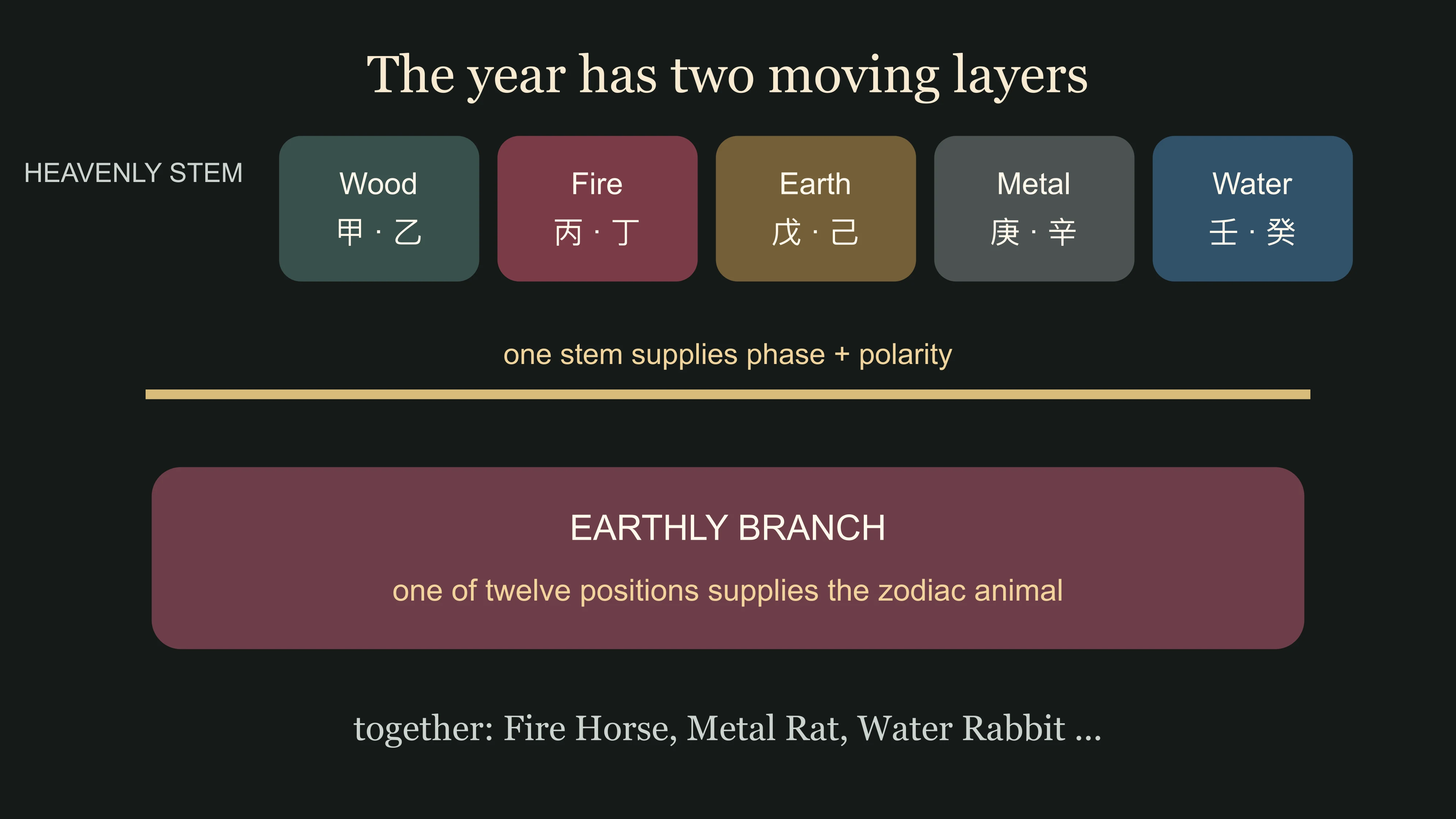
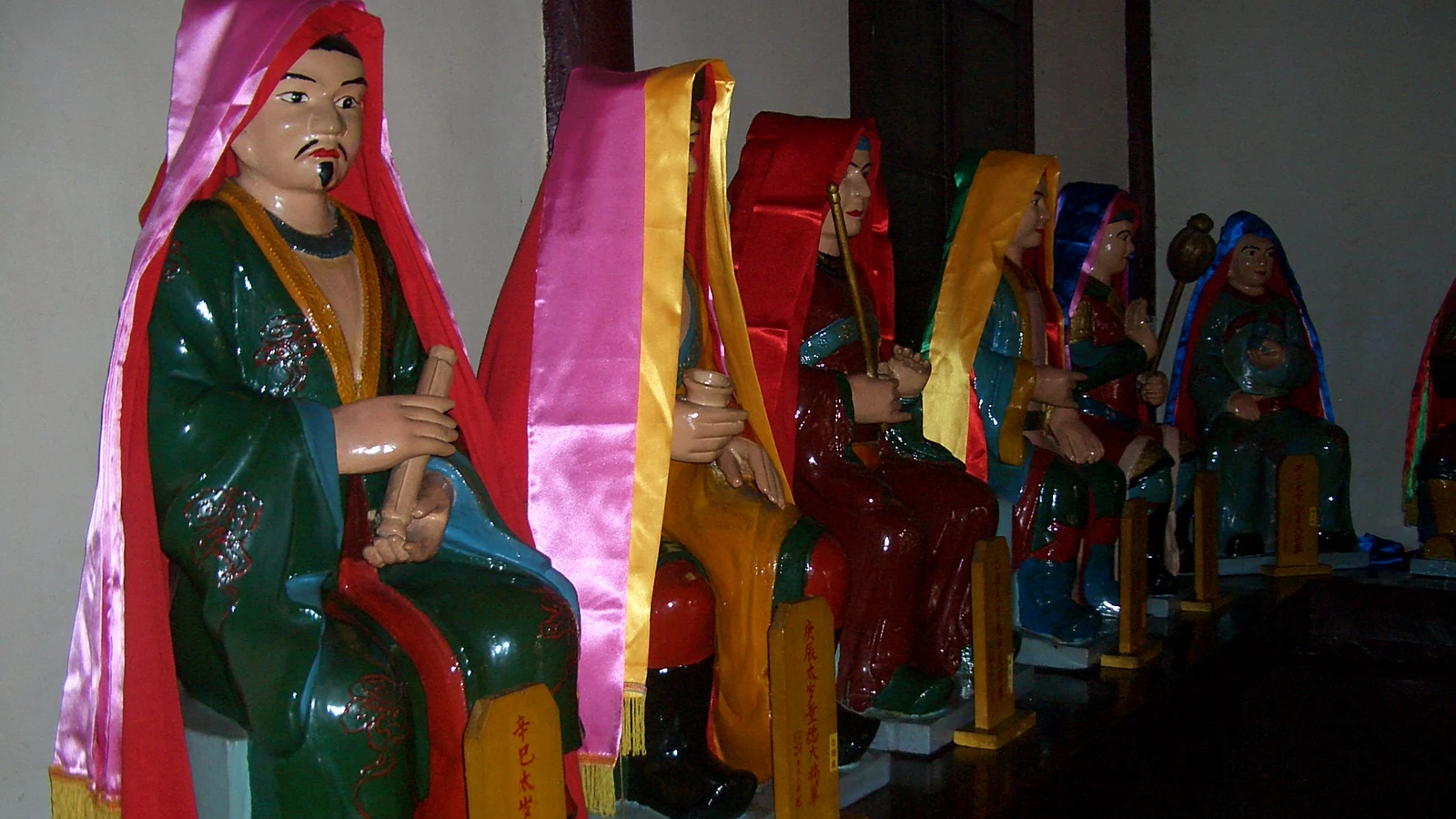
The Wuhan photograph above records one Jiazi Hall where the sixty-year cycle has institutional and devotional presence. It does not prove that every visitor interprets Tai Sui alike, and it does not calculate a birth-year element. The diagram separates the stem and branch machinery that the photograph cannot show.
Chinese zodiac elements: find yours quickly
For birthdays after Chinese New Year, the final digit of the Gregorian year gives the stem element and yin-yang polarity:
| Year ends in | Heavenly Stem | Element | Polarity |
|---|---|---|---|
| 4 | Jia 甲 | Wood | Yang |
| 5 | Yi 乙 | Wood | Yin |
| 6 | Bing 丙 | Fire | Yang |
| 7 | Ding 丁 | Fire | Yin |
| 8 | Wu 戊 | Earth | Yang |
| 9 | Ji 己 | Earth | Yin |
| 0 | Geng 庚 | Metal | Yang |
| 1 | Xin 辛 | Metal | Yin |
| 2 | Ren 壬 | Water | Yang |
| 3 | Gui 癸 | Water | Yin |
If the birthday falls in January or early February, first determine the correct Chinese calendar year. January 2026 was still Yi-Si Wood Snake; Bing-Wu Fire Horse began on February 17.
The complete Chinese zodiac guide explains the animal and Earthly Branch layer. Use the Chinese zodiac years table when an exact New Year boundary must be checked before assigning the stem.
Our conclusion: element and animal are two different wheels
Many charts imply that each animal has a natural element, then ask users to look up a separate “birth element.” This creates confusion because several correspondences are being compressed.
For the annual zodiac name, think of two wheels:
- Ten Heavenly Stems carry yin-yang and one of five phases.
- Twelve Earthly Branches carry the positions paired with zodiac animals.
The Hong Kong Observatory's Heavenly Stems and Earthly Branches reference is the compact institutional check behind that distinction. It keeps the ten-position and twelve-position systems separate before they are recombined into a year name.
Advance both wheels one step per year. Because ten and twelve realign after sixty steps, the identical stem-branch year returns every sixty years.
The element is not painted onto the animal after the fact. Stem and branch jointly name the year. 2026 is Bing-Wu: yang Fire plus Horse. 2025 is Yi-Si: yin Wood plus Snake.
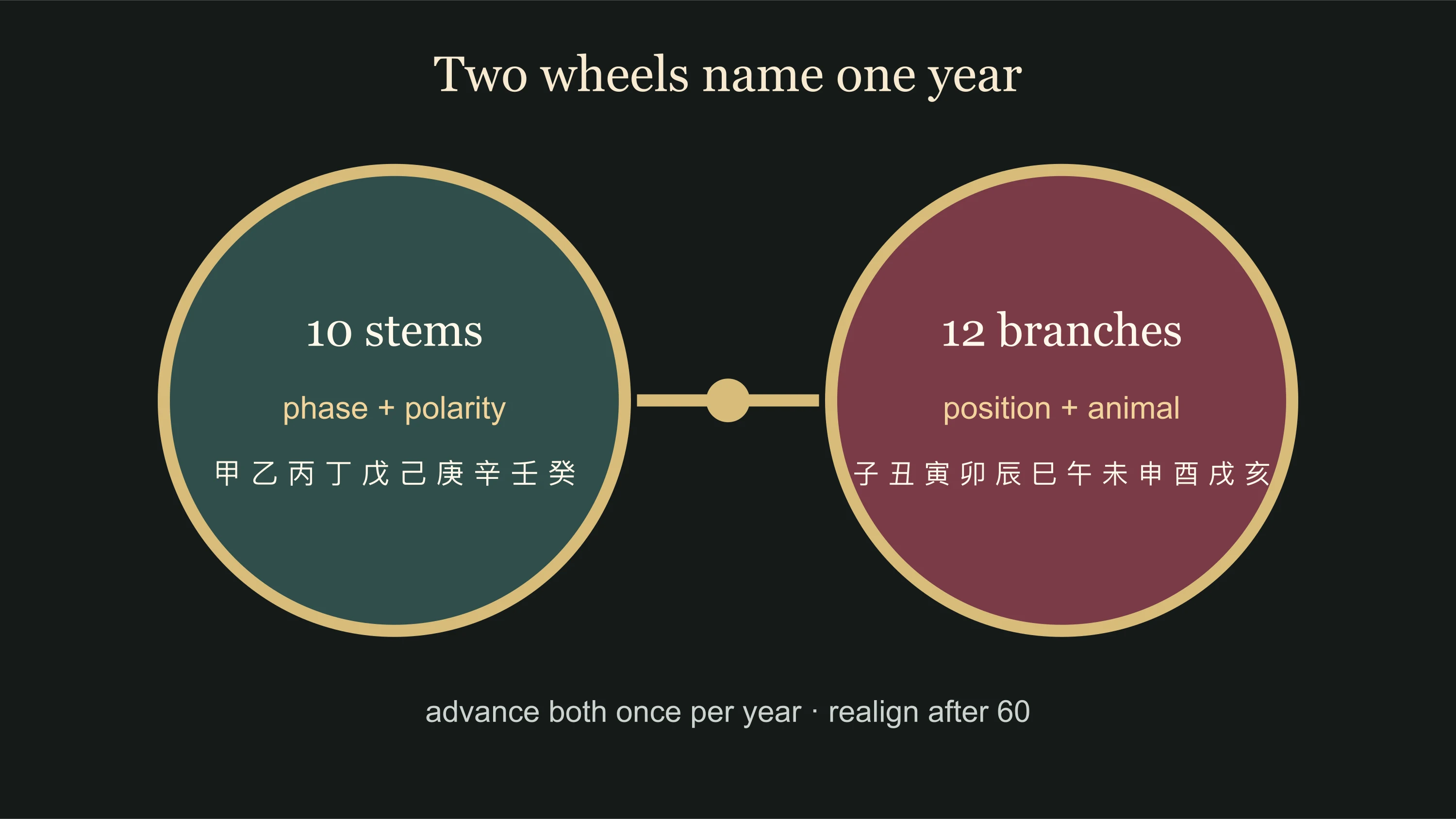
The wheel metaphor solves a mistake that color-coded animal charts often create. A red Horse may be a designer's palette; it is not evidence of a Fire Horse unless the year or Bing/Ding stem is supplied. The animal image identifies the branch layer. The element needs its own label.
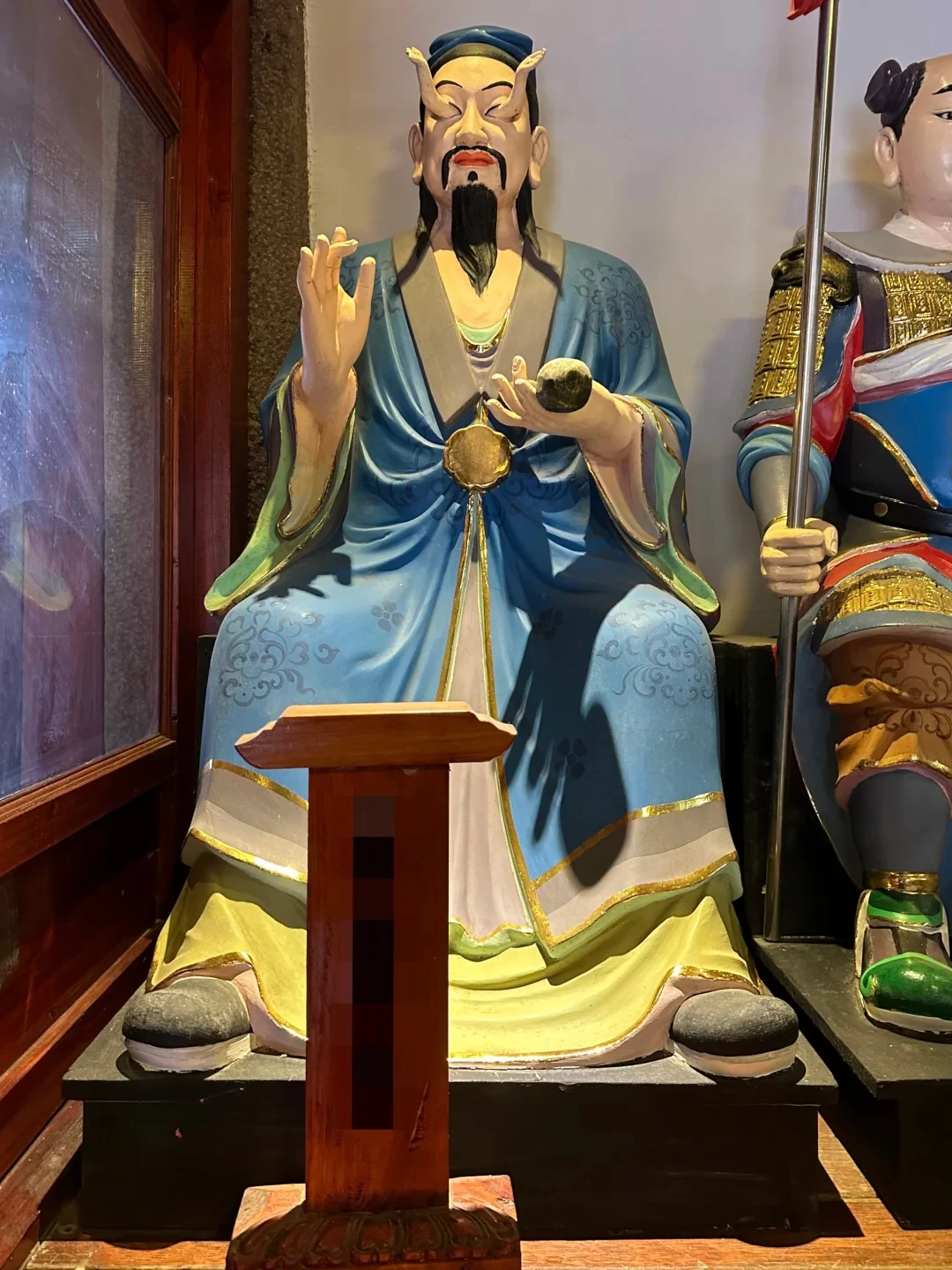
The close view matters because the sixty-year cycle is not displayed as one anonymous “zodiac god.” It is embodied through distinct figures within a Jiazi hall. Yet clothing color, face or object in hand cannot reveal this figure's stem-branch name without its label—and certainly cannot calculate a visitor's birth element.
The picture shows only one layer
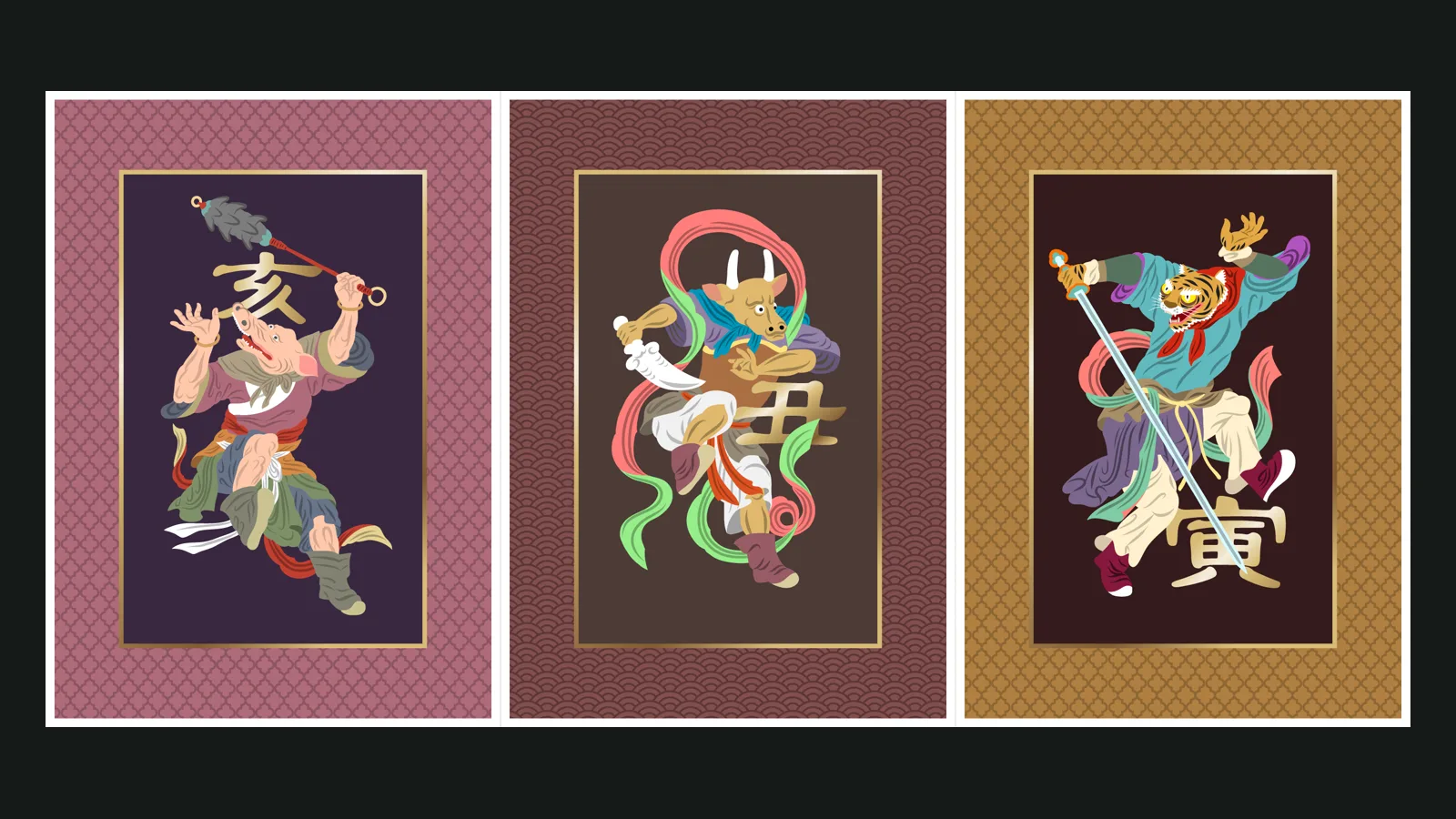
The twelve-animal wheel above shows the branch layer, but it cannot tell you a year's element by itself. The Tai Sui figures in the Wuhan Jiazi Hall give the sixty-year system a very different physical setting; their photograph cannot calculate an individual birth element either. The diagram explains a relationship between numbers, while the photograph records a particular place. Neither should be asked to prove what the other cannot.
A Horse image may represent 1966 Fire Horse, 1978 Earth Horse, 1990 Metal Horse, 2002 Water Horse or 2014 Wood Horse. You need the year or stem character to choose among them.
This is where I distrust the color-coded animal chart. You can paint a Horse red for a festival without making it a Fire Horse; the actual annual label still needs a stem and an exact year boundary. Let the picture draw your eye to the animal, then let the dated calendar decide the full name.
The ten Heavenly Stems
The stems form five yin-yang pairs:
| Element or phase | Yang stem | Yin stem |
|---|---|---|
| Wood | Jia 甲 | Yi 乙 |
| Fire | Bing 丙 | Ding 丁 |
| Earth | Wu 戊 | Ji 己 |
| Metal | Geng 庚 | Xin 辛 |
| Water | Ren 壬 | Gui 癸 |
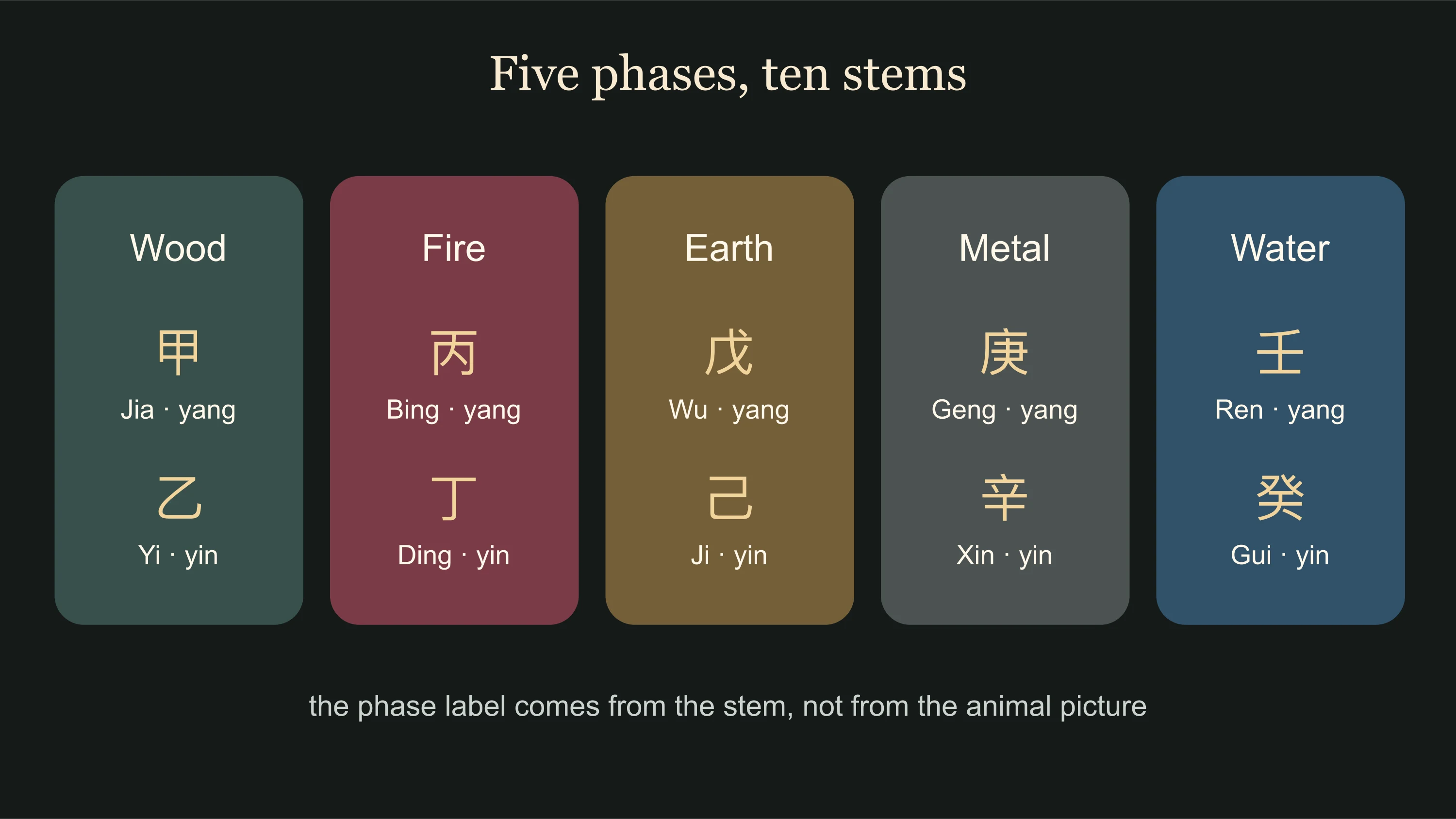
The English word “element” is convenient but imperfect. Wuxing (五行) is often better understood as five phases, processes or modes of change rather than five inert substances. Wood, Fire, Earth, Metal and Water describe relationships and transformations across multiple Chinese knowledge systems.
This distinction is not cosmetic translation advice. The Stanford Encyclopedia of Philosophy places wuxing within cycles of generation and overcoming, while the Internet Encyclopedia of Philosophy calls the five phases dynamic, interdependent modes rather than unchanging material blocks. “Element” remains useful for search and year labels; “phase” better explains what the system is doing.
This page has a narrower purpose: explain how those five labels enter a zodiac year through the Heavenly Stem.
Why one animal appears with five elements
Take Rat years:
| Year | Stem-branch | Full label |
|---|---|---|
| 1984 | Jia-Zi 甲子 | Yang Wood Rat |
| 1996 | Bing-Zi 丙子 | Yang Fire Rat |
| 2008 | Wu-Zi 戊子 | Yang Earth Rat |
| 2020 | Geng-Zi 庚子 | Yang Metal Rat |
| 2032 | Ren-Zi 壬子 | Yang Water Rat |
The Rat returns every twelve years, while the stem advances through its ten-position sequence. After five Rat returns—sixty years—the exact Jia-Zi pairing comes back.
All Rat years in this sequence are yang because Zi is a yang branch and valid stem-branch pairings preserve matching polarity. The cycle does not combine every stem with every branch; only sixty of the possible 120 pairings occur.
That last constraint is easy to miss. Ten times twelve suggests 120 combinations, but polarity keeps odd-position stems with odd-position branches and even with even. Half the mathematical pairings never occur in the traditional sequence. The sixty-year cycle is therefore structured alignment, not random mixing.
Could there be a Yin Fire Horse year? Not in this annual stem-branch sequence. The Horse branch Wu 午 occupies an odd, yang position. Fire appears in two stems: Bing 丙 is yang Fire and Ding 丁 is yin Fire. Only Bing can meet Wu in a valid pairing. The next annual step after Bing-Wu 2026 is Ding-Wei 丁未, Yin Fire Goat in 2027, beginning at that year's New Year boundary. This is a useful check on graphics that offer every element in both polarities for every animal. Five elements per animal is possible across sixty years; ten element-polarity combinations per animal are not.
That restriction does not describe the character of a Horse-born person. It describes which names the calendar can generate. To see how one such name is interpreted without treating it as fate, read the 2026 Year of the Horse guide.
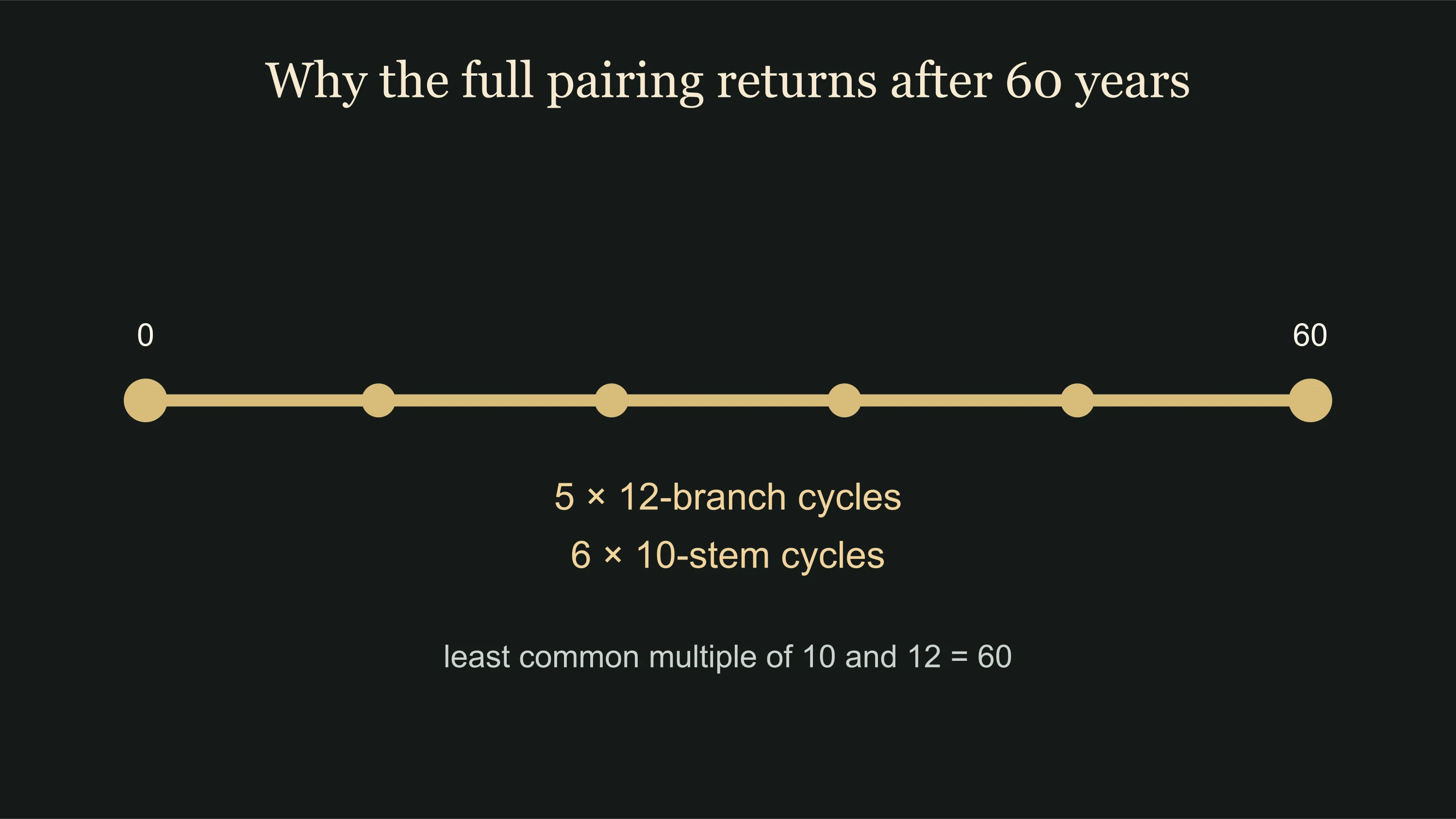
The least common multiple is the clean arithmetic explanation: sixty is the smallest number divisible by both ten and twelve. After sixty annual advances, both wheels return to their starting positions together. That is why 1984 and 2044 can both be Jia-Zi Wood Rat, while 1996 is also Rat but carries Bing Fire.
Year element is not a complete birth chart
A birth-year label is only one layer in systems such as bazi, which can use year, month, day and hour pillars. Calling someone a “Metal Ox” from their birth year does not reproduce a full professional chart.
This boundary matters because commercial calculators often turn one annual label into detailed claims about career, health or compatibility. The precision of the prose exceeds the precision of the input.
Use the year element to name a calendrical position and understand cultural design. Do not treat it as medical, financial or relationship evidence.
Three mistakes to avoid
- Using January 1 as the boundary. Check Chinese New Year for general zodiac identity.
- Assuming an animal has one permanent element. The year stem changes the label.
- Confusing Wu 戊 with Wu 午. 戊 is the yang Earth stem; 午 is the Horse branch. Romanization can match while characters and roles differ.
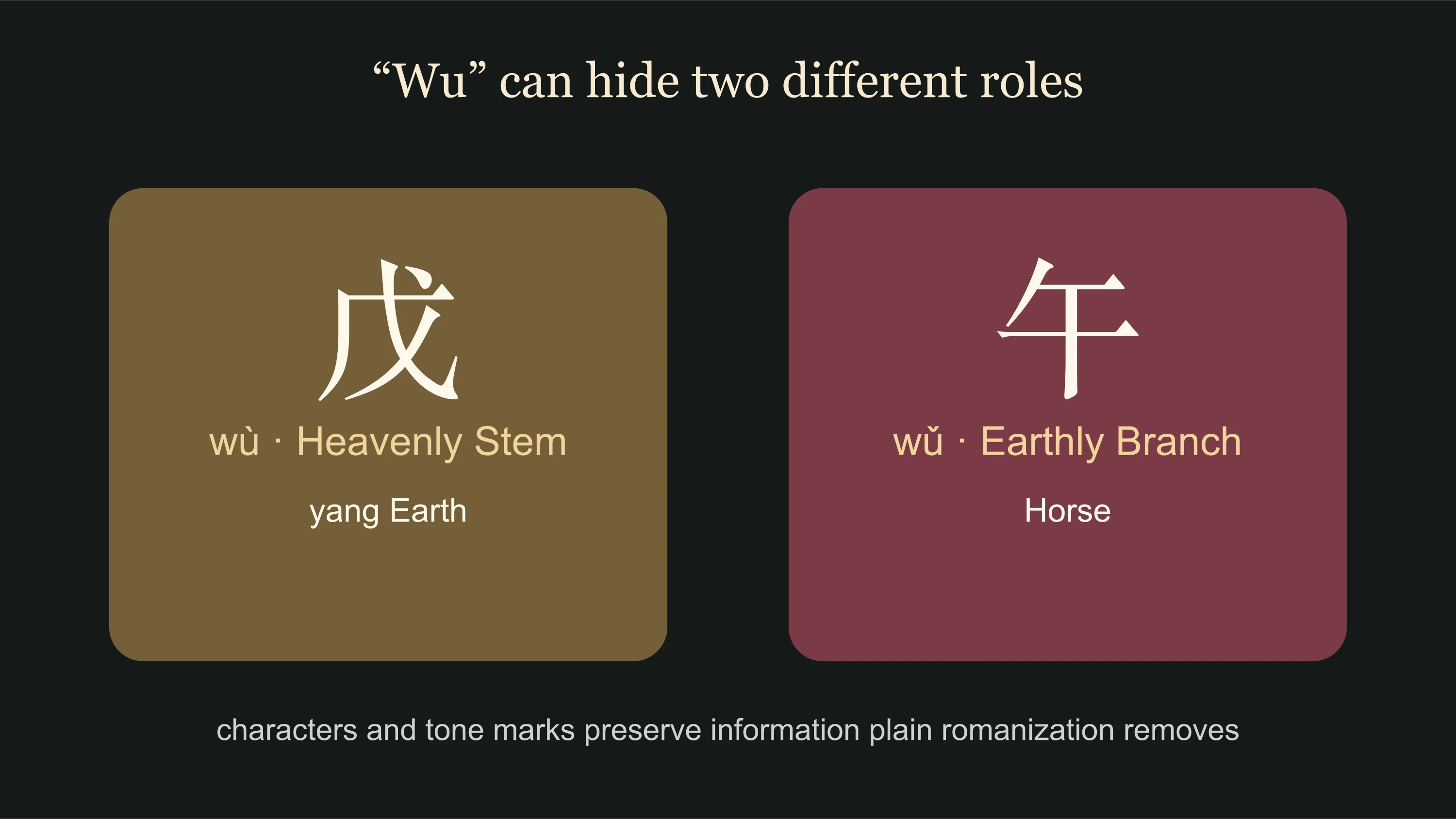
This is where English-only tables become fragile. Tone marks would distinguish wù 戊 from wǔ 午, but many search results omit them. Characters restore the difference immediately: one belongs to the ten stems and supplies Earth; the other belongs to the twelve branches and supplies Horse. If a calculator shows only “Wu,” it has removed information the reader needs.
My practical rule is to keep four fields together whenever a year is explained: Gregorian dates, stem character, branch character and plain-English label. “2026 Fire Horse” is convenient; “Bing-Wu 丙午, beginning February 17 under the Chinese New Year convention” is auditable. Readers can see where Fire comes from, where Horse comes from and which birthdays belong to the year. Precision should expose its working parts.
One Gregorian year can contain two zodiac elements
The phrase “the element for 2026” is incomplete because Gregorian 2026 crosses two Chinese zodiac years. A worked comparison makes the problem visible.
For February 1, 2026, the Horse year has not started. The correct annual pair is still Yi-Si 乙巳, Yin Wood Snake. The Gregorian final digit shortcut cannot be applied until the calendar year has been resolved; if you jump straight from the digit 6 to Fire, you have assigned the next stem too early.
For February 17, 2026, the new year has begun. The pair is Bing-Wu 丙午, Yang Fire Horse. Fire comes from Bing, Horse comes from Wu, and the polarity is yang. Four English words are carrying two characters and two separate cycle positions.
That difference is why the zodiac years boundary table belongs before any personality reading. The calculation is not difficult, but it has an order: date boundary, stem, branch, then English label. Any calculator that reverses that order can sound certain while being wrong for weeks of birthdays.
Try the same sequence in the Chinese zodiac calculator and keep the full date visible. A tool is useful when it exposes the convention; it is dangerous when it hides the convention behind a polished result card.
Five phases are relationships, not a paint palette
Modern graphics often turn Wood, Fire, Earth, Metal and Water into five colored boxes. That can help memory, but it can also flatten wuxing into decorative substances. The Chinese term describes phases that generate, restrain and transform one another. The relationships matter more than the swatch.
This is where yin and yang must stay connected to the stem system. Each phase appears in a yang and yin stem: Jia and Yi for Wood, Bing and Ding for Fire, and so on. A chart that shows only five elements has removed half of the annual stem information. A chart that shows only colors has removed the characters, order and polarity as well.
I would still use color as a navigation aid. I would never use color as proof. A red horse illustration is not automatically a Fire Horse, a metal-colored rat does not identify 2020, and a wooden figurine does not establish a Wood year. Material and palette belong to the image; the year label belongs to the stem-branch calculation.
The distinction protects cultural objects from becoming horoscope props. The Wuhan Jiazi Hall photograph records a row of figures within a living institutional space. It does not reveal the annual element of the person looking at them. The body diagrams explain cycle logic; they do not tell us what an individual worshipper believes. Each form of evidence must stop where its visibility stops.
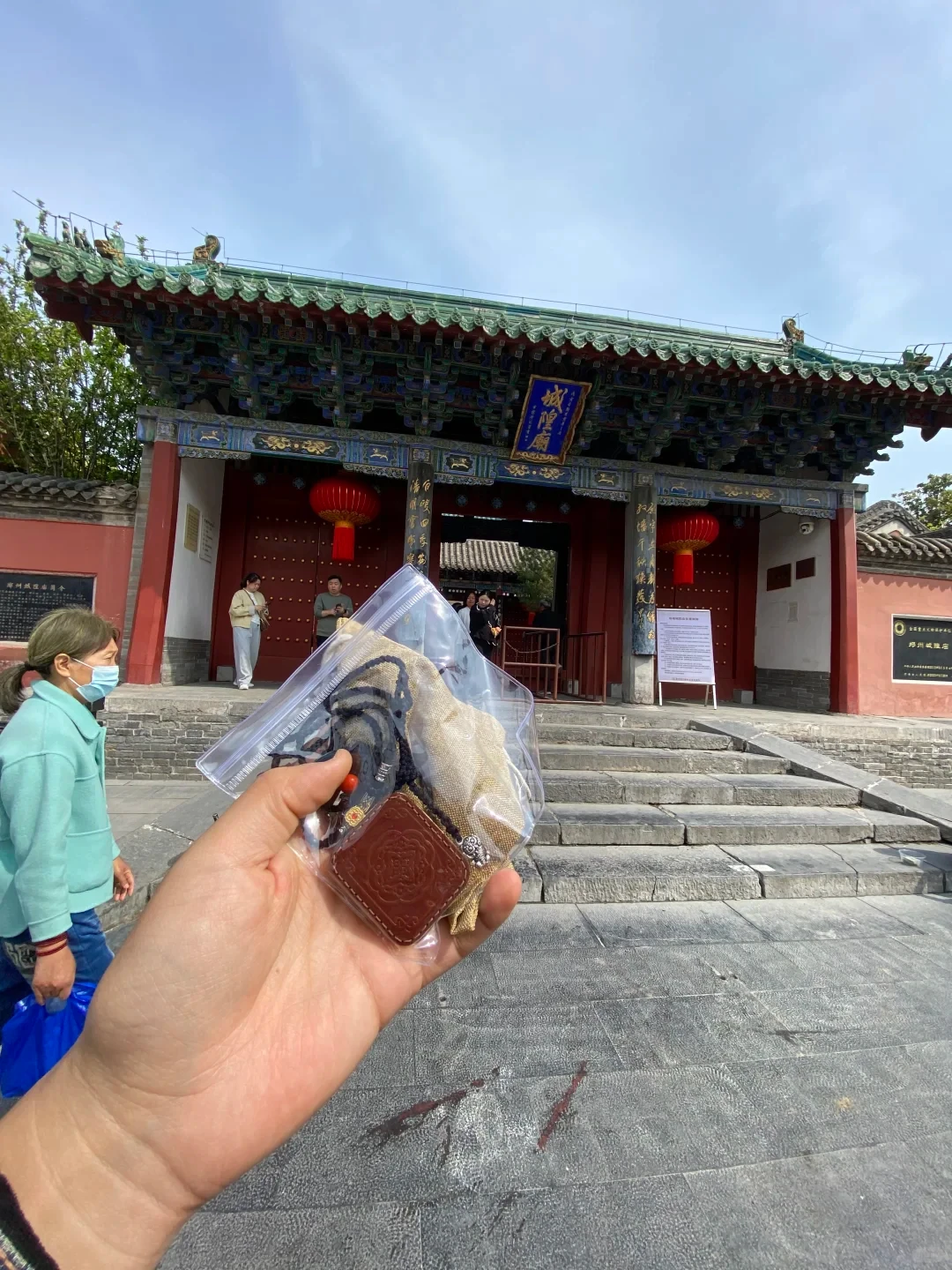
The temple gate and object held in the foreground show how calendrical language can enter a real visit, purchase and ritual setting rather than remaining an online chart. The photograph cannot tell us what the visitor believed, whether the object was used, or which element belongs to any person in the frame.
That limit is exactly why I keep calculation and devotion apart. A living practice deserves more respect than being mined for “five easy personality hacks.” First name the calendar machinery correctly. Then allow the temple, family and individual to carry meanings a search result cannot flatten into one universal answer.
How to reject an overconfident element reading
Before accepting a “Metal Ox,” “Water Tiger” or “Fire Horse” result, ask five questions:
- Did the page request a full birth date or only a Gregorian year?
- Did it state whether the boundary is Chinese New Year or Lichun?
- Did it show the Heavenly Stem character that supplies the element?
- Did it show the Earthly Branch character that supplies the animal?
- Did it separate a year label from claims about health, money or relationships?
The first four questions audit the calendar. The fifth audits editorial honesty. A correct stem-branch label still cannot diagnose a body, guarantee compatibility or predict a career. Precision in one layer does not grant authority over every layer of a life.
I want readers to become harder to impress. A long automated reading is not deep merely because it names many traits. The strongest result may be one line—“Bing-Wu 丙午, Yang Fire Horse, beginning February 17 under the Chinese New Year convention”—when every part of that line can be checked.
Make the calculation public, keep the person private
If you want to compare family years, publish the method rather than personal identifiers. A useful community post can say: “Birthday falls before the 2026 New Year boundary; therefore the year remains Yi-Si Wood Snake.” It does not need a name, birthplace, exact hour or a prediction.
That practice gives other readers something reusable. They can test the boundary, identify the stem and branch, and correct the same mistake in another year. It also keeps the page anchored in what a year element genuinely is: a position in a calendrical system, not a license to narrate someone else's inner life.
That final distinction is the best test of real understanding. Chinese zodiac elements are not five colored personality types. They are one moving wheel inside a sixty-year time system.
When the question shifts from calendar mechanics to the animals' mythic stories and modern fantasy afterlives, continue to XianLore's Chinese zodiac mythology guide. That companion route extends the lore; it does not replace the calendar evidence used for the calculation here.
Post one fully worked stem-branch calculation in Moments. Include the date rule and both Chinese characters; leave the horoscope adjectives behind.