The Chinese dragon, often called long, is a changing symbol rather than a single mascot for China. Across art, stories and public celebration it can point toward water and rain, transformation, imperial authority, protection or collective identity. The strongest correction to a quick definition is simple: its meaning lives in the object, period and occasion, not in its silhouette alone.
Dragons in Chinese culture are verbs before they are emblems
Someone looking for a translation may be tempted to write "dragon equals power" and move on. Power is part of the story, especially in court art, but it is not enough. Dragons in Chinese culture have also been imagined in relation to clouds, rivers, rain and the ability to move between realms. On a bowl, a robe, a temple roof, a parade body or a screen, the creature is being asked to do a different job.
That is why the English word can mislead. It gives Chinese long and several European traditions one familiar label, then encourages readers to assume that the animals carry the same moral character. They do not. A Chinese dragon can be forceful, dangerous or politically charged; it is not automatically a gentle emblem. Nor is it best understood as the default villain of a European fairy tale with a longer body.
The useful question is: what is the dragon doing here? Is it moving through waves on a vessel, marking the authority of a court, asking for rain in a local religious setting, or helping a community turn a street into a festive public space? The answer changes the meaning.
“Power” is a noun applied after the creature has already done something more specific. A dragon coils, rises, guards, summons, transforms or depends on many bodies to move. Follow that verb and the cultural meaning stops being generic.
| Context | Common meaning or role | Historical evidence to start with | Variation to keep in view | Misconception to avoid |
|---|---|---|---|---|
| Water, cloud and rain imagery | Weather, movement, generative force | Dragons appear with waves and clouds on many objects | Local religious traditions give water beings different names and relationships | Every dragon is only an imperial sign |
| Court art and dress | Authority, rank and political order | Dragon imagery became especially charged in later imperial visual culture | Rules and use changed by dynasty, object and status | A claw count alone can identify every object or owner |
| Ceramics and decorative arts | Auspicious force, motion, prestige, visual rhythm | Early 15th-century Jingdezhen dragon porcelain survives in museum collections | Patron, market and neighboring motifs matter | A dragon motif carries one universal message |
| Dragon dance and public celebration | Performance, collective coordination, festival presence | Living practice, not simply an ancient image on repeat | Community, region, migration and event shape the performance | Every dragon dance follows one national script |
The table is a reading tool, not a decoder ring. It cannot replace a maker's explanation, a curator's object record or a community participant's account.
Chinese dragon vs Western dragon: compare the story, not just the body
The clearest difference is often narrative role. In many Chinese settings, a long moves through clouds or water, belongs to a network of weather and authority, or comes alive through a community performance. In the familiar European Saint George story, the dragon threatens people and a knight defeats it. Those are two useful examples, not definitions of every Chinese or Western creature. A Welsh heraldic dragon, a dangerous Chinese water being and a contemporary fantasy dragon immediately break a simple “East good, West evil” chart.
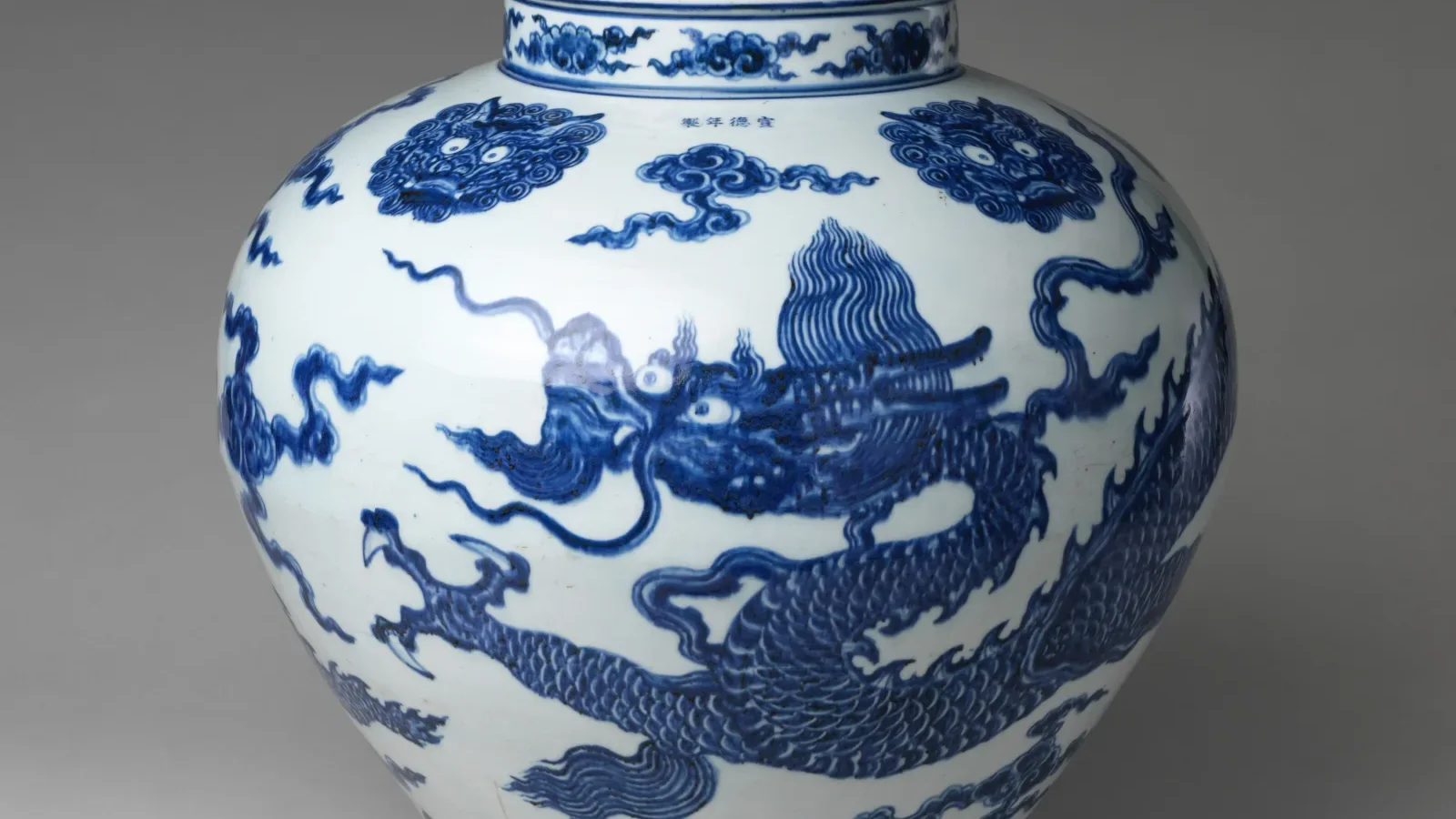
The National Gallery's account of Tintoretto's Saint George and the Dragon identifies a victim, a threatened princess and George's lance entering the dragon's jaws. That painting asks the viewer to follow a rescue and confrontation. Compare it with the documented Jingdezhen jar below: a blue dragon runs around the vessel among waves. Nobody on the jar is assigned the role of knight or captive. The shape is not a screenplay; its movement is the visual event. Reading these two objects side by side tells us more than repeating that one dragon has wings and the other does not.
| Ask this first | A Chinese dragon in this page's examples | The dragon in Saint George's story |
|---|---|---|
| What does it do? | Coils through water imagery or moves with performers. | Menaces a community and is confronted by a knight. |
| Who shares the scene? | Waves, clouds, a vessel, a religious object or a team of carriers. | George, a threatened person and the city beyond them. |
| What does the reader follow? | Changes of context, movement and relationships. | Conflict, rescue and the outcome of combat. |
Do not turn this comparison into a claim that Chinese dragons never fight or European dragons never protect. Both traditions contain many genres and centuries of change. My objection is to exporting the English word dragon as if it carried an identical plot everywhere. The better translation is a question: in this specific image or story, what relationship does the creature make visible?
Historical origins are many, not one clean beginning
Dragon-shaped and dragon-like forms have a long material history in what is now China. Museum collections make that history visible without pretending it begins in one moment. The Metropolitan Museum of Art, for example, catalogs a jade knotted dragon ring from China to the third century BCE. The object does not prove a single timeless meaning for every later dragon. It does show that dragon form had already become a powerful subject for skilled work in hard stone.
Early forms, later religious ideas, court systems, local practices and popular stories did not line up in a single parade. They accumulated. A dragon on a Warring States jade object, a Tang bronze, a Ming porcelain jar and a contemporary festival performance belong to connected but unequal histories. Treating them as identical makes history disappear under a handsome outline.
A creature made for movement
The dragon is unusually adaptable because its body is designed for motion. It coils around a jade ring, lifts through cloud bands, courses around the curved side of a vessel or stretches across the linked poles of a dance body. The eye reads a route rather than a fixed portrait. That visual energy helps explain why the creature can carry weather and transformation so persuasively.
The Met's seventh-century gilt-bronze dragon is a compact reminder that the image can survive a change of material and scale. Bronze, jade, silk, lacquer, architecture and porcelain each ask the maker to solve movement differently. A dragon is not only an animal represented by art; it is also a problem of line, surface, balance and direction.

The fourteenth-century hanging scroll makes that problem visible. The dragon does not sit neatly inside a logo boundary. Its head pushes forward while ink, worn silk and empty space keep the rest of the body unstable. I trust this image more than a polished “Chinese dragon meaning” icon because it refuses to hold still long enough to become clip art.
Where the symbol appears
In water worlds and religious life
Many readers first meet the Chinese dragon as a decorative animal. In religious and storytelling traditions, however, dragons may be connected with rain, seas, rivers and lakes. Dragon Kings appear in a range of tales and religious contexts as powerful water beings. That language should be handled precisely: it does not mean that every image of a dragon is an object of worship, or that every Chinese community tells the same story about it.
Water is the clue that many quick summaries leave out. A dragon emerging from waves or paired with clouds is not merely being made to look grand. The surrounding forms can direct the viewer toward weather, movement or an imagined water realm. The actual object, its inscription, its place of use and the period still determine how confidently we can read that connection.

This sutra box is the correction I want beside every claim that a dragon automatically means emperor. Dragons cross a red lacquer religious container amid clouds. Object function changes the reading before claw-count folklore even begins. The Met record identifies material and object; it does not license a universal explanation of every dragon around a sacred text.
Longnü breaks the male-power shorthand

Longnü—the Dragon Girl—makes the “dragon equals masculine imperial power” shortcut collapse completely. The Met identifies this gilt copper-alloy figure as Dragon Girl (Longnü) and dates it to 1641. Her presence inside Buddhist narrative and visual culture is not a decorative exception; it proves that dragon identity can enter kinship, gender, devotion and transformation.
I insist on this example because global dragon branding overwhelmingly selects the most muscular version of the creature. Gold, claws, smoke, emperor, power. Longnü asks for another vocabulary. A culture is not understood when its loudest commercial symbol erases the quieter figures living inside its stories.
In court culture and decorative arts
Imperial use gave the dragon some of its most visible political weight. Court commissions, robes and ceremonial objects made dragon imagery a language of authority, but authority was not the creature's original or only meaning. It is better to say that late imperial institutions concentrated particular meanings around it than to say the creature was "owned" by emperors from the beginning.
An early fifteenth-century Jingdezhen jar with dragon shows why material context matters. Its cobalt-blue dragon moves around a porcelain form made for viewing in the round. The museum record identifies the object as Chinese Jingdezhen ware. From that much, we can responsibly observe a dragon integrated with a high-skill ceramic surface. We should not invent its owner, audience or emotional force without evidence.
The related guide to Chinese symbols and their meanings offers a wider method for reading motifs beside color, sound, season and use. On a vessel, ask what else appears with the dragon. Waves, clouds, flowers, inscriptions, a reign mark and the object form all matter. If you are considering a design for skin rather than reading a dated vessel, our Chinese dragon tattoo meaning guide asks a different question: what do the artist and wearer intend the whole composition to say?
In dance, community and public space
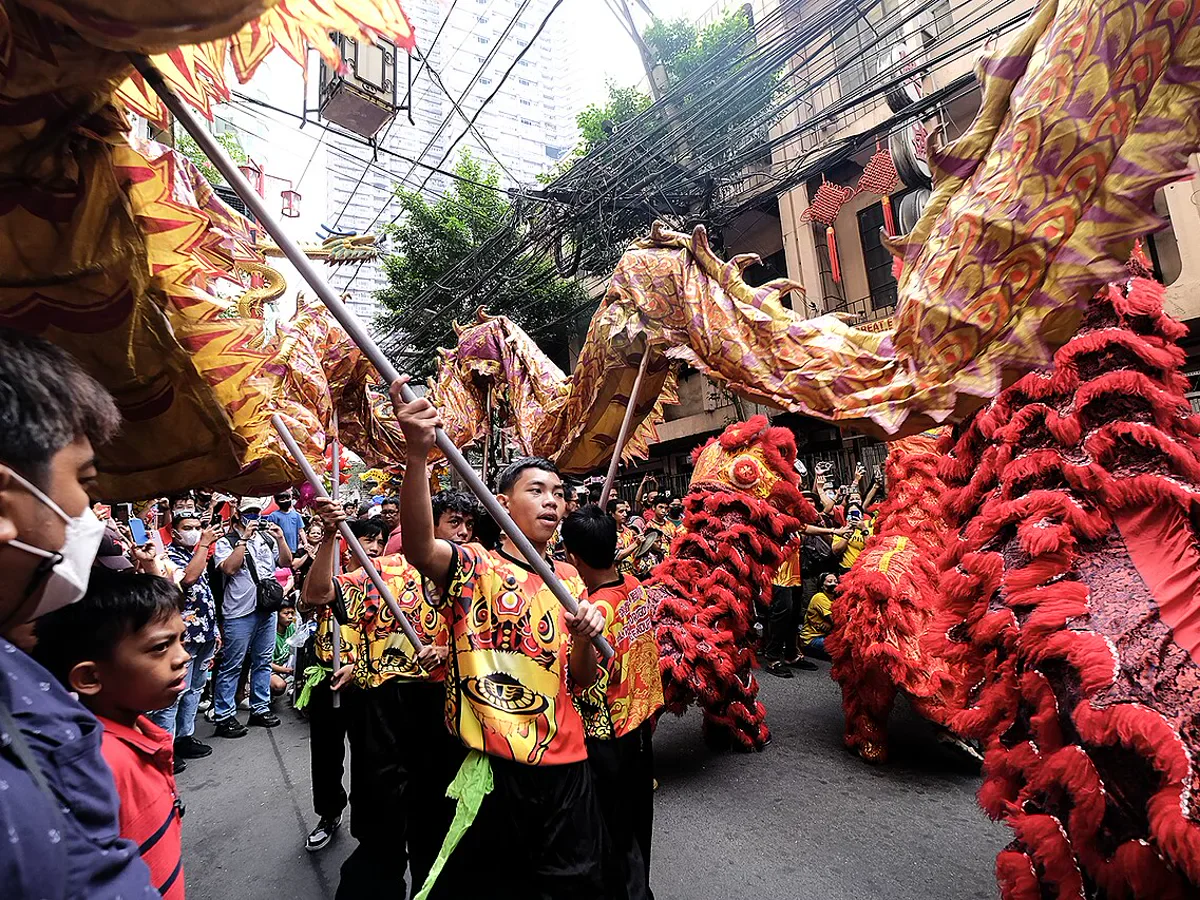
Dragon dance makes the image social. The creature is no longer confined to a wall or a vessel; multiple people make its motion visible together. It can appear around Lunar New Year, at openings, in cultural events and in diaspora celebrations, but an outside observer should not assume the same repertoire, training, religious meaning or local history in each case.
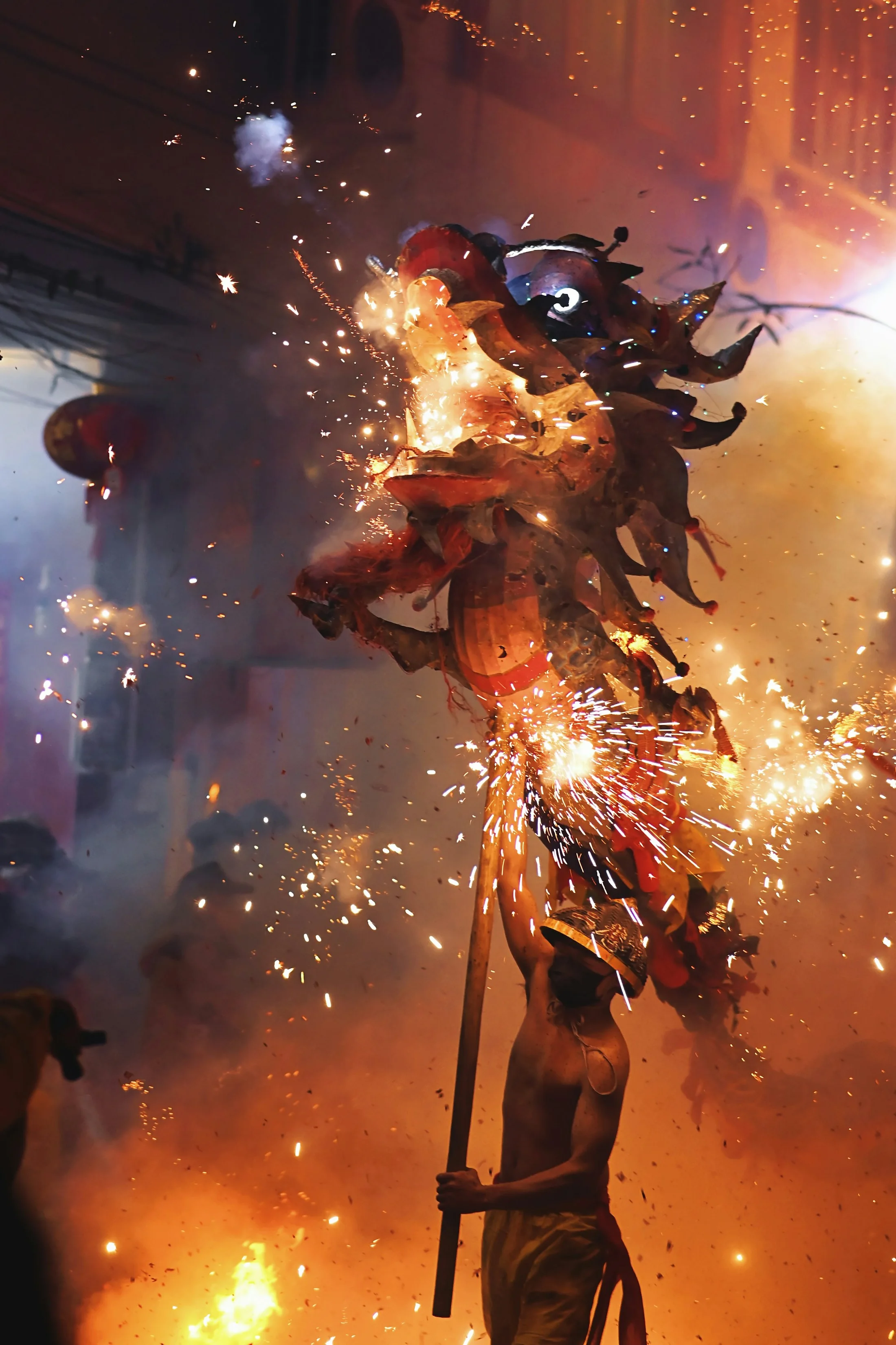
This contemporary Binyang fire-dragon photograph makes the difference from a lone dragon-slayer scene tangible: a person carries the head while sparks and other participants make a public event around it. It documents one festival performance, not every Chinese dragon dance or a universal belief about fire.
This is where a glossy phrase such as "the dragon brings luck" becomes particularly thin. A performance may be festive and still require rehearsal, coordination, fundraising, school or association support, and careful knowledge of a local tradition. The dragon is not only seen; it is carried, timed and negotiated by people.
What moves me in a dragon dance is not a slogan about luck but the visible dependence between people. No single carrier owns the line. A turn succeeds only when hands, feet, drum and distance agree. That is why I read the performance as a public image of coordination: power is convincing here because it is shared, rehearsed and briefly made alive. The dedicated dragon dance guide owns the performance photographs and follows that collective technique in detail; this page owns the change in meaning when an image becomes an event.
Meanings change with context and region
One reason dragons remain useful is that they can hold several kinds of meaning at once. A family might choose dragon imagery for a child's zodiac year. A temple setting may point toward a religious geography of water beings. A museum object may lead a visitor into court history or technical craft. A business logo may borrow only the creature's speed or visual force. These are not interchangeable uses.
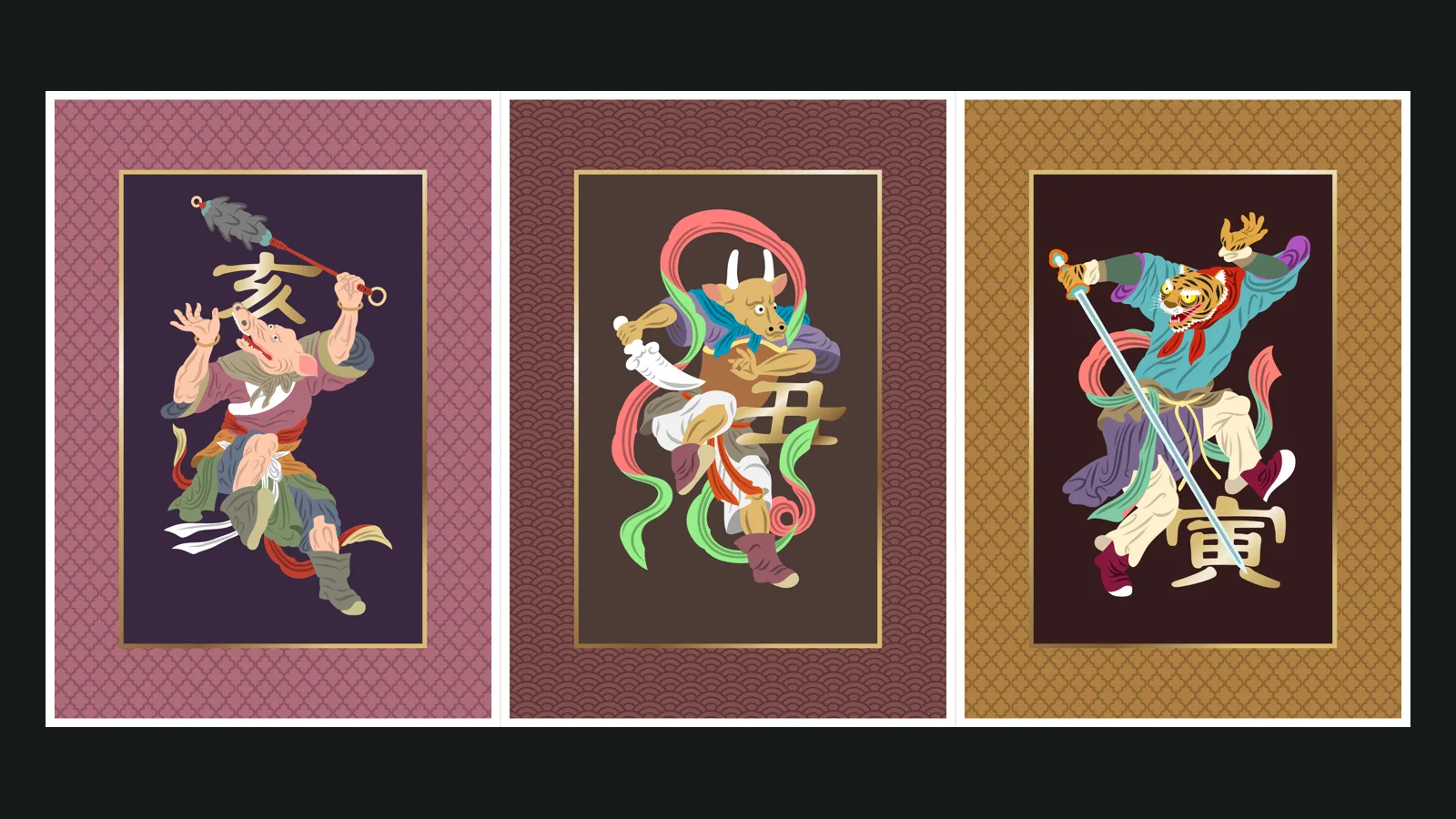
Language also matters. Mandarin long is only one entry point into a multilingual world. Regional languages, local ritual vocabulary and diaspora histories complicate any claim that "Chinese people believe" one thing. The same caution applies to the zodiac: the Dragon is one of twelve calendar animals, but zodiac design does not automatically carry the full religious, courtly or artistic history of every dragon image.
The nearby Chinese mythology guide is useful for stories and supernatural figures. It should not replace attention to actual objects. A mythological reading can illuminate a temple image; it cannot automatically explain a ceramic export vessel or a restaurant sign. The Year of the Dragon guide owns the zodiac-calendar question; a birth-year animal is not a summary of every dragon object.
Common misconceptions
"The Chinese dragon is always good"
This flattens a large body of stories and religious imagination. Dragons can be auspicious, but they can also be powerful, demanding, unpredictable or dangerous. Water itself is life-giving and destructive; images connected with water do not need to become harmless to be culturally important.
"Five claws tell the whole story"
Claw counts are often repeated online as if they function like a universal passport stamp. Court regulations and rank distinctions are real historical subjects, but a reliable reading requires the object's date, place, medium, intended audience and documentation. A cropped commercial graphic or a modern souvenir does not offer enough evidence for confident court-history claims.
"A dragon design makes something authentically Chinese"
A dragon can be an inherited sign, a playful visual reference, a commercial shortcut or an outsider's stereotype. A design becomes more thoughtful when it can name its source, material logic and context rather than adding clouds, gold and an unlocated dragon to signal "Chinese style."
How to engage respectfully
Start with the specific thing in front of you. If it is a museum object, read the record and note its date, medium and collection history. If it is part of a public performance, learn the event's local context and avoid stepping into a rehearsal or procession for a photograph. If you are buying an object, ask who made it, where the design comes from and whether the seller can describe the material rather than offering only a slogan about luck.
For artists and designers, the harder and more interesting route is to study movement. Notice how a dragon turns a vessel's curve into a path, how cloud bands set a rhythm, or how a dance body makes several people responsible for one line of motion. Copying the outline is easy. Understanding the relationships around it takes attention.
Dragons in Chinese culture endure because they have never had one job. They can carry a storm, a political order, an artisan's line, a family celebration or a public claim to belonging. Respect begins when we stop asking the dragon to summarize an entire civilization and let the particular object or performance tell us where it has been.
The shortest answer to “what does the Chinese dragon symbolize?” is therefore not one noun. It can carry water, authority, transformation, protection or collective identity, but the correct meaning comes from the dated object, the named community and the action around it.
In the comments, choose one dragon on this page and tell me which visible action changed your reading. Then publish a dragon action record in East Moment's community: one authorized image, its date or event, and one verb—coiling, guarding, raining, ranking, transforming or moving through a crowd. Return when regional vocabulary and new object records sharpen the map.
Continue through the Chinese symbols hub for the full reading method, compare the dragon with phoenix symbolism, or enter Chinese mythology when the creature becomes a character rather than a motif.