Dragon dance is not one performer pretending to be an animal. It is a moving line of people turning spacing, pole height and shared rhythm into the illusion of one continuous body. The head attracts the camera, but the real test is farther back: does every section receive the same motion, preserve the curve and pass it cleanly to the tail?
Dragon dance is collective geometry
A dragon is carried on poles at multiple body sections. One performer controls the head, others carry the repeated body hoops or segments, and the last controls the tail. Many teams also follow a performer carrying a ball or “pearl,” which gives the head a moving target and helps draw the route.

No one performer can see or correct the whole shape. Each person reads the section ahead, maintains distance from the section behind and adjusts stride, pole angle and height. That makes dragon dance less like a mascot performance and more like moving calligraphy: one broken stroke changes the whole line.
Length is impressive only when it remains controllable. Add more body sections and the dragon becomes harder to turn, accelerate and recover. A shorter team with clean spacing can look more alive than a very long dragon collapsing into slack fabric.
The head proposes; the body must answer
The head can rise, dive, turn or chase the pearl, but it cannot simply improvise at full speed and hope the body survives. A route has to travel backward through the line.
Imagine the head drawing a wide S. The next performer must enter the same curve at the right moment, then the next, until the tail completes it. If each person copies only the head's current position, the pattern compresses. The useful reference is the section immediately ahead.

This is why the head is both star and servant. It gives direction, but its movement must be legible enough to reproduce. A spectacular head flourish that knots the middle is bad leadership disguised as showmanship.
The Smithsonian National Museum of Asian Art's dragon dance resource documents a 2014 performance by a Zhejiang Wu Opera troupe in which the dragon follows a pearl and the body carries a wave through coordinated teamwork. It is useful because motion, not a still costume, carries the explanation. That one documented troupe does not define every regional team or ceremony.
Watch the same performance in the Smithsonian Folklife film with your eyes on the middle and tail instead of the head. The useful evidence is not that the dragon looks festive; it is that each pole receives a slightly later version of the same movement. That delay is what makes many workers disappear into one animal.
Read the wave from front to tail
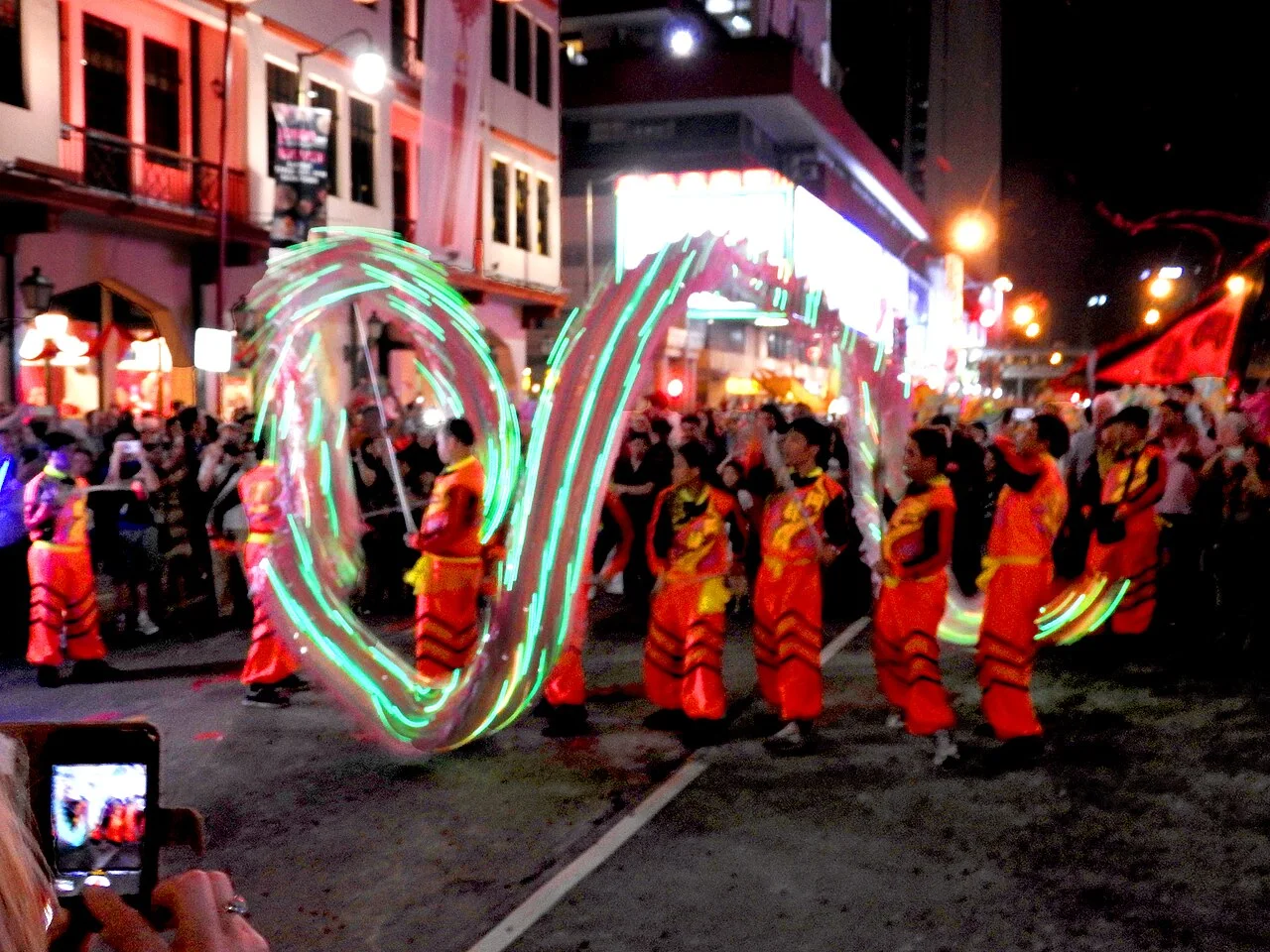
The wave is the most revealing basic pattern. Performers lift and lower adjacent sections in sequence so the body appears to send energy along itself.
Watch three variables:
- Amplitude: how high each pole rises and how low it returns.
- Spacing: whether the fabric remains extended without being pulled rigid.
- Delay: how long each section waits before repeating the movement ahead.
Too little delay makes the whole dragon bounce as one stiff object. Too much delay creates disconnected humps. Uneven spacing produces dead sections where the fabric sags or snaps.
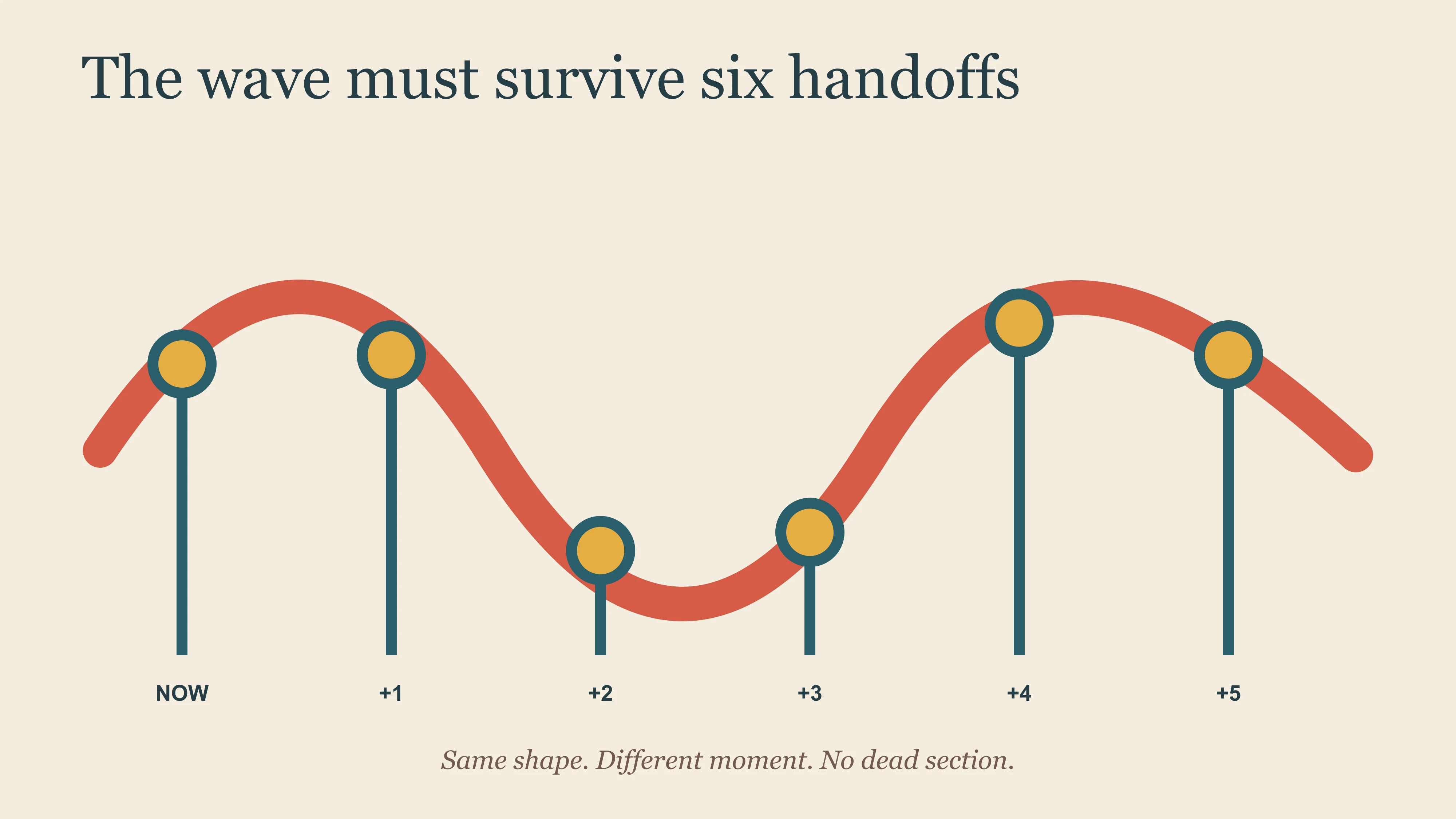
Every pole holds a different moment of the same shape. If one person copies the wrong moment, the body breaks even when every performer is working hard. East Moment original editorial diagram.
Night-light dragons make these failures easier to see. The illuminated outline exposes continuity that dense color and daylight detail can hide. Light is not only decoration here; it turns timing into a visible line.
Spirals are difficult because the inside and outside move differently
When a dragon coils or spirals, performers on the inside of the curve travel a shorter path than those outside. Everyone cannot keep the same stride length. The team must preserve section spacing while bodies move at different speeds.

A good spiral lets you read the dragon from head to tail. A poor one looks like fabric piled around people. The exit matters as much as the entry: performers must unwind without reversing poles, trapping the tail or opening a gap.
This is the section of the performance most phone videos misunderstand. A close head shot may look energetic while hiding whether the coil is coherent. Step back. The pattern is the evidence.
The pearl is a route-maker, not a magic remote
The ball carried ahead of the dragon is often described in English as a pearl. Visually, it gives the head something to pursue, circle or test. Practically, the leader helps establish speed, radius and destination.
The pearl performer must know what the full body can complete. A turn that is easy for one person may be impossible for the last five sections at the available street width. Good leadership therefore includes looking back, reading obstacles and leaving the tail enough time.
The pearl also helps an audience understand intention. A dragon approaching an empty space can look random; a dragon following, surrounding or playing with a target becomes a scene.
What the poles reveal about labor
The poles make an abstract body physical. Every rise is shoulder and core work. Every low pass demands bent knees and spatial awareness. Wind adds drag. Long fabric keeps moving after a performer wants to stop.
Look at hands rather than faces for a moment. Some performers push vertically, others angle the pole to preserve the curve, and those approaching a turn prepare before the head reaches it. Uniform costumes make the group readable, but uniform movement would be a mistake. Each location has a different job inside one result.
This is the East Moment judgment at the center of the page: dragon dance celebrates collective power not because many people are present, but because individual adjustment disappears into shared continuity.
A team is more than a head and several anonymous poles
The pearl leader sets a readable destination. The head performer turns that destination into character and commits the first line. The middle sections preserve volume: they stop the dragon from looking like a head dragging loose fabric. The tail finishes every sentence. It often has the least visual glamour and the hardest timing problem because it receives each decision last, when the available street may already be closing.
Calling everyone behind the head “support” misses the intelligence of the form. The middle diagnoses the team. If spacing tightens there, the head has asked too much or the handoff is late. If the tail whips rather than flows, an error has accumulated through several people. Roles are different, but responsibility is continuous.
This is also why replacement performers cannot simply memorize a routine from the outside. They need to understand the neighbor before them, the weight and flex of their pole, and the fraction of a beat their section occupies. The choreography lives between positions, not inside one star's sequence.
Rehearsal should remove the dragon before adding it
The smartest rehearsal begins with the route. Walk it without costume. Mark narrow turns, slopes, cables, curbs, wet patches and the point where a crowd is likely to press inward. Then rehearse pole spacing at low speed. Only after the line can turn and stop cleanly should the fabric and full amplitude be added.
A practical progression looks like this:
- Walk the route and agree on calls, stopping points and emergency exits.
- Hold spacing in a straight line without looking at the audience.
- Pass one small wave from head to tail, then ask exactly where it died.
- Add a turn at walking speed and make the inside shorten while the outside opens.
- Practise recovery deliberately: late handoff, slack fabric, missed marker and an obstacle entering the route.
- Add speed, music, smoke or light only when the team can repair itself without panic.
That last step is the one I trust. A team that has rehearsed only success can look brilliant until the street answers back. A team that knows recovery remains a dragon when reality interrupts the choreography.
Wind, pavement and street width rewrite the dance
Performance space is not an empty container. Wind loads the fabric and can turn a high lift into a sideways pull. Rain changes grip and footwork. Rough paving punishes repeated low stances. A narrow street reduces the radius available to the pearl and head; a wide square asks the team to create its own visual boundary. Night lighting makes timing legible but can hide curbs and faces from performers.
The route should therefore change the choreography. Insisting on the same spiral everywhere is not artistic integrity; it is carelessness. Good teams edit amplitude, direction and speed so the body remains coherent and people remain safe. The dragon does not prove its power by ignoring the street. It becomes convincing by negotiating with it.
Audiences are part of that negotiation. A crowd that steps forward for a close photograph can erase the turning room the tail needs. Organizers who place barriers without understanding the full body can trap the very performance they booked. The most respectful viewer gives the dragon width.
Meaning without one tidy origin story
In Chinese culture, dragons are associated with auspicious power, vitality and control of water and weather in many traditions. Dragon dance appears at Lunar New Year, Lantern Festival and other civic or community celebrations as a public wish for energy and good fortune.
That does not prove one uninterrupted origin story for every modern troupe. Forms, materials, competition rules and diaspora settings have changed. A school performance, a professional competition team and a temple-festival procession can all use a dragon while organizing meaning differently.
For the calendrical and family rituals around the season, continue to Chinese New Year. For the dragon as a cultural symbol rather than a carried performance body, use the Chinese dragon guide. These are connected ideas, not interchangeable explanations.
Dragon dance versus lion dance
The simplest distinction is structural:
- A dragon is a long body carried by many people on poles; watch waves, coils, spacing and route.
- A lion is commonly one compact body animated by two people; watch eyes, mouth, weight, hesitation and character.
Compare that exposed line of poles with the hidden paired body in the lion dance guide. Confusing the two because both appear at Lunar New Year erases the different intelligence each form demands.
Recovery is the most honest part of the performance
Perfect clips teach viewers to hunt for peaks: the highest head, tightest coil or fastest run. I watch what happens just after the peak. Does the line breathe back into even spacing? Can a performer lower a tired shoulder without sending a kink backward? When a turn opens too wide, does the next section absorb the error or amplify it?
A dropped curve is not automatically failure. The failure is allowing one mistake to become six unrelated movements. Recovery shows whether the team is listening. Sometimes the correction is deliberately smaller than the error: the head steadies, the middle restores distance and the tail completes a modest line. Nothing spectacular happens, which is exactly why the skill is easy to miss.
Film the recovery if you want evidence rather than a souvenir. Start wide enough to include head, middle and tail. Hold the frame after the obvious flourish. One continuous shot will tell you more about coordination than ten close-ups cut to the drum.
How to watch the next performance
Do not remain locked on the head. Try this sequence:
- Watch the head and pearl establish one route.
- Shift your eyes to the middle and see whether the curve arrives intact.
- Follow the same movement to the tail.
- During a spiral, compare inside and outside footwork.
- Watch the recovery: can the dragon return to a clean line without visible panic?
If the venue allows, choose a viewpoint with width rather than proximity. A dragon needs room in your frame because space is part of its technique.
Final verdict
The dragon is not alive where it is loudest or closest. It is alive where motion survives the journey from one person to the next.
Watch the middle. That is where individual ambition has nowhere to hide and collective skill becomes visible.
Continue through Chinese culture when you want to compare this exposed chain of poles with other practices in which craft, ritual and public space make collective knowledge visible.