Lion dance works when you forget the two people under the fabric. One performer gives the creature its eyes, mouth, ears and front legs; the other supplies its back, weight and spring. The craft is not acrobatics alone. It is synchronized breath, balance, musical timing and enough character to make a constructed head appear suspicious, hungry, proud or delighted.
Lion dance begins with one impossible body
The Smithsonian's lion dance overview identifies the paired performers and Lunar New Year context. The photographs and observations here go one step closer, asking how two bodies coordinate well enough to make one creature appear to think.
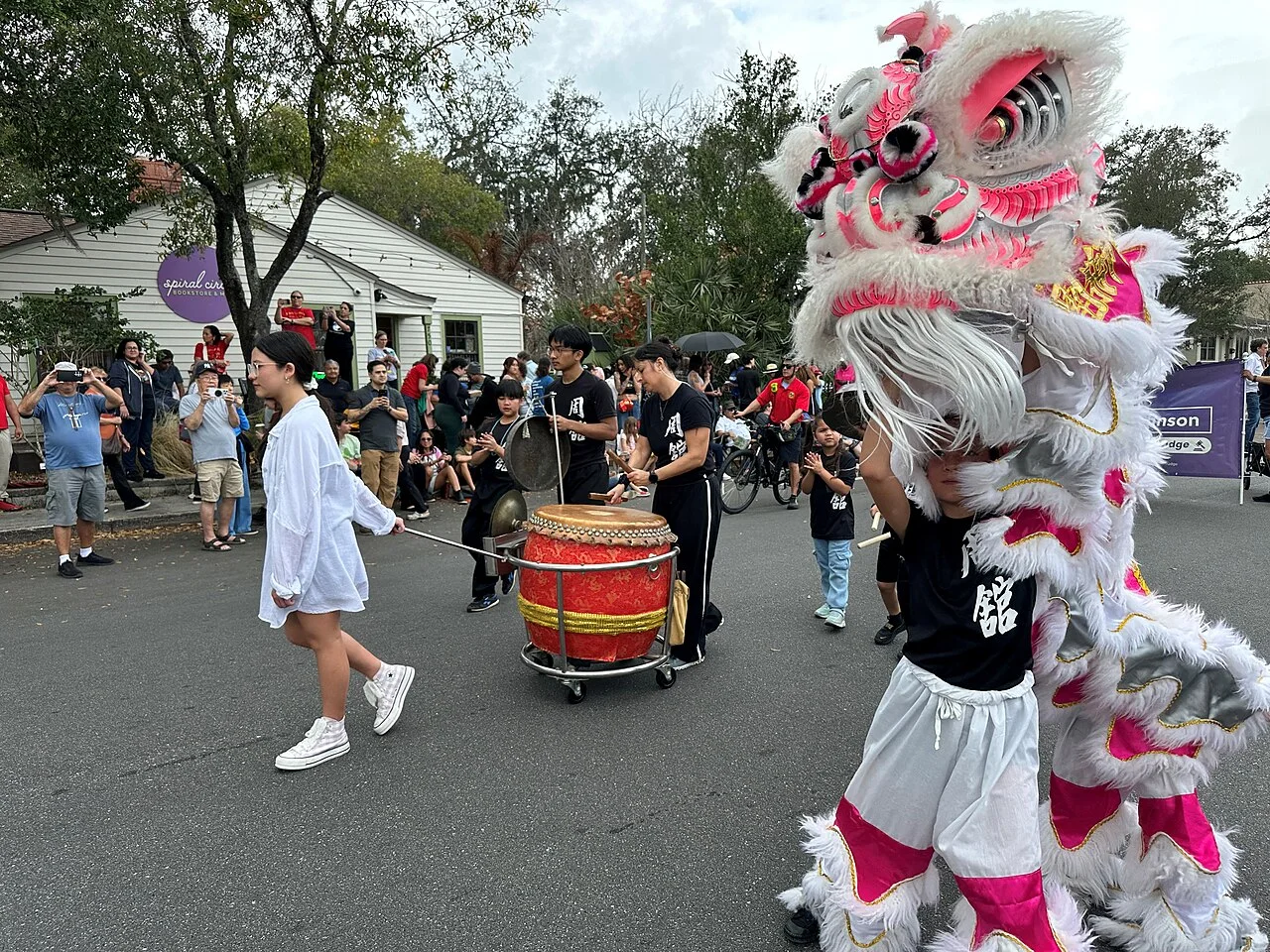
Look closely at the image below. The lion is one animal to the audience, but its front and rear halves are solving different physical problems.

The front performer carries and animates the head while controlling the forequarters. The rear performer bends at the waist, follows without seeing the whole route and must place the back legs where the front has already committed the body. When the lion stands tall, one performer may rise onto the other's thighs or shoulders depending on the routine. When it scratches, sleeps or tests an object, both must agree on the creature's center of gravity.
This is why a technically difficult jump can still feel dead. If the rear arrives half a beat late, the lion stretches into two people. If the head moves without the hips responding, it becomes a mask being waved. The best pair preserves one spine.
The face is a control panel for personality
Many southern lion heads have movable eyelids, ears and mouths. The performer does not shake every control at once. A slow blink can suggest waking; a quick head turn creates suspicion; a lowered head followed by a cautious lift makes an ordinary object feel dangerous.

The exaggerated face is not evidence that the performer should exaggerate every second. Stillness gives movement meaning. Watch for the pause before the lion touches food, approaches a doorway or commits to a jump. That hesitation is acting.
The costume also asks the audience to accept a productive contradiction: this lion is obviously made of fabric, fur, bamboo or composite structure, yet its eyes meet yours. Lion dance is compelling precisely because the mechanism remains partly visible while the personality wins anyway.
The drum does not decorate the lion; it drives it
The percussion group usually centers a large drum with gongs and cymbals. The music marks changes in pace, posture, attention and danger. Performers train movement phrases with rhythmic patterns, so a cue can coordinate bodies that cannot easily speak inside a loud costume.
Do not hear the percussion as one continuous wall of noise. Listen for three things:
- a repeating pulse that establishes the lion's walk or examination;
- a tightening pattern that announces acceleration, a lift or a jump;
- a decisive strike that gives a landing, reveal or bow its edge.
The audience often watches the head and misses the drummers reading the same performance. Turn sideways for thirty seconds. You will see hands, eyes and sticks maintaining the animal from outside its body.
The rhythm also exposes weak performance. A loud strike can make any leap feel important for one second, but it cannot repair a head that arrives without weight or a rear performer who is still searching for the front performer's feet. I listen for the quieter preparation: the beat that lowers the body, the held fraction before contact and the recovery phrase that tells the creature to become curious again. The drum does not merely announce danger. It gives two hidden people the same clock.
That is why recorded clips can flatten the craft. A phone microphone compresses the drum, the crowd and the cymbals into noise, while a close crop removes the musicians and the lion's path through the room. At a live performance, stand where you can see both animal and percussion. The distance between them is part of the mechanism.
Cai qing turns appetite into a small drama
In cai qing (采青), often translated as “plucking the greens,” the lion approaches and takes a prepared offering, commonly involving leafy greens and sometimes a red packet. The exact setup and sequence vary by school, occasion and host.
What matters theatrically is not “lion eats lettuce.” The lion must discover, inspect, hesitate, overcome the problem and then present or scatter the transformed offering. Curiosity becomes a ritual action associated with good fortune and prosperity.
That sequence also shows why a lion should have character. A prop hanging above a doorway is meaningless until the performer makes the animal want it, fear it or puzzle over it. The audience reads the task through behavior before it reads symbolism.

At a shop opening or Chinese New Year, the route through a doorway and the relationship to the host matter as much as a big trick. Do not stand between the lion and the prepared offering simply to secure a photograph.
High poles reveal the partnership, not just courage
High-pole routines make the hidden cooperation brutally clear. A southern lion pair may leap between narrow platforms, rear up, turn or create the illusion of testing unstable ground. The front performer must commit the head and forequarters while the rear performer controls propulsion and landing alignment.

The Foshan photograph gives scale: the platforms are small, the head changes the performer's sightline, and the second body must land as part of the same animal. A clean landing is not merely athletic success. The lion must recover its personality immediately. If the performers freeze as two relieved athletes, the illusion breaks.
This is also the point where spectators should respect risk. Keep the landing and safety zone clear. Do not use a close camera position to pressure a team into performing around you.
What the audience cannot see under the cloth
The rear performer often sees less of the route and none of the lion's facial expression. Their job is not simply to follow. They must read pressure through the cloth and the front performer's hips, shorten or lengthen the body without creating a visible break, and arrive underneath a lift early enough that the head can remain expressive.
Heat and fatigue matter too. The costume traps warmth; the stance stays low; a parade surface may be uneven; the head changes the front performer's view. The pair still has to make tired legs look like an alert animal rather than two athletes negotiating the next step. This is why I value a convincing scratch, recoil or suspicious pause more than a trick isolated for social media. Small behavior proves that technique has survived fatigue.
There is also a moral difference between risk and spectacle. High poles make danger visible, but the strongest routine never asks the audience to forget training, spotting, spacing and the crew controlling the performance zone. Courage is not carelessness. A troupe protects the illusion by protecting the performers who create it.
Southern and northern lion are not color options
“Chinese lion dance” names a family of forms, not one costume sold in different palettes. Southern styles associated with Guangdong are often recognized by large expressive heads, strong martial-arts lineage and routines such as cai qing. Northern lion forms commonly use furrier, more naturalistic bodies and may emphasize playful acrobatics, pairing and ball work.
Those are orientation points, not a license to identify every troupe from one photograph. Schools adapt, diaspora communities combine training histories, and event costumes circulate beyond a single region. Ask the team what form they practice instead of turning a quick visual guess into regional certainty.
For readers exploring Guangdong context, Guangzhou offers a useful next route into the language, commerce and public festival culture surrounding many southern traditions. Foshan has its own martial and performance lineages; one Ancestral Temple photograph cannot stand for every southern school.
Lion dance and dragon dance solve opposite problems
| Lion dance | Dragon dance |
|---|---|
| Usually two performers inhabit one creature | A line of performers carries one long body on poles |
| The head can blink, chew, scratch and act at close range | The body creates waves, coils and travelling patterns across space |
| Character grows from intimate behavior and weight | Character grows from collective geometry and continuity |
| Percussion closely cues posture and dramatic beats | Route, spacing and pole timing sustain the moving line |
If you remember only one distinction, use this: watch a lion's face; watch a dragon's whole body. The dragon dance guide explains why following only the dragon head causes you to miss the most difficult work.
How to watch without reducing it to a photo opportunity
- Find the drummer before the performance starts.
- Identify the front and rear performers through the legs.
- Watch one complete action: waking, searching, climbing, eating or bowing.
- Notice the pause that gives the action intention.
- After a trick, watch how quickly the pair restores one spine and one personality.

At community scale, the lion is not a distant stage object. It moves through children, elders, shopkeepers, musicians and phones. That closeness is part of the pleasure, but it makes audience behavior part of the choreography. Leave a path. Let children see. Do not grab the head or costume unless the troupe explicitly invites interaction.
Lion dance survives through teams, not holiday content
A viral New Year clip can make lion dance look seasonal, but a convincing two-minute appearance rests on months of ordinary repetition. Somebody stores and repairs the head. Younger members learn the cymbal pattern before they inherit a more visible role. Senior performers correct the angle of a landing, the length of a pause and the way a rear leg must answer a head turn. Businesses and community organizations provide occasions; families provide time; a school preserves its own vocabulary of movement.
The Wing Luke Museum's Lunar New Year fair record is one accountable example of lion dance inside a diaspora community program. It should not be mistaken for a universal model. A temple event in Foshan, a shop opening in Guangzhou and a museum fair in Seattle have different hosts, spatial rules and audiences. The form travels because teams negotiate those differences without surrendering the discipline underneath them.
This is the part I want the broader Chinese culture collection to make visible. Heritage is not an object that survives because it is old. It survives because particular people keep giving evenings, storage space, sore legs, transport and attention to it. Applaud the jump, but notice the ecosystem that made the jump possible.
If you return to this page after another performance, bring one precise comparison: how did the lion enter, what problem did it solve, and which musical cue changed its behavior? That record is more valuable than another claim that all lion dances mean the same thing.
Final verdict
The point of lion dance is not that a costume resembles a zoological lion. It does not. The achievement is that two people, a percussion group and an audience agree to sustain one alert creature in real time.
The next time you watch, do not count jumps first. Find the moment when both performers breathe as one body and the head seems to make a decision. That is where craft becomes life.