Chinese dragon tattoo meaning is not one translation of one animal. A dragon can carry ideas of rain, movement, authority, protection or an entirely personal turning point, but the tattoo's meaning emerges from its composition and the wearer's intention. Look first at what the dragon is doing, what surrounds it and how it moves over the body. A color chart or a claw-count rule cannot do that reading for you.
Chinese dragon tattoo meaning begins with the entire composition
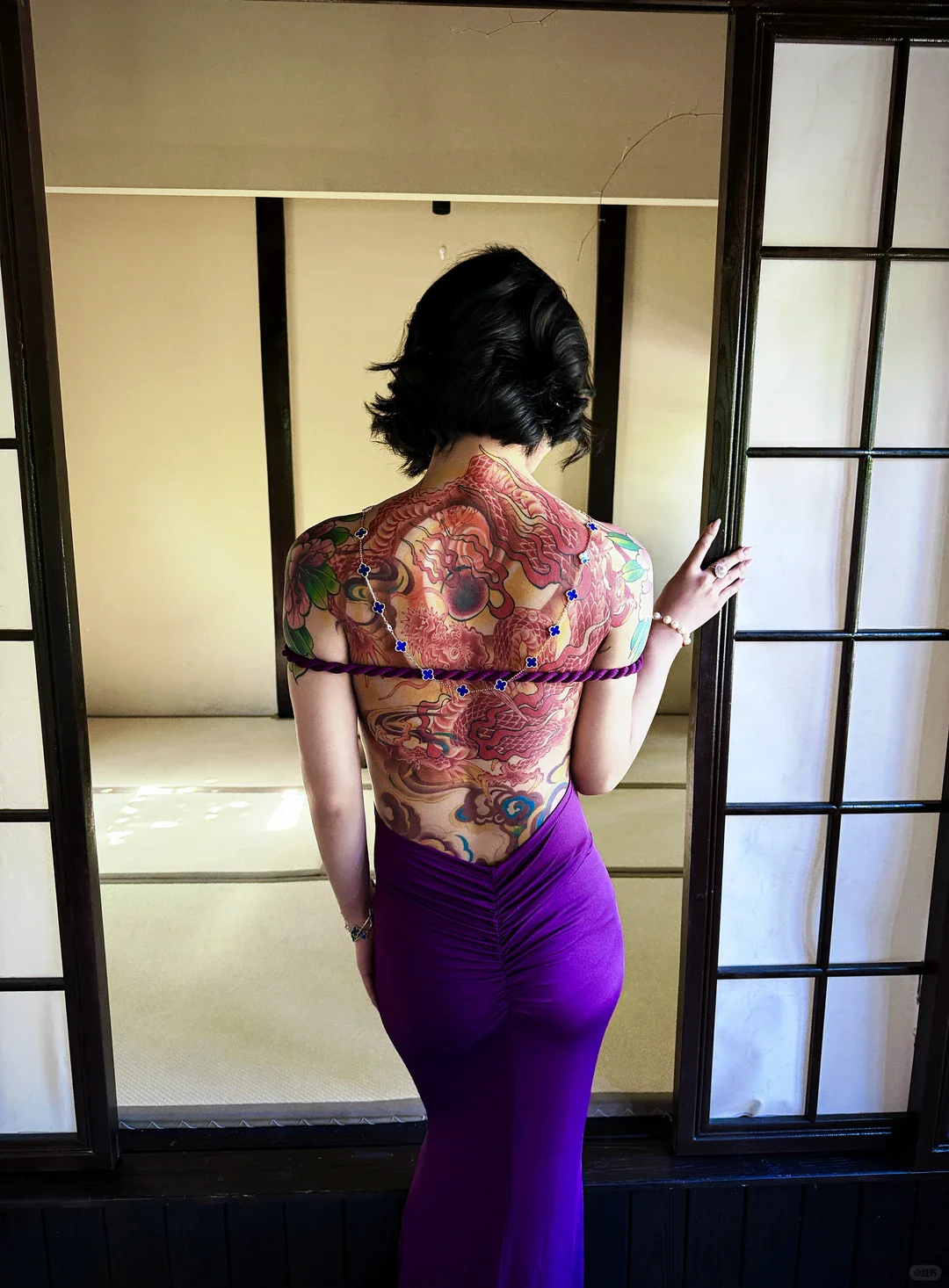
A red dragon curves across a person's back. Flowers, water-colored shapes and open skin interrupt its line. On another arm, a grey-green dragon coils through clouds. These are not interchangeable stickers with the same dictionary entry. The first design makes a large back into a field of color and movement; the second uses the turning of a shoulder and elbow to reveal different parts of one body. The actual photographs on this page are contemporary tattoos, not ancient objects or illustrations of a myth. That distinction matters: a modern artist is making choices with an inherited visual vocabulary, not reproducing an official code.
I dislike the certainty of online charts that tell a stranger, “A red dragon always means this; five claws always mean that.” They make an exciting object less interesting. A tattoo is made by an artist, carried by a person and seen while that person moves. The right question is not only what does the dragon symbolize? It is which dragon, in which arrangement, for whom?
This page therefore does a different job from our broader guide to dragons in Chinese culture and the Chinese symbols collection. Those routes trace meanings through water, court art, religious stories and other motifs. Here I concentrate on a contemporary decision: how to read or choose a dragon image for skin without making false claims about the past.
Why clouds and water matter more than a color slogan
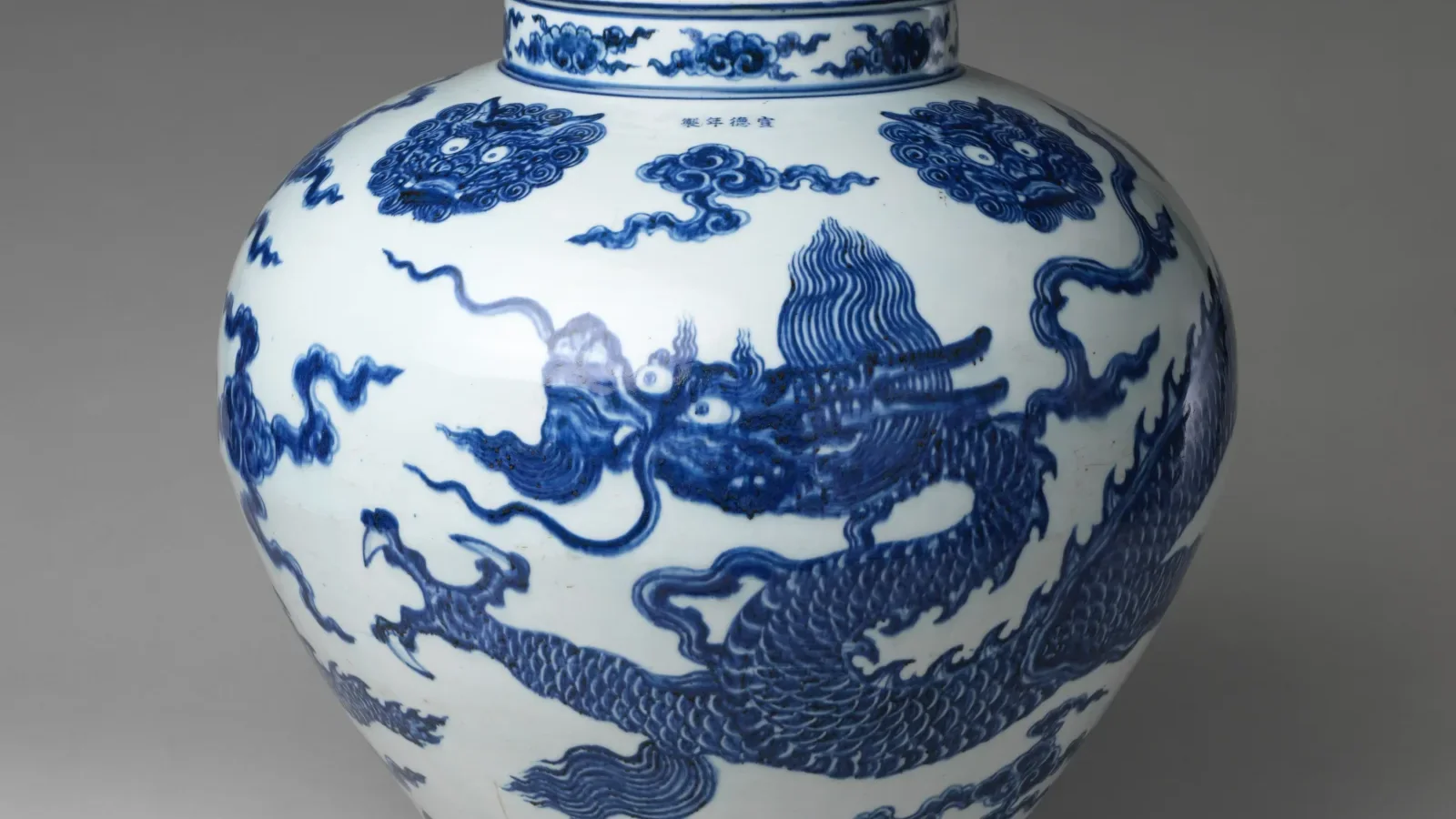
In Chinese visual traditions, dragons often inhabit weather. They move through clouds, command or bring rain, and connect the sky to water below. The Smithsonian's Eleven Dragons teaching resource describes the creature's association with clouds and life-giving rain; the Metropolitan Museum's account of Beneficent Rain places a dragon inside a specific painting and Daoist context. Neither institution is publishing a tattoo glossary. They give us a stronger historical ground: clouds and water are not filler around a dragon.
In the photographed shoulder piece below, green-blue curves pass over the dragon's scales. I read them as part of the design's weather and motion, not as a promise that the wearer has acquired supernatural luck. On the body, cloud bands also solve a visual problem: they let a long creature turn around muscle, disappear around an arm and return at another angle. Symbolism and composition work together.
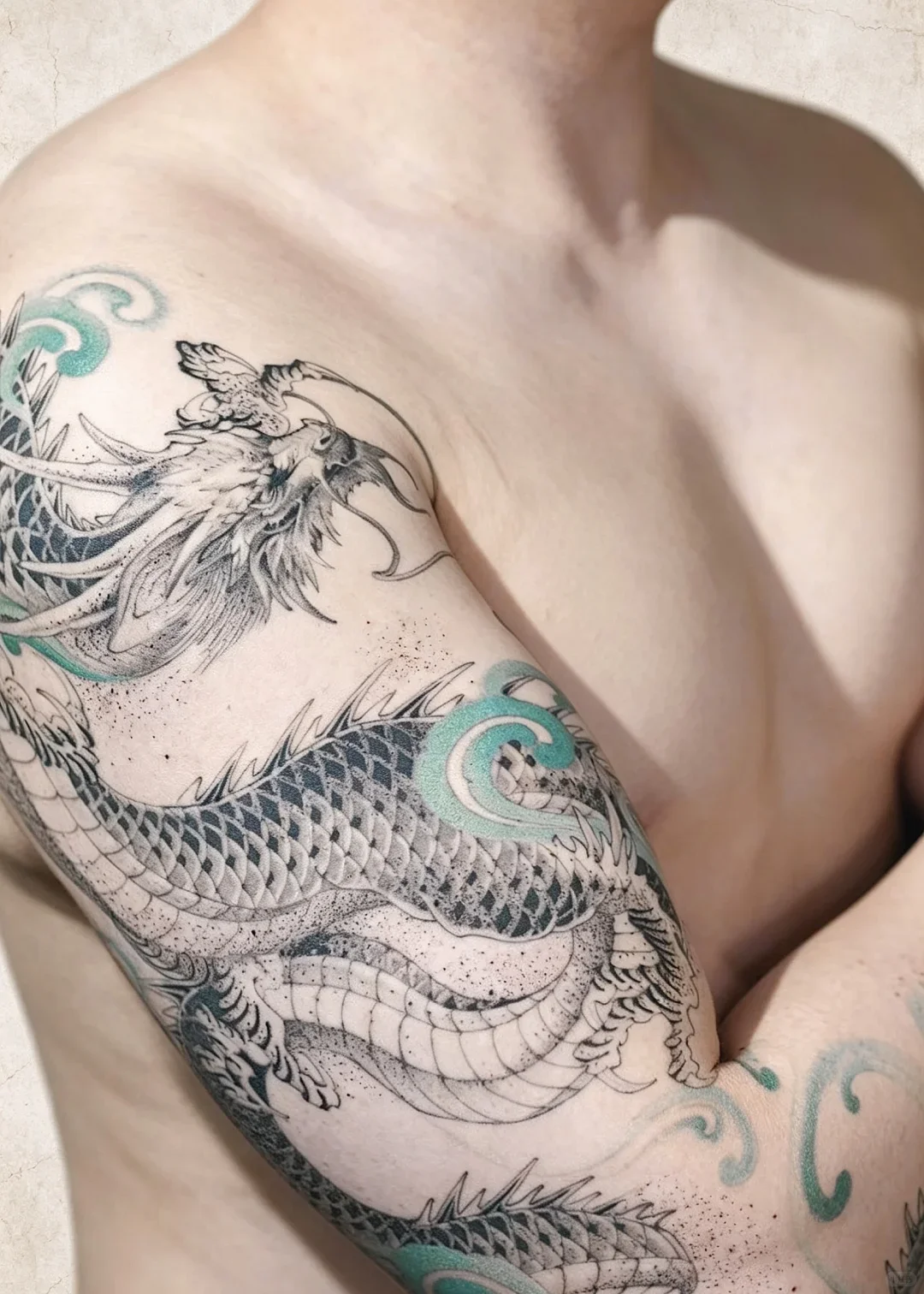
The photograph proves the artist's visible composition and its fit across a shoulder and upper arm. It does not prove why this wearer chose it. A good reading keeps those two statements apart.
Our Chinese cloud motif guide goes further into cloud shapes across Chinese objects. That is a better next step than memorizing an invented list of cloud “powers.”
Red, black and blue do not come with universal instructions
Color changes a tattoo's emotional temperature immediately. Red can make a dragon feel hot, public and celebratory; a black-and-grey design can privilege line, scales and shadow; blue or green passages can pull an eye toward water and air. Those are visual observations, not universal historical translations. The red tattoo above does not let me infer the wearer's birth year, family belief or promised fortune. The artist and wearer would have to tell us that.
What I admire in the red back piece is that the dragon is not isolated like a badge. The line runs into other shapes; the back is treated as a whole surface. Whether every flower belongs to a particular historical symbolic system is a separate claim that the photograph alone cannot support. A responsible reader can say “dragon among colored floral and cloud-like elements” without pretending to identify a ritual, dynasty or exact intended message.
The black-and-grey forearm piece below offers a useful correction. At first glance, its scales and long curling form might make someone call it a dragon. Look at the head and fins: this is a koi. The photograph is here as a comparison, not as a third dragon tattoo. A single familiar texture is insufficient to identify the animal or its cultural story. Ask the artist about the reference object and style lineage before attaching a national or symbolic label.
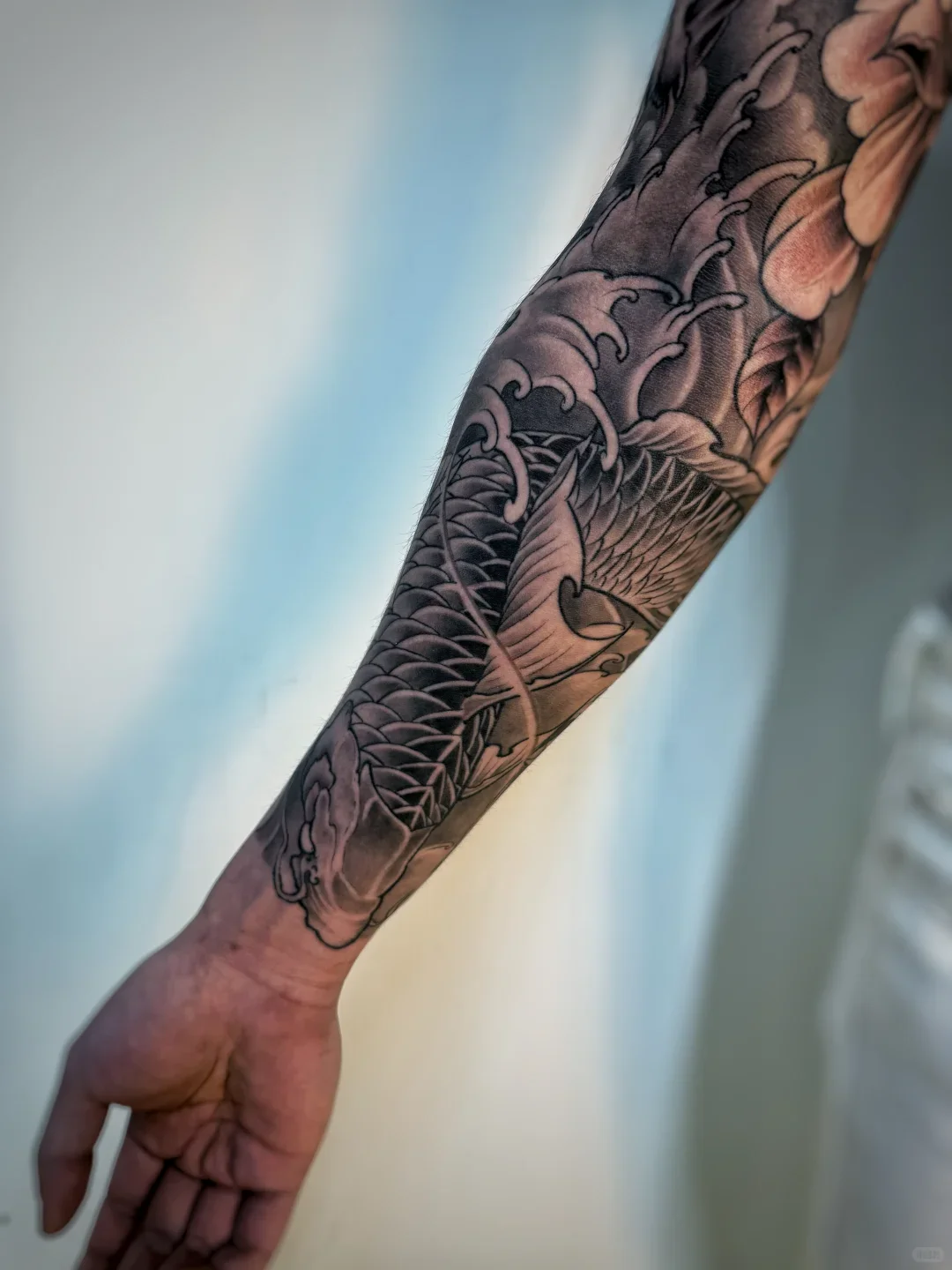
My test for color advice is simple: if a chart confidently assigns one emotion to every red, black, blue or gold dragon without seeing the composition or speaking to the wearer, it is selling confidence rather than interpretation.
The pearl, claws and direction: details worth asking about
Some traditional dragon images pair the creature with a pearl. Do not assume the pearl is just an accessory or automatically call it the sun. A Metropolitan Museum study of the dragon-and-pearl motif examines differing interpretations and notes how the motif is treated in Chinese literature and art. The historical evidence makes this a useful design question, not a license to label every circle in a tattoo as one exact sacred object.
Claws also tempt overconfident advice. Particular imperial garments and court objects used regulated dragon imagery, but a twenty-first-century tattoo with a given number of claws is not automatically an imperial claim. Details vary by period, medium, maker and design tradition; the edge of a sleeve can hide a claw as easily as an artist can deliberately change it. The best reading begins with the complete reference image and the artist's intent. If a seller promises that five claws will confer status, I would leave the room.
Direction is subtler and more useful. Does the head face the hand, the shoulder or the spine? Does the body climb, dive, protect a central object or spiral around another creature? The pose determines how the eye travels. A descending dragon over waves feels unlike a rising one emerging from cloud. That distinction is partly symbolic, partly theatrical and partly anatomical. Skin is curved; a design must survive rotation, distance and the way clothing covers it.
For a tattoo consultation I would bring three references: one historical or museum object to identify a visual feature, one contemporary tattoo to test how it wraps a body, and one brief sentence describing the personal meaning I want to preserve. The museum object informs the design; it does not dictate it. The contemporary photo shows a feasible composition; it does not define the history.
Chinese dragon, Western dragon, or a mixed design?
English uses the same word, dragon, for creatures that do different narrative work. A winged, fire-breathing adversary in European fantasy is not a reliable template for the Chinese long. The Chinese creature is frequently long-bodied and connected with water, clouds and transformation; some stories and images give it political or religious roles. But “Chinese dragons are always good and Western dragons are always evil” is another poor chart. Stories resist it, and contemporary tattoo artists routinely combine visual traditions.
If you are researching a design, ask what you actually want to carry. Is the attraction the sinuous line, the weather, a family connection, a story, an image of authority or a sense of change? If the answer is simply “it looks powerful,” say so. Aesthetic pleasure does not need a fabricated ancestor. I prefer an honest personal reason to a grand story copied from a search result.
The pairing changes the reading too. A koi and dragon may invite a transformation story; a dragon and phoenix may suggest a relationship or balance in some decorative contexts. Neither pairing has a single guaranteed meaning on another person's body. Reference the specific object or story you are borrowing from, then ask how your tattoo changes it.
What to ask before choosing a Chinese dragon tattoo
Start with the artist's work, not the flash sheet's caption. Can the artist show healed examples of long, detailed creatures across a shoulder, back or arm? Does the dragon remain readable at the size you want? Are the scales, whiskers, claws and head arranged as one body, or has a dramatic face been attached to a generic serpent? Ask which source images shaped the drawing and whether the artist is combining Chinese, Japanese, fantasy or other conventions. That question is about clarity, not policing inspiration.
Then place the design on a moving body. A photograph of a flat sketch cannot show what happens when an elbow bends, a shoulder turns or clothing reveals only half the animal. The photographed dragon sleeve and koi forearm both show how a long figure is revealed in stages. A dragon tattoo succeeds when each partial view still feels intentional; it also needs a recognizable head and body if a viewer is to distinguish it from a fish.
Finally, separate artistic meaning from medical or safety decisions. Ink, healing, skin response and studio hygiene deserve professional advice from a qualified local practitioner; this cultural page cannot assess a person's health or certify a studio. Do not let a symbolic reading substitute for practical due diligence.
My conclusion is deliberately narrower than a mystical slogan: a Chinese dragon tattoo is strongest when its wearer and artist can explain the choice of dragon, action, surroundings and placement without claiming an invented universal code. The dragon can carry force, weather, memory or reinvention. The design must tell us which reading it is asking for. If you have one, what is the single visible detail you would want a stranger to notice before telling you what it “means”? Share an authorized design and that explanation in Moments, then compare it with the older visual vocabulary in our Chinese dragon guide.