Koi fish meaning is not one universal code. Modern ornamental koi can represent beauty, care, status, luck or personal endurance, but the strongest Chinese readings usually come from older and broader images of carp and fish: a carp struggling toward the Dragon Gate becomes transformation and earned advancement; fish (yu, 鱼) can sound like surplus (yu, 余) and become a wish for abundance. Color alone cannot decide which story you are looking at.
Koi fish meaning begins with a translation problem
Type “koi fish meaning” into a search box and you will be offered a neat emotional palette: red means love, black means overcoming adversity, gold means wealth, blue means peace, two koi mean marriage. It looks useful because it is easy to memorize. It is also exactly where the cultural confusion begins.
Koi is the Japanese word commonly used in English for ornamental carp. Nishikigoi refers more specifically to the patterned ornamental carp developed and classified in Japan. The Government of Japan's account of nishikigoi places their systematic breeding about two hundred years ago in mountain villages near present-day Ojiya in Niigata. Their color patterns evoke nishiki, rich brocade, which is why the fish became known as “swimming jewels.”
That history matters. A red-and-white fish in a contemporary pond may genuinely be a Japanese nishikigoi. A fourteenth-century Chinese inkstone showing a carp and dragon is not a “koi design” merely because an English viewer recognizes the body as carp-like. A Yuan porcelain plate with an unidentified fish is not improved by relabeling it koi. The translation would make the image feel familiar while taking away the culture that actually explains it.
My first rule is blunt: do not use “koi” as a decorative English synonym for every Chinese fish.
| What you are looking at | Safest name | Meaning begins with |
|---|---|---|
| A documented modern ornamental variety | Koi or nishikigoi | Breeding, pattern, pond culture, ownership and modern associations |
| A Chinese object documented as carp or 鲤鱼 | Carp | Action, water, gate, dragon, companions, inscription and object use |
| A Chinese object documented only as fish | Fish | Number, wordplay, companions, occasion and medium |
| An unattributed tattoo or online graphic | Uncertain stylized fish | The maker's stated intent, not a borrowed universal color chart |
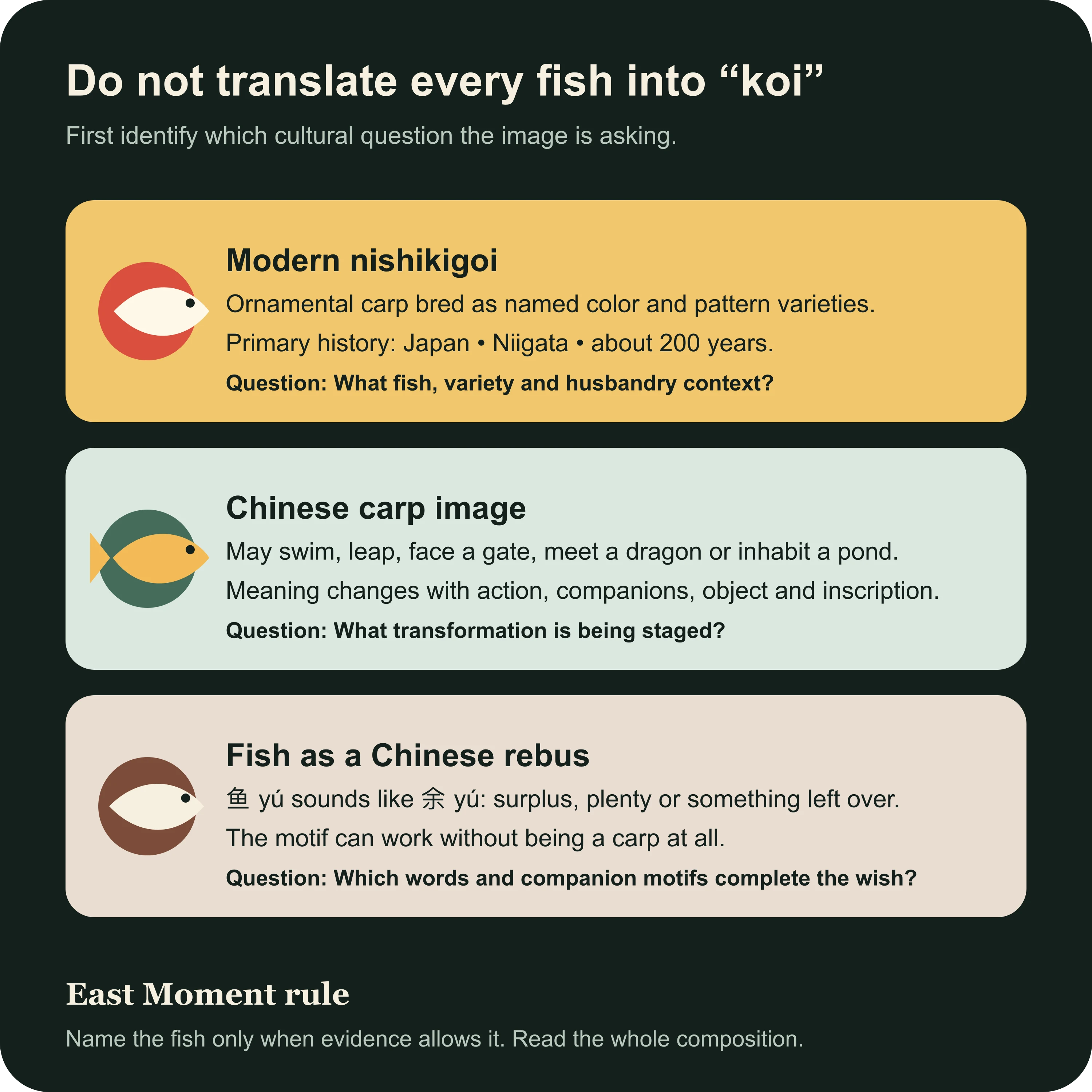
The diagram separates three questions that the internet routinely compresses into one. They can overlap, but overlap is not identity. Modern Chinese ponds contain Japanese-derived nishikigoi traditions; modern luck language calls celebrities and strangers “锦鲤”; older Chinese art gives carp and fish multiple lives. The job of a serious page is to show where those lives meet without pretending they were always the same.
A real koi pond proves beauty and breeding—not an ancient Chinese code
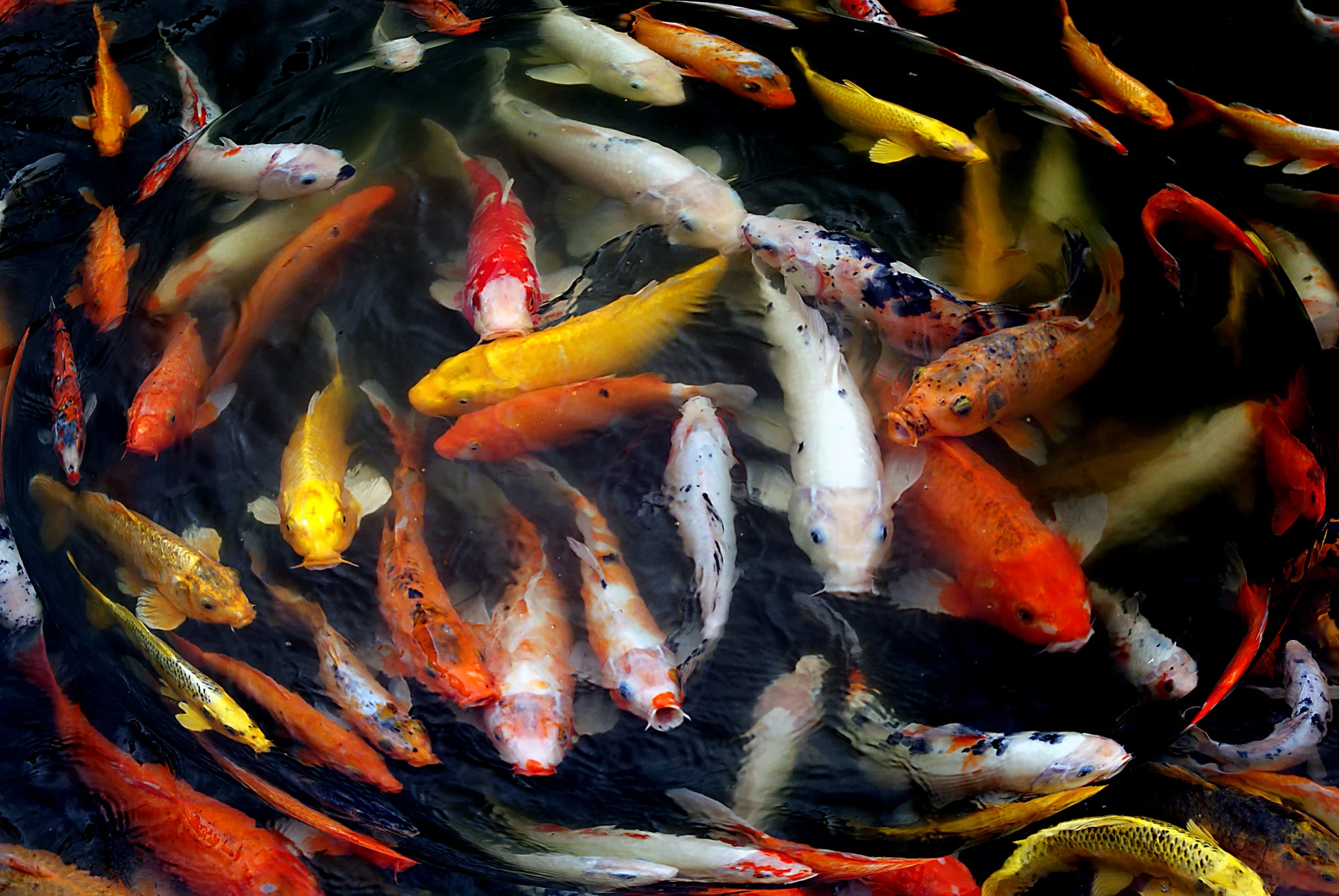
Bernard Spragg released this photograph of modern ornamental koi under CC0. The image proves visible variation in body color and pattern. It does not establish each fish's named variety, ancestry, market value or a compulsory spiritual meaning.
The first thing I feel when I look at this pond is not “red equals romance.” It is pressure and movement. Bodies overlap. A white fish disappears beneath an orange one. Dark water turns every bright patch into a moving fragment. No fish remains a clean icon for more than a second.
That experience explains why koi attract affection. They are large enough to recognize individually, patterned enough to compare, and responsive enough for people to build routines around feeding and care. A pond becomes an archive of time: which fish grew, which scar healed, which pattern changed as the body expanded, which animal approaches first. Meaning grows through attention.
But the photograph cannot carry a Chinese historical claim by itself. Modern nishikigoi breeding, judging and variety language developed through Japan. Chinese viewers can embrace these fish, breed them, sell them, photograph them and add new lucky associations; cultural adoption is real. What we must not do is project every modern color classification backward onto Chinese paintings and ceramics.
This is where I disagree with most symbolism pages. A color can identify part of a fish's appearance. It does not automatically identify the emotion, destiny or moral quality of the owner.
Chinese fish symbolism is larger than carp—and much larger than koi
Chinese decorative language often begins not with zoology but with sound. The word for fish, 鱼 (yu), sounds like 余 (yu), meaning surplus, abundance or something remaining beyond immediate need. That is the verbal engine behind wishes translated as “may there be abundance year after year.”
The British Museum's Yuan-dynasty fish dish makes the relationship explicit in its curatorial record: fish functions as a rebus for wealth and prosperity because 鱼 and 余 share the same pronunciation. The important word is fish, not koi. The object is recorded with a mandarin fish, and its auspicious force does not require the animal to be a carp.
This distinction changes how we read familiar phrases:
- 年年有余 (niannian you yu) wishes for surplus year after year. A fish image can visually replace the final sound.
- 富贵有余 connects wealth, status and surplus; the exact composition may use fish with flowers or other signs.
- A pair of fish may intensify ideas of abundance, pairing or harmony, but the object record and occasion still matter.
- Fish combined with lotus can create additional wordplay around continuity, but not every lotus-and-fish pond is automatically one fixed rebus.
The broader Chinese symbols guide explains why these designs behave like sentences. One motif supplies a sound, another supplies an adjective or verb, and the object itself supplies an occasion. A fish on a New Year envelope, a fish in a scholar painting and a fish on a dining plate do not speak at the same volume.
The Dragon Gate makes carp meaning about change, not passive luck
The most powerful Chinese carp story is 鱼跃龙门—the fish or carp leaping the Dragon Gate. In the familiar visual narrative, carp struggle upstream; the one that passes the gate transforms into a dragon. The image became a metaphor for advancement through difficult selection, especially examination success.

The Metropolitan Museum of Art records this fourteenth-century inkstone with dragon and carp as Chinese Yuan-dynasty stoneware. Its curatorial account connects the decoration to the Dragon Gate myth and to success in the civil service examination. The medium makes the metaphor unusually precise: diligent use of the inkstone is what might carry the scholar from one condition to another.
Look closely at what the object refuses to promise. The carp is not lucky because it owns a lucky color. It is defined by distance from the dragon. Between them sit water, threshold and labor. The transformation has a cost.
That is why I prefer Dragon Gate imagery to generic “good luck” language. Luck can sound like a gift dropped into someone's hands. The carp story honors appetite, repetition, embarrassment and another attempt after failure. It does not guarantee success; it dramatizes why success changes identity.
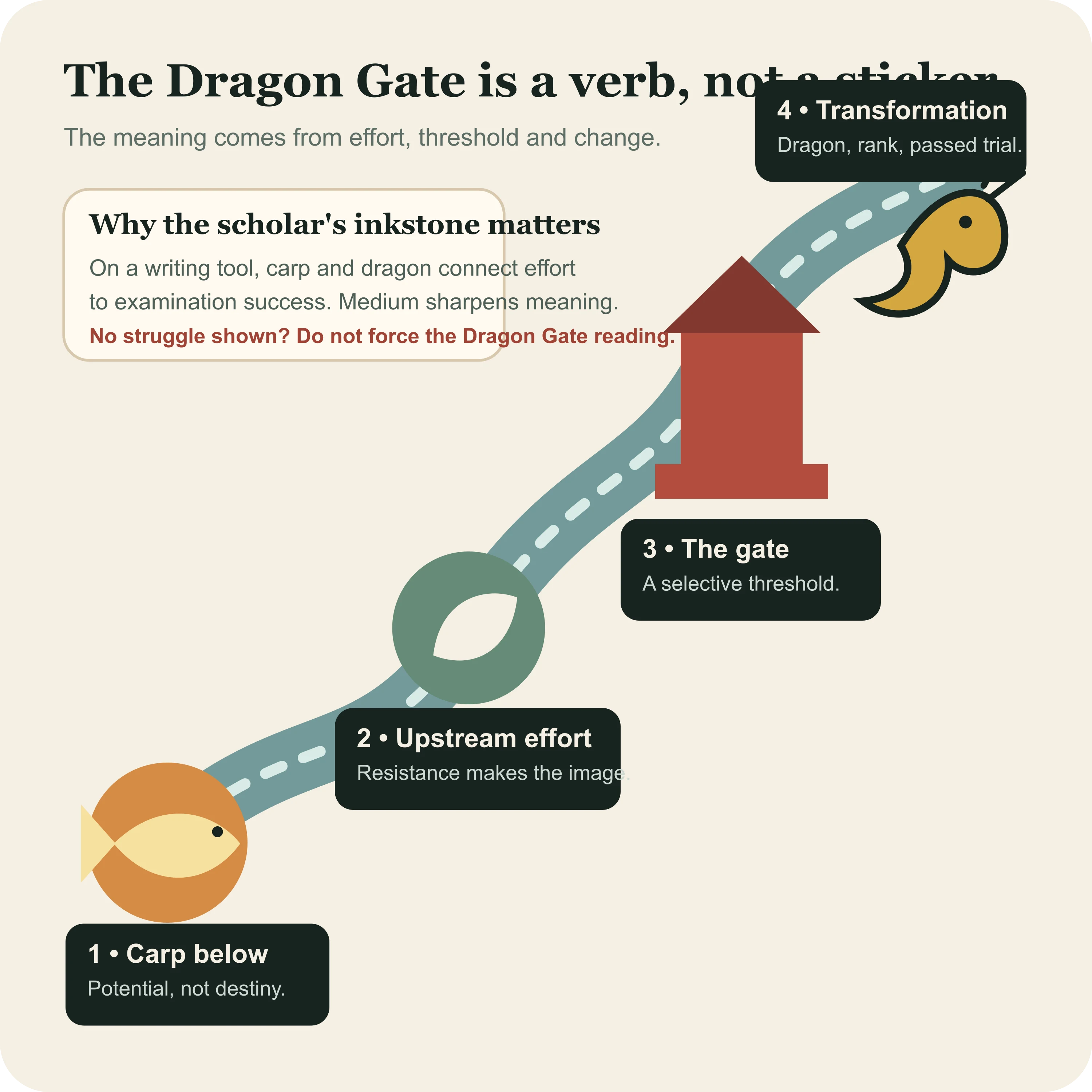
The scholar's inkstone also protects us from a modern mistake. A lone fish swimming horizontally on a T-shirt does not automatically represent the Dragon Gate. To earn that reading, the image should give us evidence of ascent, waterfall, gate, dragon, waves, inscription or a recorded title. No threshold, no automatic transformation story.
If you want the larger creature history, continue to the guide to Chinese dragons. The dragon is not merely the carp's upgraded skin; it changes the fish's relation to power, heaven, water and social rank.
A carp in a lotus pond is living inside a composition

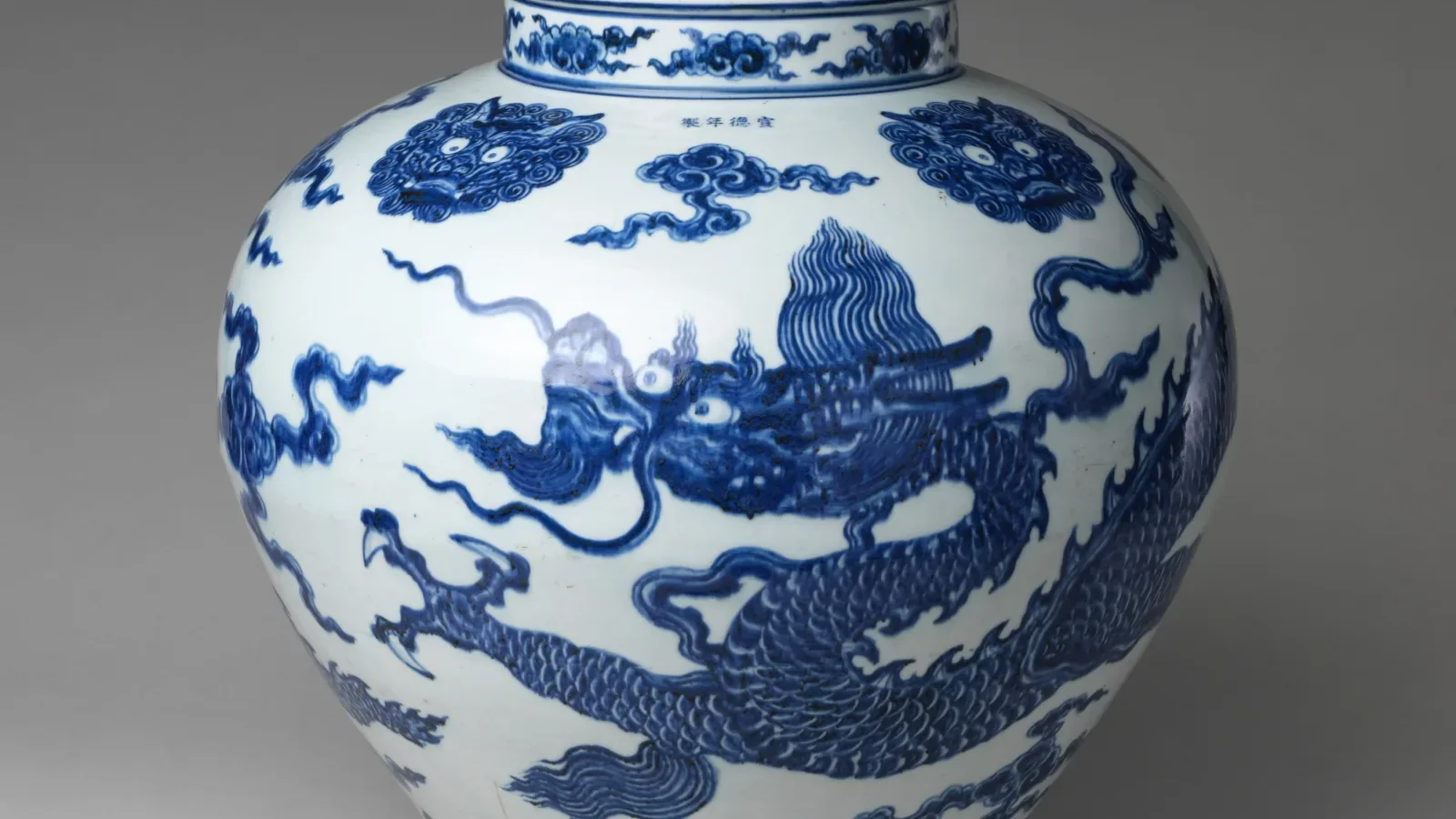
The Met identifies this mid-sixteenth-century jar as a Chinese Jiajing-period Jingdezhen porcelain vessel with carp in a lotus pond. The fish curve around the body among aquatic plants. They are not printed labels waiting for us to decode separately.
The vessel changes the pond. A real pond has no fixed front; the jar also makes the viewer walk around it. One carp disappears at the shoulder while another returns on the opposite side. Lotus stems and water plants divide the surface without turning it into a grid. The body of the jar supplies the water's circular movement.
This is why the Chinese porcelain patterns guide begins with verbs rather than symbol lists. The carp swim, lotus leaves interrupt, borders contain, and the curved wall withholds half the scene. Meaning is produced by those actions.
The lotus can contribute purity, continuity, summer growth or a sound-based auspicious phrase, but only when the particular design supports it. Our separate lotus flower meaning guide shows why lotus symbolism cannot be reduced to one word either. Put two unstable symbols together and you do not get a stable answer. You get a richer object that demands more looking.
“Nine carp” proves why counting sometimes matters—and often does not

The Met records Nine carp as a nineteenth-century Chinese set of four hanging scrolls attributed to Gong Gu. One large carp leads eight smaller fish through grasses. Here the number nine is not internet numerology pasted onto the painting. The museum links the group to the “nine similitudes” in the Book of Odes and to wishes for longevity and constancy through another sound relationship.
The scale difference matters as much as the count. The great body in front makes the smaller fish feel like a moving lineage. Four vertical scrolls cut the water into architectural intervals. The fish continue across those boundaries, so family and continuity become spatial rather than merely verbal.
This is the right way to use number symbolism:
- Count what is genuinely visible.
- Check whether the title, inscription or institutional record activates the number.
- Ask how size, grouping and direction make the count perceptible.
- Refuse to invent an auspicious number when cropping, damage or repetition makes the count uncertain.
Most “two koi meaning” articles skip all four steps. Two fish can suggest partnership, balance, abundance or simply a pleasing composition. If they circle like a yin-yang graphic, that is a modern design decision unless a documented historical object says otherwise. A couple tattoo may sincerely represent two people, but sincerity does not turn that private meaning into an ancient universal law.
A fish can mean freedom before it means fortune
Chinese painting gives fish another life: movement in water can become pleasure, spontaneity and unforced freedom.
The Cleveland Museum of Art records a circa-1400 Chinese hanging scroll titled Fish. Four fish move among aquatic plants, and the water is suggested through bodies and vegetation rather than painted as a solid field. The museum notes the auspicious fish/abundance homophone, but the visual experience is not exhausted by that pun.
The Met's Fish at play, attributed to Zhao Kexiong, goes further. Its institutional account emphasizes fish flipping and weaving through grasses and connects the image to natural life at its freest and most spontaneous. This is a useful correction: Chinese fish imagery can carry auspicious language while also being attentive observation, brushwork and delight.
I want to preserve that freedom. If every fish must become a fortune charm, the animal loses its water. Its turn, pause, submerged edge and relation to plants disappear beneath a motivational caption. The best fish paintings let us feel a world that does not need to perform success for us.
A Yuan fish plate shows why “koi” can be the wrong confident answer

The Met identifies this mid-fourteenth-century plate simply as Plate with fish. Its record discusses Jingdezhen porcelain, cobalt painting and the darker “heaped and piled” effect created during firing. It does not identify the central animal as koi.
That modest title is editorial discipline. The fish has scales, fins, a strong body and aquatic plants around it, but the object does not need a more specific English identity to become valuable. The painter used cobalt to make the fish surge across the circular field. Lotus scrolls and borders organize the rim. Firing marks preserve the difficulty of controlling imported cobalt.
Calling it “ancient Chinese koi porcelain” would produce a clickable caption and a weaker article. It would replace what the museum can prove—date, place, material, technique and a fish—with a familiar search term the record does not support.
This is East Moment's evidence rule: a precise uncertainty is more valuable than a confident false name.
Koi color meaning is personal language, not a Chinese dictionary
Color can matter deeply. Red, white, black, gold and blue carry visual and cultural associations; named nishikigoi varieties depend on pattern, ground color and placement. Tattoo clients and pond owners also attach private memories to particular fish. None of that is trivial.
What I reject is the claim that one global chart can translate every koi color across Japanese breeding culture, Chinese symbolism, tattoo studios and personal grief.
| Popular online claim | What can honestly be said |
|---|---|
| Red koi always means romantic love | Red can intensify celebration, passion or personal attachment; the specific work and owner decide the claim |
| Black koi always means overcoming adversity | A black fish can be chosen for that modern meaning, but color alone does not prove a historical Chinese narrative |
| Gold koi guarantees wealth | Gold easily attracts wealth associations; no image or fish guarantees a financial outcome |
| Blue koi means masculine calm | This is not a universal Chinese code and may come from a particular tattoo or commercial chart |
| Two koi always means marriage | A pair can support partnership or harmony, but direction, companions and stated intent remain necessary |
A person can say, “My black koi marks the year I survived.” That is a complete, honest meaning because it names an owner and a memory. A website cannot convert that sentence into “black koi have meant survival in China for centuries” without evidence.
Personal symbolism becomes stronger when it admits that it is personal.
Koi tattoo meaning must begin with the direction of the story
People searching for koi meaning are often planning a tattoo. They need more than museum history, but they also deserve protection from fake certainty.
For a tattoo, I would ask five questions before discussing color:
- What is the fish doing? Swimming, rising, falling, turning, fighting water or resting?
- Is there a threshold? Waterfall, gate, wave, dragon or no transformation scene at all?
- Which tradition are you naming? Japanese nishikigoi, Chinese carp, a hybrid tattoo vocabulary or your own family story?
- What accompanies the fish? Lotus, peony, waves, dragon, child, text, date or another fish?
- What must remain true in ten years? A private memory can endure; a trendy color chart may not.
An upward carp facing difficult water can support a Dragon Gate reading. A transformed dragon can mark arrival, but also the loss of an earlier self. A pair can represent two people if the wearer says so. A pond of patterned koi can celebrate beauty and care without pretending to be an examination metaphor.
The right tattoo meaning is not the oldest-sounding answer. It is the answer whose visual grammar and personal statement agree. Tattoo hygiene, artist selection and aftercare are separate health questions; this cultural page does not replace professional advice.
Fish belongs to food, festival and family life too
Symbols become thin when they are separated from ordinary life. Fish is not only painted, carved or tattooed. It is purchased, cleaned, cooked, served whole, divided around a table and discussed across regional food traditions.
At Chinese New Year, the phrase 年年有余 can move between spoken wish, printed fish, red envelope, table decoration and an actual dish. That movement is the point. The sound becomes visible; the visible image becomes edible; the meal becomes a family memory. Our Chinese New Year guide keeps those layers together instead of treating the festival as a collection of lucky icons.

The Met records this amber dish with a child chasing a fish as Chinese Qing-dynasty work and notes that the scene likely carried good wishes as well as playful appeal. The child changes the emotional register. The fish is not a lonely emblem; it becomes something pursued, held near the body and folded into wishes for family life.
I love this object because it refuses the sterile symbol chart. The scene has awkwardness and humor. A child reaches, a fish slips, the carved material glows like preserved sunlight. Good wishes feel more convincing when they have motion and touch.
What koi fish symbolism does not prove
Koi and carp imagery can carry powerful meanings. It cannot do everything people ask of it.
A fish image does not prove:
- that the animal is koi rather than carp, another fish or a stylized hybrid;
- that red, black, gold or blue has one fixed meaning across China and Japan;
- that a tattoo owner shares the designer's published interpretation;
- that a pond, ornament or phone wallpaper will produce luck or wealth;
- that paired fish always represent marriage;
- that every leaping fish refers to the Dragon Gate;
- that a museum object is authentic, valuable or correctly attributed because its motif looks auspicious;
- that Japanese nishikigoi breeding history and older Chinese carp imagery are interchangeable.
The boundary is not a weakness. It is what lets the meanings we can prove become sharper.
Use six questions to read any koi, carp or fish image
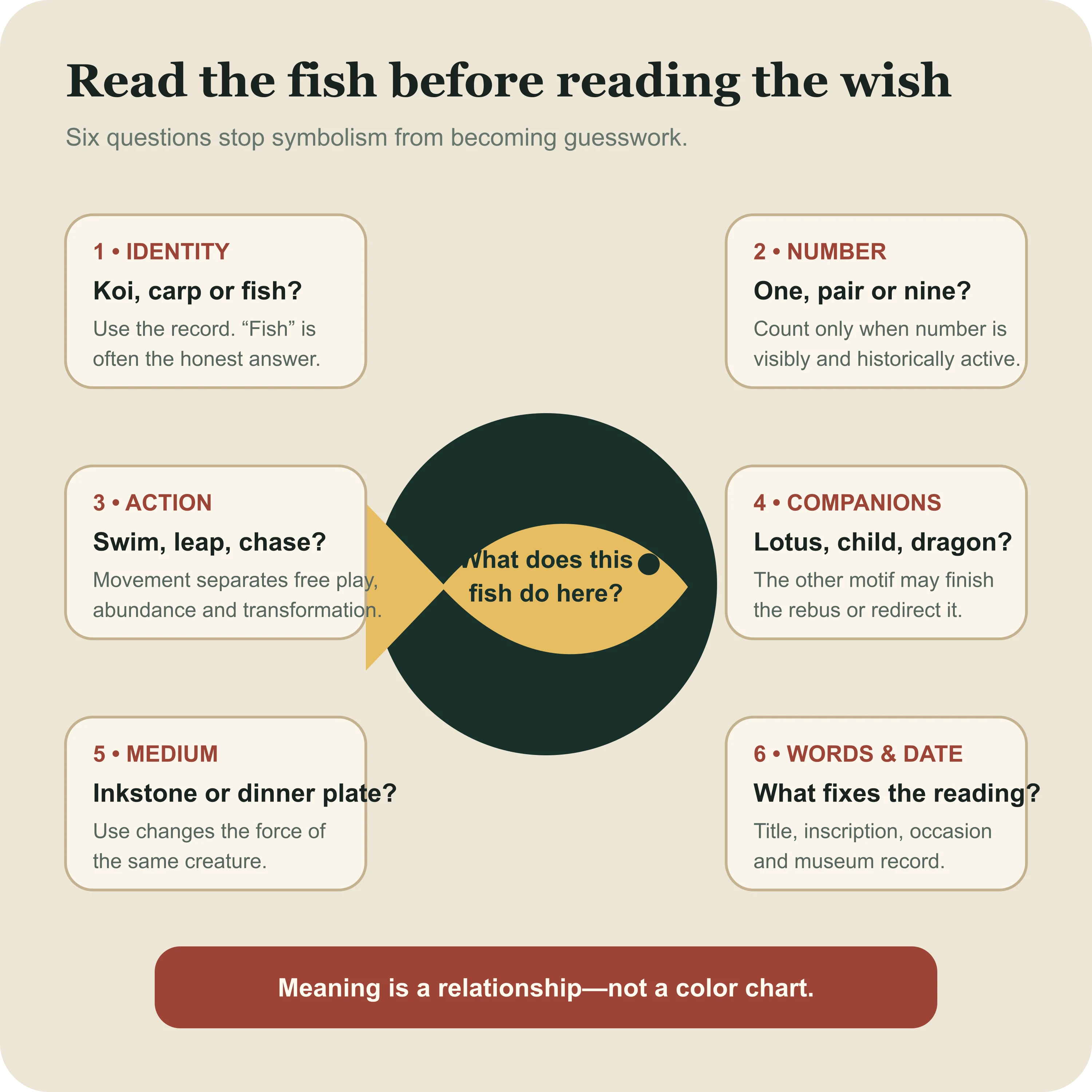
When someone sends me a fish image and asks, “What does this mean?”, I use this order:
- Identity: Does the source say nishikigoi, carp, mandarin fish or only fish? If there is no source, stay cautious.
- Number: Is the count stable and intentional? Does the record activate a pair, eight, nine or another number?
- Action: Is the fish playing, swimming calmly, leaping, struggling upstream, being chased or transforming?
- Companions: Are there lotus flowers, waves, children, dragons, gates, other fish or written characters?
- Medium: Is this an inkstone used for study, a food vessel, a painting, red envelope, garden pond or tattoo?
- Words and date: What do the title, inscription, occasion and reliable object record allow us to say?
That sequence converts symbolism from a vending machine into a method. Put in an image; do not expect one lucky word to fall out. Look until the relationships become visible.
My verdict: the carp matters because it can become—but has not yet become
The koi is beautiful. The carp is ambitious. The fish is abundant. These three sentences can all be true, but they belong to different scenes.
Modern nishikigoi gives us cultivated beauty, individual recognition and the long intimacy of care. Chinese fish wordplay turns sound into a wish that life should leave something over—food, money, time, children, possibility. Dragon Gate imagery gives the carp a harsher and more moving role: it is measured against what it has not yet crossed.
That unfinished state is the meaning I keep.
I do not admire the carp because success is guaranteed. I admire it because the image allows failure to remain visible. Water pushes back. The gate stays high. The dragon is present as possibility, not entitlement. On a scholar's inkstone, every ground stroke and failed page sits between fish and transformation.
So my answer to “what does a koi fish mean?” is firm: first decide whether you are looking at a modern koi, a Chinese carp or a broader fish motif. Then read action, companions, medium and words. Never let a color chart erase the story.
Continue through Chinese symbols and meanings, study how fish move around Chinese blue-and-white porcelain, or bring a difficult image to Moments and let the community test what the evidence can actually hold.