Lotus flower meaning in Chinese culture includes purity, integrity, spiritual awakening, peace, continuity and summer abundance. But “purity” is only the doorway. The living plant, Buddhist image, scholar's essay, spoken pun, garden pond and porcelain surface each make the lotus do a different job. If one sentence claims to explain every lotus, it has already removed the context that created the meaning.
Lotus flower meaning begins with the living plant
The lotus flower in this guide is Nelumbo nucifera, called 莲 (lian) or 荷 (he) in Chinese. It is an aquatic plant whose rhizomes grow in mud while leaves, flowers and seed heads rise into light. That physical structure comes before symbolism.
The Royal Botanic Gardens, Kew describes broad leaves that can sit on or rise above the water, stalks reaching upward, white-to-pink flowers, and the unmistakable seed receptacle at the centre. Kew also notes that the plant has been cultivated in China for more than three thousand years. People did not encounter it only as a temple emblem. They encountered ponds, shade, rain rolling across leaves, lotus root, seeds, fragrance, insects and the visible cycle from bud to broken stem.
That lived biology creates several cultural possibilities:
| Visible or lived quality | Cultural reading it can support | What still needs context |
|---|---|---|
| Rhizome in mud, flower above water | Purity under compromised conditions | Buddhist, literary or modern decorative setting |
| Upright stem and open bloom | Integrity, openness, self-possession | Inscription, artist, audience and composition |
| Water-repellent leaf surface | Cleanliness and non-attachment | Whether the work actually emphasizes the leaf |
| Bud, flower, seed head and decay together | Continuity, time, renewal and mortality | Sequence, season and the surrounding life |
| Edible rhizome and seeds | Home, season, nourishment and ordinary life | Region, recipe, festival and family practice |
I refuse to begin with “lotus equals purity” because it makes the plant sound like a logo. Purity becomes convincing only when we see what the flower rises through, what remains attached below and what the viewer chooses to notice.
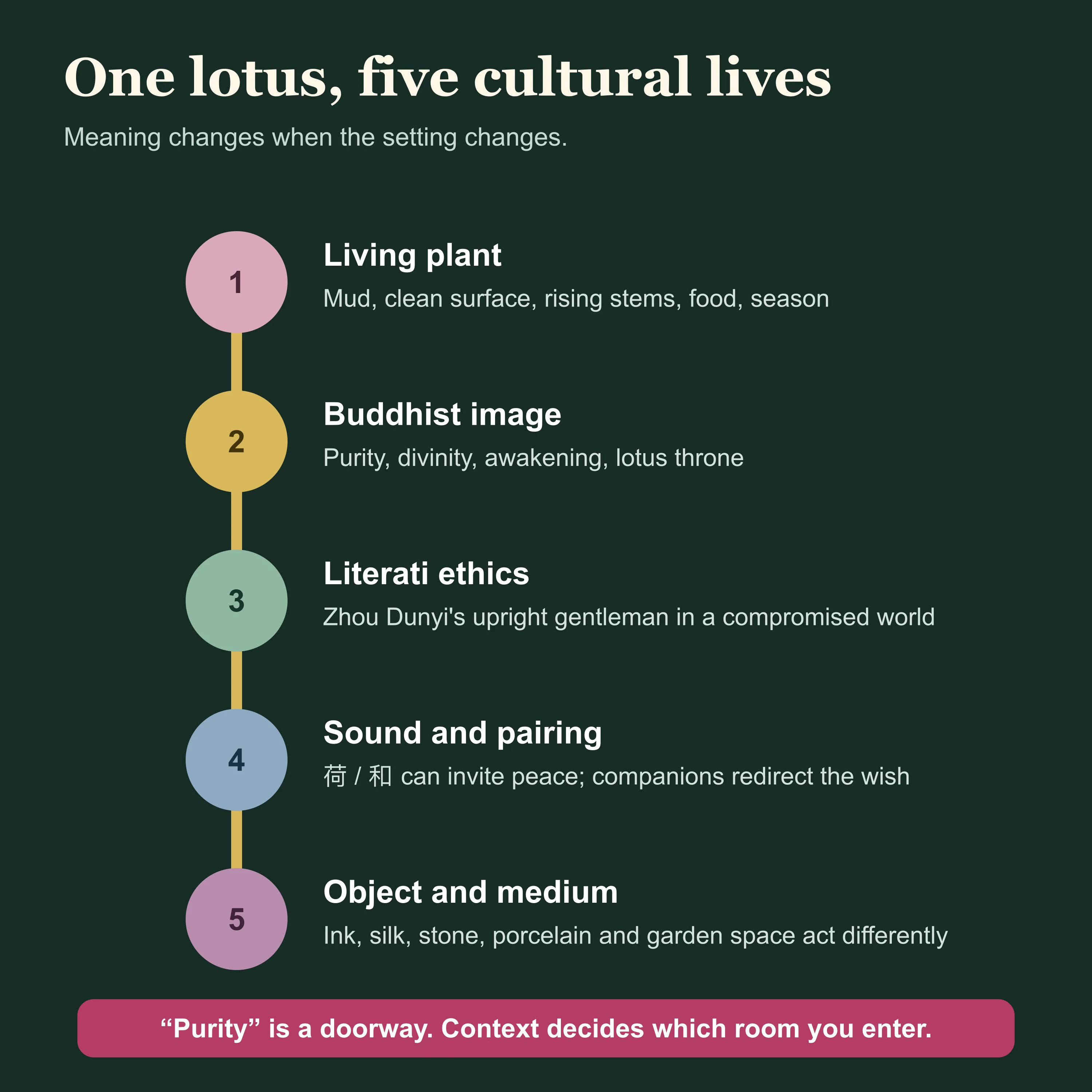
The diagram is not five competing definitions. It is a route. The living plant supplies a form; religion, literature, speech and material culture keep reinterpreting that form.
Lotus and water lily are not botanical synonyms
English captions often use “lotus” and “water lily” as if they name the same plant. They do not.
Sacred lotus belongs to the Nelumbonaceae family. Water lilies belong to the Nymphaeaceae family. Kew explains that the resemblance once led people to treat them as close relatives, but modern botanical work places them far apart. The lotus is closer to plane trees and proteas than to water lilies.
The fastest visual checks are practical:
- Lotus leaves are usually complete, round shields without the deep notch common in water-lily leaves.
- Lotus leaves and flowers often stand clearly above the water; water-lily leaves usually float on the surface.
- A mature lotus forms the conspicuous cone-like seed receptacle people recognize as a lotus pod.
- A distant flower photograph may hide all three clues; uncertainty is therefore the correct label.
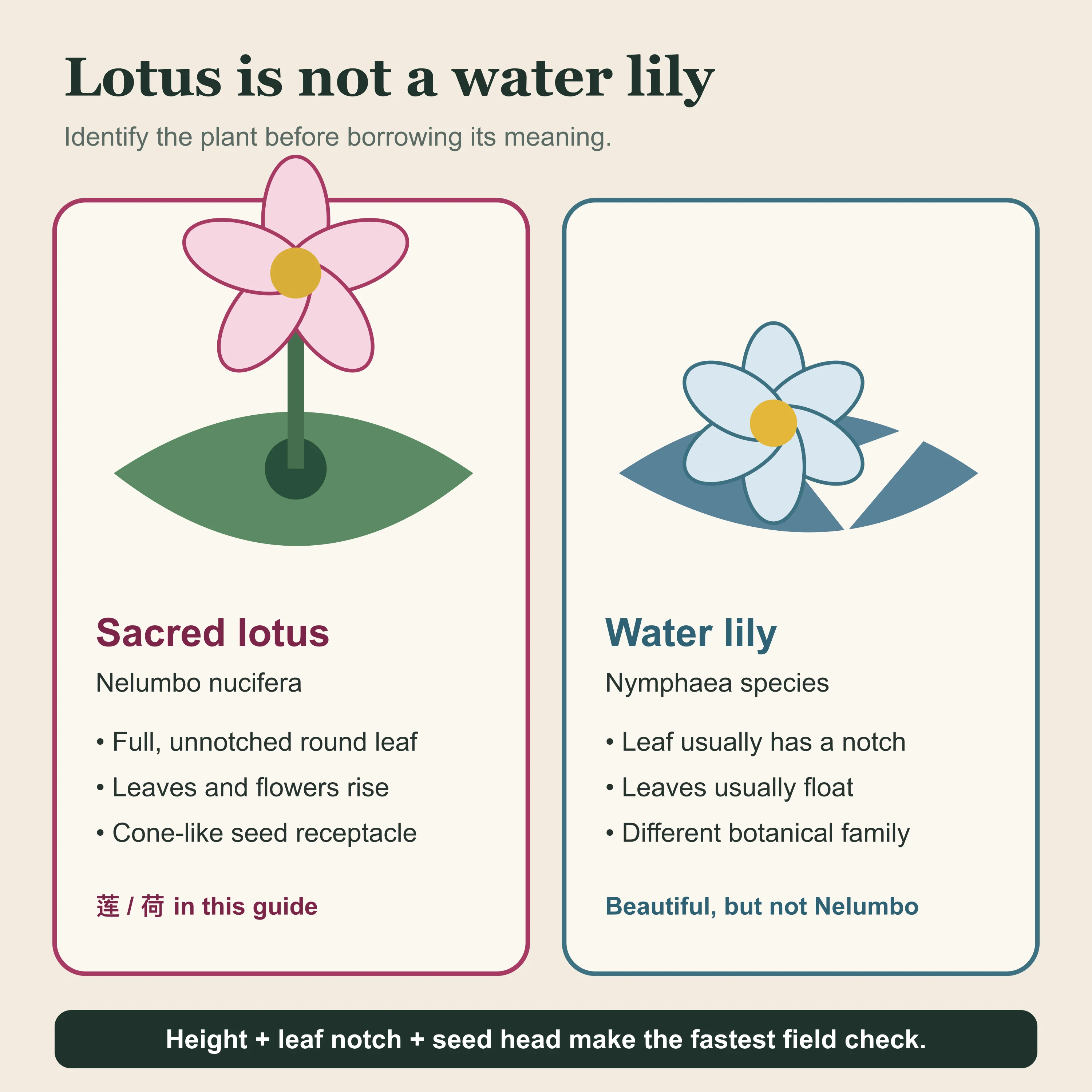
This matters culturally because many traditions use the English word “lotus” for several aquatic flowers. Buddhist texts, translations and visual conventions can also use lotus language more broadly than modern botanical classification. A serious article must allow religious language and plant science to coexist without pretending they are the same sorting system.
My rule is simple: identify the photographed plant botanically when the evidence allows it; identify the historical image using the museum's title and record; do not force one system to impersonate the other.
A Suzhou lotus pond is not a symbol board
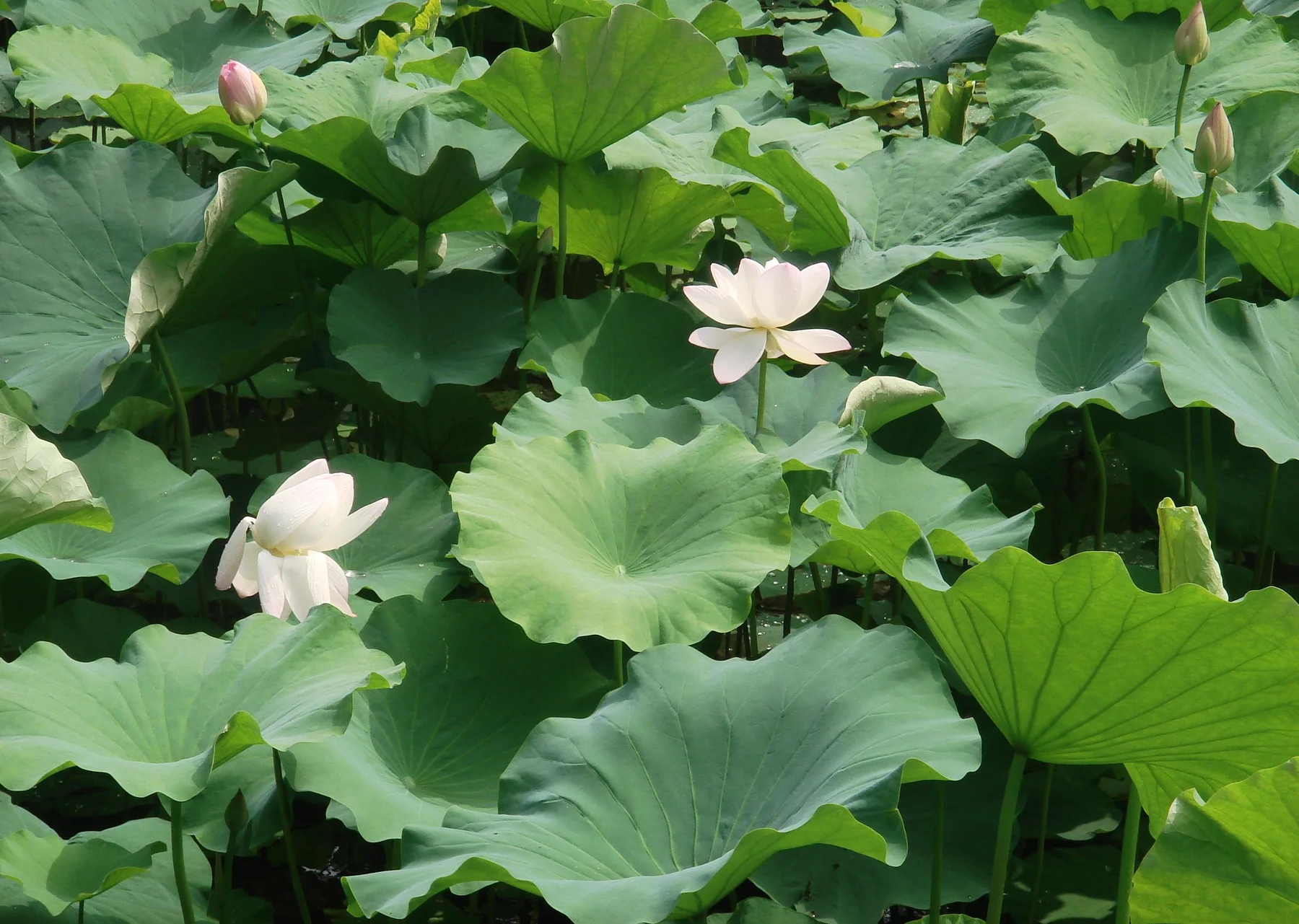
韩笃一 photographed this Nelumbo nucifera in Suzhou's Humble Administrator's Garden in 2009 and released the image into the public domain. The photograph documents the recorded plant in a Chinese garden; it does not prove the historical planting date or one compulsory meaning.
Look at the actual pond before reading the flower. Leaves overlap at different heights. Buds, open blooms and seed structures do not line up like an icon set. Some leaves face us; others turn away. Light breaks across a dense surface. The lotus belongs to an ecosystem and a designed view at once.
This is why the Chinese gardens guide matters. A lotus may be approached through a corridor, framed by a window, seen beneath rain, reflected in water or encountered after a turn in the path. Architecture edits the plant without freezing it. The viewer's walking speed, weather and season become part of the experience.
The living pond also corrects a moral cliché. Mud is not “evil” and water is not automatically “good.” Mud sustains the rhizome. The plant's celebrated cleanliness depends on the same wet environment that simplified moral language tries to reject. The lotus is moving precisely because its purity is relational, not because it has escaped nature.
That is the first East Moment judgment on this page: the lotus does not deny the world below it; it transforms its relationship to that world.
In Buddhist art, the lotus is a place, an attribute and a promise
The lotus carried religious meaning across Asia before it became a Chinese literati metaphor. Hindu and Buddhist traditions both made the flower central to ideas of divinity and purity. In Chinese Buddhist art, it can become a throne, pedestal, held attribute, halo-like frame, offering, pond or part of a sacred realm.

The Met records Monk Holding a Lotus as a sixth- or seventh-century wall-painting fragment from the Kizil cave complex in present-day Xinjiang. The lotus is held. That action is different from sitting on a lotus throne. It places flower, hand and religious identity into one relationship.
The image proves that a monk and lotus appear together in this recorded work. It does not prove that every flower held by a monk means exactly the same doctrine, or that we can reconstruct the complete cave program from one fragment.

The Met records this marble Buddha as Chinese and dated 707. The figure sits above a carved lotus pedestal. Here the lotus is architecture for sacred presence. It separates and supports the figure while making transcendence visible through an earthly flower.
The pedestal does not mean “this Buddha is a flower.” It changes the figure's status in space. Kew's cultural account notes that lotus thrones appear beneath Buddhas and other divine figures in East Asian art. The flower becomes a visual threshold between ordinary ground and sacred body.
This distinction is crucial:
- Held lotus: attention falls on attribute, offering, identity or teaching.
- Lotus seat: the flower organizes sacred rank and bodily presence.
- Lotus pond or realm: the motif can shape an entire imagined environment.
- Lotus-pattern border: repetition may structure a sacred object without narrating a pond.
“Buddhist purity” is therefore accurate but incomplete. The image tells us which kind of purity is being staged and what role the lotus performs.
Zhou Dunyi turned the lotus into a gentleman under pressure
For many Chinese readers, lotus meaning is inseparable from Northern Song thinker Zhou Dunyi and his short essay On the Love of the Lotus (爱莲说). The Internet Encyclopedia of Philosophy notes that the essay draws on cultural material shared across Confucian, Daoist and Buddhist traditions. That mixed inheritance matters. The text did not invent the lotus from nothing; it repositioned an already powerful flower.
Zhou's famous argument admires the lotus because it emerges from mud without being stained, is washed by clear water without becoming showy, is hollow within and upright without, carries fragrance and can be admired without being casually handled. He calls it the junzi—the exemplary or noble person—among flowers.
The Chinese University of Hong Kong Press sample translation makes the chain of observation especially clear. Plant features become ethical language:
- mud becomes a compromised social environment;
- an unstained bloom becomes integrity;
- a straight stem becomes upright conduct;
- open internal structure becomes moral clarity;
- restrained fragrance becomes influence without self-advertisement;
- distance becomes dignity and boundaries.
This is not a scientific explanation of a lotus. It is a philosopher using precise plant observation to construct a human ideal.
The page on Confucianism owns the larger tradition of cultivated conduct, learning, ritual and social responsibility. Here the useful point is narrower: Zhou made the lotus morally legible because each virtue remained attached to a visible plant feature. Later repetition often keeps “purity” and drops the stem, fragrance, distance and social criticism that made the metaphor rich.
My reading is firm: Zhou's lotus is not innocent because it never met dirt. It is admirable because contact did not decide its character.
That is also why the metaphor still reaches people. It is not asking us to live outside imperfect institutions, families, workplaces or public life. It is asking whether we can remain open and upright inside them without becoming theatrical about our virtue.
Ink painting allows the lotus to age, bend and become strange

The Met records Bada Shanren's Birds in a lotus pond as a circa-1690 handscroll in ink on satin. The work is meant to be viewed from right to left. That format refuses the single perfect bloom that dominates stock imagery.
Birds lean, stare and interrupt one another. Lotus leaves become heavy black forms, torn edges and unstable shelters. Stems cross space. The pond is inhabited rather than idealized. A handscroll also introduces time: the viewer reveals one section after another instead of receiving the whole composition in one glance.
This lotus is not a corporate symbol of clean optimism. It can carry decay, humor, suspicion and difficult companionship. The flower's cultural dignity remains, but the artist does not protect it from life.
That is the second East Moment judgment: a serious symbol must survive moods that are not flattering. If lotus can mean only spotless serenity, then Bada Shanren's birds, damaged leaves and awkward bodies become an inconvenience. I think they are the point. Integrity without fatigue is advertising. Integrity after weather feels human.
The neighboring plum blossom meaning guide reaches a related conclusion through cold and bare branches. Plum earns resilience by opening before spring is secure. Lotus earns integrity by remaining visibly connected to water and mud. Their meanings touch, but their physical arguments are different.
On porcelain, lotus becomes movement around a vessel

The Met records this Flask with Lotus Pond as mid-fourteenth-century Yuan-dynasty Jingdezhen porcelain painted in cobalt blue beneath a transparent glaze. Its online text connects lotus with Buddhist purity while also naming summer, longevity, elegance and other virtues in Chinese art.
The object prevents those words from floating free. Lotus leaves, stems, blossoms and pond life have to fit a narrow neck, swelling body and circular route. A motif disappears around the side and returns. The viewer cannot understand the composition from one cropped flower.
The Chinese porcelain patterns guide explains this grammar: a continuous pond, isolated spray, reserve, medallion and border do different visual work. The Chinese blue-and-white porcelain guide separately owns cobalt, glaze and firing history. Here I care about what the vessel makes the lotus do.
On the flask, the lotus becomes circulation. Stem and leaf guide the eye around the body. Blue pigment converts wet plant life into line. The transparent glaze gives pond imagery a luminous surface. Meaning therefore arrives through technique and movement, not only subject.
This is why a lotus tattoo, porcelain flask and Buddhist pedestal cannot be explained by one copied paragraph. They may share a flower, but the body carrying it changes the message.
Sound can turn a lotus into peace—but only in the right pairing
Chinese auspicious imagery often works through sound. A motif may invite a word because its name resembles another desired word. The Smithsonian National Museum of Asian Art notes that 荷 (he, lotus) can evoke 和 (he, harmony or peace) through pronunciation in a Ming-dynasty tapestry with dragonfly and lotus plants.
That does not mean every lotus secretly spells “peace.” Wordplay becomes stronger when object title, companion motif, inscription, occasion or established design supports it. The visual combination is a sentence; the lotus alone is one possible word.
The same caution applies to 莲 (lian) and words for continuity. Lotus seeds, paired blossoms, fish, children and repeated forms can participate in wishes for succession, abundance or harmonious relationship. But the exact reading needs the exact combination. “Lotus means fertility” pasted beneath every painting is cultural laziness.
I use three confidence levels:
- Visible fact: a recorded lotus, bird, child, fish or vessel appears.
- Documented convention: museum scholarship connects this combination or sound to a reading.
- Exact-object intention: inscription, provenance or historical record supports why this particular work was made.
Most online symbol pages jump from level one to level three. East Moment should make the bridge visible.
Lotus is also food, texture and family time
The sacred lotus has an edible life that symbolic guides often ignore. Kew records the use of rhizomes and seeds as food across Asia. In China, lotus root can be sliced, stir-fried, simmered, stuffed or made sweet; seeds can enter soups, pastes and pastries. A lotus leaf can shape scent and presentation. The plant arrives at the table in parts that do not look like a perfect flower.
This matters because culture is not divided into “high symbolism” and “ordinary eating.” A child pulling fibres from a slice of lotus root, a family sharing lotus-seed paste, or someone buying fresh pods by a summer lake may build a stronger memory than a dictionary definition.
The mooncake guide shows how fillings, regional styles, gifting and festival expectations turn ingredients into social objects. Lotus-seed paste in a mooncake does not automatically carry the full Buddhist or Zhou Dunyi symbolism of a painted bloom. It carries taste, season, labor, brand, family preference and occasion. That boundary protects both meanings from becoming vague.
The third East Moment judgment is personal: a symbol becomes culturally real when it can move from temple and painting into the hand, garden and kitchen without losing its history.
What lotus flower symbolism does not automatically prove
A confident page needs firm limits:
- A photographed aquatic flower is not automatically sacred lotus; check leaf, height and seed receptacle.
- Buddhist lotus imagery is not interchangeable with Zhou Dunyi's Confucian gentleman metaphor.
- A lotus motif does not prove the owner is pure, spiritual, peaceful or fertile.
- A five-, eight- or many-petaled design does not carry one universal meaning without specific context.
- Indian, Chinese, Tibetan, Japanese, Korean, Vietnamese and Egyptian lotus histories are not one culture with different costumes.
- A lotus pattern cannot authenticate, date or value a porcelain, textile, jade or painting.
- A food made from lotus does not inherit every religious meaning of the flower.
- A museum photograph proves the recorded object, not the attribution of a visually similar object online.
Those boundaries do not weaken cultural meaning. They stop meaning from becoming available for every sales claim.
Use five questions to read any lotus image or object
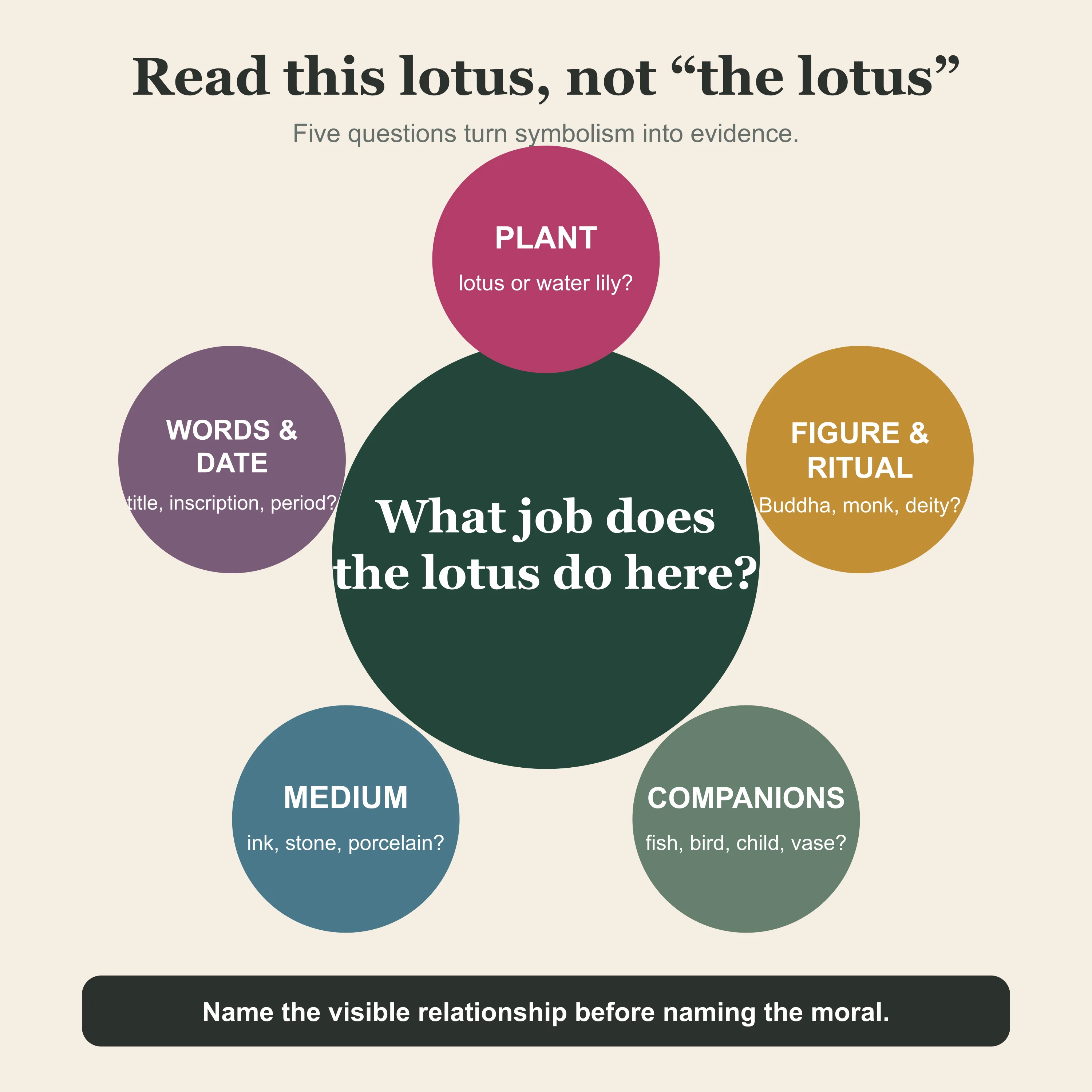
When I encounter a lotus image, I ask:
- What plant or historical label is documented? Is this Nelumbo nucifera, a water lily, or a religious “lotus” whose identity belongs to another naming system?
- Is a sacred figure, monk or ritual action present? Held flower, lotus throne and lotus realm create different relationships.
- What companions appear? Fish, birds, children, insects, rocks, architecture and other plants redirect the meaning.
- What is the medium and placement? Ink scroll, stone pedestal, silk tapestry, porcelain body, garden pond and food each create different evidence.
- What do title, inscription and date say? Words and historical setting can confirm, complicate or overturn the first visual impression.
Then I write two sentences:
This lotus earns its meaning through…
The image still cannot prove…
That practice allows emotion without invention. I can say Bada Shanren's pond feels wary and alive because the birds, damaged leaves, ink weight and handscroll sequence visibly create that feeling. I cannot claim to know every private thought behind the work.
My verdict: the lotus is not untouched—it is transformed
The Chinese lotus is moving because it remains connected to mud, water, appetite, faith, philosophy and human making. It is never only a clean flower floating above an embarrassing world.
Buddhist art makes the lotus a threshold for sacred presence. Zhou Dunyi turns its stem, fragrance and unstained bloom into a gentleman's conduct. A garden lets weather and walking create the view. Bada Shanren allows pond life to become damaged, comic and uneasy. A Yuan flask makes lotus circle a porcelain body. Spoken language can invite peace through sound. The kitchen turns rhizome and seed into memory.
Purity is real, but it is the first layer—not the final answer.
Continue through the Chinese symbols collection to compare how plants, animals, colors and objects build meaning differently. Then bring one lotus image or object to Moments. Post the complete view. Mark lotus, water lily or uncertain. Record the setting, companions, medium and date. Name one interpretation the evidence supports and one claim it cannot support.
That will create a lotus archive worth returning to: not a wall of perfect flowers, but a record of how real people learn to look.