Plum blossom meaning in Chinese culture is resilience, renewal, integrity and hope—but none of those meanings sits inside the flower like a hidden label. The meaning is created by contrast: soft petals on a bare branch, fragrance in cold air, new life before the landscape looks ready, and a person who stops long enough to notice. Remove the season, branch, painting, poem and act of looking, and “resilience” becomes a souvenir-shop slogan.
Plum blossom meaning begins with when it blooms
The plum blossom (Prunus mume, 梅 mei) matters because it enters the year at the difficult edge between winter and spring. It does not wait for a green background to make life obvious. Flowers can appear while branches remain bare and cold still controls the scene. That timing produces the emotional argument.
I would not translate the argument as “the flower defeats winter.” That sounds heroic but shallow. A plum blossom is fragile. Wind can take it. Frost can mark it. Its force comes from opening without pretending the cold has disappeared. That is a more human kind of courage: not invulnerability, but presence under pressure.
This is why four common meanings belong together:
| Common reading | What visibly creates it |
|---|---|
| Resilience or fortitude | A tender bloom persists against cold, exposed wood and an unfinished season |
| Renewal or hope | The first visible life changes how the remaining winter is understood |
| Integrity | The branch does not need lush abundance or public applause to hold its form |
| Solitude | Sparse blossoms and open space make one presence feel deliberate rather than lonely |
The Royal Botanic Gardens, Kew identifies the plant as Prunus mume and notes something English common names hide: despite “plum blossom,” it is botanically closer to an apricot than a plum. That correction is not trivia. Chinese cultural meaning begins with an actual plant, not with an English label that happens to sound familiar.
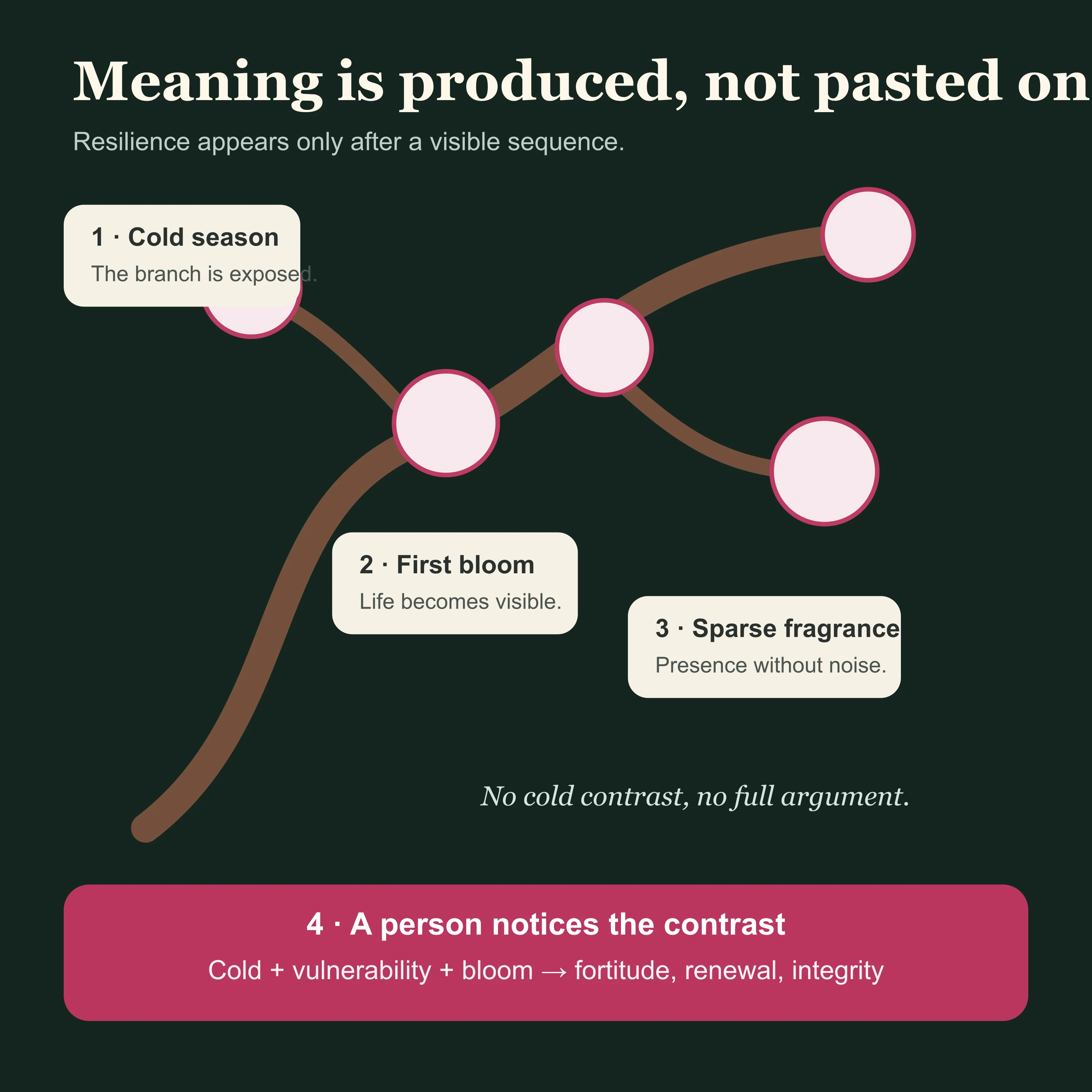
The sequence above explains why I reject one-line symbol lists. “Plum blossom means perseverance” gives the conclusion but removes the experience that earned it. East Moment should do the opposite: return the cold air, the branch and the watcher to the sentence.
Mei is not wintersweet—and yellow is the fastest warning
One of the most useful Chinese winter-flower arguments is also one of the simplest: not every fragrant flower on a bare winter branch is mei.
The pale or deep yellow, waxy-looking flower commonly called wintersweet is Chimonanthus praecox, 蜡梅 or 腊梅 (lamei). It is not a yellow form of Prunus mume. Kew's Plants of the World Online record places wintersweet in the Calycanthaceae family and describes its creamy-yellow, waxy flowers appearing on bare stems in late winter and early spring. Plum blossom belongs to the rose family.
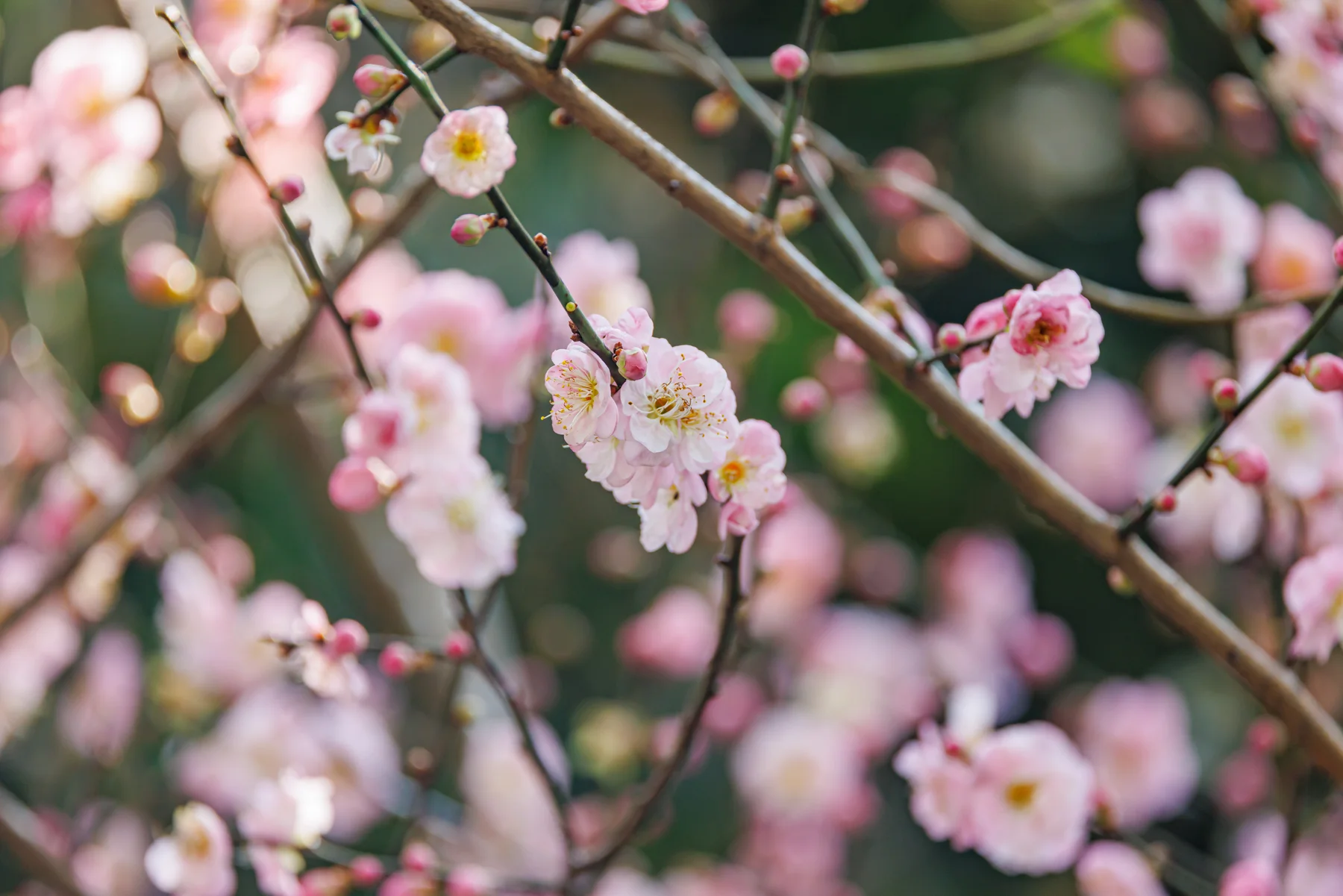
Dinkun Chen photographed these pink Prunus mume flowers in Shenzhen in January 2023. Wikimedia Commons licenses the image under CC BY-SA 4.0. The photograph establishes the recorded plant and visible flower; it does not make every pink five-petaled flower a plum blossom.

そらみみ photographed these Chimonanthus praecox flowers in 2018. Wikimedia Commons licenses the image under CC BY-SA 4.0. Their yellow, translucent, waxy appearance is a strong clue, not a substitute for a botanical record.
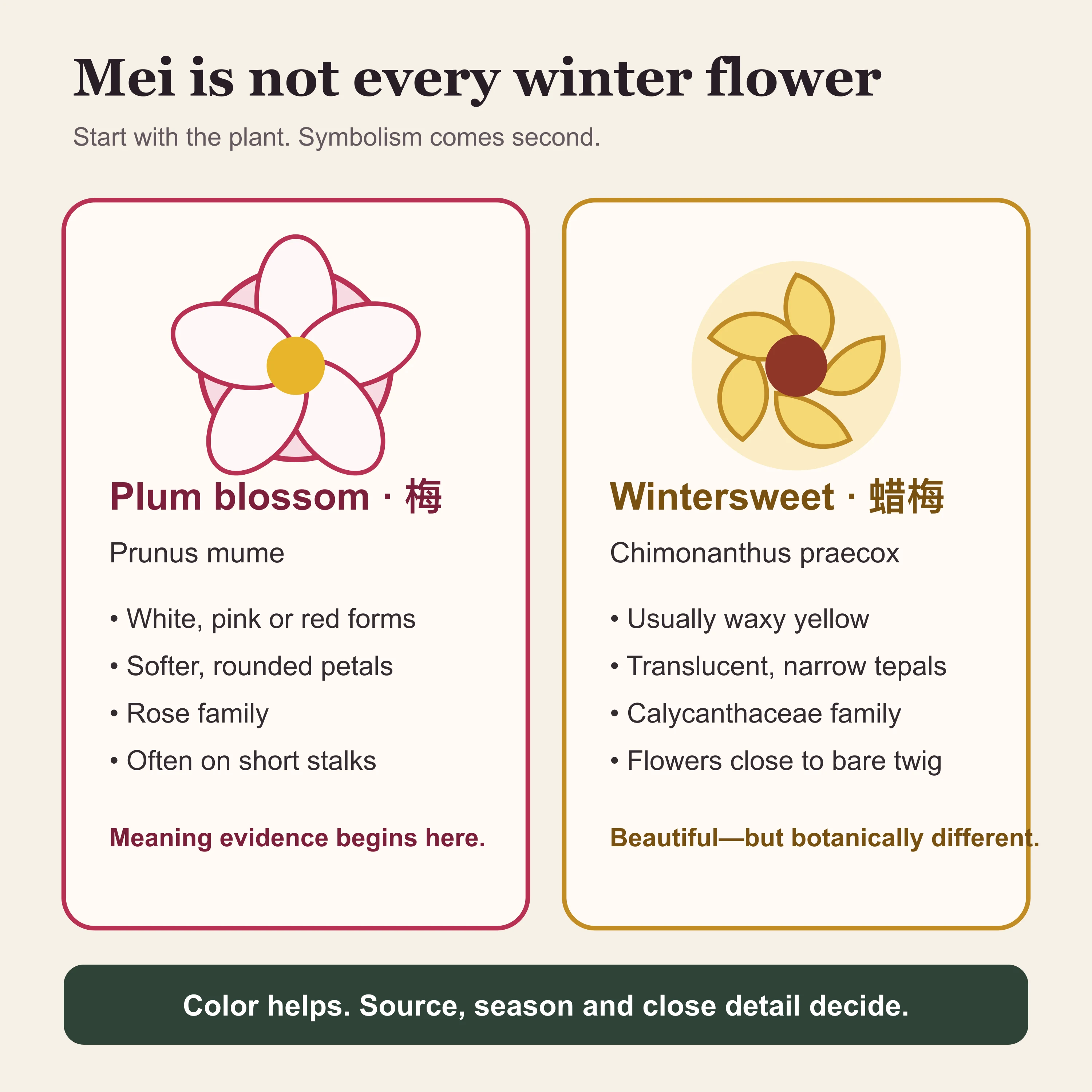
This distinction changes cultural reading. Wintersweet has its own long life in Chinese gardens, seasonal observation, poetry and fragrance culture. Calling it “plum blossom” does not honor that history; it erases it. The goal is not to police every casual caption. The goal is to stop an image from borrowing symbolism through a mistaken name.
When a photograph has no source, I use a careful label: “a winter-flowering branch, possibly wintersweet” is better than a confident false identification. Expertise is not turning every flower into an answer. It is knowing where the image stops speaking.
The bare branch carries more meaning than the number of petals
Internet symbolism loves counting. Five petals become five blessings; eight blossoms become prosperity; a red bloom becomes luck. Some of those readings may be meaningful in a documented modern design, festival product or specific work. They are not a universal key for every plum image.
I care more about the branch.
An old, angular branch lets vulnerability and endurance occupy the same line. Sparse blossoms leave cold space visible. Dense flowers can create celebration, but one or two blossoms on dark wood create tension. Ink painting can exaggerate that tension because black line and pale paper strip away the distracting abundance of a full garden.
This is the visual grammar behind much Chinese plum imagery:
- Old wood carries time, weather and accumulated difficulty.
- New blossom interrupts that age without erasing it.
- Empty paper or sky keeps cold and solitude present.
- Asymmetry makes growth feel discovered rather than manufactured.
- Fragrance, which cannot be painted directly, enters through poetry, memory and the viewer's imagination.
A five-petaled flower may support an auspicious reading when context says so. But if the page automatically declares “five petals equal the Five Blessings,” it has stopped looking. Count only after you understand season, composition, medium and inscription.
A Southern Song painting makes looking part of the meaning

The Metropolitan Museum of Art records Ma Yuan's Viewing plum blossoms by moonlight as an early thirteenth-century Southern Song work. The title changes everything. This is not only a plum-blossom picture. It is a picture of a person making time to look.
The figure is small. The architecture shelters but does not dominate him. The branch enters a space already shaped by night, moonlight, distance and attention. Meaning is therefore social and bodily: someone walked, paused, raised his head and allowed a seasonal detail to reorganize the night.
This is the East Moment idea I want to defend most strongly: Chinese flower symbolism is often a practice before it is a definition. People visit gardens, wait for a season, write a line, pour tea, invite a friend, compare one flowering year with another, or stand alone beneath a branch. The symbol is built through repeated acts of attention.
That is why the Chinese gardens guide matters here. A garden does not arrange plants as isolated labels. Path, frame, borrowed view, wall opening, weather and walking sequence decide when a plant becomes visible. Plum blossom near a window, courtyard wall or winding path can make arrival itself part of the image.
If a search result removes the watcher and gives only “resilience,” it has discarded the most intimate evidence.
Poetry gives the blossom a fragrance the picture cannot hold
Two famous poetic habits explain why plum blossom remains emotionally alive.
One is distance. In Wang Anshi's Plum Blossoms, flowers appear at the corner of a wall; fragrance reveals that the white in the distance is not snow. The poem does not announce a moral lesson. It gives the reader a small sensory correction. Sight hesitates; scent decides.
The other is sparse shadow. Lin Bu's plum poetry made slender branches, slanting shadows and faint fragrance almost inseparable from the cultivated image of the flower. I do not need to paste the entire poem here. The important point is how little material the scene requires: water, moon, shadow, scent. Plum blossom becomes powerful because the poem refuses visual noise.
That restraint is not emotional coldness. It is emotional concentration. A crowded arrangement says, “Look how much is here.” A sparse plum branch says, “Notice what survived.”
This also explains why translation often feels flat. English can carry “fragrance,” “shadow” and “cold,” but a symbol list removes the relationship among them. The experience lives in the sequence: you see pale forms, mistake them for snow, smell the air, then understand that spring has begun before the landscape announces it.
Scholar painting turns a branch into a position in the world

The Met records Jin Nong's Blossoming plum as a 1759 Qing-dynasty hanging scroll in ink on paper. Jin Nong specialized in plum blossoms. That repetition matters. When an artist returns to one subject, the flower becomes less like botanical illustration and more like a language for line, character and self-positioning.
Ink makes the branch carry almost the entire emotional load. Its bends are not errors waiting to be corrected by a straight ruler. They hold age, interruption and stubborn continuation. Blossoms do not hide the structure; they make the structure visible.

The Met's record for Li Fangying's Bamboo, plum, and rock connects plum blooming in the cold with perseverance when talent goes unappreciated. The object is especially useful because it does not isolate plum. Bamboo and rock alter the social atmosphere. This is no longer one flower bearing a private emotion; it is a relationship among forms that bend, endure, shelter and remain.
The same artist's 1742 Album of Blossoming Plum integrates poetry, painting and calligraphy. The Met describes plum as the first flower of spring and connects it with fortitude, renewal, moral purity and loyalty. That institutional summary supports the broad cultural reading. The individual leaves, inscriptions and brush decisions explain how a particular work earns it.
This is the gap between information and understanding. Information says “plum symbolizes moral purity.” Understanding asks why one black branch, one pale flower and one written line made that reading convincing to a historical viewer.
The Three Friends of Winter is a relationship, not three emojis
Plum, pine and bamboo are commonly grouped as the Three Friends of Winter (suihan sanyou, 岁寒三友). The phrase joins three plants that remain visually or symbolically present through the cold: evergreen pine, bamboo that keeps its structure and plum that flowers near winter's end.
The grouping is often flattened into three interchangeable words—longevity, flexibility, resilience. That misses the friendship.
Pine holds needles when other trees are bare. Bamboo bends, segments its growth and remains green. Plum produces tender flowers against exposed wood. Their differences create the companionship. A painting that combines them can therefore stage a conversation among endurance, adaptability and renewal. Rock may add stability or hardship; an inscription can pull the scene toward friendship, loyalty, retirement or political disappointment.
The strongest reading is not “all three mean good character.” It is: character becomes legible through different responses to the same season.
That line is also why I resist personality quizzes. Owning a plum picture does not prove that the owner is resilient. Wearing a plum pendant does not reveal a moral biography. A motif can express a wish, quote a tradition, answer a room's decoration or simply be loved as form.
On porcelain and New Year objects, placement changes the message
Plum blossom does not carry identical weight in ink painting, carved wood, embroidered clothing, paper-cut decoration and porcelain. Medium changes what the flower can do.
On a scroll, empty paper may stand for air, snow, distance or silence. On porcelain, the flower must negotiate a curved body. A branch can wrap around a vase, enter a reserve, repeat as a border or meet magpie, bamboo, rock or another seasonal flower. The Chinese porcelain patterns guide explains why placement comes before symbolism: the same blossom behaves differently as a continuous branch, isolated spray or framed panel.
On a Chinese New Year object, plum may strengthen a seasonal message of renewal because the festival also turns attention toward the year's beginning. But context still decides. A commercial red-and-gold design, a scholar's ink branch and a family paper decoration may share a flower without sharing audience, tone or historical claim. The Chinese New Year guide owns the wider festival system; plum blossom is one visual participant, not the entire festival reduced to a flower.
The rule is simple: ask what the motif is doing on this object, in this room, at this moment. “What does plum blossom mean?” is the beginning of interpretation, not the end.
What plum blossom does not automatically prove
Strong cultural writing needs boundaries. Here are mine:
- It does not prove Five Blessings because five petals are visible. That may be an intentional modern auspicious reading, but it needs object-specific evidence.
- It does not turn every yellow winter flower into mei. Wintersweet is a different plant.
- It does not make every East Asian plum image culturally identical. Chinese, Japanese, Korean and Vietnamese histories overlap and diverge; the exact work and setting matter.
- It does not reveal the owner's personality. A motif can be decorative, inherited, fashionable, commissioned or simply beautiful.
- It does not authenticate an antique. A plum pattern cannot establish date, maker, kiln, provenance, restoration or value.
- It does not require one approved emotion. A bare branch can feel hopeful, lonely, severe, intimate or defiant depending on composition and viewer.
These limits do not weaken symbolism. They rescue it from becoming a sticker attached to any convenient image.
Use five questions to read any plum blossom image
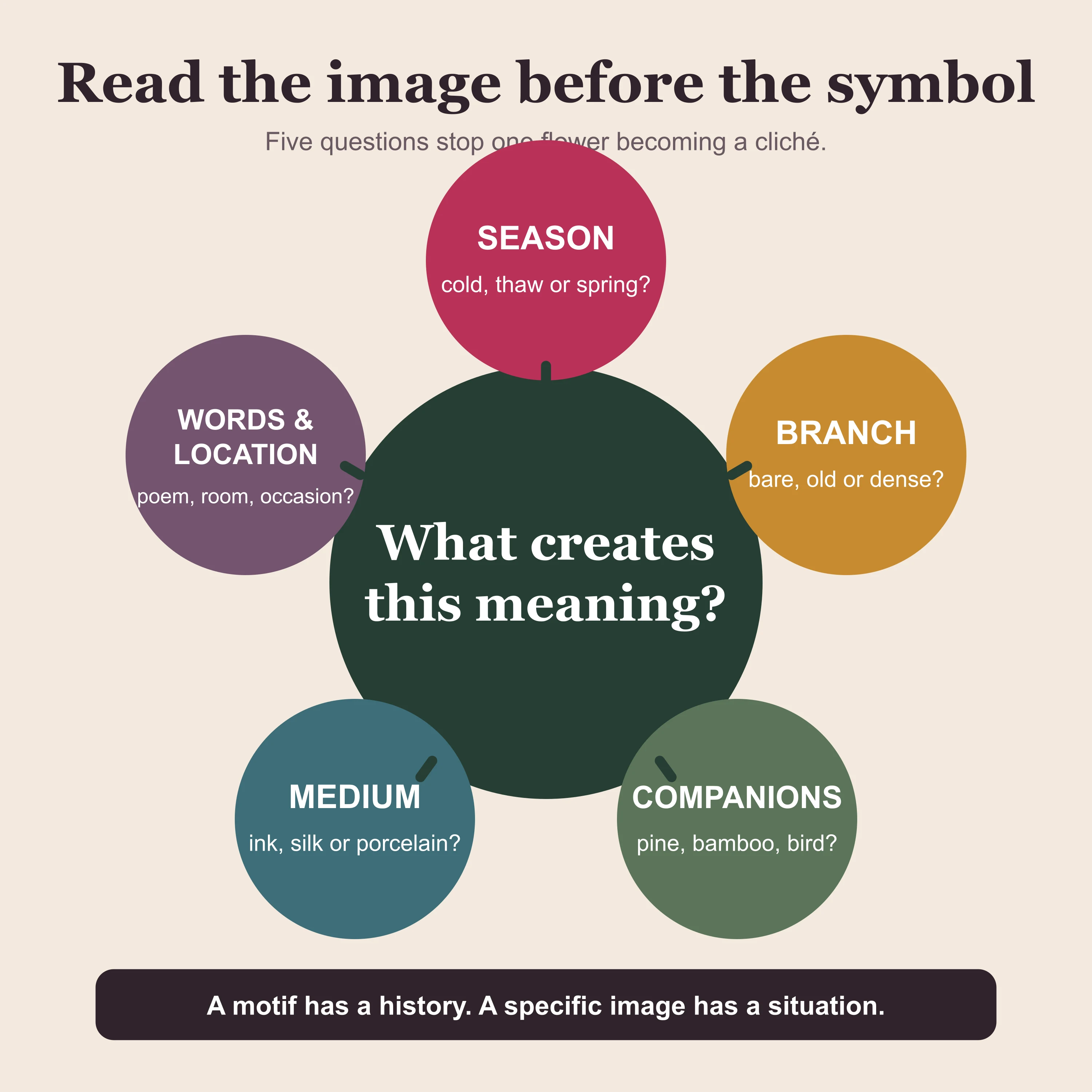
When a plum image catches my attention, I now use five questions:
- What season is visible or named? Snow, bare wood, thaw, moonlight and early spring create different pressure.
- What does the branch look like? Old, angular, broken, dense, young, upright and trailing forms carry different rhythms.
- What accompanies the flower? Pine, bamboo, rock, bird, water, architecture and human figures shift the relationship.
- What is the medium? Ink can make absence active; porcelain makes rotation and placement matter; embroidery makes texture and wear visible.
- What do words and location add? An inscription, title, room, festival, garden path or family story may contain the strongest evidence.
Then I write two sentences:
This image builds its meaning from…
It still cannot prove…
That habit protects both emotion and fact. The first sentence allows a clear personal judgment. The second keeps the judgment from impersonating documentation.
My verdict: plum blossom is courage without theatre
The plum blossom is not powerful because it is loud. It is powerful because it does not need the landscape to agree with it before it opens.
That is why its Chinese meaning still works. The flower does not arrive after all difficulty has ended. It arrives while difficulty remains visible. Old branch and new petal occupy one frame. Fragrance reaches the viewer before the world looks like spring. A scholar can turn that contrast into integrity; a friend can turn it into companionship; a person walking under moonlight can turn it into one private moment of recognition.
I would choose that complex image over “resilience” printed beneath a decorative icon every time. Resilience is not the name of the flower. It is the relationship among cold, vulnerability, timing and attention.
Continue through the Chinese symbols collection to compare how meaning changes across animals, colors, plants and objects. Then bring one plum-blossom image to Moments. Post the full image—not only a cropped flower. Record the plant name if known, season, branch, companion motif, medium and inscription. Write exactly where the feeling of resilience or renewal comes from, and name one thing the image still cannot prove.
That will create something more valuable than another symbol list: a living archive of how people actually look.