2025 was the Year of the Snake from January 29, 2025 through February 16, 2026. The Snake is not best understood as a coded personality type. Its stronger cultural idea is controlled transformation: a life form that changes its surface, disappears from view and returns.
Year of the Snake dates and the New Year boundary
Recent Snake years are 1929, 1941, 1953, 1965, 1977, 1989, 2001, 2013, 2025 and 2037.
| Snake year | Begins | Ends | Element |
|---|---|---|---|
| 1989 | February 6, 1989 | January 26, 1990 | Earth |
| 2001 | January 24, 2001 | February 11, 2002 | Metal |
| 2013 | February 10, 2013 | January 30, 2014 | Water |
| 2025 | January 29, 2025 | February 16, 2026 | Wood |
A child born on January 20, 2025 is a Dragon under the Chinese New Year convention. A child born on January 29 is a Snake. The exact birthday matters; check it with the zodiac calculator.
The complete Chinese zodiac cycle shows how Snake fits between Dragon and Horse and why each animal is paired with a branch rather than replacing it.
Our conclusion: the Snake is powerful because it resists one meaning
Generic zodiac copy calls the Snake wise, elegant, secretive and intuitive. The traits sound precise until you notice they could describe almost any attractive fictional strategist.
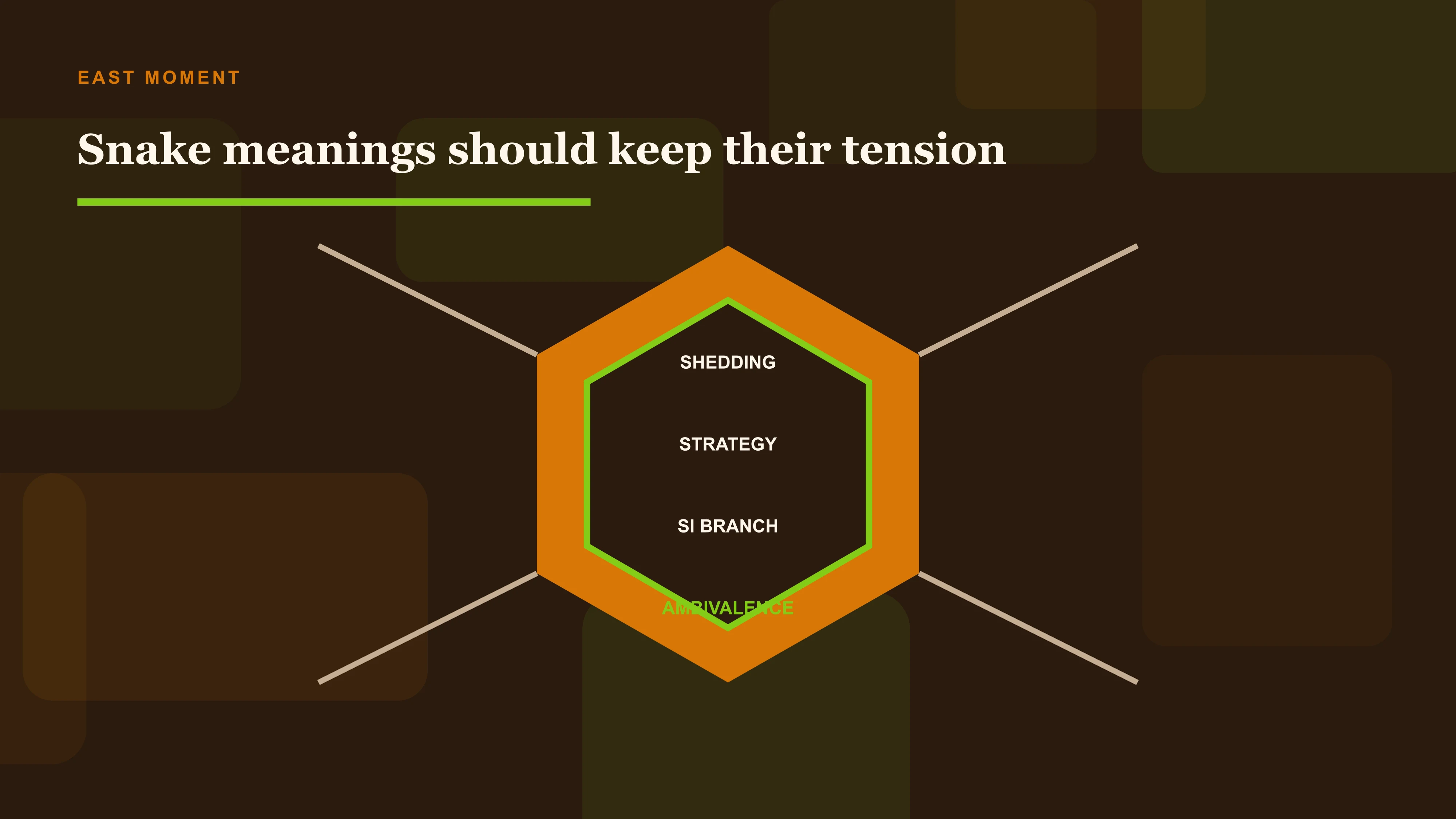
Chinese Snake imagery is more valuable when we keep its tension. A snake can signal renewal because it sheds its skin. It can also create unease because it moves close to the ground, hides and appears suddenly. It sits near the dragon in visual imagination but remains unmistakably bodily and earthbound.
The Snake's cultural force comes from ambiguity, not from a single flattering adjective. It asks how something can be feared and admired, concealed and visible, old and newly surfaced at the same time.
Si is the branch; she is the animal

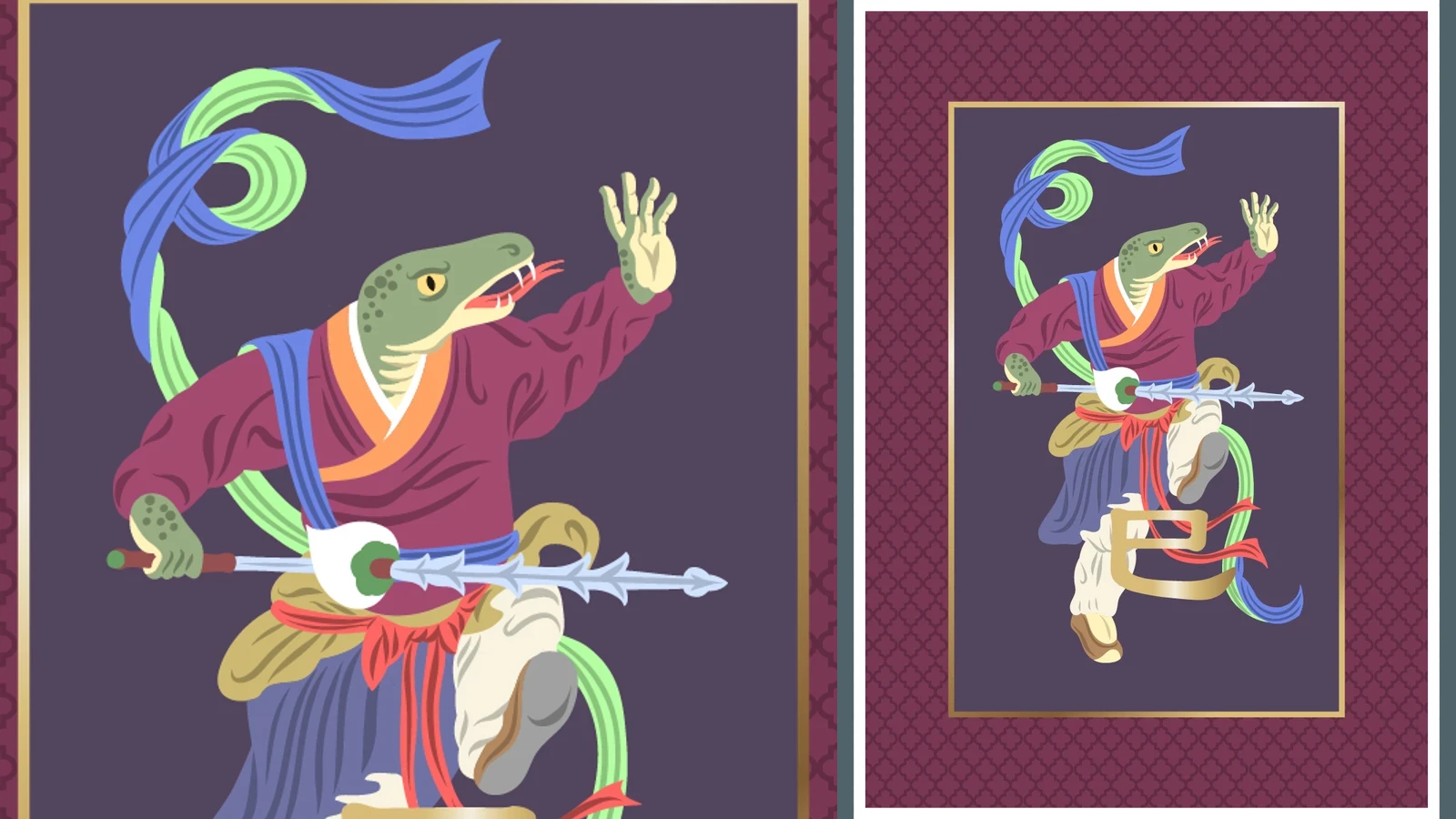
The Snake panel in our authorized illustration carries 巳 (si), the sixth Earthly Branch. The ordinary Chinese word for snake is 蛇 (she).
Si marks a position in the twelve-branch system and is traditionally linked with the double-hour from roughly 9 a.m. to 11 a.m. Pairing it with a snake gives an abstract time marker a memorable body.
The illustration turns that body into a loop around the figure. The curve matters more than a list of personality traits: it makes continuity, concealment and return visible. This is contemporary artwork, so it documents modern visual interpretation rather than ancient practice.
A Song dynasty figure changes how we read the zodiac

The Metropolitan Museum of Art identifies this eleventh-century Jingdezhen qingbai porcelain as a Chinese zodiac figure of a snake. The animal does not replace the human body. A robed figure holds the small snake as an identifying sign.
That detail corrects a modern assumption. Zodiac imagery has not always meant twelve cartoon animal faces lined up like brand characters. Artists could make the system legible through hybrid figures, held attributes and material conventions. The contemporary illustration above and the Song object solve the same recognition problem in radically different visual languages.
The comparison is evidence of continuity in the zodiac system, not proof that the modern artwork copies Song design. Similar subject does not mean direct descent.
Snake, dragon and the problem of easy equivalence
Snakes and dragons can share long bodies, scales and transformative associations in Chinese visual culture. That does not make a snake a “small dragon,” nor does it erase the different positions of Snake and Dragon in the zodiac.
The zodiac keeps them adjacent: Dragon is fifth, Snake sixth. Yet the Dragon often expands outward toward clouds, rain and public authority, while Snake stories retain closer contact with the ground, the hidden body and metamorphosis.
The famous Legend of the White Snake is not the origin of the Snake zodiac. It is useful here because its transformed snake spirit intensifies the same cultural tension: human and nonhuman identity, love and danger, sympathy and suspicion. Do not use one story to explain the entire sign; use it to see why “mysterious” is an inadequate summary.
What Wood Snake means in 2025
2025 combines the Yi (乙) Heavenly Stem with the Si (巳) branch. Yi is associated with yin Wood, producing the Wood Snake label.
The element belongs to the sixty-year stem-branch cycle. It does not turn every 2025 birth into a person with a shared psychological profile. The previous Wood Snake year was 1965; the next will be 2085.
This precision is worth keeping because it shows how the calendar works. The fatalistic personality claims are not.
How to use Snake symbolism without flattening it
During a Snake year, notice what designers choose to show:
- A complete snake body emphasizes line, rhythm and transformation.
- A coiled snake can suggest stored energy or protection.
- A snake held by a human figure functions as an identifying attribute.
- The branch 巳 signals the calendrical system; the word 蛇 simply names the animal.
Then ask whether the caption identifies a historical object securely. A museum date and material tell you what an artifact can support. An unattributed image labeled “ancient Chinese snake” tells you almost nothing.
The Year of the Snake becomes deeper when we stop forcing the animal to confess one personality. Its real advantage is that it keeps several meanings alive without resolving them too quickly.
Year of the Snake meaning becomes dishonest when every change is called renewal
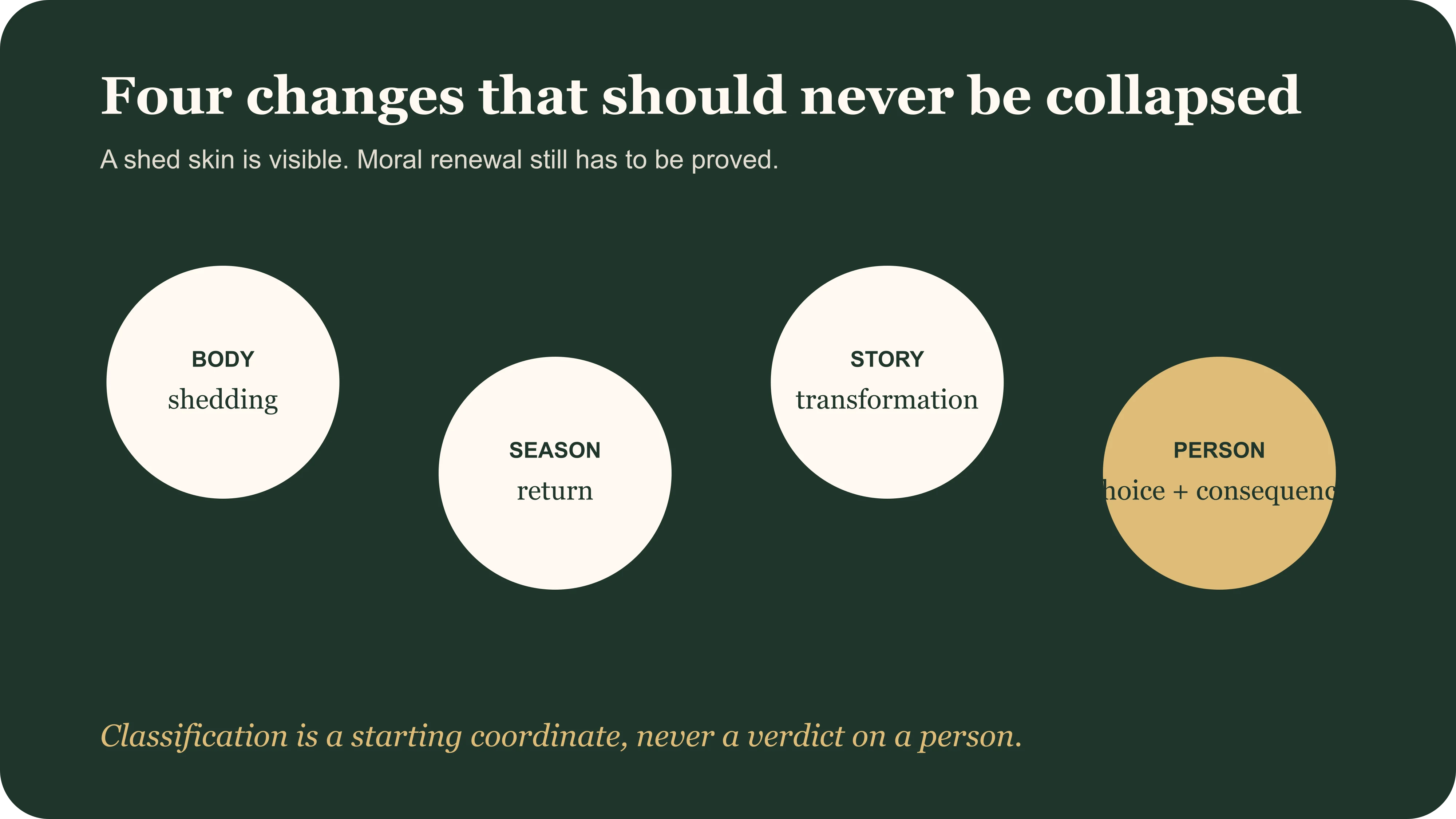
Shedding is visible and dramatic, so modern Snake-year writing loves to turn it into guaranteed personal transformation. The biological event cannot carry that moral promise by itself. A body replaces an outer layer. A person still has to choose what changes, accept the cost and live differently afterward.
That is why the Snake remains more interesting than a clean “rebirth” slogan. It can carry attraction and fear, healing and danger, secrecy and close attention to the ground. These tensions do not need to be solved into a positive personality. They make the symbol useful because viewers must ask what kind of change the surrounding story has actually shown.
The Met's Chinese Zodiac Figure of a Snake offers a disciplined historical object. The figure holds the animal as an attribute. It confirms zodiac identity and object type; it does not prove that Song-dynasty viewers shared a modern self-help language of shedding trauma. That limit prevents a contemporary metaphor from colonizing the whole past.
Snake, dragon and serpent-bodied makers must remain distinct
Chinese myth contains snake-bodied or serpentine figures, and dragon imagery can share elongated bodies, scales and movement. Visual similarity is not identity. Nuwa, Fuxi, a zodiac Snake, a river spirit and a decorative dragon enter different stories. Inscription, companions, posture, attributes and source title must do the identification work.
The phrase “little dragon” is sometimes used affectionately for the snake, but it should not erase difference. A zodiac sequence needs both positions. Dragon imagery often expands into cloud, water and cosmic reach; Snake imagery can remain closer to ground, body and immediate transformation. Calling one a reduced version of the other makes both less precise.
This boundary matters on search pages because a dramatic image can outrank a correct one. If a supposed Snake-year illustration has horns, claws, cloud control and a source title naming a dragon, no amount of keyword repetition turns it into evidence for this page. Visual honesty begins with refusing the convenient asset.
What Wood Snake identifies in 2025
The 2025 classification joins the earthly branch associated with Snake to the relevant heavenly stem and Wood correspondence. The Hong Kong Observatory's 2025 conversion table establishes the calendar boundary. It does not forecast an individual's health, relationship or investment result.
Wood can shape the year's visual and interpretive language—growth, flexibility, plant forms—but those associations remain cultural reading. They are not measurable forces attached to every birth. A child born in the year receives a calendar coordinate, not an assigned personality.
My rule is to demand a verb after “transformation.” What was released? What practice changed? Who bears the consequence? If a Snake image cannot answer, enjoy it as design and stop before claiming it documents renewal. The Chinese mythology collection is the next route for named serpent-linked figures; the zodiac hub keeps this calendar animal in its own lane.
Snake symbolism fails when “transformation” becomes empty praise
Shedding skin is the obvious metaphor, but an actual snake does not shed because it has completed a self-help programme. The biological event is not proof that a Snake-year person is spiritually reborn. Cultural interpretation begins after that distinction, not before it.
I use a three-part test. First, name what is left behind: a role, habit, debt, disguise or damaged relationship. Second, show the new practice rather than announcing a new identity. Third, identify the cost. Change without consequence is only branding.
This makes Snake imagery useful in stories without turning it into diagnosis. A coiled body can hold tension; a narrow passage can imply risk; a discarded skin can mark a transition. But the object, caption and narrative must support that reading. A stock snake placed beside the word “wisdom” proves nothing.
The limitation matters most in 2025 content. “Wood Snake” can name the calendrical pairing and inspire material choices, but it cannot certify investment timing, health or compatibility. The honest page gives the boundary, the iconographic distinctions and the interpretive question—then lets the reader do the human work.
The body line is the evidence
Snake imagery communicates through its line: coiled, extended, knotted, rising or disappearing. A tight coil can conserve force or stage warning. An extended body can describe travel, exposure or pursuit. The same animal symbol changes before a single adjective is added.
That is why cropped images are risky. Remove the head, tail, surrounding object or companion and you may destroy the very evidence needed to distinguish snake, dragon, rope or decorative scroll. A beautiful crop can be an editorial falsehood.
My Snake-year rule is therefore visual before mystical: keep enough of the body and context to see what is happening. Only then discuss renewal, secrecy or strategy. The sign does not confer those traits on a person; the image earns them, if at all, through posture and story.
A Snake-year keeps its ambiguity
Fear and protection can inhabit the same snake image. Venom makes the animal dangerous; its control of rodents can make it useful; its hidden movement makes it difficult to supervise. That unstable combination explains more than the tidy label “mysterious.”
Different communities and stories may treat snakes as ancestors, threats, medicines, omens or transformed beings. Those traditions cannot be compressed into one national meaning. Name the story, place and object whenever possible.
The best conclusion is not that Snake means one thing. It is that Snake forces the viewer to watch transitions carefully. Something appears, withdraws or changes skin, but the moral value remains undecided until the story supplies a consequence.