Recent Dog years are 1982, 1994, 2006 and 2018. “Loyal” is the usual one-word meaning, but loyalty is not an animal substance or a birth-year gene. The stronger symbol is guarding: a relationship among a dog, a boundary and the people allowed to cross it.
Year of the Dog dates and exact boundaries
Dog years include 1922, 1934, 1946, 1958, 1970, 1982, 1994, 2006, 2018, 2030 and 2042.
| Dog year | Begins | Ends | Element |
|---|---|---|---|
| 1982 | January 25, 1982 | February 12, 1983 | Water |
| 1994 | February 10, 1994 | January 30, 1995 | Wood |
| 2006 | January 29, 2006 | February 17, 2007 | Fire |
| 2018 | February 16, 2018 | February 4, 2019 | Earth |
February 1, 2018 was still in the Rooster year. Use the full-date calculator around the annual boundary.
See the complete Chinese zodiac guide for Dog's place in the twelve-animal order and the calendar system beneath the imagery.
Our conclusion: Dog meaning begins at the threshold
Generic zodiac pages turn the Dog into a bundle of human virtues: loyal, honest, dependable and protective. These claims sound positive because they remove the situation that gives loyalty meaning.
A guarding dog needs a threshold—gate, courtyard, herd, house or social group. It distinguishes familiar from unfamiliar and responds when something crosses the line. Dog symbolism is therefore relational. It describes attachment and boundary work, not a personality floating inside an individual.
This reading also preserves tension. Guarding can feel safe to the protected person and threatening to the outsider. Loyalty always has an object; boundaries always include and exclude.
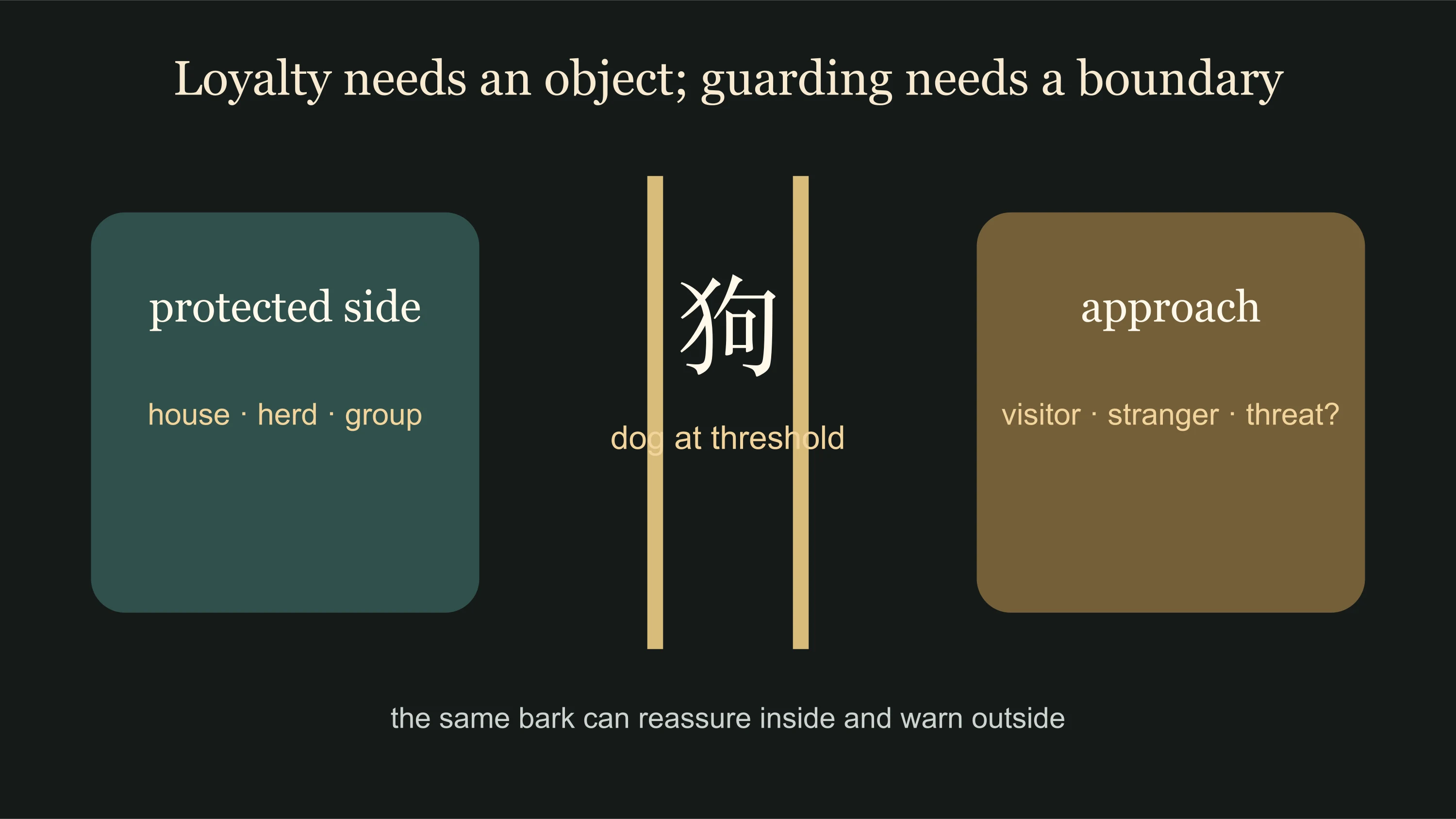
I prefer the threshold because it refuses an easy compliment. From inside the gate, the bark can mean reassurance. From outside, the same sound can mean warning or danger. Nothing about the dog's action changed; the listener's relationship to the boundary did. A symbol becomes more honest when it can hold both experiences at once.
Xu is the branch, gou is the dog
The Dog corresponds to 戌 (xu), the eleventh Earthly Branch. The animal word is 狗 (gou).
Xu is traditionally linked with roughly 7 p.m. to 9 p.m. It follows Rooster and precedes Pig. In zodiac design, 戌 identifies the calendar position even though it is not the ordinary written word for dog.
The branch is easy to confuse with similar-looking characters if read quickly. Accurate captions should preserve 戌 rather than guessing from a stylized font. The animal picture can help identify the intended branch, but it should not replace reading the character.
Why Chinese gives you more than one dog character
Readers may also encounter 犬 (quan) as well as 狗 (gou). Gou is the common everyday word for dog; quan appears in compounds, formal classification and older or literary usage. Neither is the zodiac branch 戌.
This gives one Dog image three possible textual layers. 戌 marks calendrical position. 狗 names the familiar animal directly. 犬 may frame the animal through a more formal, compound or historical register.
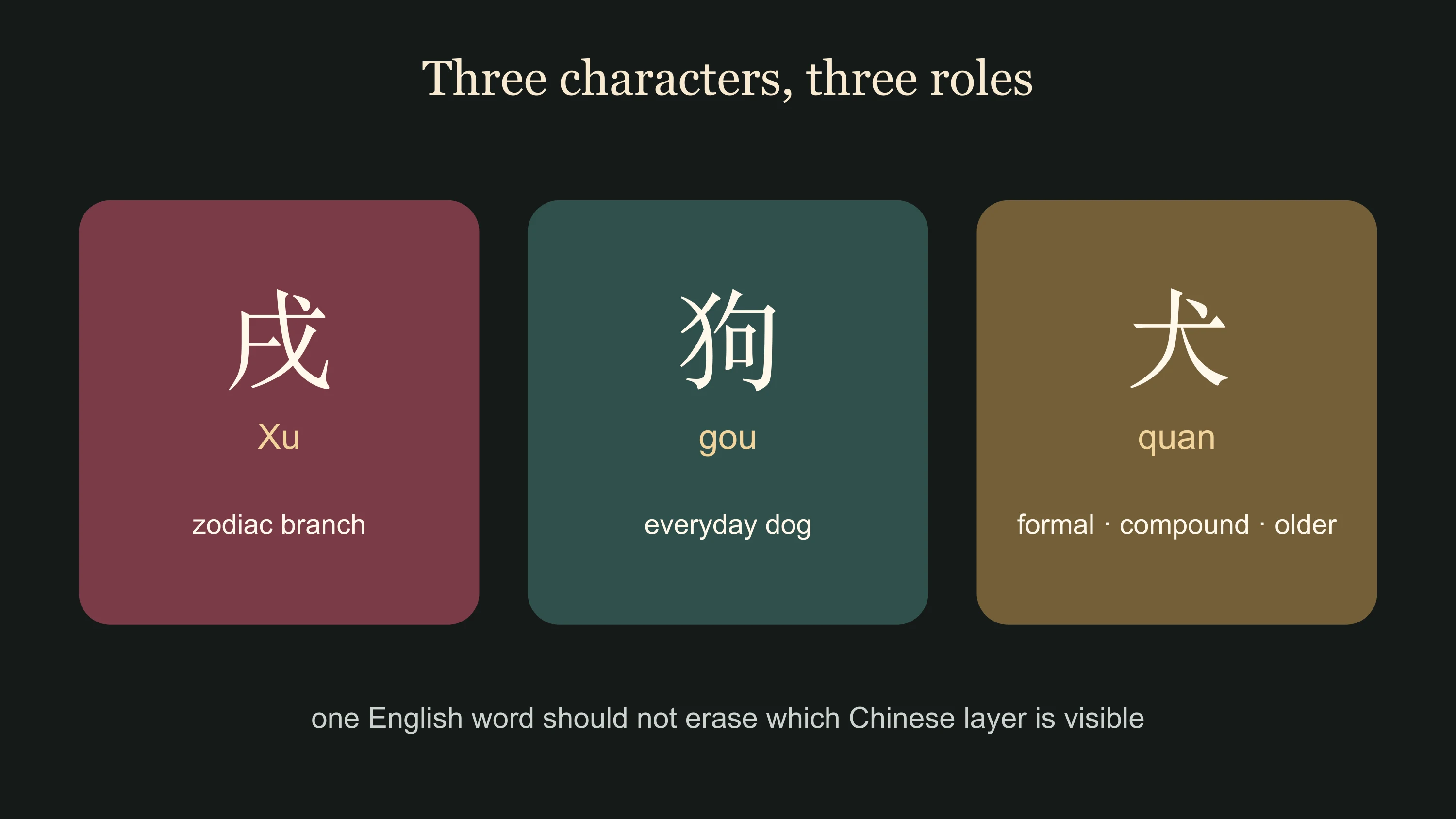
The correct caption should follow the visible text and source context. Translating all three as if they were the same written label removes information that the object deliberately supplies.
An eleventh-century Dog held as an attribute

The Metropolitan Museum of Art identifies this eleventh-century Jingdezhen qingbai porcelain as a Chinese zodiac figure of a dog. A robed human figure holds the animal close to the body.
The format is revealing. Modern zodiac graphics often enlarge the animal until it becomes the entire character. Here, the small dog functions as an attribute that identifies the human-form figure. Zodiac meaning depends on recognition, not naturalistic scale.
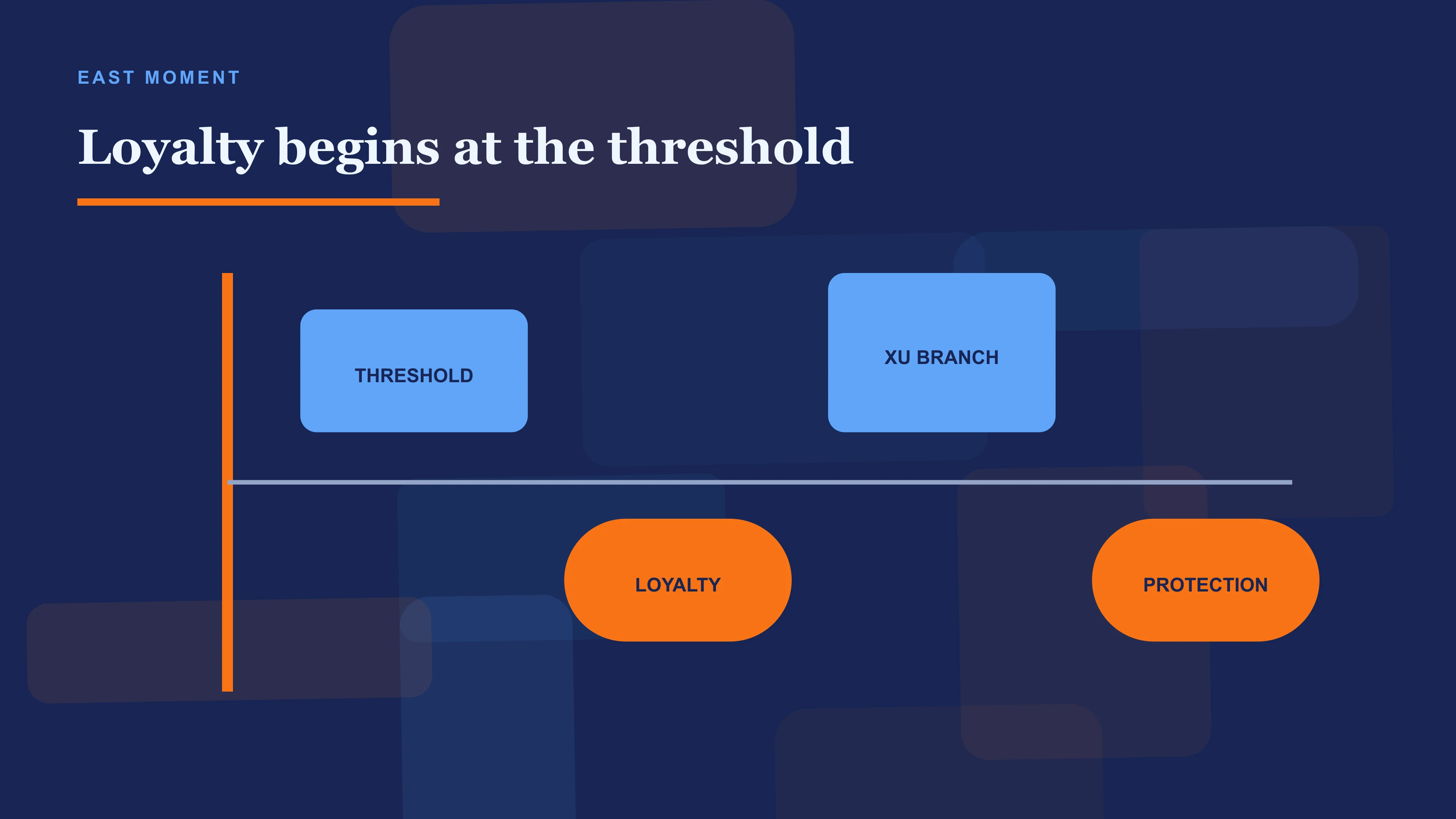
The contemporary East Moment hero takes the opposite route: the Dog has the leading body and the large 戌 character anchors its branch. Comparing them shows two visual solutions to one calendrical category.
Guarding is not the same as universal friendliness
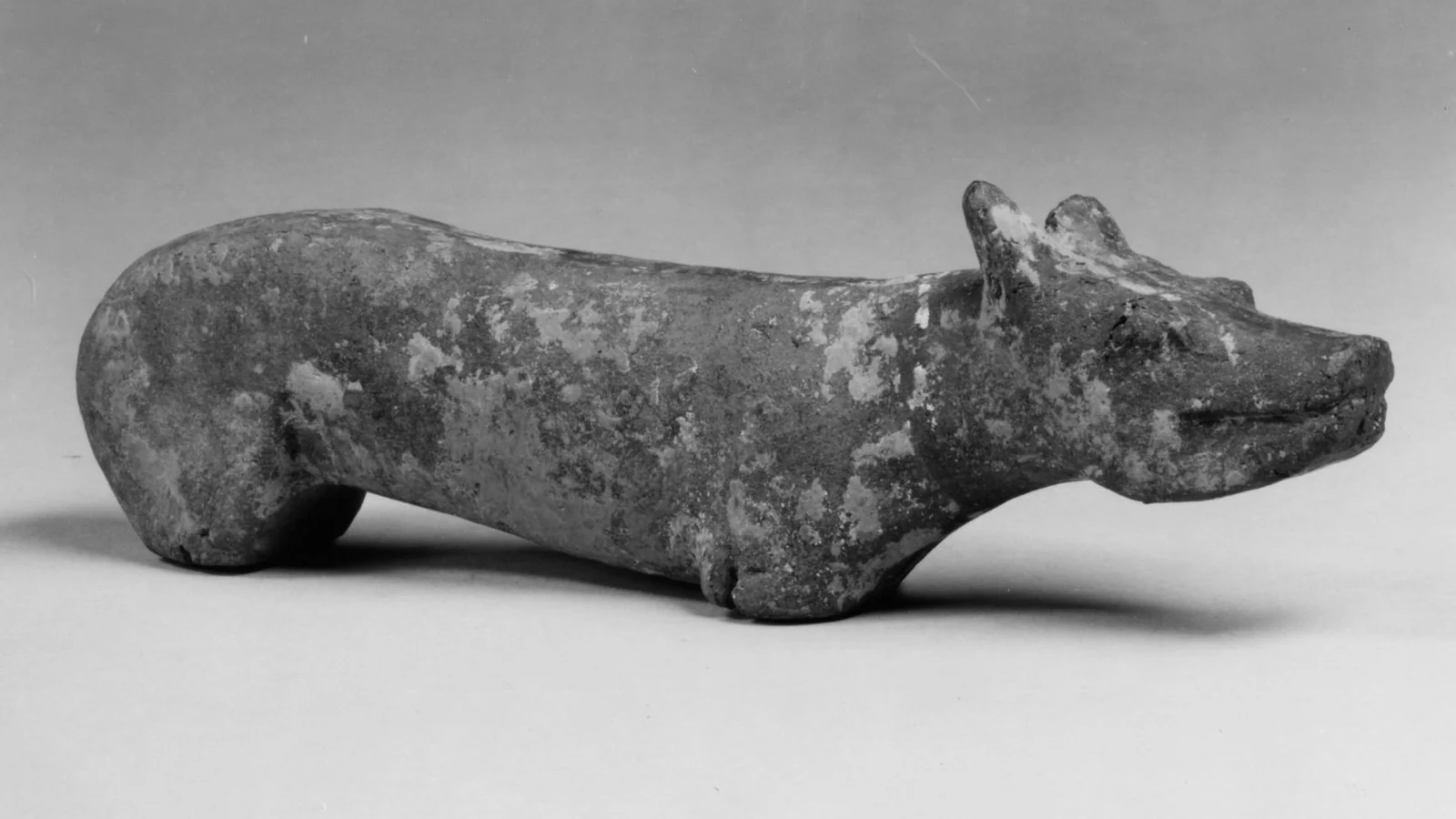
The Met identifies this fifth- to sixth-century object simply as a Dog. Its long body, raised ears and forward-facing head create alertness without showing a gate, handler or threat. That limit matters. The figure can support a claim about posture and material presence, but it cannot prove guarding, companionship or zodiac use by itself. Role begins only when the object record or surrounding scene supplies a relationship.
Modern pet culture often emphasizes companionship, emotional support and individual animal personality. Guarding imagery emphasizes boundary, warning and duty. Both relationships exist in the longer history, but they should not be collapsed into a timeless statement that Chinese culture has always seen dogs in one way.
Kelsey Granger's study of early China shows the chronology that a simple list hides. Early textual and archaeological evidence presents dogs as food, hunting aids, guards, livestock and sacrificial or ceremonial victims—not as lapdogs. Post-Han accounts increasingly record canine heroism, moral character and close human bonds, while dog-occupied tombs make individual treatment visible in material evidence. Region, period and social context matter.
This complexity strengthens rather than weakens the symbol. The Dog sits close to human life precisely because the relationship has taken many forms.
The Great Race Dog makes a joke about ability
In popular Great Race stories, the Dog is an excellent swimmer but finishes eleventh because it stops to play or bathe in the river. The joke works through contradiction: competence does not guarantee priority.
This is a legend used to remember the order, not a historical account of how 戌 entered the branch system. It gives the Dog personality for narrative purposes. Other contexts can make the same animal disciplined guardian or intimate companion.
Treat the story as a mnemonic, not a personality assessment of everyone born in a Dog year.
My rule for reading Dog-year imagery
Look for the relationship the design constructs:
- A dog at a doorway turns architecture into a protected boundary.
- A dog beside a person emphasizes attachment or service.
- 戌 connects the image to the zodiac calendar.
- A playful race scene emphasizes delay and pleasure rather than guarding.
Then ask who is inside, who is outside and what the dog is expected to do. That question produces more cultural information than declaring Dog-born people loyal.
The Year of the Dog is best understood through a threshold. Loyalty is the emotional label; guarding is the visible action that gives it structure.
That rule also improves captions. “A loyal dog” guesses an inner quality. “A dog positioned beside a closed courtyard gate, facing the approach” describes evidence. Historical research may then explain how guarding relationships changed by period, but the visible action should come before the moral adjective.
It also leaves room for affection without pretending affection is universal. A dog asleep against a person's leg constructs intimacy; a dog fixed at an entrance constructs controlled access. Both relationships may be close, but they are not the same visual claim.
The Year of the Dog is about negotiated trust
“Loyal” is the adjective attached to the Year of the Dog so often that it has almost stopped meaning anything. Loyalty is not a substance stored in an animal. It is a relationship built through proximity, feeding, work, protection and repeated recognition.
Look at a dog image and ask where the boundary lies. Is the animal outside a gate, below a chair, beside a hunter or facing another creature? Is its body relaxed, alert or restrained? The distance between bodies tells us more about trust than a caption that simply calls the dog faithful.
The zodiac Dog corresponds to the earthly branch xu (戌). That branch belongs to the calendar's twelve-position system; the everyday word for dog is gou (狗) or quan (犬) in particular written and historical contexts. Mixing those labels carelessly can make an inscription appear more zodiac-specific than it is.
A guardian is not the same as a pet
Modern pet culture encourages an intimate reading of every dog image. Historical objects may instead show hunting, guarding, status, burial belief or household utility. Affection can be present, but it should not be projected automatically.
This is the Dog page's strongest visual test: who controls the threshold? A dog tied to a post, a dog placed in a tomb and a dog sleeping in a family courtyard perform radically different symbolic work. Material matters too. A ceramic tomb figure records a funerary context; a New Year paper-cut performs a seasonal wish; a family photograph records one particular bond.
I also resist the idea that loyalty means obedience without judgment. A meaningful guardian distinguishes familiar from dangerous. It does not simply submit. That makes discernment the neglected half of Dog symbolism and explains why loyalty can become a burden when the relationship is unjust.
The sign cannot certify character
A Dog birth year does not prove honesty, compatibility or moral worth. Zodiac profiles can become affectionate family shorthand, but they should never excuse controlling behaviour or condemn someone as suspicious. The cultural symbol opens a vocabulary; it does not close a case.
The Metropolitan Museum of Art's collection search for dogs provides dated objects that can be read through material and context. Individual catalogue entries identify their objects; they do not prove universal Dog-year traits.
My conclusion is sharper than the usual compliment: the Dog matters because trust has edges. Someone is welcomed, someone is warned, and someone must maintain the relationship. Read those edges in the object. Then compare the Year of the Rooster and Year of the Pig to see how announcement, protection and household abundance occupy three adjacent positions in the cycle.
Loyalty without reciprocity is a trap
The Dog sign is often used to praise unconditional devotion. I reject that phrase when it hides neglect. A working or companion animal depends on food, care, shelter and recognition. Protection moves in both directions.
This reciprocal view also improves visual reading. A dog facing outward at a gate performs one kind of guarding. A person bending to meet a dog's gaze shows another bond. A chained dog may display control rather than loyalty. The scene decides.
Zodiac language is best used as a prompt for relationship ethics, not as proof that a Dog-year friend will never betray us. Trust is made in repeated action. The sign can remind us to notice that work; it cannot do the work for us.
Breed is not the historical meaning
Modern dog culture can make breed identity dominate every image. Many historical Chinese objects do not support that precision. A curled tail or compact body may invite comparison with a modern breed, but a confident label needs a reliable catalogue or specialist source.
What the object often shows more securely is role: guarding, companionship, hunting, burial protection or status. Role is the better first question because it stays close to posture and context.
I would rather call an animal “a dog figure guarding a threshold” than guess a breed and lose the scene. Exactness is not always a narrower noun. Sometimes it is a more accurate verb.
That verb creates the final boundary. A tomb dog accompanies the dead; a courtyard dog negotiates living space; a zodiac dog marks recurring time. Their bodies may resemble one another, but their jobs do not. Keep the jobs visible and the familiar word “loyalty” regains weight.
Trust is not an adjective pasted on the animal. It is the repeated exchange the image must make visible.