Recent Rooster years are 1981, 1993, 2005 and 2017. The Rooster is an animal clock, but the zodiac branch You belongs to early evening rather than dawn. That apparent mismatch is the clue: animal associations help remember time; they do not need to describe every hour literally.
Year of the Rooster dates and exact boundaries
Rooster years include 1933, 1945, 1957, 1969, 1981, 1993, 2005, 2017, 2029 and 2041.
| Rooster year | Begins | Ends | Element |
|---|---|---|---|
| 1981 | February 5, 1981 | January 24, 1982 | Metal |
| 1993 | January 23, 1993 | February 9, 1994 | Water |
| 2005 | February 9, 2005 | January 28, 2006 | Wood |
| 2017 | January 28, 2017 | February 15, 2018 | Fire |
A January 10, 2017 birthday belongs to the Monkey year. Check exact dates with the Chinese zodiac calculator.
The complete Chinese zodiac cycle shows Rooster's position among all twelve animals and the branch structure that gives the order meaning.
Our conclusion: the Rooster makes time audible
The Met describes the rooster as auspicious because its crowing brings out the sun and dispels darkness. A rooster's call is not a precise timestamp, but it makes the transition toward day audible.
That makes “punctual” and “observant” personality labels feel less arbitrary. They borrow from a real human-animal relationship with daily rhythm. But the useful cultural idea is not that every Rooster-born person arrives early. The Rooster turns time into a sound a household can hear.
This also explains why vigilance belongs to the imagery. The raised head, open beak and upright body advertise attention before any horoscope supplies an adjective.
You is the branch; ji is the chicken
The tenth Earthly Branch is 酉 (you). The everyday word 鸡 / 雞 (ji) covers chicken, while 公鸡 / 公雞 specifies rooster. You is traditionally associated with roughly 5 p.m. to 7 p.m.
That evening slot surprises readers who connect roosters only with sunrise. The mismatch sets a useful boundary: branch-animal correspondences organize memory and symbolism; they are not a literal wildlife schedule for every sign.
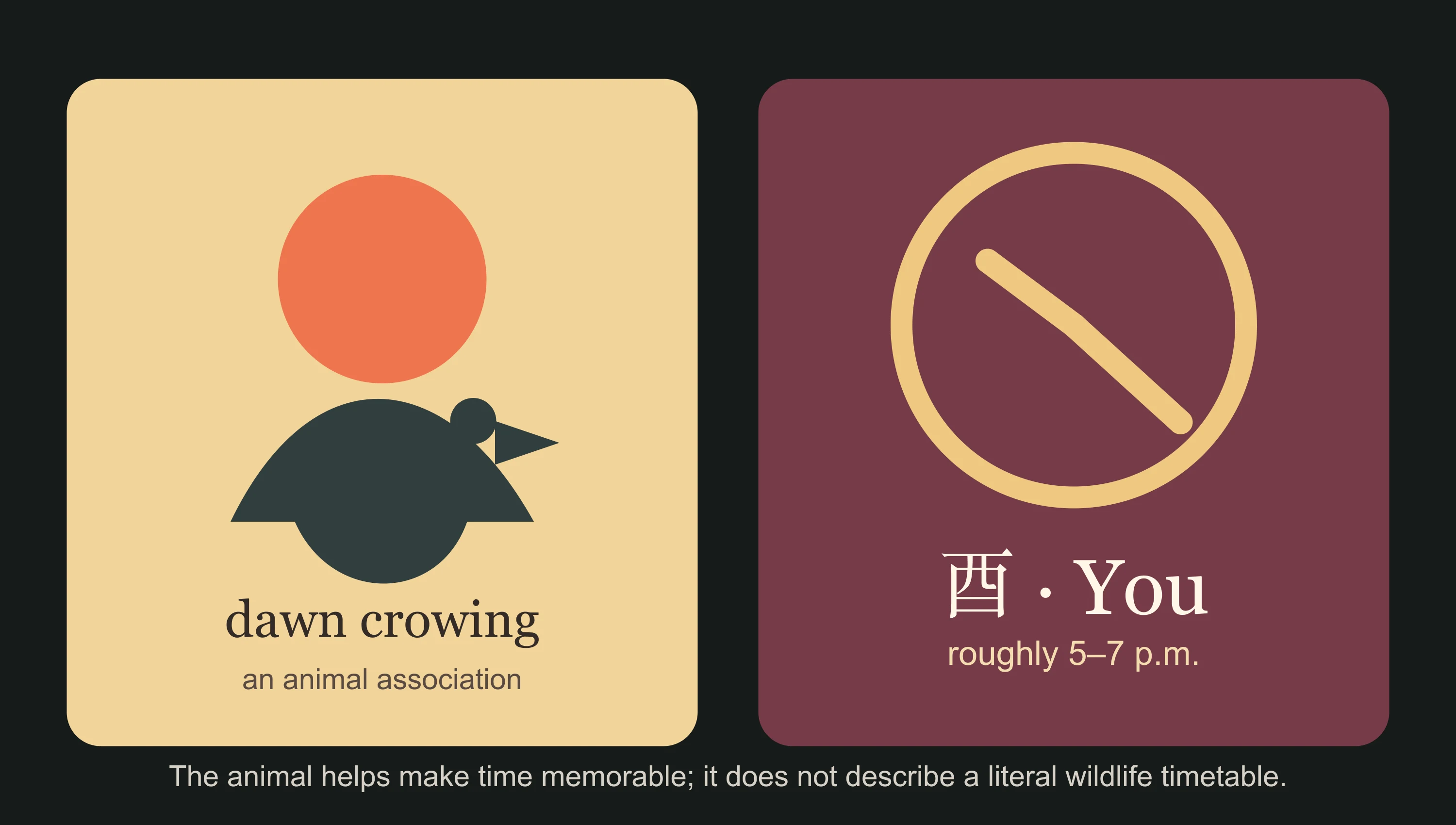
I used to treat this mismatch as something an explainer needed to apologize for. Now I think it is the most useful part of the Rooster sign. The crow belongs to lived animal observation; the two-hour branch belongs to a calendrical system. Their connection is mnemonic and cultural rather than zoologically exact.
That distinction also protects the article from false precision. A rooster may crow before dawn, after disturbance or throughout the day. The zodiac does not depend on every bird obeying one clock. It depends on communities finding animal images memorable enough to carry an ordered sequence.
Do not translate 酉 as rooster outside the zodiac context. It is the branch marker, not the normal animal name.
An eleventh-century Rooster held close

The Metropolitan Museum of Art identifies this eleventh-century Jingdezhen qingbai porcelain as a Chinese zodiac figure of a rooster. A human-form figure holds the small bird as an attribute.
The object communicates Rooster without enlarging comb, feathers or beak into a mascot. Recognition depends on the relationship between person and held animal. Our contemporary hero reverses the scale: the Rooster becomes the protagonist and 酉 becomes a large graphic anchor.
This comparison is more valuable than saying the style “evolved.” It shows that one zodiac identity can be encoded through attribute, hybrid body or branch character without one format replacing all others.
I am especially drawn to the small held bird. The human figure occupies most of the object, yet the Rooster controls its identity. That reverses the modern instinct to make a zodiac animal enormous, cute and instantly saleable. Recognition here rewards a second look.
Rooster or phoenix: use anatomy and context
Chinese New Year graphics can stylize a rooster until its tail becomes spectacular. That does not automatically turn it into fenghuang, the mythic bird often translated as phoenix.
| Visible clue | Supports Rooster | Supports fenghuang |
|---|---|---|
| 酉 or a named birth year | Strong | Weak without crossover context |
| Recognizable comb, wattles and chicken body | Strong | Not decisive for fenghuang |
| Twelve-animal sequence | Decisive | Unlikely |
| Explicit fenghuang caption or mythic pairing | Weak | Strong |
| Bright long tail alone | Possible | Possible, insufficient |
Color is the least reliable shortcut. Read anatomy, text and narrative role together. A design may deliberately hybridize the birds, but that conclusion needs more evidence than “the feathers look fancy.”
The emotional difference matters too. Rooster imagery usually keeps contact with household time, vigilance, display or the twelve-animal sequence. Fenghuang imagery more often enters imperial, marital, cosmological or mythic relationships. A bright tail can belong to either. Narrative role is stronger evidence than saturation.
Why 2017 was a Fire Rooster
2017 combines Ding (丁) with You (酉). Ding is associated with yin Fire, producing the Fire Rooster label.
The same Ding-You pairing occurred in 1957 and returns in 2077. Rooster years recur every twelve years; identical stem-branch years recur every sixty.
The element is a calendar classification. It does not prove that people born in 2017 are louder, more dramatic or more ambitious than anyone else.
The Great Race gives the Rooster a team
In popular Great Race versions, Rooster, Monkey and Goat cooperate to cross the river. The Rooster may find a raft, while the others clear weeds or propel it.
This legend helps remember positions eight through ten as a cooperative sequence. It is not documented history of how the branch system began. Its Rooster is useful not because it “predicts” personality but because it supplies a role inside a compact moral story.
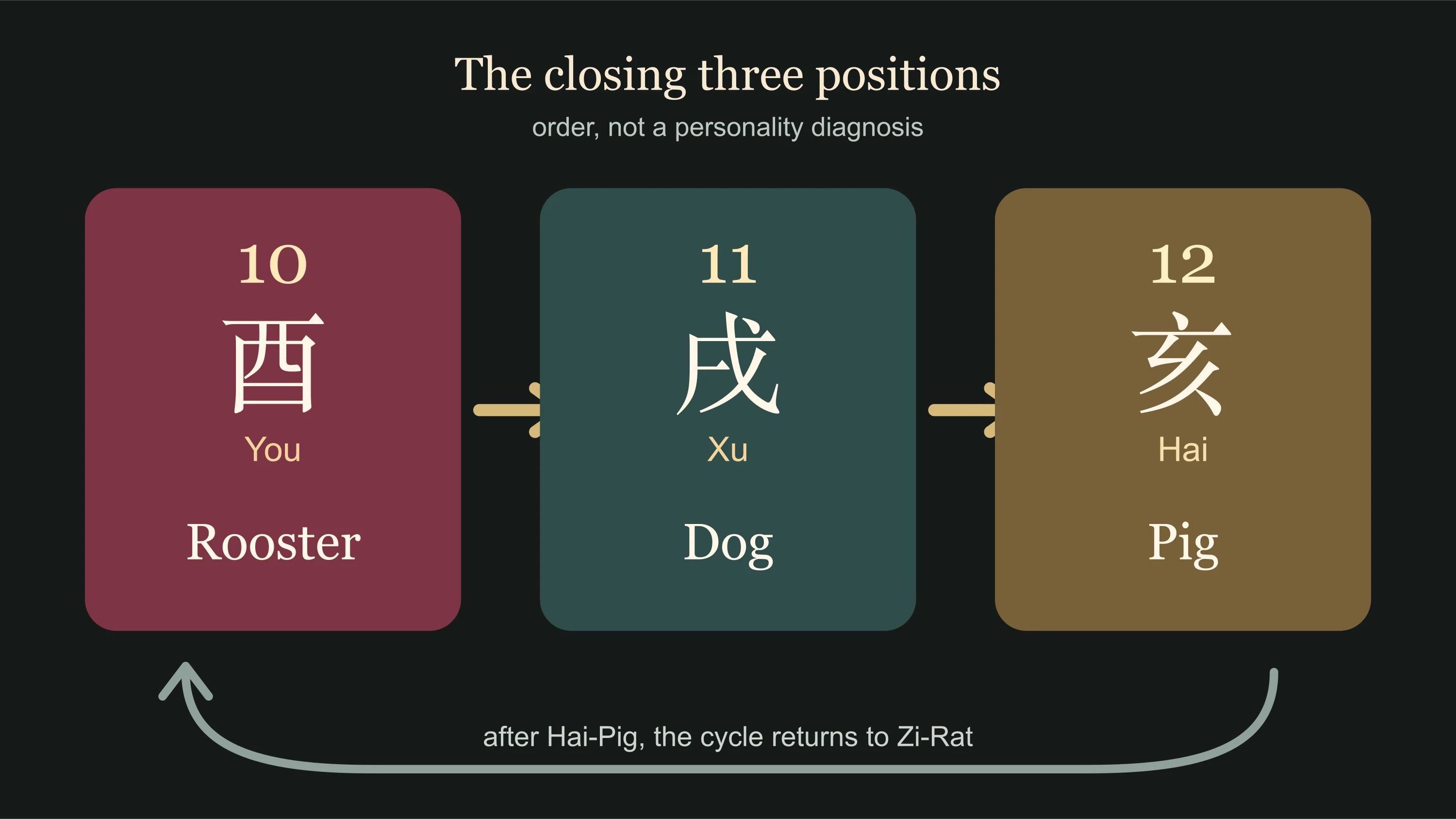
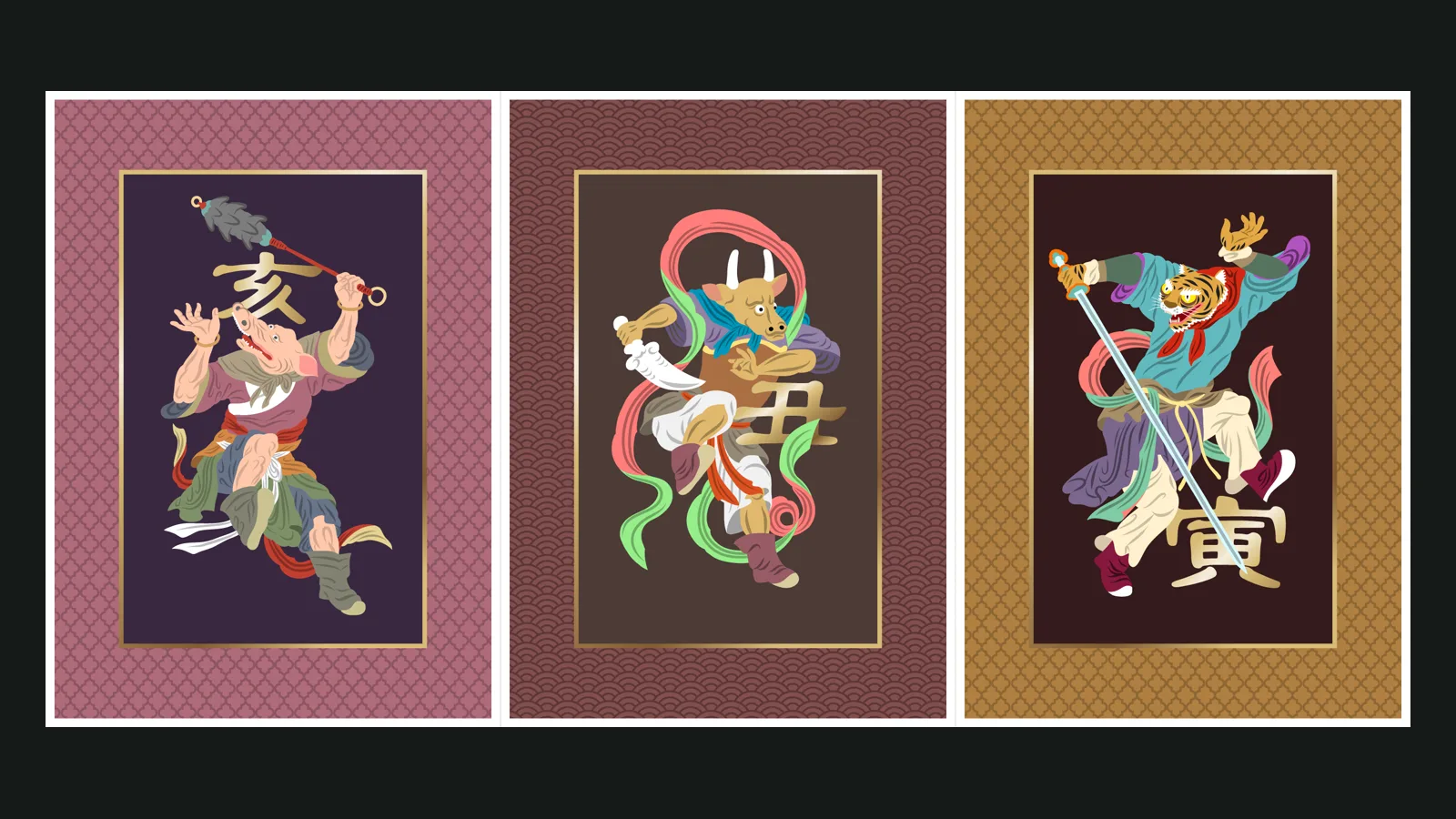
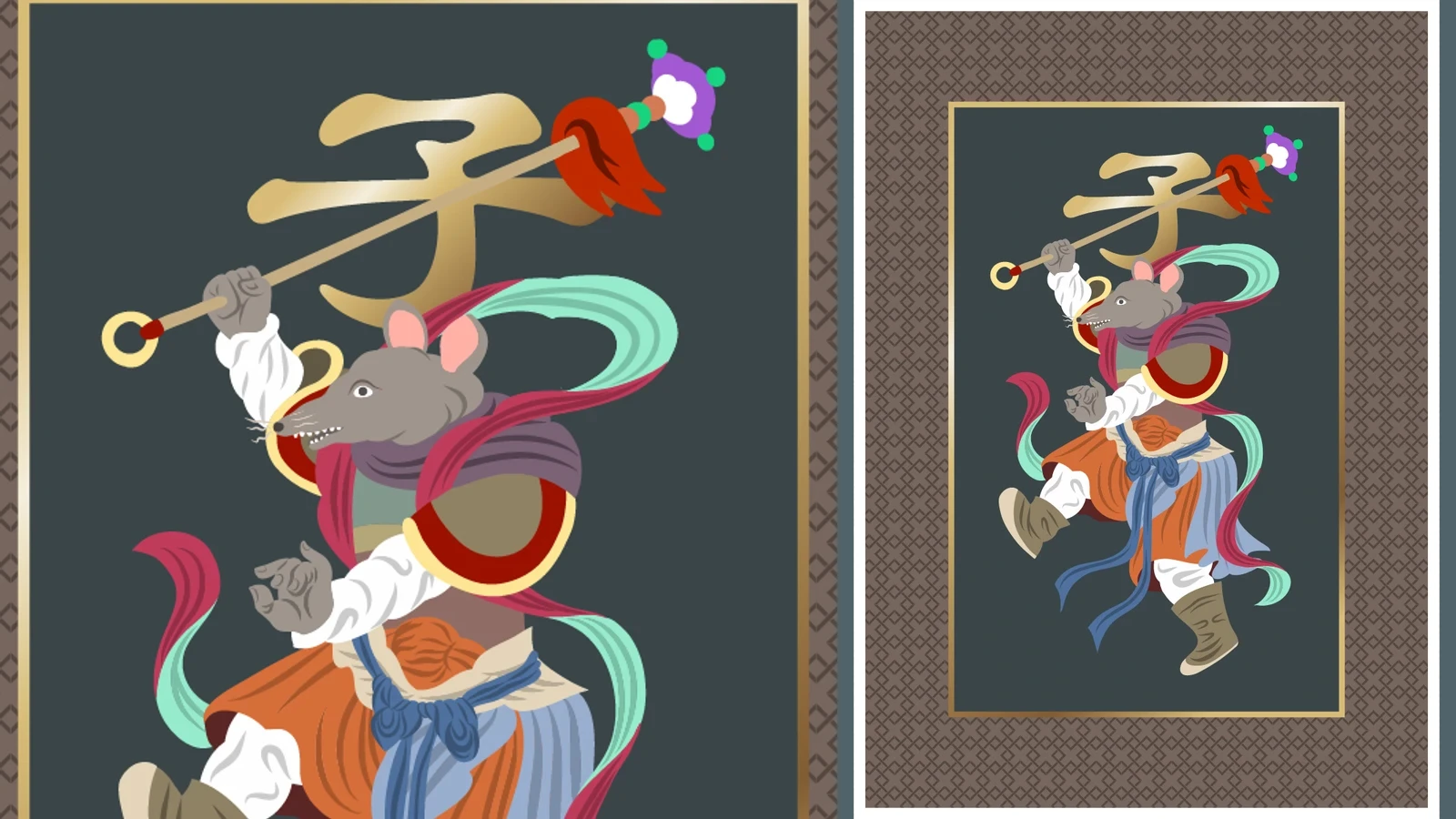
Placed beside Dog and Pig, Rooster stops floating as an isolated personality profile. It is the tenth position in a sequence approaching closure. The diagram does not assign three personalities; it proves the order: You-Rooster is followed by Xu-Dog and Hai-Pig. Only after that does the cycle return to Zi-Rat.
What Rooster descriptions get wrong
Words such as confident, punctual, proud and outspoken are easy to circulate because they sound personal. They are also broad enough to fit millions of people after the fact. I would rather trace each adjective back to the bird image: upright posture can suggest display, crowing can suggest announcement, and routine can suggest punctuality.
That makes the symbolism legible without turning it into a diagnosis. A Rooster-born child does not owe anyone loudness or discipline. The sign offers a cultural vocabulary a family may enjoy, question or ignore.
How to read Rooster-year imagery
Look for branch 酉, open beak, comb, upright stance, sun, clock, home or group context. Then ask whether the image emphasizes announcing, guarding, returning or displaying.
The Year of the Rooster becomes precise when we stop calling the bird merely confident. Its deeper function is to make rhythm public—to turn a change in time into something heard by others.
The Year of the Rooster is an alarm before it is a personality
The rooster's first cultural power is not confidence. It is timing. Before phones and clocks entered every room, a crow could divide darkness from the working day. That makes the animal a living signal: heard before fully seen, ordinary yet impossible to ignore.
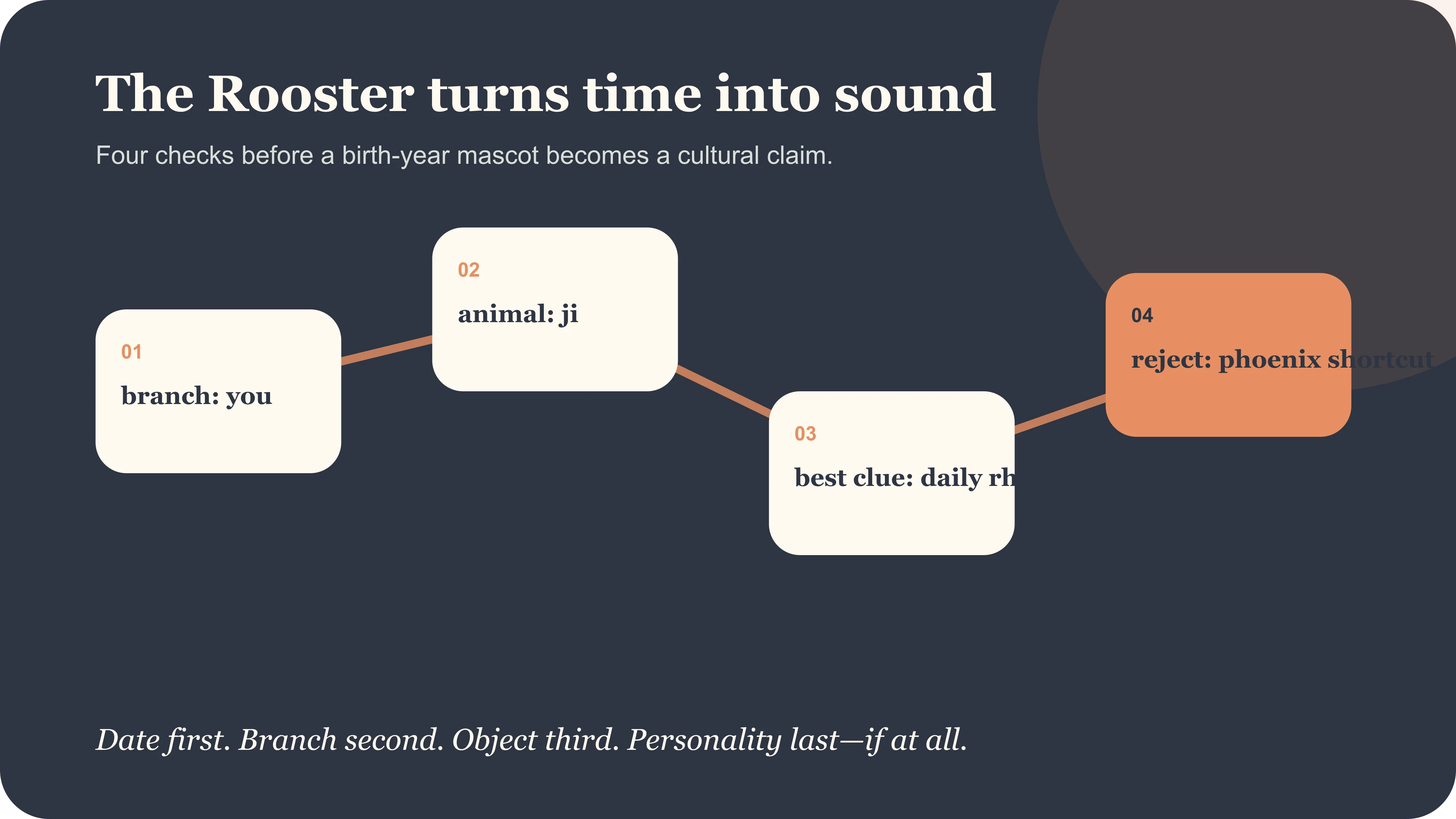
This is why I distrust zodiac copy that stops at “proud, punctual and hardworking.” It turns a relationship between sound, labour and dawn into office-performance language. The better question is: what does the rooster announce, and who is expected to act after hearing it? A household wakes. A gate opens. Work begins. The symbol lives in that chain.
The zodiac position uses the earthly branch you (酉). A rooster or chicken is the conventional animal pairing, but the branch is not simply another word for the bird in every historical context. A painting of poultry can document animal imagery; only its title, inscription or use can connect it securely to the zodiac.
Display and usefulness share the same body
The rooster is visually extravagant—comb, tail, stance, colour—but belongs to the practical farmyard. That collision gives the sign more depth than vanity. Beauty is attached to vigilance and domestic economy, not separated from them.
A good Rooster-year image therefore lets the body perform. The beak may open in a crow. The claws grip a threshold. Hens or chicks may shift the scene toward protection and continuity. A perfectly isolated profile on red paper works as a festive sign, but it cannot carry the whole social meaning of the animal.
Rooster imagery also enters wordplay and moral symbolism. The five visible virtues sometimes mapped onto the bird—civil bearing, martial ability, courage, benevolence and trustworthiness—belong to an interpretive tradition. They are culturally meaningful, not biological measurements of everybody born in a Rooster year.
Read sequence as well as symbol
In the twelve-animal cycle, Rooster follows Monkey and precedes Dog. That sequence can help a collection page avoid twelve disconnected mascot cards. Monkey manipulates and improvises; Rooster announces and orders; Dog guards and relates. I do not claim this is a universal ancient narrative. It is a useful editorial route through three distinct symbolic jobs.
The Hong Kong Observatory's stems and branches page establishes the calendrical system behind the animal sequence. It does not establish personality predictions.
My firm reading is that Rooster imagery becomes interesting when sound produces consequence. If nothing wakes, opens, gathers or changes, the bird is only decoration. Follow the Chinese zodiac hub for the full sequence, or compare the Year of the Dog to see how an announcing threshold becomes a guarded one.
I refuse to reduce the Year of the Rooster to a flattering personality card. I hear a demand in the crow: dawn has arrived, somebody must answer and ordinary work is about to begin. That is not as marketable as “confident and lucky,” but it is more human, more Chinese and far harder to forget.
Dawn is a shared schedule, not a private trait
The rooster's call matters because other bodies hear it. A sound becomes cultural time when households, workers or rituals respond. That is different from calling one person “punctual” because of a birth year.
An urban reader may know the rooster mainly through New Year graphics or food; a rural memory may begin with an unwanted early crow. Both are real contemporary relationships, but neither alone represents all of China. The page should hold the distance between them.
My favourite Rooster question is not whether the bird is proud. It is what begins after the call. When an image supplies no listener, threshold or consequence, it may still be beautiful. It simply cannot prove the social work that gives dawn symbolism its force.
The domestic bird also carries gendered assumptions
English “Rooster” selects the adult male bird, while Chinese zodiac labels are often translated as Rooster, Cock or Chicken. A picture of a hen with chicks changes the emphasis toward care and continuity; a fighting cock changes it toward controlled aggression and spectacle.
This is another place where the source must overrule the page template. Preserve “hen,” “cock” or “chicken” when the object record is specific. Use Rooster for the established zodiac route, then explain the visual evidence honestly.
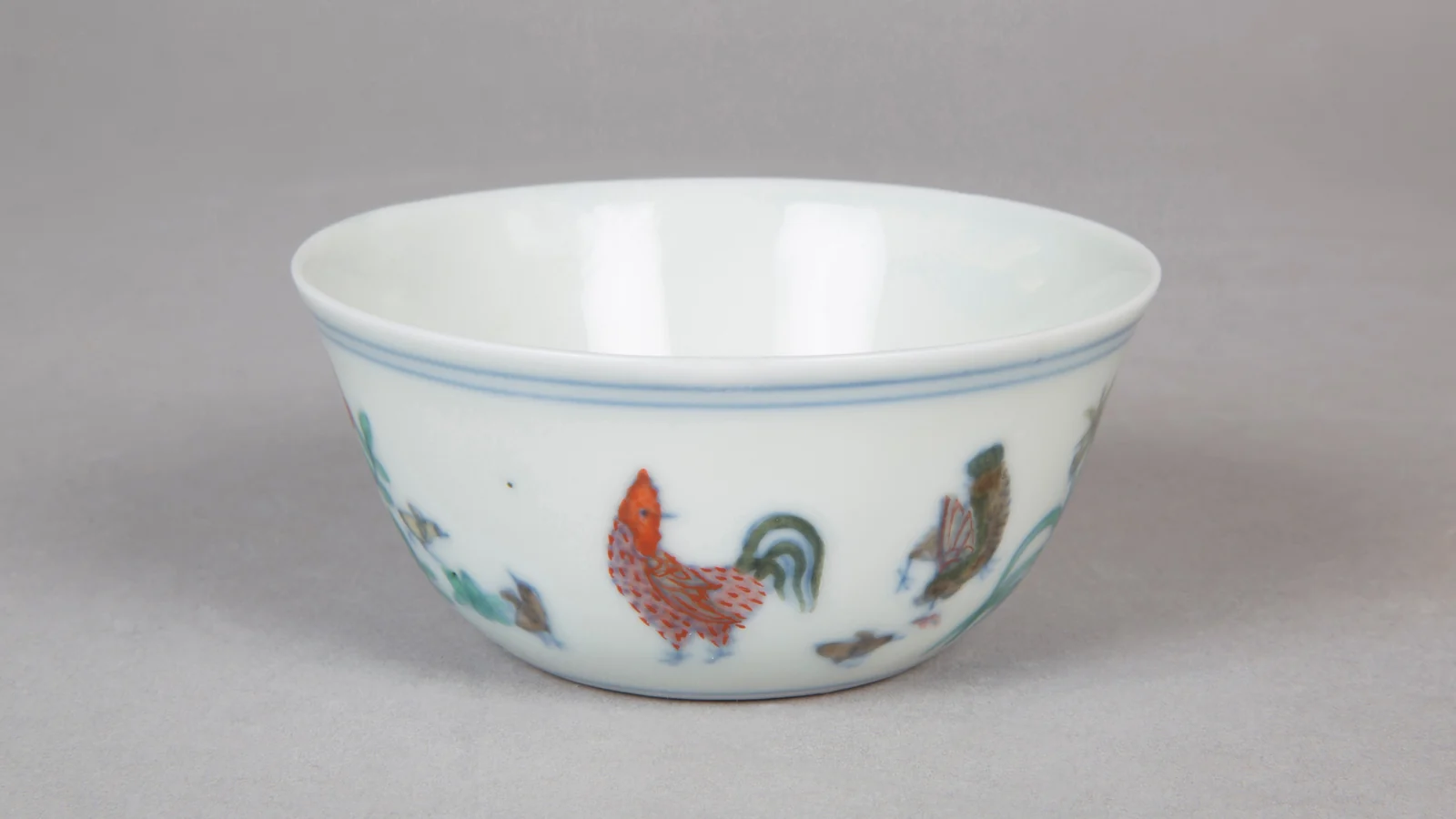
The Met calls this Jingdezhen porcelain object a Chicken cup, not a Rooster-year cup. Its painted group is still decisive evidence for the translation problem: the domestic scene cannot be reduced to one adult male bird. Rooster, hen and chicks distribute display, care and continuity across the same small vessel. The cup does not prove zodiac meaning; it proves what the English word “Rooster” can hide.
The sign grows richer when one translation does not erase an entire domestic world. Dawn-calling display is important, but so are eggs, care, food and household labour.
That household labor is quieter than the burden carried in the Year of the Ox, but both signs lose depth when modern personality copy erases the work that made the animal culturally legible.