Recent Pig years are 1983, 1995, 2007 and 2019. English often turns “pig” into an insult about dirt, greed or body size. That baggage is a poor guide to the Chinese zodiac, where the domestic animal can point toward food security, household wealth and the pleasure of having enough.
Year of the Pig dates and exact boundaries
Pig years include 1923, 1935, 1947, 1959, 1971, 1983, 1995, 2007, 2019, 2031 and 2043.
| Pig year | Begins | Ends | Element |
|---|---|---|---|
| 1983 | February 13, 1983 | February 1, 1984 | Water |
| 1995 | January 31, 1995 | February 18, 1996 | Wood |
| 2007 | February 18, 2007 | February 6, 2008 | Fire |
| 2019 | February 5, 2019 | January 24, 2020 | Earth |
January 2019 still belonged to the Year of the Dog. The full-date calculator prevents this common mistake.
The complete Chinese zodiac cycle shows how Pig closes the twelve-branch sequence before Rat begins it again.
Check the date before reading a Pig-year profile
The most common mistake is assigning the animal by the Gregorian year alone. A baby born in January 2019 is normally still a Dog in the public Chinese New Year system; a baby born after February 5 enters the Earth Pig year. The exact date matters more than a clever personality paragraph.
Some traditional astrology practices use a seasonal boundary around lichun (立春, the Beginning of Spring) instead of Lunar New Year. That difference should be named, not hidden. This guide uses Lunar New Year because it is the convention most international readers meet on calendars, family greetings and public festival material. If a chart gives another result, first identify its boundary rule.
Our conclusion: abundance is material before it is moral
A 5,000-year archaeological study from Henan describes pigs as central to China's economic, social and symbolic systems since the Early Neolithic. At the Xiawanggang site, husbandry gradually shifted toward household management, while some Longshan-period pigs were fed millet products and domestic refuse. Pig abundance was therefore produced through feed, labor and management, not merely imagined as a lucky shape.
Pig abundance is not abstract luxury. It is the material condition of having enough to raise, eat, sell or reproduce. That context explains why generosity and enjoyment can attach to the sign without reducing it to overeating.
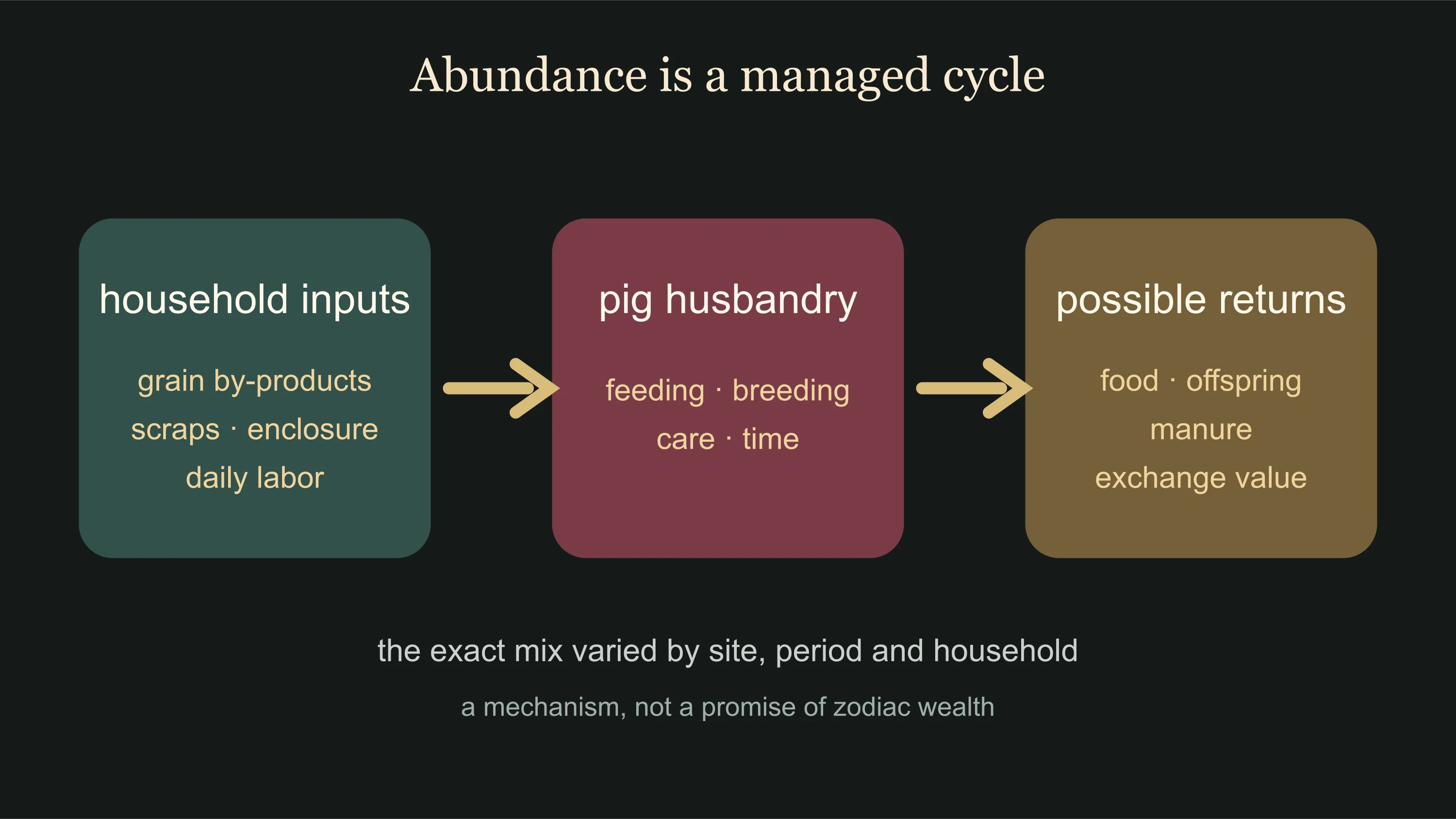
The arrows matter more to me than the familiar lucky-pig smile. A household supplies grain by-products, scraps, enclosure and daily attention; the animal can return food, manure, offspring or exchange value. Not every site, period or family organized that cycle identically, but the mechanism makes “abundance” concrete. Luck imagery arrives after work, feed and survival—not in place of them.
English insult meanings reverse the social perspective. Calling a person a pig condemns excess or dirt. Reading a zodiac Pig only through that insult misses the animal's economic and domestic value.
Hai is the branch; zhu is the animal
The Pig corresponds to 亥 (hai), the twelfth Earthly Branch. The everyday animal word is 猪 / 豬 (zhu). Hai is traditionally linked with roughly 9 p.m. to 11 p.m.
As the twelfth branch, Hai closes the cycle before the Year of the Rat begins it again. “Last” does not mean least important. A closed sequence needs an end that can hand time back to the beginning.
The Great Race's sleepy Pig turns that formal last place into a joke, but 亥 is the real calendrical position. The story is a memory device, not the origin document.
The pig under a roof: useful clue, dangerous shortcut
The modern character 家 (jia, home or family) visibly combines 宀, a roof component, with 豕, an old graph associated with pig or swine. The PLOS ONE study notes this pig-inside-a-house form in a Shang bronze inscription while discussing the long economic and symbolic place of pigs in China.
It is often expanded into a neat claim: “Ancient Chinese people believed a house was not a home without a pig.” That sentence is more certain than the character alone can support. Character components can preserve old material associations, but they are not a complete census of household life or one-step proof of a universal belief.
Use 家 as an entry point, then ask for archaeological, textual and regional evidence before building a social history around it. The visible pig-under-roof structure strengthens the page's domestic-abundance thesis; it does not authorize a romantic story about every ancient family.
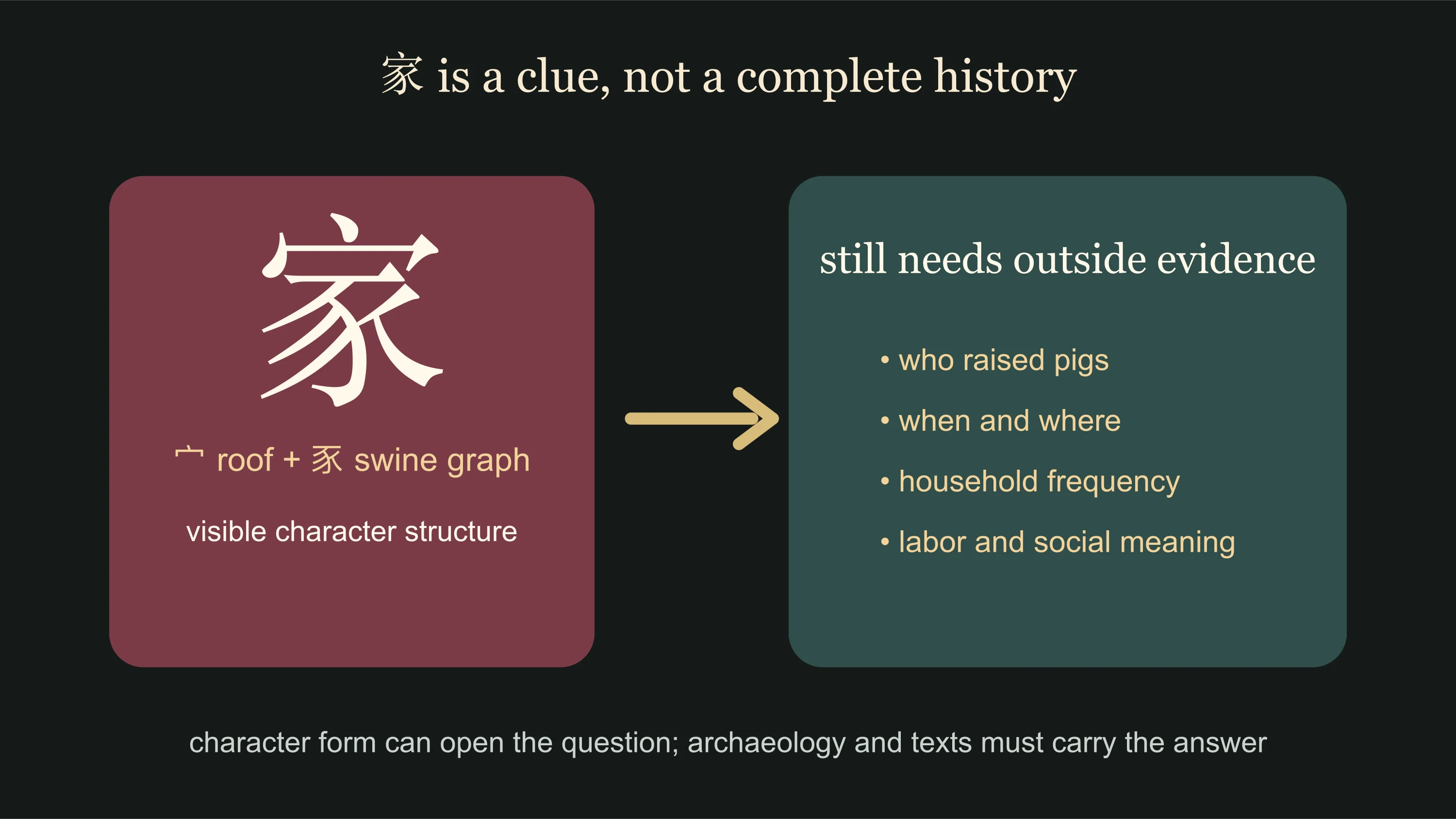
I keep the character on this page because it is visually unforgettable, but I refuse the viral version of the argument. A memorable character analysis can show that home and swine became graphically connected; it cannot, by itself, tell us the percentage of households that kept pigs, who did the labor, how enclosure changed across regions or what “family” meant in every period. Those questions need evidence outside the square of one character.
An eleventh-century Pig is small but decisive

The Metropolitan Museum of Art identifies this eleventh-century Jingdezhen qingbai porcelain as a Chinese zodiac figure of a pig. The robed human-form figure holds the small animal as its identifying attribute.
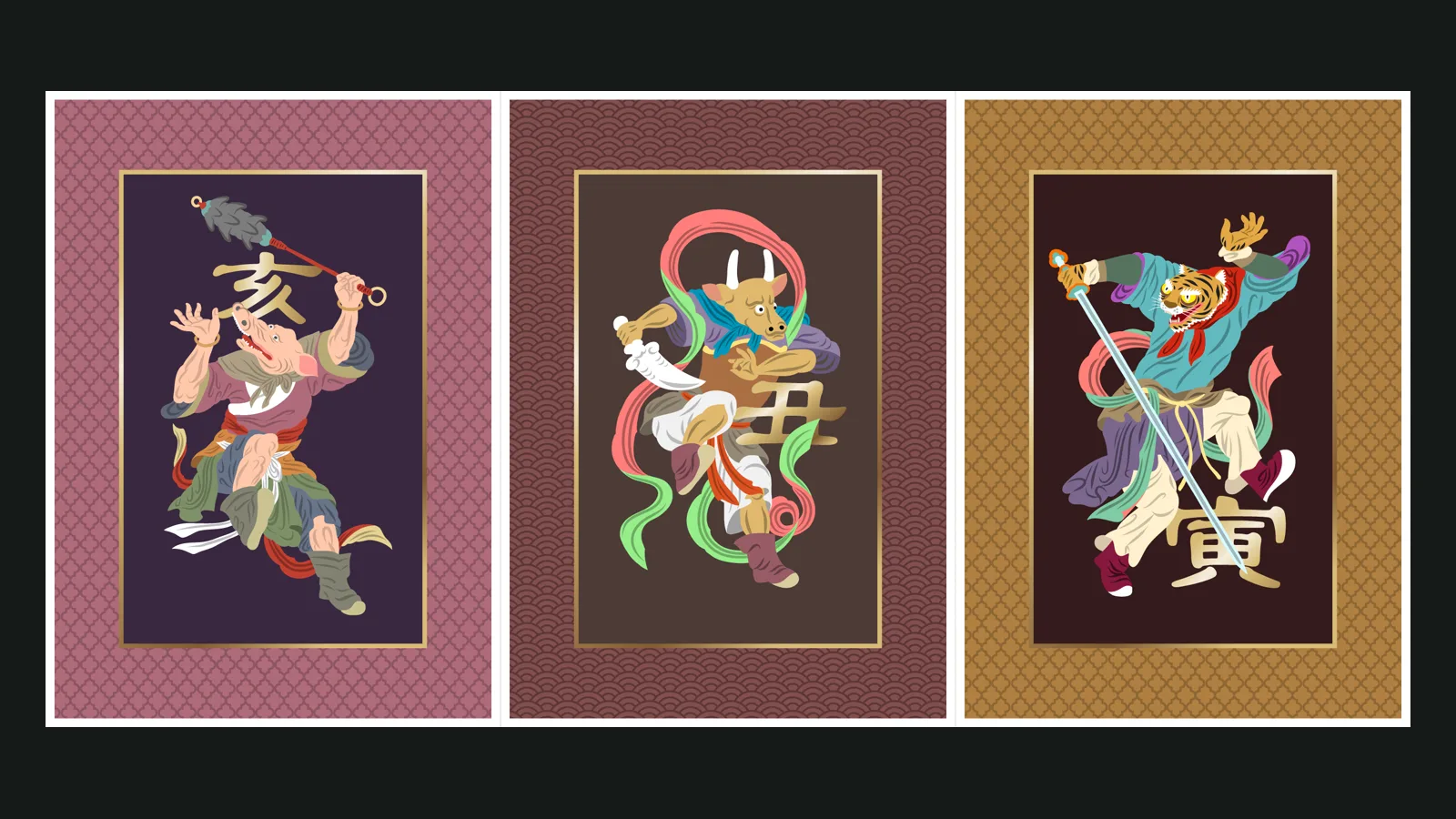
Scale does not determine importance here. The pig occupies little physical space, yet it decides the figure's zodiac identity. Our contemporary hero uses the opposite strategy: an animal-headed body dominates the frame and a large 亥 makes the branch explicit.
I like the older object's restraint. It does not need a pink body, coin, red envelope or exaggerated belly to announce prosperity. In fact, it does not explicitly announce prosperity at all; it identifies a zodiac animal. Keeping those two claims separate prevents a museum object from becoming an all-purpose illustration for whatever modern Pig symbolism we want to sell.
The comparison shows why a useful caption must identify both subject and visual mechanism. “Ancient zodiac statue” would discard the animal, material, date and way recognition works.
Why 2019 was an Earth Pig
2019 combines Ji (己) with Hai (亥). Ji is associated with yin Earth, producing the Earth Pig label.
The same Ji-Hai pairing appeared in 1959 and returns in 2079. Pig years repeat every twelve years; identical stem-branch combinations repeat every sixty.
Earth does not scientifically make 2019-born people more grounded or practical. The element belongs to the calendrical name, not a psychological test.
The Pig's Great Race ending is not a verdict
Popular versions say the Pig eats, sleeps or arrives after taking its time. The punchline works because everyone else treats the race as urgent.
That story can support images of contentment, appetite and unhurried pleasure. It can also invite moral judgment about laziness. Neither should become a diagnosis of Pig-born people.
The stronger reading keeps the contradiction: the Pig loses the race but completes the zodiac. Narrative failure and structural necessity occupy the same animal.
My rule for reading Pig-year imagery
Look for 亥, household enclosure, food, offspring, rounded body, sleeping or feast context. Then ask whether abundance is being celebrated, mocked or moralized.
Do not import an English insult automatically. Translate the social role before translating the emotion. The Year of the Pig closes the animal cycle with a practical question: what does a household count as enough?
My answer is deliberately less glamorous than “wealth.” Enough means a managed surplus: food after immediate hunger, animals that can reproduce, waste that can be reused, or value that can survive until it is needed. That material reading gives the Pig dignity without pretending that every Pig image promises money—or that every Pig-born person shares one appetite, body type or fate.
The Year of the Pig belongs inside the household economy
The Year of the Pig is routinely reduced to wealth, appetite and a round smiling mascot. The historical animal is more demanding. A pig converts household scraps and labour into food, stored value and ritual provision. Abundance is not magic; it is organised care, enclosure, feeding and time.
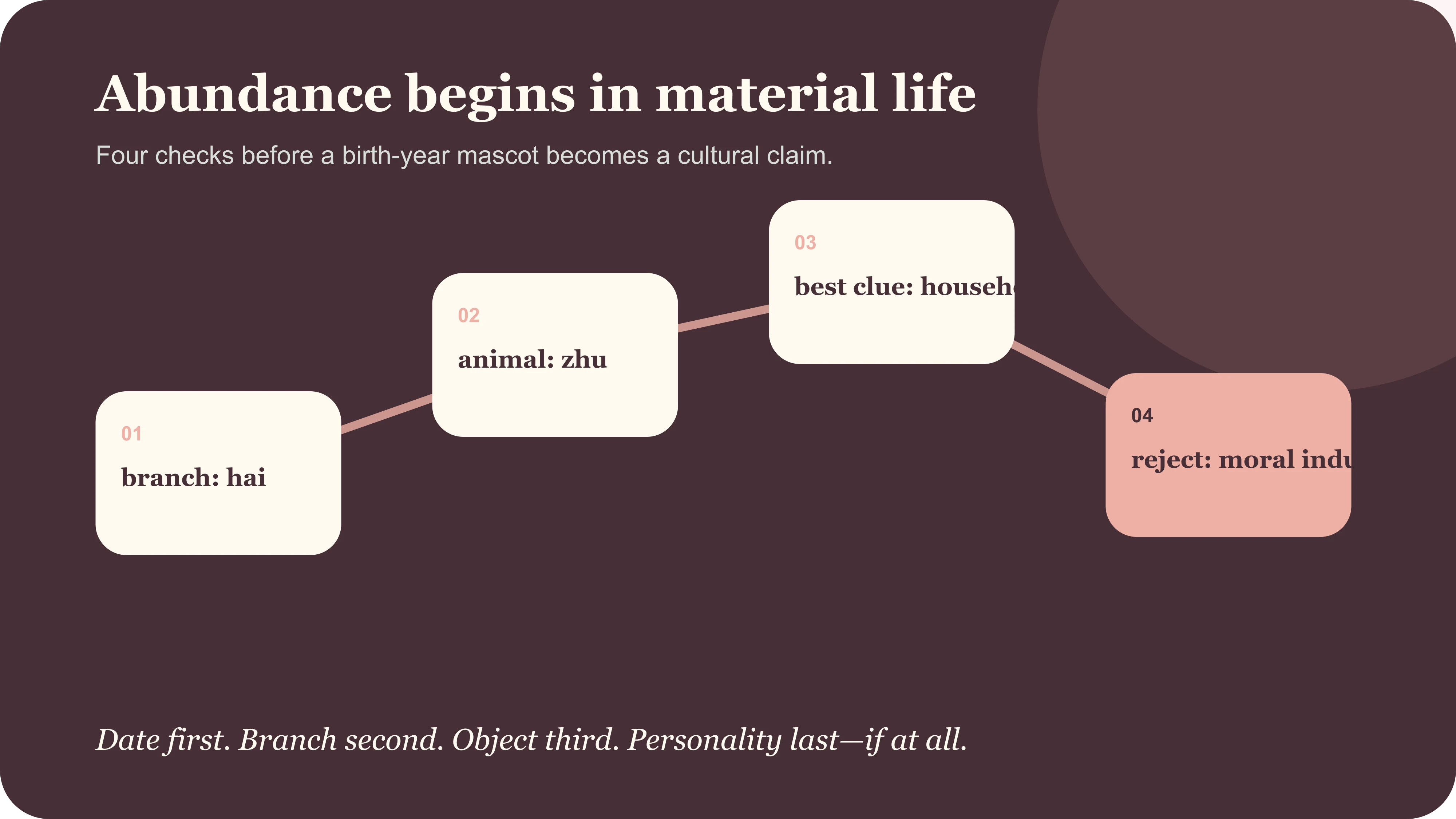
That is why the roof-and-pig explanation often attached to the character jia (家, home or family) is so attractive. It gives one memorable picture of settlement. But etymology deserves discipline: a graphic component can illuminate how a form was analysed historically without proving that every Chinese idea of family is literally defined by owning pigs.
The zodiac animal corresponds to the earthly branch hai (亥), while common words for pig include zhu (猪). The branch and animal pairing is conventional; a pig depicted on an object does not become zodiac evidence unless date, inscription, sequence or use supports that claim.
Prosperity has a smell, a schedule and a cost
New Year design sanitises the pig into pink cheeks and coins. Rural household life is less polite: feed must be gathered, pens cleaned, illness managed and slaughter timed. Removing that labour makes prosperity look childish.
I prefer Pig imagery that leaves some material truth visible—a pen, a trough, piglets, a butchered offering, a ceramic body heavy enough to suggest stored value. Those details keep the symbol connected to subsistence and exchange. They also make the boundary between abundance and excess legible.
A feast can express hospitality; waste can display status. A full piggy bank can represent security; hoarding can isolate wealth from use. The sign's best question is therefore not “Will I become rich?” but “What is being accumulated, for whom, and what labour sustains it?”
The twelfth animal closes the cycle without ending interpretation
Pig occupies the final position in the twelve-animal sequence. Modern retellings sometimes turn that position into a joke about lateness or sleep. Those stories are entertaining, but multiple race legends circulate and no single version should be treated as the historical source of the entire system.
The Hong Kong Observatory's introduction to stems and branches supplies the calendrical framework. It does not confirm one animal-race folktale or predict Pig-year finances.
My conclusion is deliberately practical: Pig symbolism is strongest when it makes household value visible. It asks how food becomes security and when comfort becomes waste. Continue to the Chinese zodiac hub to restart the cycle with Rat, or move into traditional Chinese food to see how preservation, sharing and festival timing turn ingredients into social memory.
A Pig-year feast should still show where food comes from
Festival abundance can make the animal disappear into a finished dish or a gold mascot. Restoring the chain—raising, feeding, slaughter, cooking and sharing—does not ruin celebration. It gives the feast moral and material weight.
Different readers will draw different boundaries around meat, ritual and household prosperity. The page should not pretend that one nostalgic rural image represents every Chinese family. It can, however, identify the labour and choices a specific image records.
The Pig closes the cycle with a useful discomfort: comfort is good, but comfort without memory of its inputs becomes waste. That is my strongest reason to keep the sign connected to real household economy. Wealth is not a floating blessing. It is value gathered, maintained and distributed. If the distribution never appears, the prosperity claim is incomplete.
Pig and boar should not be flattened
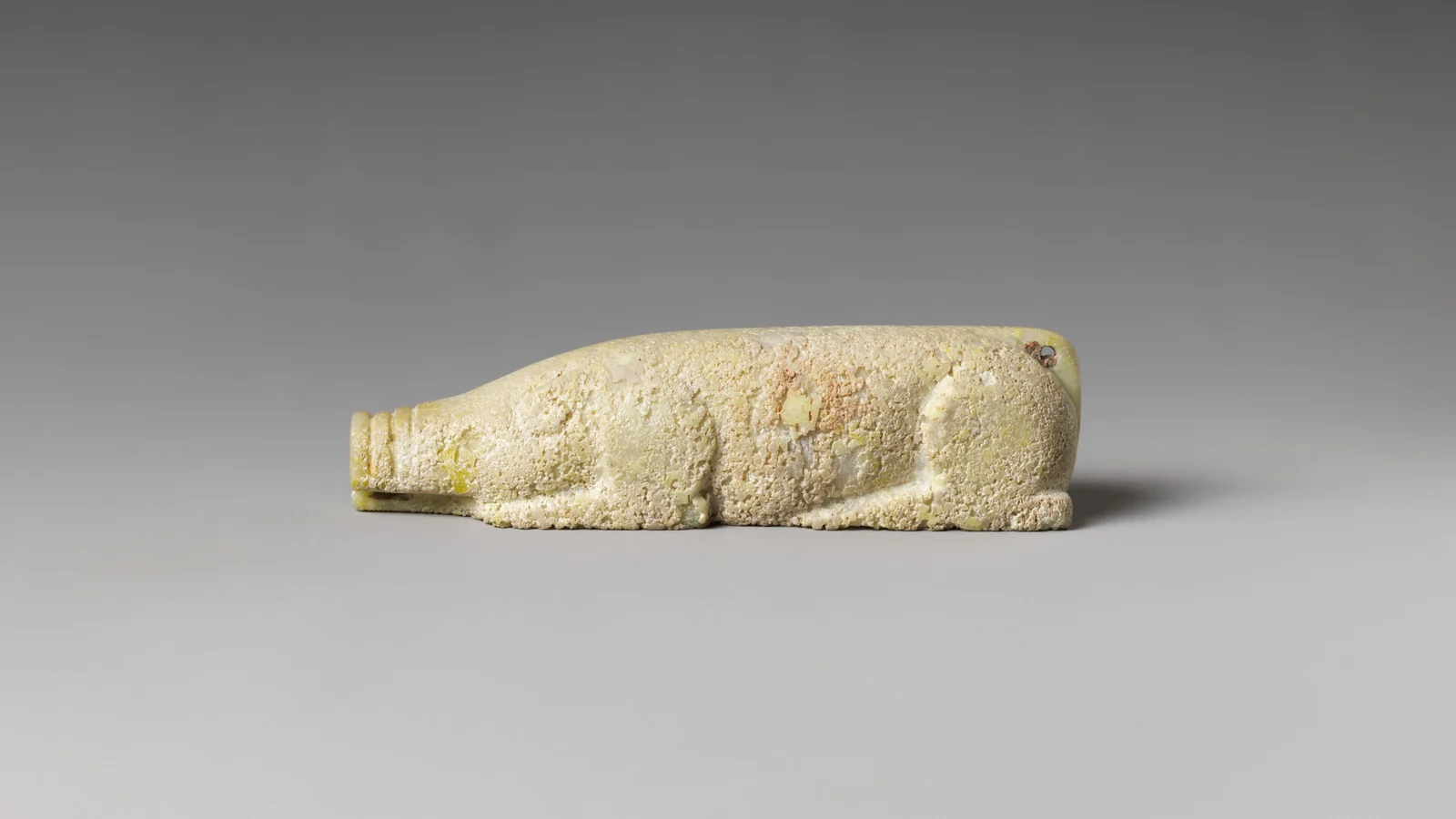
The Met records this first- to second-century dolomite carving as Pig in Recumbent Position. Its compact body and resting posture are visible; household prosperity is not. That distinction is exactly why I want the object here. A real pig form can anchor species and material without being forced to advertise wealth, appetite or a birth-year personality.
A domestic pig in an enclosure belongs to a different human relationship from a wild boar confronted in forest or hunt imagery. Body, tusks, setting and catalogue label matter. Both may enter broader pig symbolism, but they do not prove the same household story.
This distinction corrects another easy prosperity cliché. Domestication makes stored value possible; wildness introduces danger, pursuit and contested land. The visual evidence decides which system is present.
When the source is uncertain, keep the claim modest. “Pig-like zodiac figure” may be more honest than a grand explanation of wealth. Restraint does not weaken a page. It tells the reader exactly where interpretation begins.
That honesty is the real abundance: enough context to distinguish a household animal, a wild boar, a zodiac figure and a festive mascot without forcing them into one promise of money.
What the Pig sign does not promise
The Pig is often marketed as a shortcut to wealth, luck or an easy life. The historical argument here is more grounded. A domestic pig can represent a managed surplus because food, enclosure and labour make that surplus possible. It does not guarantee that a Pig-year person will become rich, generous or fond of luxury.
For a reader born in a Pig year, I would use the sign as a question about resources: what do you preserve, who shares it and what hidden work keeps the household comfortable? For a reader choosing a gift or decoration, the same question prevents the animal from becoming a pile of coins detached from food and care.
This also explains why “Pig compatibility” tables should be treated cautiously. The twelve-animal cycle supplies sequence and cultural imagery; it does not provide a verified measure of relationship quality. Trust, communication and actual household arrangements are stronger evidence than a match between Hai and another branch.