Recent Rat years are 1984, 1996, 2008 and 2020, but the Rat's first place is more interesting than a claim that Rat people are simply “clever.” The sign begins the cycle because Chinese zodiac culture values the ability to find an opening when size and resources are limited.
Year of the Rat dates and exact boundaries
Rat years include 1924, 1936, 1948, 1960, 1972, 1984, 1996, 2008, 2020 and 2032. The sign changes at Chinese New Year, not January 1.
| Rat year | Begins | Ends | Element |
|---|---|---|---|
| 1984 | February 2, 1984 | February 19, 1985 | Wood |
| 1996 | February 19, 1996 | February 6, 1997 | Fire |
| 2008 | February 7, 2008 | January 25, 2009 | Earth |
| 2020 | January 25, 2020 | February 11, 2021 | Metal |
A January 20, 2020 birthday still belongs to the Pig year. Check any January or February date with the Chinese zodiac calculator.
The complete Chinese zodiac cycle shows where Rat sits relative to the other eleven animals and why the animal is paired with an Earthly Branch.
Our conclusion: the Rat represents access, not abstract intelligence
The standard personality list says Rat people are smart, adaptable, charming and sometimes opportunistic. The problem is not that these associations never appear. The problem is that “smart” explains nothing specific about the animal's place in the system.
The Rat is small, lives near human stores and survives by reading spaces larger animals overlook. Its symbolic advantage is therefore access: the crack in a wall, the unattended supply, the moment when another animal supplies the power.
That is why the Great Race story remains memorable. The Rat cannot out-pull the Ox or out-fly the Dragon. It rides on the Ox and jumps ahead at the finish. The legend turns a structural fact—the Rat comes first—into a compact argument about leverage.
This is folklore, not documented calendar history. It does not prove how the zodiac was invented. Its value is pedagogical: one morally ambiguous decision makes the order impossible to forget.
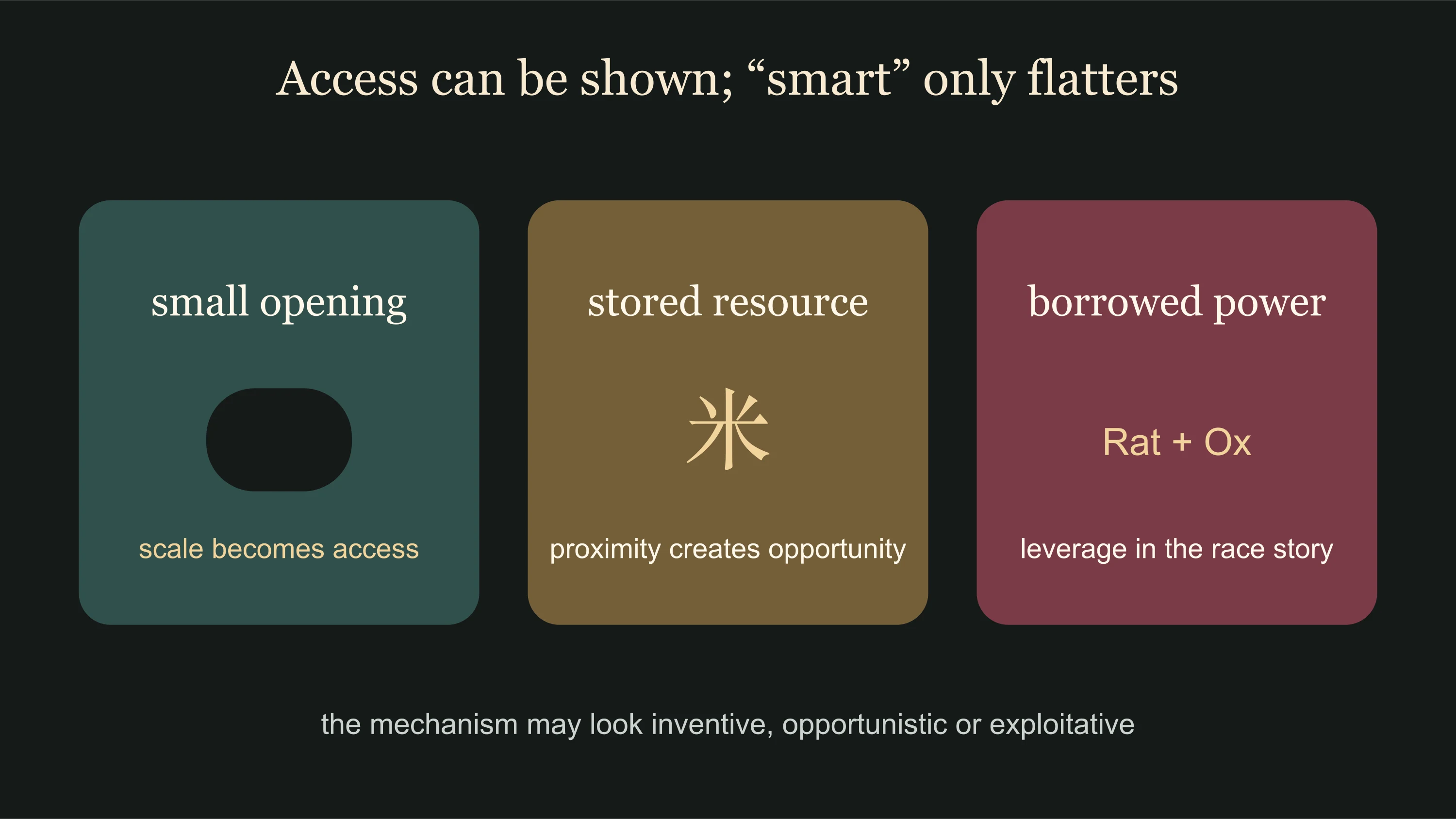
I prefer “access” because it can be shown. A gap fits one body and excludes another; stored grain creates opportunity; the Ox supplies movement the Rat lacks. “Intelligent” merely praises an invisible trait. Access explains why small scale can become an advantage without pretending every use of that advantage is admirable.
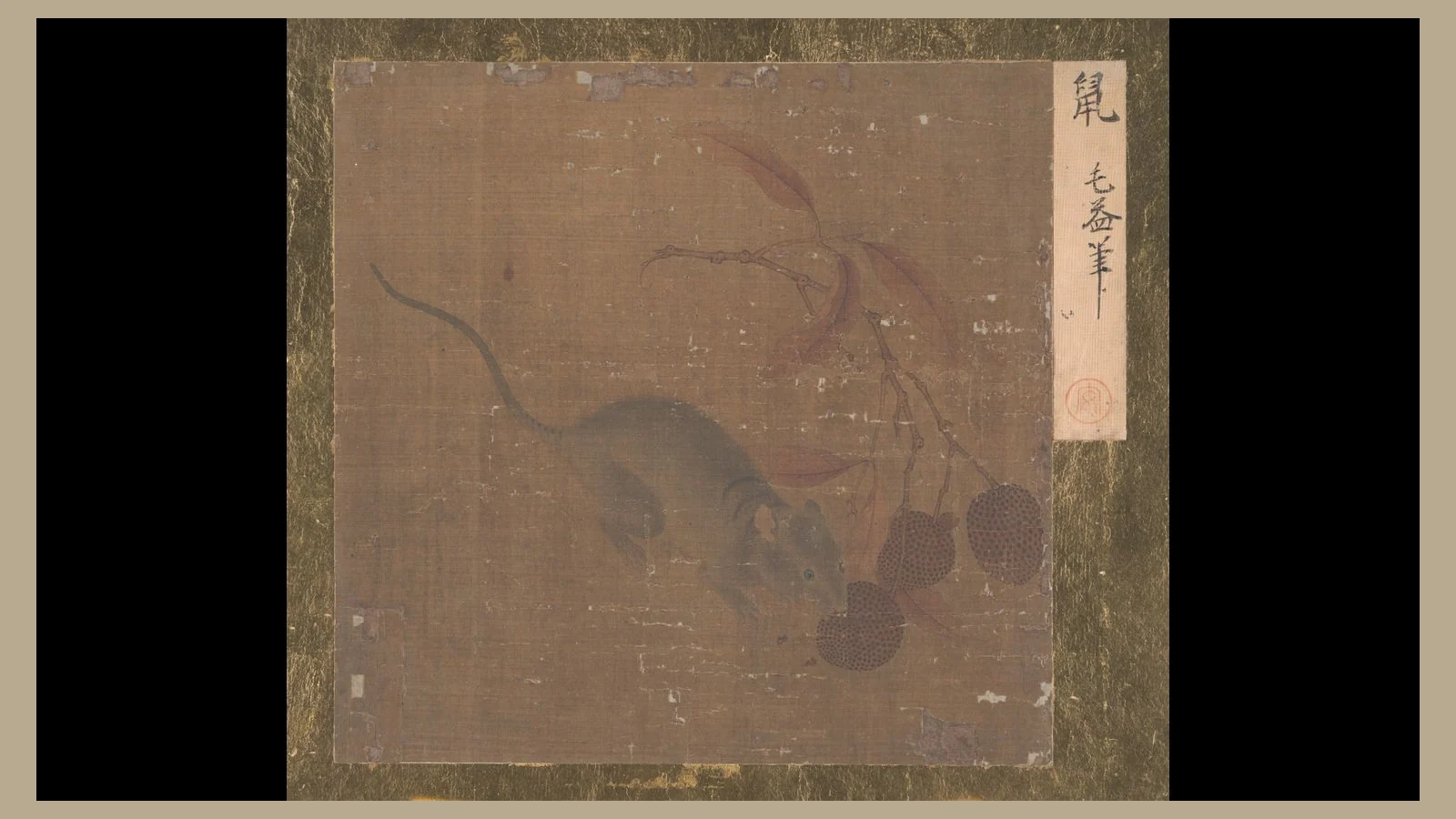
The Met catalogues this album leaf as Mouse Eating Lichee Fruit. Nothing in the record makes it a Rat-year picture, and the fruit does not automatically mean wealth. What the image does prove is the relationship this page needs: small bodies, a desirable resource and the last few inches of access. One mouse reaches the fruit while another remains behind it. That visible arrangement carries more interpretive weight than a generic “clever” label.
Zi is first, but it does not mean rat
The character beside the Rat in our authorized illustration is 子 (zi), the first Earthly Branch. The everyday animal word is 鼠 (shu), a term that can cover rat or mouse depending on context.
Zi is traditionally linked to the double-hour from roughly 11 p.m. to 1 a.m. That midnight position creates a useful paradox: the cycle starts while one calendar day is becoming another. “First” is not presented as a bright morning opening. It begins in darkness, at a threshold.
The branch matters more than the mascot. Zi supplies the Rat's formal place in the time system; the animal gives that place a body and a story.
Why 2020 was a Metal Rat, not just Rat
The twelve branches combine with ten Heavenly Stems to produce a sixty-year cycle. In 2020, Geng (庚) joined Zi (子). Geng is associated with yang Metal, so the year was a Metal Rat year.
The previous Geng-Zi year was 1960; the next will be 2080. Rat years occur every twelve years, but the same stem-branch pairing returns only after sixty. This distinction is more useful than elemental personality copy. It shows the machinery of the calendar without claiming that everyone born in 2020 shares a “metallic” temperament.
When an object includes both a stem and branch, it identifies a more precise year than the animal alone. When it shows only a cute rat, context must do more of the dating work.
A thirteenth-century figure shows a different Rat

The Metropolitan Museum of Art identifies this thirteenth-century earthenware tomb figure as a Chinese zodiac figure, mouse. It is fully zoomorphic: a compact animal body sits low to the ground while the raised head supplies the alertness and identity.
That form corrects the expectation that old zodiac art must resemble today's twelve cute animal icons—or that historical zodiac figures always used animal heads on human bodies. The modern East Moment illustration in the hero stands upright, moves diagonally and places a large branch character behind the animal. The older object depends on a low silhouette and animal anatomy. Both can represent the first zodiac animal, but only the modern image makes Zi explicit.
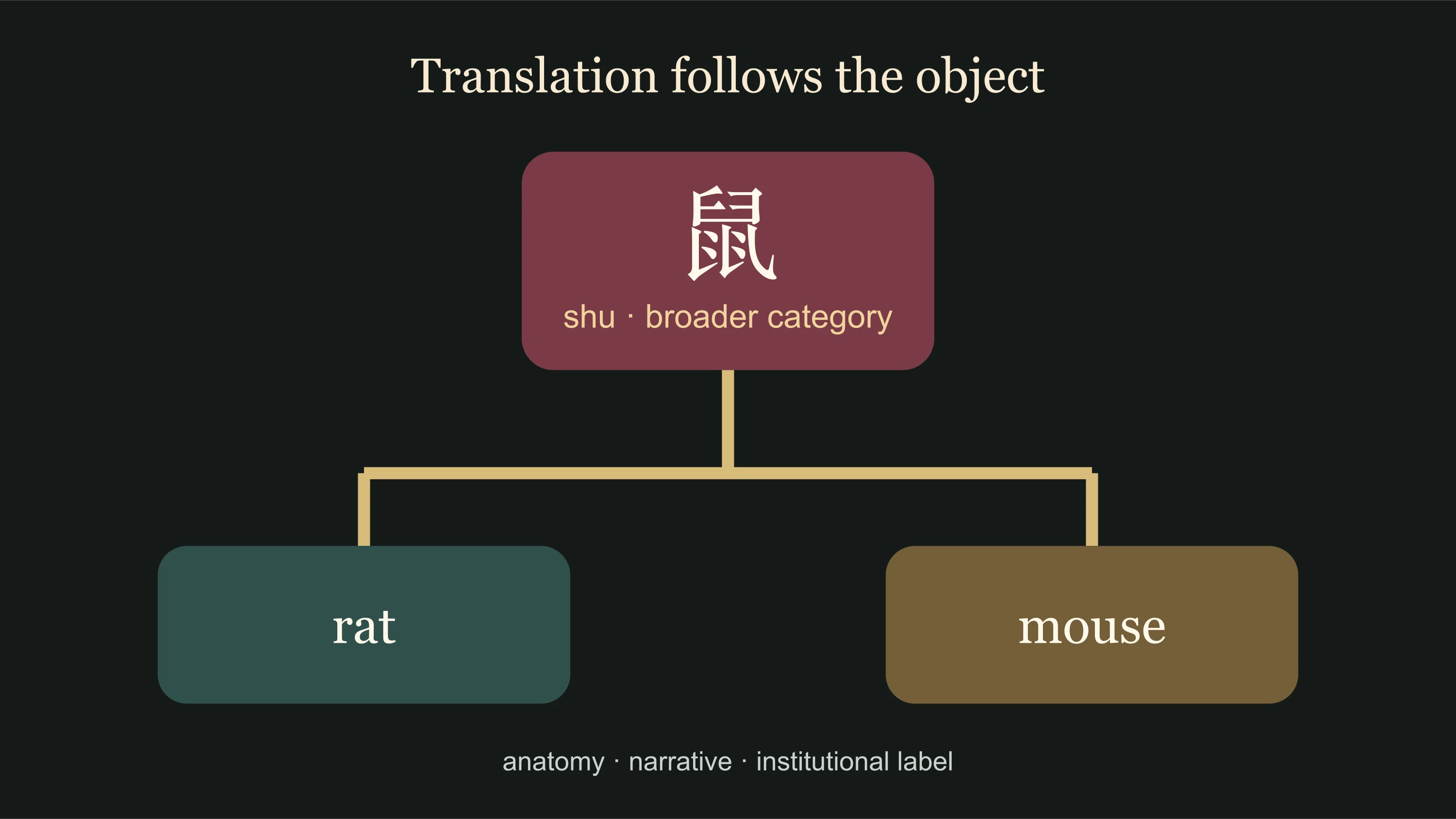
The museum's English label also exposes a translation choice. English speakers often ask whether the first animal is a rat or mouse. Chinese 鼠 does not force exactly the same boundary. The correct translation depends on the object, story and institutional convention.
What the Great Race explains—and what it hides
In the best-known version, the Rat asks the Ox for a ride across a river, then jumps ahead to finish first. The story explains order through personality: steady Ox supplies labor; quick Rat supplies strategy.
It also produces the zodiac's most useful tension. Resourcefulness can look admirable when it solves a problem and selfish when it exploits someone else. Calling the Rat merely “intelligent” removes that tension and turns a sharp story into a compliment generator.
Different Great Race retellings change details, including the Cat's absence. Treat them as evolving legends. The formal Earthly Branch system is older and more important than any single modern retelling.
My rule for reading Rat-year imagery
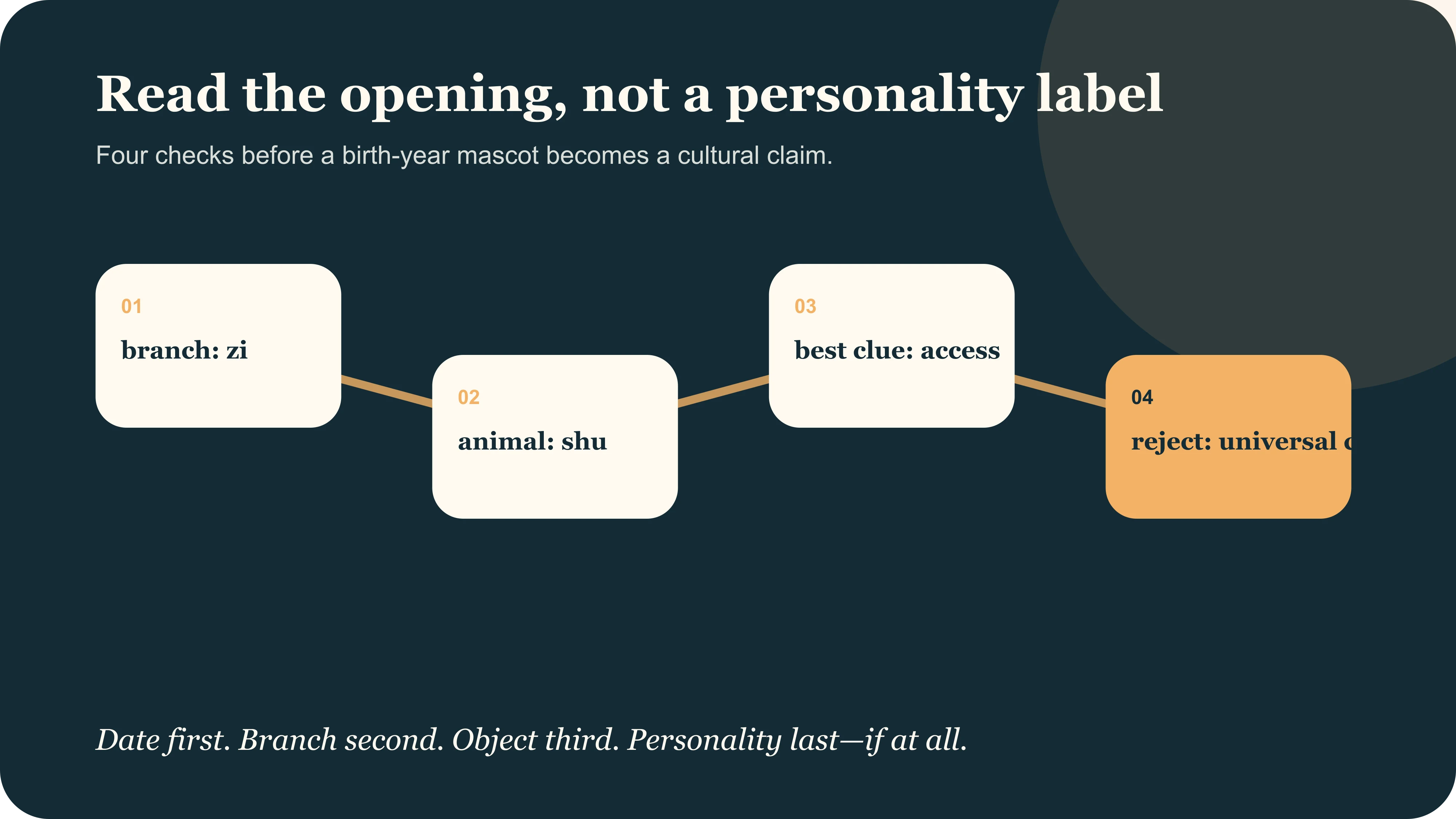
During a Rat year, ask four concrete questions:
- Does the design use 子, 鼠, or only an animal picture?
- Does the English caption choose rat or mouse, and does the object support that choice?
- Is the Rat shown alone, or in relation to grain, money, the Ox or the start of a sequence?
- Is a personality claim being presented as folklore or as false psychological certainty?
The Rat's real cultural value is not a promise that every Rat-born person can outsmart a room. It is the more specific idea that beginnings sometimes belong to whoever notices the route everyone else missed.
That route is not automatically virtuous. In one story it is invention; in another it may be trespass or exploitation. Keeping the moral ambiguity is what makes the Rat feel alive rather than reduced to a flattering horoscope result.
The Year of the Rat starts the sequence by finding an opening
The Rat's first position is often converted into a motivational poster about intelligence. I think that misses the animal's sharper cultural logic. A rat does not dominate a field through size. It notices the opening between storage, shelter and human routine. Its advantage is access: entering a system built by somebody else and surviving inside its margins.
That makes grain storage a better interpretive setting than an abstract brain icon. Where food is gathered, loss and abundance become measurable. The Rat can signify quickness and resourcefulness because its body is observed in relation to containers, walls and night activity. Remove that material relationship and “clever” becomes a compliment that could be pasted onto Monkey, Snake or any ambitious child.
The sequence position matters, but it does not prove the popular Great Race story is the historical origin of the entire zodiac. The story is a brilliant memory device: a small animal wins through timing and access rather than strength. Use it to remember the order. Do not let it erase the older calendar structure explained by the Hong Kong Observatory's stems and branches guide.
A Rat-year child does not arrive with a finished character
Families may enjoy calling a Rat child alert, adaptable or shrewd. Those descriptions can become affectionate language, but they are not measurements. A birth year cannot establish honesty, intelligence or future wealth. Worse, the “cunning rat” stereotype can turn a playful label into moral suspicion before a child has made any choice at all.
I would keep the useful half of the image: attention to openings. Ask what a person notices, how they use limited resources and whether their quickness helps only themselves or also repairs a shared problem. Those are observable actions. They turn a zodiac conversation into a question about conduct rather than a verdict delivered by date.
The Met's Chinese Zodiac Figure, Mouse is useful precisely because it refuses the modern cartoon shortcut. The animal appears as an attribute held by a human-form figure. Zodiac identity is presented through an object relationship, not a mascot face floating alone. That is the visual grammar readers should learn to notice.
The best Rat imagery shows a system, not a slogan
Look for doors, baskets, grain, fruit, night, ledges and small routes through a larger composition. A good design makes scale meaningful: the Rat is small, but the environment contains opportunities that size cannot control. A weak design simply adds coins and the word “smart,” converting a living symbol into commercial flattery.
The boundary with other meanings also matters. Rats in a painting may signal infestation, satire, abundance under pressure or scientific observation. They are not automatically zodiac animals. Confirm the date, title, surrounding branches or New Year context before attaching the zodiac label. The calculator settles the calendar question; the object itself still needs to be read.
My final rule is simple: the Year of the Rat should make us notice who controls access to resources and who survives the gaps. That is more precise, more human and more demanding than telling millions of people they share one clever personality.
Rat ingenuity is clearest at the edge of scarcity
The Rat becomes interesting when the scene shows a constraint: a narrow opening, guarded grain, darkness or a larger animal's territory. Cleverness without a constraint is just flattery. Show what the animal notices, what it risks and what it carries away.
That reading also reveals the sign's uncomfortable half. The same skill that preserves a household can become extraction from someone else's store. I would rather keep that tension than publish another list calling Rat people universally charming and resourceful.
One Rat image test: follow the grain
Place a rat beside a sealed grain jar and the meaning begins with access. Add scattered grain and the story changes to leakage or theft. Add offspring and the same abundance can suggest reproduction and household continuity. The animal has not changed; the relations around it have.
This is how I want Rat-year pages to work. Do not paste “wealth” under every mouse-shaped ornament. Follow the grain, hole, vessel and gaze. If the source record calls the object a zodiac figure, say so. If it only identifies a mouse, keep the claim at the animal level.
Rat opens the twelve-animal cycle, but “first” does not prove superiority. Race legends explain the order through wit, borrowing and opportunism in different versions. Treat them as living folktales, not a single archival transcript. The unresolved moral tension—resourceful survivor or clever taker—is precisely what keeps the Rat worth discussing.
Small scale is part of the symbol
Rat imagery works through proximity to cracks, containers and leftovers. Enlarge the animal into a heroic poster and some of its cultural logic disappears. Its power comes from entering systems built by larger bodies.
That does not make the sign inferior. It makes it a study in scale: what can be noticed from below, what escapes institutional attention and what survival costs somebody else.
The Rat begins the cycle with an uncomfortable lesson. Being first is not the same as being noble, and being small is not the same as being powerless.
Compare that tension with the visible burden in the Year of the Ox: the cycle moves from access and improvisation to labour that cannot hide its weight.
Then compare it with the Year of the Pig, where food is not something entered through a gap but value produced and maintained inside a household system.